
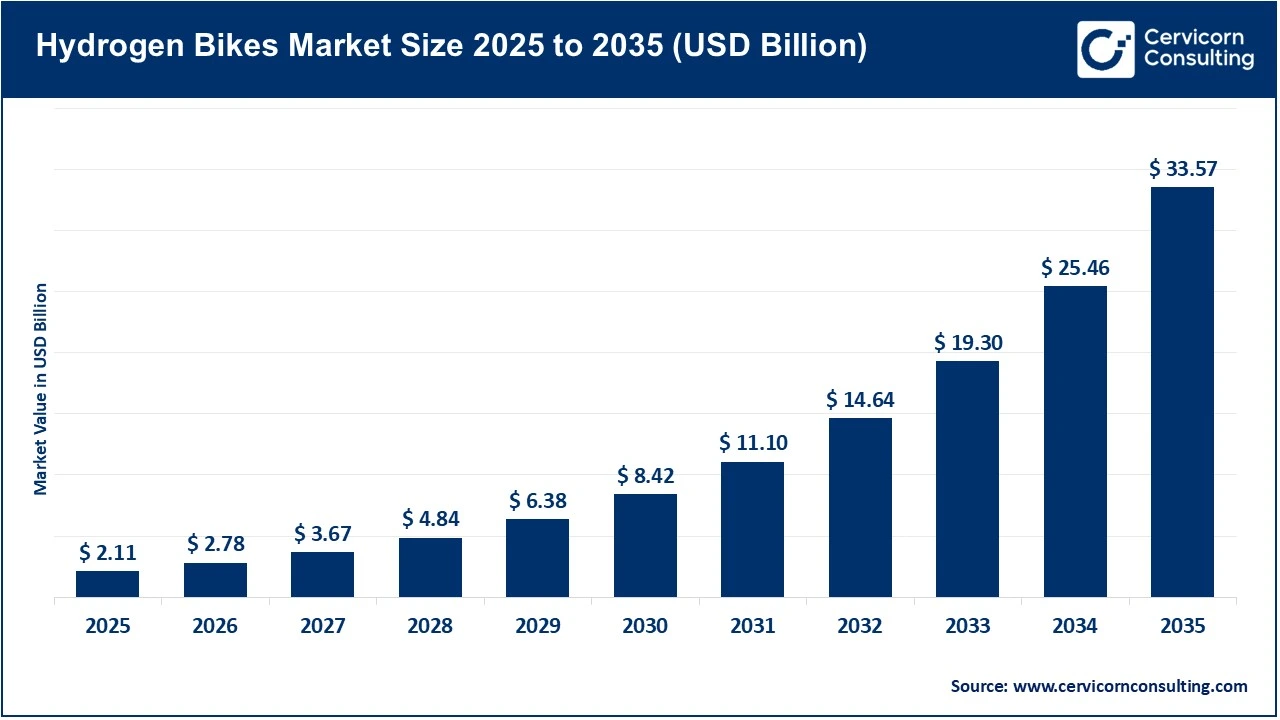
The global hydrogen bikes market size was valued at USD 2.11 billion in 2025 and is expected to surpass around USD 33.57 billion by 2035, expanding a compound annual growth rate (CAGR) of 31.9% over the forecast period from 2026 to 2035. The hydrogen bike market is being driven by rising demand for zero-emission transport and the need for faster refueling alternatives to battery-powered two-wheelers. Governments across Asia and Europe are increasing investments in hydrogen infrastructure, while major automotive manufacturers are expanding fuel-cell research for two-wheel mobility. Hydrogen-powered bikes offer advantages such as refueling in under 5 minutes and longer operational range than conventional electric bikes, making them attractive for commercial delivery fleets and urban logistics. A 2025 logistics study found that hydrogen cargo bikes delivered 15% more parcels daily than battery-electric alternatives, reduced refueling detours by 31.4%, and lowered fuel consumption per trip by 32%. The same study estimated that fleets of 100 hydrogen cargo bikes could reduce annual COâ‚‚ emissions by up to 120 metric tons.
Another major growth factor is the rising commercialization and production activity around hydrogen fuel-cell technology. Companies such as Honda, Kawasaki, Hyundai, and Yamaha are investing heavily in hydrogen mobility platforms, while governments are supporting green hydrogen production and the deployment of refuelling stations. Hyundai alone announced a hydrogen fuel-cell production facility in South Korea, valued at approximately USD 654 million, to strengthen its future hydrogen mobility manufacturing capacity. Industry adoption is also increasing in the public transport and logistics sectors, particularly in countries such as Japan, South Korea, China, and India. In India, the hydrogen fuel-cell vehicle sector is projected to expand rapidly due to policy support and infrastructure investment, with logistics emerging as one of the fastest-growing application areas. Additionally, hydrogen-powered vehicles can achieve nearly 360 miles of range with refuelling times of only 3–5 minutes, highlighting their operational advantage in commercial transportation.
Impact of Decarbonization and Emission Regulations on Hydrogen Bikes Market
Stringent decarbonisation targets and tightening emissions regulations are pushing governments and industries to accelerate the shift towards zero-emission mobility solutions, directly benefiting hydrogen bikes. Policies aligned with the Paris Agreement and national net-zero commitments are driving reductions in tailpipe emissions, especially in urban transport, where two-wheelers contribute significantly to air pollution in countries like India and China. Regulatory frameworks such as fuel-economy norms, low-emission zones, and bans on internal combustion engine (ICE) vehicles in major cities are encouraging the adoption of hydrogen fuel-cell bikes as a clean alternative, offering zero tailpipe emissions and faster refuelling than battery EVs. Additionally, government incentives for green hydrogen production and clean mobility, particularly in regions such as Europe and the Asia-Pacific, are lowering entry barriers for manufacturers and fleet operators, making hydrogen bikes increasingly viable for last-mile delivery, public mobility, and commercial applications.
Key Growth Factors
Report Scope
| Area of Focus | Details |
| Market Size in 2026 | USD 2.78 Billion |
| Market Size in 2035 | USD 33.57 Billion |
| CAGR 2026 to 2035 | 31.90% |
| Dominant Region | Asia-Pacific |
| Key Segments | Type, Vehicle Type, Fuel Cell Type, Power Output, Application, Region |
| Key Companies | Honda, Yamaha Motor, Suzuki, Kawasaki Motors, Toyota Motor Corporation, Segway-Ninebot, Bajaj Auto, Qinghang-Tech, HydroRide Europe AG, H2 Motronics, Rubri Energy |
1. Kawasaki’s Public Demonstration of Hydrogen Motorcycle Technology
Kawasaki Heavy Industries significantly advanced the commercialization of hydrogen bikes by publicly demonstrating its hydrogen-powered Ninja H2 HySE motorcycle at the Le Mans racing event in 2025. The motorcycle uses a modified supercharged hydrogen combustion engine and showcased the practical application of hydrogen in high-performance two-wheel mobility. This milestone is driving the market by increasing consumer and investor confidence in hydrogen-powered motorcycles and proving that hydrogen technology can support performance-oriented mobility applications beyond passenger cars. The demonstration accelerated global awareness of hydrogen bikes and strengthened the role of motorsports as a testing platform for future clean mobility technologies.
2. HySE Consortium Expanding Hydrogen Engine Development
The Hydrogen Small mobility & Engine technology Association (HySE), backed by companies including Honda Motor Co., Yamaha Motor, Suzuki Motor Corporation, and Kawasaki Heavy Industries, expanded collaborative hydrogen engine development through Dakar Rally participation and advanced prototype testing. The consortium’s activities are helping standardize hydrogen engine technologies for small mobility vehicles and accelerating R&D efficiency through shared investment. This initiative is driving the hydrogen bikes market by reducing development costs, improving fuel-system innovation, and encouraging suppliers and infrastructure companies to participate in the hydrogen mobility ecosystem.
3. India’s Green Hydrogen Mobility Pilot Programs
The Government of India launched several pilot projects under the National Green Hydrogen Mission to accelerate the deployment of hydrogen mobility across transport sectors. The initiative includes hydrogen-powered vehicles, new hydrogen refuelling stations, and infrastructure support to reduce dependence on fossil fuels. These programmes are creating a favourable environment for hydrogen-powered two-wheelers by encouraging domestic hydrogen production, infrastructure development, and adoption of clean mobility. The initiative is also attracting investments from mobility startups and vehicle manufacturers seeking opportunities in India’s rapidly expanding alternative-fuel transport market.
4. Hyundai’s Hydrogen Fuel Cell Production Expansion
Hyundai Motor Company strengthened the hydrogen mobility ecosystem by beginning construction of a large-scale hydrogen fuel-cell manufacturing facility in South Korea, backed by an investment of approximately USD 654 million. The facility will produce next-generation fuel cells and electrolyzers for various mobility applications, supporting the broader commercialization of hydrogen-powered transportation technologies. This development is indirectly driving the hydrogen bikes market by lowering fuel-cell production costs, improving supply-chain scalability, and accelerating technological advancements that can later be adapted for lightweight two-wheel vehicles. Increased industrial-scale fuel-cell production is expected to improve affordability and encourage wider adoption of hydrogen mobility solutions globally.
The hydrogen bikes market is segmented by region into North America, Europe, Asia-Pacific, Latin America, and LAMEA. Here is a brief overview of each region:
The North America hydrogen bikes market size was estimated at USD 0.39 billion in 2025 and is expected to exceed around USD 6.24 billion by 2035. The North America market is in an early but innovation-driven phase, supported by strong investments in hydrogen infrastructure and clean mobility technologies. The presence of advanced R&D ecosystems, partnerships between mobility companies and energy providers, and government-backed hydrogen programs are accelerating development. Growing demand for zero-emission transport solutions, especially in urban logistics and last-mile delivery, is creating opportunities for hydrogen-powered two-wheelers. Additionally, increasing focus on decarbonization and alternative fuels is encouraging pilot projects and prototype deployments across the region.
United States: Strong hydrogen infrastructure investments, active fuel-cell research, and rising demand for clean logistics solutions are driving growth.
Canada: Government support for green hydrogen and focus on sustainable transport solutions are boosting adoption.
The Asia-Pacific hydrogen bikes market size was valued at USD 0.90 billion in 2025 and is expected to surpass around USD 14.37 billion by 2035.
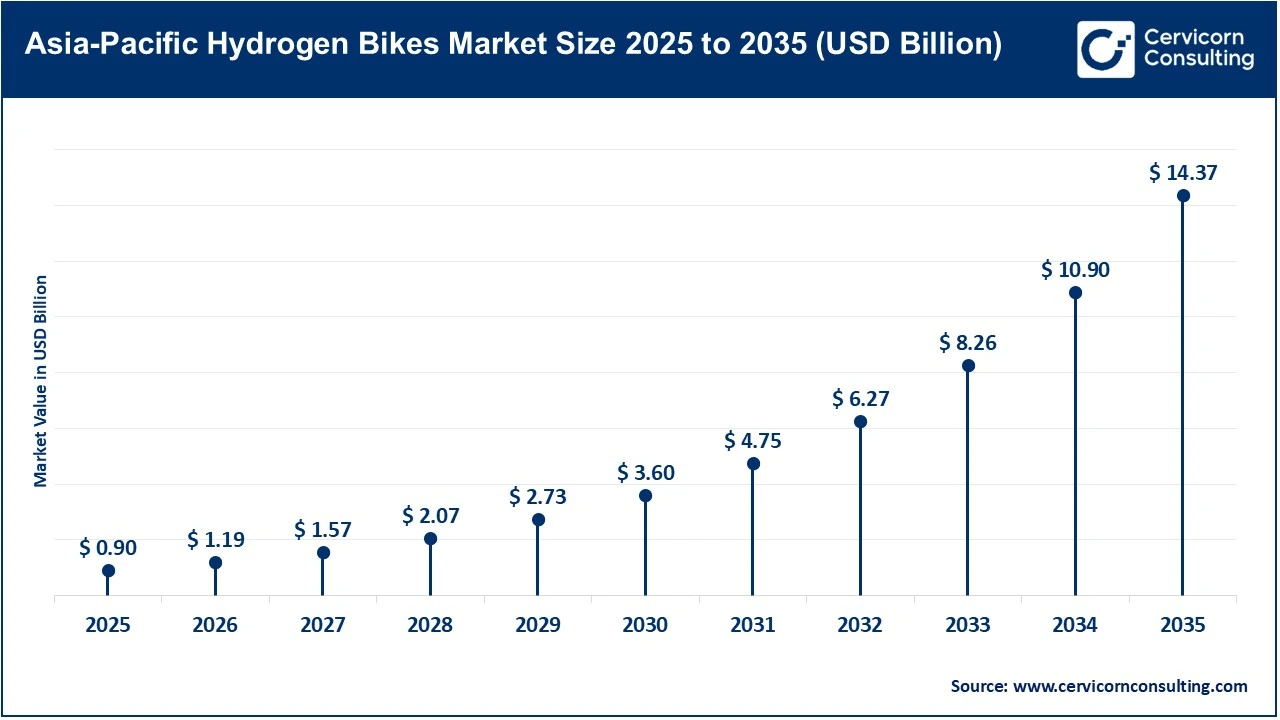
The Asia Pacific market is gaining strong momentum due to the region’s dominant two-wheeler usage, rapid urbanization, and aggressive government policies supporting hydrogen energy. Countries are prioritizing hydrogen as a key pillar for decarbonization, investing in production, storage, and refueling infrastructure. The presence of major two-wheeler manufacturers and rising demand for efficient, zero-emission mobility especially in dense urban areas and logistics are accelerating innovation and pilot deployments. As infrastructure improves and costs decline, the region is expected to become a global leader in hydrogen-powered two-wheeler adoption.
Japan: Advanced hydrogen ecosystem, strong OEM collaboration, and early commercialization leadership.
China: Large-scale production capacity and aggressive infrastructure expansion driving rapid growth.
India: Emerging high-potential market supported by policy push and massive two-wheeler demand.
The Europe hydrogen bikes market size reached at USD 0.58 billion in 2025 and is forecasted to grow around USD 9.20 billion by 2035. The Europe market is strongly driven by aggressive decarbonization targets, strict emission regulations, and well-defined hydrogen strategies across the region. Governments are heavily investing in green hydrogen production, refueling infrastructure, and clean mobility solutions to meet climate goals aligned with carbon neutrality targets. The region’s focus on sustainable urban transport, low-emission zones, and banning internal combustion vehicles is accelerating the need for zero-emission alternatives such as hydrogen bikes. Additionally, strong collaboration between governments, automotive companies, and energy providers is fostering innovation and early-stage commercialization of hydrogen-powered two-wheelers.
Germany: Leading hydrogen infrastructure development and strong industrial backing drive market growth.
France: Government-led investments and focus on green hydrogen accelerate adoption.
United Kingdom: Policy support and innovation ecosystem driving hydrogen mobility growth.
Hydrogen Bikes Market Share, By Region, 2025 (%)
| Region | Revenue Share, 2025 (%) |
| Asia Pacific | 42.8% |
| Europe | 27.4% |
| North America | 18.6% |
| LAMEA | 11.2% |
The LAMEA hydrogen bikes market was valued at USD 0.26 billion in 2025 and is anticipated to reach around USD 3.76 billion by 2035. The LAMEA market is in a nascent but promising stage, supported by increasing investments in green hydrogen production and growing awareness of sustainable mobility solutions. Countries in the Middle East are focusing on becoming global hydrogen hubs by leveraging abundant renewable energy resources, while Latin America and Africa are gradually adopting hydrogen strategies to reduce emissions and diversify energy sources. Although infrastructure for hydrogen mobility is still developing, rising urbanization, government initiatives, and interest in clean transportation especially for logistics and last-mile delivery are expected to create future opportunities for hydrogen-powered two-wheelers.
Brazil: Expanding renewable energy capacity and early hydrogen initiatives support market development.
Saudi Arabia: Large-scale green hydrogen projects positioning the country as a global leader.
The hydrogen bikes market is segmented into type, vehicle type, fuel cell type, power output, application, and geography.
Hydrogen fuel cell bikes currently dominate the market due to their fully zero-emission operation and superior efficiency compared to hybrid alternatives. These bikes rely entirely on fuel cells, eliminating the need for large batteries and reducing overall vehicle weight. Their quick refueling time, typically under five minutes, and extended range make them highly suitable for both personal and commercial applications. Government incentives for pure hydrogen mobility and increasing investment in fuel-cell infrastructure are further strengthening their dominance, especially in early-adopting regions focused on clean transportation solutions.
Hydrogen Bikes Market Share, By Type, 2025 (%)
| Type | Revenue Share, 2025 (%) |
| Hydrogen Fuel Cell Bikes | 68.5% |
| Hydrogen Hybrid Bikes (Fuel Cell + Battery) | 31.5% |
Hydrogen hybrid bikes are emerging as the fastest-growing segment as they combine the advantages of fuel cells and battery systems, offering improved flexibility and reliability. These bikes allow energy recovery through regenerative braking while maintaining extended range through hydrogen fuel. They are particularly attractive in regions with limited hydrogen refueling infrastructure, as the battery component provides backup power. Manufacturers are increasingly focusing on hybrid designs to reduce range anxiety and improve performance, making them a transitional solution that supports gradual adoption of full hydrogen mobility systems.
Hydrogen e-bikes dominate the market due to their affordability, simplicity, and strong demand in urban commuting. These lightweight vehicles are easier to integrate with existing cycling infrastructure and require lower power output, making them ideal for early-stage hydrogen adoption. Their use in short-distance travel and bike-sharing programs further boosts their demand. Additionally, governments promoting micro-mobility and sustainable urban transport are supporting hydrogen e-bike deployment, especially in densely populated cities where low-speed, eco-friendly mobility solutions are prioritized.
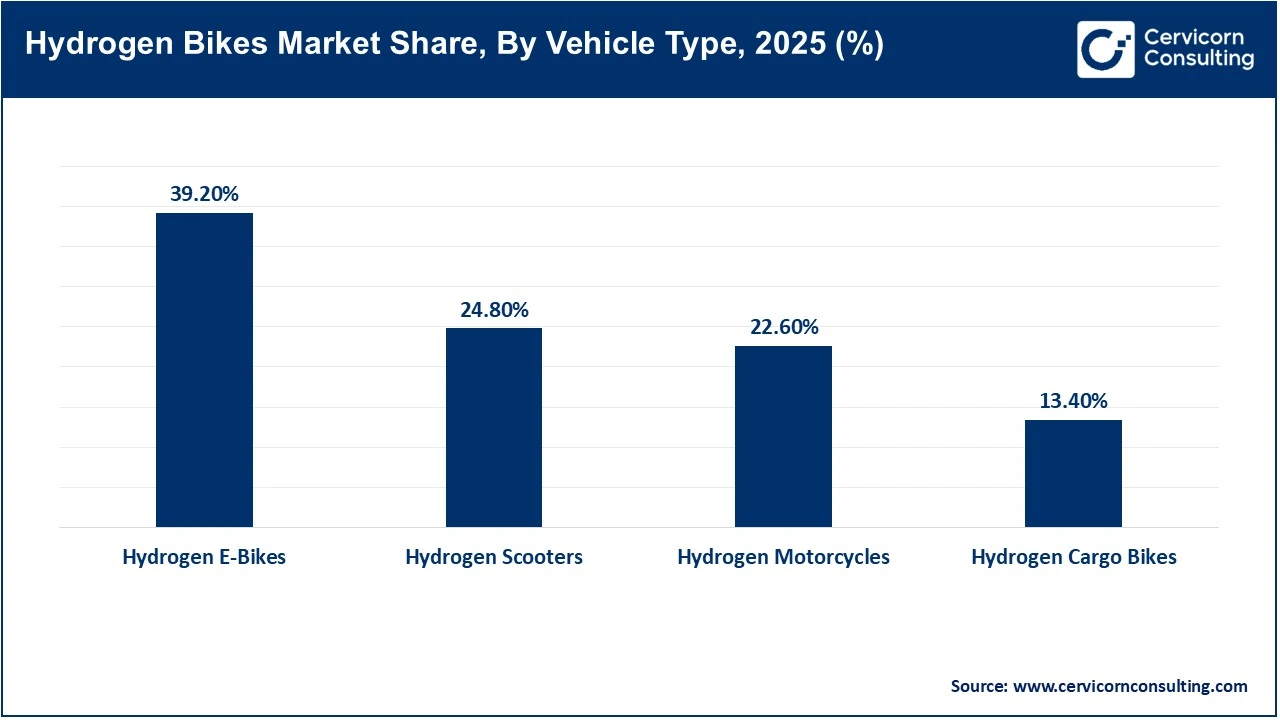
Hydrogen cargo bikes are the fastest-growing segment, driven by rapid expansion in e-commerce and last-mile delivery services. Logistics companies are increasingly adopting these bikes due to their higher payload capacity, longer operational hours, and quick refueling compared to battery-powered cargo bikes. They significantly improve delivery efficiency while reducing emissions in urban areas. With cities implementing stricter emissions standards and promoting green logistics, hydrogen cargo bikes are gaining traction as a scalable, sustainable solution for commercial transportation and fleet operations.
PEM fuel cells dominate the hydrogen bikes market due to their lightweight design, fast startup capability, and suitability for mobile applications. They operate efficiently at lower temperatures, making them ideal for two-wheelers that require quick response times and compact systems. Most current hydrogen mobility prototypes and commercial models use PEM technology for its proven reliability and adaptability. Ongoing advances in membrane materials and cost-reduction initiatives are further strengthening its position as the preferred fuel-cell technology in the hydrogen bikes ecosystem.
Hydrogen Bikes Market, By Fuel Cell Type, 2025 (%)
| Fuel Cell Type | Revenue Share, 2025 (%) |
| PEM Fuel Cell (Proton Exchange Membrane) | 71.3% |
| Solid Oxide Fuel Cell (SOFC) | 14.1% |
| Alkaline Fuel Cell | 8.7% |
| Others | 5.9% |
Solid oxide fuel cells are the fastest-growing segment due to their high efficiency and ability to use a wider range of fuels, including hydrogen blends. Although currently less common in bikes due to high operating temperatures, ongoing research is improving their feasibility for lightweight applications. SOFC technology offers longer lifespan and better energy conversion efficiency, making it attractive for future high-performance and long-range hydrogen bikes. As innovation progresses, this segment is expected to gain traction, particularly in premium and specialized vehicle categories.
The below 50 kW segment dominates the hydrogen bikes market as it aligns with the requirements of urban commuting and lightweight two-wheelers such as e-bikes and scooters. These vehicles prioritize efficiency, affordability, and ease of use over high performance. Lower power output also reduces system complexity and hydrogen consumption, making adoption more practical in the early stages. Widespread demand for low-speed, short-distance mobility solutions in urban environments continues to drive this segment’s dominance.
Hydrogen Bikes Market, By Power Output, 2025 (%)
| Power Output | Revenue Share, 2025 (%) |
| Below 50 kW | 52.4% |
| 50–80 kW | 33.1% |
| Above 80 kW | 14.5% |
The 50–80 kW segment is the fastest-growing, driven by rising demand for mid-range performance motorcycles that balance power and efficiency. This category caters to consumers seeking higher speeds and longer travel distances without compromising sustainability. Advancements in fuel-cell technology and system integration are enabling better performance within this range. As hydrogen infrastructure expands, more manufacturers are focusing on this segment to meet the needs of both personal and commercial users who require versatile and reliable two-wheel mobility solutions.
Personal mobility remains the dominant application segment, driven by the large global base of two-wheeler users, particularly in emerging economies. Hydrogen bikes offer a clean alternative to conventional petrol-powered vehicles, making them attractive for daily commuting. Their quick refueling and extended range enhance convenience for individual users. Government incentives, urban congestion, and rising fuel costs are further encouraging consumers to adopt hydrogen-powered two-wheelers for personal transport.
Hydrogen Bikes Market, By Application, 2025 (%)
| Application | Revenue Share, 2025 (%) |
| Personal Mobility | 46.7% |
| Commercial Use (Delivery & Logistics) | 24.9% |
| Shared Mobility | 11.6% |
| Sports & Racing | 7.8% |
| Military & Defense | 5.4% |
| Others | 3.6% |
Commercial use in delivery and logistics is the fastest-growing segment, fuelled by the rapid growth of e-commerce and demand for efficient last-mile delivery solutions. Hydrogen bikes provide longer operating hours and faster refueling than battery-electric alternatives, making them ideal for high-utilization fleets. Companies are increasingly adopting these bikes to meet sustainability targets and reduce operational downtime. As urban emission regulations tighten, hydrogen-powered logistics fleets are expected to expand significantly, driving strong growth in this segment.
By Type
By Vehicle Type
By Fuel Cell Type
By Power Output
By Application
By Geography
Chapter 1. Market Introduction and Overview
1.1 Market Definition and Scope
1.1.1 Overview of Hydrogen Bikes
1.1.2 Scope of the Study
1.1.3 Research Timeframe
1.2 Research Methodology and Approach
1.2.1 Methodology Overview
1.2.2 Data Sources and Validation
1.2.3 Key Assumptions and Limitations
Chapter 2. Executive Summary
2.1 Market Highlights and Snapshot
2.2 Key Insights by Segments
2.2.1 By Type Overview
2.2.2 By Vehicle Type Overview
2.2.3 By Fuel Cell Type Overview
2.2.4 By Power Output Overview
2.2.5 By Application Overview
2.3 Competitive Overview
Chapter 3. Global Impact Analysis
3.1 Russia-Ukraine Conflict: Global Market Implications
3.2 Regulatory and Policy Changes Impacting Global Markets
Chapter 4. Market Dynamics and Trends
4.1 Market Dynamics
4.1.1 Market Drivers
4.1.2 Market Restraints
4.1.3 Market Opportunities
4.1.4 Market Challenges
4.2 Market Trends
Chapter 5. Premium Insights and Analysis
5.1 Global Hydrogen Bikes Market Dynamics, Impact Analysis
5.2 Porter’s Five Forces Analysis
5.2.1 Bargaining Power of Suppliers
5.2.2 Bargaining Power of Buyers
5.2.3 Threat of Substitute Products
5.2.4 Rivalry among Existing Firms
5.2.5 Threat of New Entrants
5.3 PESTEL Analysis
5.4 Value Chain Analysis
5.5 Product Pricing Analysis
5.6 Vendor Landscape
5.6.1 List of Buyers
5.6.2 List of Suppliers
Chapter 6. Hydrogen Bikes Market, By Type
6.1 Global Hydrogen Bikes Market Snapshot, By Type
6.1.1 Market Revenue (($Billion) and Growth Rate (%), 2022-2035
6.1.1.1 Hydrogen Fuel Cell Bikes
6.1.1.2 Hydrogen Hybrid Bikes (Fuel Cell + Battery)
Chapter 7. Hydrogen Bikes Market, By Vehicle Type
7.1 Global Hydrogen Bikes Market Snapshot, By Vehicle Type
7.1.1 Market Revenue (($Billion) and Growth Rate (%), 2022-2035
7.1.1.1 Hydrogen E-Bikes
7.1.1.2 Hydrogen Scooters
7.1.1.3 Hydrogen Motorcycles
7.1.1.4 Hydrogen Cargo Bikes
Chapter 8. Hydrogen Bikes Market, By Fuel Cell Type
8.1 Global Hydrogen Bikes Market Snapshot, By Fuel Cell Type
8.1.1 Market Revenue (($Billion) and Growth Rate (%), 2022-2035
8.1.1.1 PEM Fuel Cell (Proton Exchange Membrane)
8.1.1.2 Solid Oxide Fuel Cell (SOFC)
8.1.1.3 Alkaline Fuel Cell
8.1.1.4 Others
Chapter 9. Hydrogen Bikes Market, By Power Output
9.1 Global Hydrogen Bikes Market Snapshot, By Power Output
9.1.1 Market Revenue (($Billion) and Growth Rate (%), 2022-2035
9.1.1.1 Below 50 kW
9.1.1.2 50–80 kW
9.1.1.3 Above 80 kW
Chapter 10. Hydrogen Bikes Market, By Application
10.1 Global Hydrogen Bikes Market Snapshot, By Application
10.1.1 Market Revenue (($Billion) and Growth Rate (%), 2022-2035
10.1.1.1 Personal Mobility
10.1.1.2 Commercial Use (Delivery & Logistics)
10.1.1.3 Shared Mobility
10.1.1.4 Sports & Racing
10.1.1.5 Military & Defense
10.1.1.6 Others
Chapter 11. Hydrogen Bikes Market, By Region
11.1 Overview
11.2 Hydrogen Bikes Market Revenue Share, By Region 2024 (%)
11.3 Global Hydrogen Bikes Market, By Region
11.3.1 Market Size and Forecast
11.4 North America
11.4.1 North America Hydrogen Bikes Market Revenue, 2022-2035 ($Billion)
11.4.2 Market Size and Forecast
11.4.3 North America Hydrogen Bikes Market, By Country
11.4.4 U.S.
11.4.4.1 U.S. Hydrogen Bikes Market Revenue, 2022-2035 ($Billion)
11.4.4.2 Market Size and Forecast
11.4.4.3 U.S. Market Segmental Analysis
11.4.5 Canada
11.4.5.1 Canada Hydrogen Bikes Market Revenue, 2022-2035 ($Billion)
11.4.5.2 Market Size and Forecast
11.4.5.3 Canada Market Segmental Analysis
11.4.6 Mexico
11.4.6.1 Mexico Hydrogen Bikes Market Revenue, 2022-2035 ($Billion)
11.4.6.2 Market Size and Forecast
11.4.6.3 Mexico Market Segmental Analysis
11.5 Europe
11.5.1 Europe Hydrogen Bikes Market Revenue, 2022-2035 ($Billion)
11.5.2 Market Size and Forecast
11.5.3 Europe Hydrogen Bikes Market, By Country
11.5.4 UK
11.5.4.1 UK Hydrogen Bikes Market Revenue, 2022-2035 ($Billion)
11.5.4.2 Market Size and Forecast
11.5.4.3 UK Market Segmental Analysis
11.5.5 France
11.5.5.1 France Hydrogen Bikes Market Revenue, 2022-2035 ($Billion)
11.5.5.2 Market Size and Forecast
11.5.5.3 France Market Segmental Analysis
11.5.6 Germany
11.5.6.1 Germany Hydrogen Bikes Market Revenue, 2022-2035 ($Billion)
11.5.6.2 Market Size and Forecast
11.5.6.3 Germany Market Segmental Analysis
11.5.7 Rest of Europe
11.5.7.1 Rest of Europe Hydrogen Bikes Market Revenue, 2022-2035 ($Billion)
11.5.7.2 Market Size and Forecast
11.5.7.3 Rest of Europe Market Segmental Analysis
11.6 Asia Pacific
11.6.1 Asia Pacific Hydrogen Bikes Market Revenue, 2022-2035 ($Billion)
11.6.2 Market Size and Forecast
11.6.3 Asia Pacific Hydrogen Bikes Market, By Country
11.6.4 China
11.6.4.1 China Hydrogen Bikes Market Revenue, 2022-2035 ($Billion)
11.6.4.2 Market Size and Forecast
11.6.4.3 China Market Segmental Analysis
11.6.5 Japan
11.6.5.1 Japan Hydrogen Bikes Market Revenue, 2022-2035 ($Billion)
11.6.5.2 Market Size and Forecast
11.6.5.3 Japan Market Segmental Analysis
11.6.6 India
11.6.6.1 India Hydrogen Bikes Market Revenue, 2022-2035 ($Billion)
11.6.6.2 Market Size and Forecast
11.6.6.3 India Market Segmental Analysis
11.6.7 Australia
11.6.7.1 Australia Hydrogen Bikes Market Revenue, 2022-2035 ($Billion)
11.6.7.2 Market Size and Forecast
11.6.7.3 Australia Market Segmental Analysis
11.6.8 Rest of Asia Pacific
11.6.8.1 Rest of Asia Pacific Hydrogen Bikes Market Revenue, 2022-2035 ($Billion)
11.6.8.2 Market Size and Forecast
11.6.8.3 Rest of Asia Pacific Market Segmental Analysis
11.7 LAMEA
11.7.1 LAMEA Hydrogen Bikes Market Revenue, 2022-2035 ($Billion)
11.7.2 Market Size and Forecast
11.7.3 LAMEA Hydrogen Bikes Market, By Country
11.7.4 GCC
11.7.4.1 GCC Hydrogen Bikes Market Revenue, 2022-2035 ($Billion)
11.7.4.2 Market Size and Forecast
11.7.4.3 GCC Market Segmental Analysis
11.7.5 Africa
11.7.5.1 Africa Hydrogen Bikes Market Revenue, 2022-2035 ($Billion)
11.7.5.2 Market Size and Forecast
11.7.5.3 Africa Market Segmental Analysis
11.7.6 Brazil
11.7.6.1 Brazil Hydrogen Bikes Market Revenue, 2022-2035 ($Billion)
11.7.6.2 Market Size and Forecast
11.7.6.3 Brazil Market Segmental Analysis
11.7.7 Rest of LAMEA
11.7.7.1 Rest of LAMEA Hydrogen Bikes Market Revenue, 2022-2035 ($Billion)
11.7.7.2 Market Size and Forecast
11.7.7.3 Rest of LAMEA Market Segmental Analysis
Chapter 12. Competitive Landscape
12.1 Competitor Strategic Analysis
12.1.1 Top Player Positioning/Market Share Analysis
12.1.2 Top Winning Strategies, By Company, 2022-2024
12.1.3 Competitive Analysis By Revenue, 2022-2024
12.2 Recent Developments by the Market Contributors (2024)
Chapter 13. Company Profiles
13.1 Honda
13.1.1 Company Snapshot
13.1.2 Company and Business Overview
13.1.3 Financial KPIs
13.1.4 Product/Service Portfolio
13.1.5 Strategic Growth
13.1.6 Global Footprints
13.1.7 Recent Development
13.1.8 SWOT Analysis
13.2 Yamaha Motor
13.3 Suzuki
13.4 Kawasaki Motors
13.5 Toyota Motor Corporation
13.6 Segway-Ninebot
13.7 Bajaj Auto
13.8 Qinghang-Tech
13.9 HydroRide Europe AG
13.10 H2 Motronics
13.11 Rubri Energy