
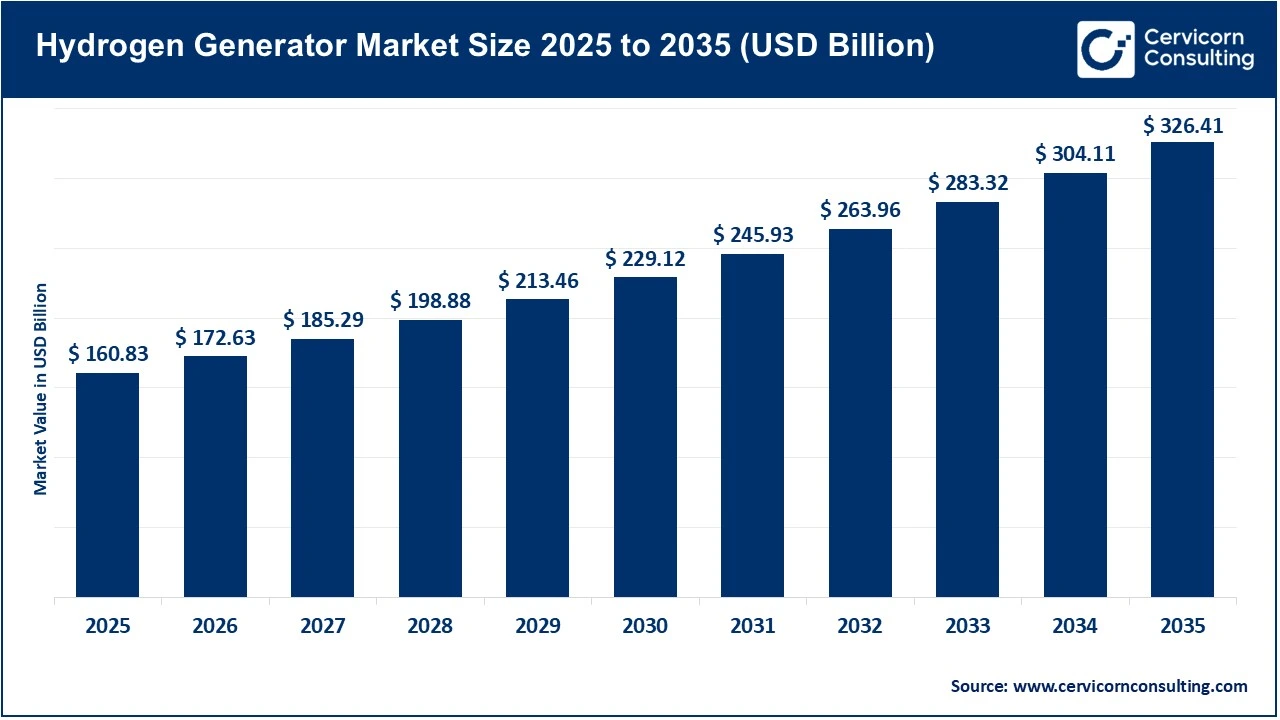
The global hydrogen generator market size was valued at USD 160.83 billion in 2025 and is expected to exceed around USD 326.41 billion by 2035, exhibiting a compound annual growth rate (CAGR) of 7.4% over the forecast period from 2026 to 2035. The hydrogen generator market is experiencing significant growth, driven by global decarbonization goals and the transition towards cleaner energy systems. More than 70 countries have announced net-zero emissions targets, necessitating major transformation across the industrial and energy sectors. In this transition, green and blue hydrogen will play important roles in future energy systems, as they can reduce greenhouse gas emissions. At the same time, the rapid expansion of renewable energy capacity is improving the economic viability of hydrogen generation, since the levelized cost of hydrogen (LCOH) depends on the availability of relatively cheap carbon-free electricity. As these renewable electricity sources become more important, electrolytic hydrogen appears to be gaining a cost-competitive advantage in regions with high-density renewable resource utilization, where studies estimate an average LCOH of 4.1 euros/kg H2 in high-renewable resource areas.
Another major factor supporting market growth is rising industrial demand for hydrogen and an increasing focus on energy security initiatives. Hydrogen generators enable countries to utilize domestic renewable resources to produce hydrogen locally, reducing dependence on volatile global natural gas markets. This shift is becoming increasingly important for nations seeking greater energy independence. For example, Senegal is currently evaluating the techno-economic potential of wind-based green hydrogen production to reduce reliance on imported fossil fuels. Similarly, industrial sectors such as steel, chemicals, and refining are expanding their use of hydrogen to protect operations from carbon tax fluctuations and supply chain disruptions. Governments are also supporting this transition through national renewable energy targets. In Morocco, the national energy strategy aims to achieve 52% renewable installed capacity by 2030.
Integration of Renewable Energy Systems in the Hydrogen Generation Market
The increasing integration of hydrogen systems with renewable energy infrastructure is a significant market trend. Hydrogen generators are increasingly deployed as flexible energy assets that absorb surplus electricity from renewable sources such as wind and solar. This enables efficient, long-duration energy storage, improves grid flexibility, and enhances overall grid stability. This trend is particularly evident in the offshore wind sector, where hydrogen generation systems are integrated to utilize excess power generated during peak production periods. The growing scale of offshore wind deployment supports this momentum, with more than 322 offshore wind projects operating globally by the end of 2023.
Moreover, the broader integration of hydrogen into modern energy systems is supported by modelling and digital technologies that help manage bidirectional energy platforms, enabling consumers to also serve as producers.
What is a hydrogen generator, and how does it work?
A hydrogen generator is a device that produces hydrogen by electrolyzing distilled or deionized water with a conductivity of less than 0.1 μS, using a polymeric ion exchange membrane. Inside the generator, a polymer membrane cell (PEM) carries out the electrolysis process. The cell contains two electrodes, an anode and a cathode, separated by a membrane. When water is introduced and electricity is supplied, the electrolysis reaction occurs. Hydrogen ions migrate to the cathode, while oxygen ions migrate to the anode. Water is thus split into hydrogen and oxygen.
The hydrogen produced is then purified and dried using various technologies, such as adsorption drying with automatic regeneration on two cartridges, desiccant cartridge drying, and Permapure drying, to achieve the purity required for specific applications.
What are the benefits of using a hydrogen generator?
There are several significant advantages to using a hydrogen generator. Firstly, hydrogen generators offer a safer and more practical alternative to high-pressure hydrogen cylinders. They guarantee consistent purity of the hydrogen produced, eliminating the risk of contamination that can occur when cylinders are replaced.
Hydrogen generators are also cost-effective, reducing the costs associated with cylinder purchase, delivery and replacement. They also provide a continuous, on-demand source of hydrogen, eliminating potential interruptions to processes or experiments. What’s more, using a hydrogen generator is an environmentally friendly option, reducing the carbon footprint by avoiding frequent cylinder transport and promoting more sustainable resource management in laboratories and industrial facilities.
Report Scope
| Area of Focus | Details |
| Market Size in 2026 | USD 172.63 Billion |
| Market Size in 2035 | USD 326.41 Billion |
| CAGR 2026 to 2035 | 7.40% |
| Dominant Region | Asia-Pacific |
| Key Segments | By Source, By Deployment Mode, By Technology, By Application, By Region |
| Key Companies | Linde plc, Air Liquide, Air Products and Chemicals, Inc., Cummins Inc., Plug Power Inc., Nel ASA, ITM Power plc, Siemens Energy AG, McPhy Energy S.A., Toshiba Energy Systems & Solutions Corporation, Teledyne Energy Systems, Proton OnSite, Peak Scientific Instruments, HyGear, Xebec Adsorption Inc. |
1. Major Government Funding and Policy Initiatives
Government funding and supportive policy frameworks have become major growth drivers in the hydrogen generator market. The United States and the European Union, in particular, have introduced significant investment packages to develop regional hydrogen hubs. These initiatives are designed to overcome the "chicken-and-egg" dilemma, which is the lack of both production (generators) and consumption (large industrial off-takers). The development of hydrogen as a sustainable energy source is supported by broader low-carbon transition initiatives, including investments in renewable energy and infrastructure upgrades that enhance hydrogen production and distribution.
2. Commercial Electrolyze Deployment Milestones at Scale
The large-scale commercial deployment of electrolyzers is playing an essential role in the hydrogen generator market. In late 2024, several multi-megawatt electrolyzer facilities were commissioned across Europe and Asia, signalling the transition of electrolysis technology from pilot projects to industrial-scale operations. Countries such as Germany, China, and the United States have aligned policies with technological and energy-sourcing innovations. These developments are enabling the production of hydrogen using wind, solar, and nuclear energy, making green hydrogen generation increasingly feasible at scale. In particular, China is a leader in industrial-scale alkaline electrolyzer manufacturing, helping reduce capital expenditure costs globally.
3. Strategic Mergers and Expansion of Infrastructure
Strategic mergers, acquisitions, and infrastructure investments mark a significant milestone in the market. The traditional oil and gas sector is actively expanding into clean energy production. These firms are leveraging their expertise in large-scale engineering, gas handling, and infrastructure development to establish a strong presence in the emerging hydrogen economy. Meanwhile, international cooperation is accelerating infrastructure development across regions. For instance, projects such as the Erasmus+ INNOMED initiative in Morocco are supporting the integration of solar energy systems with hydrogen production and distribution networks.
4. Advancements in Hydrogen Generation and Distribution Systems
Technological progress in hydrogen generation and distribution systems is significantly improving the commercial viability of hydrogen. Hydrogen pipeline networks optimise the geographic location of industry, enabling hydrogen generation in renewable energy-rich regions and aligning production with demand. Similarly, hydrogen pipelines carry hydrogen to populated regions with higher demand intensity. Breakthroughs in distribution infrastructure are essential for reducing the overall cost of hydrogen systems and improving access to low-carbon fuel, thereby supporting industrial electrification and enabling the transition towards a sustainable future economy.
The hydrogen generator market is segmented by region into North America, Europe, Asia-Pacific, and LAMEA. Here is a brief overview of each region:
The Asia-Pacific hydrogen generator market size was valued at USD 61.12 billion in 2025 and is expected to exceed around USD 124.04 billion by 2035.
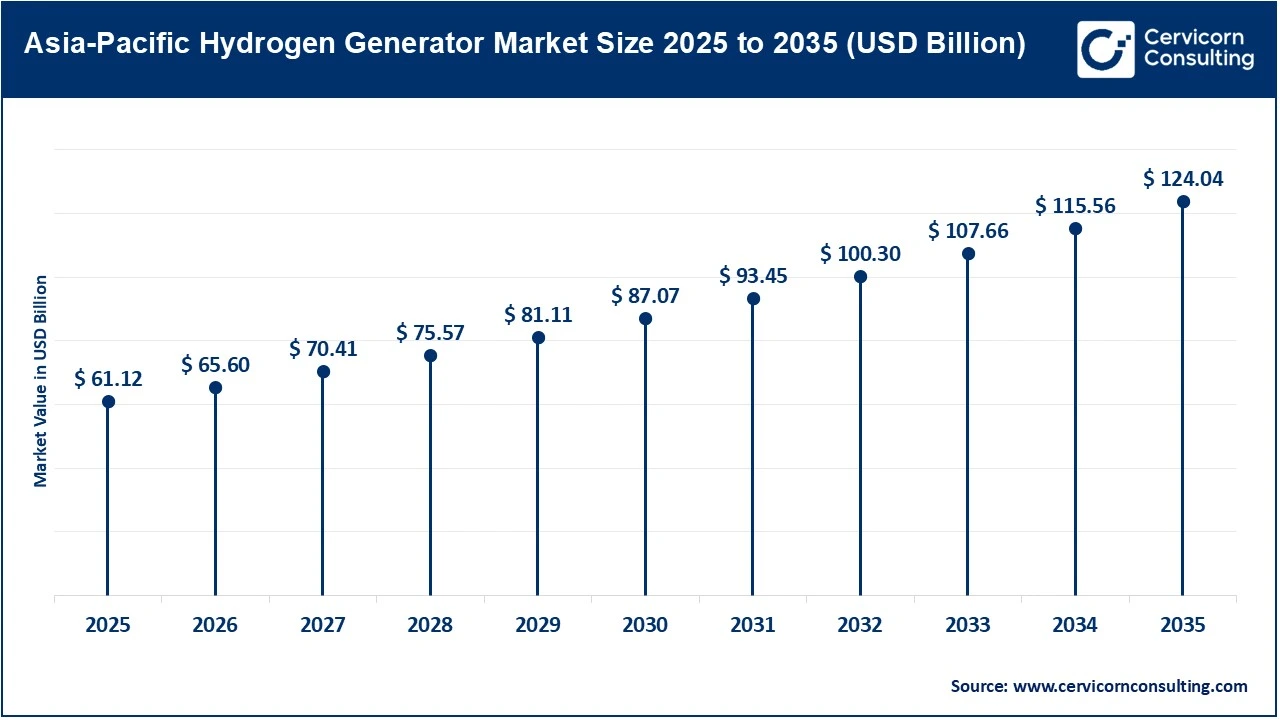
The Asia-Pacific region is the dominant market, driven primarily by China’s large-scale industrial capacity and India’s accelerating decarbonization initiatives. Across the region, industrial decarbonisation in sectors such as steel and cement has become a strategic economic priority. In 2023, China installed over 1.5 GW of hydrogen capacity, representing a year-on-year increase of 300%. The predominant regional focus on advanced technologies, such as alkaline systems, requires lower upfront CAPEX and strong durability in demanding industrial environments.
China: Leadership in Alkaline Electrolyzer Manufacturing and Hydrogen Infrastructure Development
China is leveraging its large-scale manufacturing capabilities to reduce hydrogen generator costs and strengthen its position as a global leader in deploying hydrogen infrastructure.
India: National Green Hydrogen Mission Supporting Domestic Manufacturing Growth
India is becoming a more important player in the hydrogen generator market through the National Green Hydrogen Mission, with a strong focus on domestic electrolyzer manufacturing and on reducing dependence on fossil fuel imports.
The North America hydrogen generator market size was estimated at USD 38.60 billion in 2025 and is projected to hit around USD 78.34 billion by 2035. North America is witnessing rapid growth, largely supported by strong federal incentives and infrastructure investments. The U.S. Inflation Reduction Act (IRA) is the primary policy focus in North America, centred on "demand-side" stimulation, in which federal tax credits create a competitive advantage for clean hydrogen by narrowing the cost gap with fossil-fuel-based alternatives. This policy supports massive private investment, particularly in the development of regional hydrogen hubs that integrate hydrogen production, storage, and end-use applications within localized ecosystems.
United States: Federal Tax Credits and Expansion of Domestic Hydrogen Manufacturing
The United States is rapidly shifting from hydrogen research and development to large-scale commercial deployment, supported by policy frameworks for clean energy production.
Canada: Advancing Blue Hydrogen Production and Export Capability
Canada is leveraging its abundant hydroelectric resources and natural gas reserves to strengthen its position as a major producer and exporter of green and blue hydrogen, particularly to Europe and East Asia.
The Europe hydrogen generator market size was accounted for USD 45.03 billion in 2025 and is predicted to surpass around USD 91.39 billion by 2035. Europe’s hydrogen generator market is primarily driven by stringent emissions-reduction policies and long-term hydrogen development strategies. The European Union’s REPowerEU aims to achieve 10 million tonnes of domestic green hydrogen production by 2030 to reduce reliance on natural gas imports and strengthen energy sovereignty. In 2024, the first auction for the European Hydrogen Bank attracted bids for more than 8GW of capacity, underscoring a substantial pipeline of hydrogen projects awaiting final investment decisions. Europe has a strong reputation as a global leader in technological innovation, with a focus on advanced solutions such as solid oxide electrolysis cells (SOEC) and offshore hydrogen production.
United Kingdom: Net-Zero Targets and Offshore Wind
The UK is focused on "Hydrogen Villages" and on decarbonizing industrial clusters, in part by utilizing the extensive offshore wind resources available in the North.
Germany: European Hydrogen Backbone and Industrial Decarbonization
Germany is driving growth in Europe's hydrogen generator market through robust industrial subsidies, large-scale hydrogen infrastructure development, and strategic import initiatives to decarbonize its industrial base.
Hydrogen Generator Market Share, By Region, 2025 (%)
| Region | Revenue Share, 2025 (%) |
| Asia Pacific | 38% |
| Europe | 28% |
| North America | 24% |
| LAMEA | 10% |
The LAMEA hydrogen generator market was valued at USD 16.08 billion in 2025 and is anticipated to reach around USD 32.64 billion by 2035. The LAMEA region is emerging as a market, supported by renewable energy resources and growing export opportunities. Countries in Latin America and the Middle East are leveraging strong solar and wind resources to develop cost-competitive green hydrogen production. This green hydrogen is mainly exported as ammonia or e-fuels. For example, the NEOM Green Hydrogen Project in Saudi Arabia plans to export 600 tonnes of carbon-free hydrogen daily by 2026 and has an estimated value of USD 8.4 billion, indicating a new global benchmark for project financing in the hydrogen sector.
Brazil: Ethanol-to-Hydrogen in an Oil-to-Hydrogen Migration
Brazil has one of the cleanest power infrastructures and a strong renewable energy capacity, positioning the country as a natural leader in low-cost green hydrogen production and biofuels projects.
United Arab Emirates: Solar-Powered Hydrogen for Markets Beyond the Gulf
The UAE is strongly diversifying its economy, using its solar resources to lead the way in hydrogen in the Middle East, while maintaining upstream investments as a global energy hub.
The hydrogen generator market is segmented into source, deployment mode, technology, application, and region.
Gray hydrogen is the leading segment of the market due to the well-established infrastructure and lower production costs of the gray hydrogen supply chain. In the European ammonia sector, hydrogen produced via Steam Methane Reforming (SMR) generates about 36 million tons of CO2 annually, highlighting the significant carbon footprint associated with this conventional production method. Moreover, technological advances and the availability of low-cost natural gas in certain regions are further strengthening the advantages of gray hydrogen.
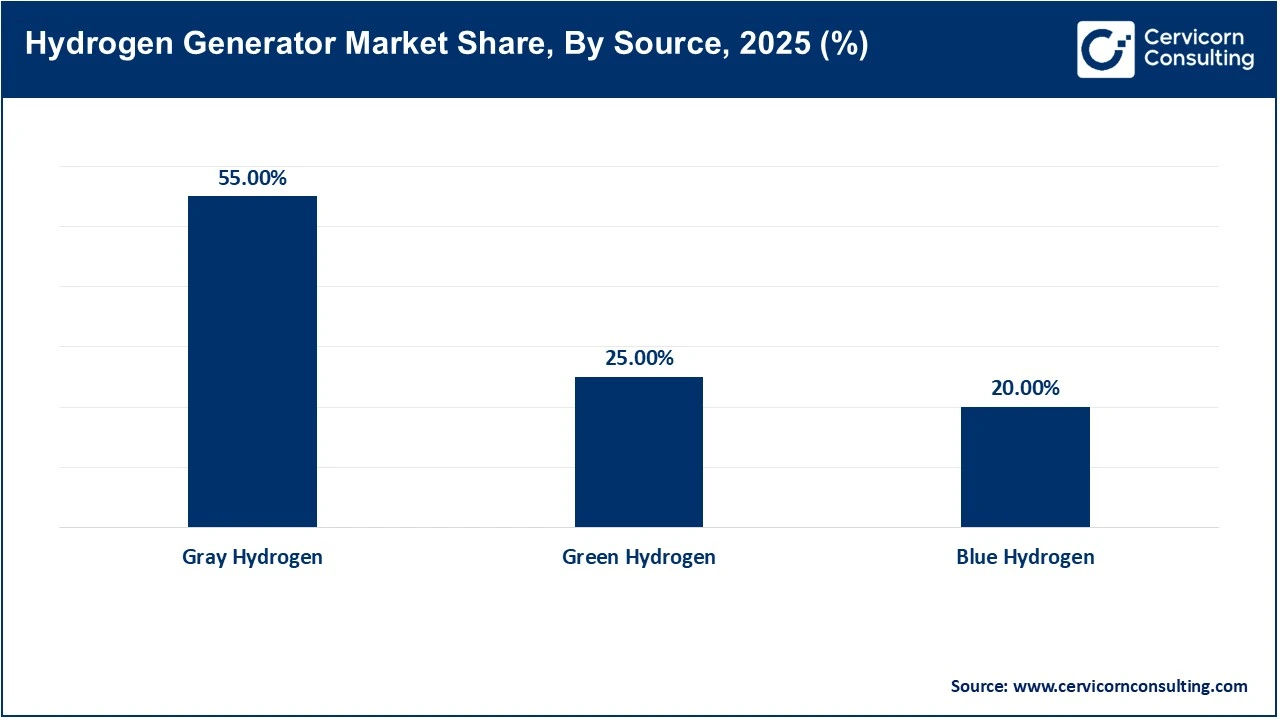
Green hydrogen is growing fastest in the market due to the growing need to decarbonise industrial sectors and the sharp reductions in renewable energy costs. Green hydrogen is attracting high investment, offering an opportunity for nearly zero-emission production. The resurgence after a period of decline in national hydrogen strategies and carbon taxes is making green hydrogen the only reasonable long-term solution for companies to achieve net-zero commitments.
Captive is the dominant deployment model in the market because hydrogen is expensive to transport, and its low energy density makes long-distance transport more challenging. Most industrial end-users, such as refineries and chemical plants, prefer on-site hydrogen generators to ensure a reliable, continuous supply, avoiding high-pressure storage and transport logistics. This model is reinforced by the emergence of local energy communities, which signal a trend towards on-site generation and consumption.
Hydrogen Generator Market Share, By Deployment Mode, 2025 (%)
| Deployment Mode | Revenue Share, 2025 (%) |
| Captive | 68% |
| Merchant | 32% |
Merchant is becoming the fastest-growing deployment segment of the market, driven by the rapid expansion of hydrogen refueling infrastructure in the transportation sector. As the electrification of the transportation sector accelerates, demand for "delivered" hydrogen to power FCEVs and heavy-duty trucks is rising quickly. This growth is being driven by existing and emerging centralized hydrogen hubs that are developed to distribute gas to a network of satellite refueling stations for hydrogen.
Steam Methane Reforming (SMR) is the dominant hydrogen technology because it is the most established and most economical for large-scale production of pure hydrogen. SMR has served as an industry standard for decades, primarily supplying hydrogen feedstocks for ammonia and refinery applications. Despite its high carbon footprint, SMR's efficiency and the existing global natural gas infrastructure make it the dominant technology for the majority of global hydrogen production and supply volume.
Hydrogen Generator Market Share, By Technology, 2025 (%)
| Technology | Revenue Share, 2025 (%) |
| Steam Methane Reforming (SMR) | 46% |
| Electrolysis | 18% |
| Partial Oxidation (POX) | 14% |
| Coal Gasification | 12% |
| Auto Thermal Reforming (ATR) | 10% |
Electrolysis is the fastest-growing technology, as it is the primary method for producing green hydrogen from renewable energy generation. With increasing global emphasis on clean energy transitions, electrolysis continues to benefit from R&D investment and economies of scale in manufacturing. The development of both alkaline and Proton Exchange Membrane (PEM) electrolyzers offers improved efficiency and flexibility, enabling better integration with intermittent renewable energy sources like wind and solar.
Ammonia production is the largest end-use segment in the hydrogen generator market, as hydrogen is the primary feedstock for nitrogen-based fertilizers. The growing population continues to demand access to ammonia-based fertilizers, creating a "recession-proof" market for hydrogen. Beyond agriculture, ammonia is widely used as a liquid "hydrogen carrier". It is much easier and cheaper to store and transport than gaseous or liquid hydrogen.
Hydrogen Generator Market Share, By Application, 2025 (%)
| Application | Revenue Share, 2025 (%) |
| Ammonia Production | 32% |
| Petroleum Refinery | 28% |
| Methanol Production | 14% |
| Transportation | 12% |
| Power Generation | 8% |
| Others | 6% |
Transport is the fastest-growing end user in the market, mainly due to the limitations of battery electric vehicles (BEVs) for heavy-duty applications such as marine shipping, long-haul trucking, and non-electrified rail transport. Hydrogen fuel cells offer a better power-to-weight ratio, refueling times comparable to diesel, and an exciting avenue for zero-emission heavy-duty alternatives for logistics operations. In regions such as Uzbekistan, studies have shown that diesel trucks can be replaced with hydrogen-powered trucks or hydrogen-natural gas blends (HCNG), resulting in significant annual CO2 reductions.
By Source
By Deployment Mode
By Technology
By Application
By Region
Chapter 1. Market Introduction and Overview
1.1 Market Definition and Scope
1.1.1 Overview of Hydrogen Generator
1.1.2 Scope of the Study
1.1.3 Research Timeframe
1.2 Research Methodology and Approach
1.2.1 Methodology Overview
1.2.2 Data Sources and Validation
1.2.3 Key Assumptions and Limitations
Chapter 2. Executive Summary
2.1 Market Highlights and Snapshot
2.2 Key Insights by Segments
2.2.1 By Source Overview
2.2.2 By Deployment Mode Overview
2.2.3 By Technology Overview
2.2.4 By Application Overview
2.3 Competitive Overview
Chapter 3. Global Impact Analysis
3.1 Russia-Ukraine Conflict: Global Market Implications
3.2 Regulatory and Policy Changes Impacting Global Markets
Chapter 4. Market Dynamics and Trends
4.1 Market Dynamics
4.1.1 Market Drivers
4.1.2 Market Restraints
4.1.3 Market Opportunities
4.1.4 Market Challenges
4.2 Market Trends
Chapter 5. Premium Insights and Analysis
5.1 Global Hydrogen Generator Market Dynamics, Impact Analysis
5.2 Porter’s Five Forces Analysis
5.2.1 Bargaining Power of Suppliers
5.2.2 Bargaining Power of Buyers
5.2.3 Threat of Substitute Products
5.2.4 Rivalry among Existing Firms
5.2.5 Threat of New Entrants
5.3 PESTEL Analysis
5.4 Value Chain Analysis
5.5 Product Pricing Analysis
5.6 Vendor Landscape
5.6.1 List of Buyers
5.6.2 List of Suppliers
Chapter 6. Hydrogen Generator Market, By Source
6.1 Global Hydrogen Generator Market Snapshot, By Source
6.1.1 Market Revenue (($Billion) and Growth Rate (%), 2022-2035
6.1.1.1 Gray Hydrogen
6.1.1.2 Green Hydrogen
6.1.1.3 Blue Hydrogen
Chapter 7. Hydrogen Generator Market, By Technology
7.1 Global Hydrogen Generator Market Snapshot, By Technology
7.1.1 Market Revenue (($Billion) and Growth Rate (%), 2022-2035
7.1.1.1 Steam Methane Reforming (SMR)
7.1.1.2 Electrolysis
7.1.1.3 Partial Oxidation (POX)
7.1.1.4 Coal Gasification
7.1.1.5 Auto Thermal Reforming (ATR)
Chapter 8. Hydrogen Generator Market, By Deployment Mode
8.1 Global Hydrogen Generator Market Snapshot, By Deployment Mode
8.1.1 Market Revenue (($Billion) and Growth Rate (%), 2022-2035
8.1.1.1 Captive
8.1.1.2 Merchant
Chapter 9. Hydrogen Generator Market, By Application
9.1 Global Hydrogen Generator Market Snapshot, By Application
9.1.1 Market Revenue (($Billion) and Growth Rate (%), 2022-2035
9.1.1.1 Ammonia Production
9.1.1.2 Petroleum Refinery
9.1.1.3 Methanol Production
9.1.1.4 Transportation
9.1.1.5 Power Generation
9.1.1.6 Others
Chapter 10. Hydrogen Generator Market, By Region
10.1 Overview
10.2 Hydrogen Generator Market Revenue Share, By Region 2024 (%)
10.3 Global Hydrogen Generator Market, By Region
10.3.1 Market Size and Forecast
10.4 North America
10.4.1 North America Hydrogen Generator Market Revenue, 2022-2035 ($Billion)
10.4.2 Market Size and Forecast
10.4.3 North America Hydrogen Generator Market, By Country
10.4.4 U.S.
10.4.4.1 U.S. Hydrogen Generator Market Revenue, 2022-2035 ($Billion)
10.4.4.2 Market Size and Forecast
10.4.4.3 U.S. Market Segmental Analysis
10.4.5 Canada
10.4.5.1 Canada Hydrogen Generator Market Revenue, 2022-2035 ($Billion)
10.4.5.2 Market Size and Forecast
10.4.5.3 Canada Market Segmental Analysis
10.4.6 Mexico
10.4.6.1 Mexico Hydrogen Generator Market Revenue, 2022-2035 ($Billion)
10.4.6.2 Market Size and Forecast
10.4.6.3 Mexico Market Segmental Analysis
10.5 Europe
10.5.1 Europe Hydrogen Generator Market Revenue, 2022-2035 ($Billion)
10.5.2 Market Size and Forecast
10.5.3 Europe Hydrogen Generator Market, By Country
10.5.4 UK
10.5.4.1 UK Hydrogen Generator Market Revenue, 2022-2035 ($Billion)
10.5.4.2 Market Size and Forecast
10.5.4.3 UK Market Segmental Analysis
10.5.5 France
10.5.5.1 France Hydrogen Generator Market Revenue, 2022-2035 ($Billion)
10.5.5.2 Market Size and Forecast
10.5.5.3 France Market Segmental Analysis
10.5.6 Germany
10.5.6.1 Germany Hydrogen Generator Market Revenue, 2022-2035 ($Billion)
10.5.6.2 Market Size and Forecast
10.5.6.3 Germany Market Segmental Analysis
10.5.7 Rest of Europe
10.5.7.1 Rest of Europe Hydrogen Generator Market Revenue, 2022-2035 ($Billion)
10.5.7.2 Market Size and Forecast
10.5.7.3 Rest of Europe Market Segmental Analysis
10.6 Asia Pacific
10.6.1 Asia Pacific Hydrogen Generator Market Revenue, 2022-2035 ($Billion)
10.6.2 Market Size and Forecast
10.6.3 Asia Pacific Hydrogen Generator Market, By Country
10.6.4 China
10.6.4.1 China Hydrogen Generator Market Revenue, 2022-2035 ($Billion)
10.6.4.2 Market Size and Forecast
10.6.4.3 China Market Segmental Analysis
10.6.5 Japan
10.6.5.1 Japan Hydrogen Generator Market Revenue, 2022-2035 ($Billion)
10.6.5.2 Market Size and Forecast
10.6.5.3 Japan Market Segmental Analysis
10.6.6 India
10.6.6.1 India Hydrogen Generator Market Revenue, 2022-2035 ($Billion)
10.6.6.2 Market Size and Forecast
10.6.6.3 India Market Segmental Analysis
10.6.7 Australia
10.6.7.1 Australia Hydrogen Generator Market Revenue, 2022-2035 ($Billion)
10.6.7.2 Market Size and Forecast
10.6.7.3 Australia Market Segmental Analysis
10.6.8 Rest of Asia Pacific
10.6.8.1 Rest of Asia Pacific Hydrogen Generator Market Revenue, 2022-2035 ($Billion)
10.6.8.2 Market Size and Forecast
10.6.8.3 Rest of Asia Pacific Market Segmental Analysis
10.7 LAMEA
10.7.1 LAMEA Hydrogen Generator Market Revenue, 2022-2035 ($Billion)
10.7.2 Market Size and Forecast
10.7.3 LAMEA Hydrogen Generator Market, By Country
10.7.4 GCC
10.7.4.1 GCC Hydrogen Generator Market Revenue, 2022-2035 ($Billion)
10.7.4.2 Market Size and Forecast
10.7.4.3 GCC Market Segmental Analysis
10.7.5 Africa
10.7.5.1 Africa Hydrogen Generator Market Revenue, 2022-2035 ($Billion)
10.7.5.2 Market Size and Forecast
10.7.5.3 Africa Market Segmental Analysis
10.7.6 Brazil
10.7.6.1 Brazil Hydrogen Generator Market Revenue, 2022-2035 ($Billion)
10.7.6.2 Market Size and Forecast
10.7.6.3 Brazil Market Segmental Analysis
10.7.7 Rest of LAMEA
10.7.7.1 Rest of LAMEA Hydrogen Generator Market Revenue, 2022-2035 ($Billion)
10.7.7.2 Market Size and Forecast
10.7.7.3 Rest of LAMEA Market Segmental Analysis
Chapter 11. Competitive Landscape
11.1 Competitor Strategic Analysis
11.1.1 Top Player Positioning/Market Share Analysis
11.1.2 Top Winning Strategies, By Company, 2022-2024
11.1.3 Competitive Analysis By Revenue, 2022-2024
11.2 Recent Developments by the Market Contributors (2024)
Chapter 12. Company Profiles
12.1 Linde plc
12.1.1 Company Snapshot
12.1.2 Company and Business Overview
12.1.3 Financial KPIs
12.1.4 Product/Service Portfolio
12.1.5 Strategic Growth
12.1.6 Global Footprints
12.1.7 Recent Development
12.1.8 SWOT Analysis
12.2 Air Liquide
12.3 Air Products and Chemicals, Inc.
12.4 Cummins Inc.
12.5 Plug Power Inc.
12.6 Nel ASA
12.7 ITM Power plc
12.8 Siemens Energy AG
12.9 McPhy Energy S.A.
12.10 Toshiba Energy Systems & Solutions Corporation
12.11 Teledyne Energy Systems
12.12 Proton OnSite
12.13 Peak Scientific Instruments
12.14 HyGear
12.15 Xebec Adsorption Inc.