Decarbonization Market Size, Growth, Forecast 2026 to 2035
The global decarbonization market size was recorded at USD 2.37 trillion in 2025 and is expected to hit around USD 7.22 trillion by 2035, reflecting a compound annual growth rate (CAGR) of 11.78% over the forecast period from 2026 to 2035. The decarbonization market is experiencing rapid growth due to stricter government regulations, corporate sustainability goals, and technological advancements in clean energy. Countries worldwide are implementing carbon pricing, emission reduction policies, and renewable energy incentives, driving investments in green solutions. Businesses are also adopting low-carbon strategies to meet consumer demand for sustainable products and reduce operational costs. This shift is accelerating the adoption of renewable energy, energy storage, and electric mobility.
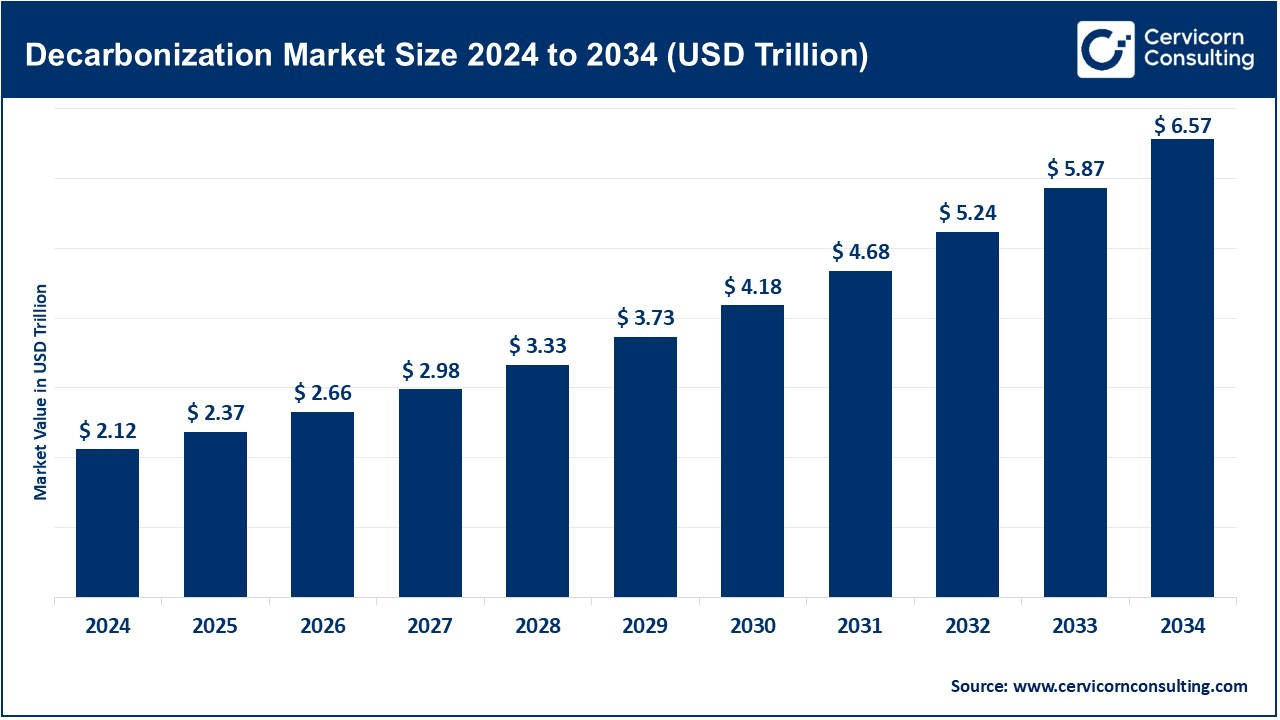
Additionally, innovations in hydrogen fuel, battery technology, and AI-driven energy optimization are further boosting the market. The growing commitment to achieving net-zero emissions by 2050 is pushing companies across various sectors power, manufacturing, and transportation to invest in decarbonization solutions. Emerging economies are also joining this transition, supported by international funding and partnerships. As a result, the market is expected to expand significantly, transforming industries and paving the way for a cleaner, greener global economy.
Report Highlights
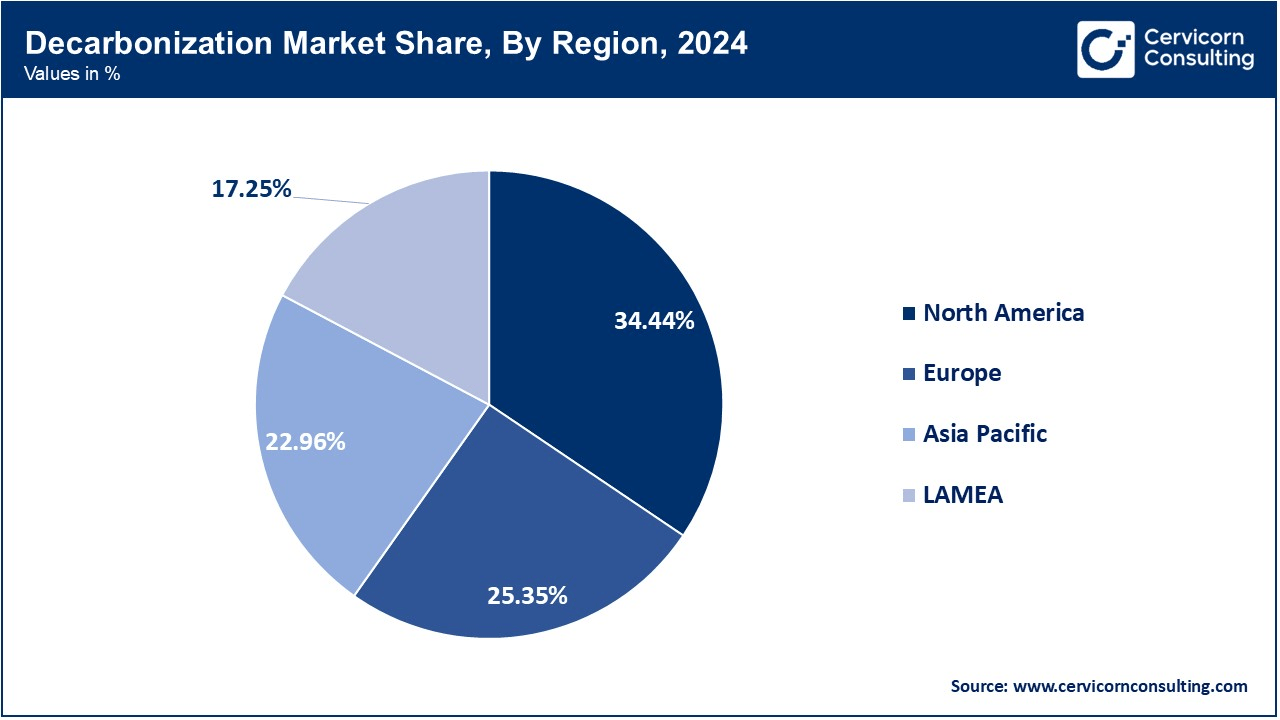
- North America captured a share of 34.44% in 2025 because of extensive spending in carbon capture technologies, renewable energy investments and corporate commitment towards net zero emissions across industries.
- The Europe region occupied a revenue share of 25.35% in 2025 owing to robust climate regulations, carbon pricing mechanisms, and aggressive decarbonization goals set forth by the European Union.
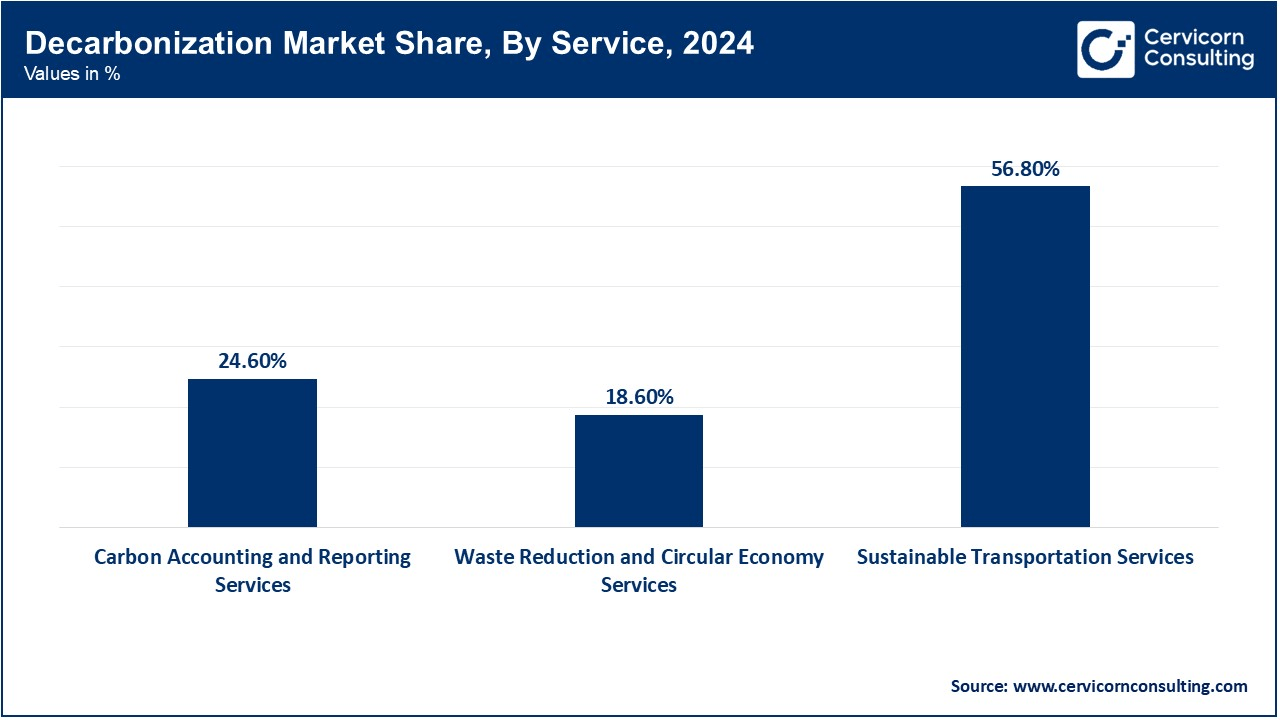
- By product type, sustainable transport services had a revenue share of 56.52% in 2025 because the government and corporate sectors are aggressively deploying e-mobility, low emission logistics, and sustainable transport solutions to mitigate their carbon emissions.
- By technology type, renewable energy technologies garnered a revenue share of 69.76% in 2025 due to accelerated adoption of solar, wind, hydro, and other clean energy technologies replacing fossil fuel based power generation.
- By deployment model, the cloud based model dominated as the chief deployment model in 2025 since cloud platforms enable real-time emissions monitoring, sustainability reporting, and carbon management across diverse geographically distributed operations.
- By end-user industry, the oil & gas industry held the largest share in 2025 because energy companies have significantly invested in carbon reduction technologies, methane emission monitoring systems, carbon capture projects and sustainability efforts.
What is Decarbonization?
Decarbonization refers to the process of reducing or eliminating carbon dioxide emissions from industries, transportation, energy production, and other sectors. The goal is to transition from fossil fuels (coal, oil, and gas) to cleaner, renewable energy sources like solar, wind, and hydropower. This shift is essential to combating climate change and achieving global net-zero emission targets.
The process involves multiple strategies, including improving energy efficiency, adopting electric vehicles (EVs), using carbon capture and storage (CCS) technologies, and promoting sustainable practices in industries like steel, cement, and agriculture. Governments, businesses, and organizations worldwide are implementing policies and investing in cleaner technologies to support decarbonization efforts. Additionally, carbon offset programs, such as reforestation and carbon credits, help balance unavoidable emissions.
Decarbonization is crucial for a sustainable future, reducing environmental damage, improving public health, and driving innovation in green technologies. Countries and businesses that adopt decarbonization strategies not only contribute to environmental protection but also gain economic benefits through energy cost savings, job creation, and long-term sustainability.
Decarbonization Industry Statistics (2024-2026)
- Global investment in energy transition reached more than $2 trillion in 2024.
- More than 580GW was added to global energy systems in 2024. Solar became the dominant source of all new power generation globally.
- More than 140 countries, representing more than 90% of global GDP, has stated goals of net-zero emissions or carbon neutrality.
- Global EV sales exceeded 17 million in 2024, constituting around 1 in 5 new cars sold globally.
- The number of operational and planned CCUS projects reached 700+ worldwide in 2025, showing industrial interests on emissions reduction technology.
- Total investment in hydrogen committed by governments and companies reached more than $680 billion globally with hundreds of large scale projects developed.
- Solar PV capacity across the globe surpassed 2 TW in 2025 becoming one of the fastest developing technologies historically.
- Wind capacity additions passed 1,100 GW of cumulative capacity worldwide, being one of the pillars of decarbonization strategy.
Major Government Initiatives
| Country |
Initiative |
Key Objective |
Investment/Target |
| United States |
U.S. National Clean Hydrogen Strategy and Roadmap |
United States U.S. National Clean Hydrogen Strategy and Roadmap Scale |
Target of 10 million metric tons of clean hydrogen production annually by 2030 |
| Germany |
National Hydrogen Strategy |
Develop green hydrogen economy and industrial decarbonization |
More than EUR 18 billion committed to hydrogen development |
| United Kingdom |
CCUS Cluster Sequencing Program |
Develop carbon capture and storage infrastructure |
Supports multiple industrial carbon capture hubs |
| China |
14th Five-Year Plan for Renewable Energy |
Expand solar, wind, energy storage, and smart grid infrastructure |
Renewable energy capacity expected to exceed 1,200 GW |
| India |
National Green Hydrogen Mission |
Establish India as a global green hydrogen production hub |
USD 2.4 billion direct government support with larger private investments |
| Saudi Arabia |
Saudi Green Initiative |
Reduce carbon emissions and expand renewable energy deployment |
Target to reduce 278 million tons of CO₂ annually by 2030 |
| Canada |
Emissions Reduction Plan 2030 |
Achieve significant emissions reductions by 2030 and net-zero by 2050 |
Includes clean technology tax credits and carbon pricing measures |
Recent Trends
Surge in Renewable Energy Adoption
- Renewable energy sources, such as solar, wind, and hydropower, are at the core of decarbonization strategies worldwide. In 2024, the renewable energy segment accounted for over 70.7% of the global decarbonization market revenue as governments and industries accelerated their transition from fossil fuels. The U.S. Department of Energy (DOE) announced a USD 10 billion investment to expand solar and wind capacity, aiming to generate 80% of electricity from renewables by 2030.
- Similarly, in Europe, wind energy capacity surged by 12% year-over-year, with countries like Germany and the UK leading the way in offshore wind expansion. China, the largest renewable energy investor, installed over 150 GW of solar capacity in 2023, surpassing its annual targets. This global shift is reducing dependence on coal-based power generation and lowering emissions, contributing significantly to decarbonization efforts.
Expansion of Sustainable Transportation
- The transportation sector, responsible for nearly 25% of global CO₂ emissions, is rapidly transitioning towards sustainable solutions. The adoption of electric vehicles (EVs) has accelerated, with global EV sales reaching 14.2 million units in 2023, marking a 35% increase from the previous year. In the U.S., the fourth quarter of 2024 saw 365,824 EVs sold, a 7.3% year-over-year growth. Governments are introducing incentives to support this shift; for example, the U.S. Inflation Reduction Act (IRA) includes tax credits of up to USD 7,500 per EV, while the European Union plans to ban new gasoline and diesel car sales by 2035.
- Moreover, the deployment of charging infrastructure is expanding rapidly, with China installing over 1 million EV charging stations in 2023 alone. Public transport is also embracing electrification, with cities like London, Paris, and New York committing to 100% electric bus fleets by 2030.
Corporate Climate Commitments
- Companies across industries are setting aggressive climate targets to align with the Paris Agreement's goal of limiting global warming to 1.5°C. The Science-Based Targets initiative (SBTi) reported that over 5,000 companies have committed to reducing their emissions in line with climate science. Major corporations such as Amazon, Microsoft, and Apple have pledged to become carbon neutral or negative by 2030. Investments in corporate sustainability initiatives have surged, with global spending on decarbonization strategies projected to exceed USD 3.5 trillion by 2030.
- Additionally, the rise of Environmental, Social, and Governance (ESG) investing has placed pressure on businesses to disclose their carbon footprints, with over 90% of the world's largest companies now publishing sustainability reports. Companies are also integrating carbon offset programs and renewable energy procurement into their operations to meet their net-zero targets.
Technological Innovations in Energy Efficiency
- Breakthroughs in energy efficiency technologies are playing a crucial role in decarbonization. Heat pumps, which are more energy-efficient than traditional heating systems, are seeing rapid adoption; in 2024, heat pump sales outpaced gas furnace sales in the U.S. for the first time. Buildings account for nearly 40% of global energy consumption, and innovations such as smart grids, energy-efficient lighting, and AI-powered energy management systems are optimizing energy use.
- The global energy storage market, essential for balancing renewable energy fluctuations, is expected to grow at a CAGR of 25%, with lithium-ion battery production capacity surpassing 1,200 GWh annually. Companies like Tesla, Siemens, and Schneider Electric are investing billions into energy efficiency solutions to enhance grid stability and reduce emissions. These innovations not only lower carbon footprints but also result in significant cost savings for businesses and consumers.
Strengthened Government Policies and Investments
- Government regulations and financial incentives are accelerating decarbonization efforts worldwide. The European Green Deal has earmarked EUR 1 trillion to support clean energy projects and aims to make the EU climate-neutral by 2050. In the U.S., the Inflation Reduction Act (IRA) allocated USD 369 billion for climate and energy initiatives, including tax credits for renewable energy and electric vehicle production.
- Japan has committed to reducing its carbon emissions by 50% by 2030, with significant investments in hydrogen infrastructure. Meanwhile, China's Five-Year Plan emphasizes achieving peak carbon emissions by 2030 and carbon neutrality by 2060, backed by multi-billion-dollar investments in solar, wind, and carbon capture technologies. The establishment of carbon pricing mechanisms, such as the EU Emissions Trading System (ETS) and China’s national carbon market, has also incentivized industries to cut emissions and adopt cleaner technologies.
Report Scope
| Area of Focus |
Details |
| Market Size in 2026 |
USD 2.66 Trillion |
| Expected Market Size by 2035 |
USD 7.22 Trillion |
| Projected CAGR 2026 to 2035 |
11.78% |
| High-impact Region |
North America |
| Leading Growth Region |
Asia-Pacific |
| Key Segments |
Service, Technology, Deployment, End User, Region |
| Key Companies |
General Electric (GE), Siemens Energy, Schneider Electric, ABB Ltd., Honeywell International Inc., Tesla, Inc., Vestas Wind Systems A/S, Ørsted A/S, NextEra Energy, Inc., Shell Plc (Renewables & Energy Solutions), Mitsubishi Heavy Industries, Ltd., Carbon Clean Solutions Limited |
Decarbonization Market Dynamics
Market Drivers
Government Regulations and Net-Zero Commitments
- Governments worldwide are enacting strict regulations to curb carbon emissions and transition towards net-zero economies. The European Green Deal has allocated EUR 1 trillion to achieve carbon neutrality by 2050. Similarly, the U.S. Inflation Reduction Act (IRA) includes USD 369 billion in climate-related incentives, accelerating clean energy adoption. China has also pledged to peak carbon emissions by 2030 and achieve net-zero emissions by 2060, backed by USD 400 billion investments in renewable energy projects. Such regulations push industries to adopt sustainable practices, boosting the decarbonization market.
Rapid Growth in Renewable Energy Deployment
- The renewable energy sector is expanding at an unprecedented rate, significantly reducing dependence on fossil fuels. In 2023, global solar power capacity surged by 48% year-over-year, while wind power grew by 21%. According to the International Energy Agency (IEA), renewables will account for over 90% of new global electricity generation by 2026. The declining costs of solar (down 82% since 2010) and wind energy (down 48%) are making them the preferred choice for power generation. This shift is a major driver for the decarbonization market.
Market Restraints
High Initial Investment Costs
- Despite long-term benefits, the upfront costs of decarbonization technologies remain a significant barrier. Building new renewable energy infrastructure, upgrading power grids, and implementing carbon capture technologies require billions in capital investment. For instance, the average cost of setting up a utility-scale solar farm is USD 1.5 million per MW, while offshore wind farms cost around USD 4 million per MW. This financial burden slows down adoption, particularly in developing economies with limited government incentives.
Slow Adoption in Hard-to-Abate Industries
- Industries such as cement, steel, chemicals, and aviation contribute nearly 30% of global CO₂ emissions, but they face difficulties in decarbonizing due to technological and economic constraints. Carbon capture and storage (CCS) technologies, which could help these sectors, are still expensive and lack large-scale adoption. In 2023, CCS capacity reached 45 million metric tons per year, but this accounts for less than 1% of global emissions, indicating slow progress.
Market Opportunities
Growth in Carbon Pricing and Emission Trading Systems (ETS)
- Governments are implementing carbon pricing mechanisms to incentivize emissions reductions. The European Union's Emissions Trading System (ETS), which covers 40% of the EU’s emissions, saw carbon prices rise to EUR 100 per ton in 2024, pushing companies to adopt greener technologies. Similarly, China’s national carbon market, launched in 2021, now covers 4.5 billion metric tons of carbon dioxide emissions, making it the world’s largest carbon trading system. Expanding these programs presents a massive opportunity for companies offering decarbonization solutions.
Rising Demand for Green Hydrogen
- Green hydrogen, produced using renewable energy, is emerging as a key decarbonization solution, particularly for heavy industries and transportation. The global green hydrogen market is projected to grow at a CAGR of 38%, reaching USD 153.78 billion by 2033. Countries like Germany, Japan, and the U.S. are investing billions in hydrogen infrastructure, with over 680 hydrogen projects announced globally. As costs decline, green hydrogen adoption will accelerate, creating new market opportunities.
Market Challenges
Grid Infrastructure and Energy Storage Limitations
- The integration of renewable energy into existing grids poses a significant challenge. Many power grids are outdated and struggle to handle the variability of solar and wind energy. For instance, in the U.S., 70% of transmission lines are over 25 years old, leading to bottlenecks in clean energy distribution. Energy storage solutions, such as lithium-ion batteries, are improving, but the global battery storage capacity (estimated at 500 GWh in 2024) is still insufficient to meet growing renewable energy demands.
Supply Chain Disruptions and Resource Constraints
- The decarbonization market depends heavily on raw materials such as lithium, cobalt, and rare earth metals, which are essential for batteries, wind turbines, and solar panels. However, supply chain disruptions, geopolitical tensions, and limited mining capacities are creating shortages. In 2023, lithium prices surged by 120%, affecting battery production costs and slowing the expansion of energy storage solutions. Addressing these supply chain challenges is critical for sustaining market growth.
Decarbonization Market Regional Analysis
The decarbonization market is segmented into various regions, including North America, Europe, Asia-Pacific, and LAMEA. Here is a brief overview of each region:
Why does North America leads in the decarbonization market?
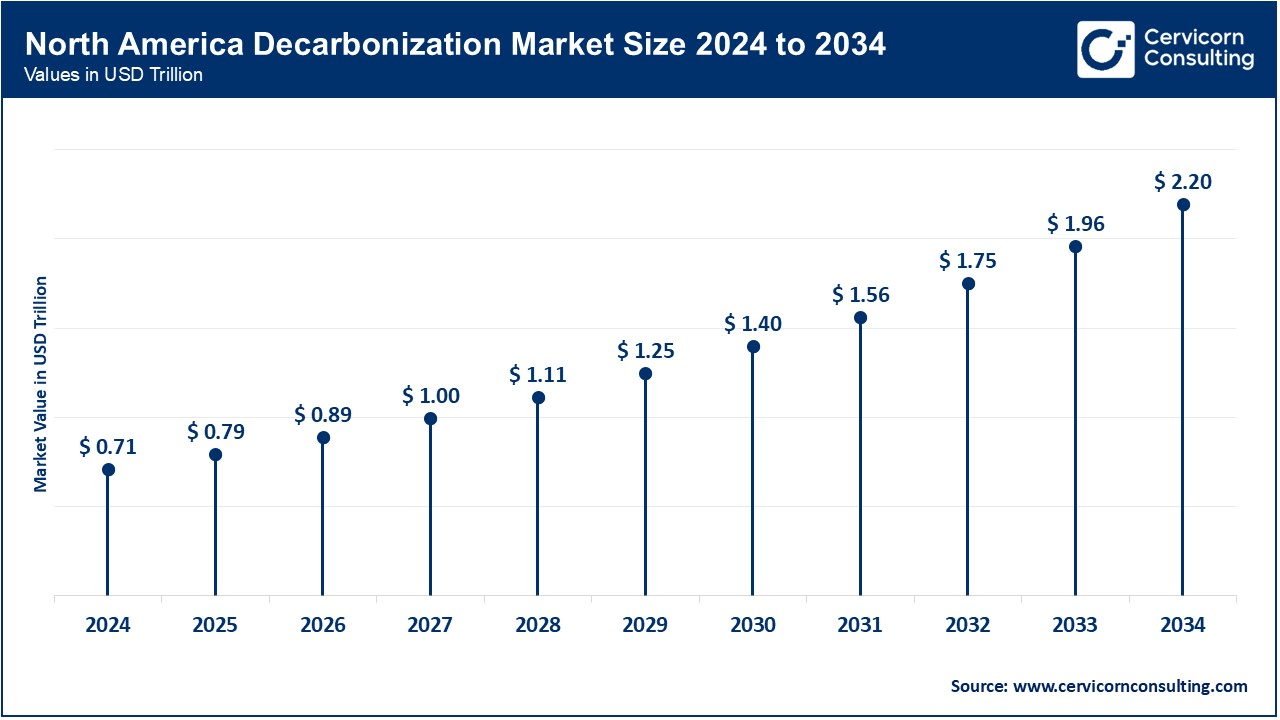
The North America decarbonization market size was calculated at USD 0.79 trillion in 2025 and is predicted to hit around USD 2.42 trillion by 2035. North America holding the highest market share in 2025. This dominance is driven by strong government policies, corporate sustainability commitments, and advanced technological innovations. The U.S. plays a pivotal role, with large-scale investments in renewable energy, carbon capture and storage (CCS), and electric vehicles (EVs). Federal initiatives such as the Inflation Reduction Act (IRA) and state-level net-zero targets accelerate market growth. The region's mature energy sector, increasing adoption of green hydrogen, and growing carbon offset programs further bolster decarbonization efforts. Canada also contributes significantly with its aggressive carbon pricing policies and clean energy transitions.
Why is Asia-Pacific witnessing fastest growth in the decarbonization market?
The Asia-Pacific decarbonization market is forecasted to grow form USD 0.54 trillion in 2025 to over USD 1.66 trillion by 2035. Asia-Pacific (APAC) is the fastest-growing region, with rapid industrial transformation and ambitious government climate policies. Countries like China, India, Japan, and South Korea are leading the transition with massive investments in renewable energy, sustainable transportation, and carbon capture technologies. China remains the largest investor in solar and wind power, while Japan and South Korea focus on hydrogen energy and green infrastructure. India’s increasing focus on energy efficiency, green manufacturing, and carbon credit trading further propels market expansion. APAC's industrial decarbonization, growing EV adoption, and rising green finance initiatives make it a key driver in the global market.
Europe: A Steady and Strong Decarbonization Market
The Europe decarbonization market size was accounted for USD 0.60 trillion in 2025 and is forecasted to surpass around USD 1.83 trillion by 2035. Europe holds a substantial share, backed by its strong regulatory framework and climate leadership. The European Union’s (EU) Green Deal, Fit for 55 package, and carbon border tax are key enablers of market growth. The region’s well-established renewable energy sector, commitment to circular economy models, and corporate net-zero targets ensure sustained growth. Germany, France, and the U.K. lead in offshore wind energy, hydrogen fuel initiatives, and CCS adoption. Europe’s advanced research and development (R&D) in carbon removal technologies and energy-efficient solutions solidify its position as a mature and stable market for decarbonization.
Why is LAMEA emerging region for decarbonization market?
The LAMEA decarbonization market was estimated at USD 0.41 trillion in 2025 and is anticipated to reach around USD 1.25 trillion by 2035. The LAMEA region presents emerging growth opportunities. While its market share is smaller compared to other regions, increasing investments in renewable energy, sustainable agriculture, and carbon credit programs drive demand. Brazil and Mexico are expanding solar and wind energy projects, while the Middle East focuses on green hydrogen and carbon capture initiatives. African nations are adopting clean energy solutions and afforestation projects to counter carbon emissions. Government-led sustainability programs, rising foreign investments, and corporate ESG commitments are expected to accelerate decarbonization efforts in LAMEA, contributing to moderate but steady market growth.
Decarbonization Market Segmental Analysis
The decarbonization market is segmented into service, technology, deployment, end-use and region. Based on service, the market is classified into carbon accounting and reporting services, waste reduction and circular economy services and sustainable transportation services. Based on technology, the market is classified into renewable energy technologies, electric vehicles (EVs), carbon removal technologies, energy efficiency solutions and carbon capture and storage (CCS). Based on deployment, the market is classified into on-premises and cloud. Based on end-use, the market is classified into oil & gas, agriculture, aerospace & defense, energy and utility, automotive & transportation, government and manufacturing.
Service Analysis
Sustainable Transportation Services: The Sustainable Transportation Services segment has dominated the market in 2025. The push for greener mobility solutions is accelerating the adoption of sustainable transportation services. Electrification of public transport, fuel-efficient logistics, and investments in high-speed rail networks are key trends. Many cities are implementing low-emission zones and offering incentives for businesses to adopt sustainable fleet management solutions. The deployment of EV charging infrastructure, coupled with policy support, is further driving demand for sustainable transport services.
Carbon Accounting and Reporting Services: Organizations worldwide are increasingly adopting carbon accounting tools to track emissions and ensure compliance with environmental regulations. Governments and financial institutions are pushing for standardized carbon reporting frameworks, such as the Greenhouse Gas (GHG) Protocol and Science Based Targets initiative (SBTi). Companies like Microsoft and Salesforce have launched AI-powered carbon tracking solutions, making it easier for businesses to assess and reduce their carbon footprint. The demand for carbon reporting services is rising across industries, particularly in energy, manufacturing, and retail.
Waste Reduction and Circular Economy Services: Many corporations are shifting towards circular business models to minimize waste generation and promote resource efficiency. Companies like Adidas and IKEA are investing in sustainable materials, closed-loop recycling, and product take-back programs to minimize environmental impact. Governments are also introducing extended producer responsibility (EPR) laws to push businesses toward sustainable production practices. This segment is growing as industries seek to optimize resource use while reducing costs and waste disposal challenges.
Technology Analysis
Renewable Energy Technologies: The Renewable Energy Technologies segment was leader in 2025. Solar and wind energy continue to dominate the renewable energy landscape, with record capacity additions in many regions. Many corporations are signing power purchase agreements (PPAs) with renewable energy providers to meet their sustainability goals. Offshore wind energy projects are gaining traction, with new developments in Europe, the U.S., and China. Advancements in battery storage solutions are also enabling better integration of renewables into the grid.
Electric Vehicles (EVs): The electric vehicles segment is expected to register a significant CAGR during the forecast period. The EV market is witnessing a surge in demand due to falling battery costs, government incentives, and improved charging infrastructure. Automakers are expanding their EV production lines, and new models with extended range and faster charging capabilities are entering the market. Fleet electrification is also becoming a priority for logistics and transportation companies, reducing overall emissions in the sector. Governments worldwide are setting ambitious targets to phase out internal combustion engine (ICE) vehicles.
Carbon Removal Technologies: Technologies like Direct Air Capture (DAC) and enhanced weathering are emerging as critical tools for reducing atmospheric carbon dioxide. Major corporations are investing in carbon removal projects to offset their emissions. Biochar, which sequesters carbon in soil while improving agricultural productivity, is gaining attention as a scalable solution. Carbon offset markets are expanding as businesses seek verified carbon removal credits.
Energy Efficiency Solutions: Businesses and households are adopting energy efficiency measures such as smart thermostats, LED lighting, and advanced building insulation. Industrial sectors are implementing energy management systems to optimize consumption and reduce operational costs. AI-driven energy optimization is helping enterprises reduce energy wastage and improve grid stability. Green building certifications, such as LEED and BREEAM, are driving investments in energy-efficient infrastructure.
Carbon Capture and Storage (CCS): Oil and gas companies, power plants, and heavy industries are integrating CCS solutions to curb emissions. Governments are funding large-scale CCS projects to accelerate adoption. While CCS technology is still expensive, advancements in capture efficiency and storage techniques are improving its feasibility. Industrial hubs and clusters are exploring shared CCS infrastructure to reduce costs and enhance scalability.
Deployment Analysis
On-premises: The on-premises segment led the market in 2025. Large enterprises in manufacturing, oil & gas, and heavy industries prefer on-premises decarbonization solutions due to security, customization, and regulatory compliance. Industrial facilities with high emissions rely on in-house carbon tracking and reduction solutions to meet their sustainability targets. In sectors where real-time monitoring of emissions is critical, on-premises solutions provide greater control and integration with operational workflows.
Cloud: Cloud-based decarbonization solutions are becoming increasingly popular among small and medium-sized enterprises (SMEs) and service-based industries. Cloud platforms provide scalability, real-time data access, and seamless integration with existing business systems. AI-powered cloud solutions help organizations analyze emissions data, generate insights, and automate sustainability reporting. Tech companies are leading the charge in developing cloud-based tools for carbon tracking, energy optimization, and ESG compliance.
End Use Analysis
The oil & gas segment generated the highest revenue in 2025 and is projected to grow at a CAGR of 13.8% during the forecast period.
Decarbonization Market Revenue Share, By End-use, 2025 (%)
| End Use |
Revenue Share, 2025 (%) |
| Oil & Gas |
30.20% |
| Agriculture |
16.30% |
| Aerospace & Defense |
6.50% |
| Energy and Utility |
21.10% |
| Automotive & Transportation |
17.40% |
| Government |
5.10% |
| Manufacturing |
3.40% |
Decarbonization Market Top Companies
Recent Development
- Schneider Electric: Recognized as a leader in clean and affordable energy solutions, Schneider Electric has integrated sustainability and energy management into all its offerings. The company aims for carbon neutrality within its operations by 2025, targeting 90% renewable energy use and ensuring that 80% of its revenue aligns with its Green Premium standard.
- Siemens Energy: Ranked second in promoting clean energy, Siemens excels in industrial digital automation and green infrastructure. The company has set a goal to achieve carbon neutrality by 2030, focusing on renewable energy adoption and sustainable technologies.
- ABB Ltd.: Leading in industrial automation and robotics, ABB has committed to reducing its customers' emissions by at least 100 megatonnes by 2030, equivalent to the annual emissions of approximately 30 million combustion vehicles. The company also aims for carbon neutrality within the same timeframe.
- Honeywell International Inc.: Positioned among the top companies driving the clean energy revolution, Honeywell continues to invest in sustainable technologies and solutions, contributing to the global transition toward cleaner energy sources.
- Tesla, Inc.: Maintaining its leadership in the automotive industry, Tesla is expanding its electric vehicle lineup and investing in charging infrastructure to support the growing demand for sustainable transportation.
Market Segmentation
By Service
- Carbon Accounting and Reporting Services
- Waste Reduction and Circular Economy Services
- Sustainable Transportation Services
By Technology
- Renewable Energy Technologies
- Electric Vehicles (EVs)
- Carbon Removal Technologies
- Energy Efficiency Solutions
- Carbon Capture and Storage (CCS)
By Deployment
By End-use
- Oil & Gas
- Agriculture
- Aerospace & Defense
- Energy and Utility
- Automotive & Transportation
- Government
- Manufacturing
By Region
- North America
- APAC
- Europe
- LAMEA