South Korea AI Infrastructure Market Size and Growth 2026 to 2035
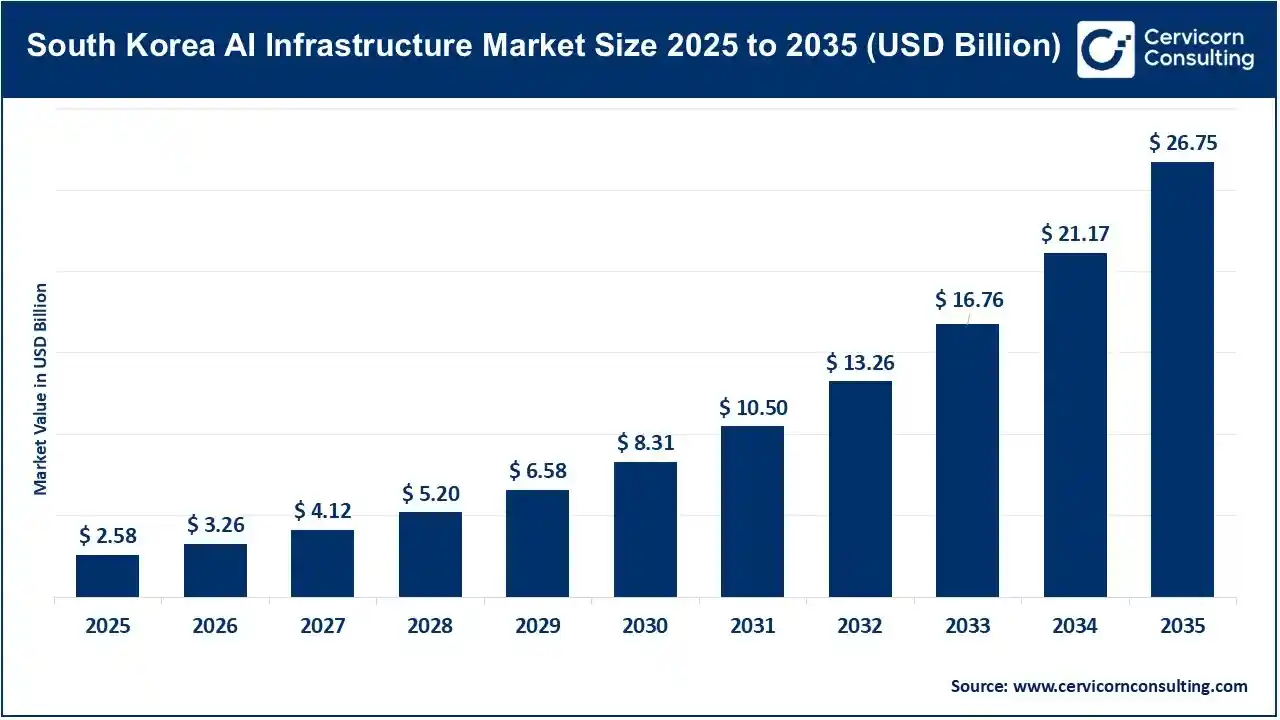
The South Korea AI infrastructure market size was valued at USD 2.58 billion in 2025, the market is estimated to reach at USD 26.75 billion by 2035. The market is expected to grow at a promising CAGR of 26.35% during the forecast period of 2026-2035.
Report Highlights
- By Offering, the Hardware segment has generated highest revenue share of 72% in 2025.
- By Deployment Model, the Cloud-based segment has accounted for a revenue share of 48% in 2025.
- By Technology, the Deep Learning segment has captured revenue share of 58% in 2025.
- By Application, the AI Data Center & HPC segment has garnered 38% revenue share in 2025.
- By End Use Industry, the Semiconductor & Electronics segment has recorded highest revenue share of 38% in 2025.
Why Is South Korea Emerging as Asia’s Next AI Infrastructure Powerhouse?
By seamlessly integrating its state-of-the-art semiconductor ecosystem, cutting-edge manufacturing technology, high-speed connectivity infrastructure, and aggressive investment in AI computing infrastructure, South Korea is emerging as one of the most strategically important AI infrastructure development hubs in Asia.
In contrast to countries that are largely centered on AI software development, South Korea is fostering an end-to-end integrated AI ecosystem in areas ranging from AI chips and high-bandwidth memory (HBM) to hyperscale AI data centers, sovereign AI models, cloud infrastructure and robotics, and industrial AI solutions.
Driven by massive public-private investment, South Korea's move from a "semi-conductor nation" into a "AI infrastructure powerhouse" is picking up speed, positioning the country as one of the leading global markets for next-generation AI computing.
Investment, Production and Strategic Landscape
- South Korea announced one of the largest AI infrastructure expansions globally, with plans to deploy over 260,000 NVIDIA GPUs across government AI computing centers and major industrial companies.
- South Korea’s Ministry of Science and ICT is establishing the National AI Computing Center through a public-private partnership with an investment scale of approximately KRW 2 trillion.
- The center aims to provide high-performance AI computing resources for universities, research institutions, startups, and enterprises while accelerating domestic AI semiconductor adoption.
- Samsung Electronics is developing an AI factory equipped with more than 50,000 NVIDIA GPUs to accelerate semiconductor design, AI research, and digital transformation.
- SK Group is building an AI factory with over 50,000 NVIDIA GPUs focused on semiconductor innovation, digital twins, robotics, and AI agent development.
- Hyundai Motor Group is deploying around 50,000 NVIDIA GPUs to support autonomous driving, AI-powered manufacturing, and mobility intelligence.
- NAVER Cloud is expanding AI infrastructure with more than 60,000 GPUs to support enterprise AI and physical AI workloads.
Can South Korea Challenge the U.S. and China in the Global AI Infrastructure Race?
- South Korea is also rapidly expanding its AI computing capacity to compete with larger AI economies which is also seeking to enter into the larger AI economies of the U.S. and China.
- In 2025 the country announced that it will invest in obtaining over 260,000 high-end NVIDIA GPUs were powered in national AI infrastructure. Approximately 50,000 will be reserved for state-funded sovereign AI programs and the National AI Computing Center.
- The rest will be given out to the nation's tech majors Samsung Electronics, SK Group, Hyundai Motor Group, and NAVER Cloud to be incorporated into the AI factories, industrial AI, robotics and autonomous vehicle segments of their businesses.
- To gain entry to the top tiers occupied by the U.S. and China will, however require some navigation through some inherent deficiencies in South Korean approach though.
- There's a persistent and overwhelming U.S. dominance over the AI software ecosystem, cloud capacity and breakthrough AI models, just as there is a substantial Chinese lead given the size of the domestic market and broad scope of adoption across varied industries.
- South Korea’s strongest opportunity lies in Physical AI, where artificial intelligence interacts with real-world environments through robots, factories, and autonomous systems. Unlike many countries focused primarily on digital AI applications, South Korea can integrate AI infrastructure directly into its manufacturing ecosystem.
South Korean Government Initiatives in AI Infrastructure Development
- National AI Computing Center Development: The South Korean government is establishing a National AI Computing Center to expand access to large-scale AI computing resources for businesses, researchers, and AI developers.
- Deployment of More Than 260,000 Advanced GPUs: South Korea is securing more than 260,000 NVIDIA GPUs to accelerate AI infrastructure development.
- KRW 1.9 Trillion AI Sector Investment Program: The Ministry of Science and ICT secured approximately KRW 1.9067 trillion in additional AI sector funding to strengthen national AI competitiveness.
- Sovereign AI Foundation Model Development: South Korea is supporting domestic AI model development to reduce dependence on foreign AI platforms.
Market Dynamics
Driver
Expansion of Generative AI and Industrial AI Workload
The deployment of new use cases like generative AI, AI agents, autonomous vehicles, and industrial automation is becoming the engine for South Korea’s AI infrastructure market. Companies continue to spend on GPU clusters, AI data centers, cloud computing services, and HPC capabilities to handle mounting compute needs triggered by developing use cases.
South Korea's unique high-performance silicon and high-touch silicon industries are fueling AI infrastructure development across multiple verticals, notably within semiconductor fabs, automotive production, and robotics and intelligent factories. More than 260,000 NVIDIA GPUs are powering government and industry-run AI workloads in South Korea, revealing the growing magnitude of computing needs.
Restraint
High Energy Requirements and Infrastructure
Despite strong investment momentum, the expansion of AI infrastructure faces challenges related to electricity demand, data center availability, and high capital requirements. AI data centers require significantly higher power consumption compared with traditional facilities due to intensive GPU workloads, advanced cooling requirements, and continuous computing operations. Limited power availability and increasing energy costs may slow the deployment of large-scale AI facilities in densely populated regions.
Furthermore, South Korea remains dependent on imported AI accelerators, particularly GPUs from global suppliers such as NVIDIA, creating supply chain vulnerabilities. Although domestic companies are developing AI semiconductor alternatives, achieving competitive performance against global AI accelerator leaders remains a long-term challenge.
Opportunity
Emergence of Physical AI and Sovereign AI Ecosystems
South Korea has a substantial opportunity to lead the world in physical AI infrastructure by coupling robotics, autonomous mobility, and the future of manufacturing with artificial intelligence. Unlike many other markets primarily targeting cloud-AI services, South Korea’s industries can deploy AI hardware directly into the world through factories, automobiles, semiconductor production processes and robots. Furthermore, investing in its own national AI infrastructure can fuel rapid growth for Korean businesses.
Seoul now supports the growth of cloud providers, AI hardware startups, and enterprise IT organizations with public investments in a National AI Computing Center and Korean foundation model initiatives.
South Korea is poised to connect everything AI-related through the vast ecosystems supported by large enterprises and cloud service providers like Samsung Electronics, SK Group, Hyundai Motor Group and NAVER Cloud, extending from chips through Computing, Cloud, to Real world AI Applications.
Segmental Analysis
Deployment Model Analysis
Cloud-based AI infrastructure accounted for the largest share of the South Korea AI infrastructure market in 2025. The adoption of cloud-based AI infrastructure is set to grow as enterprises will continue to embrace and adopt the generative AI the GPU based IaaS offerings and rapid scaling up of sovereign AI cloud ecosystems. Companies in South Korea continue to rely more on cloud-based AI infrastructure to reduce expenses of dedicated hardware by offering high-performance computing resources.
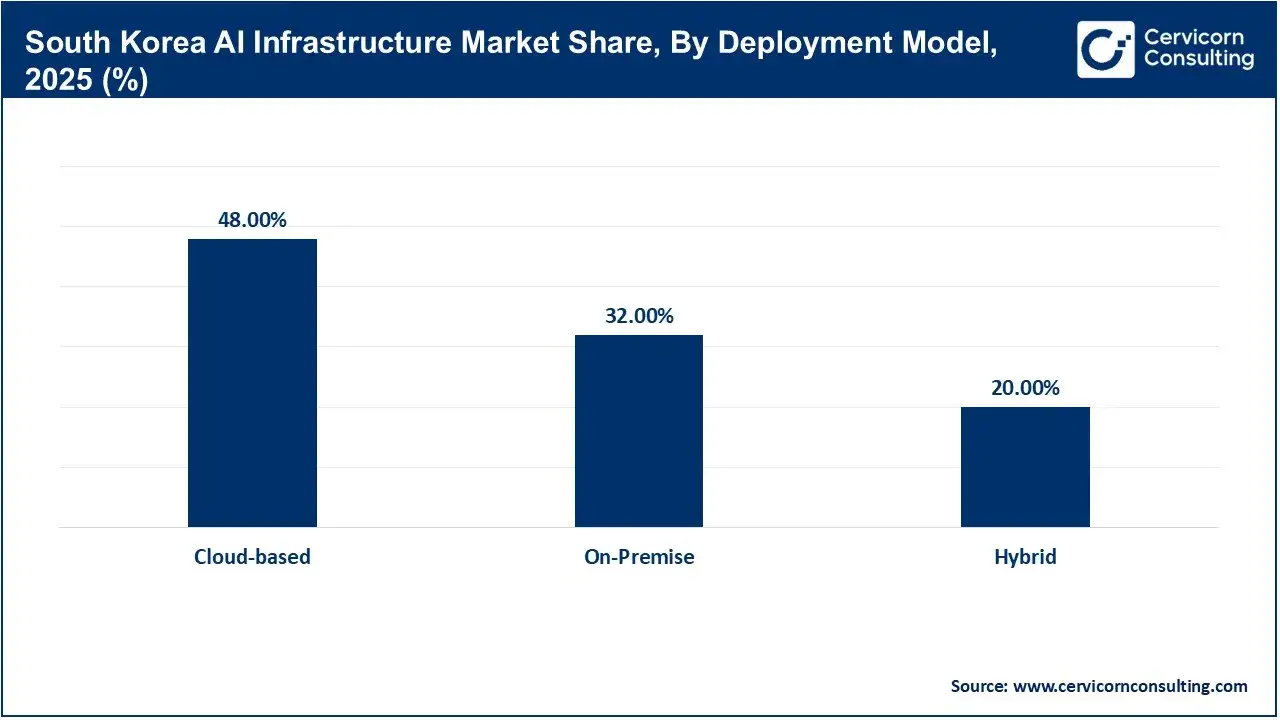
Hybrid AI infrastructure is expected to witness the fastest growth during the forecast period as companies in South Korea prefer to maintain control over sensitive data while gaining the benefits of cloud-based scalability. Key industries such as semiconductor manufacturing, automotive, defence, and health care sector are adopting hybrid approaches that offer best of both worlds between private AI and public cloud offerings.
The development of the 'AI Factory' by Samsung, SK Group and Hyundai Motor Groups aims at developing highly industrialized capabilities with the help of a combination of high-end computing resources with dedicated AI platforms and sophisticated AI-ready cloud.
Application Analysis
The AI data center & HPC infrastructure segment held the biggest share in 2025 based on the large computational need of generative AI, AI agents, autonomous systems and industrial AI, which has been greatly increased and boosted. So far, the massive growth of AI workloads led to a huge demand of GPU clusters, network systems with higher speed and higher bandwidth and memory system with higher bandwidth and also power efficient data center infrastructure.
South Korea is actively pushing ahead for AI computing resource creation through government and private enterprise-based project. Korea government and business leader are pouring huge investment in constructing large-scale AI computing infrastructure across the country, for instance, there are a total of over 260,000 of NVIDIA GPUs deployment with nation AI computing center, cloud vendors, semiconductor companies and other industries.
| Application |
Revenue Share, 2025 (%) |
| Generative AI |
32% |
| AI Data Center & HPC |
38% |
| Physical AI & Robotics Infrastructure |
18% |
| Edge AI |
12% |
Generative AI infrastructure is forecasted to be a segment with the fastest growth. On the one hand, Korean companies are actively working on domestic foundation AI models, AI agents and enterprise AI solutions, the rising demand for Korean language-based AI models, business automation tools and AI assisted services have fueled up the appetite for AI computing infrastructure.
With sovereign AI projects, South Korea is fostering the creation of domestic AI models among NAVER, SK Telecom, LG AI Research, Upstage and NC AI. By providing foundation AI models with South Korea based scenario such as Korean enterprises use cases, government applications and some vertical specific tasks.
End Use Analysis
The semiconductor and electronics industry accounted for the largest share of South Korea’s AI infrastructure market in 2025 due to the country’s global leadership in memory semiconductors, AI chips, and advanced manufacturing. Semiconductor companies require massive AI infrastructure for chip design, manufacturing optimization, predictive analytics, and automated semiconductor fabrication.
Samsung Electronics and SK hynix are at the center of South Korea’s AI infrastructure ecosystem. SK hynix’s leadership in HBM technology has strengthened Korea’s role in global AI supply chains, while Samsung is expanding AI semiconductor manufacturing and AI factory capabilities.
| End Use Industry |
Revenue Share, 2025 (%) |
| Semiconductor & Electronics |
28% |
| Automotive & Mobility |
20% |
| Manufacturing |
18% |
| Telecommunication |
15% |
| Healthcare |
10% |
| Government & Defense |
9% |
Automotive and mobility is expected to register the fastest growth during the forecast period due to increasing adoption of autonomous driving technologies, AI-powered vehicle systems, robotics, and smart manufacturing. South Korea’s automotive industry is transitioning toward AI-driven mobility ecosystems requiring advanced computing infrastructure.
Hyundai Motor Group is leading this transformation by investing in AI factories and physical AI applications that integrate autonomous driving, manufacturing intelligence, robotics, and simulation platforms. The company’s collaboration with NVIDIA includes deployment of large-scale GPU infrastructure to support AI model development and mobility applications.
South Korea AI Infrastructure Market Competitive Landscape:
| Company |
Key Developments & Strategic Focus |
| Samsung Electronics |
Samsung is strengthening its AI infrastructure position through advanced semiconductor manufacturing, HBM memory development, AI chips, and GPU-powered AI factories. |
| SK hynix |
The company announced plans for a semiconductor cluster investment of approximately KRW 400 trillion and a roadmap for 15 GW AI data center infrastructure across South Korea. |
| NAVER Cloud |
NAVER Cloud is developing Korea’s sovereign AI infrastructure through its GAK Sejong AI data center and HyperCLOVA ecosystem. |
| SK Telecom |
The company is focusing on AI agents, enterprise AI, and infrastructure-as-a-service opportunities. |
| Samsung SDS |
Samsung SDS is emerging as a major AI infrastructure integrator by combining Samsung’s semiconductor capabilities with cloud and enterprise IT expertise. |
| KT Corporation |
KT is leveraging its nationwide telecom network and data center capabilities to provide AI cloud infrastructure, enterprise AI services, and AI-powered networking solutions. |
| LG AI Research |
LG AI Research is developing large-scale AI models and industrial AI solutions through its EXAONE platform. |
| Hyundai Motor Group |
Hyundai is investing in AI infrastructure to support autonomous vehicles, robotics, and smart factories. |
| Kakao Enterprise |
Kakao Enterprise is expanding AI infrastructure capabilities through cloud platforms, AI services, and participation in South Korea’s national AI computing initiatives. |
| NHN Cloud |
NHN Cloud is developing AI infrastructure services focused on enterprise AI adoption, GPU-based computing, and cloud platforms. |
Recent News
- In July 2026, South Korea’s Ministry of Science and ICT announced the launch of a public and private alliance to coordinate the development of 18.4 gigawatts of AI data centers. This brings together government agencies and technology companies aiming to expand the country’s AI infrastructure.
- In July 2026, NVIDIA announced a $500 billion partnership in South Korea with SK Group in order to expand their AI collaboration through a new agreement covering AI infrastructure & next-generation memory technology.
Segments Covered
By Offering
- Hardware
- Services
- Software
By Deployment Model
- Cloud-based
- On-Premise
- Hybrid
By Technology
- Machine Learning
- Deep Learning
- By Application
- Generative AI
- AI Data Center & HPC
- Physical AI & Robotics Infrastructure
- Edge AI
By End Use Industry
- Semiconductor & Electronics
- Automotive & Mobility
- Manufacturing
- Telecommunication
- Healthcare
- Government & Defense