Robotics Market Size, Growth, Forecast 2026 To 2035
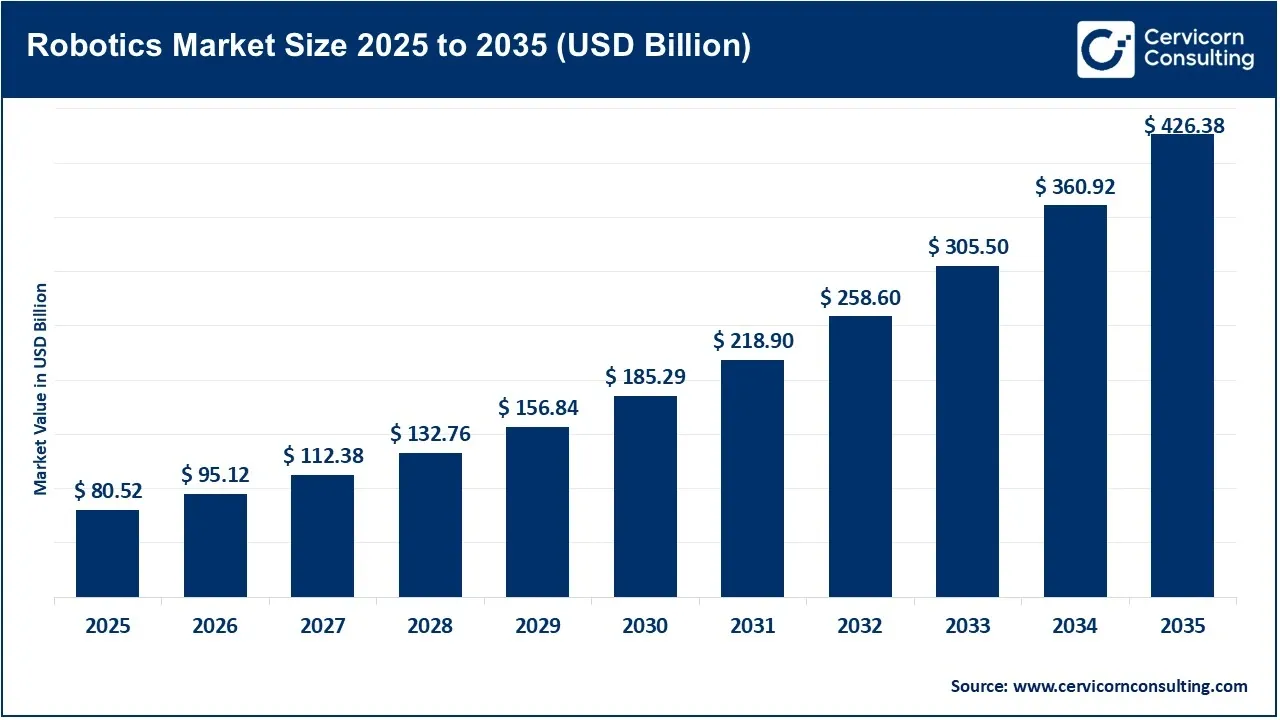
The global robotics market size was valued at USD 80.52 billion in 2025, expected to reach at USD 426.38 billion by 2035. The market is observed to grow at a CAGR of 18.14% during the forecast period from 2026 to 2035. Advancements in artificial intelligence, machine learning, computer vision, and sensor technologies are enabling the development of more intelligent, autonomous, and collaborative robots capable of performing complex tasks in manufacturing, healthcare, logistics, agriculture, and service applications.
Report Highlights
- By region: Asia Pacific dominated the robotics market in 2025, driven by strong manufacturing capabilities, high industrial robot installations, and significant investments in smart factories, semiconductors, and electric vehicles.
- By region: North America is expected to be the fastest-growing regional market, driven by accelerating investments in AI-powered robotics, advanced manufacturing automation, reshoring initiatives, and increasing adoption across logistics, healthcare, and industrial sectors.
- By robot type: Industrial robots dominated the robotics market in 2025, driven by widespread adoption across automotive, electronics, metal fabrication, and machinery manufacturing for high-speed, precise, and repetitive operations.
- By robot type: Collaborative robots are expected to witness the fastest growth, supported by increasing demand for flexible automation, SME adoption, and AI-powered human-robot collaboration.
- By component: Hardware dominated the market in 2025, owing to strong demand for robotic arms, sensors, actuators, controllers, cameras, and other essential robotic system components.
- By component: Services emerged as the second-largest segment and are expected to grow significantly, driven by rising demand for robot integration, maintenance, consulting, lifecycle management, and robotics-as-a-service (RaaS).
- By application: Logistics and warehousing dominated the market in 2025, supported by rapid e-commerce expansion, warehouse automation, autonomous mobile robots (AMRs), and increasing demand for faster order fulfillment.
- By application: Medical and surgical is expected to witness the fastest growth, owing to increasing adoption of robotic-assisted surgeries, rehabilitation robots, and healthcare automation.
- By end use: Automotive dominated the market in 2025, fueled by extensive robot deployment for welding, painting, assembly, inspection, and growing investments in electric vehicle manufacturing.
- By end use: Electronics and semiconductor emerged as the second-largest end-use segment, supported by expanding semiconductor fabrication, precision manufacturing, and growing automation in chip production.
What is the Robotics Market?
The robotics market represents the design, manufacture, integration and deployment of robotic systems that can automate or semi-automate tasks in various industrial, commercial and consumer settings. The market includes a broad spectrum of products including industrial robots, collaborative robots (cobots), autonomous mobile robots (AMRs), medical robots, service robots, humanoid robots, and a suite of supporting technologies such as artificial intelligence (AI), machine learning, computer vision, sensors, robotic operating software and cloud-based automation platforms.
The robotics market is serving various end-use industries such as automotive, electronics, healthcare, logistics, agriculture, retail, food & beverage, aerospace and defense where robotics is deployed for increased productivity, accuracy, operational cost savings and addressing labor shortages. Further aided by the advances in AI-driven automation, Industry 4.0 concepts, adoption of intelligent robots in manufacturing and service sectors, the global robotics market is growing significantly.
Robotics Market Key Manufacturing & Production Statistics
- Around 542,000 industrial robot units were installed globally in 2024, the second highest ever. For four years in a row, the number of annual installations remained over 500,000 units globally.
- Asia made up the vast majority of robot installations globally in 2024, with 74% of all global robot installations. The share of Europe and the Americas was 16% and 9% respectively.
- China remained the biggest industrial robot market globally and it installed about 295,000 units in 2024 (54% of the total industrial robot units sold globally) China is also the largest installed base for robots, exceeding 2.02 million installed robots in 2024.
- 57% of robots installed in the Chinese market were produced by Chinese robot manufacturers in 2024, making them more significant than those from foreign manufacturers for the first time in China's robot market.
- As a large market for industrial robotics, Japan installed 44,500 units in 2024. Japan remained one of the largest manufacturers and exporters of industrial robots.
- With some 30,600 installed units in 2024, South Korea remains one of the largest robot markets globally and boasts the highest robot density in the world (1,220 robots per 10,000 employees in manufacturing).
- The United States installed 34,200 units, accounting for 68% of total installations in the Americas and has an extensive use of robots in automation of manufacturing facilities across key sectors including automotive, logistics, electronics and food.
- Europe saw about 85,000 installations in 2024, making it the second-largest robotics market globally, though it declined from last year's 95,000 robot installations in the region. Germany alone contributed about 32% of Europe’s total robot installations with its 26,982 installed units in 2024.
- The country that recorded the highest annual growth in robot installations was India, with 9,120 installations in 2024, up 7% year-on-year. India is now the sixth largest industrial robot installer in the world, with robot applications primarily within the automotive industry.
Top Global Startups in Robotics (2026 Analysis)
| Startup |
Headquarters |
Core Focus |
Flagship Product/Technology |
Key End-use Industries |
| Figure AI |
United States |
Humanoid Robotics |
Figure 02 humanoid robot with Helix AI |
Manufacturing, Warehousing, Logistics |
| Apptronik |
United States |
Humanoid Robotics |
Apollo humanoid robot |
Manufacturing, Healthcare, Logistics |
| Agility Robotics |
United States |
Bipedal Humanoid Robots |
Digit autonomous robot |
Warehousing, E-commerce, Distribution |
| 1X Technologies |
Norway |
AI-powered Humanoid Robots |
NEO and EVE robots |
Home Assistance, Security, Commercial Services |
| NEURA Robotics |
Germany |
Cognitive & Collaborative Robotics |
MAiRA cognitive robot and 4NE-1 humanoid |
Industrial Automation, Manufacturing |
| Skild AI |
United States |
Robotics Foundation Models |
Skild Brain for autonomous robots |
Multi-industry Robotics, Automation |
| Physical Intelligence (π) |
United States |
AI Foundation Models for Robots |
π0 Robot Foundation Model |
Manufacturing, Logistics, Consumer Robotics |
| Unitree Robotics |
China |
Quadruped & Humanoid Robotics |
G1 humanoid, Go2 and B2 quadruped robots |
Research, Industrial Inspection, Education |
Market Dynamics
Driver
Growing Demand for Automation Across Industries
The growing trend of automation is the significant catalyst for the robotics market in the manufacturing, logistics, healthcare, agriculture, and commercial industries. As organizations leverage robotics solutions for automation to streamline workflow processes, increase production accuracy, decrease labor dependency, and lower overall expenses.
To meet the demands for increased production speeds, enhanced work safety, and reliable quality standards, many industries are integrating the usage of industrial robots, collaborative robots (cobots) and autonomous mobile robots (AMRs). Besides, the growth of Industry 4.0 and smart manufacturing techniques is also fostering the integration of robotics technologies in different applications.
Restraint
High Initial Investment and Integration Complexity
However, although the technology has matured, the high prices of robotic equipment, their implementation, maintenance and workforce training represent the major obstacle for market development. For SMEs that frequently do not have sufficient capital, robotic applications may prove too complex to be implemented with current production technologies, cybersecurity problems and issues involving workforce expertise and ongoing software updates may present additional constraints for their adoption.
Opportunity
Increasing Adoption of AI-Powered and Humanoid Robots
Emerging technologies such as artificial intelligence, machine learning and advanced perception technology have driven tremendous growth in the robotics market. Robots equipped with AI are getting smarter, able to learn and adapt and perform sophisticated tasks in different environments. The rising investments in foundation AI models, humanoid and autonomous robots is expected to pave way for new applications and technologies to revolutionize areas including manufacturing, services, healthcare and logistics.
Regional Analysis
What Made Asia Pacific Dominate Robotics Market in 2025?
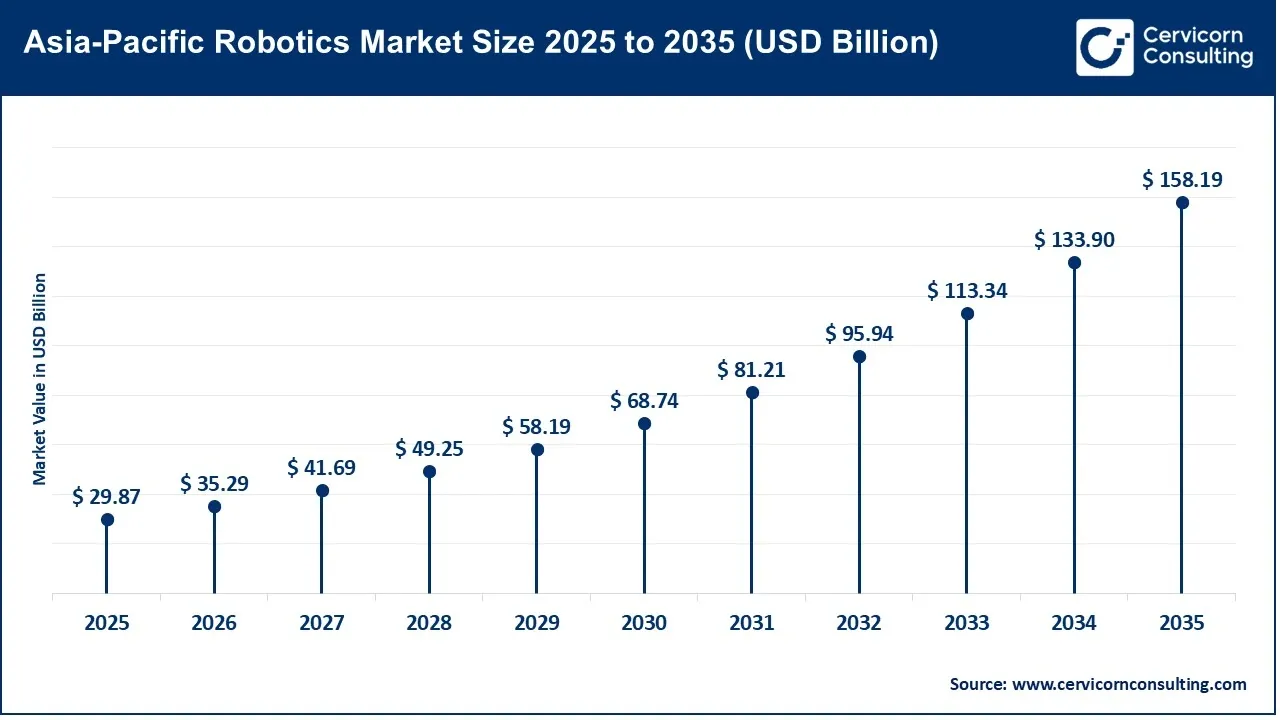
The Asia-Pacific robotics market size was valued at USD 29.87 billion in 2025 and is projected to surpass USD 158.19 billion by 2035. Asia Pacific held the largest market share in 2025 owing to the established manufacturing infrastructure, growing robot density, and strong concentration of top robot manufacturers like FANUC Corporation, Yaskawa Electric Corporation, Omron Corporation, and Kawasaki Heavy Industries. China, Japan, and South Korea dominate industrial robot adoption as manufacturers in industries like automotive, consumer goods, semiconductor, and electronics employ robots extensively for their vast production output.
- China has been the largest buyer of industrial robots globally for the past many years as companies increasingly turn to automation on their production floors to enhance productivity and cope up with increasing labor wages.
- Japan has the largest share in robot innovations and exports while South Korea is home to some of the highest density robots in its manufacturing operations.
Also, initiatives by respective governments for Industry 4.0, Smart factories, AI integration and support to domestic robotics innovations along with increasing investments in semiconductor fabrication plants and electric vehicle production are predicted to help the region dominate the robotics market during the entire forecasting period.
Top Asian Countries in Robotics Market
- China: China is the largest market for robots in Asia, thanks to wide industrial automation, proactive government support for advanced manufacturing, and high robot installation in the automotive, electronics, battery and semiconductor manufacturing industries.
- Japan: Japan is a world leader in robot development and manufacturing and has the world's largest robot manufacturer and one of the few major robotics companies, including FANUC, Yaskawa Electric, Kawasaki Heavy Industries, and Omron. The company dominates industrial robots, collaborative robots, service robots, and precision automation.
- South Korea: With the world's highest robot density in the manufacturing sector, South Korea's electronics, auto and semiconductor industries are well established, the Korean government is accelerating the robotics market through the promotion of artificial intelligence, intelligent factories and new generation robotics.
- India: India's growth potential is spurred by automation in the automotive, pharmaceutical, food processing, and warehousing industries, with the government pushing the manufacturing sector toward Make in India and smart manufacturing investments, helping to boost robotic installations.
- Singapore: The country has actively invested in AI, medical robots, automated warehousing and smart cities to build an advanced robotic ecosystem, especially in service robots and automated vehicles as a leading hub in Asia.
- Taiwan: The number of robots is growing in semiconductors, electronics, and smart manufacturing in Taiwan. As a global leader in chip manufacturing, Taiwan sees increased robot automation needs and visual inspection for complex chip designs.
North America Robotics Market Analysis
The North America robotics market size was estimated at USD 21.26 billion in 2025 and is anticipated to hit USD 112.56 billion by 2035. The North America region is expected to be the fastest-growing segment during the study period due to significant investments being made in Artificial Intelligence (AI), autonomous robotics and advanced manufacturing technologies. There is increased implementation of collaborative robots, autonomous mobile robots (AMRs), warehouse automation solutions and humanoid robots based on AI across several industries in North America including logistics, healthcare, defense, manufacturing, and so on.
- United States has developed into a global hotspot for robotics innovations, driven by technology giants and innovative robotics companies including Boston Dynamics, Intuitive Surgical, NVIDIA, Tesla, Figure AI, Agility Robotics, along with considerable venture capital funding being provided to robotics startups.
Increased proliferation of e-commerce, rise in the labour shortage problem and expanding need for intelligent warehouse automation have led to greater adoption of robotics technologies in distribution centres. Moreover, support from governments for domestic production of semiconductor chip and an increase in defense modernization initiatives along with growth in AI research programs would result in massive growth potential for robotics market in North America.
Segmental Analysis
Robot Type Analysis
The industrial robots segment held the highest share of the robotics market in 2025 owing to extensive adoption in manufacturing sector, including automotive, electronics, metal fabrication, and machinery production industries. Industrial robots dominate robot type in the market due to their high speed, precision, and ability to perform repetitive tasks such as welding, assembly, painting, material handling, and packaging.
Growth in smart manufacturing, factory automation, and Industry 4.0 transformation has prompted manufacturers to adopt robots in their operations to improve production efficiency, reduce operating expenses and increase product quality.
Automotive is one of the largest industries to adopt industrial robots for assembling, welding, and handling automotive parts.
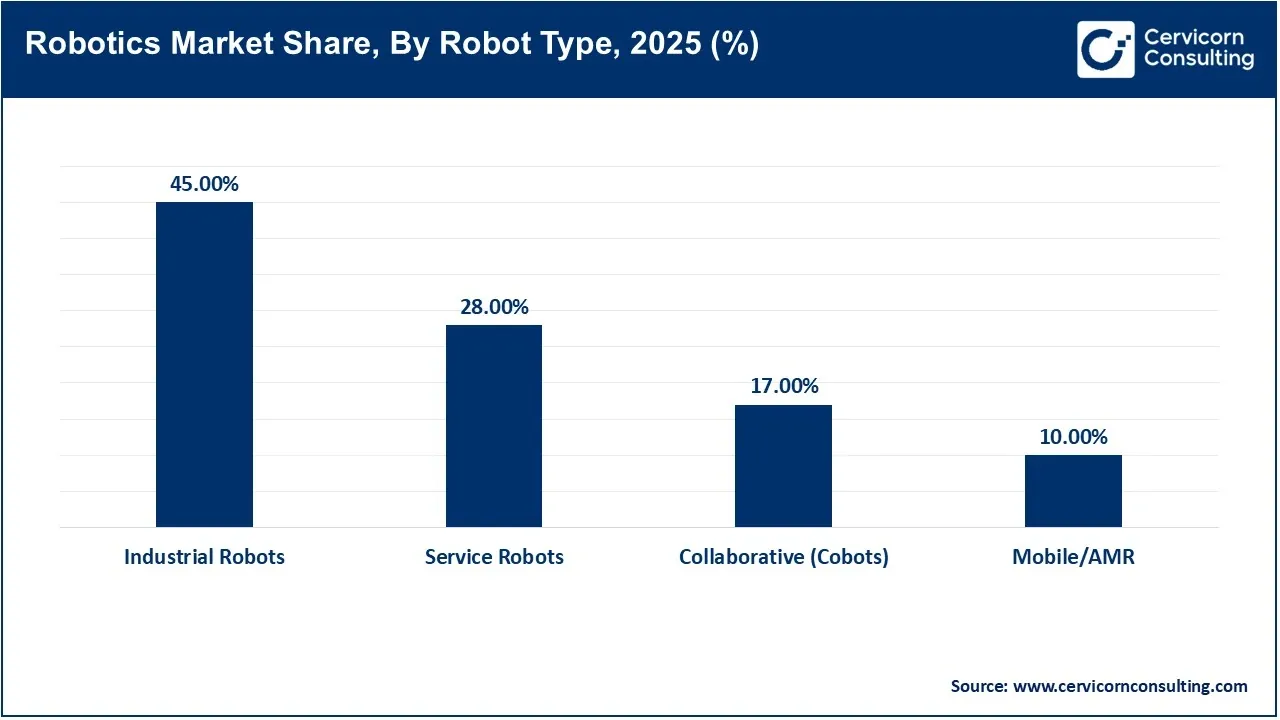
The collaborative robots segment is anticipated to grow at a fastest rate due to demand for flexible automation in close proximity to human operators. Cobots are ideal for Small and medium sized enterprises(SMEs) due to low implementation cost and size and supports various operations like assembly, inspection, packaging, machine tending, and healthcare without the need for substantial changes in infrastructure.
Development of technologies such as machine learning, AI, machine vision and sensor technology enhanced efficiency and applicability of collaborative robots in the end-use industry and is projected to fuel demand for the collaborative robots over the projected time frame.
Component Analysis
In 2025, the hardware segment constituted the largest share of the robotics market, due to the increased demand for components such as robotic arms, controllers, sensors, actuators, cameras and other components necessary to operate robotic systems. Robotics hardware components hold significant importance as more companies seek to equip robots with higher functionality to boost operational productivity, accuracy, and robustness. The adoption of industrial, autonomous mobile and human robot systems has expanded the use of advanced hardware components, including high-end sensors and motion-control system.
Robotics Market Share, By Component, 2025 (%)
| Component |
Revenue Share, 2025 (%) |
| Hardware |
62% |
| Software |
22% |
| Services |
16% |
The services segment saw significant expansion as robotic companies witnessed rising demand for robot installation, repair, integration, consulting, maintenance, and robot lifecycle management services.
Due to the high number of companies investing in robotics and automating their business processes, they need the expertise to efficiently deploy, maintain and operate these sophisticated robotics systems. The trend towards Robotics-as-a-Service (RaaS) model is boosting the growth of the services sector.
Application Analysis
The logistics and warehousing sector led the robotics market in 2025 driven by increasing e-commerce growth, high demand for warehouse automation, and an ever-increasing need for faster order fulfillment. Companies are widely adopting AMRs, robotic picking systems and automated sorting solutions for better inventory management, lower operating expenses and improved supply chain performance. The widespread adoption of robotics in logistics operations is also boosted by a growing scarcity of manual labor and increasing consumer demand for fast deliveries.
Robotics Market Share, By Application, 2025 (%)
| Application |
Revenue Share, 2025 (%) |
| Manufacturing & Assembly |
24% |
| Logistics & Warehousing |
36% |
| Medical & Surgical |
16% |
| Defense & Security |
8% |
| Inspection & Maintenance |
12% |
| Cleaning & Sanitation |
4% |
The medical and surgical sector is also expected to witness a strong growth as usage of robotic assisted surgery, rehabilitation robots and advanced automation systems rise across the healthcare sector. Robotic systems are enabling surgeons to perform highly precise, minimally invasive procedures and lead to enhanced patient outcomes. Growing healthcare investments, an aging demographic, and rapid advancements in medical robotics are major factors that contribute to its growth.
End-use Analysis
In 2025, the automotive sector accounted for the largest share in the robotics market, driven by the early and widespread deployment of robotic technology for the vehicle production. In the automotive sector, manufacturers widely utilize robots for various processes such as welding, painting, assembling, handling, inspection, and transporting to optimize productivity, ensure consistent quality. The rapid switch towards EVs and heavy investment in the development of battery manufacturing plants are also boosting robotics deployment in the automotive sector.
Robotics Market Share, By End-use Industry, 2025 (%)
| End-use Industry |
Revenue Share, 2025 (%) |
| Automotive |
29% |
| Electronics & Semiconductor |
25% |
| Food & Beverages |
12% |
| Healthcare Providers |
14% |
| Military & Defense |
11% |
| Others |
9% |
In 2025, the electronics and semiconductor sector also emerged as another significant end-user industry for robots as there is increasing demand for higher levels of precision in electronics manufacturing process. The application of robotics for the fabrication of semiconductors, wafer handling, component mounting, testing, and inspection activities are rapidly increasing. Expanding semiconductor production capabilities and growing demand for technologically advanced chips will support robotics market growth in the electronics and semiconductor sector.
Competitive Landscape
| Company |
Headquarters |
Key Contribution to Robotics Market |
| ABB Ltd. |
Switzerland |
ABB is a leading robotics and automation company offering industrial robots, collaborative robots, robotic software, and digital solutions for manufacturing, logistics, and process industries. |
| FANUC Corporation |
Japan |
FANUC is one of the world's largest industrial robotics manufacturers, providing factory automation solutions, robotic arms, CNC systems, and AI-enabled manufacturing technologies. |
| KUKA AG |
Germany |
KUKA specializes in industrial robots, collaborative robots, autonomous mobile robots, and intelligent automation solutions for automotive, healthcare, and manufacturing applications. |
| Yaskawa Electric Corporation |
Japan |
Yaskawa develops Motoman industrial robots, collaborative robots, motion control systems, and automation solutions widely used in welding, assembly, and material handling. |
| Universal Robots A/S |
Denmark |
Universal Robots is a pioneer in collaborative robotics, offering flexible and user-friendly robotic arms designed to support automation among small and medium-sized enterprises. |
| Omron Corporation |
Japan |
Omron provides industrial robots, autonomous mobile robots, machine vision systems, and integrated automation platforms for smart manufacturing and logistics applications. |
| Teradyne Inc. |
United States |
Teradyne operates in robotics through Universal Robots and Mobile Industrial Robots (MiR), focusing on collaborative robots and autonomous mobile robotics solutions. |
| Intuitive Surgical, Inc. |
United States |
Intuitive Surgical is a leading healthcare robotics company known for its da Vinci robotic surgical systems that improve precision and minimally invasive procedures. |
| Boston Dynamics, Inc. |
United States |
Boston Dynamics develops advanced mobile and humanoid robots, including Spot and Atlas, focused on autonomous mobility, inspection, and complex robotic applications. |
| Siemens AG |
Germany |
Siemens integrates robotics with industrial automation, digital twins, industrial software, and smart factory technologies to support Industry 4.0 transformation. |
Recent News
- July 2026 –Hyundai Motor Group announced plans to make Boston Dynamics a fully owned subsidiary by acquiring SoftBank’s remaining stake, strengthening its focus on humanoid robots, autonomous systems, and AI-driven manufacturing automation.
- July 2026 –Blackstone invested in South Korean robotics supplier Futronic, which develops high-precision actuators used in automotive and industrial robotics, highlighting increasing investment in critical robotics components.
Segments Covered
By Robot Type
- Industrial Robots
- Service Robots
- Collaborative (Cobots)
- Mobile/AMR
By Component
- Hardware
- Software
- Services
By Application
- Manufacturing & Assembly
- Logistics & Warehousing
- Medical & Surgical
- Defense & Security
- Inspection & Maintenance
- Cleaning & Sanitation
By End-use Industry
- Automotive
- Electronics & Semiconductor
- Food & Beverages
- Healthcare Providers
- Military & Defense
- Others
By Region
- North America
- Europe
- Asia Pacific
- Latin America
- Middle East & Africa