Physical AI Market Size, Growth, Forecast 2026 to 2035
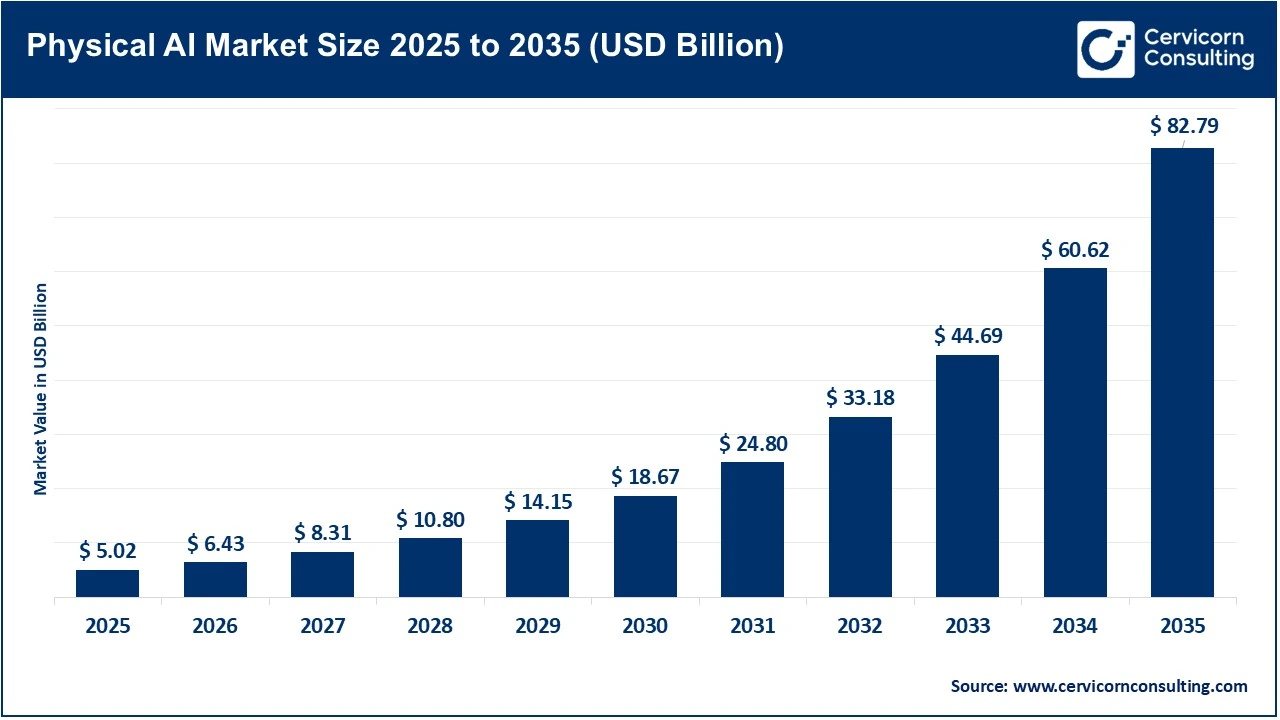
The global physical AI market size was estimated at USD 5.02 billion in 2025 and is expected to be worth around USD 82.79 billion by 2035, registering a compound annual growth rate (CAGR) of 32.8% over the forecast period 2026 to 2035. The physical AI market growth is driven by rapid advancements in robotics, sensors, and AI models, enabling machines to perceive, learn, and act in the physical world. The increasing demand for automation across industries, especially in manufacturing, logistics, and healthcare, is a key factor. For example, over 70% of global manufacturers plan to boost investments in robotics and AI-driven automation to address labor shortages and improve efficiency. In healthcare, robotic surgeries are expected to grow at a double-digit annual rate as AI-enabled systems offer greater precision and better patient outcomes. Similarly, logistics companies are deploying embodied AI robots to cut last-mile delivery costs, which can make up to 53% of total shipping expenses.
Another important driver is the rising acceptance of collaborative robots (cobots) and humanoid systems designed to work alongside people. Cobot adoption alone is projected to have a CAGR of over 20% through 2034, as small- and medium-sized enterprises adopt more cost-effective automation solutions. Moreover, advancements in computer vision, reinforcement learning, and natural language processing are enhancing robots' ability to operate more flexibly in various environments. Governments across Asia, Europe, and North America are actively encouraging the adoption of smart manufacturing and robotics through different initiatives. Collectively, these developments create a strong opportunity for Physical AI to establish itself within the transformative technology landscape across multiple sectors.
Report Highlights
- By Region, North America captured highest revenue share of 40.6% in 2025, supported by early technology adoption, strong R&D investments, and a mature ecosystem of AI hardware manufacturers.
- By Region, the Asia-Pacific region emerged as the fastest-growing market in 2025, holding a 30.6% share, fueled by rapid industrialization, government incentives for AI adoption, and expansion of robotics in countries like China, Japan, and South Korea.
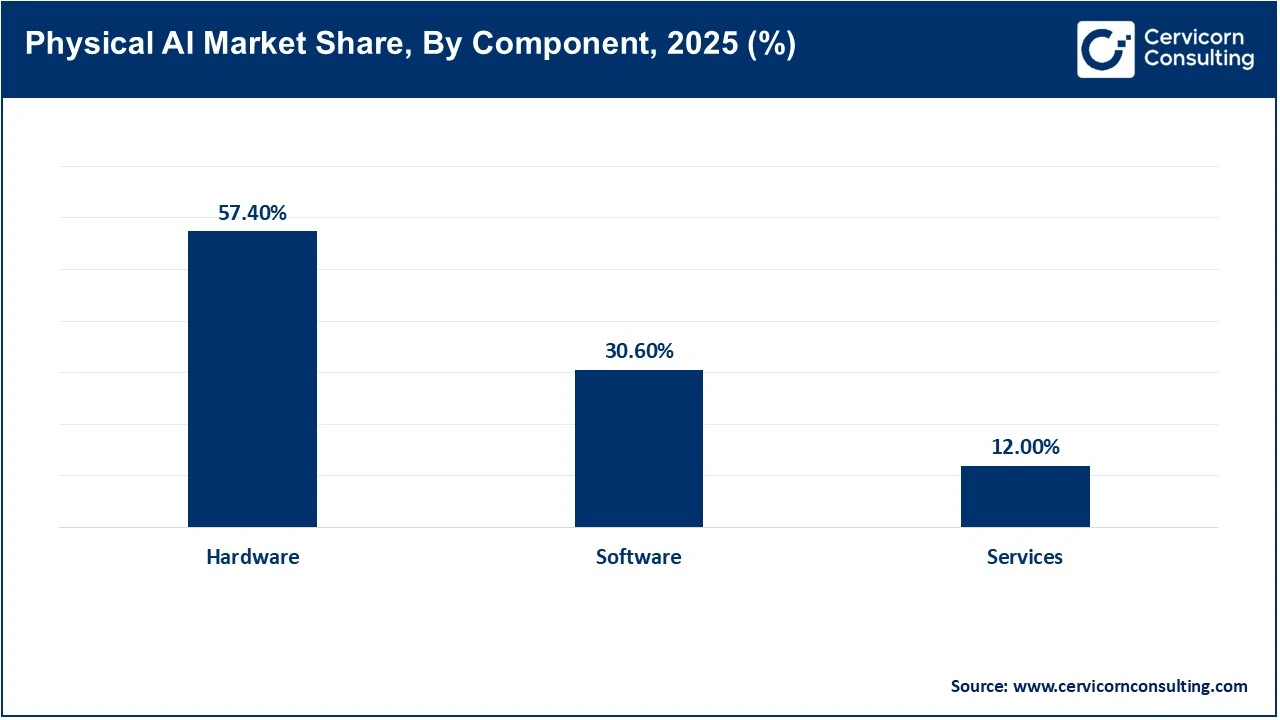
- By Component, the hardware segment dominated market in 2025, accounting for 57.4% of total revenue, driven by the growing demand for sensors, processors, and embedded systems in robotics and intelligent machines.
- By Robot Type, the industrial robots represented the dominant segment in 2025, capturing 38.6% of market revenue, as factories increasingly adopt AI-powered automation for precision manufacturing and cost efficiency.
- By Application, the manufacturing & automotive segment has accounted highest market share of 23.1% in 2025, driven by widespread deployment of intelligent robotics for assembly, quality control, and supply chain optimization.
- By Application, the healthcare segment was the fastest-growing in 2025, supported by rising investments in surgical robotics, AI-assisted diagnostics, and elder care automation.
- By Deployment, the cloud-Based AI segment emerged as the fastest-growing, driven by its scalability, real-time data access, and ability to support complex AI models in connected robotic systems.
- By Technology, the computer vision segment has generated revenue share of 42.4% in 2025.
What is the Physical AI?
Physical AI refers to artificial intelligence embedded in machines, robots, or devices capable of interacting with the physical environment. Physical AI is different from traditional AI based systems that exist only in software. Physical AI combines perception (sensors, cameras, microphones), cognition (AI models for learning and reasoning), and action (motors, actuators, robotic limbs) to sense, decide, and act within physical environments. In this case, machines can not only process information, but they can move, manipulate, and adapt in human environments.
The application of Physical AI spans multiple industries, including using humanoid robots to interact with customers, surgical robots for procedures, autonomous mobile robots in warehouses, and collaborative robots (cobots) in factories. Researchers are also exploring biologically inspired systems, such as soft robotics and artificial muscles, which allow machines to demonstrate human-like movement flexibility. In summary, Physical AI represents the cutting edge of AI, robotics, and materials science, with the aim of creating intelligent systems that can work with humans and operate effectively in complex and dynamic physical environments.
Here are some recent developments in the Physical AI
| Development |
Key Details |
Implications |
| Apptronik raises USD 350M to scale humanoid robots (“Apollo”) |
Funding round led by B Capital and Capital Factory, with participation from Google. The focus is to deploy Apollo robots in warehouses, manufacturing, elder care, healthcare. |
Signals strong investor confidence; move from prototype toward commercial deployment. Expanding sectors like elder care show broader applications. |
| OpenAI amps up robotics & humanoid research |
Hiring researchers in humanoid systems, using simulation and teleoperation, working on physical control AI. |
Shows that AGI / general intelligence efforts are reconnecting to physical agents. More resources being devoted to training AI that can operate in real, messy physical environments. |
| Ant Group unveils humanoid robot “R1” |
Demonstrated tasks like cooking shrimp; use-cases envisioned in healthcare, tourism, companionship, guides. Slow movement in early demos. No pricing yet. |
Entry of new big players (tech & finance firms) into humanoid robots. Focus on everyday tasks & public-facing roles (not just industry) indicates expanding use-cases. |
| SEER Robotics showcases new controllers & robots |
Debuted products like the SRC-5000 embodied intelligent controller (for full body control), wheeled humanoid robot, quadruped robot dog, etc. |
Advances in hardware + embodied control systems. The controllers that can integrate perception, motion, and multi-body coordination are enabling more flexible, adaptable robotics. |
| EngineAI’s new humanoid and quadruped robots |
PM01 humanoid with autonomous fall recovery, fluid movements; T800 full-size heavy duty humanoid; JS01 quadruped robot for rugged terrain; SA02 for enthusiasts. |
Expanding variety of robot types: from rugged outdoor / industrial to lighter versions for hobbyists. Demonstrates increasing sophistication in mobility and sensing. |
| Google DeepMind’s Gemini Robotics / Vision-Language-Action Models |
Models like “Gemini Robotics”, “Vision-Language-Action” applied to robotics to improve reasoning, generalization, task adaptability. On-device versions emerging. |
Trends toward combining foundation models (language + vision) with embodied control. Helps robots understand instructions, adapt to new environments or tasks. |
Physical AI Market Trends
Rise of Collaborative Robots (Cobots)
- Collaborative robots (cobots) are increasing in popularity because they can safely work alongside humans. In 2024, global shipments of cobots exceeded 50,000 units, a nearly 14% rise from the previous year. In a survey, over 70% of manufacturers said they plan to adopt cobots to address labor shortages and reduce repetitive strain injuries among workers.
Vision-Language-Action (VLA) Models
- Robots are evolving beyond simple automation to gain a deeper understanding of their environment and the world around them, much like humans do. The robotics team at Google recently demonstrated robots using Vision-Language-Action AI that could follow instructions given naturally, such as "pick up the red mug and put it on the shelf." Studies in academia have shown that these models increase task success rates by 30-40% over traditional rule-based systems, especially in unstructured environments.
Growth of Humanoid and Generalist Robots
- Humanoid robots are no longer simply prototypes—they're beginning to appear in real environments. For example, the Apollo robot from Apptronik is developed for warehousing duties, such as lifting and stacking, and is undergoing trial programs that suggest it could lessen the effort of manual labor by up to 40% in repetitive tasks. The Tesla Optimus humanoid has made strides in dexterity, including folding laundry and lifting up to 20 kilogram weights, indicating improved capability.
Focus on Energy Efficiency and Battery Life
- Power supply remains a robot’s biggest limitation. Currently, humanoids can operate for 1.5 to 2 hours before needing a recharge. Engineers are working on lighter materials and regenerative actuators to extend battery life. Some prototypes have increased operation times by 20–25% by optimizing energy use in motors and joints. Self-charging stations and swappable batteries are also becoming more common to boost uptime.
Physical AI Market Dynamics
Market Drivers
Increasing Adoption of Robotics in Industries
- The accelerating adoption of robotics across manufacturing, logistics, and automotive plants is a core demand driver for the Physical AI market. As robots shift from pre-programmed machines to autonomous, AI-enabled systems, enterprises are investing not only in hardware but also in perception, control, and simulation stacks that define Physical AI.
- Industrial data underline the trend: global factory robot installations reached about 542,000 units in 2024, more than double a decade ago, with Asia leading deployments. IFR International Federation of Robotics This expanding installed base creates a large retrofit opportunity for adding advanced AI to existing robots, while new deployments are increasingly specified with AI-native features from day one.
- Amazon is a clear illustration. The company recently deployed its one-millionth warehouse robot and introduced an AI foundation model to orchestrate its mobile fleets, improving routing, storage density, and worker safety. About Amazon Such at-scale rollouts push demand for Physical AI platforms that can coordinate heterogeneous robots in real time inside variable fulfillment environments.
- Tesla offers a second example from discrete manufacturing. The company is piloting Optimus humanoid robots on production lines and plans to scale deployment across factories, targeting repetitive, ergonomically challenging tasks. Business Insider+1 Bringing humanoids into production requires advanced computer vision, force control, safety, and high-fidelity simulation—precisely the domains where Physical AI vendors compete. As more manufacturers follow this path, capital spending will migrate from standalone robotics projects to integrated Physical AI platforms embedded across the shop floor.
Advancements in AI, Sensors, and Actuator Technologies
- Advances in AI, sensing, and actuator technologies are turning physical AI from fixed automation into adaptive, revenue-generating assets. Modern robots increasingly fuse foundation models, real-time perception, and high-torque, lightweight actuators, allowing them to handle unstructured environments, mixed workloads, and frequent product changeovers. This improves OEE, reduces engineering time for new tasks, and expands the addressable market from automotive lines to logistics, retail, and field operations.
- A clear example is Amazon’s new Vulcan system and the DeepFleet AI model in its fulfillment centers. Vulcan combines vision with force-feedback sensors so robots can “see and feel” items, significantly broadening the SKU range they can handle safely alongside human workers. DeepFleet then optimizes the paths and coordination of a fleet now exceeding one million mobile robots, raising throughput per square foot while containing labor and energy costs.
- Boston Dynamics offers another illustration. Its Spot robots now pair advanced perception, thermal and LiDAR sensors, and agile actuators with agentic AI through a partnership with IFS. This stack enables autonomous inspection of complex industrial sites, automatic anomaly detection, and direct integration into maintenance and asset-management workflows, turning robots into always-on field technicians rather than occasional inspection tools.
- As these capabilities scale, customers increasingly justify deployments on hard ROI—higher uptime, better safety, and data-rich operations—making progress in AI, sensor, and actuator technology a primary growth engine for the physical AI market.
Market Restraints
High Cost of Implementation
- High cost of implementation remains a major restraint in the Physical AI market, particularly as businesses transition from traditional automation to advanced robotic systems with cognitive capabilities. Physical AI requires complex hardware integrations, machine learning models, specialized sensors, and advanced computing infrastructure. These components often involve high upfront investment and long deployment cycles. Beyond the cost of acquiring equipment, organizations face additional spending on customization, workforce training, and maintenance to ensure systems perform reliably in real-world environments. For many industries, especially mid-sized enterprises, these expenses slow adoption and create hesitation around scaling projects beyond pilot phases.
- A significant example is the logistics sector’s adoption of intelligent sorting robots. Companies like DHL have tested autonomous material-handling systems equipped with vision-based AI and precision grippers for e commerce fulfillment. While they offer operational efficiency, implementation across large warehouses demands millions of dollars in infrastructure upgrades, from redesigning layouts to installing high-speed networks. As a result, adoption is often limited to select high-volume facilities rather than full-scale deployment.
- Similarly, hospitals investing in robotic surgical systems face prohibitive costs. Physical AI-enabled surgical robots require advanced imaging modules, real-time analytics, and continuous software upgrades. The purchase price alone can exceed several million dollars, with additional expenses for disposable instruments and mandatory technician support. This financial burden restricts adoption primarily to premium healthcare networks, limiting accessibility for smaller institutions. Consequently, the cost barrier remains a central challenge slowing the broader expansion of Physical AI across industries.
Limited Skilled Workforce
- Limited availability of skilled engineers and technicians is emerging as a major restraint for the Physical AI market. Deploying intelligent robots, autonomous drones, smart manufacturing systems, and AI-driven machines requires a unique blend of expertise in robotics, embedded systems, machine learning, sensor integration, safety compliance, and cyber-physical engineering. However, most labor markets are still dominated by traditionally trained mechanical or electronics engineers, creating a widening gap between industry requirements and available talent. This shortage slows product development cycles, increases operational costs, and forces companies to invest heavily in internal training rather than scaling deployments.
- A clear example of this challenge can be seen in the industrial robotics sector in Japan and South Korea. Several mid-sized manufacturing firms report delays in adopting collaborative robots due to a lack of engineers skilled in programming real-time control systems and configuring AI-powered vision technologies. Although the hardware is available, absence of multidisciplinary talent limits full integration on factory floors, reducing ROI expectations. Another example is from the logistics automation market in the United States. Warehousing companies deploying autonomous material-handling robots face long implementation periods because few technicians understand both robotics maintenance and AI-driven navigation software. As a result, companies are forced to rely on costly support contracts from technology vendors or specialized robotics service firms.
- The growing talent deficit is not only hindering innovation but also inflating costs, creating a significant barrier to scaling Physical AI solutions globally. Addressing this gap will require sustained investments in multi domain education, industry-academia partnerships, and standardized training programs.
Market Opportunities
Growth in Healthcare and Elder Care Robotics
- Rising demand for automation in healthcare and elderly support systems is creating a strong market opportunity for Physical AI solutions. Ageing populations in countries such as Japan, Germany, China, and the United States are driving the need for assistive robots capable of performing physical tasks, reducing dependency on overburdened human caregivers. Physical AI systems with mobility, perception, and decision making abilities are increasingly being used to support daily activities, rehabilitation, medication management, and patient monitoring. This shift enables hospitals, home-care services and assisted living facilities to improve efficiency, reduce labour shortages, and deliver safer patient handling.
- Robots equipped with advanced sensors, dexterous manipulators, and AI-driven motion control enable precise interaction with fragile patients, lowering risks of falls and injuries. These solutions also help address rising healthcare costs by automating repetitive and physically stressful tasks like lifting, transporting supplies, and cleaning.
- For instance, Diligent Robotics’ Moxi, deployed in several U.S. hospitals to automate logistics workflows, including delivery of medical supplies, lab samples, and medications. By reducing routine workload, Moxi allows nurses to focus on core patient care. Another real-world case is Toyota’s Human Support Robot (HSR), used in Japanese elder-care facilities to assist individuals with limited mobility by retrieving objects, helping with daily activities, and interacting through voice and touch commands. These use-cases illustrate how healthcare-focused Physical AI is evolving from pilot programs to mainstream adoption, positioning the sector as a high-growth avenue for robotics innovation.
Expansion in Autonomous Vehicles and Delivery Systems
- The growing adoption of autonomous mobility is becoming a powerful catalyst for Physical AI, particularly in commercial transport and last-mile delivery. As governments and enterprises accelerate automation to reduce labor costs, improve operational safety, and speed up logistics, physical AI solutions that enable autonomous navigation, perception, manipulation, and decision-making are gaining substantial market traction. This transition is creating new revenue streams for robotics firms, sensor manufacturers, and AI platforms that can support scalable fleets of autonomous vehicles and delivery robots.
- Surge in demand for contactless logistics and efficient urban mobility act as a key driver. Retailers, e commerce players, and logistics companies are investing in AI-enabled delivery systems to streamline operations and reduce dependency on human couriers. For example, Nuro, a U.S.-based autonomous delivery startup, has partnered with brands like Kroger and Domino’s to deploy small self-driving vehicles designed for grocery and food delivery. These vehicles operate on public roads, use advanced robotic perception, and decrease delivery time while lowering operational expenses, demonstrating how Physical AI directly leads to commercial efficiency.
- Another significant example is TuSimple, a company developing autonomous trucking solutions for long-haul freight. By integrating powerful Physical AI systems for perception, lane optimization, and real-time route planning, TuSimple has achieved automated highway operations with reduced fuel consumption and improved safety. This illustrates how Physical AI enables business models built around continuous, unmanned operations at industrial scale, particularly in logistics-intensive sectors.
- Overall, expansion in autonomous vehicles and delivery systems is opening high-value markets for Physical AI, rewarding companies that can deliver reliable autonomy, cost optimization, and seamless integration into transport ecosystems.
Market Challenges
Safety and Regulatory Concerns
- Safety and regulatory concerns have become one of the most persistent challenges in the Physical AI market, shaping both product development and commercialization strategies. Physical AI systems—such as autonomous robots, humanoids, industrial cobots, and AI-powered devices—interact directly with humans and real-world environments. This raises strict expectations around operational safety, liability, and ethical control. Meeting these requirements significantly slows deployment timelines and increases compliance costs, especially in industries with high-risk standards such as manufacturing, aviation, healthcare, and mobility.
- A major issue is the absence of consistent global regulation. Companies must navigate differing policies across countries regarding machine behavior, data collection through sensors, and autonomy levels. Safety certifications also require extensive testing to avoid physical injury or system malfunctions. As these systems learn in real time, regulators face difficulty in defining “acceptable risk,” further delaying approvals.
- For example, Waymo’s autonomous driving solutions faced safety scrutiny after incidents during testing phases in the U.S. Regulators demanded deeper validation of decision-making algorithms, pushing the company to scale back pilot programs until compliance improved. Similarly, Intuitive Surgical, a leader in robotic surgery, has faced regulatory delays due to concerns over surgical accuracy, device malfunctions, and post-operative risks. These cases highlight how achieving regulatory trust demands continuous investment, extensive testing, and long-term safety assurance, slowing broader Physical AI adoption across sectors.
Ethical and Social Implications
- Ethical and social implications represent a growing challenge in the Physical AI market as organizations face mounting scrutiny over how intelligent machines interact with humans, manage data, and impact the workforce. Physical AI systems—ranging from autonomous robots to AI-powered industrial machines— operate in real-world environments, which means their decisions can directly influence safety, privacy, and employment.
- A key concern is accountability. When a robot makes an autonomous decision that leads to harm or bias, it is often unclear who should be held responsible—the developer, the manufacturer, or the user. This lack of clarity complicates product deployment and increases regulatory pressure. In addition, data usage by Physical AI solutions raises privacy issues, particularly when robots collect and analyze personal or environmental data in workplaces, factories, hospitals, or public spaces.
- For instance, SoftBank Robotics’ Pepper robot, deployed in retail and healthcare environments, has raised privacy and consent concerns due to its ability to record interactions and analyze customer behaviors. Several institutions paused deployments until data storage and usage policies were clarified, indicating how ethical doubts can restrict adoption.
- Similarly, Waymo’s autonomous delivery and mobility services have faced public resistance due to concerns over safety, job displacement for drivers, and the opacity of decision-making algorithms. Community pushback has slowed expansion in certain regions, despite proven technical capabilities.
- These examples highlight that ethical and social questions are not just philosophical debates but real barriers affecting market growth, acceptance, and regulatory compliance in the Physical AI landscape.
Physical AI Market Regional Analysis
The physical AI market is segmented into various regions, including North America, Europe, Asia-Pacific, and LAMEA. Here is a brief overview of each region:
North America: Innovation Powerhouse Driving Global AI Leadership
The North America physical AI market size was estimated at USD 2.04 billion in 2025 and is predicted to surpass around USD 31.84 billion by 2035, reflecting a CAGR of 32.1% from 2026 to 2035.
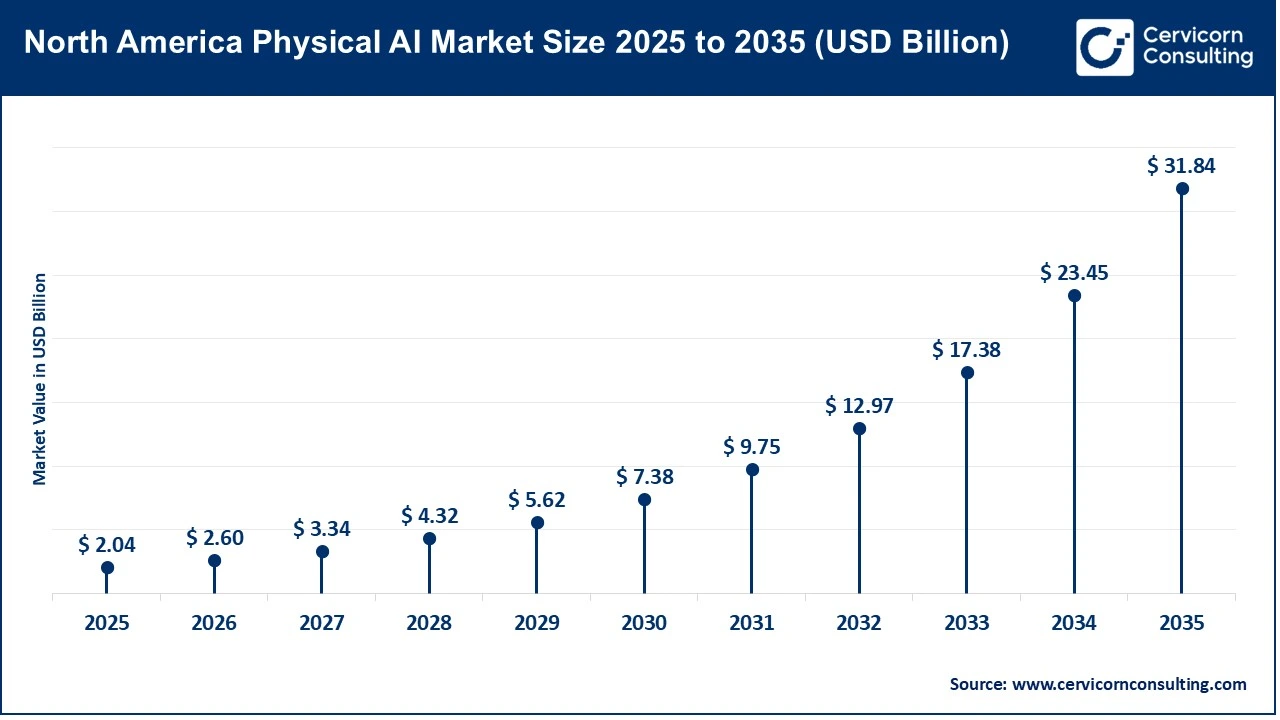
North America leads the market, driven by robust infrastructure, substantial R&D investments, and early adoption across sectors like manufacturing, healthcare, and defense. The U.S. is home to major AI innovators such as IBM, Microsoft, and NVIDIA, contributing to its market dominance. Canada is also emerging as a significant player; for instance, Canadian AI startup Cohere has expanded into Europe with the opening of a new office in Paris, aiming to increase its market share amid growing regional demand for AI services. This move aligns with French President Emmanuel Macron’s initiative to establish France as a European AI hub to strengthen digital sovereignty.
Physical AI Market Revenue, By Region, 2024 to 2026 (US$ Mn)
| Region |
2024 |
2025 |
2026 |
| North America |
1,612.7 |
2,041.1 |
2,602.1 |
| Europe |
932.4 |
1,183.1 |
1,512.3 |
| Asia-Pacific |
1,191.4 |
1,536.4 |
1,995.7 |
| LAMEA |
209.1 |
260.6 |
326.7 |
Asia-Pacific (APAC): Rapid Growth Fueled by Industrialization and Government Initiatives
The Asia-Pacific physical AI market size reached at USD 1.53 billion in 2025 and is forecast to expand around USD 28.91 billion by 2035, accelerating a CAGR of 34.6% from 2026 to 2035. The APAC region is experiencing rapid growth in the market, fueled by industrialization, government-backed robotics initiatives, and expanding manufacturing hubs in countries like China, Japan, and South Korea. China is heavily investing in AI and robotics for smarter manufacturing and the automation of public services. Japan leads in developing humanoid and care robots for the elderly, while South Korea focuses on integrating AI into various sectors.
Europe: Strategic Policy-Driven Growth with Emphasis on Ethical AI
The Europe physical AI market size was recorded at USD 1.18 billion in 2025 and is predicted to surpass around USD 18.94 billion by 2035, registering a CAGR of 32.4% from 2026 to 2035.. Europe is witnessing significant advancements, supported by strategic policies and investments in digital transformation. The European Union emphasizes ethical AI development, ensuring data privacy and regulatory compliance. Recent developments include the opening of a new office by Canadian AI startup Cohere in Paris, aiming to increase its market share amid growing regional demand for AI services. This move aligns with French President Emmanuel Macron’s initiative to establish France as a European AI hub to strengthen digital sovereignty.
Latin America, Middle East, and Africa (LAMEA): Emerging Market with High Growth Potential
The LAMEA physical AI market was valued at USD 260.6 million in 2025 and is anticipated to reach around USD 3.08 billion by 2035 with a CAGR of 28.3% from 2026 to 2035. The LAMEA region is experiencing rapid growth in the market, driven by increasing adoption in sectors like healthcare, agriculture, and manufacturing, supported by emerging digital transformation strategies. Countries such as Brazil, South Africa, and the UAE are investing in AI technologies to enhance industrial automation and improve public services. In Saudi Arabia, a partnership between Edarat and KPMG aims to accelerate AI adoption across the Kingdom, leveraging data center infrastructure and AI expertise to implement scalable and secure AI solutions.
Physical AI Market Segmental Analysis
The physical AI market is segmented into component, technology, robot type, application, deployment, and region.
Component Analysis
Hardware: Hardware forms the backbone of Physical AI, comprising sensors, actuators, processors, and embedded systems that enable robots to perceive and act. This segment dominates the market because hardware is mainly the initial investment in manufacturing and industrial automation. Ongoing demand for advanced sensors and high-performance chips drives consistent success in this segment.
Software: Software includes AI algorithms, machine learning models, and control systems that give robots intelligence so they can analyze data, adapt, and make decisions. This is the fastest-growing segment, driven by industry needs for flexible robots capable of functioning in constantly changing real-life situations. Software upgrades support ongoing sales growth for vendors.
Services: Offerings include integration, maintenance, consulting, and training that assist organizations in deploying Physical AI smoothly. Although this market segment is smaller, it rapidly grows to become a crucial factor in reducing adoption barriers and maximizing the advantages of operational AI systems.
Technology Analysis
Computer Vision: Computer vision leads this segment, empowering robots with the ability to “see” and interpret their surroundings. It plays a critical role in tasks like quality inspection, navigation, and object recognition in industries ranging from manufacturing to healthcare.
Speech / NLP: Natural language processing enables robots to understand and respond to voice commands, improving human-robot interaction. It is increasingly adopted in service and social robots to create seamless, natural communication experiences.
Physical AI Market Revenue, By Technology from 2024 to 2026 (US$ Mn)
| Technology |
2024 |
2025 |
2026 |
| Computer Vision |
1,673.5 |
2,127.5 |
2,724.5 |
| Speech / NLP |
862.1 |
1,101.2 |
1,416.8 |
| Gesture / Movement Recognition |
661.2 |
835.0 |
1,062.4 |
| Reinforcement Learning & Control Systems |
597.5 |
768.3 |
995 |
| Others |
151.3 |
189.2 |
238.1 |
Gesture / Movement Recognition: Gesture recognition technology allows robots to interpret human movements, making collaboration safer and more intuitive. It is especially relevant for collaborative robots and assistive devices.
Reinforcement Learning & Control Systems: This is the fastest-growing technology segment, allowing robots to learn autonomously via trial-and-error and adapt to new tasks. It is vital for next-generation adaptive robots in warehouses, autonomous vehicles, and research.
Others (Multi-modal AI, Biomimetic Robotics): These include hybrid AI models and bio-inspired designs, driving innovation in advanced robotics and making machines more capable and efficient.
Robot Type / Form Factor Analysis
Industrial Robots: Industrial robots dominate the market due to their widespread use in automotive, electronics, and general manufacturing. They deliver high precision, speed, and productivity, making them the backbone of industrial automation.
Service Robots: These are deployed in healthcare, hospitality, and retail to assist humans in tasks like cleaning, delivery, or patient support. Their market share is steadily increasing as labor shortages and demand for automation grow.
Humanoids / Social Robots: Humanoid robots are designed to interact with humans in a lifelike way and are gaining adoption in education, research, and customer-facing roles. Their growth is slow but promising.
Physical AI Market Revenue, By Robot Type, 2024 to 2026 (US$ Mn)
| Robot Type |
2024 |
2025 |
2026 |
| Industrial Robots |
1,526.1 |
1,936.5 |
2,475.3 |
| Service Robots |
561.9 |
717.6 |
923.0 |
| Humanoids/Social Robots |
549.0 |
693.7 |
883.1 |
| Cobots |
478.4 |
614.8 |
795.9 |
| Exoskeletons/Prosthetics |
346.8 |
439.4 |
560.6 |
| Mobile Robots/Drones |
483.4 |
619.2 |
798.8 |
Cobots: Collaborative robots are the fastest-growing form factor, allowing safe side-by-side work with humans. Their flexibility, compact size, and affordability make them attractive to small and medium-sized enterprises.
Exoskeletons / Prosthetics: This niche segment helps improve human mobility and rehabilitation outcomes. Growing adoption in healthcare and military sectors is expected to boost demand.
Mobile Robots / Drones: Mobile robots and drones are increasingly used for logistics, agriculture, and security applications. Their ability to autonomously navigate complex environments makes them a rising force in the market.
Application Analysis
Manufacturing & Automotive: This is the largest application segment, where Physical AI is used for welding, assembly, quality inspection, and production line automation. It drives efficiency and cost reduction in highly competitive industries.
Healthcare: Healthcare is the fastest-growing application segment as AI-driven robots are increasingly used for surgeries, rehabilitation, patient monitoring, and eldercare. Aging populations and the need to relieve healthcare staff workload are driving this growth.
Logistics & Warehousing: Robots streamline inventory handling, picking, and order fulfillment, helping e-commerce and supply chains meet rising consumer demand with speed and accuracy.
Physical AI Market Revenue, By Application, 2024 to 2026 (US$ Mn)
| Application |
2024 |
2025 |
2026 |
| Healthcare |
709.6 |
902.2 |
1,155.5 |
| Manufacturing & Automotive |
906.9 |
1,158.0 |
1,489.5 |
| Logistics & Warehousing |
538.6 |
680.5 |
866.1 |
| Retail & Hospitality |
484.3 |
622.5 |
805.9 |
| Defense & Security |
371.8 |
471.0 |
601.1 |
| Agriculture |
313.6 |
401.0 |
516.6 |
| Education & Research |
359.7 |
455.6 |
581.2 |
| Others |
261.2 |
330.4 |
420.8 |
Retail & Hospitality: Robots are improving customer experience by assisting with service, restocking, and cleaning, especially in labor-constrained markets.
Defense & Security: Physical AI plays a critical role in surveillance, bomb disposal, and reconnaissance. The demand is consistent but niche.
Agriculture: Robotics enable precision farming, harvesting, and monitoring, helping farmers boost yields and reduce labor costs.
Education & Research: Robots serve as learning tools for students and as experimental platforms for advancing robotics and AI research.
Others: Specialized uses include space exploration, mining, and entertainment applications, adding diversity to the market landscape.
Deployment Analysis
On-device: On-device deployment dominates because it allows real-time decision-making with low latency and strong data privacy, critical for safety and mission-critical applications.
Physical AI Market Share, By Deployment, 2024 to 2026 (US$ Mn)
| Deployment |
2024 |
2025 |
2026 |
| Cloud-based AI |
1,881.0 |
2,410.1 |
3,110.7 |
| On-device |
2,064.6 |
2,611.1 |
3,326.0 |
Cloud-based AI: This is the fastest-growing deployment mode, offering scalable computing power, centralized updates, and advanced AI training. As connectivity improves, more robots are expected to rely on cloud-based intelligence.
Physical AI Market Top Companies
The physical AI industry is highly competitive, dominated by major technology and robotics companies that focus on integrating advanced AI with physical systems. Key players such as Boston Dynamics, ABB, FANUC, Siemens, NVIDIA, and SoftBank Robotics lead the market through continuous innovation in robotics, machine learning, and automation solutions. These companies invest heavily in R&D to develop intelligent robots capable of autonomous navigation, object recognition, and adaptive decision-making. Additionally, several startups are entering niche segments such as healthcare robotics, collaborative robots (cobots), and exoskeletons, intensifying competition and driving technological advancements. Partnerships, mergers, and acquisitions are common strategies to expand capabilities, geographic reach, and customer bases, with a strong emphasis on developing AI-driven software platforms that enhance robot intelligence and functionality.
Another key competitive factor in the Physical AI market is the growing focus on regional and sector-specific dominance. For instance, North American companies leverage their advanced technology ecosystem and venture funding to dominate industrial and service robotics, while Asia-Pacific players—particularly in Japan, South Korea, and China—are rapidly expanding in manufacturing automation, care robots, and mobility solutions. European firms emphasize ethical AI, regulatory compliance, and precision engineering, targeting healthcare and industrial automation applications. Smaller companies and startups are competing by offering highly specialized solutions, such as AI-powered logistics robots or humanoid service robots, creating pockets of intense innovation. The competitive landscape is thus defined not only by technological capability but also by the ability to adapt to regional needs, regulatory environments, and sector-specific applications, making agility and innovation critical for sustaining market leadership.
Global Perspectives and Future Outlook
Internationally, organizations are recognizing the economic potential of Physical AI. NITI Aayog's report suggests that faster adoption of AI across key industries in India could add between USD 500 billion and USD 600 billion to the country's GDP by 2035, driven by improvements in productivity and workforce efficiency.
In the United States, Goldman Sachs reports a significant discrepancy between the economic impact of artificial intelligence and its reflection in official GDP statistics. Since 2022, AI infrastructure revenue among U.S. companies has surged by USD 400 billion, indicating a significant economic contribution. However, official GDP figures only attribute USD 45 billion (or 0.2% of GDP) of this growth to AI, while Goldman estimates the real impact is closer to USD 160 billion, leaving approximately USD 115 billion unaccounted for in government data.
Market Segmentation
By Component
- Hardware
- Software
- Services
By Technology
- Computer Vision
- Speech / NLP
- Gesture / Movement Recognition
- Reinforcement Learning & Control Systems
- Others (multi-modal AI, biomimetic robotics)
By Robot Type / Form Factor
- Industrial Robots
- Service Robots
- Humanoids/Social Robots
- Cobots
- Exoskeletons/Prosthetics
- Mobile Robots/Drones
By Deployment
By Application
- Healthcare
- Manufacturing & Automotive
- Logistics & Warehousing
- Retail & Hospitality
- Defense & Security
- Agriculture
- Education & Research
- Others
By Region
- North America
- APAC
- Europe
- LAMEA