AI Data Centre Market Size, Growth, Forecast 2026 to 2035
The global AI data centre market size hit roughly USD 5.76 billion in 2025 and is projected to reach USD 25.53 billion by 2035, reflecting a compound annual growth rate (CAGR) of 40.1% from 2026 to 2035. The AI data center market is expanding rapidly due to the increasing adoption of AI-driven technologies across various sectors such as healthcare, retail, finance, and manufacturing.
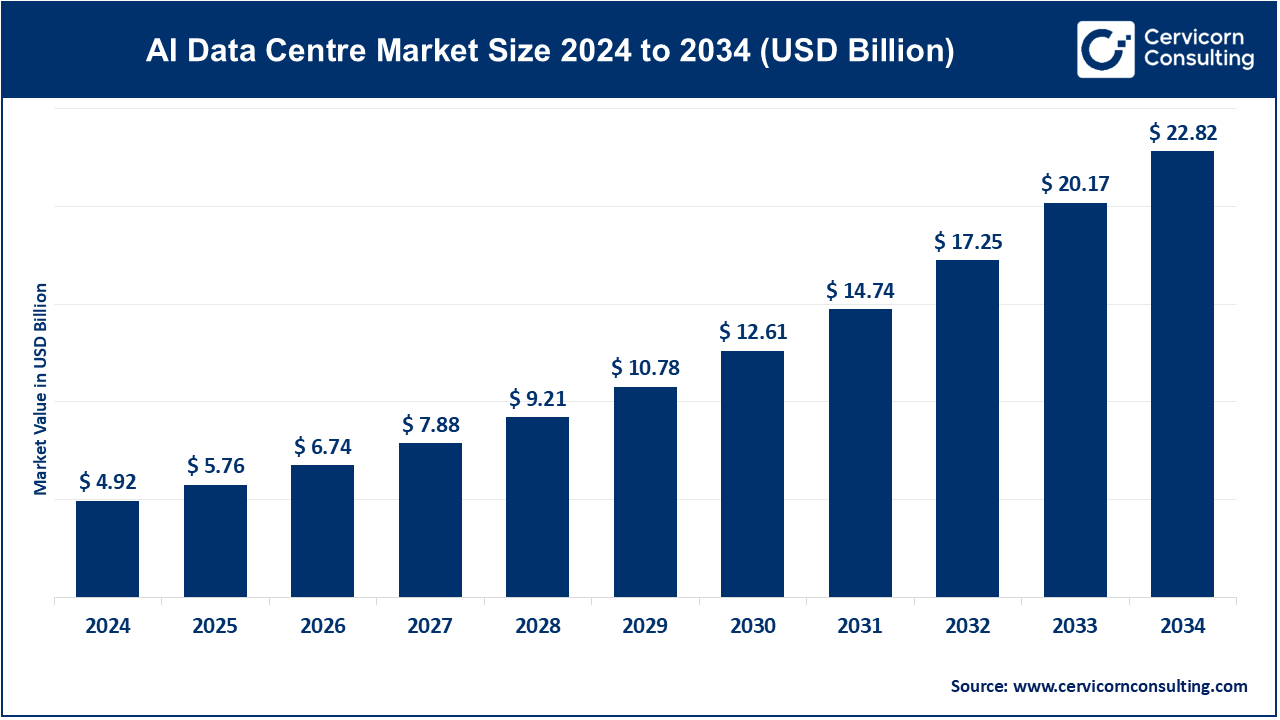
Businesses are leveraging AI to enhance efficiency, automate processes, and gain deeper insights from data, driving the demand for powerful computing infrastructure. Cloud service providers like AWS, Google Cloud, and Microsoft Azure are leading the way, building AI-focused data centers with cutting-edge technologies to accommodate this surge in demand. The rise of generative AI applications, like ChatGPT, and AI-based tools for image recognition, natural language processing, and predictive analytics have significantly influenced the growth. Additionally, the push for energy-efficient and sustainable data centers has created opportunities for innovation in cooling systems, renewable energy integration, and green computing. In recent, Microsoft plans to invest USD 80 billion in AI data center infrastructure during its fiscal year 2025, reflecting the growing demand for cloud and AI services. Government funding for AI research and policies supporting digital transformation also play a key role in boosting the market.
The world’s global AI compute demand grew by 30%-40% annually during 2023-2026, fueled by training of massive-scale models and subsequent inference workloads. Increasingly, modern data centers for AI are built around GPU clusters; the latest deployments use more than 10,000-25,000 accelerators per data center, at the hyperscale AI supercomputer level.
Additionally, the push for energy-efficient and sustainable data centers has created opportunities for innovation in cooling systems, renewable energy integration, and green computing. In recent, Microsoft plans to invest USD 80 billion in AI data center infrastructure during its fiscal year 2025, reflecting the growing demand for cloud and AI services. Government funding for AI research and policies supporting digital transformation also play a key role in boosting the market.
What is an AI data center?
An AI data center is a specialized facility designed to support artificial intelligence (AI) applications and workloads. Unlike traditional data centers, AI data centers use high-performance computing (HPC) hardware, such as GPUs and TPUs, to handle the complex calculations required for machine learning and AI algorithms. They provide the infrastructure to train AI models, process large volumes of data, and deploy AI applications efficiently. These centers also incorporate advanced cooling systems, energy-efficient designs, and optimized network configurations to handle the significant computational demands of AI. AI data centers are used in industries such as healthcare, finance, autonomous vehicles, and e-commerce to power AI innovations like chatbots, fraud detection systems, and recommendation engines.
Report Highlights
- By region, North America accounted a share of 39.40% in 2025 attributed to established cloud provider networks, extensive AI data centers, and initial GPU implementation.
- By component, hardware captured a revenue share of 59% in 2025; the need for robust GPUs, storage, and networking drives revenue for hardware solutions.
- By data centre type, hyperscale data centers generated the highest revenue share of around 52% in 2025 as they are centralizing.
- By technology, machine learning (ml) garnered a revenue share of 36% in 2025 as the use of machine learning in training, learning and optimization is soaring.
- By deployment model, cloud-based solutions held a revenue share of 53% in 2025 as it efficiently handles AI computations.
- By AI workload type, training workloads recorded a revenue share of 44% in 2025 as large-scale model training requires significant compute power and dominates overall AI infrastructure usage.
- By cooling infrastructure, air cooling recorded a revenue share of 61% in 2025 because it remains the most widely deployed and cost-effective cooling method for existing data center installations.
- By power capacity, 20–50 mw segment generated the maximum revenue share of 37% in 2025 as it represents the optimal balance between scalability and operational efficiency for mid-to-large AI data center deployments.
- By end-user, technology and cloud service providers accounted for a revenue share of 40% in 2025 due to their dominant role in building, operating, and scaling global AI data center infrastructure.
Infrastructure and Consumption Insights
- Global AI data centers are already deploying 10,000-25,000 GPUs in a large-scale training cluster and a rise in the demands for high-density hardware manufacturing.
- The newest AI supercomputing centers designs are being created for power requirements as high as 200-300 MW at a location to fulfill ever higher scalability needs of its infrastructure.
- The power densities at contemporary AI data centers are running at 20-60kW/rack versus 5-10kW/rack at conventional data centers.
- The new trend is seeing increased use of 40%-45% newly constructed data center AI systems incorporating 20-60kW/rack utilizing air-cooled technologies.
- Training AI models consumes 5-10x greater energy intensity compared to traditional cloud use-cases, thanks to its consistent huge model processing demands that occur continuously 24/7 365 days per year.
- High density clusters utilizing HBM from 3-8TB/rack are running direct liquid to chip or immersion cooled IT systems as are hyperscale systems.
- AI use cases, such as training, continue to be heavily concentrated, yet AI inference has began experiencing continuous 24/7 uptime requirements resulting in more always-on systems designs.
- Data center networking infrastructure is shifting toward 800G Ethernet and InfiniBand deployment, enabling high-speed GPU-to-GPU communication in training clusters.
Top Government Initiatives
| Country |
Key AI Data Center Initiative |
Focus Area |
| United States |
Expansion of hyperscale AI data centers by major cloud providers including large-scale GPU clusters and AI supercomputing facilities across multiple states |
AI compute scaling, GPU infrastructure, hyperscale cloud expansion |
| China |
National rollout of “Eastern Data, Western Computing” initiative to build large AI data center hubs in western regions with renewable energy integration |
AI infrastructure redistribution, energy-efficient computing clusters |
| India |
Development of AI-ready data center parks under Digital India and state-level data center policies in Maharashtra, Telangana, and Tamil Nadu |
Domestic cloud expansion, AI infrastructure localization |
| Germany |
Expansion of sovereign AI cloud and green data center infrastructure under EU digital sovereignty programs and energy-efficient computing mandates |
Green AI computing, data sovereignty, low-carbon data centers |
| United Arab Emirates |
Development of large-scale AI infrastructure hubs such as AI-focused cloud zones in Abu Dhabi and Dubai with hyperscale partnerships |
AI cloud hubs, sovereign AI infrastructure, hyperscale partnerships |
Recent Major Milestones
1. Hyperscaler Capital Expenditure Surge in AI Infrastructure
Between 2025 and 2026, major cloud providers including Microsoft, Amazon, Google, and Meta have increased investments in AI-focused data centers. This trend suggests that AI infrastructure is shifting from a supporting role to a central component of digital economies. The expansion is likely to increase global capacity, streamline supply chains, and further consolidate market share among established leaders.
- The total hyperscaler investment in AI and data center infrastructure is expected to reach between USD 500 billion and USD 700 billion during 2025–2026.
- Microsoft alone is projected to spend over USD 80 billion annually on AI infrastructure development.
- Amazon is estimated to allocate more than USD 75 billion toward data center expansion in 2025.
- Global data center capacity is expected to grow at a rate of 20–30% year-over-year.
- AI workloads are projected to contribute to over 40% of new data center demand by 2026.
2. Rise of AI-Native Infrastructure Providers (Neo-Cloud Players)
A new category of AI-focused infrastructure companies, including CoreWeave and Nebius, is emerging to provide specialized GPU-based computing services. These firms are securing large-scale contracts with enterprises and even major technology companies such as Meta. This development is driving the market by increasing access to computing, reducing dependence on traditional hyperscalers, and intensifying industry-wide competition.
- CoreWeave has reached a valuation of over USD 20 billion as of 2025, reflecting strong investor confidence.
- AI infrastructure contracts are increasingly valued between USD 10 billion and USD 30 billion over multi-year periods.
- The demand for GPU-based cloud services is growing at a rate exceeding 50% compound annual growth (CAGR).
- Non-hyperscaler providers currently account for approximately 15–25% of AI compute workloads, and this share is rising.
- AI-native infrastructure providers can deploy computing resources 30–50% faster than traditional cloud providers.
3. Integration of Energy Infrastructure with AI Data Centers
The development of AI data centers is closely linked to the creation of dedicated energy infrastructure, reflecting the substantial power demands of these facilities. Industry leaders, including NVIDIA, are working with utilities and energy providers to secure consistent and scalable power sources. This trend suggests that addressing energy constraints is becoming a key factor in the expansion and location strategy of data centers, with potential to shape future market growth.
- A typical AI data center requires between 100 megawatts and over 1 gigawatt of power per facility.
- Large hyperscale AI campuses are being designed with capacities ranging from 5 to 10 gigawatts.
- Energy consumption from AI data centers is growing at an annual rate of approximately 25%.
- Data centers are projected to consume 8–10% of global electricity by 2030.
- Power-related costs account for approximately 40–60% of total data center operating expenses.
4. Adoption of Liquid Cooling and Thermal Technology Innovation
Rising computational demands from AI workloads are generating more heat than traditional air cooling systems can manage effectively. In response, companies are turning to liquid cooling solutions, as seen in recent acquisitions like Ecolab’s purchase of CoolIT Systems. This shift is likely to support higher performance and improved energy efficiency, while also facilitating the rollout of advanced AI chips.
- The liquid cooling market for data centers is expected to grow at a rate of 25–30% CAGR.
- Liquid cooling solutions can reduce cooling energy consumption by 30–40% compared to traditional air cooling systems.
- Rack power density in AI data centers has increased from approximately 10 kW to over 50–100 kW per rack.
- Cooling systems account for roughly 30–40% of total data center energy usage.
- The global thermal management market for data centers is projected to exceed USD 10 billion by 2027.
AI Data Center Capacity by Key Developing Countries
| Country |
Current Capacity |
Planned Capacity |
Major Investment Highlights |
Key Companies |
Key Clusters |
Strategic Insight |
| India |
~1.5 GW |
~2.5 GW (near-term), ~14 GW long-term |
India is attracting multi-billion-dollar investments from hyperscalers and colocation providers, supported by government incentives and state-level policies. |
Microsoft, Amazon, NTT Data, Reliance Industries |
Mumbai, Chennai, Hyderabad, Noida |
India is emerging as a cost-efficient global AI infrastructure hub with strong domestic demand. |
| Saudi Arabia |
~0.25 GW |
~6 GW |
Saudi Arabia is investing billions through sovereign funds to build large-scale AI data centers as part of Vision 2030. |
Amazon, Microsoft, Saudi Aramco |
Riyadh, NEOM |
The country is leveraging sovereign capital and energy resources to build giga-scale AI infrastructure. |
| UAE |
~0.2–1 GW |
~5 GW |
The UAE is developing mega AI projects such as Stargate and investing heavily in digital economy initiatives. |
Microsoft, Google, G42 |
Abu Dhabi, Dubai |
The UAE is positioning itself as a global AI hub connecting Europe, Asia, and Africa. |
| China |
Multi-GW (largest in Asia) |
Continuous expansion (national clusters) |
China is investing heavily in AI infrastructure through government-backed programs and domestic tech giants. |
Alibaba, Tencent, Baidu |
Beijing, Shanghai, Shenzhen, Inner Mongolia |
China is building a self-reliant AI ecosystem with massive hyperscale capacity. |
| Brazil |
~0.5–1 GW |
Expanding steadily |
Brazil is attracting global investments to serve as a regional hub for Latin America. |
Equinix, Ascenty, Google |
São Paulo, Rio de Janeiro |
Brazil is becoming the gateway for AI infrastructure in Latin America. |
1. India – Capacity Scaling at High Speed
India is rapidly increasing its AI data center capacity due to strong enterprise demand and hyperscaler expansion. The country is transitioning from a regional data hub to a global AI infrastructure destination, with capacity expansion focused on major metro clusters.
- India currently has around 1.5 GW of data center capacity, which reflects its growing digital infrastructure base.
- The country is expected to increase capacity to around 2.5 GW in the near term, effectively doubling its operational scale.
- Long-term projections indicate that India could reach approximately 14 GW of total capacity, driven by AI and cloud demand.
- This expansion is supported by large-scale investments and increasing adoption of AI workloads across industries.
2. Saudi Arabia – Rapid Buildout with Gigawatt Targets
Saudi Arabia is aggressively building AI data center capacity through sovereign-backed initiatives, positioning itself as a future mega AI infrastructure hub.
- Initial AI data center projects in Saudi Arabia are targeting around 250 MW of capacity in early phases.
- The country aims to scale this to approximately 6 GW of total capacity in the long term, reflecting ambitious infrastructure plans.
- Investments are being supported through national infrastructure funds and strategic partnerships with global firms.
3. UAE – Mega AI Data Center Projects
The UAE is developing some of the world’s largest AI-focused data center campuses, aiming to become a global AI compute hub.
- The “Stargate UAE” project alone is planned to reach around 5 GW of total capacity, making it one of the largest AI data center clusters globally.
- The initial phase of the project includes approximately 1 GW capacity, with 200 MW launched early.
- These facilities are designed to host advanced AI chips and large-scale compute infrastructure.
4. China – Largest AI Infrastructure Expansion Globally
- China has one of the largest AI data center ecosystems, supported by government initiatives and domestic tech giants.
- China is investing over USD 50 billion annually in AI infrastructure and computing clusters, highlighting its scale of expansion.
- The country hosts some of the largest data center campuses globally, including multi-million-square-foot facilities.
- AI data center capacity is expanding rapidly, although concerns about overcapacity and underutilization have been raised.
5. Brazil – Growing Regional Capacity Hub
- Brazil is emerging as a key AI data center hub in Latin America, with increasing investments and infrastructure development.
- Brazil currently operates hundreds of data center facilities, contributing significantly to regional capacity.
- The country is expanding hyperscale capacity to serve growing cloud and AI demand across Latin America.
- Global providers are entering the market to develop new large-scale data center campuses.
The AI data center market in developing countries is advancing due to significant investments, rapid expansion of capacity, and active government involvement. India, for example, is attracting major hyperscalers such as Microsoft and Amazon by leveraging cost efficiencies and growing digital demand. In the Middle East, sovereign funding and access to energy resources are supporting the development of large-scale infrastructure. China is intensifying global competition through state-supported growth led by companies like Alibaba, while Brazil is facilitating the emergence of new regional markets for AI applications. These developments suggest a shift toward a more distributed and scalable infrastructure model, which may accelerate AI adoption globally and reduce dependence on established data center hubs.
Market Trends
- Focus on AI-Powered Automation: This trend of a data centre’s move in workloads itself is shifting toward AI-powered automation, with cooling, load balancing, and energy management running autonomously. These AI tools analyse real-time data and, in real time, make the necessary adjustments to improve performance and efficiency with reduced need for manual interventions and, by extension, operating cost.
- Edge Computing Integration: The rise of the edge computing trend shall shape the data centre infrastructure, since there's a need for data processing to be nearer to its point of origin. AI is making real-time processing and analysis possible at the edge, allowing this shift as the boundary of the data centre advances closer to the end-user. This puts an end to centralization of data and also reduces bottlenecks created due to bandwidth in such data centres.
- Growth in AI-Driven Security Solutions: It has also led to increasingly significant development in AI-driven security solutions as threats surfacing cyber-attacks increase with the rise of sophistication. AI-based security solutions identify anomaly and realize real-time potential threats, hence bringing into play a proactive approach to the data being protected. This trend is becoming very important considering the sensitivities of the information that may be housed within data centres and the significance of infrastructure it supports.
- AI-Optimized Cooling Solutions: Cooling is the biggest energy expense in data centres, and now comes the innovation of the latest AI-enabled mechanism to optimize it. AI-powered solutions monitor environmental parameters and control the cooling system dynamically to make it work in an optimum manner while minimizing energy waste. This is the way to reduce the green footprint of data centres and operational costs.
- Emphasis on Integrating Renewable Energy: AI allows data centres to make optimal integration with renewable energy sources like solar and wind within their power supply. By learning about weather conditions, the production of energy, and consumption forecasts, AI helps data centres utilize more renewable sources of energy. This trend fulfils the global sustainability charter while supporting data centres with less usage of fossils.
Report Scope
| Area of Focus |
Details |
| Market Size in 2026 |
USD 6.74 Billion |
| Projected Market Size (2035) |
USD 25.53 Billion |
| Growth Rate (2026 to 2035) |
40.10% |
| Dominant Region |
North America |
| Fastest Growing Region |
Asia-Pacific |
| Report Segmentation |
Component, Data Centre Type, Technology, Deployment Model, AI Workload Type, Cooling Infrastructure, Power Capacity, End-User, Region |
| Key Companies |
NVIDIA Corporation, Intel Corporation, IBM Corporation, Google LLC, Microsoft Corporation, Amazon Web Services (AWS), Alibaba Cloud Baidu, Inc., Oracle Corporation, Advanced Micro Devices (AMD), Inc., Hewlett Packard Enterprise (HPE), Cisco Systems, Inc., Dell Technologies, Tencent Cloud, Fujitsu Limited. |
Market Dynamics
Drivers
- Accelerated Digital Transformation: While business leaders become increasingly dependent on AI-driven digital solutions, the demand for AI-enhanced data centres has picked up. From analytics in real-time to better decisions being made through artificial intelligence, AI's role in digital transformation has become an imperative for organizations to stay competitive under a fast-evolving tech landscape.
- Cost-Efficiency and Operational Savings: The AI-data centres are designed to provide huge savings through optimization of energy usage, cooling systems, and the overall operational efficiency of the data centre. Additionally, there is also a reduction in the necessity for direct human interventions with the streamlining of data centre operations, making these the efficient means to reduce costs while improving performance and scalability.
Restraints
- Data Privacy and Cyber Security Concerns: AI has much to play with extensive amounts of sensitive data that are processed in the centres. Since this situation poses key concerns over data privacy and security, organizations concerned for data security may not be ready for the expansion of AI in data centres without adequate measures to ensure protection of data.
- Diverse Regulatory Landscapes: Data privacy regulations and standards differ a lot by region, making it quite a hassle to implement AI solutions in diverse markets. This challenge will create difficulties in corresponding alignment of AI data centres with regional compliance requirements, adding a related delay in market expansion to regions with strict or different regulatory frameworks.
Opportunities
- Emerging markets will invest in digital infrastructures to enhance their growth in the technology sector. AI data centres will provide opportunities for such regions to build advanced infrastructure that allows rapid data processing, storage, and analytics.
- If the growth of 5G networks persists, then there will be a tremendous need for edge computing capabilities, AI-enabled data centres will find themselves with opportunities for processing and analysing data much closer to source, reducing latency and enhancing real-time data processing and analysis as required by sectors such as telecom, healthcare, and IoT.
Challenges
- Integration with Legacy Systems: The challenges for integration of these AI technologies would be in going into data centres with legacy systems in place. In fact, integration of new AI capabilities with already existing workflows without impacting established workflows can be costly and quite complex, and hence, AI should end up enhancing rather than complicating the system.
- User Adoption and Engagement: To achieve its peak maturity, AI-enabled data centres will be acceptable and usable by the end-user who will use AI-driven processes. Henceforth, continued investment in user-friendly interfaces, intuitive controls, and training programs would be necessitated to ensure all stakeholders were getting maximum benefits of AI within their data centre operations.
Regional Analysis
Why does North America leads the AI data centre market?
The North America AI data centre market size valued at USD 2.27 billion in 2025 and is predicted to reach around USD 10.06 billion by 2035.
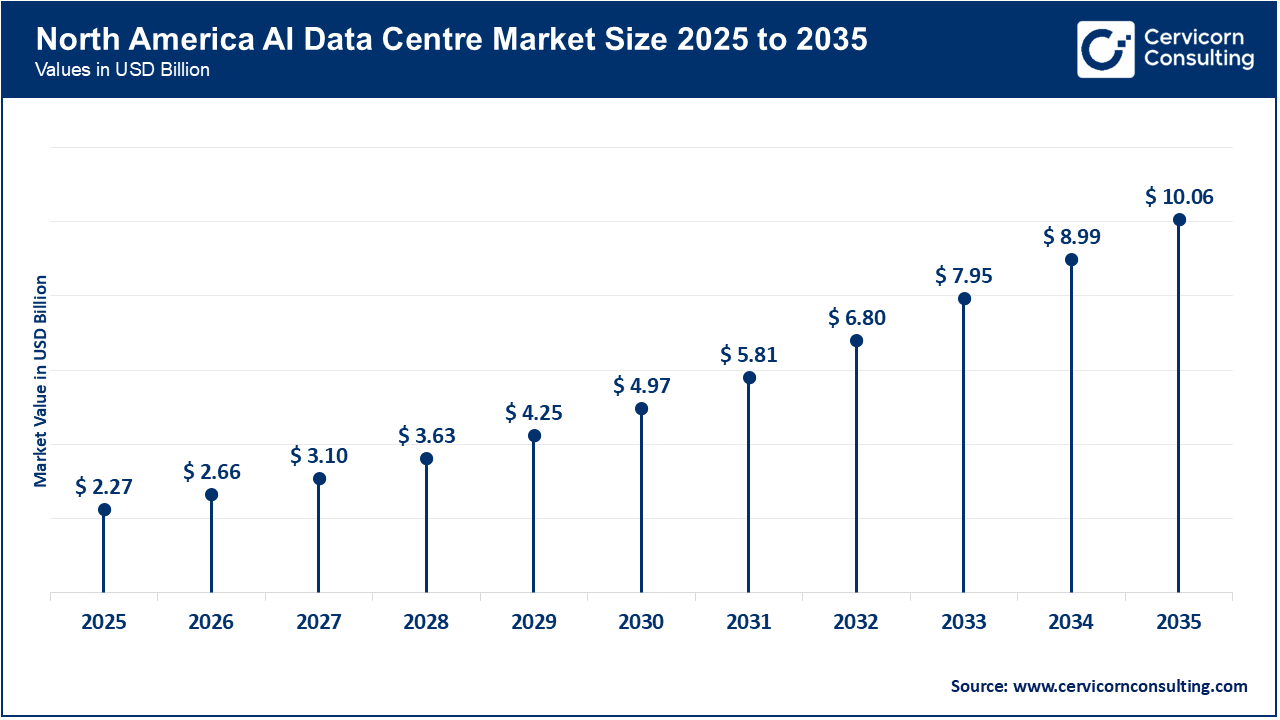
North America is the most significant hub for developing AI data centre innovation. As such, it has spent a lot in smart data centre and AI-driven infrastructure. The region is picked up by AI and cloud technology that is driving the region, especially the US and Canada. Government incentives have been driving growth in the market coupled with strong demand by big tech houses and enterprises of energy-efficient data centres.
What are the driving factors of Europe AI data centre market?
The Europe AI data centre market size accounted for USD 1.24 billion in 2025 and is forecasted to surpass around USD 5.49 billion by 2035. Artificial intelligence adoption is very robust in Europe. Digital transformation has become the top focus for the EU as well as sustainability, and primarily based on these factors, the adoption of artificial intelligence throughout Europe is happening. Primarily, Germany, the UK, and France comprise the top market leaders in Europe with a highly significant number of investments made in artificial intelligence to meet the rigorous carbon reduction targets. Evidently, for the region, the commitment towards sustainability and green energy is driving AI-driven solutions within data centres for the optimization of energy use and reduction of carbon emissions.
Why is Asia-Pacific growing rapidly in the AI data centre market?
The Asia-Pacific AI data centre market size estimated at USD 1.45 billion in 2025 and is projected to hit around USD 6.43 billion by 2035. There is a rapid growth of artificial intelligence data centres in the region, with China, Japan, and South Korea being front runners. The countries are establishing AI-driven data centres to develop the digital economy in the region. High investment in AI research along with government plans for smart infrastructure is further driving the market.
Market Share, By Region, 2025 (%)
| Region |
Revenue Share, 2025 (%) |
| North America |
39.40% |
| Europe |
21.50% |
| Asia-Pacific |
25.20% |
| LAMEA |
13.90% |
LAMEA AI Data Centre Market is Emerging
The LAMEA AI data centre market size valued at USD 0.80 billion in 2025 and is anticipated to reach around USD 3.55 billion by 2035. The LAMEA region is emerging amid the growing interest in digitalization and energy management. The countries are now beginning to invest in AI to achieve the effective efficiency of the data centres and reduce the cost of operations. Not as rapid in the growth of others, still much to develop and achieve this area because it already has developed infrastructure and continues to implement AI-driven solutions.
Segmental Analysis
The AI data centre market is segmented into component, data centre type, technology, deployment model and region. Based on component, the market is classified into hardware, software, and services. Based on data centre type, the market is classified into enterprise data center, colocation data center, hyperscale data centers, and edge data centers. Based on technology, the market is classified into Machine Learning (ML), Deep Learning (DL), Natural Language Processing (NLP), and Computer Vision. Based on deployment model, the market is classified into on-premises, cloud-based, hybrid.
Component Analysis
- Hardware: includes servers, storage devices, network appliances, GPUs, TPUs, and other specialized hardware that supports processing AI workloads inside the data centre.
- Software: Refers to AI-oriented software platforms, data analytics tools, machine learning frameworks, and data management solutions that help iron out AI functionalities inside a data centre.
- Services: involves consulting, integration, implementation, maintenance, and managed services which underpin AI operations inside the data centre.

Data Centre Type Analysis
- Enterprise data centre One specific organization owns and operates their data centres for particular AI and data processing requirements.
- Colocation data centre One is called a colocation facility; here, several customers store their servers and equipment in that shared facility. It also integrates AI tools for better data management and analysis.
- Hyperscale Data Centres Large centres built to enable massive volumes of data, mostly run by tech titans like Amazon, Google, and Microsoft, with highly advanced AI.
- Edge Data centres smaller data centres close to the end-users. They use AI to process data on the edge, reducing latency, particularly useful for real-time applications.
Market Share, By Data Centre Type, 2025 (%)
| Data Centre Type |
Revenue Share, 2025 (%) |
| Enterprise Data Center |
18% |
| Colocation Data Center |
23% |
| Hyperscale Data Centers |
52% |
| Edge Data Centers |
7% |
Technology Analysis
- Machine Learning (ML): designed to be friendly to ML algorithms and workflow includes training and inferencing processes
- Deep Learning (DL) data centres whose infrastructures are optimized for deep learning applications, and thus typically extremely computationally intensive and therefore require a lot of power, such as GPUs or TPUs
- Natural Language Processing (NLP) AI data centre processing large volumes of text and speech to be used in developing virtual assistants or automated customer services.
- Computer Vision: Computing centres provisioned for image and video processing jobs, enabling applications in areas like face recognition, autonomous vehicles and surveillance.
Market Share, By Technology, 2025 (%)
| Technology |
Revenue Share, 2025 (%) |
| Machine Learning (ML) |
36% |
| Deep Learning (DL) |
31% |
| Natural Language Processing (NLP) |
18% |
| Computer Vision |
15% |
Deployment Model Analysis
- On-Premises: AI computing centres hosted on-premises by an organization that have more control over infrastructure and security but require large capital outlays.
- Cloud-Based: AI is delivered through cloud services, where organizations can remotely leverage powerful AI computing centres from a third party without necessarily having to build sophisticated on-premises infrastructure.
- Hybrid: This refers to a mix between on-premises and cloud resources, and an organization can flexibly allocate AI workloads based upon the required cost, performance, or security needs of different environments.
Market Share, By Deployment Model, 2025 (%)
| Deployment Model |
Revenue Share, 2025 (%) |
| On-Premises |
25% |
| Cloud-Based |
53% |
| Hybrid |
22% |
AI Data Centre Market Top Companies
- NVIDIA Corporation
- Intel Corporation
- IBM Corporation
- Google LLC
- Microsoft Corporation
- Amazon Web Services (AWS)
- Alibaba Cloud
- Baidu, Inc.
- Oracle Corporation
- Advanced Micro Devices (AMD), Inc.
- Hewlett Packard Enterprise (HPE)
- Cisco Systems, Inc.
- Dell Technologies
- Tencent Cloud
- Fujitsu Limited.
Both emerging enterprises and established ones are making strides in innovation that is changing the AI data centre market. There are several marked emerging companies such as graph core and Cerebra’s Systems which are doing everything possible to advance AI and ML in terms of bettering the speed and efficiency of data centres. To illustrate, Graph core Company has introduced the Intelligence Processing Unit, which takes care of heavy AI workloads, offering up more space and energy utilization improvements. Cerebra’s Systems on the other hand sells the largest integrated circuit known as the Wafer Scale Engine meant for high-performance computing AI.
Such traditional market leaders such as NVIDIA and IBM continue to be the major players in the AI data centre market, using their strong R&D, to stay on top. Advanced CPU technology refers mainly to the NVIDIA GPUs, which are still the number one source of AI data processing. As far as CCD for business is concerned, the IBM solution is more about the infusion of AI in the massive very big data trends to get actions that define path to efficiency and processes optimization. All these though different and operating in different markets, are key players in the quest for the digitalization of data center operations and possess innovations that enhance performance and lower power consumption and make it possible to use AI in many areas of the economy.
CEO Statements
NVIDIA (Jensen Huang, CEO):
"AI is the most important technological revolution of our time, and our data center products are designed to enable organizations to harness the full potential of artificial intelligence. We're committed to providing the infrastructure that accelerates AI innovation and drives transformative change across industries."
IBM (Arvind Krishna, CEO):
"At IBM, we believe that AI should be infused into every aspect of business operations. Our AI-powered data centers are not just about processing power; they are about delivering actionable insights that empower organizations to make smarter, data-driven decisions."
Google Cloud (Thomas Kurian, CEO):
"Google Cloud is focused on helping businesses leverage AI to transform their operations. Our AI data centers are designed to deliver unparalleled scalability and efficiency, enabling our customers to innovate faster and achieve their business goals."
Microsoft Azure (Satya Nadella, CEO):
"We are committed to empowering every organization to harness the power of AI. Our Azure AI data centers provide the resources necessary for businesses to develop intelligent applications that drive growth and enhance customer experiences."
Recent Developments
Strategic Launches and Expansions highlight the rapid advancements and collaborative efforts in the AI Data Centre market. Industry players are involved in various aspects of AI Data Centre, including technology, component, and AI, play a significant role in advancing the market. Some notable examples of key developments in the AI Data Centre Market include:
- In September 2024, the drive to develop more powerful AI capabilities will require significant infrastructure investment to support it. Today, BlackRock, Global Infrastructure Partners (GIP), Microsoft, and MGX announced the Global AI Infrastructure Investment Partnership (GAIIP) to make investments in new and expanded data centres to meet growing demand for computing power, as well as energy infrastructure to create new sources of power for these facilities. These infrastructure investments will be chiefly in the United States fuelling AI innovation and economic growth, and the remainder will be invested in U.S. partner countries.
- In September 2024, OpenAI Chief Executive Officer Sam Altman and Nvidia Corporation CEO Jensen Huang met with senior Biden administration officials and other industry leaders at the White House, where they discussed steps to address massive infrastructure needs for artificial intelligence projects.
- In September 2024, Abu Dhabi-based advanced technologies group G42 shall build upto 2 Gigawatt AI-ready data centres in India - double of total existing capacity - as part of pact signed between the UAE and Indian governments aimed at co-developing sovereign AI.
Market Segmentation
By Component
- Hardware
- Compute (GPUs, CPUs, TPUs, ASICs)
- Memory (HBM, DRAM, Flash)
- Storage (NVMe SSD, HDD, Object Storage)
- Networking (Switches, Routers, Interconnects)
- Software
- AI Workload Management Platforms
- Orchestration Tools (e.g., Kubernetes for AI)
- Virtualization & Containerization Software
- AI Model Training/Inference Frameworks
- Services
- Deployment & Integration
- Managed Services
- Consulting & Support
By Data Centre Type
- Enterprise data center
- Colocation data center
- Hyperscale Data Centers
- Edge Data centers
By Technology
- Machine Learning (ML)
- Deep Learning (DL)
- Natural Language Processing (NLP)
- Computer Vision
By Deployment Model
- On-Premises
- Cloud-Based
- Hybrid
By AI Workload Type
- Training Workloads
- Inference Workloads
- Real-Time Analytics
- Generative AI
- Reinforcement Learning
By Cooling Infrastructure
- Liquid Cooling
- Immersion Cooling
- Direct-to-Chip Liquid Cooling
- Air Cooling
- CRAH/CRAC Units
- Chilled Water Systems
- Hybrid Cooling Systems
By Power Capacity
- Below 5 MW
- 5–20 MW
- 20–50 MW
- Above 50 MW
By End-User
- Technology & Cloud Service Providers
- BFSI
- Healthcare & Life Sciences
- Automotive (Autonomous Driving)
- Retail & E-commerce
- Government & Defense
- Telecom
- Energy & Utilities
- Education & Research
By Region
- North America
- APAC
- Europe
- LAMEA