
The global AI data centre market size was valued at USD 5.76 billion in 2025 and is expected to exceed around USD 25.53 billion by 2035, growing at a compound annual growth rate (CAGR) of 40.1% from 2026 to 2035. The AI data center market is expanding rapidly due to the increasing adoption of AI-driven technologies across various sectors such as healthcare, retail, finance, and manufacturing. Businesses are leveraging AI to enhance efficiency, automate processes, and gain deeper insights from data, driving the demand for powerful computing infrastructure. Cloud service providers like AWS, Google Cloud, and Microsoft Azure are leading the way, building AI-focused data centers with cutting-edge technologies to accommodate this surge in demand. The rise of generative AI applications, like ChatGPT, and AI-based tools for image recognition, natural language processing, and predictive analytics have significantly influenced the growth. Additionally, the push for energy-efficient and sustainable data centers has created opportunities for innovation in cooling systems, renewable energy integration, and green computing. In recent, Microsoft plans to invest USD 80 billion in AI data center infrastructure during its fiscal year 2025, reflecting the growing demand for cloud and AI services. Government funding for AI research and policies supporting digital transformation also play a key role in boosting the market.
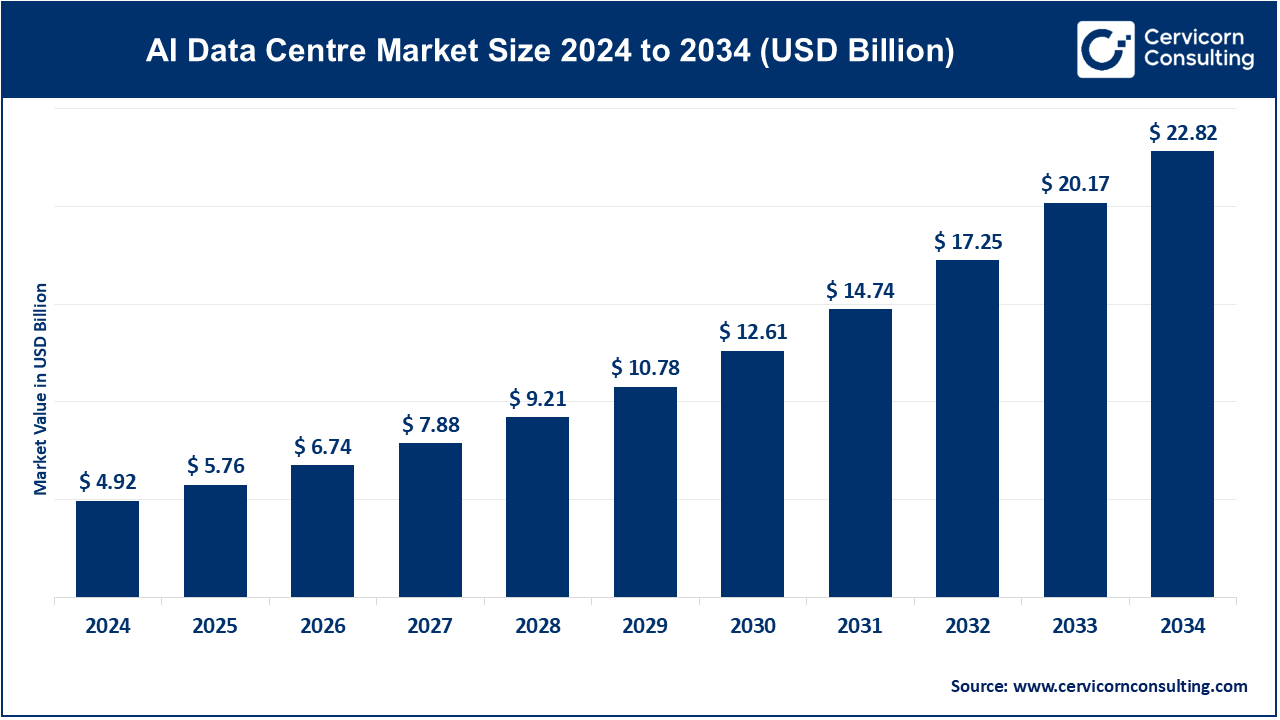
An AI data center is a specialized facility designed to support artificial intelligence (AI) applications and workloads. Unlike traditional data centers, AI data centers use high-performance computing (HPC) hardware, such as GPUs and TPUs, to handle the complex calculations required for machine learning and AI algorithms. They provide the infrastructure to train AI models, process large volumes of data, and deploy AI applications efficiently. These centers also incorporate advanced cooling systems, energy-efficient designs, and optimized network configurations to handle the significant computational demands of AI. AI data centers are used in industries such as healthcare, finance, autonomous vehicles, and e-commerce to power AI innovations like chatbots, fraud detection systems, and recommendation engines.
1. Hyperscaler Capital Expenditure Surge in AI Infrastructure
Between 2025 and 2026, major cloud providers including Microsoft, Amazon, Google, and Meta have increased investments in AI-focused data centers. This trend suggests that AI infrastructure is shifting from a supporting role to a central component of digital economies. The expansion is likely to increase global capacity, streamline supply chains, and further consolidate market share among established leaders.
2. Rise of AI-Native Infrastructure Providers (Neo-Cloud Players)
A new category of AI-focused infrastructure companies, including CoreWeave and Nebius, is emerging to provide specialized GPU-based computing services. These firms are securing large-scale contracts with enterprises and even major technology companies such as Meta. This development is driving the market by increasing access to computing, reducing dependence on traditional hyperscalers, and intensifying industry-wide competition.
3. Integration of Energy Infrastructure with AI Data Centers
The development of AI data centers is closely linked to the creation of dedicated energy infrastructure, reflecting the substantial power demands of these facilities. Industry leaders, including NVIDIA, are working with utilities and energy providers to secure consistent and scalable power sources. This trend suggests that addressing energy constraints is becoming a key factor in the expansion and location strategy of data centers, with potential to shape future market growth.
4. Adoption of Liquid Cooling and Thermal Technology Innovation
Rising computational demands from AI workloads are generating more heat than traditional air cooling systems can manage effectively. In response, companies are turning to liquid cooling solutions, as seen in recent acquisitions like Ecolab’s purchase of CoolIT Systems. This shift is likely to support higher performance and improved energy efficiency, while also facilitating the rollout of advanced AI chips.
| Country | Current Capacity | Planned Capacity | Major Investment Highlights | Key Companies | Key Clusters | Strategic Insight |
| India | ~1.5 GW | ~2.5 GW (near-term), ~14 GW long-term | India is attracting multi-billion-dollar investments from hyperscalers and colocation providers, supported by government incentives and state-level policies. | Microsoft, Amazon, NTT Data, Reliance Industries | Mumbai, Chennai, Hyderabad, Noida | India is emerging as a cost-efficient global AI infrastructure hub with strong domestic demand. |
| Saudi Arabia | ~0.25 GW | ~6 GW | Saudi Arabia is investing billions through sovereign funds to build large-scale AI data centers as part of Vision 2030. | Amazon, Microsoft, Saudi Aramco | Riyadh, NEOM | The country is leveraging sovereign capital and energy resources to build giga-scale AI infrastructure. |
| UAE | ~0.2–1 GW | ~5 GW | The UAE is developing mega AI projects such as Stargate and investing heavily in digital economy initiatives. | Microsoft, Google, G42 | Abu Dhabi, Dubai | The UAE is positioning itself as a global AI hub connecting Europe, Asia, and Africa. |
| China | Multi-GW (largest in Asia) | Continuous expansion (national clusters) | China is investing heavily in AI infrastructure through government-backed programs and domestic tech giants. | Alibaba, Tencent, Baidu | Beijing, Shanghai, Shenzhen, Inner Mongolia | China is building a self-reliant AI ecosystem with massive hyperscale capacity. |
| Brazil | ~0.5–1 GW | Expanding steadily | Brazil is attracting global investments to serve as a regional hub for Latin America. | Equinix, Ascenty, Google | São Paulo, Rio de Janeiro | Brazil is becoming the gateway for AI infrastructure in Latin America. |
1. India – Capacity Scaling at High Speed
India is rapidly increasing its AI data center capacity due to strong enterprise demand and hyperscaler expansion. The country is transitioning from a regional data hub to a global AI infrastructure destination, with capacity expansion focused on major metro clusters.
2. Saudi Arabia – Rapid Buildout with Gigawatt Targets
Saudi Arabia is aggressively building AI data center capacity through sovereign-backed initiatives, positioning itself as a future mega AI infrastructure hub.
3. UAE – Mega AI Data Center Projects
The UAE is developing some of the world’s largest AI-focused data center campuses, aiming to become a global AI compute hub.
4. China – Largest AI Infrastructure Expansion Globally
5. Brazil – Growing Regional Capacity Hub
The AI data center market in developing countries is advancing due to significant investments, rapid expansion of capacity, and active government involvement. India, for example, is attracting major hyperscalers such as Microsoft and Amazon by leveraging cost efficiencies and growing digital demand. In the Middle East, sovereign funding and access to energy resources are supporting the development of large-scale infrastructure. China is intensifying global competition through state-supported growth led by companies like Alibaba, while Brazil is facilitating the emergence of new regional markets for AI applications. These developments suggest a shift toward a more distributed and scalable infrastructure model, which may accelerate AI adoption globally and reduce dependence on established data center hubs.
Report Scope
| Area of Focus | Details |
| Market Size in 2026 | USD 6.74 Billion |
| Projected Market Size (2035) | USD 25.53 Billion |
| Growth Rate (2026 to 2035) | 40.10% |
| Dominant Region | North America |
| Fastest Growing Region | Asia-Pacific |
| Report Segmentation | Component, Data Centre Type, Technology, Deployment Model, AI Workload Type, Cooling Infrastructure, Power Capacity, End-User, Region |
| Key Companies | NVIDIA Corporation, Intel Corporation, IBM Corporation, Google LLC, Microsoft Corporation, Amazon Web Services (AWS), Alibaba Cloud Baidu, Inc., Oracle Corporation, Advanced Micro Devices (AMD), Inc., Hewlett Packard Enterprise (HPE), Cisco Systems, Inc., Dell Technologies, Tencent Cloud, Fujitsu Limited. |
The North America AI data centre market size valued at USD 2.27 billion in 2025 and is predicted to reach around USD 10.06 billion by 2035.
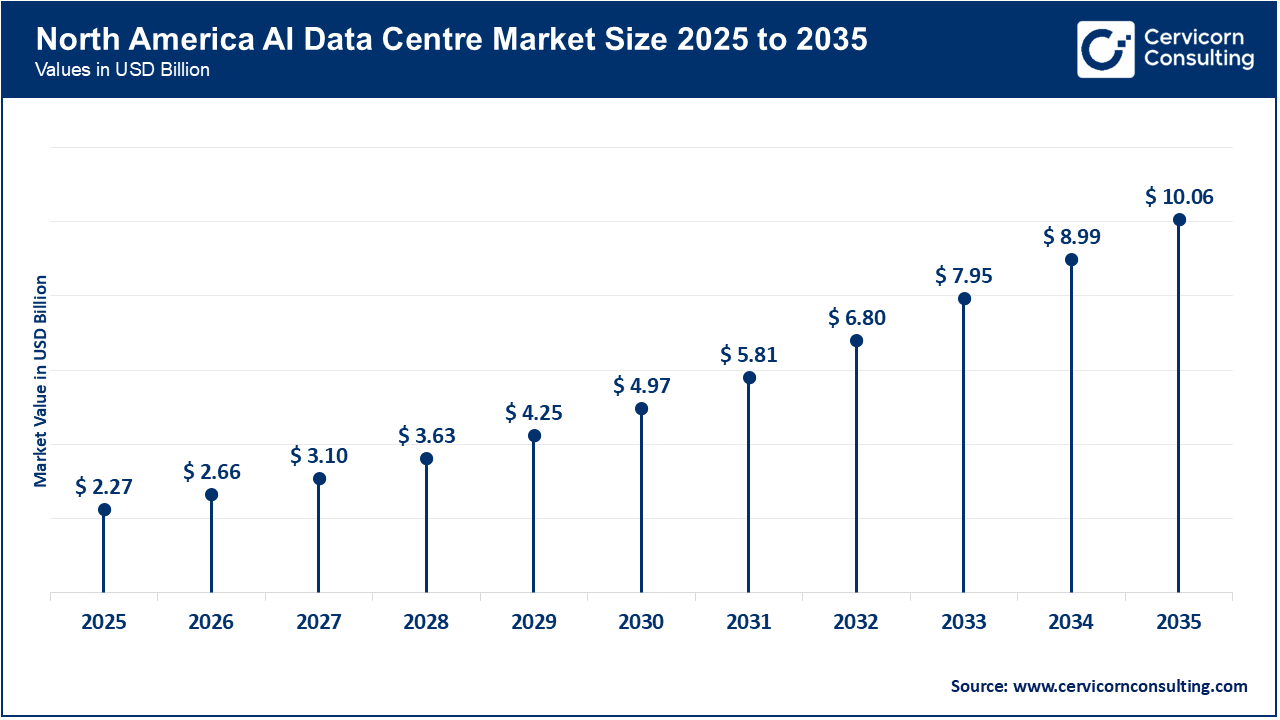
North America is the most significant hub for developing AI data centre innovation. As such, it has spent a lot in smart data centre and AI-driven infrastructure. The region is picked up by AI and cloud technology that is driving the region, especially the US and Canada. Government incentives have been driving growth in the market coupled with strong demand by big tech houses and enterprises of energy-efficient data centres.
The Europe AI data centre market size accounted for USD 1.24 billion in 2025 and is forecasted to surpass around USD 5.49 billion by 2035.
Artificial intelligence adoption is very robust in Europe. Digital transformation has become the top focus for the EU as well as sustainability, and primarily based on these factors, the adoption of artificial intelligence throughout Europe is happening. Primarily, Germany, the UK, and France comprise the top market leaders in Europe with a highly significant number of investments made in artificial intelligence to meet the rigorous carbon reduction targets. Evidently, for the region, the commitment towards sustainability and green energy is driving AI-driven solutions within data centres for the optimization of energy use and reduction of carbon emissions.
The Asia-Pacific AI data centre market size estimated at USD 1.45 billion in 2025 and is projected to hit around USD 6.43 billion by 2035.
There is a rapid growth of artificial intelligence data centres in the region, with China, Japan, and South Korea being front runners. The countries are establishing AI-driven data centres to develop the digital economy in the region. High investment in AI research along with government plans for smart infrastructure is further driving the market.
Market Share, By Region, 2025 (%)
| Region | Revenue Share, 2025 (%) |
| North America | 39.40% |
| Europe | 21.50% |
| Asia-Pacific | 25.20% |
| LAMEA | 13.90% |
The LAMEA AI data centre market size valued at USD 0.80 billion in 2025 and is anticipated to reach around USD 3.55 billion by 2035.
The LAMEA region is emerging amid the growing interest in digitalization and energy management. The countries are now beginning to invest in AI to achieve the effective efficiency of the data centres and reduce the cost of operations. Not as rapid in the growth of others, still much to develop and achieve this area because it already has developed infrastructure and continues to implement AI-driven solutions.
The AI data centre market is segmented into component, data centre type, technology, deployment model and region. Based on component, the market is classified into hardware, software, and services. Based on data centre type, the market is classified into enterprise data center, colocation data center, hyperscale data centers, and edge data centers. Based on technology, the market is classified into Machine Learning (ML), Deep Learning (DL), Natural Language Processing (NLP), and Computer Vision. Based on deployment model, the market is classified into on-premises, cloud-based, hybrid.

Market Share, By Data Centre Type, 2025 (%)
| Data Centre Type | Revenue Share, 2025 (%) |
| Enterprise Data Center | 18% |
| Colocation Data Center | 23% |
| Hyperscale Data Centers | 52% |
| Edge Data Centers | 7% |
Market Share, By Technology, 2025 (%)
| Technology | Revenue Share, 2025 (%) |
| Machine Learning (ML) | 36% |
| Deep Learning (DL) | 31% |
| Natural Language Processing (NLP) | 18% |
| Computer Vision | 15% |
Market Share, By Deployment Model, 2025 (%)
| Deployment Model | Revenue Share, 2025 (%) |
| On-Premises | 25% |
| Cloud-Based | 53% |
| Hybrid | 22% |
Both emerging enterprises and established ones are making strides in innovation that is changing the AI data centre market. There are several marked emerging companies such as graph core and Cerebra’s Systems which are doing everything possible to advance AI and ML in terms of bettering the speed and efficiency of data centres. To illustrate, Graph core Company has introduced the Intelligence Processing Unit, which takes care of heavy AI workloads, offering up more space and energy utilization improvements. Cerebra’s Systems on the other hand sells the largest integrated circuit known as the Wafer Scale Engine meant for high-performance computing AI.
Such traditional market leaders such as NVIDIA and IBM continue to be the major players in the AI data centre market, using their strong R&D, to stay on top. Advanced CPU technology refers mainly to the NVIDIA GPUs, which are still the number one source of AI data processing. As far as CCD for business is concerned, the IBM solution is more about the infusion of AI in the massive very big data trends to get actions that define path to efficiency and processes optimization. All these though different and operating in different markets, are key players in the quest for the digitalization of data center operations and possess innovations that enhance performance and lower power consumption and make it possible to use AI in many areas of the economy.
CEO Statements
NVIDIA (Jensen Huang, CEO):
"AI is the most important technological revolution of our time, and our data center products are designed to enable organizations to harness the full potential of artificial intelligence. We're committed to providing the infrastructure that accelerates AI innovation and drives transformative change across industries."
IBM (Arvind Krishna, CEO):
"At IBM, we believe that AI should be infused into every aspect of business operations. Our AI-powered data centers are not just about processing power; they are about delivering actionable insights that empower organizations to make smarter, data-driven decisions."
Google Cloud (Thomas Kurian, CEO):
"Google Cloud is focused on helping businesses leverage AI to transform their operations. Our AI data centers are designed to deliver unparalleled scalability and efficiency, enabling our customers to innovate faster and achieve their business goals."
Microsoft Azure (Satya Nadella, CEO):
"We are committed to empowering every organization to harness the power of AI. Our Azure AI data centers provide the resources necessary for businesses to develop intelligent applications that drive growth and enhance customer experiences."
Strategic Launches and Expansions highlight the rapid advancements and collaborative efforts in the AI Data Centre market. Industry players are involved in various aspects of AI Data Centre, including technology, component, and AI, play a significant role in advancing the market. Some notable examples of key developments in the AI Data Centre Market include:
By Component
By Data Centre Type
By Technology
By Deployment Model
By AI Workload Type
By Cooling Infrastructure
By Power Capacity
By End-User
By Region
Chapter 1 Market Introduction and Overview
1.1 Market Definition and Scope
1.1.1 Overview of AI Data Centre
1.1.2 Scope of the Study
1.1.3 Research Timeframe
1.2 Research Methodology and Approach
1.2.1 Methodology Overview
1.2.2 Data Sources and Validation
1.2.3 Key Assumptions and Limitations
Chapter 2 Executive Summary
2.1 Market Highlights and Snapshot
2.2 Key Insights by Segments
2.2.1 By Component Overview
2.2.2 By Data Centre Type Overview
2.2.3 By Technology Overview
2.2.4 By Deployment Model Overview
2.3 Competitive Overview
Chapter 3 Global Impact Analysis
3.1 COVID 19 Impact on AI Data Centre Market
3.1.1 COVID-19 Landscape: Pre and Post COVID Analysis
3.1.2 COVID 19 Impact: Global Major Government Policy
3.1.3 Market Trends and Opportunities in the COVID-19 Landscape
3.2 Russia-Ukraine Conflict: Global Market Implications
3.3 Regulatory and Policy Changes Impacting Global Markets
Chapter 4 Market Dynamics and Trends
4.1 Market Dynamics
4.1.1 Market Drivers
4.1.1.1 Accelerated Digital Transformation
4.1.1.2 Cost-Efficiency and Operational Savings
4.1.2 Market Restraints
4.1.2.1 Data Privacy and Cyber Security Concerns
4.1.2.2 Diverse Regulatory Landscapes
4.1.3 Market Opportunity
4.1.3.1 Emerging Markets Boost Growth with AI-Driven Infrastructure
4.1.3.2 5G Growth Fuels Demand for AI-Powered Edge Computing
4.1.4 Market Challenges
4.1.4.1 Integration with Legacy Systems
4.1.4.2 User Adoption and Engagement
4.2 Market Trends
Chapter 5 Premium Insights and Analysis
5.1 Global AI Data Centre Market Dynamics, Impact Analysis
5.2 Porter’s Five Forces Analysis
5.2.1 Bargaining Power of Suppliers
5.2.2 Bargaining Power of Buyers
5.2.3 Threat of Substitute Products
5.2.4 Rivalry among Existing Firms
5.2.5 Threat of New Entrants
5.3 PESTEL Analysis
5.4 Value Chain Analysis
5.5 Product Pricing Analysis
5.6 Vendor Landscape
5.6.1 List of Buyers
5.6.2 List of Suppliers
Chapter 6 AI Data Centre Market, By Component
6.1 Global AI Data Centre Market Snapshot, By Component
6.1.1 Market Revenue (($Billion) and Growth Rate (%), 2023-2035
6.1.1.1 Hardware
6.1.1.2 Software
6.1.1.3 Services
Chapter 7 AI Data Centre Market, By Data Centre Type
7.1 Global AI Data Centre Market Snapshot, By Data Centre Type
7.1.1 Market Revenue (($Billion) and Growth Rate (%), 2023-2035
7.1.1.1 Enterprise data center
7.1.1.2 Colocation data center
7.1.1.3 Hyperscale Data Centers
7.1.1.4 Edge Data centers
Chapter 8 AI Data Centre Market, By Technology
8.1 Global AI Data Centre Market Snapshot, By Technology
8.1.1 Market Revenue (($Billion) and Growth Rate (%), 2023-2035
8.1.1.1 Machine Learning (ML)
8.1.1.2 Deep Learning (DL)
8.1.1.3 Natural Language Processing (NLP)
8.1.1.4 Computer Vision
Chapter 9 AI Data Centre Market, By Deployment Model
9.1 Global AI Data Centre Market Snapshot, By Deployment Model
9.1.1 Market Revenue (($Billion) and Growth Rate (%), 2023-2035
9.1.1.1 On-Premises
9.1.1.2 Cloud-Based
9.1.1.3 Hybrid
Chapter 10 AI Data Centre Market, By Region
10.1 Overview
10.2 AI Data Centre Market Revenue Share, By Region 2025 (%)
10.3 Global AI Data Centre Market, By Region
10.3.1 Market Size and Forecast
10.4 North America
10.4.1 North America AI Data Centre Market Revenue, 2023-2035 ($Billion)
10.4.2 Market Size and Forecast
10.4.3 North America AI Data Centre Market, By Country
10.4.4 U.S.
10.4.4.1 U.S. AI Data Centre Market Revenue, 2023-2035 ($Billion)
10.4.4.2 Market Size and Forecast
10.4.4.3 U.S. Market Segmental Analysis
10.4.5 Canada
10.4.5.1 Canada AI Data Centre Market Revenue, 2023-2035 ($Billion)
10.4.5.2 Market Size and Forecast
10.4.5.3 Canada Market Segmental Analysis
10.4.6 Mexico
10.4.6.1 Mexico AI Data Centre Market Revenue, 2023-2035 ($Billion)
10.4.6.2 Market Size and Forecast
10.4.6.3 Mexico Market Segmental Analysis
10.5 Europe
10.5.1 Europe AI Data Centre Market Revenue, 2023-2035 ($Billion)
10.5.2 Market Size and Forecast
10.5.3 Europe AI Data Centre Market, By Country
10.5.4 UK
10.5.4.1 UK AI Data Centre Market Revenue, 2023-2035 ($Billion)
10.5.4.2 Market Size and Forecast
10.5.4.3 UK Market Segmental Analysis
10.5.5 France
10.5.5.1 France AI Data Centre Market Revenue, 2023-2035 ($Billion)
10.5.5.2 Market Size and Forecast
10.5.5.3 France Market Segmental Analysis
10.5.6 Germany
10.5.6.1 Germany AI Data Centre Market Revenue, 2023-2035 ($Billion)
10.5.6.2 Market Size and Forecast
10.5.6.3 Germany Market Segmental Analysis
10.5.7 Rest of Europe
10.5.7.1 Rest of Europe AI Data Centre Market Revenue, 2023-2035 ($Billion)
10.5.7.2 Market Size and Forecast
10.5.7.3 Rest of Europe Market Segmental Analysis
10.6 Asia Pacific
10.6.1 Asia Pacific AI Data Centre Market Revenue, 2023-2035 ($Billion)
10.6.2 Market Size and Forecast
10.6.3 Asia Pacific AI Data Centre Market, By Country
10.6.4 China
10.6.4.1 China AI Data Centre Market Revenue, 2023-2035 ($Billion)
10.6.4.2 Market Size and Forecast
10.6.4.3 China Market Segmental Analysis
10.6.5 Japan
10.6.5.1 Japan AI Data Centre Market Revenue, 2023-2035 ($Billion)
10.6.5.2 Market Size and Forecast
10.6.5.3 Japan Market Segmental Analysis
10.6.6 India
10.6.6.1 India AI Data Centre Market Revenue, 2023-2035 ($Billion)
10.6.6.2 Market Size and Forecast
10.6.6.3 India Market Segmental Analysis
10.6.7 Australia
10.6.7.1 Australia AI Data Centre Market Revenue, 2023-2035 ($Billion)
10.6.7.2 Market Size and Forecast
10.6.7.3 Australia Market Segmental Analysis
10.6.8 Rest of Asia Pacific
10.6.8.1 Rest of Asia Pacific AI Data Centre Market Revenue, 2023-2035 ($Billion)
10.6.8.2 Market Size and Forecast
10.6.8.3 Rest of Asia Pacific Market Segmental Analysis
10.7 LAMEA
10.7.1 LAMEA AI Data Centre Market Revenue, 2023-2035 ($Billion)
10.7.2 Market Size and Forecast
10.7.3 LAMEA AI Data Centre Market, By Country
10.7.4 GCC
10.7.4.1 GCC AI Data Centre Market Revenue, 2023-2035 ($Billion)
10.7.4.2 Market Size and Forecast
10.7.4.3 GCC Market Segmental Analysis
10.7.5 Africa
10.7.5.1 Africa AI Data Centre Market Revenue, 2023-2035 ($Billion)
10.7.5.2 Market Size and Forecast
10.7.5.3 Africa Market Segmental Analysis
10.7.6 Brazil
10.7.6.1 Brazil AI Data Centre Market Revenue, 2023-2035 ($Billion)
10.7.6.2 Market Size and Forecast
10.7.6.3 Brazil Market Segmental Analysis
10.7.7 Rest of LAMEA
10.7.7.1 Rest of LAMEA AI Data Centre Market Revenue, 2023-2035 ($Billion)
10.7.7.2 Market Size and Forecast
10.7.7.3 Rest of LAMEA Market Segmental Analysis
Chapter 11 Competitive Landscape
11.1 Competitor Strategic Analysis
11.1.1 Top Player Positioning/Market Share Analysis
11.1.2 Top Winning Strategies, By Company, 2023-2025
11.1.3 Competitive Analysis By Revenue, 2023-2025
11.2 Recent Developments by the Market Contributors (2025)
Chapter 12 Company Profiles
12.1 NVIDIA Corporation
12.1.1 Company Snapshot
12.1.2 Company and Business Overview
12.1.3 Financial KPIs
12.1.4 Product/Service Portfolio
12.1.5 Strategic Growth
12.1.6 Global Footprints
12.1.7 Recent Development
12.1.8 SWOT Analysis
12.2 Intel Corporation
12.3 IBM Corporation
12.4 Google LLC
12.5 Microsoft Corporation
12.6 Amazon Web Services (AWS)
12.7 Alibaba Cloud
12.8 Baidu, Inc.
12.9 Oracle Corporation
12.10 Advanced Micro Devices (AMD), Inc.