Hydrogen Truck Market Size, Growth, Forecast 2026 To 2035
The global hydrogen truck market size reached USD 3.84 billion in 2025 and is expected to exceed around USD 16.97 billion by 2035, exhibiting a compound annual growth rate (CAGR) of 16.5% over the forecast period from 2026 to 2035. The hydrogen truck market is primarily driven by stringent decarbonization policies and the growing demand for zero-emission freight transportation. Governments across Europe, North America, and Asia-Pacific are accelerating hydrogen mobility through funding, tax incentives, and hydrogen corridor initiatives. Hydrogen fuel cell trucks can reduce lifecycle greenhouse gas emissions by more than 85% compared to conventional diesel trucks when powered by green hydrogen, making them attractive for fleet operators seeking sustainability targets. In addition, heavy-duty hydrogen trucks offer long driving ranges and rapid refueling, improving operational efficiency for logistics companies while supporting compliance with increasingly stringent emission regulations.
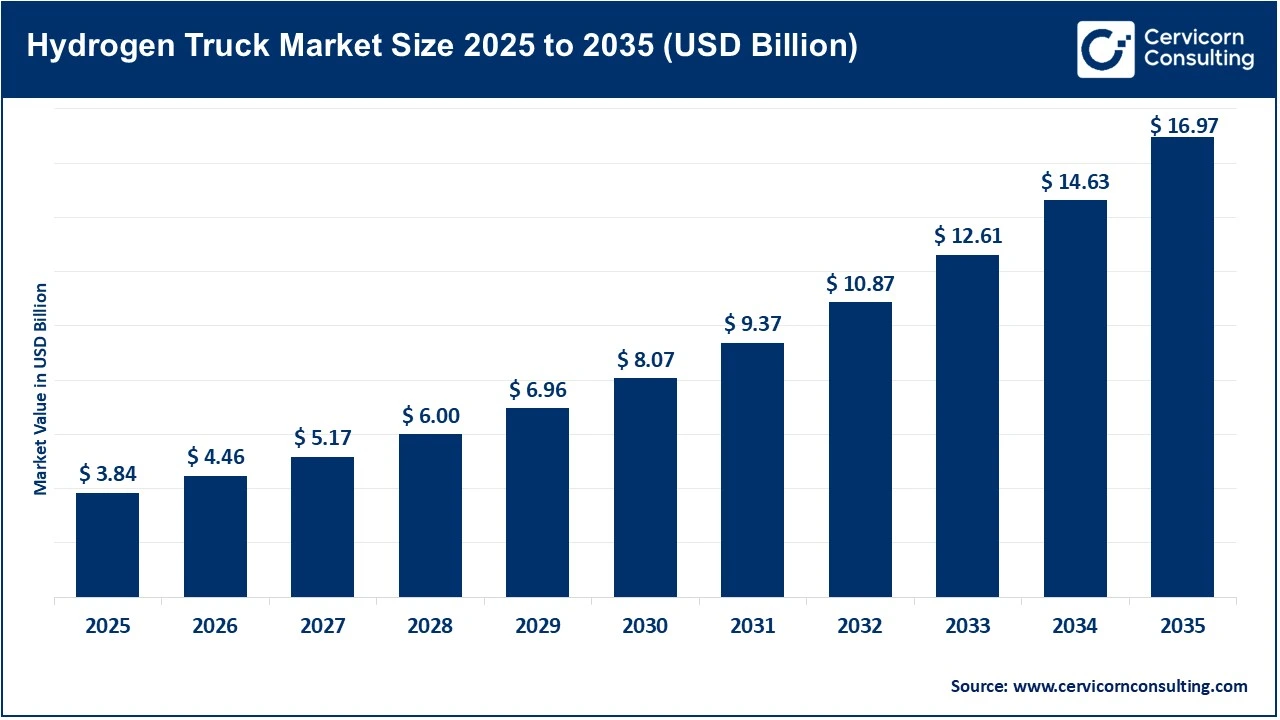
Another significant growth factor is the rapid expansion of hydrogen production and refueling infrastructure, coupled with continuous advancements in fuel cell technology. More than 1,000 hydrogen refueling stations were operating worldwide by the end of 2024, with over half located in Asia, improving fuel accessibility for commercial fleets. Simultaneously, advances in proton exchange membrane (PEM) fuel cells have enhanced durability, efficiency, and power output while reducing system costs. Increasing investments by truck manufacturers, energy companies, and public agencies in hydrogen ecosystems are further strengthening supply chains and accelerating commercial deployment across long-haul logistics, construction, mining, and municipal transportation applications.
Report Highlights
- Asia-Pacific dominated the hydrogen truck market with 48.2% share, supported by China's hydrogen infrastructure expansion, strong commercial vehicle production, and extensive government-backed fuel cell deployment initiatives.
- Heavy-Duty Trucks held the largest 55.6% market share, driven by increasing long-haul freight demand, superior payload capacity, extended driving range, and rapid hydrogen refueling capabilities.
- Hydrogen Fuel Cell Electric Trucks (FCEV) accounted for 91.4% of the market, owing to zero-emission operation, higher efficiency, longer range, and growing investments in hydrogen mobility infrastructure.
- Above 500 km range vehicles captured 47.5% market share, reflecting strong adoption among logistics operators requiring long-distance transportation with minimal refueling interruptions and higher operational efficiency.
- Logistics & Freight Transportation led applications with 44.8% market share, fueled by expanding e-commerce activities, fleet decarbonization strategies, and rising demand for sustainable heavy-duty transportation solutions.
What is a Hydrogen Truck?
A hydrogen truck is a commercial vehicle powered by hydrogen instead of conventional diesel, using either a hydrogen fuel cell electric powertrain (FCEV) or a hydrogen internal combustion engine (H2-ICE). In fuel cell trucks, hydrogen reacts with oxygen to generate electricity that powers an electric motor, with water vapor and heat as the only tailpipe emissions. Hydrogen trucks are particularly suited for medium- and heavy-duty freight because they offer long driving ranges, fast refueling, and high payload capacity while supporting global decarbonization goals for the transportation and logistics sectors.
Benefits of Hydrogen Truck
- Zero tailpipe emissions: Fuel cell hydrogen trucks emit only water vapor, eliminating CO₂, nitrogen oxides (NOₓ), and particulate matter during operation.
- Significant lifecycle emission reduction: When powered by green hydrogen, lifecycle greenhouse gas emissions can be reduced by more than 85% compared with conventional diesel trucks.
- Fast Refueling: Most hydrogen trucks can be refueled in approximately 10–15 minutes, minimizing fleet downtime and enabling high vehicle utilization.
- Long driving range: Commercial hydrogen trucks can achieve driving ranges of 400–1,000 km per refueling, making them suitable for long-haul transportation.
- Higher payload capacity: Hydrogen powertrains are generally lighter than large battery packs, allowing trucks to carry heavier cargo without significantly reducing range.
- Improved fleet productivity: Hydrogen trucks maintain diesel-like refueling convenience while offering electric drivetrain efficiency, making them ideal for continuous freight and logistics operations.
- Proven operational performance: In New Zealand, a hydrogen truck completed over 100,000 km, saved more than 40,000 liters of diesel, and reduced over 110 tonnes of CO₂ emissions during commercial operation.
Hydrogen Truck Market Dynamics
Market Driver
1. Government Decarbonization Policies and Incentives
Governments worldwide are introducing strict emission regulations and financial incentives to accelerate the adoption of hydrogen-powered commercial vehicles. Regions such as Europe, China, Japan, and the United States are investing heavily in hydrogen mobility through subsidies, tax benefits, and hydrogen corridor projects. These initiatives encourage logistics companies to replace diesel fleets with zero-emission alternatives. In addition, the global fuel cell vehicle fleet exceeded 72,000 units, supported by 1,022 hydrogen refueling stations by the end of 2023, demonstrating increasing policy-driven deployment and infrastructure expansion.
2. Rising Demand for Long-Haul Zero-Emission Freight
Hydrogen trucks are increasingly preferred for long-distance freight because they combine long driving ranges with rapid refueling, overcoming limitations associated with battery-electric trucks. Their ability to operate continuously while maintaining high payload capacity makes them suitable for logistics, mining, and construction applications. Industry studies indicate hydrogen fuel cell trucks provide clear advantages in continuous mileage and refueling time compared with battery-electric alternatives, making them an attractive solution for heavy-duty commercial transportation where operational efficiency remains a critical purchasing factor.
Market Restraint
1. High Vehicle and Fuel Costs
The high acquisition cost of hydrogen trucks and the relatively expensive production of low-carbon hydrogen remain major barriers to widespread adoption. Fuel cell systems, hydrogen storage tanks, and refueling infrastructure significantly increase ownership costs compared to diesel vehicles. According to the International Energy Agency, fuel cell trucks remained approximately 35% more expensive than diesel trucks in China during 2024, mainly because of higher hydrogen fuel prices and infrastructure expenses. These cost challenges continue to limit commercial fleet expansion.
2. Limited Hydrogen Refueling Infrastructure
Despite ongoing investments, hydrogen refueling infrastructure remains insufficient for large-scale commercial deployment, particularly across long-haul transportation routes. Many countries have only a limited number of stations, creating operational uncertainty for logistics operators. Although the global network surpassed 1,022 hydrogen refueling stations by the end of 2023, infrastructure remains concentrated in a few regions, requiring substantial expansion before hydrogen trucks can achieve widespread market penetration and reliable cross-border freight operations.
Market Opportunity
1. Expansion of Green Hydrogen Production
Rapid investments in renewable energy and electrolysis technologies are creating significant opportunities for hydrogen truck adoption. The International Energy Agency estimates that the cost of producing renewable hydrogen could decline by approximately 30% by 2030 through cheaper renewable electricity and large-scale manufacturing of electrolysers. Lower hydrogen production costs will improve fuel affordability, strengthen fleet economics, and encourage commercial transport operators to transition from diesel to hydrogen-powered heavy-duty vehicles.
2. Growing Investments in Hydrogen Ecosystems
Public and private investments across the hydrogen value chain are accelerating commercialization opportunities for truck manufacturers and infrastructure providers. According to the International Energy Agency, final investment decisions for hydrogen projects doubled during the previous year, with China accounting for more than 40% of newly approved projects. These investments support hydrogen production facilities, refueling stations, and supply chains, creating a stronger ecosystem that can accelerate deployment of hydrogen-powered commercial transportation globally.
Market Challenge
1. Competition from Battery-Electric Trucks
Hydrogen trucks face strong competition from battery-electric trucks, which are benefiting from rapidly declining battery costs, expanding charging infrastructure, and higher commercial adoption. According to the International Energy Agency, electric trucks reached approximately 9% of global truck sales in 2025, with sales exceeding 400,000 units worldwide. This rapid growth increases competitive pressure on hydrogen truck manufacturers, requiring continuous improvements in cost efficiency, vehicle performance, and hydrogen availability.
2. Uncertain Hydrogen Demand and Supply Chain Development
Although hydrogen investments are increasing, commercial demand remains uncertain, slowing infrastructure deployment and project execution. The International Energy Agency reports that current hydrogen demand targets account for only about one-quarter of announced production projects, while many developments remain in early planning stages because of financing constraints, regulatory delays, and unclear market signals. These uncertainties complicate long-term investment decisions for truck manufacturers, fleet operators, and hydrogen suppliers.
Hydrogen Truck Market Regional Analysis
The hydrogen truck market is segmented by region into North America, Europe, Asia-Pacific, Latin America, and LAMEA. Here is a brief overview of each region:
Why is North America witnessing robust growth in the hydrogen truck market?
The North America hydrogen truck market size was accounted for USD 0.71 billion in 2025 and is expected to surge around USD 3.16 billion by 2035. The North America market is witnessing robust growth due to increasing investments in hydrogen production, expanding refueling infrastructure, and stringent emission regulations targeting the heavy-duty transportation sector. The region is actively transitioning toward zero-emission commercial vehicles through federal and state incentive programs, public-private hydrogen corridor projects, and clean freight initiatives. Leading truck manufacturers and energy companies are accelerating the commercialization of hydrogen fuel cell trucks, while logistics operators are adopting hydrogen-powered fleets for long-haul transportation. Growing investments in green hydrogen production, advancements in fuel cell technology, and rising demand for sustainable freight solutions continue to strengthen the regional market outlook.
United States: Strong federal hydrogen investments, expanding hydrogen corridors, and commercial fleet decarbonization drive market growth
- The United States has allocated up to USD 7 billion for seven Regional Clean Hydrogen Hubs to expand hydrogen production, distribution, and transportation infrastructure.
- Heavy-duty trucks account for approximately 23% of greenhouse gas emissions from the U.S. transportation sector despite representing only a small share of vehicles, accelerating demand for zero-emission hydrogen trucks.
Canada: Growing green hydrogen production, clean freight initiatives, and provincial hydrogen strategies support market expansion
- Canada has launched a national hydrogen strategy targeting leadership in low-carbon hydrogen production while supporting commercial transportation decarbonization.
- Provinces including British Columbia, Alberta, and Quebec are investing in hydrogen production facilities, refueling stations, and hydrogen-powered heavy-duty transportation projects.
Why does Asia-Pacific (APAC) dominate in the hydrogen truck market?
The Asia-Pacific hydrogen truck market size was estimated at USD 1.85 billion in 2025 and is projected to hit around USD 8.18 billion by 2035.
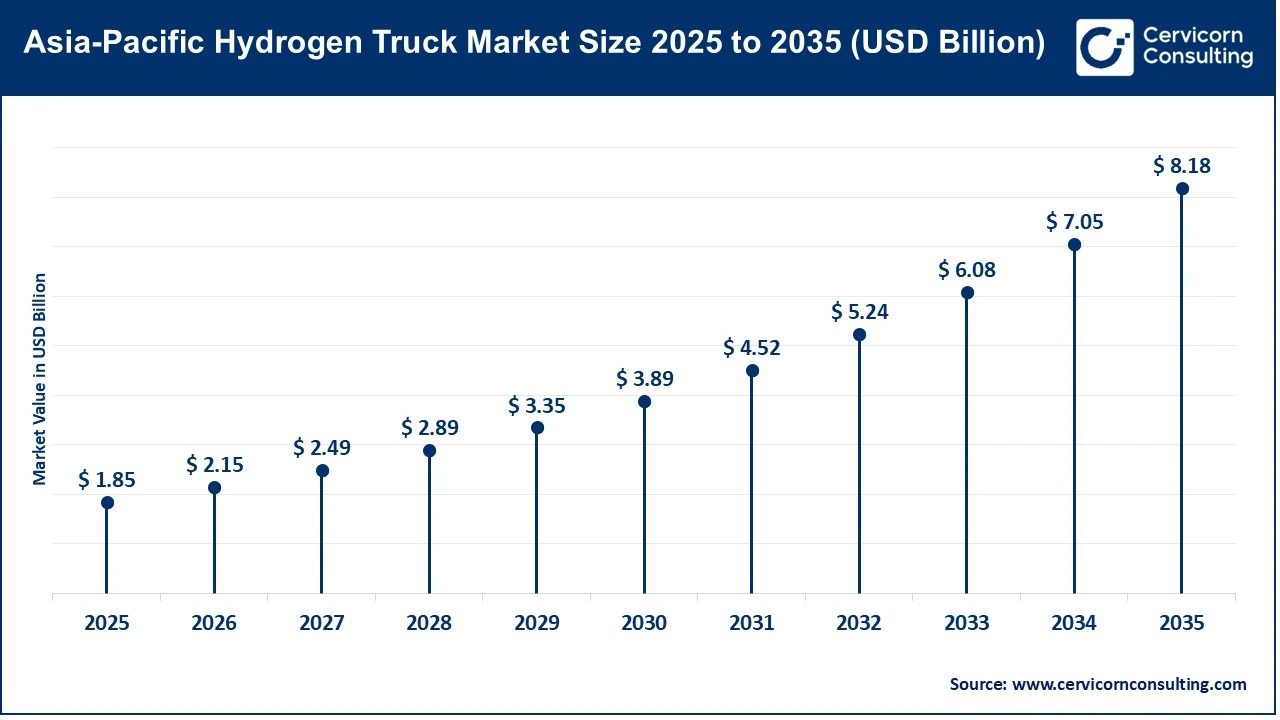
The Asia-Pacific market dominates the global landscape, supported by strong government policies, expanding hydrogen production capacity, and significant investments in fuel cell technology. Countries such as China, Japan, South Korea, and Australia are accelerating hydrogen ecosystem development through subsidies, hydrogen refueling station expansion, and commercial fleet deployment programs. The region also benefits from a large commercial vehicle manufacturing base, increasing freight transportation demand, and ambitious carbon neutrality targets. Continuous investments in green hydrogen production, public-private partnerships, and hydrogen-powered logistics corridors are further accelerating the commercialization of hydrogen trucks across industrial, mining, port, and freight transportation applications.
China: World's largest hydrogen vehicle market, strong government support, and rapid hydrogen infrastructure expansion drive market leadership
- China operates more than 540 hydrogen refueling stations, representing over 50% of the world's hydrogen refueling infrastructure, supporting large-scale deployment of fuel cell commercial vehicles.
- The country aims to deploy around 50,000 fuel cell vehicles by 2025 under its national hydrogen industry development plan, with heavy-duty trucks identified as a priority application.
- Leading domestic manufacturers and provincial governments are expanding hydrogen-powered logistics corridors and commercial fleet demonstration projects across major industrial and freight transportation regions.
Japan: Advanced fuel cell technology, national hydrogen strategy, and commercial fleet demonstrations support market growth
- Japan's Basic Hydrogen Strategy promotes hydrogen as a cornerstone of carbon neutrality, encouraging adoption across commercial transportation and logistics sectors.
- The country continues expanding hydrogen refueling infrastructure with more than 160 hydrogen stations, supporting fuel cell trucks, buses, and other commercial vehicles.
Why is Europe experiencing substantial growth in hydrogen truck market?
The Europe hydrogen truck market is expanding from USD 1.06 billion in 2025 to over USD 4.67 billion by 2035. The Europe market is experiencing substantial growth due to stringent carbon emission regulations, increasing investments in renewable hydrogen production, and the rapid expansion of hydrogen refueling infrastructure. The region is accelerating the transition toward zero-emission freight transportation through the European Union's climate policies, hydrogen strategies, and financial support for clean mobility projects. Leading commercial vehicle manufacturers, energy companies, and logistics providers are collaborating to deploy hydrogen-powered trucks across major freight corridors. Growing investments in green hydrogen production, cross-border hydrogen infrastructure, and fuel cell technology innovation continue to strengthen Europe's position as a leading hydrogen truck market.
Germany: Europe's hydrogen truck leader with strong industrial base and hydrogen infrastructure investments
- Germany has committed over €9 billion under its National Hydrogen Strategy to accelerate hydrogen production, infrastructure development, and commercial transportation decarbonization.
- The country hosts one of Europe's largest hydrogen refueling networks, with more than 110 hydrogen stations, supporting fuel cell trucks, buses, and logistics fleets.
- Major truck manufacturers and logistics companies are expanding hydrogen truck pilot projects and establishing hydrogen freight corridors connecting key industrial and logistics hubs across the country.
United Kingdom: National hydrogen strategy, clean mobility investments, and expanding hydrogen production drive market growth
- France has allocated more than EUR 7 billion to develop a low-carbon hydrogen economy, focusing on industrial decarbonization and sustainable transportation.
- The country is expanding hydrogen refueling infrastructure and supporting commercial vehicle deployment through public funding and regional clean mobility initiatives.
Hydrogen Truck Market Share, By Region, 2025 (%)
| Region |
Revenue Share, 2025 (%) |
| Asia-Pacific |
48.20% |
| Europe |
27.50% |
| North America |
18.60% |
| LAMEA |
5.70% |
What factors are witnessing steady growth of LAMEA hydrogen truck market?
The LAMEA hydrogen truck market was valued at USD 0.22 billion in 2025 and is anticipated to reach around USD 0.97 billion by 2035. The LAMEA hydrogen truck market is gradually expanding as countries across Latin America, the Middle East, and Africa invest in green hydrogen production, sustainable freight transportation, and industrial decarbonization. The region possesses abundant renewable energy resources, enabling large-scale green hydrogen development for domestic use and export. Governments are introducing national hydrogen strategies, while mining companies, logistics operators, and port authorities are evaluating hydrogen-powered heavy-duty trucks to reduce emissions. Increasing foreign investments, public-private partnerships, and hydrogen export initiatives are expected to accelerate the deployment of hydrogen trucks across commercial transportation and industrial applications.
Saudi Arabia: Large-Scale Green Hydrogen Investments and Vision 2030 Initiatives Accelerate Market Development
- Saudi Arabia is developing one of the world's largest green hydrogen projects through the NEOM Green Hydrogen Project, expected to produce up to 600 tonnes of green hydrogen per day upon full operation.
- The country's Vision 2030 program prioritizes clean energy, hydrogen production, and low-carbon transportation, creating opportunities for hydrogen-powered commercial vehicle adoption.
Brazil: Expanding Green Hydrogen Capacity, Renewable Energy Leadership, and Sustainable Logistics Support Market Growth
- Brazil generates more than 85% of its electricity from low-carbon sources, providing a strong foundation for cost-effective green hydrogen production.
- Several hydrogen hub projects are under development at major ports, including the Port of Pecém, supporting hydrogen production, export, and heavy-duty transportation applications.
Hydrogen Truck Market Segmental Analysis
The hydrogen truck market is segmented into vehicle type, propulsion technology, range, application, and geography.
Vehicle Type Analysis
Heavy-duty trucks dominate the hydrogen truck market because they benefit the most from hydrogen fuel technology, offering long driving ranges, high payload capacity, and rapid refueling compared to battery-electric alternatives. These trucks are widely deployed for long-haul logistics, freight transportation, mining, and industrial operations where continuous operation is essential. Government decarbonization policies targeting commercial freight emissions and increasing investments in hydrogen refueling corridors further strengthen demand, making heavy-duty trucks the largest revenue-generating segment across global hydrogen truck deployments.
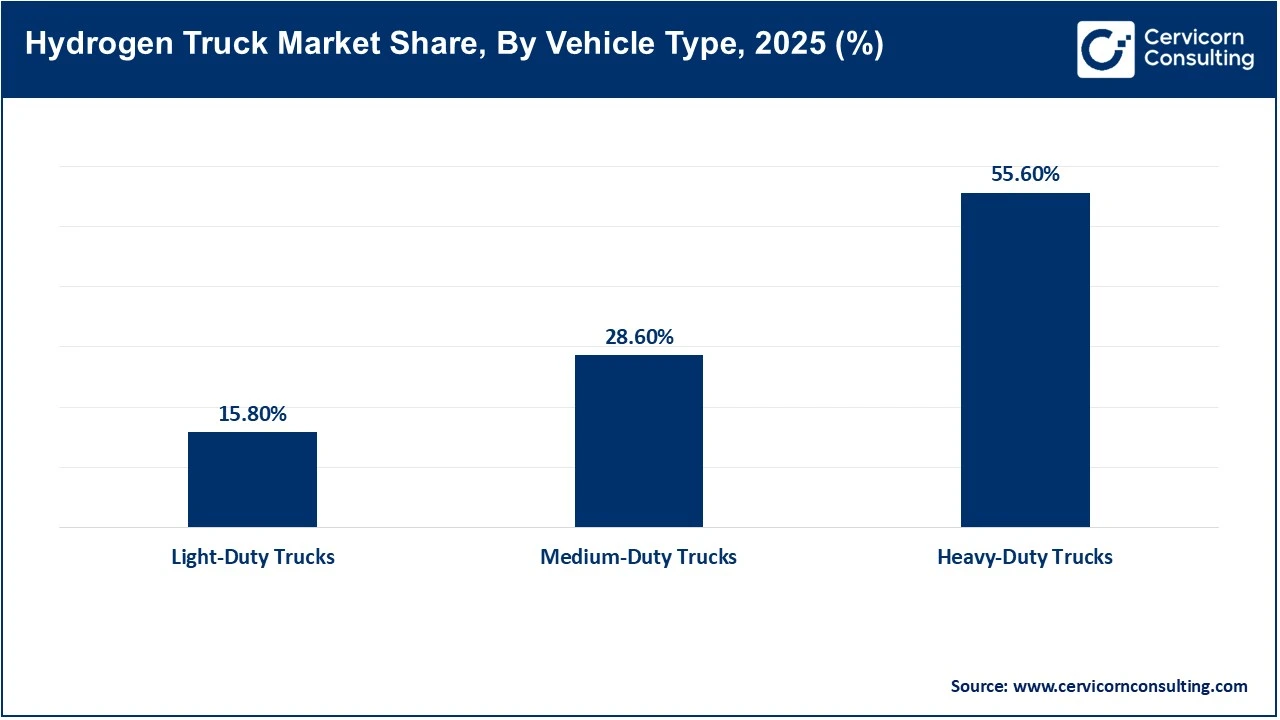
Medium-duty trucks are projected to witness the fastest growth due to increasing adoption in regional distribution, municipal transportation, and urban delivery services. Fleet operators are investing in hydrogen-powered medium-duty vehicles to reduce emissions while maintaining operational flexibility and faster refueling than battery-electric alternatives. Expanding hydrogen infrastructure, government incentive programs, and growing commercial availability of fuel cell platforms are accelerating adoption, particularly for applications requiring daily operations with moderate payloads and extended driving ranges.
Propulsion Technology Analysis
Hydrogen Fuel Cell Electric Trucks (FCEVs) account for the largest market share owing to their zero tailpipe emissions, superior energy efficiency, and long-distance operational capability. Fuel cell technology delivers higher driving ranges and shorter refueling times than battery-electric heavy trucks, making it the preferred solution for commercial freight operators. Strong investments from truck manufacturers, expanding hydrogen infrastructure, and supportive government funding continue to reinforce the commercial dominance of fuel cell-powered hydrogen trucks worldwide.
Hydrogen Truck Market, By Propulsion Technology, 2025 (%)
| Propulsion Technology |
Revenue Share, 2025 (%) |
| Hydrogen Fuel Cell Electric Trucks (FCEV) |
91.4% |
| Hydrogen Internal Combustion Engine (H2-ICE) Trucks |
8.6% |
Hydrogen Internal Combustion Engine (H2-ICE) trucks are expected to register the fastest growth due to their lower development costs and compatibility with existing engine manufacturing technologies. Commercial vehicle manufacturers are increasingly exploring H2-ICE solutions as an economical pathway toward low-carbon transportation while utilizing established production facilities. Their simpler integration, reduced engineering complexity, and suitability for heavy-duty applications are encouraging adoption, particularly in regions where hydrogen infrastructure is gradually expanding.
Range Analysis
The above 500 km range segment dominates the hydrogen truck market because long-distance transportation remains the primary commercial application for hydrogen-powered trucks. Fleet operators prefer vehicles capable of extended travel between refueling stops to maximize operational efficiency and reduce downtime. Hydrogen fuel cell technology naturally supports longer driving distances than many battery-electric alternatives, making this segment highly attractive for cross-country freight movement, industrial logistics, and intercity commercial transportation.
Hydrogen Truck Market, By Range, 2025 (%)
| Range |
Revenue Share, 2025 (%) |
| Below 300 km |
18.4% |
| 300–500 km |
34.1% |
| Above 500 km |
47.5% |
The 300–500 km range category is expected to experience the fastest growth as regional logistics, urban distribution, and municipal transportation increasingly adopt hydrogen-powered commercial vehicles. This range effectively balances operating costs, vehicle weight, and refueling convenience while meeting the daily mileage requirements of many commercial fleets. Continued improvements in fuel cell efficiency and expanding hydrogen station networks are making mid-range hydrogen trucks increasingly practical for diverse transportation applications.
Application Analysis
Logistics and freight transportation represent the largest application segment due to rising demand for zero-emission long-haul transportation and sustainable supply chain operations. Hydrogen trucks provide extended driving ranges, fast refueling, and high payload capacity, making them highly suitable for freight operators seeking diesel alternatives. Growing e-commerce activity, stricter emission regulations, and corporate sustainability commitments are accelerating adoption across logistics companies, positioning this application as the dominant contributor to overall market demand.
Hydrogen Truck Market, By Application, 2025 (%)
| Application |
Revenue Share, 2025 (%) |
| Logistics & Freight Transportation |
44.8% |
| Municipal Services |
12.3% |
| Construction |
10.2% |
| Mining |
11.4% |
| Port Operations |
8.6% |
| Waste Management |
6.5% |
| Others |
6.2% |
Port operations are anticipated to be the fastest-growing application as ports worldwide pursue carbon-neutral cargo handling and transportation systems. Hydrogen trucks are increasingly deployed for container movement, terminal logistics, and drayage operations due to their ability to operate continuously with minimal downtime. Government-backed hydrogen hub initiatives, investments in clean port infrastructure, and increasing integration of hydrogen-powered equipment are driving rapid adoption, particularly across major international trade and shipping hubs.
Hydrogen Truck Market Top Companies
Recent Developments
- In September 2025, Daimler Truck announced that five Mercedes-Benz GenH2 fuel cell trucks successfully completed more than 225,000 kilometers in real-world customer operations across Germany. The trial validated the trucks' long-range performance, fuel efficiency, and operational reliability, providing critical data for next-generation vehicle development and supporting the company's roadmap toward commercial hydrogen truck production in Europe.
- In October 2025, Hyundai expanded deployment of its XCIENT Fuel Cell heavy-duty trucks across Europe and South Korea through partnerships with logistics operators. The initiative strengthened commercial hydrogen freight transportation, demonstrated the reliability of fuel cell technology under daily operating conditions, and supported Hyundai's strategy to accelerate the global adoption of zero-emission hydrogen-powered commercial vehicles.
- In June 2025, Toyota announced the formation of a new commercial vehicle holding company with Hino Motors, Mitsubishi Fuso, and Daimler Truck to accelerate the development of hydrogen-powered commercial vehicles. The collaboration aims to combine engineering expertise, strengthen fuel cell innovation, and accelerate commercialization of next-generation hydrogen trucks for global freight transportation.
Market Segmentation
By Vehicle Type
- Light-Duty Trucks
- Medium-Duty Trucks
- Heavy-Duty Trucks
By Propulsion Technology
- Hydrogen Fuel Cell Electric Trucks (FCEV)
- Hydrogen Internal Combustion Engine (H2-ICE) Trucks
By Range
- Below 300 km
- 300–500 km
- Above 500 km
By Application
- Logistics & Freight Transportation
- Municipal Services
- Construction
- Mining
- Port Operations
- Waste Management
- Others
By Geography
- North America
- Europe
- Asia-Pacific
- LAMEA