Hydrogen Mobility Market Size and Growth 2026 to 2035
The global hydrogen mobility market size was valued at USD 102.74 billion in 2025 and is expected to surpass around USD 421.57 billion by 2035, exhibiting a compound annual growth rate (CAGR) of 15.2% over the forecast period from 2026 to 2035.
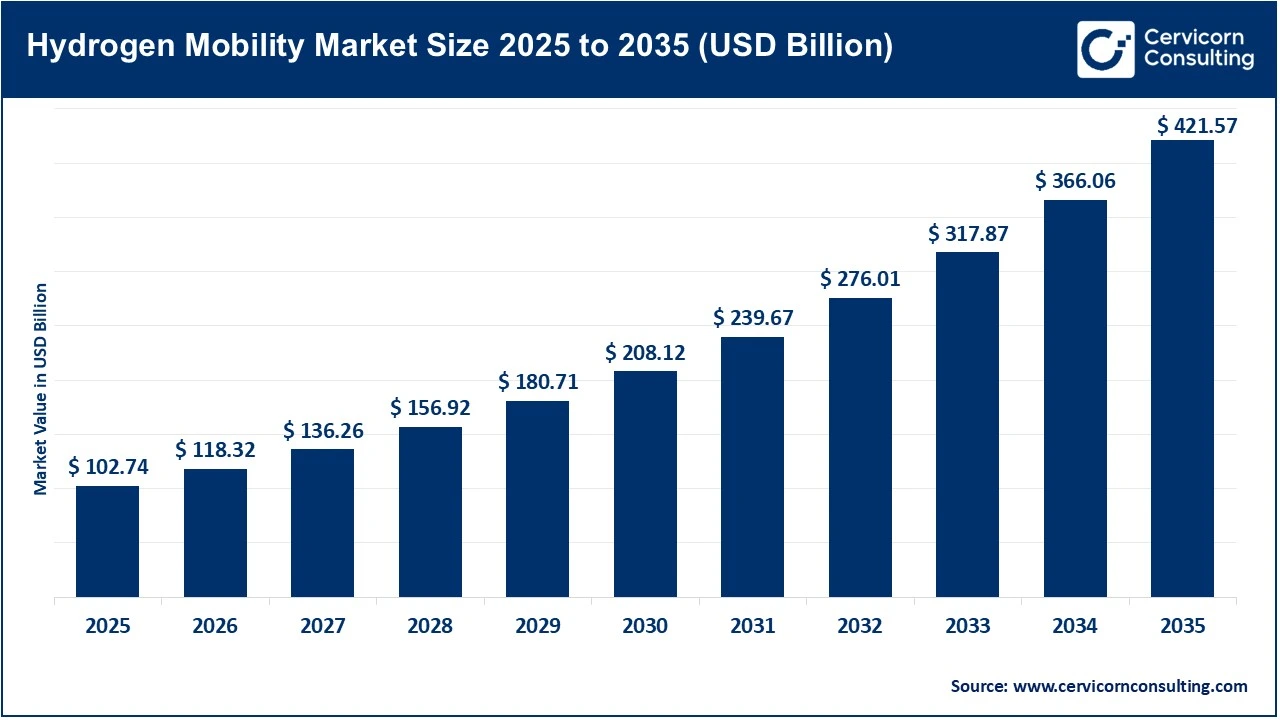
The hydrogen mobility market is mainly propelled by the global efforts to decarbonise and strict emission standards, especially in heavy-duty transport where battery-electric options are limited by range and charging times. Governments in Asia, Europe, and North America are increasingly supporting hydrogen infrastructure with subsidies, tax benefits, and clean transport mandates. Fuel-cell vehicles (FCEVs) are becoming more popular because they can be refilled quickly- usually within 3–5 minutes- and offer extensive driving ranges, making them ideal for buses, trucks, freight, rail, and commercial fleets. Meanwhile, automakers like Toyota, Hyundai, and BMW are investing more in hydrogen mobility, and countries including Japan, South Korea, Germany, and China keep hydrogen a key part of their energy plans. The hydrogen fuel cell vehicle segment is expected to grow rapidly as confidence in hydrogen-powered transportation increases.
Another significant growth driver is the rapid expansion of hydrogen refueling stations and decreasing fuel-cell technology costs. By the end of 2024, over 1,369 hydrogen refueling stations were operational worldwide in 44 countries, with more than 400 either under construction or planned, enhancing access for both commercial and passenger hydrogen vehicles. Improvements in fuel-cell efficiency and lower system costs are also boosting the commercial appeal of hydrogen mobility, especially for long-distance transport where reliability is vital. Additionally, increased investments in green hydrogen production are bolstering the supply chain and advancing net-zero transport goals. Nevertheless, market growth still relies on expanding infrastructure and cutting hydrogen production costs in key regions.
Report Highlights
- By Region, Asia Pacific led the global hydrogen mobility market with a share of 46.8%, supported by strong government hydrogen strategies, rapid fuel-cell vehicle deployment, expanding hydrogen refueling infrastructure, and large-scale investments across China, Japan, and South Korea.
- By Mobility Mode, the commercial vehicles segment dominated the market with a share of 34.7%, supported by rising adoption of hydrogen-powered trucks, freight vehicles, and heavy-duty transport requiring long driving range and fast refueling capabilities.
- By Technology, the fuel cell technology held the largest market share of 58.6%, owing to strong deployment in hydrogen passenger vehicles, buses, and commercial fleets, supported by high energy efficiency and zero tailpipe emissions.
- By Hydrogen Source, the gray hydrogen accounted for the largest market share of 51.3%, supported by established production infrastructure, lower costs, and widespread availability for transportation applications.
- By Application, the freight & logistics dominated the application segment with a share of 36.9%, driven by increasing demand for hydrogen-powered long-haul transportation, fleet decarbonization initiatives, and operational advantages over battery-electric alternatives.
What is Hydrogen Mobility and Its Applications
Hydrogen mobility refers to the use of hydrogen as a clean energy source for transportation, primarily through hydrogen fuel cells or hydrogen combustion engines to power vehicles with low or zero tailpipe emissions. In hydrogen fuel cell vehicles (FCEVs), hydrogen reacts with oxygen to generate electricity, producing only water vapor as a byproduct, making it an environmentally sustainable alternative to fossil-fuel-powered transport. Hydrogen mobility is widely applied across passenger vehicles, buses, heavy-duty trucks, rail transport, maritime vessels, aviation, and industrial mobility equipment such as forklifts and mining vehicles. It is particularly valuable in long-range and heavy-load transportation because hydrogen-powered vehicles offer fast refueling times and extended driving ranges compared to many battery-electric alternatives, making them suitable for logistics, public transit, freight, ports, airports, and other commercial mobility applications.
Stringent Emission Regulations & Corporate ESG Targets Driving Market Growth
Stringent vehicle emission regulations and rising corporate ESG (Environmental, Social, and Governance) commitments are significantly accelerating hydrogen mobility adoption, particularly in heavy-duty transport, logistics, and public transit. Governments are tightening decarbonization mandates to phase out diesel vehicles and reduce transport-sector emissions, forcing fleet operators and OEMs to transition toward zero-emission technologies such as hydrogen fuel cell vehicles (FCEVs). At the same time, corporations with net-zero targets are increasingly investing in hydrogen-powered trucks, buses, and commercial fleets to reduce Scope 1 and Scope 3 emissions while maintaining operational efficiency through long range and fast refueling. Hydrogen mobility is especially attractive for freight, mining, ports, and industrial transport where battery-electric vehicles may face payload and charging constraints. Regulatory pressure combined with ESG-driven procurement strategies is therefore creating sustained demand for hydrogen-powered mobility solutions.
Some of the key factors of this growth
- The transportation sector contributes roughly 14% of global greenhouse gas emissions, increasing pressure for zero-emission mobility solutions.
- The European Union mandates all new cars and vans sold from 2035 to be zero-emission, while urban buses are targeted for 100% emission reduction by 2035.
- The EU heavy-duty vehicle regulation targets a 90% reduction in truck emissions by 2040, boosting hydrogen truck deployment.
- Commercial fleet operators are increasingly adopting hydrogen mobility to align with corporate net-zero and ESG reporting requirements, especially in logistics and industrial transportation.
Report Scope
| Area of Focus |
Details |
| Market Size in 2026 |
USD 118.32 Billion |
| Market Size in 2035 |
USD 421.57 Billion |
| CAGR 2026 to 2035 |
15.20% |
| Dominant Region |
Asia-Pacific |
| Key Segments |
Mobility Mode, Technology, Hydrogen Source, Application, Region |
| Key Companies |
Toyota Motor Corporation, Hyundai Motor Company, Honda Motor Co., Ltd., BMW Group, Daimler Truck AG, Ballard Power Systems, Plug Power Inc., Nikola Corporation, Cummins Inc., Air Liquide, Linde plc, Hexagon Purus |
Recent Major Milestones
1. India’s National Green Hydrogen Mission Mobility Pilots (2025)
India accelerated hydrogen mobility deployment through new pilot projects under the National Green Hydrogen Mission, allocating funding for hydrogen-powered buses and trucks across multiple transport corridors. The initiative includes 37 hydrogen vehicles (fuel-cell and hydrogen ICE trucks/buses) and nine hydrogen refueling stations, supported by major players such as Tata Motors, Indian Oil, NTPC, and Ashok Leyland. This milestone is driving the market by creating real-world operating ecosystems, lowering technology risk for fleet operators, and stimulating investments in hydrogen refueling infrastructure, which is essential for scaling commercial hydrogen mobility adoption.
- 37 hydrogen-powered vehicles planned under pilot deployment.
- 9 hydrogen refueling stations to support mobility corridors.
- Government support includes around INR 496 crore for mobility pilot projects.
2. Hyundai Motor’s Hydrogen Fuel Cell Manufacturing Expansion (2025)
In late 2025, Hyundai Motor broke ground on a USD 654 million hydrogen fuel-cell manufacturing plant in South Korea, aimed at producing fuel cells and electrolyzers for hydrogeassenger cars, trucks, buses, marine vessels, and industrial vehicles. This development strengthens supply-chain capacity and lowers production costs for fuel-cell systems, helping hydrogen mobility become more commercially viable. By expanding manufacturing at scale, Hyundai is accelerating technology maturity and increasing confidence among OEMs and fleet operators considering hydrogen-powered mobility solutions.
- USD 654 million investment in hydrogen fuel-cell production.
- Facility to support passenger vehicles, commercial trucks, buses, and marine mobility.
- Plant expected to be operational by 2027, expanding global hydrogen mobility supply capacity.
3. India’s First Hydrogen-Powered Heavy-Duty Truck Deployment (2025)
India witnessed a major milestone with the deployment of its first hydrogen-powered fuel-cell mining truck by Adani Enterprises in Chhattisgarh. Designed to carry heavy industrial loads while replacing diesel trucks, the project demonstrates hydrogen’s feasibility in hard-to-abate heavy-duty transport segments. This milestone is driving the market by proving hydrogen’s operational value in mining, freight, and logistics applications where long range, fast refueling, and high payload capacity are critical, encouraging industrial fleet electrification beyond passenger transport.
- Truck designed to carry up to 40 tons of cargo.
- Operational range of approximately 200 km per refuel.
- Emits only water vapor and warm air, replacing diesel emissions.
4. Expansion of Green Hydrogen Production for Mobility Applications (2025)
Governments are increasingly linking hydrogen production directly with mobility deployment. By mid-2025, India had allocated 862,000 tonnes of annual green hydrogen production capacity to 19 companies, while simultaneously launching hydrogen pilots in transport and shipping. This is a major market milestone because mobility adoption depends heavily on reliable, low-cost hydrogen supply. Expanding domestic green hydrogen production reduces fuel costs, strengthens energy security, and supports the creation of integrated hydrogen ecosystems for transportation and logistics.
- 19 companies allocated 862,000 tonnes/year of green hydrogen production capacity.
- 3,000 MW annual electrolyzer manufacturing capacity awarded to 15 firms.
- India targets 5 million metric tons of green hydrogen production by 2030.
Regional Analysis
The hydrogen mobility market is segmented by region into North America, Europe, Asia-Pacific, Latin America, and LAMEA. Here is a brief overview of each region:
North America Hydrogen Mobility Market: Driven by Stringent Decarbonization Policies, Expanding Hydrogen Infrastructure, and Strong Commercial Vehicle Adoption
The North America hydrogen mobility market size was estimated at USD 20.14 billion in 2025 and is projected to surpass around USD 82.63 billion by 2035. The North America market is experiencing substantial growth, supported by aggressive decarbonization targets, increasing investments in clean transportation, and the expansion of hydrogen production and refueling infrastructure. The region is witnessing growing adoption of hydrogen-powered buses, heavy-duty trucks, freight vehicles, and industrial mobility solutions, particularly in logistics, mining, and public transportation where long driving range and fast refueling are critical advantages. Rising federal incentives for clean hydrogen production, zero-emission vehicle mandates, and private-sector investments by automotive OEMs and energy companies are accelerating the development of the hydrogen ecosystem.
United States: Strong clean hydrogen investments, commercial fleet electrification, and supportive federal incentives continue driving market expansion.
The U.S. represents the largest hydrogen mobility market in North America due to growing deployment of hydrogen-powered heavy-duty trucks, transit buses, forklifts, and port mobility applications. Federal initiatives including the Inflation Reduction Act (IRA) and the U.S. National Clean Hydrogen Strategy are accelerating investments in hydrogen production, storage, and transportation infrastructure. States such as California continue leading hydrogen vehicle deployment and fueling infrastructure development, while major companies including Toyota, Plug Power, Nikola, and Cummins are actively expanding hydrogen mobility solutions.
- The U.S. Department of Energy announced USD 7 billion in funding for regional clean hydrogen hubs to accelerate hydrogen ecosystem development.
- California accounts for the majority of U.S. hydrogen refueling stations, supporting hydrogen passenger and commercial vehicle deployment.
- Growing investments in hydrogen-powered freight corridors are accelerating heavy-duty truck adoption across logistics networks.
Canada: Expanding clean hydrogen strategies, public transit decarbonization, and abundant renewable energy resources support market growth.
Canada is strengthening its hydrogen mobility ecosystem through national hydrogen roadmaps, increasing hydrogen bus deployment, and investments in clean fuel infrastructure. Provinces such as British Columbia, Alberta, and Quebec are actively supporting hydrogen-powered transit systems and industrial transportation to reduce carbon emissions. Strong availability of renewable electricity and government support for green hydrogen production are helping Canada position itself as a key hydrogen supplier and mobility innovation hub.
- Canada’s national hydrogen strategy targets hydrogen to contribute significantly toward achieving net-zero emissions by 2050.
- Hydrogen-powered bus pilot programs are expanding across public transit systems in major provinces.
- Increasing public-private investments are supporting hydrogen production and refueling infrastructure expansion.
Asia-Pacific (APAC) Hydrogen Mobility Market: Driven by National Hydrogen Strategies, Rapid Commercial Vehicle Deployment, and Expanding Refueling Infrastructure
The Asia-Pacific drogen mobility market size was valued at USD 48.08 billion in 2025 and is expected to hit around USD 197.29 billion by 2035.
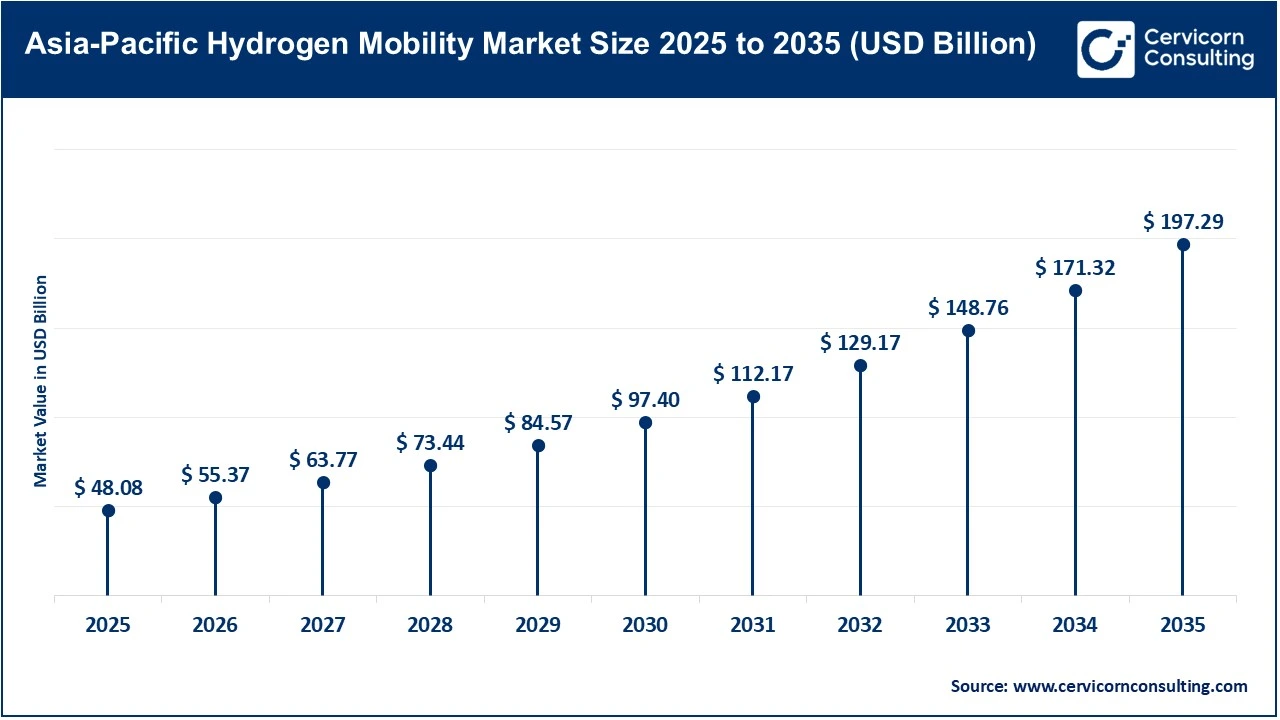
The Asia Pacific market is witnessing strong growth, supported by aggressive government hydrogen roadmaps, increasing investments in fuel-cell transportation, and rapid expansion of hydrogen refueling infrastructure. Countries across the region are prioritizing hydrogen mobility to strengthen energy security, reduce transport-sector emissions, and decarbonize heavy-duty transport, public transit, and industrial logistics. Strong participation from automotive OEMs, fuel-cell technology developers, and energy companies is accelerating commercialization. Additionally, favorable subsidies, public-private partnerships, and national clean energy programs are encouraging hydrogen vehicle deployment, making Asia Pacific one of the leading global regions for hydrogen mobility expansion.
China: Large-scale hydrogen vehicle deployment, strong policy support, and industrial hydrogen capabilities continue driving market expansion.
- China targets deployment of approximately 50,000 fuel-cell vehicles (FCVs) by 2025 under national hydrogen development plans.
- More than 400 hydrogen refueling stations are operational or under development, among the highest globally.
- Hydrogen demonstration city clusters are receiving billions of yuan in government support to accelerate commercialization.
Japan: Strong hydrogen leadership, advanced refueling networks, and fuel-cell vehicle innovation support market growth.
- Japan aims to deploy around 800,000 fuel-cell vehicles by 2030 under its hydrogen strategy.
- The country operates 150+ hydrogen refueling stations, among the highest in Asia.
- Japan targets approximately 1,000 hydrogen refueling stations by 2030 to strengthen nationwide mobility infrastructure.
India: Rising hydrogen pilot projects, National Green Hydrogen Mission, and heavy-duty transport decarbonization accelerate market development.
- India approved 37 hydrogen-powered mobility pilot vehicles and 9 hydrogen refueling stations under government-backed projects.
- The National Green Hydrogen Mission has an outlay of approximately INR 19,744 crore to support hydrogen ecosystem development.
- India targets production of 5 million metric tons of green hydrogen annually by 2030, supporting future transportation fuel demand.
Europe Hydrogen Mobility Market: Driven by Stringent Decarbonization Policies, Hydrogen Infrastructure Expansion, and Strong Commercial Transport Electrification
The Europe hydrogen mobility market size reached at USD 28.15 billion in 2025 and is predicted to grow around USD 115.51 billion by 2035. The Europe market is witnessing strong growth, supported by ambitious climate neutrality targets, stringent vehicle emission regulations, and increasing investments in hydrogen transportation ecosystems. The region is rapidly expanding hydrogen-powered buses, trucks, trains, and industrial mobility applications to reduce carbon emissions from hard-to-abate transport sectors. Strong policy support through the European Green Deal, hydrogen funding programs, and zero-emission mobility mandates is accelerating commercialization. In addition, collaborations between automotive manufacturers, hydrogen producers, utilities, and transport operators are strengthening hydrogen refueling infrastructure and promoting cross-border hydrogen transport corridors across the region.
Germany: Strong hydrogen investments, industrial mobility deployment, and government-backed hydrogen strategy continue driving market expansion.
- Germany targets approximately 10 GW of domestic electrolysis capacity by 2030 to strengthen hydrogen supply.
- The country operates one of Europe’s largest hydrogen refueling station networks with 100+ stations.
- Germany has deployed hydrogen-powered passenger trains and continues expanding hydrogen bus fleets across cities.
France: Expanding clean mobility policies, hydrogen public transit, and government funding support market growth.
- France committed more than EUR 9 billion toward hydrogen development by 2030.
- The country aims to deploy thousands of hydrogen-powered commercial and heavy-duty vehicles over the next decade.
- Hydrogen-powered buses and regional mobility projects are expanding in urban transit systems.
United Kingdom: Net-zero transport commitments, hydrogen freight initiatives, and public-private collaborations accelerate growth.
- The UK Hydrogen Strategy targets up to 10 GW of low-carbon hydrogen production capacity by 2030.
- Hydrogen-powered train and bus pilot projects are expanding across regional transportation systems.
- Government initiatives are supporting hydrogen freight and logistics decarbonization programs.
Hydrogen Mobility Market Share, By Region, 2025 (%)
| Region |
Revenue Share, 2025 (%) |
| Asia Pacific |
46.8% |
| Europe |
27.4% |
| North America |
19.6% |
| LAMEA |
6.2% |
LAMEA (Latin America, Middle East & Africa) Hydrogen Mobility Market: Driven by Green Hydrogen Investments, Export-Oriented Hydrogen Strategies, and Clean Transportation Initiatives
The LAMEA hydrogen mobility market was valued at USD 6.37 billion in 2025 and is anticipated to reach around USD 26.14 billion by 2035. The LAMEA market is gradually expanding, supported by rising investments in green hydrogen production, clean transportation initiatives, and government-led decarbonization programs. Countries across Latin America, the Middle East, and Africa are increasingly exploring hydrogen mobility to reduce fossil fuel dependency, strengthen energy diversification, and decarbonize public transport, freight, mining, and industrial mobility sectors. The region is also benefiting from abundant renewable energy resources, particularly solar and wind, which support cost-effective green hydrogen production. Growing partnerships between governments, energy firms, and mobility providers are accelerating pilot deployments of hydrogen buses, trucks, mining vehicles, and industrial transport applications.
Saudi Arabia: Large-scale green hydrogen investments, energy diversification goals, and hydrogen export ambitions continue driving market growth.
- Saudi Arabia’s NEOM project includes a USD 8.4 billion green hydrogen facility, among the largest globally.
- The country is investing heavily in clean transport and industrial decarbonization initiatives under Vision 2030.
- Hydrogen production expansion is expected to support future mobility fuel supply for heavy transport applications.
United Arab Emirates (UAE): Hydrogen innovation programs, smart mobility investments, and clean transportation policies accelerate growth.
- The UAE launched a national hydrogen roadmap targeting leadership in low-carbon hydrogen production.
- Dubai and Abu Dhabi continue expanding investments in clean and autonomous transport ecosystems.
- Public-private collaborations are supporting hydrogen mobility pilot deployments.
Segmental Analysis
The hydrogen mobility market is segmented into mobility mode, technology, hydrogen source, application, and geography.
Mobility Mode Analysis
Commercial vehicles dominate the hydrogen mobility market due to their suitability for long-haul operations, heavy payload requirements, and minimal downtime needs. Hydrogen-powered trucks and logistics fleets benefit from fast refueling times and extended driving ranges compared to battery-electric alternatives, making them attractive for freight transportation. Governments and logistics companies are increasingly investing in hydrogen trucks to meet decarbonization goals while maintaining operational efficiency. Strong deployment across mining, construction, and freight transportation further strengthens the dominance of commercial vehicles in hydrogen mobility adoption.
Hydrogen Mobility Market Share, By Mobility Mode, 2025 (%)
| Mobility Mode |
Revenue Share, 2025 (%) |
| Commercial Vehicles |
34.7% |
| Passenger Vehicles |
23.5% |
| Public Transportation |
16.2% |
| Material Handling & Off-road Vehicles |
11.4% |
| Rail Mobility |
6.1% |
| Maritime Mobility |
4.8% |
| Aviation |
3.3% |
Aviation is emerging as the fastest-growing segment in the hydrogen mobility market due to increasing investments in sustainable aviation fuels and zero-emission aircraft technologies. Aircraft manufacturers and governments are actively exploring hydrogen-powered propulsion systems to reduce aviation emissions, which account for a notable share of global carbon output. Pilot projects, prototype testing, and partnerships between aerospace companies and hydrogen suppliers are accelerating innovation. Growing pressure to decarbonize long-distance air travel is expected to significantly boost hydrogen adoption in the aviation sector.
Technology Analysis
Fuel cell technology, particularly Proton Exchange Membrane Fuel Cells (PEMFC), dominates the hydrogen mobility market because of its high efficiency, quick startup capability, and suitability for transport applications. PEMFC systems are widely used in hydrogen passenger cars, buses, and heavy-duty trucks due to their compact size and ability to operate efficiently under varying driving conditions. Leading automotive companies are prioritizing PEMFC deployment, while governments continue supporting fuel-cell mobility through incentives and infrastructure investments, reinforcing its leadership across transportation applications.
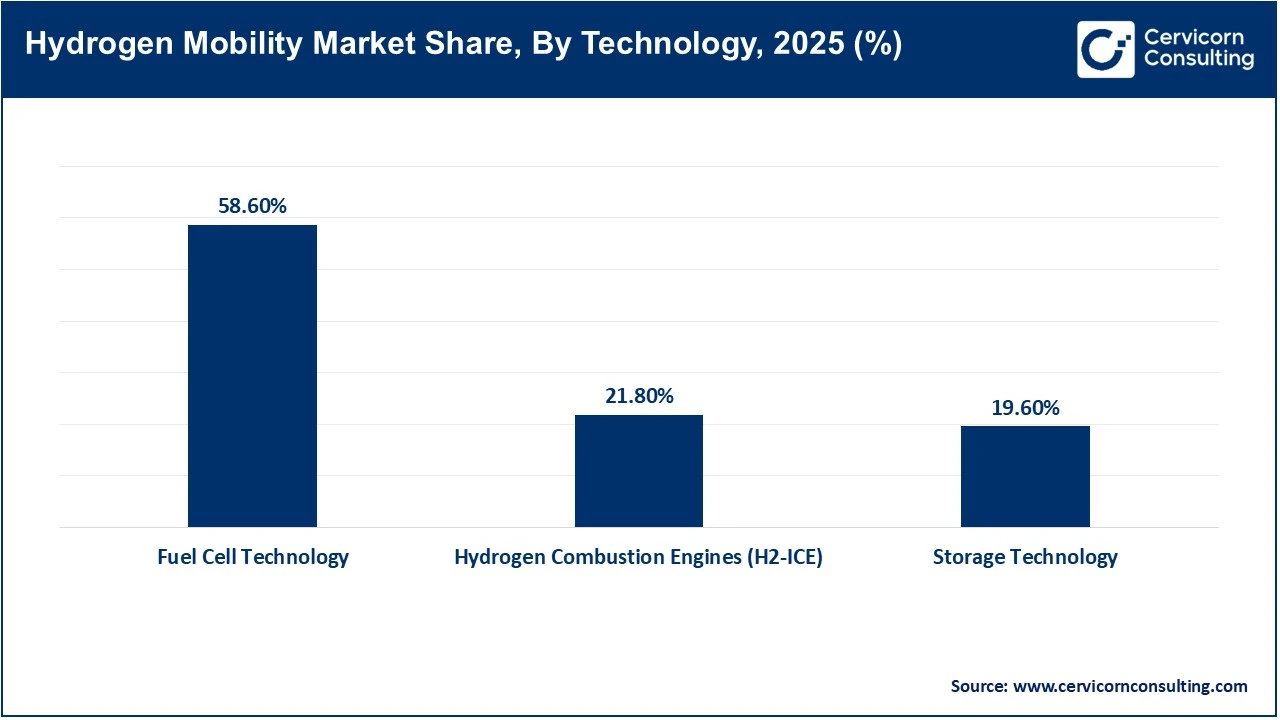
Hydrogen combustion engines (H2-ICE) are witnessing the fastest growth as manufacturers seek cost-effective alternatives to full fuel-cell systems while leveraging existing internal combustion engine platforms. Heavy-duty truck, off-road equipment, and industrial vehicle manufacturers are increasingly testing hydrogen ICE technology because it requires lower redesign costs and easier integration into conventional vehicle architectures. Growing investments from OEMs and supportive industrial decarbonization policies are accelerating commercial trials, making H2-ICE an increasingly attractive transitional technology in hydrogen mobility.
Hydrogen Source Analysis
Gray hydrogen currently dominates the hydrogen mobility market due to its widespread availability and comparatively lower production cost. Produced mainly through natural gas reforming without carbon capture, gray hydrogen remains the primary source for mobility applications in regions where green hydrogen infrastructure is still developing. Many hydrogen refueling stations continue relying on gray hydrogen to maintain supply affordability and operational continuity. Despite sustainability concerns, established supply chains and lower fuel costs continue to support its market leadership.
Hydrogen Mobility Market, By Hydrogen Source, 2025 (%)
| Hydrogen Source |
Revenue Share, 2025 (%) |
| Gray Hydrogen |
51.3% |
| Blue Hydrogen |
24.6% |
| Green Hydrogen |
18.8% |
| Pink Hydrogen |
5.3% |
Green hydrogen is the fastest-growing segment due to increasing global emphasis on decarbonization and renewable energy integration. Produced using electrolysis powered by renewable sources, green hydrogen is gaining traction as governments introduce subsidies, carbon reduction mandates, and national hydrogen strategies. Automotive OEMs and logistics operators increasingly prefer green hydrogen to meet ESG and net-zero commitments. Declining electrolyzer costs and expanding renewable energy capacity are further supporting large-scale green hydrogen production for sustainable transportation applications.
Application Analysis
Freight & logistics dominate the hydrogen mobility market because hydrogen-powered trucks provide long operational ranges, high payload capacity, and rapid refueling capabilities required for commercial transport. Logistics operators increasingly favor hydrogen for long-haul routes where battery-electric vehicles may struggle with charging time and range limitations. Rising e-commerce activity, industrial freight demand, and tightening emission regulations are encouraging fleet operators to adopt hydrogen-powered commercial transportation, making freight and logistics the largest application area in the market.
Hydrogen Mobility Market, By Application, 2025 (%)
| Application |
Revenue Share, 2025 (%) |
| Freight & Logistics |
36.9% |
| Personal Mobility |
24.7% |
| Public Transit |
17.5% |
| Industrial Mobility |
11.8% |
| Airport / Port Mobility |
5.6% |
| Defense & Military Mobility |
3.5% |
Airport and port mobility is projected to be the fastest-growing application segment as ports and airports intensify efforts to decarbonize heavy equipment and ground transport systems. Hydrogen-powered baggage vehicles, cargo handling equipment, terminal buses, forklifts, and port trucks are increasingly being deployed to reduce diesel dependency and emissions. Since these environments require continuous operations and fast refueling, hydrogen provides operational advantages over battery-electric systems. Government-supported green port initiatives are further accelerating segment growth.
Top Companies
Recent Developments
- In February 2025, Toyota Motor Corporation introduced its third-generation hydrogen fuel cell system, designed with improved fuel efficiency, durability, and lower production costs for passenger cars, commercial trucks, buses, rail, and stationary power applications. The development strengthens Toyota’s hydrogen mobility ecosystem and supports broader commercialization of hydrogen-powered transportation.
- In October 2025, Hyundai Motor Company began construction of a USD 654 million hydrogen fuel-cell manufacturing facility in South Korea to produce fuel-cell systems and electrolyzers for hydrogen-powered vehicles and industrial applications. The investment strengthens Hyundai’s hydrogen supply chain and supports expansion in heavy-duty mobility and commercial transportation.
- In January 2025, Honda Motor Co., Ltd. expanded commercialization of its next-generation hydrogen fuel-cell module, targeting passenger vehicles, construction machinery, and stationary power systems. The initiative supports Honda’s long-term hydrogen strategy and enhances fuel-cell deployment across multiple transportation applications.
Market Segmentation
By Mobility Mode
- Passenger Vehicles
- Commercial Vehicles
- Public Transportation
- Rail Mobility
- Maritime Mobility
- Aviation
- Material Handling & Off-road Vehicles
By Technology
- Fuel Cell Technology
- Proton Exchange Membrane Fuel Cells (PEMFC)
- Solid Oxide Fuel Cells (SOFC)
- Alkaline Fuel Cells (AFC)
- Hydrogen Combustion Engines (H2-ICE)
- Storage Technology
By Hydrogen Source
- Green Hydrogen
- Blue Hydrogen
- Gray Hydrogen
- Pink Hydrogen
By Application
- Personal Mobility
- Public Transit
- Freight & Logistics
- Industrial Mobility
- Defense & Military Mobility
- Airport / Port Mobility
By Geography
- North America
- Europe
- Asia-Pacific
- LAMEA