Food Containers Market Size, Growth, Forecast 2026 To 2035
The global food containers market size was valued at USD 209.31 billion in 2025 and is expected to be worth around USD 327.68 billion by 2035, growing at a compound annual growth rate (CAGR) of 4.6% over the forecast period from 2026 to 2035.
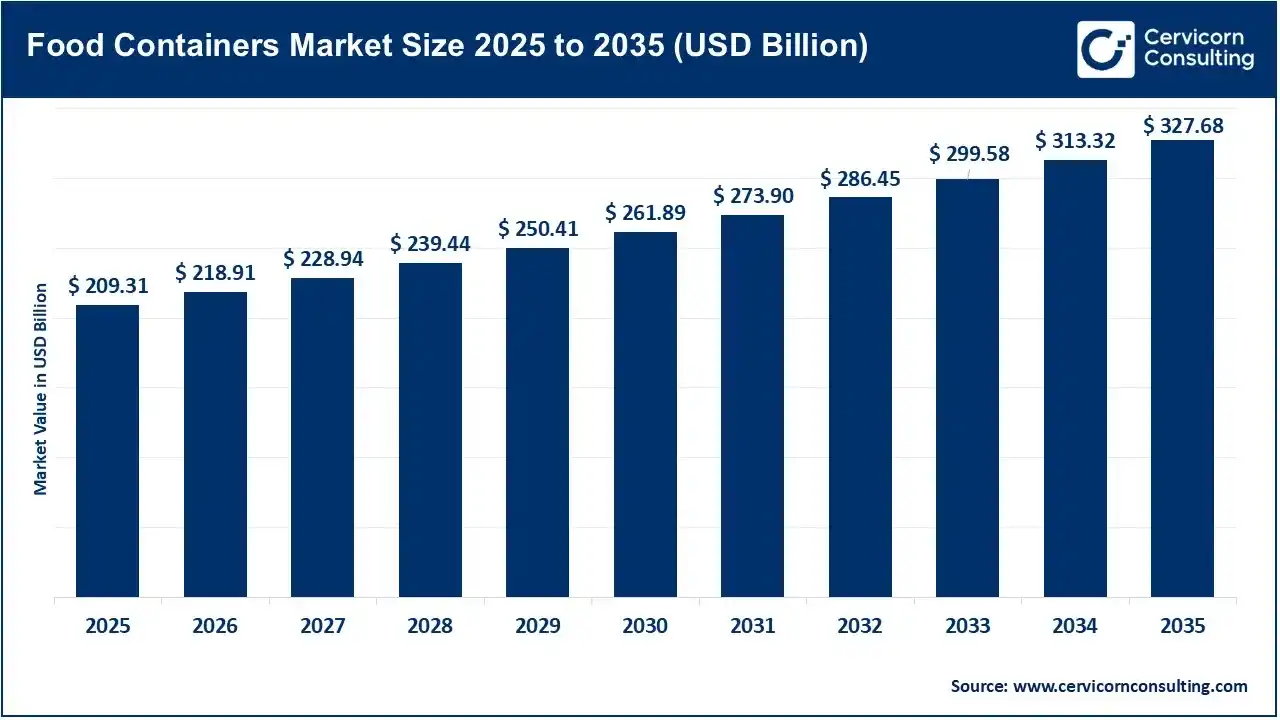
The food containers market is witnessing steady growth due to the rising consumption of packaged, ready-to-eat (RTE), and takeaway food products driven by rapid urbanization, changing lifestyles, and expanding food delivery services. The increasing participation of dual-income households and busy work schedules has accelerated demand for convenient and portable food packaging solutions. According to industry findings, 54% of global consumers prefer packaging that is recyclable, compostable, or reusable, while more than 50% actively seek products with reduced plastic packaging, encouraging manufacturers to develop sustainable food containers. Additionally, the rapid expansion of online grocery platforms, meal-kit services, and quick-service restaurants (QSRs) continues to boost demand for durable, leak-proof, and temperature-resistant packaging that maintains food quality during transportation.
Another major growth factor is the increasing focus on sustainability, food safety, and regulatory compliance across global markets. Governments are introducing stricter packaging regulations to reduce plastic waste and encourage recyclable or reusable food-contact materials. For example, the European Union's latest packaging regulations aim to reduce packaging waste by 5% by 2030 and 15% by 2040, while packaging currently represents approximately 40% of Europe's plastic consumption and average packaging waste has reached 180 kg per person annually. These regulations, combined with investments in bio-based materials, lightweight packaging, smart food containers, and advanced barrier technologies that extend shelf life and minimize food waste, are creating significant opportunities for innovation and long-term market expansion.
Report Highlights
- Asia-Pacific held the largest regional market share at 36.3%, fueled by rapid urbanization, expanding food processing industries, rising packaged food consumption, and strong growth in e-commerce and food delivery services.
- Plastic dominated the food containers market with a 41.1% share in 2026, driven by its lightweight properties, durability, affordability, and excellent barrier performance for packaged and takeaway foods.
- Cups & Tubs accounted for 35.1% of the global market, supported by rising demand for dairy products, desserts, ready-to-eat meals, and food delivery packaging requiring leak-proof and tamper-evident containers.
- Fruits & Vegetables emerged as the leading application segment, benefiting from increasing global consumption of fresh produce and the growing need for protective packaging that extends shelf life and reduces food waste.
What are Food Containers?
Food containers are packaging products specifically designed to store, protect, transport, and preserve food while maintaining its freshness, hygiene, and quality. They are manufactured using materials such as plastic, paperboard, glass, metal, aluminum, and biodegradable or compostable materials, and are widely used across households, restaurants, foodservice outlets, supermarkets, and food delivery platforms. Modern food containers are increasingly engineered with features such as leak resistance, microwave compatibility, tamper evidence, and recyclable or reusable designs to meet evolving consumer preferences and environmental regulations.
Recent Milestones
| Date |
Company or Organization |
Recent Milestone |
Market Relevance |
| August 2026 |
European Union |
Implemented the Packaging and Packaging Waste Regulation (PPWR), introducing PFAS limits in food-contact packaging and stricter recyclability requirements. |
Accelerates adoption of sustainable and compliant food container materials across Europe. |
| April 2026 |
Sealed Air |
Completed its acquisition by Clayton, Dubilier & Rice (CD&R), strengthening investment in food packaging innovation. |
Expected to support advanced packaging technologies and sustainable food container solutions. |
| April 2025 |
Novolex |
Completed the acquisition of Pactiv Evergreen, expanding its portfolio of foodservice and food container products. |
Strengthened market consolidation and expanded production capabilities in food packaging. |
Food Containers Market Dynamics
Market Drivers
1. Rising Demand for Convenience and Ready-to-Eat Foods
The growing consumption of ready-to-eat meals, takeout, meal kits, and online food delivery services is a major driver of the food containers market. Urban lifestyles, increasing workforce participation, and busy schedules have significantly increased the need for durable, leak-proof, and microwave-safe food containers. According to a 2025 McKinsey consumer survey, more than 70% of consumers consider convenience, quality, and price among the most important purchasing factors, while food safety and shelf life remain the top packaging priorities. This trend is encouraging manufacturers to develop innovative food containers that enhance portability and preserve product freshness.
2. Growing Preference for Sustainable and Recyclable Packaging
Increasing environmental awareness and stricter sustainability regulations are accelerating demand for eco-friendly food containers made from recyclable, compostable, and bio-based materials. Consumers and foodservice brands are actively replacing conventional plastics with paper, molded fiber, and reusable packaging solutions. According to McKinsey's 2025 packaging survey, 77% of consumers consider recyclable packaging to be extremely or very important, while 62% place high importance on packaging made from recycled content. These preferences are driving investments in sustainable materials, circular packaging systems, and recyclable container designs across the food packaging industry.
Market Restraints
1. Volatility in Raw Material Prices
Fluctuating prices of plastic resins, paper pulp, aluminum, and other packaging materials continue to challenge food container manufacturers by increasing production costs and compressing profit margins. Supply chain disruptions, energy price fluctuations, and geopolitical uncertainties further intensify procurement risks. In India, industry assessments indicate that converter margins fell to nearly 8% in 2024 due to raw material price volatility and recyclate supply constraints. Such cost pressures often limit investments in product innovation and create pricing challenges for manufacturers serving cost-sensitive markets.
2. Limited Recycling Infrastructure for Complex Packaging
Although sustainable packaging demand is increasing, recycling infrastructure remains inadequate for multilayer and flexible food containers. Many food containers combine multiple materials that are difficult to separate during recycling, reducing circular economy efficiency. According to the Pew Charitable Trusts, only 21% of collected plastic packaging waste is recycled globally in 2025, while 96% of recycled plastic packaging consists of rigid plastics, leaving flexible food packaging with limited recycling opportunities. These infrastructure gaps remain a significant barrier to sustainable packaging adoption.
Market Opportunities
1. Expansion of Reusable Packaging Systems
Governments, retailers, and foodservice companies are increasingly investing in reusable packaging ecosystems to reduce single-use packaging waste. Deposit-return programs, standardized reusable containers, and closed-loop collection systems are creating new business opportunities for food container manufacturers. The European Union has introduced policies targeting 10% of beverage sales in reusable containers by 2030, encouraging large-scale investment in reusable packaging infrastructure. This regulatory shift is expected to stimulate innovation in durable, reusable food container solutions across commercial foodservice and retail sectors.
2. Rapid Growth of E-commerce and Quick Commerce
The rapid expansion of online grocery shopping, food delivery platforms, and quick-commerce services is generating strong demand for protective, lightweight, and tamper-evident food containers. Packaging is increasingly becoming a key factor in ensuring product quality throughout complex delivery networks. Industry analysis shows that paper and paperboard accounted for 50.83% of India's e-commerce packaging market in 2025, while returnable and reusable packaging formats are projected to record double-digit growth over the coming years. These trends present significant opportunities for innovative food container manufacturers.
Market Challenges
1. Compliance with Evolving Environmental Regulations
Manufacturers face growing challenges in complying with increasingly stringent environmental regulations governing food-contact materials, chemical safety, recyclability, and waste reduction. Meeting these requirements often requires costly product redesigns, material substitutions, and manufacturing upgrades. Under the European Union's latest packaging regulations, all packaging must become recyclable in an economically feasible manner by 2030, while the region aims to reduce packaging waste by 15% by 2040. Adapting to these evolving standards requires continuous investment and operational adjustments.
2. Balancing Sustainability with Product Performance
Developing food containers that simultaneously deliver high barrier protection, durability, affordability, and environmental sustainability remains a complex challenge. While brands seek recyclable and compostable alternatives, these materials must still protect food quality and withstand transportation. Industry surveys show that food safety and shelf life remain consumers' highest packaging priorities, often outweighing environmental considerations during purchasing decisions. Manufacturers must therefore balance sustainability goals without compromising packaging functionality or increasing costs significantly.
Food Containers Market Regional Analysis
The food containers market is segmented by region into North America, Europe, Asia-Pacific, Latin America, and LAMEA. Here is a brief overview of each region:
North America Food Containers Market: Driven by Strong Food & Beverage Industry, Expanding Packaged Food Consumption, Rapid Growth of Food Delivery Services, and Increasing Demand for Sustainable Packaging
The North America food containers market size reached USD 39.56 billion in 2025 and is projected to surge USD 61.93 billion by 2035. North America region hits significant growth, owing to its well-established food and beverage industry, high consumption of packaged and convenience foods, advanced packaging manufacturing capabilities, and stringent food safety regulations. The region benefits from a mature retail ecosystem, widespread adoption of online grocery shopping, and the rapid expansion of quick-service restaurants (QSRs) and food delivery platforms, all of which drive consistent demand for high-performance food containers. Growing consumer preference for recyclable, reusable, and compostable packaging has accelerated investments in sustainable materials and innovative container technologies. Regulatory initiatives by the U.S. Food and Drug Administration (FDA), the Environmental Protection Agency (EPA), and Health Canada, along with corporate sustainability commitments from major food manufacturers and packaging companies, continue to promote the development of safer, lightweight, and environmentally friendly food containers, reinforcing North America's leadership in the global market.
United States: Strong Packaged Food Industry, Sustainability Initiatives, and Expanding Food Delivery Ecosystem Drive Market Growth
- According to the U.S. Department of Agriculture (USDA), consumer spending on food reached USD 2.74 trillion in 2024, including expenditures on food-at-home and food-away-from-home, creating sustained demand for food containers across retail, restaurants, and institutional foodservice.
- The U.S. Environmental Protection Agency (EPA) estimates that containers and packaging account for over 82 million tons of municipal solid waste annually, encouraging manufacturers to invest in recyclable, reusable, and compostable food container solutions aligned with circular economy objectives.
Canada: Growing Sustainable Packaging Adoption, Expanding Food Processing Industry, and Government Circular Economy Policies Support Market Expansion
- Canada is accelerating the transition toward sustainable food packaging through the Federal Plastics Registry and national initiatives aimed at achieving zero plastic waste by 2030, encouraging greater adoption of recyclable and reusable food containers across the food value chain.
- According to Agriculture and Agri-Food Canada, the country's food and beverage processing industry is Canada's largest manufacturing sector by manufacturing GDP, generating strong and consistent demand for food containers used in dairy, bakery, frozen food, meat, and ready-to-eat product packaging.
Why is Asia-Pacific (APAC) fastest-growing region in the food containers market?
The Asia-Pacific food containers market size was valued at USD 75.98 billion in 2025 and is expected to surpass around USD 118.95 billion by 2035.
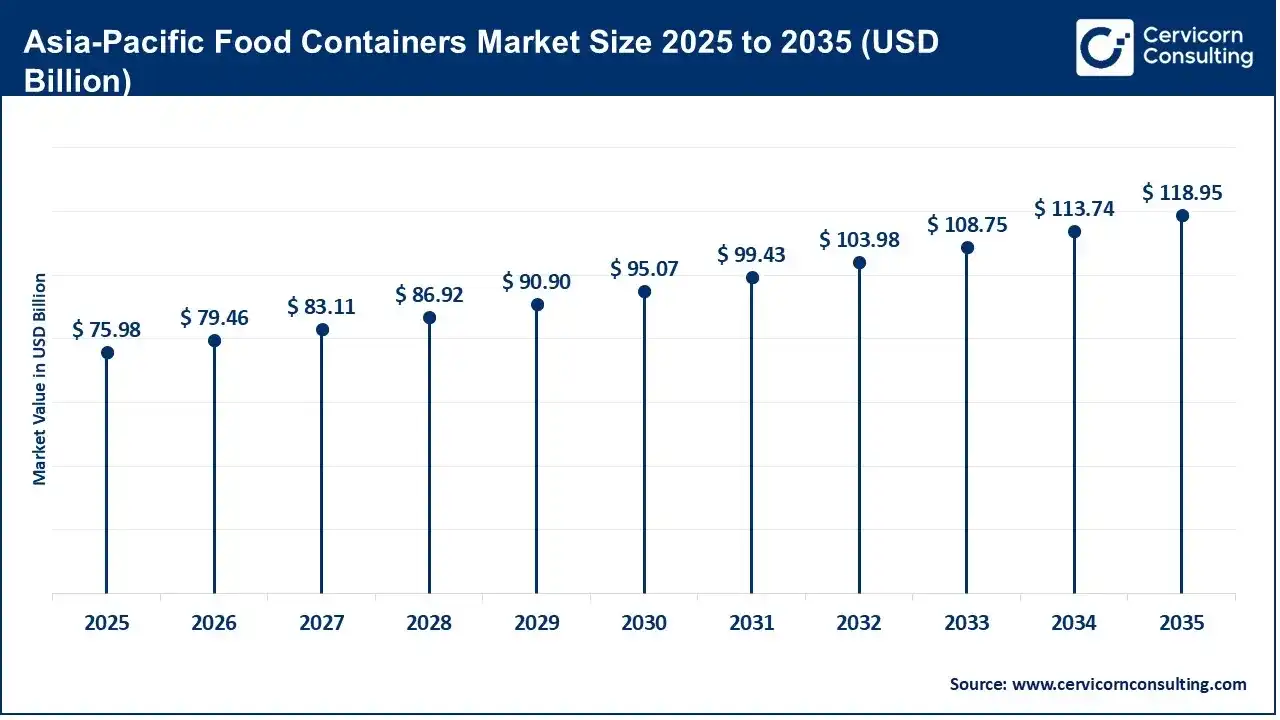
Asia-Pacific is the fastest-growing region in market due to rapid urbanization, rising disposable incomes, expanding middle-class populations, and increasing consumption of packaged and convenience foods. The region is home to some of the world's largest food manufacturing and processing industries, supported by strong growth in organized retail, online grocery platforms, and food delivery services. Governments across China, India, Japan, South Korea, and Southeast Asia are strengthening food safety regulations while encouraging sustainable packaging solutions to reduce environmental impact. Continuous investments in food processing infrastructure, export-oriented food manufacturing, and recyclable packaging technologies are accelerating demand for innovative food containers, positioning Asia-Pacific as a key growth hub for global packaging manufacturers.
China: World's Largest Food Packaging Manufacturing Base, Expanding Processed Food Consumption, and Government Food Safety Regulations Drive Market Growth
- China represents the largest food packaging market in Asia-Pacific, accounting for nearly 50% of the regional market, supported by its extensive food manufacturing industry, large consumer base, and rising demand for packaged and frozen foods.
- The country's rapidly growing urban population, increasing household incomes, and expansion of modern retail chains and e-commerce grocery platforms continue to accelerate demand for plastic, paperboard, metal, and sustainable food containers across multiple food categories.
India: Expanding Food Processing Industry, Rapid Growth in Online Food Delivery, and Government Support for Sustainable Packaging Fuel Market Expansion
- India is emerging as one of the fastest-growing food container markets, supported by rapid expansion of the food processing sector, increasing packaged food consumption, and rising demand for convenience foods among urban consumers. According to industry analysis, India is projected to register the highest growth rate in Asia-Pacific's food and beverage packaging market through 2030.
- The rapid growth of online food delivery has significantly increased packaging demand. Zomato reported that its average monthly transacting customers increased 13-fold over the past five years, highlighting the substantial expansion of delivery-driven food packaging requirements.
Europe Food Containers Market: Driven by Stringent Sustainability Regulations, Advanced Food Processing Industry, Strong Circular Economy Initiatives, and Growing Demand for Recyclable Packaging
The Europe food containers market size was estimated at USD 54.63 billion in 2025 and is predicted to hit around USD 85.52 billion by 2035. Europe represents a mature and innovation-driven food containers market, supported by its well-established food processing industry, stringent food safety standards, and strong commitment to sustainable packaging. The region is leading the transition toward recyclable, reusable, and bio-based food containers through the European Union's Packaging and Packaging Waste Regulation (PPWR) and circular economy policies. Growing consumption of convenience foods, expanding organized retail, and rising demand for premium packaged food products continue to strengthen market demand. Europe also benefits from the presence of globally recognized packaging manufacturers investing in lightweight materials, fiber-based packaging, and advanced barrier technologies, enabling the region to remain at the forefront of sustainable food container innovation. Germany remains the largest market in the region, supported by its mature recycling ecosystem and advanced packaging industry.
Germany: Advanced Packaging Manufacturing, High Recycling Rates, and Strong Circular Economy Policies Drive Market Leadership
- Germany is the largest food packaging market in Europe, supported by its highly developed food manufacturing sector and efficient recycling infrastructure. The country achieved an estimated 67% packaging recovery rate, providing manufacturers with a stable supply of recycled packaging materials and supporting sustainable food container production.
- Germany's extensive supermarket networks, convenience food consumption, and ready-meal market continue to generate strong demand for high-performance food containers across plastic, paperboard, glass, and metal packaging formats. The country's deposit-return system and circular economy initiatives further encourage the adoption of recyclable and reusable packaging solutions.
France: Premium Food Industry, Sustainable Packaging Regulations, and Eco-Design Initiatives Support Market Expansion
- France's globally recognized dairy, bakery, cheese, confectionery, and premium food industries are driving demand for high-quality food containers that offer superior barrier protection, food safety, and extended shelf life. Premium packaged foods continue to encourage innovation in sustainable packaging materials.
- France is actively implementing the European Union's Packaging and Packaging Waste Regulation (PPWR), which requires packaging to become recyclable by 2030 while promoting packaging waste reduction and greater use of recycled content. These measures are accelerating investment in recyclable, reusable, and compostable food containers.
Food Containers Market Share, By Region, 2025 (%)
| Region |
Revenue Share, 2025 (%) |
| Asia-Pacific |
36.3% |
| North America |
18.9% |
| Europe |
26.1% |
| LAMEA (Latin America, Middle East & Africa) |
18.7% |
Why is LAMEA experiencing steady growth in the food containers market?
The LAMEA food containers market was valued at USD 39.14 billion in 2025 and is anticipated to reach around USD 61.28 billion by 2035. The LAMEA region is experiencing steady growth, supported by expanding food processing industries, increasing urbanization, rising consumption of packaged and convenience foods, and the rapid development of organized retail and food delivery services. Growing investments in manufacturing, tourism, and hospitality are boosting demand for durable, lightweight, and food-safe packaging solutions across the region. Governments are also encouraging sustainable packaging through waste reduction policies and recycling initiatives, prompting manufacturers to introduce recyclable, reusable, and fiber-based food containers. Rising exports of processed food products and improvements in cold-chain logistics are further strengthening demand for high-performance food containers across Latin America, the Middle East, and Africa.
Brazil: Expanding Food Processing Industry, Strong Agricultural Exports, and Growing Packaged Food Consumption Drive Market Growth
- Brazil has one of the largest food and beverage industries in Latin America, supported by its strong agricultural production and food processing sector, creating substantial demand for food containers used in packaged foods, beverages, dairy products, and frozen foods.
- The country continues to experience rising demand for convenience foods through expanding supermarket chains, e-commerce grocery platforms, and food delivery services, encouraging manufacturers to adopt lightweight, recyclable, and high-barrier food container solutions for domestic consumption and exports.
Saudi Arabia: Food Security Initiatives, Expanding Food Manufacturing, and Sustainability Programs Support Market Expansion
- Saudi Arabia is investing heavily in food manufacturing and food security under Vision 2030, driving demand for advanced food containers across packaged foods, dairy products, beverages, and ready-to-eat meal categories. Increasing domestic production is also strengthening demand for innovative packaging solutions.
- Rapid expansion of supermarkets, convenience stores, restaurants, and online food delivery platforms is increasing the need for tamper-evident, microwave-safe, and temperature-resistant food containers capable of maintaining product quality throughout distribution.
Food Containers Market Segmental Analysis
The food containers market is segmented into material, product type, application, and geography.
Material Analysis
Plastic is the dominant material segment in the food containers market due to its lightweight nature, durability, cost-effectiveness, and excellent barrier properties against moisture and contaminants. It is extensively used for packaging dairy products, frozen foods, ready-to-eat meals, and beverages because it offers design flexibility and compatibility with automated filling lines. Plastic accounted for 41.1% of the global food containers market by material in 2025, supported by its widespread adoption across foodservice, retail, and e-commerce packaging applications.
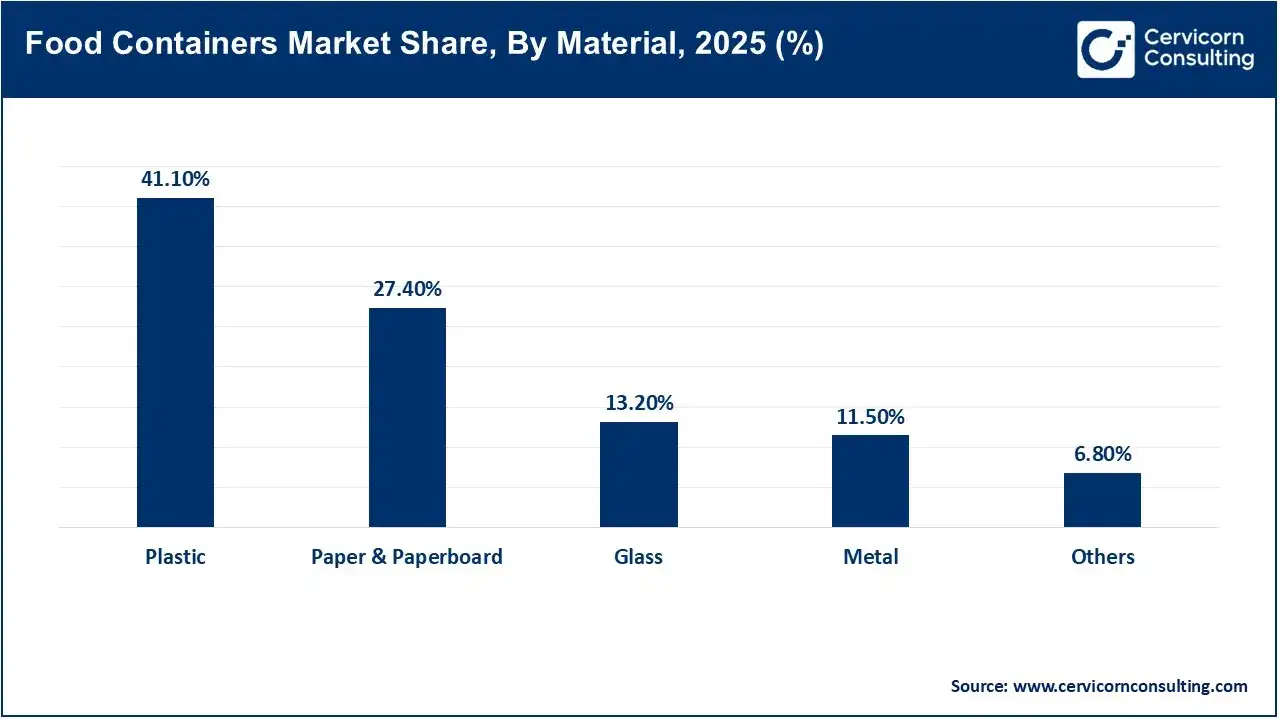
Paper & paperboard is the fastest-growing material segment owing to rising environmental awareness, stringent regulations on single-use plastics, and increasing investments in recyclable and biodegradable packaging. Food manufacturers and quick-service restaurants are rapidly adopting fiber-based containers to meet sustainability targets without compromising product performance. Advances in barrier coatings and molded fiber technology are further accelerating adoption, with the paper & paperboard segment projected to expand at approximately 7% CAGR through 2035, making it the fastest-growing material category.
Product Type Analysis
Cups & tubs represent the dominant product type due to their extensive use in dairy products, yogurt, ice cream, desserts, soups, sauces, and ready-to-eat meals. Their convenience, resealability, and compatibility with hot and cold foods make them highly preferred across retail and food service industries. Growing demand for portion-controlled packaging and takeaway meals further supports segment growth. The cups & tubs segment accounted for approximately 35.1% of the global market in 2026, maintaining its leading position across multiple food categories.
Food Containers Market, By Product Type, 2025 (%)
| Product Type |
Revenue Share, 2025 (%) |
| Cups & Tubs |
35.1% |
| Bottles & Jars |
24.8% |
| Boxes & Cartons |
21.4% |
| Trays |
11.6% |
| Others |
7.1% |
Boxes & cartons are emerging as the fastest-growing product segment due to increasing demand for sustainable takeaway packaging, online food delivery, bakery products, and meal kits. Manufacturers are introducing recyclable paperboard cartons with enhanced grease and moisture resistance, making them suitable for diverse food applications. The rapid expansion of quick-commerce platforms, organized retail, and environmentally conscious consumers continues to accelerate demand for paper-based cartons, positioning this segment for robust long-term growth across both developed and emerging markets.
Application Analysis
Ready-to-eat meals dominate the food containers market due to increasing urbanization, busy lifestyles, and growing dependence on convenience foods and food delivery services. These products require durable, microwave-safe, leak-resistant, and tamper-evident containers that preserve freshness and product quality during transportation. Rising demand from supermarkets, online meal delivery platforms, and quick-service restaurants continues to strengthen this segment, while manufacturers increasingly develop innovative packaging solutions that improve shelf life, convenience, and consumer experience.
Food Containers Market, By Application, 2025 (%)
| Application |
Revenue Share, 2025 (%) |
| Fruits & Vegetables |
26.4% |
| Ready-to-eat Meals |
20.3% |
| Dairy Products |
16.2% |
| Bakery, Snacks & Confectionery |
14.7% |
| Frozen Food |
10.8% |
| Spices & Condiments |
5.9% |
| Others |
5.7% |
Frozen food is the fastest-growing application segment, supported by increasing household freezer ownership, expanding retail cold-chain infrastructure, and growing demand for convenient long-shelf-life meals. Consumers are increasingly purchasing frozen vegetables, snacks, seafood, and prepared meals that require high-performance packaging capable of withstanding low temperatures and preventing moisture loss. Continuous innovation in high-barrier, recyclable, and temperature-resistant food containers is further driving adoption, making frozen food packaging one of the fastest-expanding applications in the global food containers market.
Food Containers Market Top Companies
Segments Covered
By Material
- Plastic
- Paper & Paperboard
- Glass
- Metal
- Others
By Product Type
- Bottles & Jars
- Cups & Tubs
- Boxes & Cartons
- Trays
- Others
By Application
- Fruits & Vegetables
- Dairy Products
- Spices & Condiments
- Frozen Food
- Bakery, Snacks & Confectionery
- Ready-to-eat Meals
- Others
By Geography
- North America
- Europe
- Asia-Pacific
- LAMEA