Sustainable Packaging Market Size and Growth 2026 to 2035
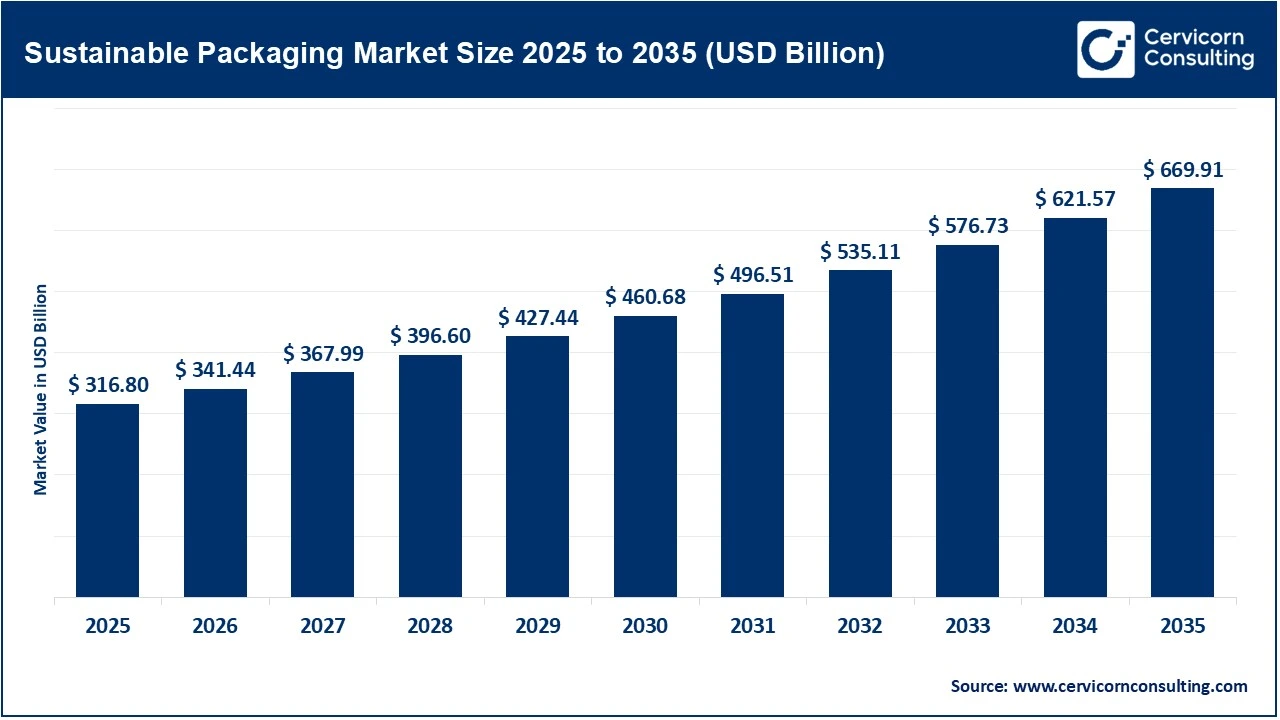
The global sustainable packaging market size reached at USD 316.80 billion in 2025 and is expected to be worth around USD 669.91 billion by 2035, exhibiting a compound annual growth rate (CAGR) of 7.8% over the forecast period from 2026 to 2035. The growth of the sustainable packaging market is mainly driven by the rapid development of regulations worldwide. Governments are increasingly shifting from voluntary guidelines to mandatory requirements, prompting organizations to adopt environmentally responsible packaging solutions. For example, the European Union’s Packaging and Packaging Waste Regulation (PPWR) aims for “100% recyclability for all packaging by 2030.” Additionally, the regulatory framework includes Extended Producer Responsibility (EPR) schemes, which transfer waste management costs from municipalities to producers, with fees based on product categories. Across European markets, EPR taxes are rising by approximately 10% to 15% annually, creating significant economic pressure to redesign packaging to avoid disposal fees when disposal costs are high.
Alongside regulatory developments, rising consumer demand for sustainable solutions also drives significant growth. This is particularly evident among younger consumers, who are more willing to pay a "green premium" for products that are either plastic-free or easy to recycle. However, a notable gap remains between consumer intention and actual purchasing behavior, mainly influenced by perceived economic benefits and the product's sustainability claims. From 2005 to 2021, the number of new food product launches featuring sustainability claims increased by nearly 3% annually, as the industry seeks to signal eco-friendliness to consumers.
Report Highlights
- By Region, the Europe dominates the regional segment, capturing 38% share of the global sustainable packaging market, mainly due to strict environmental regulations, strong recycling infrastructure, and early adoption of circular economy practices.
- By Type, the rigid packaging segment dominates the market with 62% share of the global market, mainly because of its strong protective properties and well-established recycling infrastructure.
- By Type, the flexible packaging is the fastest-growing segment with 38% revenue share, driven by higher material efficiency, lightweight structure, and lower transportation emissions.
- By Process, the recyclable packaging accounting for around 60% share, primarily because of widespread recycling systems and regulatory support for circular economy practices.
- By Process, the biodegradable packaging is the fastest-growing segment at 16% share, due to increasing consumer demand for eco-friendly and compostable alternatives
- By Material, the plastics segment dominate the market, holding 42% share, because their versatility, durability, and widespread use in food and beverage packaging.
- By Application, the food & beverages segment dominates the market, capturing 48% share, mainly due to high consumption volume and strict packaging requirements for safety and freshness.
- By Application, the healthcare is the fastest-growing segment with revenue share of 16%, primarily due to rising demand for safe, sterile, and sustainable pharmaceutical packaging.
Smart Technology Integration for Traceability and Circularity
The integration of smart technology for traceability into packaging solutions marks significant growth in the sustainable packaging market. This shift has led to the development of a new concept called "Smart Packaging," which uses technologies such as QR codes, Near Field Communication (NFC) tags, and digital watermarking to improve recycling efficiency and support circular economy initiatives. One of the most important developments is HolyGrail 2.0, which provides imperceptible digital watermarks on packaging that enable a high-speed sorting system to identify materials with near 100% accuracy. This quality sorting will keep food-grade plastics separate from non-food-grade plastics, resulting in a much higher value of recycled resin. The adoption of smart, sustainable packaging solutions has increased by up to 25% by 2026. This growth is further driven by the European Digital Product Passport initiative, which will require 60% of consumer goods to provide accessible information on their material composition and carbon footprint by 2027.
Top 5 Trends and Technologies
- Circular Economy Integration through Post-Consumer Recycled Plastic: The market for high-performance PCR resins is growing, as brands in the beverage sector aim for at least 50% reclaimed content in PET bottles by 2030.
- Compostable & Biodegradable Packaging: The market for compostable packaging is seeing a 15% annual growth in food service and other sectors.
- Refillable & Reusable Packaging System Growth: Refill-at-home ideas or standardized reusable containers are anticipated to reach 10% of the packaging market by 2030, as brands work to eliminate disposable waste.
- Increased Use of Intelligent Packaging: Digital product passports using QR codes and RFID tags are projected to grow by 20% annually to boost transparency.
- Carbon-neutral Production Processes: Many manufacturers are adopting renewable energy and electrification to cut Scope 3 emissions related to package production.
Key Type of Sustainable Packaging
1. Recyclable Packaging Structure
Recyclable packaging is a key element of the sustainable market, supported by established collection and processing systems. This includes materials such as PET, HDPE, aluminum, and glass.
- Increase Trend - Demand for food-grade circular PET (rPET) is projected to grow at a CAGR of 8.4% through 2028, mainly driven by the beverage industry.
- Infrastructure - Berlin has launched a "Zero Waste" agency to support household waste sorting and recycling.
2. Reusable Packaging Structure
Reusable solutions are increasing as a high-impact way to eliminate single-use waste. This involves the multiple uses of durable products that go back and forth between the producer and consumer repeatedly.
- Cost matrix - While reusable options cost more initially, the cost per use with a reusable system can be 20-30% lower than single-use, over a lifecycle of 50 uses.
- Adoption of this system - Cosmetics and household cleaning products are leading the way in adopting this shift, with major retailers starting trials for in-store refill stations.
- Environmental benefit - Switching to a reusable format is projected to reduce greenhouse gas emissions by up to 80% compared to traditional single-use plastic packaging.
3. Compostable and Bio-based materials
Compostable packaging, often made from renewable materials such as cornstarch, sugarcane, and seaweed, provides a viable alternative to plastic in food-contact applications where recycling is not possible due to contamination.
- Material Innovation: New bioplastics, including PLA (Polylactic Acid) and PHA (Polyhydroxyalkanoates) are currently being developed with improved barrier properties, which can help replace traditional plastics.
- Market News: The compostable packaging category is segmented to grow at a 10.2% CAGR, the highest of all category types.
- Limitations: The main barrier to widespread acceptance is the industrial composting facilities required for many "biodegradable", or compostable, plastics to break down properly.
Report Scope
| Area of Focus |
Details |
| Market Size in 2026 |
USD 341.44 Billion |
| Market Size in 2035 |
USD 669.91 Billion |
| CAGR from 2026 to 2035 |
7.80% |
| Dominant Region |
Europe |
| Fastest Growing Region |
Asia-Pacific |
| Key Segments |
Type, Process, Material, Packaging Format, Application, Region |
| Key Companies |
Amcor plc, Sealed Air, Sonoco Products Company, Smurfit Kappa, Berry Global Inc., Tetra Pak, Elevate Packaging, Huhtamaki Oyj, Mondi, DS Smith, Atlantic Packaging, UFlex Limited, Constantia Flexibles, Genpak, Reynolds Packaging |
Recent Major Milestones
1. Recent Government Policy Development and Mandate
The development of a government program acts as a major growth driver for the sustainable packaging market. The adoption of the EU Packaging and Packaging Waste Regulation (PPWR) in 2024 marks a significant milestone. This regulation requires a 5% reduction in packaging waste by 2030 and a further 15% reduction by 2040, encouraging companies to adopt more sustainable solutions. Simultaneously, the adoption of the UN Global Treaty to Stop Plastic Pollution passed the 2025 implementation deadline after reaching international consensus in late 2024. This treaty establishes a global standard for "problematic and unnecessary" plastics, supported by up to 175 nations that have committed to legally binding targets.
2. Strategic Corporate Sustainability Breakthroughs
Corporate initiatives and strategic collaborations have played a key role in the sustainable packaging market. In a corporate milestone, Amazon announced in 2026 that it achieved its goal of transitioning to 100% recyclable delivery packaging worldwide. By using paper-based, curbside-recyclable dunnage instead of plastic “air pillows”, Amazon removed the equivalent of approximately 50,000 tons of single-use plastic from landfills each year. This demonstrates that large-scale circularity is both technically and logistically feasible. For example, companies overcame challenges related to securing high-quality recycled material and ensuring bottle clarity. These corporate breakthroughs also benefited from long-term contracts with recyclers, which provided the financial certainty needed to invest in further infrastructure.
3. Scaling Advanced Chemical Recycling Facilities
The scaling of advanced chemical recycling facilities represents a significant technical milestone in enabling a circular plastic economy. Unlike mechanical recycling, which compromises the integrity of plastics throughout the recycling process, chemical recycling breaks down polymers into their original monomers. This process produces high-quality, food-grade recycled material suitable for packaging applications. As a result, the global market for food-grade recycled resin will meet and surpass the supply demands of manufacturers. Technologies such as cementing pyrolysis are becoming increasingly vital for brands that incorporate between 25% and 50% recycled content into their packaging.
4. Breakthroughs in Polymer Upcycling and Bio-materials
Innovations in polymer upcycling and biomaterials mark another technological milestone in the market. Bio-materials, such as seaweed-based packaging and mycelium materials, are rapidly gaining traction. These solutions have moved from small-scale pilots to multi-million-unit contracts with global retailers for protective packaging and food sachets. A major advantage of these bio-based materials is that they are inherently home-compostable and eliminate the need for industrial facilities. In 2024, venture capital funding for "alternative material" start-ups increased by up to 30%, indicating growing investor confidence in non-plastic solutions.
Sustainable Packaging Market Regional Analysis
The sustainable packaging market is segmented by region into North America, Europe, Asia-Pacific, and LAMEA. Here is a brief overview of each region:
Why does Europe dominates in the sustainable packaging market?
The Europe sustainable packaging market size was reached at USD 120.38 billion in 2025 and is expected to hit around USD 254.57 billion by 2035.
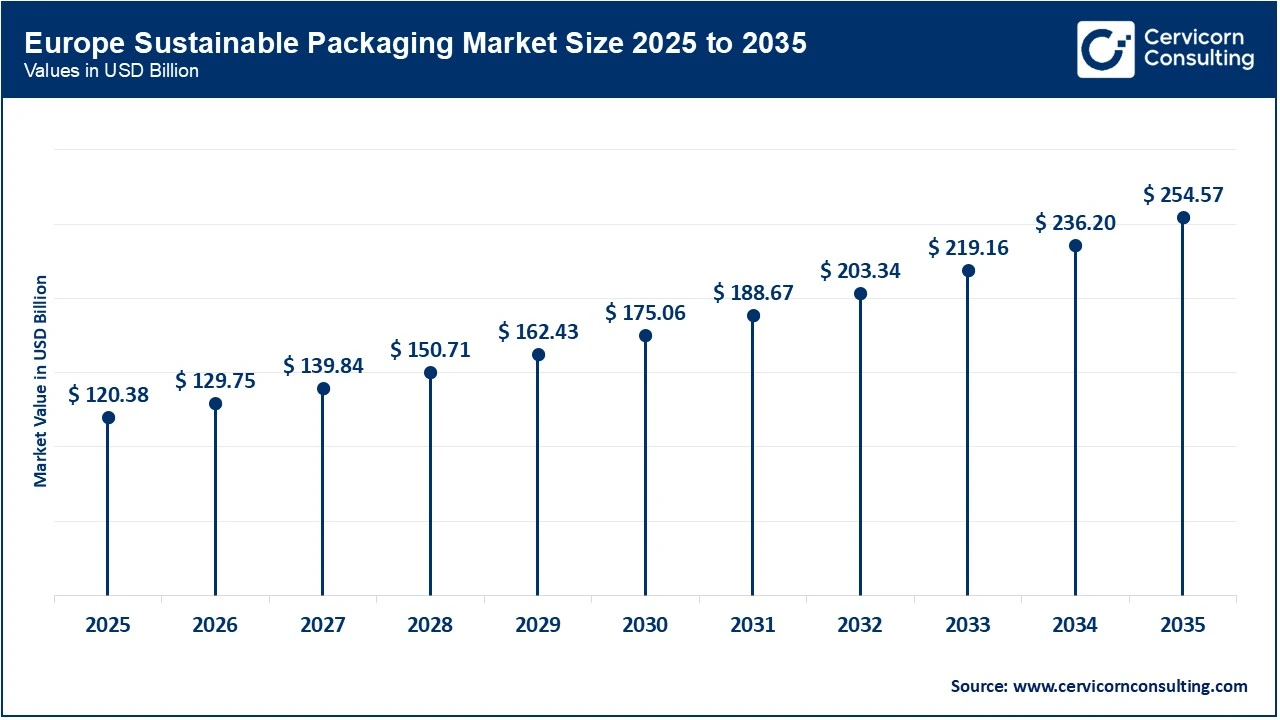
Europe is a significant player in sustainable packaging policy, largely due to its strong regulatory frameworks. Initiatives such as the European Commission’s Circular Economy Action Plan and the Packaging and Packaging Waste Regulation (PPWR) aim to ensure that all packaging is recyclable or reusable wherever possible by 2030. The EU’s plastic tax, USD 0.80 per kilogram of non-recycled plastic waste, has led to a 15% shift toward paper-based and bio-based products. The market anticipates that by 2026, the European sustainable packaging market will reach USD 190 billion, with mono-material structures being the priority to simplify the recycling process.
Germany: A Leader in Waste Management and Recycling Infrastructure
Germany maintains the Gold Standard in the Material Recovery "Pfand" system, and its sorting technology sets a benchmark for superior closed-loop systems.
- Dual System Efficiency: High-precision sorting ensures plastic waste is transformed into high-quality secondary raw materials.
- Mechanical Recycling Focus: There is a strong preference for using mono-materials, as they are easier to process with existing high-tech systems.
- Stringent Packaging Act: The recent law mandates even higher recovery rates for commercial waste.
Why is Asia-Pacific fastest-growing in the sustainable packaging market?
The Asia-Pacific sustainable packaging market size was estimated at USD 76.03 billion in 2025 and is projected to surpass around USD 160.78 billion by 2035. The Asia-Pacific region is the fastest-growing market, with a projected growth rate of 7.5% through 2026. This growth is mainly driven by the rapid expansion of e-commerce in countries like China and India, where delivery packaging volume has increased by more than 200% over five years. In countries such as China, a ban on single-use, non-degradable plastic in major metropolitan areas has led to a 30% rise in demand for compostable alternatives. At the same time, urban regions are also experiencing pressure on waste management; for example, many governments are implementing Extended Producer Responsibility (EPR) frameworks. Overall, the region reflects the global demand for sustainable materials, with manufacturers now scaling production to meet both domestic and international sustainability goals.
China: Strategic Positioning to Scale Sustainable Manufacturing
China holds a leading position in the sustainable packaging market, mainly driven by strong regulatory initiatives and rapid industrial transformation. The Chinese government's strict policy of “Single-Use Plastic Ban,” along with its new “Green Packaging” e-commerce standards, is shifting toward a significant industrial impact.
- Massive Impact in E-commerce: Those corporations, like Alibaba and JD.com, require "tape-free" boxes and reusable delivery bags, as they will standardize them across their businesses.
- Manufacturing Shift: China is now the largest producer of all biodegradable plastics, in particular PBAT and PLA.
India: Rapidly Moving Toward Plastic-Free
India is implementing EPR to develop the informal sector, targeting a large, price-sensitive consumer group.
- Ban on 19 Single-Use Items: As these bans are strictly enforced, alternatives made from paper, bamboo, and bagasse-based products are rapidly increasing.
- Synergy with the Informal Economy: The new policy aims to formalise the' ragpicker" network into official recycling value chains.
- Innovation in Bio-materials: Significant R&D efforts are now focused on agricultural waste-based packaging.
- Drivers of Urbanization: The rise of food delivery apps has driven the adoption of compostable containers and cutlery.
What are the driving factors of North America sustainable packaging market?
The North America sustainable packaging market size was valued at USD 95.04 billion in 2025 and is forecasted to grow around USD 200.97 billion by 2035. In North America, the sustainable packaging market is influenced by a mix of regulations and corporate commitments. Policies like California’s SB 54 mandate that single-use packaging be recyclable or compostable by 2032, establishing a standard across the continent. About 75% of Fortune 500 companies based in the U.S. have committed to making all their packaging reusable, recyclable, or compostable by 2025-2026, resulting in a 20% increase year over year in beverage containers using post-consumer resin (PCR). Additionally, there has been a significant investment of USD 1.5 billion in North America’s recycling infrastructure to improve the supply of high-quality recycled materials.
United States to Drive Innovation through Corporate Sustainability Commitments
The United States plays a major role in promoting sustainable packaging through robust corporate commitments and regulatory backing.
- Around 75% of Fortune 500 companies are committed to sustainable packaging goals
- Increasing use of post-consumer recycled (PCR) materials by 20% YoY growth.
Canada: Stringency in Regulation and Adoption of Circular Economy
Canada's recent federal ban on various types of single-use plastics establishes it as a leader in waste elimination.
- Zero-Plastic Waste 2030: A comprehensive roadmap of design-for-recyclability.
- Standardized Labelling: New regulations prohibit misleading "recyclable" claims to protect consumer trust.
- Public-Private Partnerships: Major investments are being made in municipal sorting infrastructure for compostable materials.
Sustainable Packaging Market Share, By Region, 2025 (%)
| Region |
Revenue Share, 2025 (%) |
| Europe |
38% |
| North America |
30% |
| Asia Pacific |
24% |
| LAMEA |
8% |
LAMEA Sustainable Packaging Market: Driven by Rising Environmental Awareness and Resource Efficiency Initiatives
The LAMEA sustainable packaging market was valued at USD 25.34 billion in 2025 and is anticipated to reach around USD 53.59 billion by 2035. The LAMEA region is experiencing a steady increase in environmental awareness, driving the adoption of resource-efficiency initiatives. In countries such as Brazil and South Africa, the sustainable packaging market is expected to grow at a CAGR of 5.2%, driven by new regulations targeting plastic pollution in coastal areas. In the Gulf Cooperation Council, approximately 25% of large retailers have committed to reducing plastic packaging by 2026 as part of the national "Green Vision" program. Although infrastructure remains a challenge, the move toward "Reuse-as-a-Service" models is strong, especially in the personal care and home care sectors, with refillable stations quickly replacing single-use sachets to cut waste in resource-limited environments.
Brazil: Fast Expansion of Bio-Based Packaging Solutions
Brazil is leveraging its agricultural wealth for bio-plastics and using its massive sugarcane industry to lead the global production of bio-based polyethylene (Green PE).
- Renewable Feedstocks: Focus on "drop-in" plastics that are bio-based but behave identically chemically to traditional resins.
- Developing Infrastructure: The increased emphasis on urban waste collection due to the larger volume of packaging.
- Leading Sector in Cosmetics: Brands like Natura are pioneers in using 100% PCR (post-consumer recycled) and bio-plastic packaging.
United Arab Emirates: Sustainability in Emerging Luxury Hubs
The UAE Net Zero 2050 mandate is driving the UAE to lead in sustainability efforts within its luxury retail and hospitality sectors.
- Green Riyadh & Dubai Initiatives: Policy efforts to reduce landfill destinations in urbanizing centers with high growth.
- Investment in Innovation: Significant avenues for funding startups based on innovation in desert-degradable materials.
Sustainable Packaging Market Segmental Analysis
The sustainable packaging market is segmented into type, process, material, packaging format, application, and region.
Type Analysis
Rigid packaging dominates the type segment in the market due to its strong protective qualities and the well-established recycling infrastructure. Rigid packaging formats such as bottles, jars, and cans are suitable for extending the shelf life of carbonated beverages and sensitive pharmaceuticals. Additionally, the widespread availability of recycling systems for materials like PET and aluminum further supports rigid packaging in the market.
Sustainable Packaging Market Share, By Type, 2025 (%)
| Type |
Revenue Share, 2025 (%) |
| Rigid |
62% |
| Flexible |
38% |
Flexible packaging is emerging as the fastest-growing segment, mainly due to significant increases in material efficiency and logistical advantages. Flexible pouches and films typically use up to 70% less plastic than rigid formats, reducing material consumption and weight. Moreover, ongoing innovations in mono-material films address recyclability challenges, further increasing the adoption of flexible packaging solutions across industries.
Process Analysis
Recyclable packaging dominates the market mainly due to the global shift toward a circular economy and more mature collection systems. Mechanical recycling processes for materials such as plastics and metals are well-established industrial methods with high recovery rates. Moreover, government mandates continue to emphasise material recovery over other end-of-life options.
Sustainable Packaging Market Share, By Process, 2025 (%)
| Process |
Revenue Share, 2025 (%) |
| Recyclable |
60% |
| Reusable |
24% |
| Biodegradable |
16% |
Biodegradable packaging is the fastest-growing sector in sustainable packaging, driven by advances in bio-polymer science and increasing bans on single-use plastics. As consumers seek alternatives to plastic pollution, biodegradable materials and products are gaining popularity. This trend is especially noticeable in the food service industry, where the potential for contamination makes composting more practical than washing and recycling.
Material Analysis
Plastic is the leading material segment in the sustainable packaging market, primarily because of its unmatched versatility, barrier properties, and extremely low production cost. Although there are environmental concerns about plastics, materials such as PET and HDPE remain essential for high-end packaging applications. The industry is working to make this segment more sustainable by increasing the use of recycled content and bio-based resins.
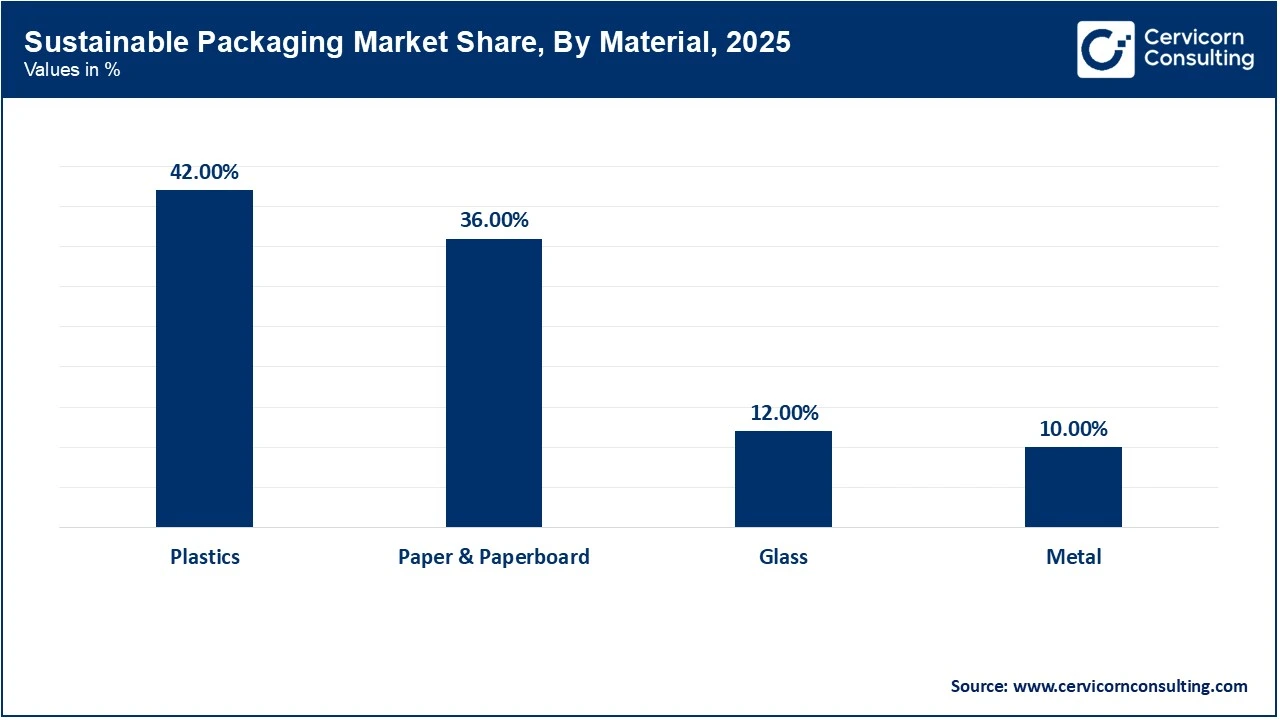
Paper & Paperboard is the fastest-growing material in the market, driven by high consumer acceptance and recycling rates. The "paperization" trend is encouraging brands to replace plastic trays, rings, and mailers with fiber-based alternatives. This transition is being rapidly accelerated by developments in proprietary aqueous coatings that provide the necessary moisture and grease resistance to replace plastic, while maintaining the recyclability of the paper.
Packaging Format Analysis
Primary packaging holds the dominant market position mainly because it is a fundamental component for effectively containing and protecting the product. Every consumer product requires primary packaging, making it the largest segment in terms of reliance. In this sector, the main focus is on material substitution and design for circularity to meet strict food-contact and food safety regulations.
Sustainable Packaging Market Share, By Packaging Format, 2025 (%)
| Packaging Format |
Revenue Share, 2025 (%) |
| Primary Packaging |
75% |
| Secondary Packaging |
18% |
| Tertiary Packaging |
7% |
Secondary packaging is the fastest-growing segment, driven primarily by the rapid expansion of e-commerce worldwide. This includes shipping boxes and protective inserts, which are shifting towards reusable crates and optimized designs—from fiber formations to reduce "void space" and waste. The growth of the delivery economy has made secondary packaging a key target for advancing sustainability and logistics improvements.
Application Analysis
The Food & Beverages segment generates the largest revenue in the market due to the high volume of packaged products and the visibility of packaging waste in the application sector. The growth of this segment is driven primarily by consumer demand for sustainable grocery options and by regulatory pressure on single-use items. Major brand leaders are actively adopting recycled materials such as rPET and bio-based materials.
Sustainable Packaging Market Share, By Application, 2025 (%)
| Application |
Revenue Share, 2025 (%) |
| Food & Beverages |
48% |
| Personal Care & Cosmetics |
22% |
| Healthcare |
16% |
| Others |
14% |
The healthcare and pharmaceutical segment is the fastest-growing end-user industry in the market because of technological advancements that allow sustainable materials to meet the strict sterilization, barrier, and safety standards for medical devices and drugs. The healthcare and pharmacy industry has traditionally been slower to adopt sustainable materials due to safety concerns. However, projections now indicate an 11% growth in healthcare and pharmacy segments through 2026.
Sustainable Packaging Market Top Companies
Recent Developments by Major Companies
- In December 2025, Tetra Pak partnered with García Carrión to introduce a paper-based barrier packaging solution for beverages, reducing dependence on fossil-based materials and improving sustainability.
- In May 2025, Amcor plc partnered with Fedrigoni to launch a recycle-ready wet wipe packaging solution using mono-material technology, improving recyclability across European PE streams.
- In January 2024, Sealed Air (now operating as SEE) launched a CRYOVAC brand compostable protein packaging tray at IPPE 2024. The tray is made from biobased, food-contact grade resin with about 54% renewable content derived from wood cellulose.
Market Segmentation
By Type
By Process
- Recyclable
- Reusable
- Biodegradable
By Material
- Plastics
- Paper & Paperboard
- Glass
- Metal
By Packaging Format
- Primary Packaging
- Secondary Packaging
- Tertiary Packaging
By Application
- Food & Beverages
- Personal Care & Cosmetics
- Healthcare
- Others
By Region
- North America
- APAC
- Europe
- LAMEA