Recycled PET Market Size 2026 to 2035
The global recycled PET (rPET) market size was valued at USD 28.62 billion in 2025 and is expected to be worth around USD 55.47 billion by 2035, exhibiting at a compound annual growth rate (CAGR) of 6.8% over the forecast period 2026 to 2035. The growth of rPET is mainly driven by demand-side sustainability rules, corporate recycled-content targets, and stronger collection systems. Governments and major brands are now setting mandatory recycled-content or deposit-return targets. As a result, beverage, food, and packaging manufacturers are required to source more rPET. Supply-chain commitments and consumer pressure are also increasing off-take agreements, which raises predictable demand for food-grade rPET. In response to this demand, large recyclers and converters are expanding their capacity. For example, Indorama has announced a significant increase in rPET output, with a multi-hundred-thousand-tonne capacity expansion and major capital investment. Specialist PCR producers such as ALPLA are also reporting several hundred thousand tons of installed or projected PCR output, including about 266,000 tons per year of rPET, to meet the needs of brands.
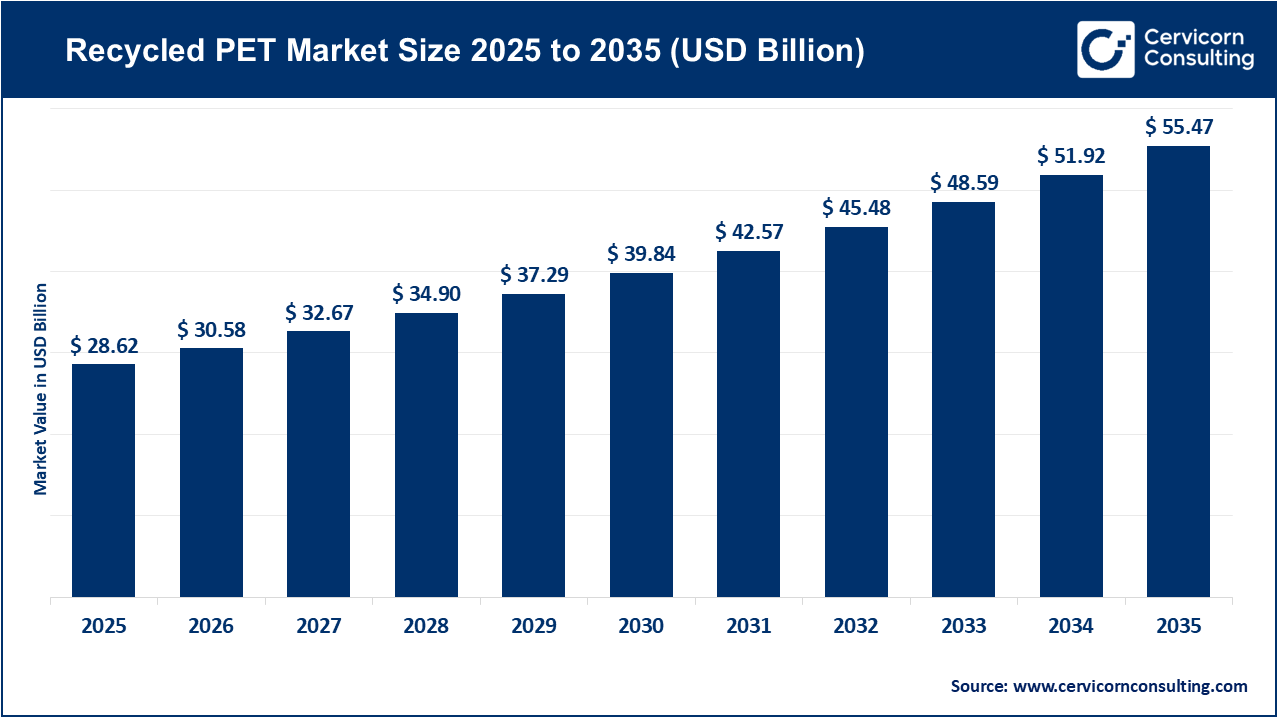
On the supply side, higher collection rates, technological improvements in washing, optical sorting, and advanced recycling processes, as well as new facility construction, are converting more bottle-bale feedstock into food-grade pellets. However, there are still regional gaps. In Europe, PET collection and sorting have accelerated, with collection rates reaching about 60% in 2022. Tray recycling capacity is also increasing rapidly, from about 57,000 tons per year in 2022 with plans to exceed 300,000 tons per year by 2025. In contrast, North American recycling rates are lower, with U.S. PET recycling at about 29% according to recent reports. This means that feedstock tightness and price fluctuations will continue to affect short-term market conditions. Overall, these regulatory, corporate procurement, and infrastructure trends are expected to support mid-single to high-single digit compound annual growth rates for rPET demand. However, competition with low-cost virgin PET and regional feedstock bottlenecks may limit growth.
Report Highlights
- Asia-Pacific leads the region, with around 44.6% of global rPET revenue, driven by manufacturing growth and recycling investments.
- North America is another significant regional contributor, with a 25.3% share, driven by established recycling infrastructure and eco-brand demand.
- Clear rPET commands a dominant position, with roughly 78% of rPET flakes usage driven by demand for food-grade and beverage packaging.
- Food & beverage containers and bottles remain one of the largest end uses, accounting for more than 43% of segment revenue as packaging companies integrate recycled content.
Growing Consumer Preference for Eco-Friendly Packaging Driving the rPET Market
The demand for eco-friendly packaging, such as recycled PET (rPET), is increasing as consumers align their purchasing decisions with environmental values. Recent surveys show that about 72% of global shoppers prefer products with clear environmental credentials. Younger consumers, especially those in Generation Z, demonstrate even stronger preferences for sustainable options. Over 80% of consumers are willing to pay more for products in sustainable packaging, and many actively choose items based on recyclability and environmental impact. These changing attitudes are leading major brands to redesign their packaging strategies to maintain market share and attract environmentally conscious buyers. As a result, the rPET market is experiencing significant growth.
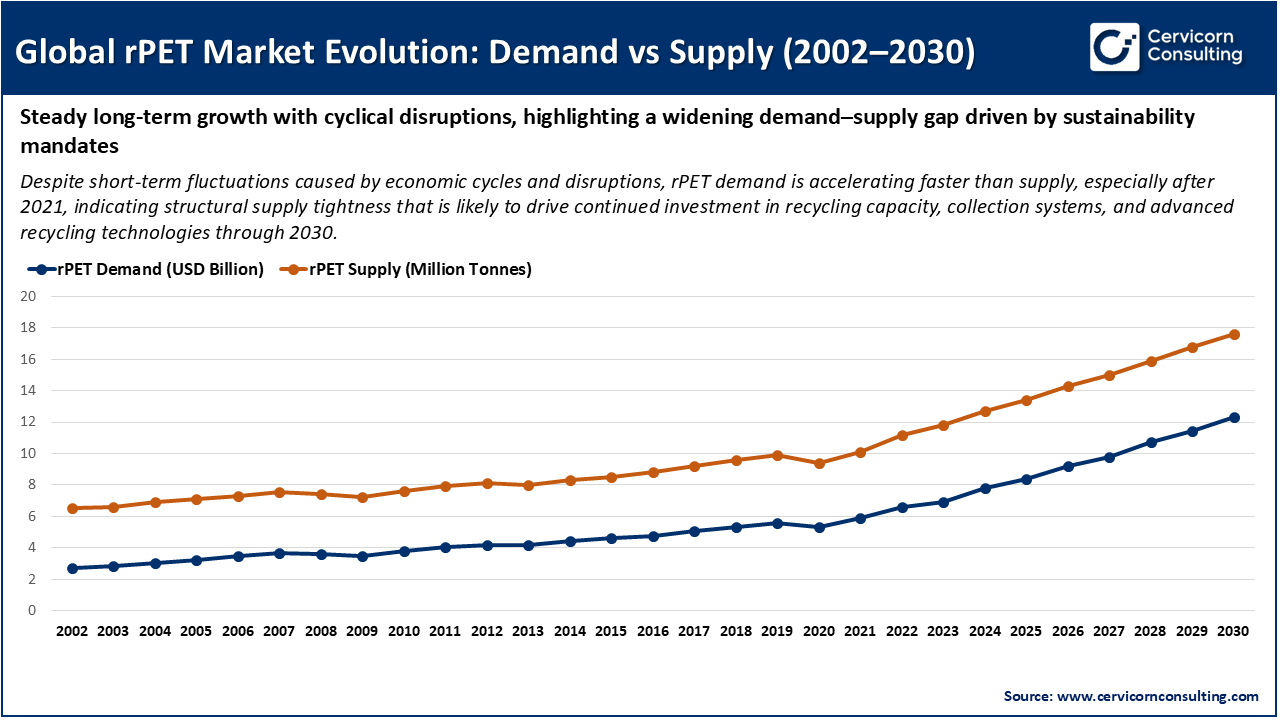
The global rPET market has shown steady growth in both demand and supply from 2002 to 2030, with some cyclical fluctuations driven by economic downturns such as the 2008–09 financial crisis and the 2020 pandemic. Supply has increased as a result of greater recycling capacity and better collection systems. However, since 2021, demand has grown at a faster rate, mainly due to regulatory requirements for recycled content and stronger sustainability commitments from brands. This has led to a widening gap between demand and supply, indicating that high-quality rPET will remain in short supply. As a result, there is a clear need for ongoing investment in recycling infrastructure to meet future market requirements.
Report Scope
| Area of Focus |
Details |
| Market Size in 2026 |
USD 30.58 Billion |
| Market Size in 2035 |
USD 55.47 Billion |
| CAGR from 2026 to 2035 |
6.80% |
| Dominant Region |
Asia-Pacific |
| Key Segments |
Product Type, Type, Grade, Source, End Use, Region |
| Key Companies |
Ergis Recycling, BariQ, Phoenix Technologies, Clear Path Recycling LLC, Libolon, Placon, M&G Chemicals, Evergreen Plastics, Inc., Zhejiang AnshunPettechsFibre Co. Ltd., Sorema, PolyQuest, Verdeco Recycling, Inc. |
Recent Major Milestones
1. EU Recycled Content Mandates for PET Bottles (2025–2030)
The Single-Use Plastics Directive introduced by the European Union requires that all PET beverage bottles include at least 25% recycled PET (rPET) by 2025, increasing to 30% by 2030. This regulation is driving a steady demand for food-grade rPET throughout Europe and among global exporters aiming to access this market. As a result, there is a clear incentive for investment in collection, processing, and recycling infrastructure to comply with these standards. These government requirements are advancing circularity in packaging and expanding the use of rPET beyond voluntary commitments, directly influencing the procurement strategies of major brands and recyclers.
2. Coca-Cola and PepsiCo Large rPET Off-Take Contracts
The global rPET market is experiencing significant growth as major beverage companies, including Coca-Cola and PepsiCo, have secured contracts for over 1.2 million tons of rPET supply through 2026. This development is encouraging recyclers such as Indorama, Alpek, and Plastipak to expand their production capacities worldwide. These long-term off-take agreements provide a reliable market for recycled PET, which supports new investments in recycling facilities and strengthens the overall economics of recycling. By committing to large volumes, these companies are helping to stabilize rPET prices and reduce risks for recyclers. This is particularly important as demand for rPET increases and competition for high-quality feedstock becomes more intense.
3. Srichakra Polyplast Triples rPET Capacity in India (2024)
Indian recycler Srichakra Polyplast commissioned two new Starlinger recycling lines in Hyderabad, increasing its annual rPET output to approximately 42,000 tons per year — a three-fold increase in capacity. This expansion reflects broader industry activity in Asia to meet rising demand from local packaging makers and export markets. By boosting domestic rPET production, such investments reduce reliance on imported recyclates, support regional collection systems, and help meeting tighter recycled content requirements pushed by both consumers and regulators across key markets.
4. Joint rPET Recycling Facilities by Indorama & PepsiCo in India
Indorama Ventures, in a joint venture with a PepsiCo bottler, is building two new PET recycling facilities in India with a combined annual capacity of about 100,000 tons of rPET. This project is a significant milestone in scaling food-grade rPET supply in one of the world’s fastest-growing packaging markets. Large-scale local capacity not only supports brand sustainability goals but also helps strengthen circular supply chains in India and Asia Pacific more broadly, where collection and recycling infrastructure are rapidly developing to meet both domestic consumption and export demand.
Market Dynamics
Market Drivers
- Regulatory Push for Recycled Content in Packaging: Government regulations mandating recycled content in plastic packaging are a primary driver of the rPET market. Policies such as the EU requirement for 25% recycled content in PET bottles by 2025 and 30% by 2030, along with extended producer responsibility (EPR) schemes in regions like North America and Asia, are creating compulsory demand for food-grade rPET. These regulations reduce reliance on voluntary sustainability commitments and force brand owners to secure long-term rPET supply, directly stimulating investment in recycling capacity and collection infrastructure.
- Brand Sustainability Commitments and Consumer Pressure: Global beverage, food, and FMCG brands are aggressively increasing rPET usage to meet public sustainability targets and respond to growing consumer preference for eco-friendly packaging. Companies such as Coca-Cola, PepsiCo, and Nestlé have pledged to use 50–100% recycled or recyclable packaging within the next decade. These commitments translate into long-term off-take agreements with recyclers, supporting market stability and accelerating capacity expansion across mechanical and advanced recycling technologies.
Market Restraints
- Limited Availability of High-Quality Feedstock: Despite growing demand, the rPET market is constrained by insufficient collection and sorting of PET waste, especially food-grade bottle-to-bottle streams. In many regions, PET collection rates remain below 40%, creating feedstock shortages and driving up rPET prices relative to virgin PET. This imbalance limits scalability and discourages smaller converters from adopting rPET due to cost volatility and inconsistent supply.
- Cost Competitiveness with Virgin PET: rPET production often remains more expensive than virgin PET, particularly during periods of low oil prices. Additional costs related to collection, sorting, washing, and decontamination make rPET less price-competitive in cost-sensitive markets. Without regulatory incentives or brand-driven premiums, converters may revert to virgin materials, slowing adoption in non-regulated applications.
Market Opportunities
- Expansion of Recycling Infrastructure in Emerging Markets: Emerging economies in Asia, Latin America, and Africa present significant growth opportunities as governments and private players invest in PET collection and recycling systems. Rapid urbanization, rising packaged-beverage consumption, and improving waste-management frameworks are creating large untapped feedstock pools. New recycling plants in India, Southeast Asia, and the Middle East are enabling regional rPET supply, reducing import dependence and supporting global brand demand.
- Technological Advancements in Recycling Processes: Advances in mechanical recycling efficiency and the commercialization of chemical and advanced recycling technologies offer strong growth potential for the rPET market. Improved sorting, decontamination, and depolymerization processes are expanding the range of applications for recycled PET, including high-purity food-grade and textile uses. These innovations help address quality limitations and increase usable yield, strengthening long-term market viability.
Market Challenges
- Quality Consistency and Food-Grade Compliance: Maintaining consistent quality and meeting stringent food-contact regulations remains a major challenge for rPET producers. Variations in feedstock composition and contamination levels can impact resin performance and regulatory compliance. This creates technical and cost challenges for recyclers and limits rPET adoption in sensitive applications such as beverages and pharmaceuticals without advanced processing systems.
- Infrastructure Gaps and Regional Imbalances: The rPET market faces uneven development across regions, with advanced recycling infrastructure concentrated in Europe and parts of North America, while other regions lag behind. These imbalances result in supply bottlenecks, logistical inefficiencies, and reliance on cross-border trade of PET waste or recycled resin. Bridging these gaps requires coordinated policy support, capital investment, and collaboration across the value chain, which can be slow and complex to implement.
Recycled PET Market Regional Analysis
The Recycled PET market is segmented by region into North America, Europe, Asia-Pacific, and LAMEA. Here is a brief overview of each region:
North America rPET Market: Driven by Corporate Commitments and Regulatory Momentum
The North America recycled PET (rPET) market size was estimated at USD 7.24 billion in 2025 and is expected to be worth around USD 14.03 billion by 2035. In North America, the rPET market growth is propelled by strong corporate sustainability commitments from major beverage and consumer goods companies, rising consumer demand for eco-friendly packaging, and evolving state/provincial regulations that target recycled content in plastics. These forces are driving investments in local recycling infrastructure and expanding rPET adoption across packaging and textile applications. While the overall regional growth rate has historically been more moderate than some other areas, North America continues to strengthen its role in circular packaging through increased rPET use, extended producer responsibility (EPR) plans and landfill reduction policies that support higher recycled content standards in major states and provinces.
Recent Developments:
- Coca-Cola pledged to use 100% rPET for some of its U.S. bottle lines, increasing food-grade recycled PET usage in major beverage products.
- Enhanced state rules and landfill bans in parts of the U.S. and Canada are stimulating demand for rPET and forcing recyclers and brands to secure sustainable resin supplies.
Europe rPET Market: Driven by Regulatory Mandates and Circular Economy Leadership
The Europe recycled PET (rPET) market size was reached at USD 5.67 billion in 2025 and is predicted to surpass around USD 10.98 billion by 2035. Europe’s rPET market is strongly driven by robust regulatory mandates such as the EU Single-Use Plastics Directive requiring minimum recycled content in PET bottles and aggressive circular economy goals set by the European Commission. Governments across the EU have embraced deposit-return schemes, stringent recycling targets and extended producer responsibility (EPR) frameworks that ensure a reliable flow of collected PET for recycling. As a result, Europe remains a leader in rPET penetration - particularly in bottle-to-bottle and food-grade applications - and maintains advanced sorting and recycling infrastructure that sustain high collection and conversion rates.
Recent developments:
- Implementation and enhancement of deposit-return schemes (DRS) in countries such as the United Kingdom and Germany to boost PET bottle collection efficiency.
- Expansion of advanced recycling technologies and partnerships (e.g., enzymatic/chemical recycling initiatives) to increase high-quality rPET output.
Asia-Pacific rPET Market: Driven by Rapid Packaging Demand and Industrial Expansion
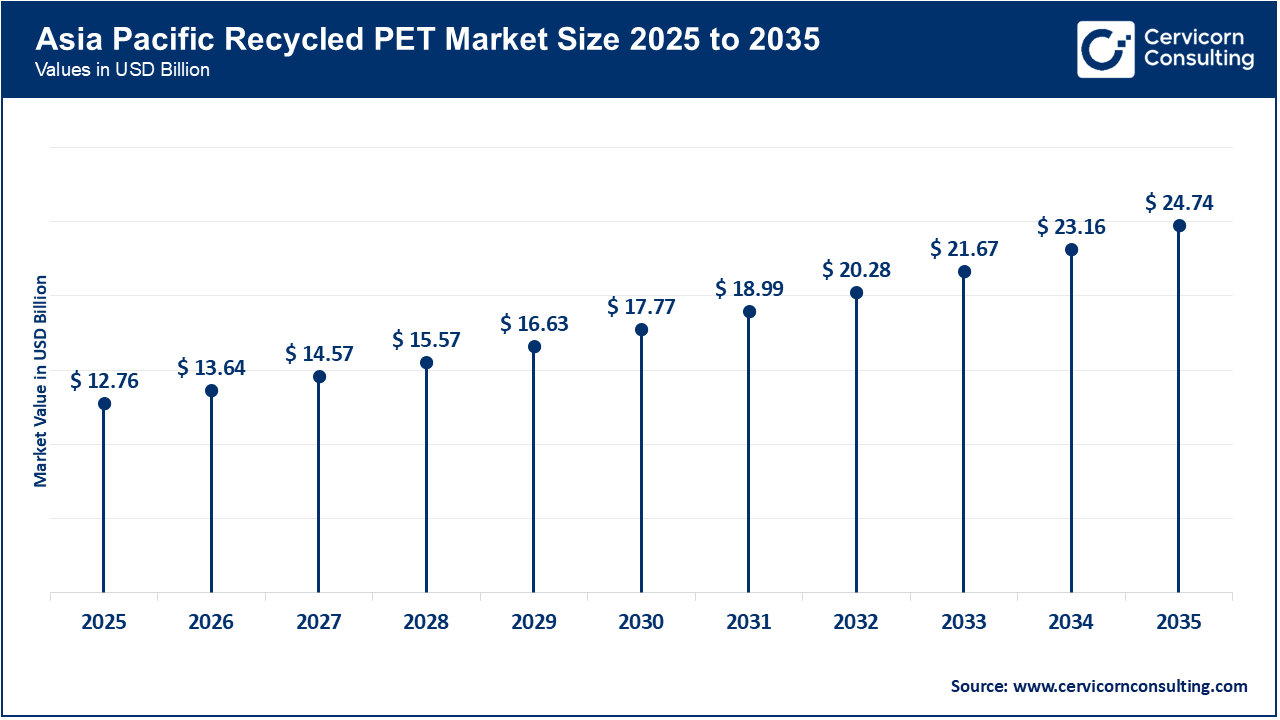
The Asia-Pacific recycled PET (rPET) market size was estimated at USD 12.76 billion in 2025 and is forecasted to hit around USD 24.74 billion by 2035. The Asia-Pacific rPET market is experiencing significant growth due to the rapid expansion of the packaging industry, ongoing urbanization, and stronger sustainability commitments from both governments and leading brands. At present, Asia-Pacific holds the largest share of global rPET demand, which is mainly attributed to increasing beverage consumption, the growth of textile manufacturing (particularly recycled polyester fiber), and greater investments in recycling infrastructure. The economic development of countries such as China and India is leading to higher capital expenditures in PET collection, mechanical recycling processes, and advanced technologies. As a result, the region is making progress toward meeting global sustainability targets.
Recent developments:
- Large rPET recycling plant investments in India and China to serve local packaging and fiber sectors.
- Expansion of joint ventures between major recyclers and beverage firms to build scalable rPET facilities for the fast-growing Asia market.
Recycled PET Market Share, By Region, 2025 (%)
| Region |
Revenue Share, 2025 (%) |
| Asia Pacific |
44.60% |
| North America |
25.30% |
| Europe |
19.80% |
| LAMEA (Latin America, Middle East & Africa) |
10.30% |
LAMEA rPET Market: Driven by Emerging Circular Policies and Market Potential
The LAMEA recycled PET (rPET) market was valued at USD 2.95 billion in 2025 and is anticipated to reach around USD 5.71 billion by 2035. The development of the rPET market in the Latin America, Middle East, and Africa (LAMEA) region is significantly influenced by new governmental policies focused on reducing plastic pollution and encouraging recycling. As brands show greater interest in sustainable packaging and collection systems expand, the market is seeing notable changes. While many LAMEA countries still have lower infrastructure and collection rates compared to more developed regions, advancements in waste management, collaborations with global recyclers, and increasing environmental awareness are creating new opportunities for rPET, particularly in rapidly urbanizing economies.
Recent developments:
- Expansion of recycling capacity and partnerships between local waste management firms and multinational brands to scale rPET supply for regional packaging markets.
- Government initiatives in select countries promoting PET collection, EPR schemes, and incentives for recycled content adoption in packaging.
Recycled PET Market Segmental Analysis
The Recycled PET market is segmented into product, raw material, application, and region.
Product Type Analysis
Clear rPET continues to be the leading product type in the market. Its optical clarity and reliable performance make it the preferred material for food-grade, beverage, and premium packaging, where product visibility and fast qualification are important. Recent industry data indicates that clear rPET accounted for about 78% of the value and share in the rPET flakes and packaging market in 2025. Transparent rPET is especially dominant in beverage applications such as water, carbonated soft drinks, and juice. These categories together form a large and stable demand base for bottle-to-bottle recycling. Major bottling companies consistently choose transparent rPET for large-scale programs, which helps maintain high volumes and encourages further investment in clear rPET production.
Recycled PET Market Share, By Product Type, 2025 (%)
| Product Type |
Revenue Share, 2025 (%) |
| Clear rPET |
78.2% |
| Colored rPET |
21.8% |
In contrast, colored rPET is expected to grow at a faster rate than clear rPET. This is because colored rPET can be made from a broader range of mixed or lower-grade feedstocks, is less expensive to process for non-food uses, and meets the increasing demand for colored and functional packaging, industrial trays, automotive parts, and some textile applications. Market studies predict that the colored rPET segment will achieve a higher compound annual growth rate in the coming years. For example, research estimates coloured rPET growth at around 8-8.5% CAGR. This growth is driven by converters and end-users who are replacing higher-cost materials with recycled content in applications that do not require optical clarity. The expansion of colored rPET is also being supported by new production lines and investments in sorting and decontamination technologies, which make it possible to upgrade previously unusable material streams into usable colored pellets.
End Use Analysis
Food and beverage bottles and containers represent the largest end-use for rPET. This is mainly due to regulatory requirements for recycled content, brand targets, and the high global volume of bottled beverages. According to regional studies and market trackers, this category consistently holds the largest share of rPET demand. For example, food and beverage uses accounted for about 24% or more of rPET flakes demand in some U.S. analyses, and this segment leads global demand for transparent and bottle-grade rPET. Major brand commitments, such as multi-year agreements and recycled-content pledges, are expected to keep demand for bottle-grade rPET high and stable. The recent increase in 100% rPET bottle programs and new government content laws in Europe and some U.S. states are also supporting this trend.
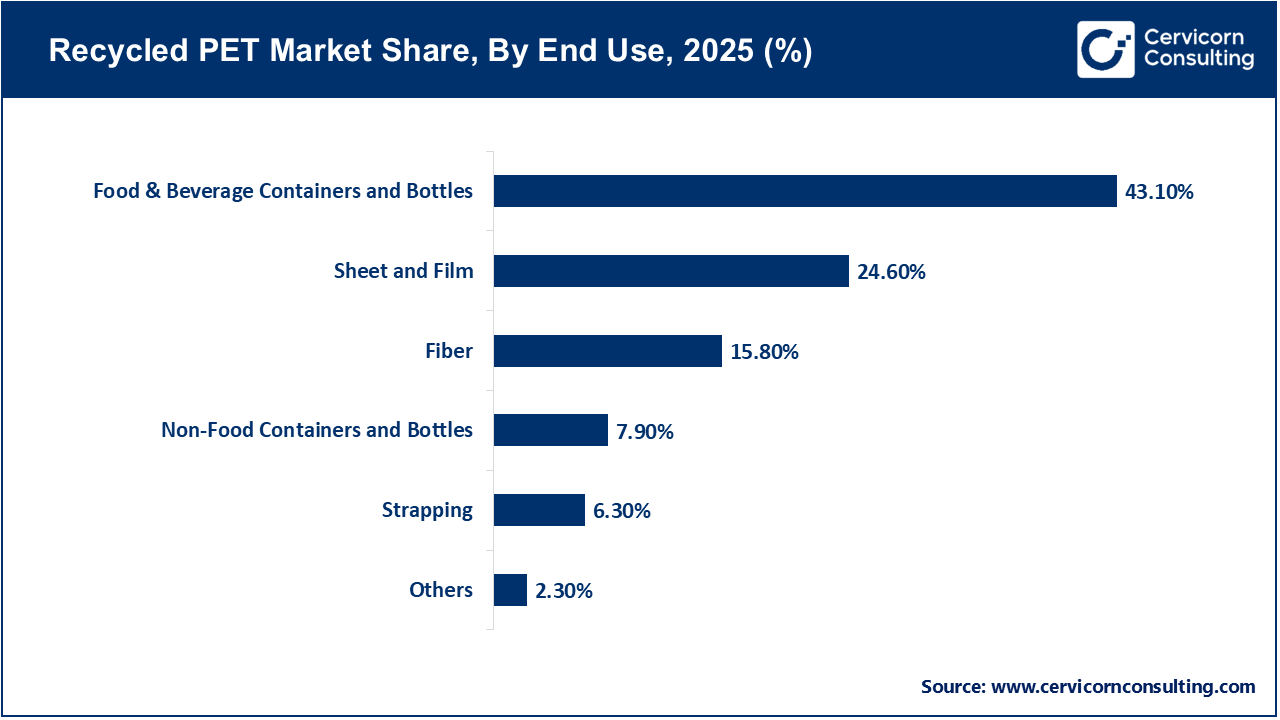
The fiber segment, which includes recycled polyester yarns and fibers for apparel, home textiles, and technical textiles, is also growing quickly. Fashion brands, sportswear companies, and textile supply chains are setting ambitious recycled-content goals and adopting circular textile strategies. Market forecasts indicate that the recycled polyester and rPET fiber market will grow at a strong rate, with more recycled bottle feedstock being used for high-volume apparel and home textile production. Forecasts for recycled polyester and apparel fiber show multi-billion-dollar growth, and centralized sourcing programs by brands are expected to drive near-term demand. This trend creates a large outlet for collected PET, but it also increases competition with bottle-to-bottle recycling, making feedstock management an important issue for the entire rPET value chain.
Recycled PET Market Top Companies
Recent Developments by Major Companies
- In December 2025, Phoenix Technologies permanently closed its rPET recycling facility in Bowling Green, Ohio. This event represents a significant change in U.S. rPET capacity, mainly caused by economic challenges and low feedstock quality. The closure reduces local processing capacity and demonstrates the sector's sensitivity to supply chain and quality issues. As a result, the industry may see more consolidation or increased investment in higher-efficiency plants in other regions.
- In August 2025, Verdeco Recycling introduced improvements to its FDA-approved rPET production process. These enhancements show that the company can convert a wide range of post-consumer plastics into high-quality, food-safe rPET pellets for industries such as food, beverage, cosmetics, and medical packaging. By focusing on quality control and customization, Verdeco is able to meet the increasing performance and sustainability requirements set by major global brands.
- In 2025, Ergis launched its ErgisMark advanced material-marking and sorting technology. This technology is intended to improve the sorting efficiency of multi-material packaging and raise both the quality and yield of recyclable streams for rPET processing. By using fluorescent markers on packaging, the system enables clean separation of materials that were previously hard to recycle. This development is expected to increase the availability of high-quality rPET feedstock and support the goals of a circular economy.
Market Segmentation
By Product Type
By Type
By Source
- Bottles and Containers
- Films and Sheets
- Others
By Grade
By End Use
- Food & Beverage Containers and Bottles
- Strapping
- Fiber
- Non-Food Containers and Bottles
- Sheet and Film
- Others
By Region
- North America
- APAC
- Europe
- LAMEA