Temperature Controlled Packaging Solutions Market Size and Growth Outlook 2026 to 2035
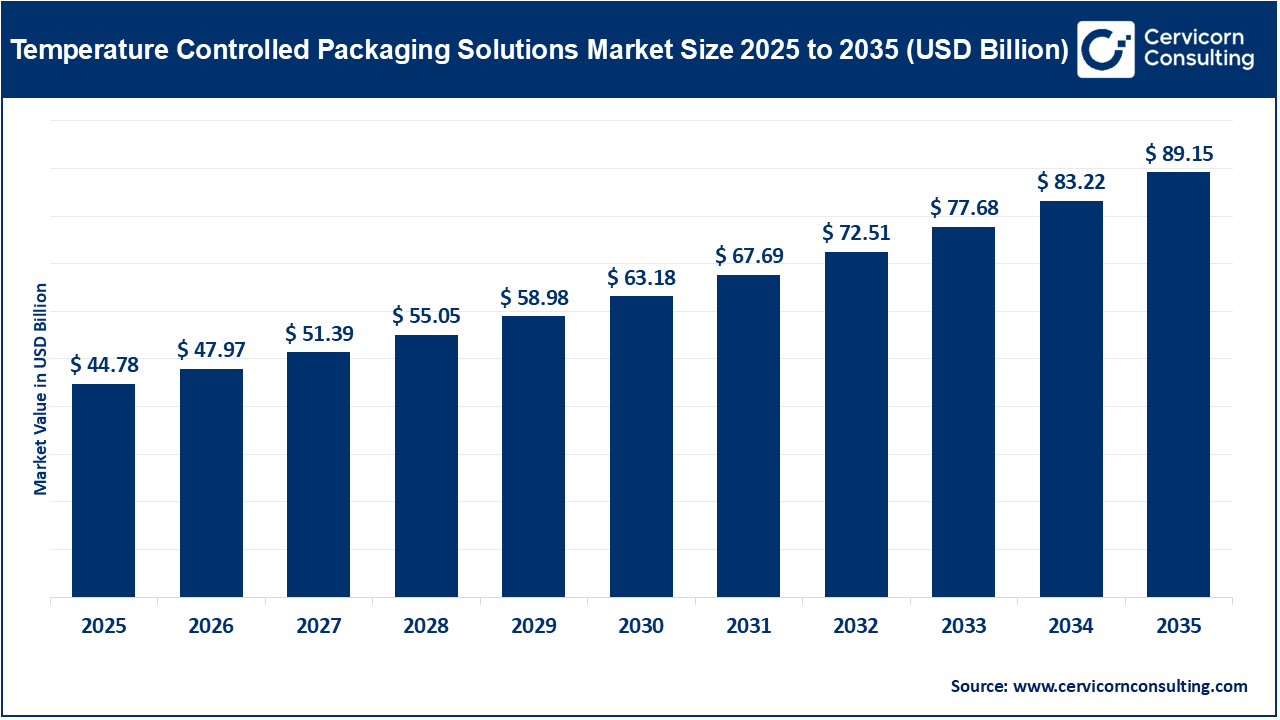
The global temperature-controlled packaging solutions market size was valued at USD 44.78 billion in 2025 and is anticipated to surpass around USD 89.15 billion by 2035, growing at a compound annual growth rate (CAGR) of 7.2% over the forecast period from 2026 to 2035. The overall growth in quick-commerce services associated to food and beverages sector promotes the expansion of temperature-controlled packaging solutions market.
Report Highlights
- North America led the market in 2025, specialized requirement for cold chain logistics has supported the market’s expansion in the region.
- Asia Pacific is observed to witness the fastest rate of growth during the forecast period owing to the rising demand from food and beverages as well as pharmaceutical sectors.
- By type, the passive systems held the dominating share of around 65% in 2025 owing to their cost-effectiveness and environmental properties.
- By type, the active systems segment is observed to grow at the fastest rate during the forecast period with the rising advancements in mechanical components in packaging sector.
- By product, the insulated shippers led the market in 2025 with revenue share of 48% due to their application in wider range of industries from pharmaceutical to food items.
- By product, the insulated containers segment is observed to grow at the fastest rate during the forecast period.
- By application, the food and beverages segment dominated the market with revenue share of 49% in 2025 with the overall rise in demand for frozen foods and other advanced packaging materials.
- By application the healthcare segment is seen to grow at the rapid pace following the changes in regulatory compliances for packaging in pharmaceutical sector.
What is Temperature Controlled Packaging Solutions Market and How it Works?
The temperature controlled packaging solutions market represents the ecosystem of products/technologies that allow one to maintain a defined temperature range while intransport/storage for items that require temperature control due to the fact that there are many industries where slight temperature variation can lead to product safety issues, product efficacy issues and/or product quality issues; this is particularly important in the pharmaceutical, biopharmaceutical and vaccine industries as well as clinical trial materials, including food packaging.
Companies that are considered as being some of the leading global providers of temperature controlled packaging solution for the healthcare supply chain and food supply chain include Sonoco, Cold Chain Technologies, and Pelican BioThermal.
Top 5 Trends & Technologies
- Smart Packaging: Integration of IoT-enabled sensors, RFID tags, and data loggers into packaging allows continuous tracking of temperature, humidity, and shock during transit.
- Rising Adoption of Returnable Packaging Systems: Reusable insulated containers and modular shippers are gaining traction as companies seek to lower long-term packaging costs and reduce waste.
- Advanced Phase Change Materials (PCMs): New PCM formulations offer precise temperature hold points such as 2–8°C, -20°C, or controlled ambient ranges.
- High-Performance Insulation Technologies: Growing use of vacuum insulated panels (VIPs), aerogels, and multi-layer fiber-based liners enhances thermal resistance while reducing package size and thickness.
Majorly Used Insulation Materials for Temperature Controlled Packaging:
| Insulation Material |
Benefits |
Key Application |
| Foam |
Cost effective and lightweight |
Food and beverages and quick shipments |
| Gel Packs |
Long lasting consistency |
Biological samples, pharmaceuticals and long shipments |
| Vacuum Insulation |
Superior insulation |
Pharmaceuticals |
| Reflective Insulation |
Reflects heat, lightweight |
Electronics, quick shipments |
How Does Recyclable Packaging Solutions Support Temperature Controlled Packaging?
By combining eco-friendly packaging design with dependable thermal capabilities, recyclable packaging solutions are helping to maintain the temperatures of items transported via the cold chain system and reduce the environmental footprint of dangerous consumables. There are many examples of new products showing how recyclable packaging materials have been successfully integrated into temperature controlled packaging solutions. One example is a product that utilizes a single-use cold chain box that can be recycled at curbside 100% (using either recycled PET or recycled paper) while providing temperature stability for up to 48 hours at chill temperatures.
Temperature Controlled Packaging Solutions Market Regional Analysis
Healthcare Temperature Controlled Packaging Solution in North America to Witness Significant Growth Rate; Region’s Dominance to Sustain
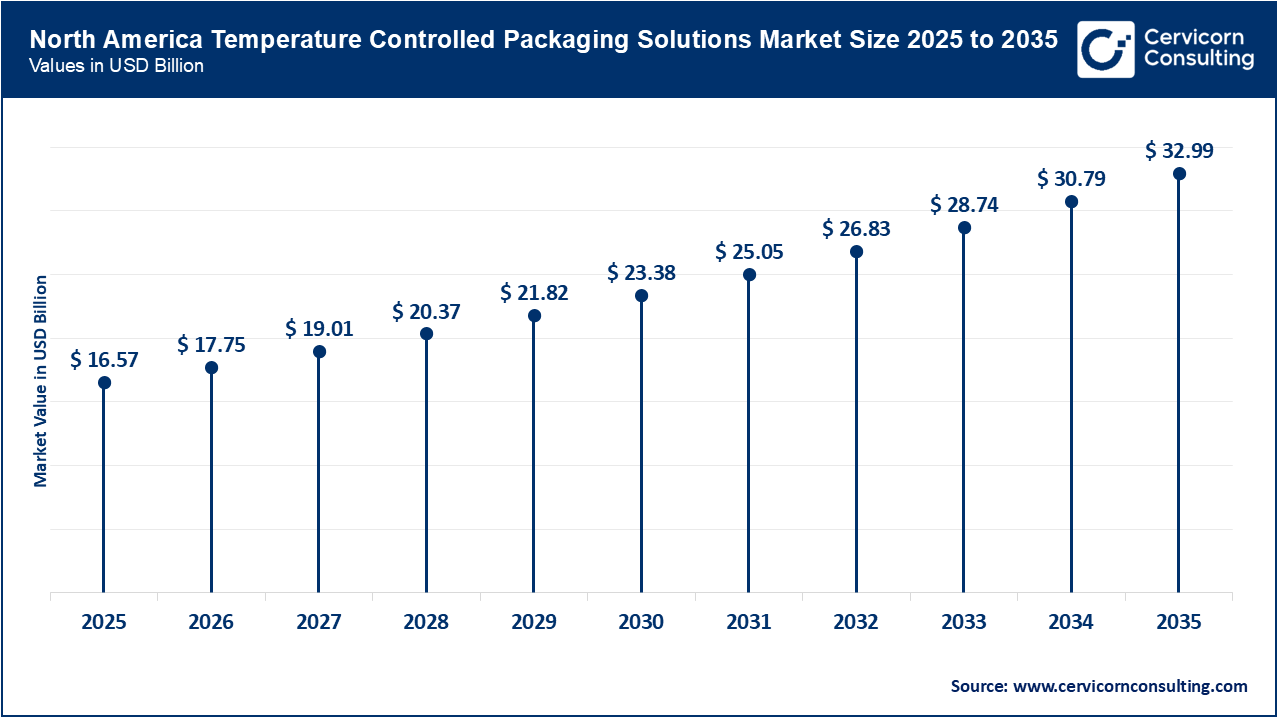
The North America temperature-controlled packaging solutions market size was valued at USD 16.57 billion in 2025 and is anticipated to surpass around USD 32.99 billion by 2035. North America in 2025, dominated the temperature controlled packaging solutions market. As the epicenter of pharmaceutical development, biologics production, vaccine formulation, and sophisticated clinical research in the world, North America has a significant need for temperature controlled packaging systems that protect the quality of products through increasingly complex supply chains during these operations.
In addition to the high volume of biologics being manufactured in North America, there are many more ways in which North America is on the cutting edge of innovation regarding therapeutic modalities. The therapeutic options created in North America include the adoption of cell and gene therapies, an increasing use of injectables, and strong enforcement of regulations requiring compliance with temperature controlled (cold chain) distribution.
Due to all this consideration, both U.S. and Canadian pharmaceutical manufacturers and logistics providers are moving towards using validated, data-enabled and reusable temperature controlled packaging solutions to support domestic distribution and international shipments of their products.
U.S. and Canada Temperature Controlled Packaging Solutions Market: A Quantitative Research
- The United States hosts over 6,000 active pharmaceutical manufacturing facilities, many handling sterile and biologic products.
- More than 70% of vaccines distributed in the U.S. move through temperature controlled channels.
- Over 85% of large pharmaceutical companies in North America use validated temperature controlled packaging rather than passive insulated shippers.
- Recently in 2025, Peli BIoThermal announced the launch of Vero One, a recyclable dry ice shipper designed to address growing demand for flexible cold chain solutions.
Expansion of Quick Food Delivery Platforms to Offer Potential for Asia Pacific Temperature Controlled Packaging Solutions Market
The Asia-Pacific temperature-controlled packaging solutions market size was estimated at USD 11.64 billion in 2025 and is anticipated to reach around USD 23.18 billion by 2035. Asia Pacific is observed to grow at the fastest rate during the forecast period. As rapid on-demand food service markets are significantly expanding across Asia; a major opportunity has come about for the temperature controlled packaging solutions industry. With the increased consumer reliance on food delivery applications to provide their ready-made meals, grocery items and perishable item purchases, it has become necessary for the logistics systems that provide these services to keep product quality and safety from the vendor to the consumer’s door. This expanding delivery system is driving up demand for insulated packaging, refrigerated transportation modules and real time temperature monitoring systems, which are critical components of temperature controlled packaging solutions.
- India’s food delivery sector is one of the fastest-growing markets, with major platforms such as Swiggy operating in more than 700 cities by 2025 under its food delivery business, alongside rapid expansion into quick-commerce services.
- By December 2025, Zomato delivered 42.2 million food delivery orders in Delhi; while for Zomato, UAE topped in internation orders delivering more than 2.3 lakh orders by the same timeframe.
- Companies like BigBasket, Swiggy and Blinkit are expanding these networks, and such infrastructure often requires temperature-controlled packaging and storage to preserve perishable items during these ultra-fast deliveries.
China to Act as Innovation Hub for Temperature Controlled Packaging Solutions
A large portion of the volume of food logistics and delivery in the area can be attributed to China. Online food delivery services/companies such as Meituan, Ele.me, and GrabFood dominate the segment and account for tens of millions of daily food deliveries in urban areas. They are rapidly expanding their reach to towns and cities outside of large metropolitan centres. There is a need for sophisticated temperature-controlled packaging systems to preserve the quality and safety of perishable and prepared food during the urban/suburban last mile deliveries from the supplier to the consumer.
In China, climate controlled packaging in cold chain logistics has been impacted by the increase in cost of insulation materials and refrigerants as refrigerant prices rose (refrigerants such as R32 and related low GWP blends) have created a search by many logistics providers to find other thermal mass materials with a hybrid cooling strategy so they could become more cost effective yet still get the required performance.
Average Costing of Packaging Materials in China
According to our expert research panel at Cervicorn Consulting, following are approximate pricing of few packaging materials in China (as of January 2026):
- The average pricing of a take away packaging disposable container (3 compartments) is $ 0.107/piece.
- A four compartment meal container with lead can cost upto $0.120/piece or less than that.
- An eco-friendly customized insulated paper packaging box (for seafood packaging) can cost up to $0.48 to 0.75 on an average.
- A multi-layer insulated aluminium foil thermal protective packaging can cost up to $ 0.90/piece.
- A low temperature biomedicine packaging solutions (global standards) can cost up to $95 in China.
Temperature Controlled Packaging Solutions Market Segmental Analysis
Type Analysis
“Passive Systems Held the Largest Share of Temperature Controlled Packaging Solutions Market in 2025”
The passive systems segment dominated the market in 2025 due to its significant market share, acceptance and low costs, as well as its ability to be used across several sectors. Passive packaging systems utilize thermal insulating material and refrigerants in their design and are commonly found in logistics providers' supply chains to manage refrigerated and frozen product shipments. These passive systems are commonly found in short distance deliveries and last mile delivery locations. According to survey results from logistics associations, over 70% of food and beverage shipments that require a temperature controlled shipment still use passive packaging systems because of their lower upfront cost and ease-of-use.
Temperature Controlled Packaging Solutions Market Share, By Type, 2025 (%)
| Type |
Revenue Share, 2025 (%) |
| Passive Systems |
65% |
| Active Systems |
35% |
The active temperature controlled packaging system segment is forecasted to grow faster during this period. Active systems include mechanical refrigeration units, battery or electricity assisted cooling, and electronic control systems that provide precise temperature ranges for longer periods of time and in less than ideal environmental conditions. The growth of this segment is driven by the increased complexity of cold chain logistics for biologics, vaccines, and high value pharmaceuticals where maintaining a stable and continuous temperature is imperative to their success.
Product Analysis
“Insulated Shippers Held the Largest Share, Insulated Containers to Grow Rapidly by 2035”
Insulated shippers segment led the temperature controlled packaging solutions in 2025, retaining the highest usage rate in medium-distance cold chain shipments. Insulated shippers are usually manufactured from expanded polystyrene, polyurethane panels, or corrugated insulative wraps. Insulated shippers are commonly used in the transportation of chilled and frozen products through regional supply chains. The leading grocery distributors have reported that insulated shippers are the preferred choice for over 50% of refrigerated grocery shipments, including chocolates, dairy products, and non-alcoholic beverages.
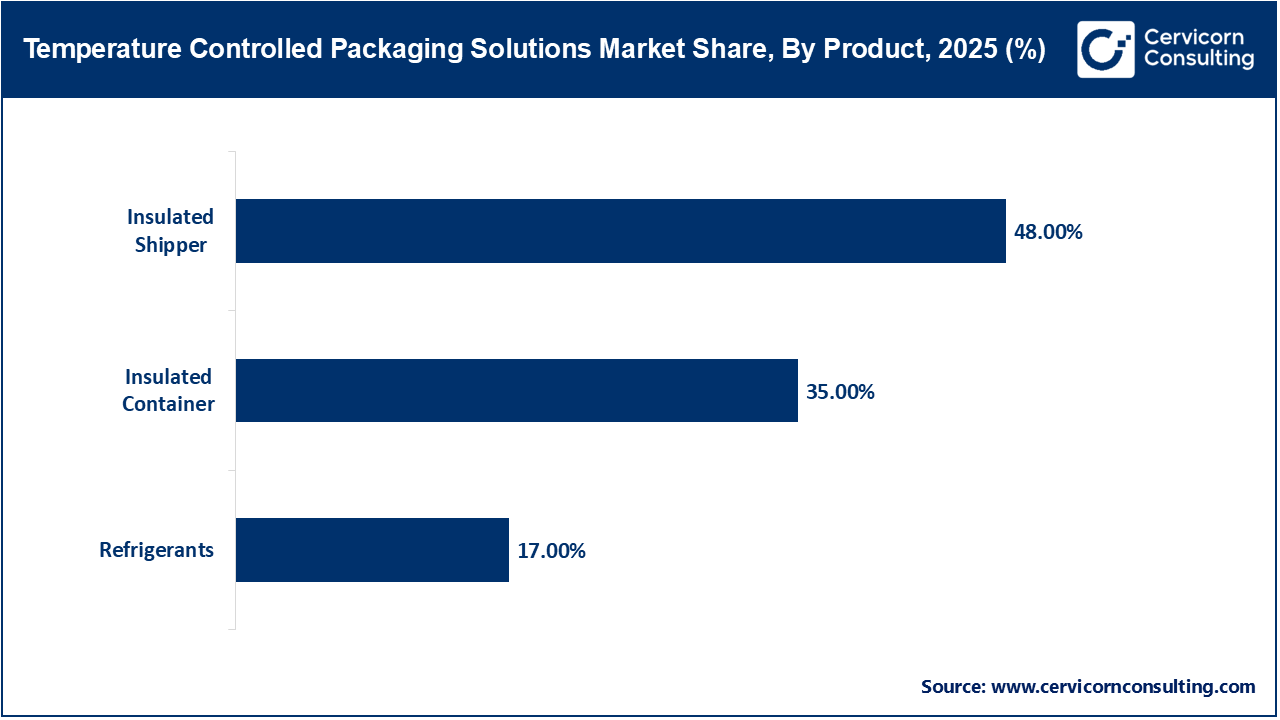
Insulated containers are expected to experience the fastest-growth in the market. Due to their flexibility for short and long-term temperature controlled shipping, they have also experienced a growth in popularity due to their growing use in premium e-commerce deliveries. Insulated containers have been engineered to carry multilayer insulation and offer a high degree of protection against external factors. As a result, they are a popular choice for the reusable/sustainable cold chain option.
Experts at Cervicorn Consulting confirm the increased use of insulated containers by some of the largest food delivery & online grocery companies as a means of maintaining product quality during the last mile delivery that is where the likelihood of temperature excursions are at their highest.
Application Analysis
“The Food and Beverages Segment Dominated the Market in 2025; Healthcare to Observe Significant Growth”
The food and beverages application segment led the temperature-controlled packaging market in 2025, due to the massive volume of perishable items that need to be transported at preserved temperatures. Sub-applications like grocery items, chocolates, alcoholic and non-alcoholic beverages, fish and meat, and dairy products cumulatively contributed to the largest market share. This is attributed to the global shift in consumer patterns, such as the consumption of fresh and frozen foods, the rise of online grocery shopping, and the demand for high-quality chilled products.
Temperature Controlled Packaging Solutions Market Share, By Application, 2025 (%)
| Application |
Revenue Share, 2025 (%) |
| Food and Beverages |
49% |
| Healthcare |
45% |
| Others |
6% |
Though food and drinks contributed to the overall volume, the healthcare application segment is the fastest-growing segment during the forecast period. The growth is driven by the unprecedented demand for temperature-sensitive medical shipments. These include pharmaceuticals, blood products, clinical trial shipments, drug testing samples, pathology specimens, and organ transplantation kits. The growth is attributed to the rise in biopharmaceutical manufacturing, the expansion of clinical trials globally, and the strict regulations for the controlled temperature logistics of biologics and vaccines.
“Industry experts report that the cold chain shipments of pharmaceuticals have been growing at a rate of 10 to 15 percent per annum, which is higher than the traditional food cold chain growth, as healthcare providers have been investing in more advanced packaging to ensure stability and compliance from the manufacturer to the point of care.”
Top Government Initiatives and Programs (2026) for Temperature Controlled and Cold Chain Packaging
| Country |
Initiative/Program |
Impact & Highlight |
| India |
Integrated Cold Chain & Value Addition Infrastructure Scheme |
National program under the Ministry of Food Processing Industries that provides credit-linked subsidies (up to 35–50% of project cost) to build and modernize cold storage, pre-cooling, CA storage, refrigerated vehicles, and processing infrastructure. |
| U.S. |
Food Traceability and Cold Chain Compliance Rules |
U.S. regulatory framework under USDA and FDA emphasizes digital traceability and rigorous temperature documentation for perishable food and healthcare shipments. |
| China |
National Cold Chain Development Plan |
Implementing multi-year cold chain logistics development plans focused on expanding pharma cold exports, ensuring vaccine and biologics distribution integrity, and upgrading refrigerated transportation networks. |
| European Union |
EU Cold Chain Regulatory Strengthening |
EU regulatory frameworks are evolving to standardize electronic traceability and thermal control requirements for temperature-sensitive shipments. |
| Brazil |
Strategic Cold Chain Infrastructure Investment Support |
The Brazilian government supports cold chain infrastructure through national programs aimed at improving refrigerated storage, transport, and pharma logistics, particularly for perishable goods and vaccine distribution. |
Temperature Controlled Packaging Solutions Market Top Companies
North America
Asia Pacific
- Tempack
- Asiacooler
- Haier Biomedical
- Thermo King India
- Beijing Guanhua HiTech
- Shandong Head Refrigeration
- Zhejiang Fridge Pressure Vessel
- Korean Vacuum Tech
- Daikin Industries
- Toyo Seikan Group Holdings
Europe
- va-Q-tec AG
- Sofrigam
- Eurobox
- Cryoport Systems
- Cabka Group
- Frigologo
- Arsenal Medical Products
- Logistik Solutions
Recent News
- In July 2025, Nordic Cold Chain announced the launch of cold chain packaging for GLP-1 drugs, this packaging solution is engineered to boost the efficiency for both incoming and outgoing freight. The requirement showed up due to consistent temperature regulation during transit to preserve effectiveness of therapeutics.
- In January 2025, DS Smith announced the launch of innovative temperature controlled packaging solution for pharmaceutical industry, TailorTemp. This is designed to support sustainability targets of biotech businesses and the packaging solution is 100% plastic free.
- In April 2025, Temprecision International announced the launch of plant-based foam refrigerant bricks, a packaging solution for shipping application made out of renewable sourced materials.
Market Segmentation
By Type
- Passive Systems
- Active Systems
By Product
- Insulated Container
- Insulated Shipper
- Refrigerants
By Application
- Food and Beverages
- Grocery
- Chocolates
- Alcoholic Beverages
- Non-alcoholic Beverages
- Fish and Meat
- Dairy Products
- Healthcare
- Pharmaceuticals
- Blood
- Clinical Trials
- Drug Testing
- Pathology
- Organ Transplantation
- Others
By Region
- North America
- Asia Pacific
- Europe
- Latin America
- Middle East and Africa