Electric Truck Charging Station Market Size, Growth, Forecast 2026 to 2035
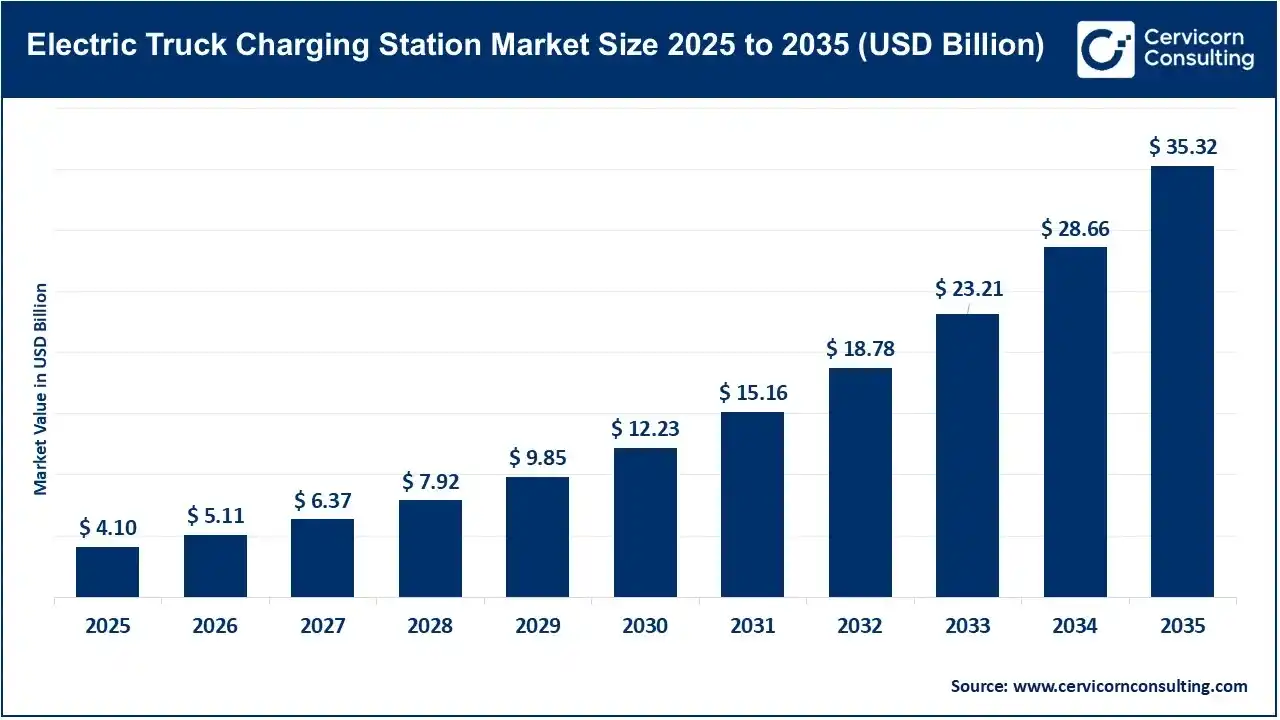
The global electric truck charging station market size was estimated at USD 4.10 billion in 2025 and is projected to hit USD 35.32 billion by 2035, expanding at a CAGR of 24.0% during the forecast period from 2026 to 2035. Rapid growth in electric truck adoption is creating a parallel requirement for dedicated, high-power charging infrastructure; global electric truck sales exceeded 400,000 units in 2025, with China accounting for more than 90% of global sales, while charging networks are increasingly expanding from depot-based systems toward highway, logistics-hub and megawatt charging infrastructure.
Report Highlights
- By region, Asia Pacific dominated the market with the largest share of 55% in 2025, supported by high electric commercial vehicle production, growing fleet electrification across major economies, and the presence of established battery and vehicle manufacturing supply chains.
- By region, North America is expected to expand at the fastest CAGR of 28% between 2026 and 2035, driven by increasing electrification of freight and delivery fleets, government-supported charging infrastructure development, and rising demand for high-power charging solutions.
- By vehicle category, the light-duty electric trucks segment dominated the market with the largest share of 36% in 2025, driven by strong adoption in last-mile delivery, urban logistics, retail distribution, and other applications where predictable operating routes make fleet electrification easier to implement.
- By vehicle category, the heavy-duty electric trucks segment is expected to witness the fastest growth during the forecast period, which also held 30% share in 2025, supported by growing efforts to decarbonize freight transportation, increasing availability of high-capacity batteries, and the development of charging infrastructure capable of supporting heavier commercial vehicles.
- By charger technology, the DC fast charging segment accounted for the largest market share of 40% in 2025, owing to its ability to significantly reduce vehicle charging downtime and support higher vehicle utilization across commercial transportation and fleet operations.
- By charger technology, the Megawatt Charging System (MCS) segment is projected to grow at the fastest rate through 2035, driven by the increasing need to recharge heavy-duty electric trucks within operational schedules and support the electrification of long-distance freight routes.
- By deployment type, the fleet depot charging segment held the largest share of 55% in 2025, supported by the operational advantages of centralized charging, predictable vehicle schedules, and the ability of fleet operators to manage charging infrastructure at dedicated parking and maintenance facilities.
- By deployment type, the highway corridor charging segment is anticipated to register the fastest CAGR of 37.2% from 2026 to 2035, driven by the expansion of long-distance electric freight transportation and the growing need for strategically located high-power chargers along major logistics routes.
- By end user, the logistics & freight segment captured the largest market share of 40% in 2025, reflecting the growing use of electric trucks in parcel transportation, distribution networks, freight operations, and high-mileage commercial fleets seeking to reduce fuel and operating costs.
- By end user, the retail & e-commerce segment accounted for the second-largest share of 20% in 2025, supported by the rapid expansion of last-mile delivery networks and the increasing deployment of electric commercial vehicles for frequent, route-based deliveries from distribution centers to customers.
Electric Truck Charging Station Market Scope
The electric truck charging station market represents the design, manufacturing, deployment, operation, and management of charging stations aimed at satisfying the demands of battery-electric medium- and heavy-duty commercial vehicles. This market is characterized by AC and DC charging stations, high-power and ultra-fast chargers, Megawatt Charging System (MCS) infrastructure, depot charging infrastructure, public and highway charging stations, fleet charging hubs, charging software, energy management systems, and supporting electrical components.
Demand factors include wider battery-electric truck adoption, government emission mandates for transportation infrastructure, an expansive freight and logistics sector, reductions in battery prices and the evolution of high-power charging technologies, among others. The market is primarily focused on charging infrastructure intended for logistics and warehousing facilities, ports, industrial sites, trucking stations, highway routes, and private fleet depots and commercial charging hubs.
Electric Truck & Charging Station Adoption Statistics (By Country)
- China: Electric truck sales exceeded 400,000 units in 2025, accounting for more than 90% of global electric truck sales.
- China: Electric trucks represented approximately 25% of total truck sales in 2025.
- United States: Electric truck sales reached approximately 20,000 units in 2025, representing around 25% year-over-year growth.
- United States: Approximately 400 public and semi-public charging points accessible to medium- and heavy-duty vehicles were available in 2025.
- United States: Electric truck charging infrastructure is concentrated around fleet depots, logistics hubs, ports and major freight corridors.
- Germany: Electric trucks accounted for approximately 3% of truck sales in 2025.
- Germany: Electric medium-freight trucks represented approximately 7% of relevant sales, compared with approximately 1.5% for heavy-freight trucks.
- Germany: The country had approximately 275 HDV charging locations and 1,034 HDV charging stations as of November 2025.
Top Government Initiatives Supporting Electric Truck & Charging Infrastructure
| Country/Region |
Government initiative |
Key details |
| China |
New Energy Heavy-Duty Truck Scale-Up Implementation Plan – 2026 |
China targets 40% new-energy heavy-truck penetration by 2030, more than 1.6 million new-energy heavy trucks, and approximately 3,000 truck charging/battery-swapping stations. |
| European Union |
Alternative Fuels Infrastructure Regulation (AFIR) & Alternative Fuels Infrastructure Facility (AFIF) |
AFIF's second phase allocated €600 million to transport decarbonization projects, including 2,000 HDV charging points of at least 350 kW and nearly 600 charging points of at least 1 MW across 11 EU member states. |
| United States |
SuperTruck Charge Initiative |
The U.S. Department of Energy announced $68 million in January 2025 for innovative medium- and heavy-duty EV charging projects near ports, distribution hubs and major freight corridors. |
| India |
PM E-DRIVE Scheme |
The scheme has a total outlay of ₹10,900 crore, including ₹500 crore for e-truck incentives and ₹2,000 crore for EV public charging infrastructure. The original scheme also targeted 1,800 fast chargers for electric buses, with infrastructure focused on cities and highways. |
| Germany |
Power to Road / German HDV Charging Network |
Germany planned 350 heavy-duty charging stations, comprising approximately 2,400 ultra-fast charging points and 1,800 MW charging points; government funding of around €1.6 billion was approved in December 2025. |
Electric Truck Charging Station Market Dynamics
Market Driver
Rapid electrification of commercial vehicle fleets
The growing implementation of battery electric medium and heavy-duty trucks in various areas, such as logistics, freight forwarding, last mile delivery, ports, mining, construction, and municipal sector will increasingly be key trends responsible for growth in the electric trucks charging station market. Operators have increasingly been electrifying their fleet based on fuel and maintenance cost, new pollution standards coming from the governments and own commitments for their carbon reduction targets.
With growing electrified trucks on road, it becomes imperative the rise in demand for fleet depot charging infrastructure, high powered public charging and corridors for charging on highways. Introduction of additional electric truck models by major OEMs coupled with financial incentives from the governments and Zero emission mandates for commercial fleets will fuel a rapid growth in adoption of EV for transport.
Market Restraint
High infrastructure and grid upgrade costs
High upfront investment associated with electric truck charging infrastructure remains a major restraint on market expansion. Heavy-duty electric trucks require substantially higher charging power than passenger EVs, often necessitating expensive high-capacity chargers, transformers, cabling, switchgear, civil infrastructure, land, and grid connections. Large fleet depots and highway charging hubs may also require costly distribution-grid upgrades to accommodate simultaneous charging of multiple trucks. In addition, lengthy permitting and grid-connection processes can delay projects and increase development costs, while relatively low charger utilization in the early stages of market adoption can extend payback periods.
Market Opportunity
Development of high-power and megawatt charging corridors
Development of MegaWatt Charging System (MCS) is creating tremendous opportunity for the EV truck charging station market, the report highlights. The need for ultra-fast electric trucks designed for long-haul routes to quickly recharge massive batteries within short loading/driver break times will support the need for charging stations offering more power than typical passenger EV systems. High-power 350 kW+, ultra-fast chargers and 1 MW-class charging facilities.
Truck manufacturers, grid operators, governments, charging providers, utilities, and fleet operators investing to build out a specialized heavy-duty infrastructure offer growth avenues for high-power charger, grid infrastructure, energy storage, charging software, and bundled charging as a service companies.
Regional Analysis
How Did China Support Asia’s Dominance in Electric Truck Charging Station Market?
The Asia Pacific region represented more than 55% of the EV truck charging station market in 2025 due to its large EV commercial vehicle manufacturing base, accelerating freight electrification pace, extensive battery supply chains and the concentration of logistics activities in the region.
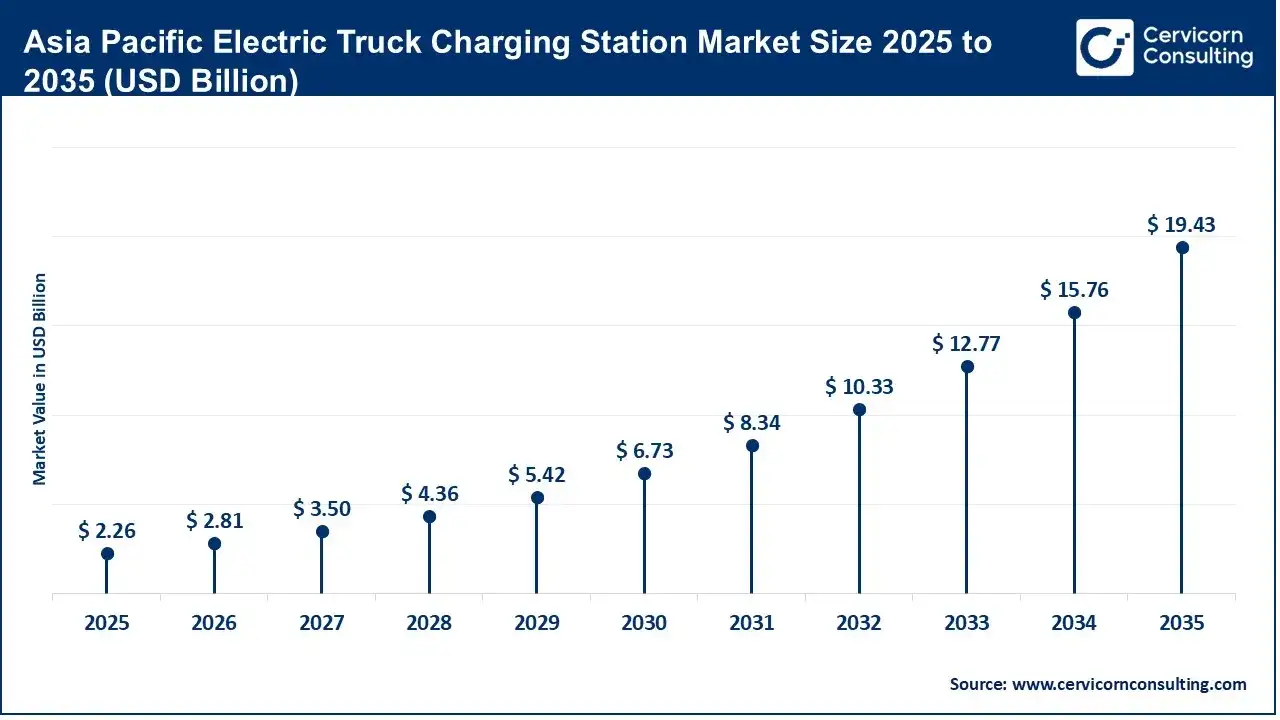
China's EV truck market already established a quite complete EV trucking infrastructure compared with other country where South Korea, Japan and India are starting to build and invest in the EV commercial vehicles market and also charge stations infrastructure.
The increasing importance of this market is proven by market development; according to the report from Reuters August 2026, the EV trucks exports from China more than doubled for a four-month period with exports going to South Asia increasing five folds in this segment Y/Y, which represents growth opportunity of regional market for electric commercial vehicles and respective charge stations business.
China's scale is extremely dominant for its perspective in the market; 80% of world's heavy-duty chargers stock is estimated to be in China in 2035. The number amounts to9 million charging units under IEA's states and current policy scenario.
North America Electric Truck Charging Station Market Analysis:
North America is forecasted to exhibit rapid growth in the electric truck charging station market at a 28.0% CAGR between 2026-2035. This region's rapid adoption is driven by the electrification of medium and heavy-duty freight transport within key logistics corridors located across the US and Canada. Commercial EV charging, in contrast to personal EV charging, is predicated on design principles of truck weights, the range of transport routes, vehicle turnaround, fleet logistics, and massive amounts of power capacity.
Beyond specific sites, North America's strategy for EV deployment, including commercial trucking, is developing more around integrated energy infrastructure rather than standalone chargers. High power demand for truck charging often demands robust power grid upgradation, energy storage solutions and sophisticated load management strategies.
One instance of these mega-watt level sites are in current operation in the US and comprise a reported 10+ Megawatt installation at a station in Barstow, California, illustrating the growing sophistication of commercial truck charging becoming an integrated energy infrastructure development rather than an EVSE (electric vehicle supply equipment) installation.
Segmental Analysis
Vehicle Category Analysis
The light-duty electric trucks subsegment represented the largest market segment in 2025, with a 36% share, driven by relatively early electric commercial truck use in urban logistics, last mile delivery, retail distribution, and service fleets. These vehicles typically have predictable routes and return to a depot for charging at the end of their service cycle, and thus were the first to commercially adopted with charging stations at the depot for overnight and managed charging of moderate-power DC fast chargers. Charging are much less problematic for a lightly used vehicle than for one which typically returns late in the day.
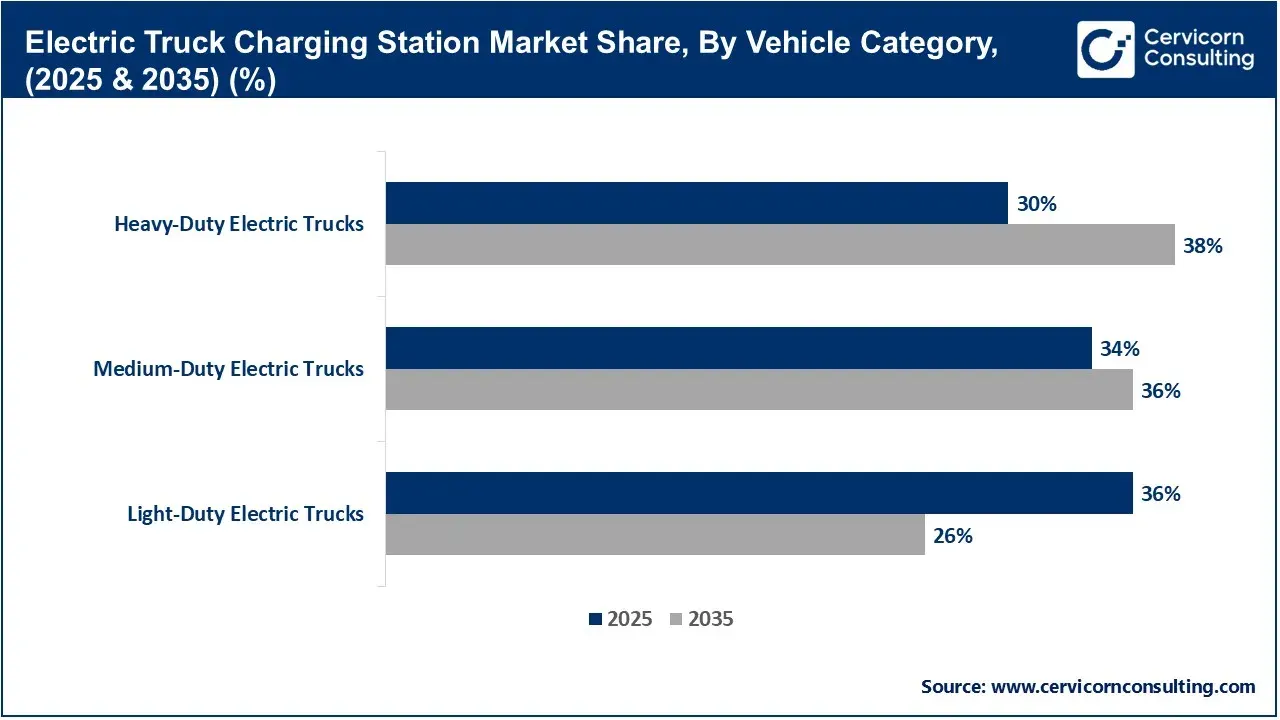
The heavy-duty electric trucks segment is expected to witness the fastest growth during the forecast period and accounted for a 30% share in 2025. Increasing interest in electrifying the freight transportation segment, rising fuel costs, growing availability of long-range EV battery technology for electric trucks and strengthening emission standards will lead to increasing share of heavy-duty electric trucks in the market during the forecasted period.
These heavy duty trucks however will differ significantly in terms of the types of charging needed for light commercial vehicles, as truck driving time is an asset that will affect the economic of transportation if they remain idled at charging stations too long. Unlike a light duty vehicle which can return and charge over night at a depot for many routes.
Charger Technology Analysis
The DC fast charging segment accounted for the largest market share of 40% in 2025, reflecting its established commercial availability and suitability for fleets requiring faster turnaround than conventional AC charging can provide. DC fast charging enables electricity to be delivered directly to the vehicle battery at substantially higher power, reducing charging time and improving fleet utilization.
The segment also benefits from the existing maturity of DC charging hardware, connector standards, charging management software and service networks. As a result, many fleet operators are likely to continue deploying DC fast charging even as MCS becomes commercially available, particularly for vehicles with predictable regional routes where charging requirements do not justify megawatt-level infrastructure.
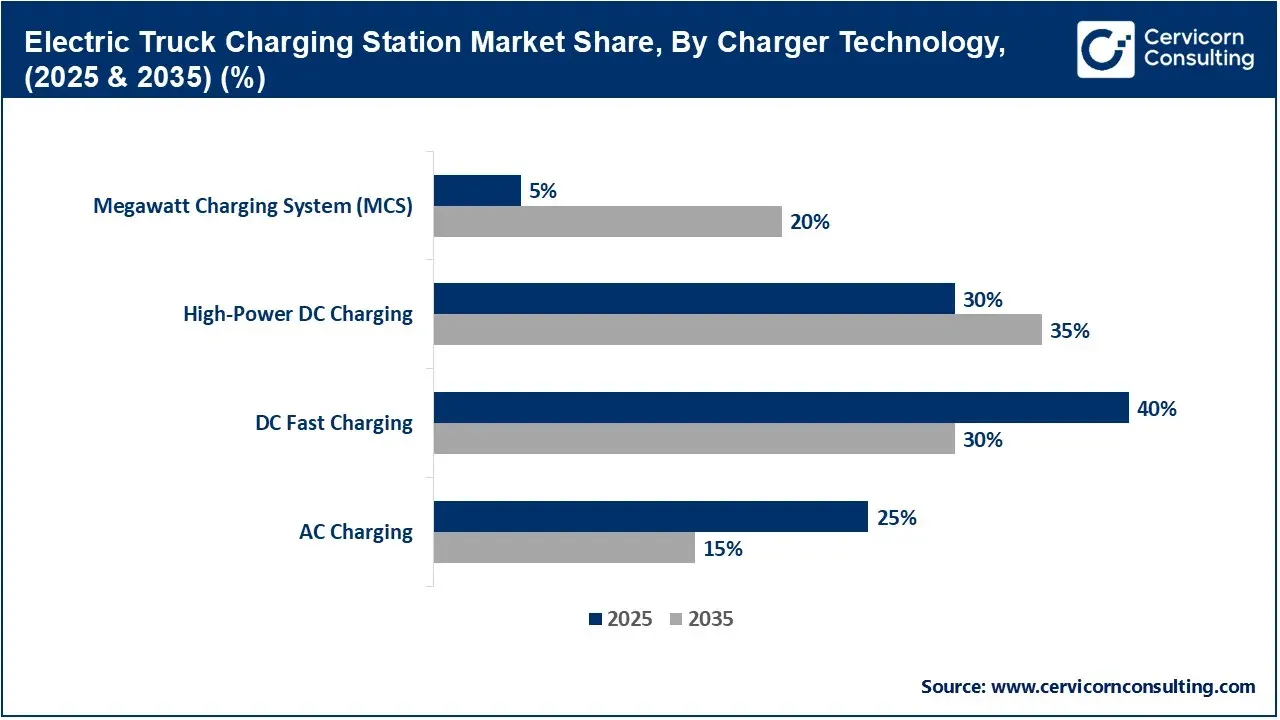
The Megawatt Charging System (MCS) segment is projected to experience the fastest growth through 2035, driven by the increasing electrification of long-haul and heavy-duty freight transportation. MCS addresses one of the biggest challenges facing electric trucks: providing sufficient energy within a commercially acceptable charging window. Heavy-duty trucks with large battery packs can require extremely high charging power to minimize downtime, making megawatt-scale infrastructure increasingly important for freight corridors and high-utilization truck hubs.
Deployment Type Analysis
The fleet depot charging segment held the largest share of 55% in 2025, reflecting the operational advantages of centralized charging for commercial fleets. Depot charging allows vehicles to be recharged during predictable periods when trucks are not operating, particularly overnight or between shifts.
This model provides fleet operators with greater control over charging schedules, electricity procurement and vehicle availability. It also allows charging infrastructure to be integrated with fleet management systems, telematics, route planning and maintenance operations. The IEA identifies private overnight depot charging as generally the most attractive charging option for electric trucks and buses because of its relatively lower power requirements and lower cost compared with opportunity charging.
| Deployment Type |
Revenue Share, 2025 (%) |
Revenue Share, 2035 (%) |
| Fleet Depot Charging |
55% |
45% |
| Public Truck Charging Hubs |
15% |
20% |
| Highway Corridor Charging |
10% |
25% |
| Distribution Center Charging |
15% |
8% |
| Opportunity Charging |
5% |
2% |
Highway corridor charging is anticipated to register the fastest CAGR of 37.2% from 2026 to 2035, reflecting the growing need to support long-distance electric freight transportation. Unlike depot charging, corridor infrastructure must accommodate vehicles that do not belong to a single fleet or operate on predictable charging schedules. This creates demand for high-power chargers, standardized payment and authentication systems, high charger uptime, pull-through truck bays and strategically located charging hubs.
The economic importance of corridor charging is particularly high for long-haul trucking because charging locations need to be aligned with freight routes, driver rest periods and vehicle range. The IEA expects public en-route charging to remain a relatively small portion of total HDV charger numbers, but it notes that these chargers can represent a disproportionately large share of total charging capacity because of their higher power levels.
End User Analysis
The logistics & freight segment captured the largest market share of 40% in 2025, reflecting the high utilization rates and predictable operating patterns of commercial freight fleets. Logistics companies operate vehicles over substantial daily distances, making fuel and energy costs a significant component of total operating expenses. Electric trucks can potentially reduce energy and maintenance costs, but these benefits depend heavily on the availability and reliability of charging infrastructure.
For logistics operators, charging is therefore increasingly becoming part of fleet optimization rather than a standalone infrastructure decision. Operators need to determine when vehicles charge, how much energy each vehicle receives, which trucks receive priority and whether charging should occur at depots or along freight corridors.
| End User |
Revenue Share, 2025 (%) |
| Logistics & Freight |
40% |
| Retail & E-commerce |
20% |
| Municipal Fleets |
16% |
| Industrial |
14% |
| Fleet Operators |
10% |
The retail & e-commerce segment accounted for the second-largest share of 20% in 2025, supported by the rapid expansion of last-mile and regional delivery operations. E-commerce creates a particularly favorable use case for electric trucks because delivery routes are generally predictable, vehicles return to distribution centers regularly and charging can be integrated into warehouse operations. Retailers can therefore establish dedicated charging infrastructure at fulfillment centers, distribution hubs and regional warehouses.
The segment is also increasingly connected to sustainability targets. Large retailers and e-commerce companies are under pressure to reduce transportation emissions while maintaining delivery speed and reliability. Electric trucks combined with depot charging provide a pathway to decarbonize delivery operations without depending entirely on public charging networks.
Top Companies
Recent News
- Kempower introduced the Mega Satellite Flex in May 2026, a high-power charging dispenser designed for the transition from conventional CCS charging to Megawatt Charging System (MCS) technology. The system supports up to 560 kW through CCS and up to 1.2 MW through MCS, allowing charging operators to serve existing electric vehicles as well as next-generation heavy-duty electric trucks using the same infrastructure.
- ABB E-mobility launched its OM X-Series in May 2026 as a distributed charging architecture designed for high-duty-cycle applications including logistics hubs, transit depots and public charging corridors. The platform can scale from 800 kW to 10 MW and beyond and is designed to support large charging sites with more than 100 charging points.
Segments Covered
By Vehicle Category
- Light-Duty Electric Trucks
- Medium-Duty Electric Trucks
- Heavy-Duty Electric Trucks
By Charger Technology
- AC Charging
- DC Fast Charging
- High-Power DC Charging
- Megawatt Charging System (MCS)
By Deployment Type
- Fleet Depot Charging
- Public Truck Charging Hubs
- Highway Corridor Charging
- Distribution Center Charging
- Opportunity Charging
By End User
- Logistics & Freight
- Retail & E-commerce
- Municipal Fleets
- Industrial
- Fleet Operators
By Region
- North America
- Europe
- Asia Pacific
- Latin America
- Middle East & Africa