Electric Trucks Market Size and Growth 2026 to 2035
The global electric trucks market size was recorded at USD 18.27 billion in 2025 and is expected to be worth around USD 235.31 billion by 2035, accelerating a compound annual growth rate (CAGR) of 29.1% over the forecast period from 2026 to 2035. Stringent emission regulations, corporate decarbonization targets, and supportive government incentives are major drivers accelerating the electric trucks market. Governments across Europe, North America, China, and other regions are implementing zero-emission vehicle mandates, purchase subsidies, and investments in commercial EV charging infrastructure to reduce greenhouse gas emissions from freight transportation. According to the International Energy Agency (IEA), global electric truck sales exceeded 400,000 units in 2025, doubling from the previous year and accounting for approximately 9% of total global truck sales, highlighting the rapid transition toward electrified commercial transport. Additionally, China continues to dominate the sector, accounting for the majority of global electric medium- and heavy-duty truck deployments, driven by strong policy support and domestic manufacturing capabilities.
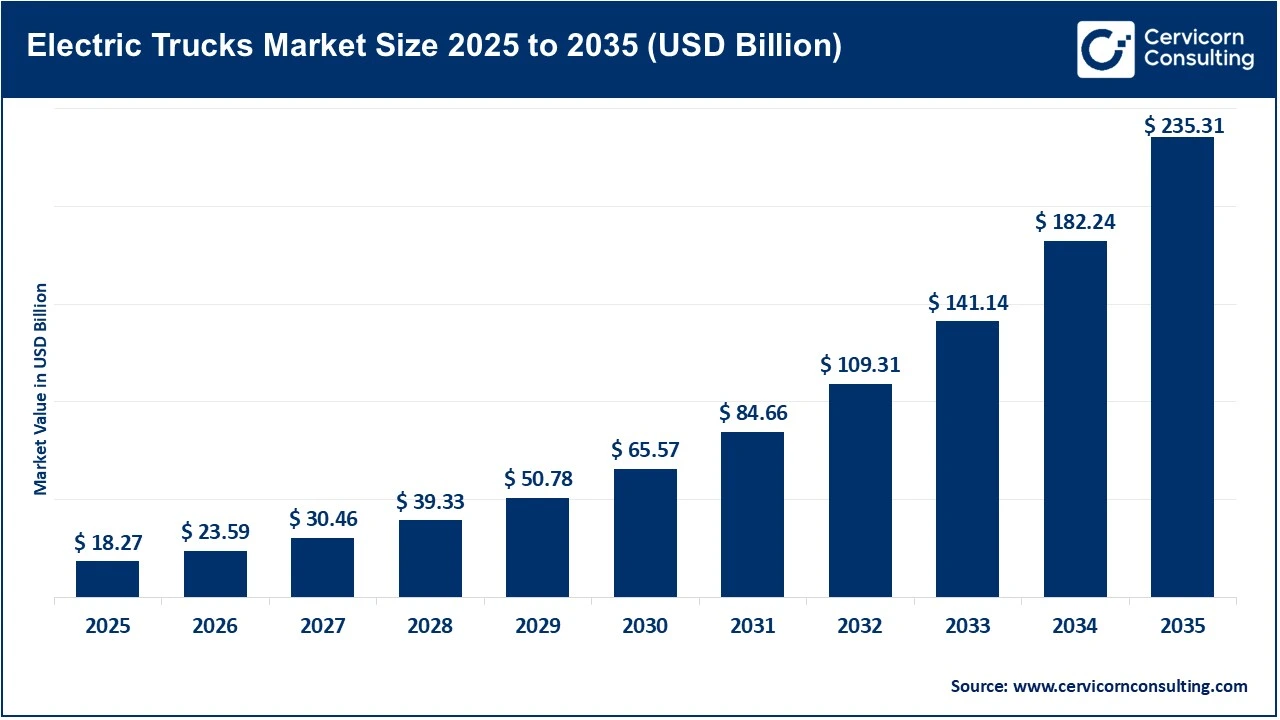
Another significant growth factor is the improving total cost of ownership (TCO), driven by declining battery prices, lower maintenance requirements, and reduced fuel costs compared to diesel trucks. Fleet operators in logistics, e-commerce, ports, mining, and municipal services are increasingly adopting electric trucks to lower operating costs while meeting sustainability commitments. Advances in battery technology, including higher-energy-density lithium iron phosphate (LFP) batteries, faster charging solutions, and expanding megawatt charging infrastructure, are further enhancing vehicle range and operational efficiency. The IEA reported that battery-electric heavy trucks in China achieved monthly sales shares of nearly 15% during 2024, demonstrating growing commercial viability for heavy-duty applications, while increasing investments by OEMs and fleet operators continue to support large-scale deployment worldwide.
Report Highlights
- Asia-Pacific dominated the electric trucks market with a 71.8% share in 2025, driven by China's production leadership, government incentives, and fleet electrification.
- Battery Electric Trucks (BEVs) held 84.6% market share due to superior efficiency, lower operating costs, expanding charging infrastructure, and widespread commercial adoption.
- Heavy-duty trucks accounted for 46.9% of the market, supported by increasing freight transportation demand, industrial logistics, and commercial fleet electrification initiatives.
- Electric trucks with ranges up to 200 miles captured 52.7% market share, primarily serving urban logistics, municipal fleets, and regional distribution operations.
- Lithium-ion batteries represented 49.4% of the market, benefiting from high energy density, proven reliability, declining costs, and mature manufacturing capabilities.
- Logistics and freight transportation led applications with a 39.6% market share, driven by e-commerce growth, sustainable delivery initiatives, and fleet modernization efforts.
What is an Electric Truck?
An electric truck is a commercial vehicle powered partially or entirely by electricity instead of conventional diesel or gasoline engines. It uses rechargeable battery packs in battery electric trucks (BEVs) or hydrogen fuel cells in fuel cell electric trucks (FCEVs) to drive electric motors that propel the vehicle. Electric trucks are designed for applications ranging from urban deliveries and municipal services to long-haul freight transportation, offering lower operating costs, reduced greenhouse gas emissions, quieter operation, and improved energy efficiency. Advancements in battery technology, charging infrastructure, and powertrain efficiency are accelerating their deployment across light-, medium-, and heavy-duty commercial vehicle segments.
Electric Truck Adoption by Country
| Country |
Estimated Electric Truck Sales |
Key Highlights |
| China |
>360,000 sales (2025) |
Over 90% of global electric truck sales; around 25% of all new truck sales were electric in 2025. |
| United States |
6,000–8,000 electric trucks in operation |
Adoption is led by medium-duty delivery fleets and port operations. |
| Germany |
4,000–5,000 registrations |
Europe's largest market for heavy-duty electric truck deployments. |
| Netherlands |
2,000 registrations |
Strong adoption supported by zero-emission freight corridors and incentives. |
| Sweden |
1,500 registrations |
High penetration driven by domestic manufacturers and green transport policies. |
| Norway |
1,000 registrations |
One of the highest electric truck adoption rates per capita. |
| France |
1,000 registrations |
Growth supported by urban low-emission zones and fleet electrification. |
| United Kingdom |
800 registrations |
Increasing deployment in logistics and municipal fleets. |
Electric Trucks Market Dynamics
Market Drivers
1. Government Policies and Zero-Emission Regulations
Governments worldwide are accelerating electric truck adoption through stringent emission regulations, purchase incentives, tax benefits, and investments in charging infrastructure. Zero-emission vehicle mandates, low-emission zones, and carbon reduction targets are encouraging logistics providers and commercial fleet operators to replace diesel trucks with electric alternatives. These supportive policies reduce the financial burden of fleet electrification while promoting sustainable transportation, driving significant demand for electric trucks across urban delivery, municipal, and long-haul freight applications.
Government Policies and Regulations Supporting the Electric Trucks Market
| Country |
Policy and Regulation |
Key Benefits for Electric Trucks |
| European Union |
CO₂ Emission Standards for Heavy-Duty Vehicles (Revised 2024) |
Requires a 45% reduction in CO₂ emissions by 2030, 65% by 2035, and 90% by 2040 for new heavy-duty vehicles, accelerating electric truck adoption. |
| United States |
Inflation Reduction Act (IRA) |
Provides tax credits of up to USD 40,000 for eligible commercial clean vehicles, including electric trucks, reducing fleet acquisition costs. |
| United States (California) |
Advanced Clean Trucks (ACT) Regulation |
Requires manufacturers to progressively increase zero-emission truck sales, promoting commercialization of electric medium- and heavy-duty trucks. |
| China |
New Energy Vehicle (NEV) Policy |
Offers purchase incentives, preferential registration, and government procurement support while promoting domestic production and deployment of electric trucks. |
| India |
PM E-DRIVE Scheme (2024–2026) |
Provides financial incentives for electric commercial vehicles, supports public charging infrastructure, and promotes domestic EV manufacturing under the Make in India initiative. |
2. Declining Operating Costs and Fleet Electrification
Lower fuel expenses, reduced maintenance requirements, and improving battery performance are making electric trucks increasingly attractive for fleet operators. Electric powertrains contain fewer moving components than diesel engines, resulting in lower servicing costs and improved reliability. Large logistics companies, e-commerce providers, and municipal agencies are electrifying fleets to reduce total operating costs while meeting environmental, social, and governance (ESG) objectives. This shift is significantly contributing to sustained market expansion.
Market Restraints
1. High Initial Purchase Cost
Despite lower operating expenses over their lifetime, electric trucks remain significantly more expensive to purchase than conventional diesel trucks due to battery costs and advanced powertrain technologies. Small and medium-sized fleet operators often face financial constraints that limit large-scale fleet replacement. Although government subsidies help reduce acquisition costs in several regions, affordability remains a key challenge, particularly in developing economies where incentive programs and financing options are limited.
Cost Comparison: Electric Truck vs. Diesel (Internal Combustion Engine) Truck
| Cost Parameter |
Electric Truck |
Diesel (ICE) Truck |
| Initial Purchase Price |
USD 180,000–400,000 |
USD 100,000–180,000 |
| Fuel/Energy Cost |
USD 0.10–0.20 per km |
USD 0.30–0.50 per km |
| Maintenance Cost |
20–40% lower than diesel trucks |
Higher due to engine, transmission, and exhaust system maintenance |
| Annual Operating Cost |
Typically 25–40% lower |
Higher due to fuel and maintenance expenses |
| Battery/Engine Replacement |
Battery replacement may be needed after 8–15 years, depending on usage |
Major engine overhaul or replacement may be required after high mileage |
| Typical Lifetime Energy Savings |
Can reduce energy costs by 40–70% compared with diesel |
No significant energy cost savings |
| Total Cost of Ownership (Long-Term) |
Lower for high-mileage fleet operations |
Lower upfront cost but generally higher lifetime operating cost |
2. Limited Charging Infrastructure
The availability of commercial-grade charging infrastructure remains insufficient for widespread electric truck deployment, particularly for medium- and heavy-duty applications. Long-haul freight operations require high-power charging stations capable of minimizing downtime, but such infrastructure is still under development in many countries. Grid capacity limitations, lengthy permitting processes, and substantial installation costs further delay infrastructure expansion, restricting broader market adoption and operational flexibility for fleet operators.
Market Opportunities
1. Expansion of Megawatt Charging Infrastructure
The development of Megawatt Charging Systems (MCS) presents a significant opportunity for the electric truck market by enabling rapid charging of heavy-duty commercial vehicles. Faster charging reduces vehicle downtime, improves fleet utilization, and makes electric trucks increasingly suitable for long-distance freight transportation. As governments, utilities, and private companies invest in highway charging corridors and commercial charging hubs, the market is expected to benefit from improved operational efficiency and wider commercial adoption.
2. Growth of E-commerce and Urban Logistics
Rapid expansion of e-commerce and same-day delivery services is creating substantial demand for zero-emission commercial vehicles operating in urban environments. Electric trucks are well suited for last-mile and regional distribution because of their quiet operation, lower emissions, and reduced operating costs. Increasing restrictions on diesel vehicles within urban centers further encourage logistics providers to adopt electric trucks, creating strong long-term growth opportunities for manufacturers and fleet operators.
Market Challenges
1. Battery Weight and Limited Driving Range
Battery packs required for medium- and heavy-duty electric trucks are large and heavy, reducing payload capacity and increasing vehicle costs. Although battery technology continues to improve, driving range remains a concern for long-haul transportation where frequent charging can reduce operational efficiency. Balancing battery capacity, vehicle weight, charging time, and payload requirements remains one of the most significant engineering and commercial challenges for manufacturers.
2. Supply Chain Constraints for Critical Materials
Electric truck production depends heavily on critical minerals such as lithium, nickel, cobalt, graphite, and rare earth elements used in batteries and electric motors. Supply disruptions, geopolitical risks, fluctuating commodity prices, and limited refining capacity can increase manufacturing costs and delay production schedules. Securing sustainable and diversified supply chains while reducing dependence on scarce raw materials remains a major challenge for vehicle manufacturers seeking to scale production globally.
Electric Trucks Market Regional Analysis
The electric trucks market is segmented by region into North America, Europe, Asia-Pacific, Latin America, and LAMEA. Here is a brief overview of each region:
Why factors are expanding North America electric trucks market?
The North America electric trucks market size was valued at USD 1.94 billion in 2025 and is expected to surpass around USD 24.94 billion by 2035. The North America market is expanding due to strong regulatory support, aggressive fleet decarbonization initiatives, and substantial investments in commercial electric vehicle infrastructure. The region is witnessing rapid adoption of electric trucks across logistics, retail, municipal services, and port operations as companies seek to reduce fuel costs and achieve sustainability targets. Government incentives, zero-emission vehicle mandates, and investments in high-power charging networks continue to accelerate market growth. Technological advancements in battery systems, fleet management software, and megawatt charging infrastructure, combined with increasing production by leading truck manufacturers, position North America as one of the fastest-growing regional markets for electric commercial vehicles.
United States: Federal Incentives, Commercial Fleet Electrification, and Expanding Charging Infrastructure Continue to Drive Market Leadership
- The United States offers federal tax credits of up to USD 40,000 for eligible commercial clean vehicles under the Inflation Reduction Act, significantly reducing the acquisition cost of electric trucks.
- The Advanced Clean Trucks (ACT) regulation, adopted by multiple states, requires manufacturers to progressively increase zero-emission truck sales, accelerating commercial vehicle electrification.
- The U.S. freight industry transports over 20 billion tons of goods annually, creating substantial demand for electric trucks in logistics, regional distribution, and last-mile delivery operations.
Canada: Net-Zero Transportation Goals, Government Incentives, and Sustainable Freight Programs Support Market Expansion
- Canada has committed to achieving net-zero greenhouse gas emissions by 2050, encouraging rapid electrification of commercial transportation through national and provincial clean mobility programs.
- The Incentives for Medium- and Heavy-Duty Zero-Emission Vehicles (iMHZEV) program provides financial support for purchasing eligible electric trucks, improving affordability for commercial fleet operators.
Why does Asia-Pacific dominates the electric trucks market?
The Asia-Pacific electric trucks market size reached at USD 13.12 billion in 2025 and is predicted to hit around USD 168.95 billion by 2035.
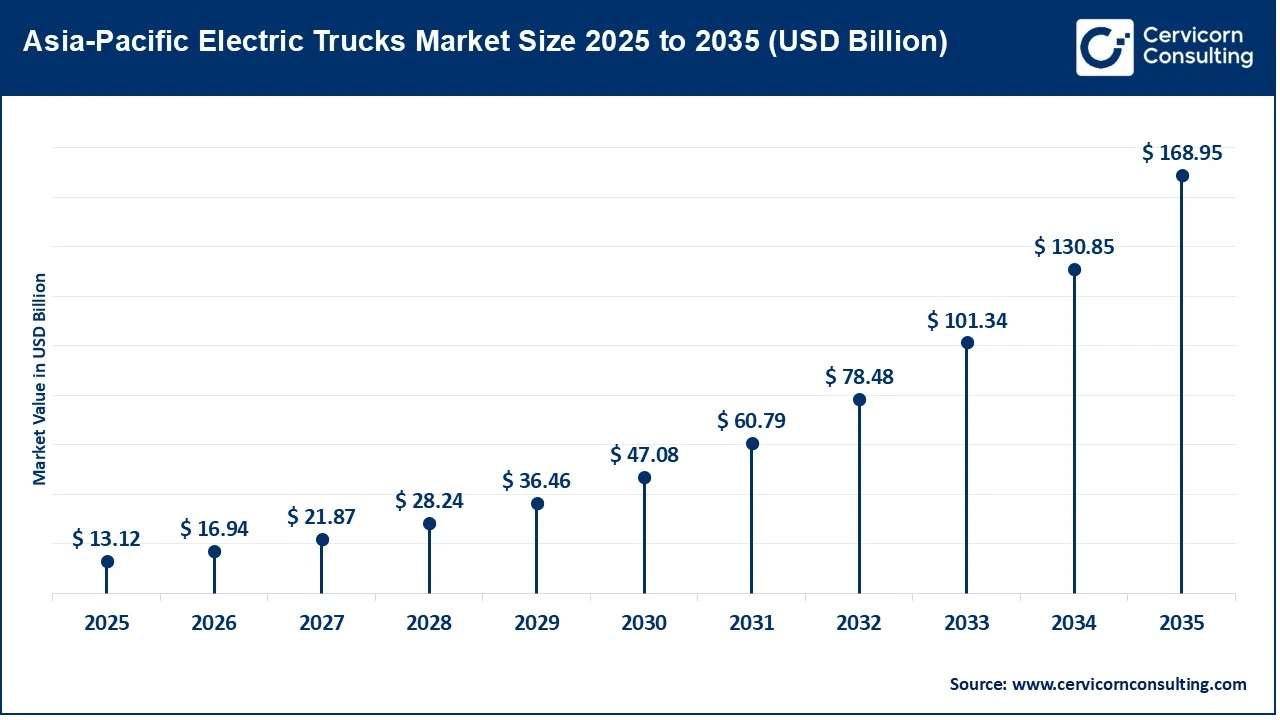
The Asia-Pacific market dominates the global industry, driven by robust government policies, rapid urbanization, large commercial vehicle fleets, and the presence of the world's largest electric vehicle manufacturing ecosystem. Countries across the region are promoting zero-emission freight transportation through purchase subsidies, tax incentives, stringent emission regulations, and investments in charging and hydrogen refueling infrastructure. The region also benefits from extensive battery manufacturing capacity, lower production costs, and strong domestic demand for electric commercial vehicles. Continuous investments by leading truck manufacturers and battery producers, coupled with the rapid expansion of e-commerce and logistics networks, continue to position Asia-Pacific as the largest and fastest-growing regional market.
China: World's Largest Electric Truck Market Driven by Government Incentives, Manufacturing Leadership, and Massive Commercial Fleet Deployment
- China accounted for more than 90% of global electric truck sales in 2025, with over 360,000 electric trucks sold, making it the world's largest production and adoption market.
- The government's New Energy Vehicle (NEV) policy, purchase incentives, and carbon neutrality goals continue to accelerate commercial vehicle electrification across logistics, ports, mining, and municipal services.
India: Government Incentives, Growing Logistics Sector, and Domestic Manufacturing Support Accelerate Market Growth
- India's PM E-DRIVE Scheme and broader electric mobility initiatives provide incentives for electric commercial vehicles while supporting charging infrastructure expansion and domestic manufacturing
- The country's rapidly expanding logistics, e-commerce, and last-mile delivery sectors are creating strong demand for electric light- and medium-duty trucks to reduce operating costs and emissions.
Why is Europe fastest-growing globally in the electric trucks market?
The Europe electric trucks market size is expanding from USD 2.59 billion in 2025 to over USD 33.41 billion by 2035. The Europe market is one of the fastest-growing globally, supported by stringent environmental regulations, strong government incentives, and ambitious decarbonization goals for the transportation sector. The region is accelerating the transition from diesel-powered commercial vehicles to zero-emission alternatives through strict CO2 emission standards, low-emission zones, and investments in public and commercial charging infrastructure. Increasing demand from logistics companies, retailers, and municipal operators, along with expanding production by leading European truck manufacturers, continues to strengthen the region's market position. Advancements in battery technology, megawatt charging systems, and hydrogen-powered commercial vehicles are further supporting large-scale adoption across freight transportation.
Germany: Europe's Largest Commercial Vehicle Manufacturing Hub and Strong Government Support Drive Market Leadership
- Germany is home to leading commercial vehicle manufacturers including Daimler Truck AG, MAN Truck & Bus SE, and Volvo Group (through major regional operations), making it Europe's leading electric truck production center.
- The German government supports zero-emission commercial vehicles through purchase subsidies, charging infrastructure investments, and funding for hydrogen mobility projects.
France: Low-Emission Transport Policies and Sustainable Logistics Investments Accelerate Electric Truck Adoption
- France is implementing ambitious carbon reduction policies that encourage commercial fleet operators to transition toward zero-emission trucks through financial incentives and regulatory support.
- Expansion of Low Emission Zones (ZFE-m) across major cities is encouraging logistics providers and municipal fleets to replace diesel trucks with electric alternatives.
Electric Trucks Market Share, By Region, 2025 (%)
| Region |
Revenue Share, 2025 (%) |
| Asia-Pacific |
71.8% |
| Europe |
14.2% |
| North America |
10.6% |
| LAMEA (Latin America, Middle East & Africa) |
3.4% |
Why is LAMEA experiencing steady growth in the electric trucks market?
The LAMEA electric trucks market was valued at USD 0.62 billion in 2025 and is anticipated to reach around USD 8 billion by 2035. The LAMEA market is experiencing steady growth as governments and private industries accelerate the transition toward low-emission commercial transportation. Rising investments in sustainable mobility, expanding renewable energy capacity, and increasing demand for cost-efficient freight solutions are encouraging the adoption of electric trucks across logistics, mining, municipal services, and urban delivery applications. Although charging infrastructure is still developing in many countries, supportive government policies, pilot fleet deployments, and growing investments by global truck manufacturers are creating significant long-term growth opportunities across the region.
Brazil: Expanding Logistics Sector, Clean Mobility Policies, and Growing Fleet Electrification Drive Regional Leadership
- Brazil possesses the largest commercial vehicle market in Latin America, creating significant opportunities for electric truck adoption across freight transportation, agriculture, and urban logistics.
- Government initiatives promoting decarbonization, renewable energy, and sustainable transportation are encouraging logistics companies and municipal operators to transition toward zero-emission commercial vehicles.
- Brazil generates more than 85% of its electricity from renewable and low-carbon sources, providing a favorable environment for commercial vehicle electrification with lower lifecycle emissions.
United Arab Emirates: Net-Zero Goals, Smart Mobility Initiatives, and Infrastructure Investments Accelerate Market Growth
- The UAE Net Zero by 2050 Strategic Initiative is driving investments in sustainable transportation, including the electrification of commercial vehicle fleets and freight operations.
- Government-led smart city programs, particularly in Dubai and Abu Dhabi, are encouraging the deployment of electric trucks for municipal services, logistics, and last-mile delivery.
Electric Trucks Market Segmental Analysis
The electric trucks market is segmented into propulsion type, vehicle class, range, battery type, application, and geography.
Propulsion Type Analysis
Battery Electric Trucks dominate the electric trucks market due to their high energy efficiency, lower operating costs, and widespread commercial availability. Governments across major markets support BEV deployment through subsidies, zero-emission mandates, and investments in charging infrastructure. BEVs are extensively used in urban deliveries, regional freight, and municipal fleets because they produce zero tailpipe emissions and require less maintenance than diesel vehicles. Continuous improvements in battery capacity and charging technology further strengthen their market leadership.
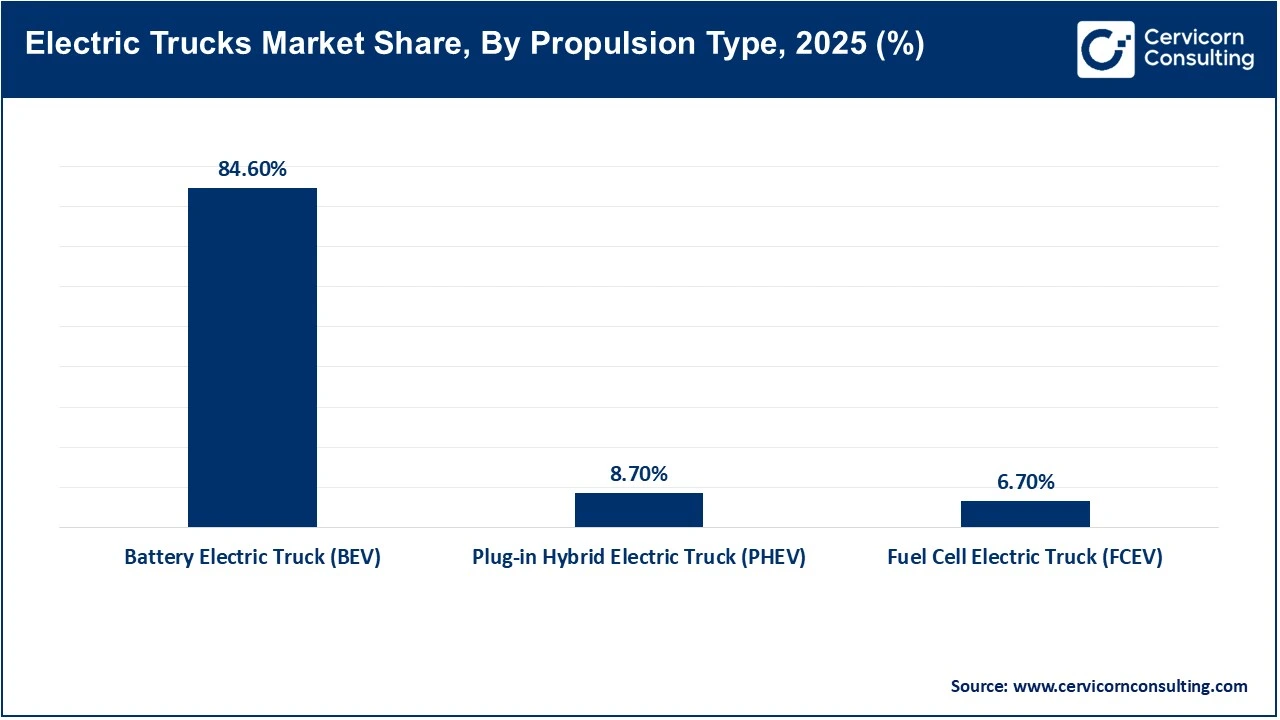
Fuel Cell Electric Trucks are expected to register the fastest growth as industries seek zero-emission solutions for long-haul freight transportation. Hydrogen fuel cells offer longer driving ranges and faster refueling compared to battery-electric trucks, making them suitable for heavy-duty logistics. Increasing investments in hydrogen production, refueling infrastructure, and government-backed hydrogen strategies across Asia, Europe, and North America are accelerating commercialization, while collaborations between truck manufacturers and energy companies continue to expand deployment opportunities.
Vehicle Class Analysis
Heavy-duty trucks hold the largest market share because they account for the highest freight movement globally and are a primary focus of fleet decarbonization initiatives. Logistics providers, ports, mining companies, and industrial operators are increasingly replacing diesel-powered heavy trucks with electric alternatives to reduce emissions and fuel expenses. Government incentives, technological advancements in high-capacity batteries, and growing investments by commercial vehicle manufacturers have significantly accelerated adoption within this vehicle class.
Electric Trucks Market, By Vehicle Class, 2025 (%)
| Vehicle Class |
Revenue Share, 2025 (%) |
| Heavy-Duty Trucks |
46.9% |
| Medium-Duty Trucks |
31.8% |
| Light-Duty Trucks |
21.3% |
Medium-duty trucks are projected to experience the fastest growth owing to their expanding use in regional freight distribution, urban logistics, and municipal operations. These vehicles typically operate on predictable daily routes, making them well suited for battery-electric technology. Rising e-commerce activity, increasing demand for sustainable delivery services, and rapid deployment of commercial charging infrastructure are encouraging fleet operators to electrify medium-duty fleets while minimizing operational disruptions.
Range Analysis
The up to 200 miles range segment dominates the market because most commercial delivery vehicles operate within urban and regional routes that do not require extended driving distances. Fleet operators benefit from overnight depot charging, lower battery costs, and improved operational efficiency. Applications such as parcel delivery, municipal waste collection, and utility services rely heavily on short-range electric trucks, making this range category the most widely adopted across developed and emerging markets.
Electric Trucks Market, By Range, 2025 (%)
| Range Segment |
Revenue Share, 2025 (%) |
| Up to 200 Miles |
52.7% |
| 201–400 Miles |
33.5% |
| Above 400 Miles |
13.8% |
The above 400 miles segment is expected to witness the fastest growth as battery technologies and hydrogen fuel cell systems continue to improve. Long-range electric trucks enable intercity freight transportation while reducing dependence on diesel-powered vehicles. Investments in megawatt charging systems, higher energy-density batteries, and hydrogen refueling infrastructure are enabling commercial fleets to expand electric truck usage into long-haul logistics, creating significant growth opportunities for manufacturers and infrastructure providers.
Battery Type Analysis
Lithium-ion batteries dominate the electric trucks market because they provide an optimal balance of energy density, charging performance, lifespan, and commercial maturity. Most electric truck manufacturers utilize lithium-ion technology due to its proven reliability and established supply chain. Continuous reductions in battery costs, improved thermal management systems, and advances in cell chemistry have strengthened lithium-ion batteries as the preferred choice for light-, medium-, and heavy-duty electric commercial vehicles.
Electric Trucks Market, By Battery Type, 2025 (%)
| Battery Type |
Revenue Share, 2025 (%) |
| Lithium-Ion Battery |
49.4% |
| Lithium Iron Phosphate (LFP) Battery |
34.8% |
| Nickel Manganese Cobalt (NMC) Battery |
13.1% |
| Solid-State Battery |
2.7% |
Lithium Iron Phosphate (LFP) batteries are the fastest-growing segment due to their superior safety, longer cycle life, and lower manufacturing costs compared to many conventional lithium-ion chemistries. Commercial fleet operators increasingly prefer LFP batteries because they reduce ownership costs while delivering dependable performance for daily logistics operations. Growing adoption by leading truck manufacturers and expanding production capacity are further accelerating the deployment of LFP-powered electric trucks worldwide.
Application Analysis
Logistics and freight transportation account for the largest share of the electric trucks market due to rising freight volumes, expanding e-commerce activities, and increasing pressure to reduce transportation emissions. Fleet operators are investing in electric trucks to lower fuel and maintenance costs while complying with stricter environmental regulations. Large-scale fleet electrification initiatives by logistics companies, retailers, and third-party transportation providers continue to reinforce this segment's dominant position.
Electric Trucks Market, By Application, 2025 (%)
| Application |
Revenue Share, 2025 (%) |
| Logistics & Freight Transportation |
39.6% |
| Retail & E-commerce Distribution |
18.4% |
| Municipal Services |
14.2% |
| Construction |
10.6% |
| Mining |
7.5% |
| Utility Services |
5.8% |
| Others |
3.9% |
Retail and e-commerce distribution is anticipated to be the fastest-growing application segment as online shopping continues to drive demand for efficient last-mile and regional delivery solutions. Electric trucks are increasingly deployed for urban deliveries because they offer lower operating costs, quiet operation, and zero tailpipe emissions. Retailers and e-commerce companies are rapidly expanding sustainable delivery fleets to meet consumer expectations and corporate sustainability goals, supporting strong long-term market growth.
Electric Trucks Market Top Companies
Recent Developments
- In April 2026, Tesla, Inc. announced that mass production of the Tesla Semi would begin in 2026, expanding its electric heavy-duty truck program to meet increasing commercial fleet demand.
- In September 2025, Volvo Group launched the long-range Volvo FH Electric, offering up to 600 km (373 miles) of driving range for regional and long-haul freight operations.
- In June 2025, Daimler Truck AG expanded customer deliveries of the Mercedes-Benz eActros 600, strengthening its portfolio of battery-electric heavy-duty trucks for long-distance logistics.
- In March 2026, BYD Company Ltd. accelerated its expansion into the European electric truck market, introducing new heavy-duty electric truck models supported by localized manufacturing and service networks.
- In January 2025, Scania AB announced the expansion of its Erinion charging initiative, targeting the installation of 40,000 charging points across Europe by 2030 to support electric truck fleets.
- In October 2025, MAN Truck & Bus SE accelerated deliveries of its next-generation MAN eTruck, expanding zero-emission transport solutions for European logistics and freight operators.
Market Segmentation
By Propulsion Type
- Battery Electric Truck (BEV)
- Plug-in Hybrid Electric Truck (PHEV)
- Fuel Cell Electric Truck (FCEV)
By Vehicle Class
- Light-Duty Trucks
- Medium-Duty Trucks
- Heavy-Duty Trucks
By Range
- Up to 200 Miles
- 201–400 Miles
- Above 400 Miles
By Battery Type
- Lithium-Ion Battery
- Lithium Iron Phosphate (LFP) Battery
- Nickel Manganese Cobalt (NMC) Battery
- Solid-State Battery
By Application
- Logistics & Freight Transportation
- Municipal Services
- Construction
- Mining
- Utility Services
- Retail & E-commerce Distribution
- Others
By Geography
- North America
- Europe
- Asia-Pacific
- LAMEA