AI in Diagnostics Market Size and Growth Factors 2026 To 2035
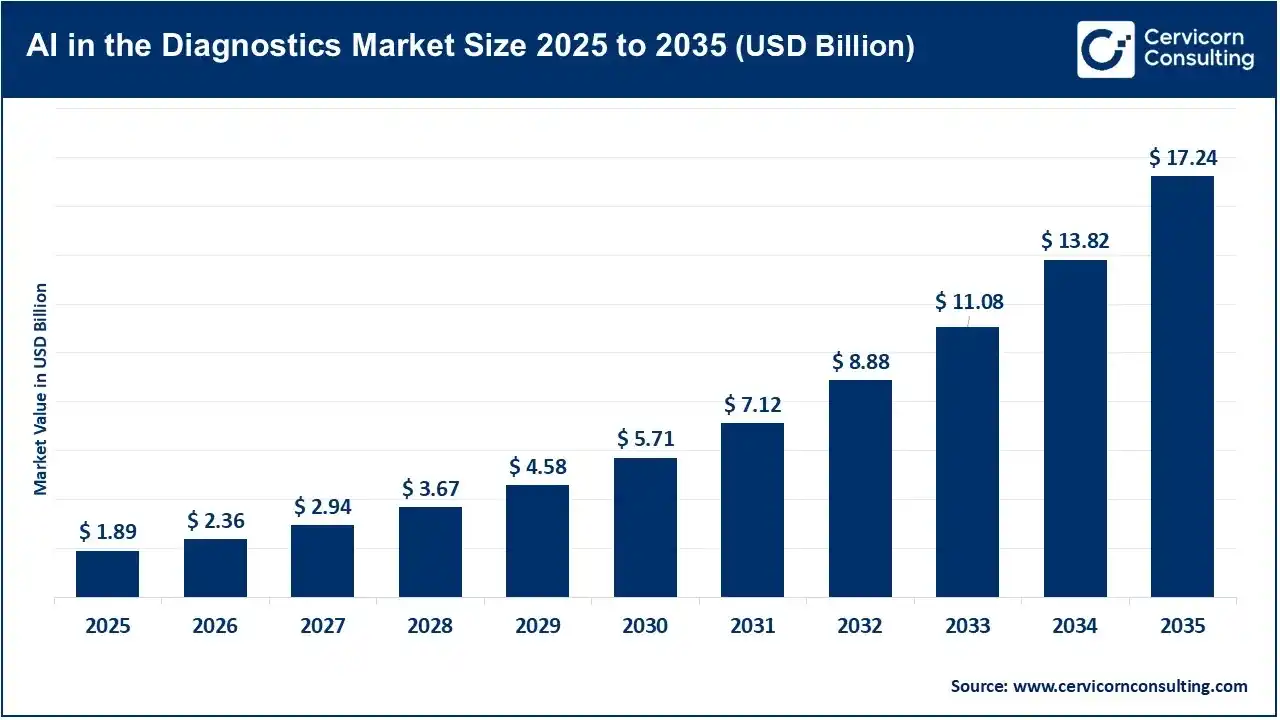
The global AI in diagnostics market size was valued at USD 1.89 billion in 2025 and is projected to grow from USD 2.36 billion in 2026 to nearly USD 17.24 billion by 2035, registering a CAGR of 24.74% over the forecast period 2026 to 2035. Growth is being increased by healthcare data volumes, the need for quicker disease detection, a lack of medical professionals, advancements in deep learning and machine learning, and the growing use of AI-based medical imaging and clinical decision support technologies, which are all contributing factors to the market's growth.
Key Takeaways
- By region, North America dominated the AI in diagnostics market in 2025, driven by advanced healthcare infrastructure and high AI adoption.
- By region, Asia Pacific is expected to grow at the fastest CAGR, supported by healthcare digitization and rising investments in AI technologies.
- By component, the software segment held the largest share of 47.10% in 2025, owing to increasing adoption of AI-based diagnostic and clinical decision-support solutions.
- By component, the services segment is expected to grow strongly, driven by rising demand for AI implementation, integration, maintenance, and technical support.
- By diagnosis type, the radiology segment dominated the market in 2025 with revenue share of 32%, supported by growing use of AI in medical imaging and automated image analysis.
- By diagnosis type, the oncology segment is expected to grow at the fastest CAGR, driven by increasing demand for early cancer detection and AI-assisted diagnosis.
- By technology, the machine learning segment held the largest share of 28% in 2025, supported by its broad use in disease prediction and diagnostic analysis.
- By technology, the deep learning segment is expected to grow at the fastest CAGR, owing to its ability to identify complex patterns in medical data and images.
- By end user, hospitals and clinics accounted for highest revenue share of 46% in 2025, supported by high patient volumes and growing AI integration across diagnostic workflows.
- By end user, diagnostic laboratories are expected to grow at the fastest CAGR, driven by laboratory automation and increasing demand for faster diagnostic testing.
Market Overview
Artificial intelligence is starting to play a significant role in contemporary diagnostic procedures. AI-based systems can look for patterns in medical imaging, patient records, lab data, pathology slides, and other healthcare data that can help doctors diagnose patients.
Deep learning and machine learning have emerged as key technologies in AI diagnostics. Large datasets can be used to train these systems to identify patterns linked to specific illnesses or anomalies. While NLP allows AI systems to interpret text-based clinical data, computer vision is especially pertinent to medical imaging.
Additionally, the market is growing beyond traditional image analysis. Predictive diagnostics, clinical decision support, laboratory processes, pathology, cardiology, cancer, neurology, ophthalmology, and other specialties are all seeing an increase in the use of AI.
Impact of AI in Diagnostics
Another significant driver of market expansion is the rising prevalence of chronic illnesses. Neurological disorders, cancer, and cardiovascular disease are among the conditions that frequently need ongoing monitoring and prompt diagnosis. AI-based technologies can help medical practitioners identify patients who might need more research and process diagnostic data more quickly.
As a result, AI in diagnostics is moving away from experimental technology and toward a more integrated part of the healthcare system. AI is being assessed by hospitals and diagnostic organizations more and more as a technology that can be integrated into current imaging, laboratory, electronic health record, and clinical workflow systems as well as a stand-alone application.
Recent Trends
Growing Use of AI in Medical Imaging
One of the most advanced applications of healthcare AI is still medical imaging. X-rays, CT scans, MRIs, ultrasounds, mammograms, and other imaging technologies are being utilized with AI systems. These systems can prioritize exams, carry out measurements, enhance image analysis, and identify anomalies. By highlighting potentially important findings, AI can also help radiologists by expediting the review of urgent cases. The vast amount of standardized digital image data available for algorithm development and validation contributes to imaging's dominant position in the AI diagnostics market.
Expansion of Digital Pathology
AI developers are also focusing more on the field of pathology. Tissue slides are transformed into high-resolution digital images via digital pathology so that computer vision and machine learning can be used for analysis. Applications of AI can help pathologists measure cellular properties, identify suspicious tissue areas, categorize tumors, and assess biomarkers. By standardizing repetitive analytical tasks, these capabilities can free up specialists to concentrate on complex clinical tasks.
Increasing Demand for Early Diagnosis
The healthcare sector is placing more and more emphasis on early disease detection and prevention. Clinicians may be able to start treatment or monitoring earlier if the disease is identified earlier. By spotting minute patterns in clinical data, diagnostic images, and other patient data, AI can support this strategy. This is especially important for diseases like cancer, heart disease, neurological conditions, and others where clinical outcomes can be affected by early intervention.
Market Dynamics
Driver
Rising Prevalence of Diseases
One of the main drivers of AI in diagnostics market is the growing incidence of chronic illnesses. Regular screening, testing, monitoring, and diagnostic evaluation are necessary for neurological diseases, cancer, cardiovascular disorders, and other chronic conditions. Simultaneously, healthcare systems are facing a shortage of skilled workers. By automating repetitive analytical tasks and supporting specialists with a high volume of diagnostic examinations, artificial intelligence (AI) can help alleviate some of the workload pressure.
An additional significant market driver is the increasing amount of healthcare data. The amount of imaging data, lab results, electronic health records, and clinical documentation generated by hospitals and diagnostic facilities is growing. AI makes it possible to process these datasets at a scale that would be challenging to accomplish with just manual analysis.
Adoption is being aided by advancements in technology. The potential uses of AI in diagnostic workflows have expanded due to advancements in computer vision, machine learning, deep learning, cloud infrastructure, and processing power. Providers are being encouraged to investigate AI-based solutions by rising healthcare costs and the growing emphasis on increasing clinical efficiency.
Restraint
High Cost of Implementation
The use of AI in diagnostics may be constrained by a number of factors, despite enormous growth potential. One significant obstacle is the high cost of implementation. Software, computer infrastructure, cybersecurity, data integration, employee training, and system upkeep may require investments from healthcare providers. Because AI diagnostic apps might need access to private patient data, data security and privacy are also crucial issues. To safeguard clinical data, healthcare organizations need to set up robust controls.
The quality of training data presents another difficulty. The data used in the development of AI algorithms is crucial. System performance may be impacted by incomplete, biased, or unrepresentative datasets. Another issue that may arise is interoperability. AI solutions must be compatible with current medical technology, including imaging, lab, and electronic health record systems. Another crucial component is clinician acceptance. Before integrating AI systems into routine decision-making, healthcare professionals must have faith in their dependability, clinical utility, and proper validation.
Opportunity
Rapid Rate of Digitization
Significant opportunities for AI diagnostics arise from the ongoing digitization of healthcare. The amount of data available for AI applications will keep growing as more hospitals switch to digital imaging, electronic health records, cloud platforms, and connected medical devices. In underprivileged areas, AI can also increase access to diagnostic knowledge. AI-supported systems could assist local medical professionals in identifying possible abnormalities and determining when specialist review is necessary in areas with limited access to specialists.
Another possibility is provided by cloud-based AI systems, which allow healthcare organizations to access sophisticated analytical capabilities without having to make significant investments in local computing hardware. The market may grow even more if AI is combined with wearable technology, telemedicine, remote monitoring, portable diagnostic tools, and linked healthcare platforms.
Key Technological Shifts
In the diagnostics sector, AI technologies are evolving quickly. One of the key tools for analyzing medical data and finding trends linked to certain illnesses is machine learning.
Deep learning is becoming especially crucial for applications that rely on images. Systems based on neural networks can be trained to identify intricate patterns in medical images and help identify diseases because radiology and pathology rely so much on visual analysis; computer vision is highly important to both fields.
AI systems can extract information from clinical notes, patient histories, pathology reports, and other text-based healthcare data thanks to natural language processing. The emergence of multimodal and generative AI is another significant technical development. These systems can produce clinically relevant summaries or information to aid in decision-making by analyzing various types of healthcare data.
Additionally, the integration of AI into current healthcare platforms is growing. Technology companies are attempting to incorporate AI capability directly into imaging, laboratory, electronic health record, and clinical workflow systems rather than forcing physicians to use separate AI applications.
Regulatory Framework
| Regulation / Framework |
Impact on AI Diagnostics |
| FDA AI-enabled medical device framework |
Provides regulatory oversight for qualifying AI-enabled medical devices in the U.S. |
| FDA Software as a Medical Device framework |
Applies to software performing medical functions and supports regulatory evaluation. |
| HIPAA |
Establishes privacy and security requirements for protected health information. |
| EU AI Act |
Introduces risk-based requirements for artificial intelligence systems, including healthcare applications. |
Regional Analysis
How Did North America Secure the Largest Share in the AI In Diagnostics Market?
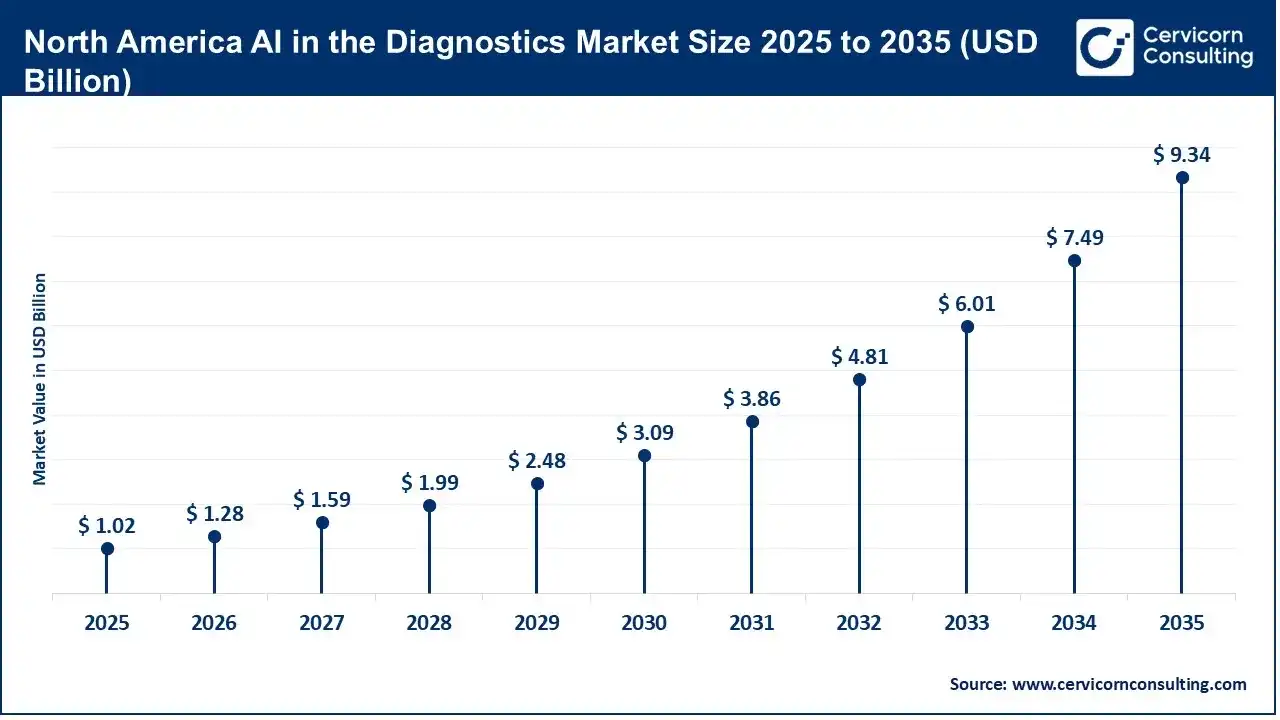
The North America AI in diagnostics market size was valued at USD 1.02 billion in 2025 and is expected to reach USD 9.34 by 2035. North America accounted for the largest regional share, backed by advanced healthcare infrastructure, extensive digitalization, significant investments in AI technologies, and robust R&D capacities. Thanks to widespread use of digital imaging, improved diagnostic systems, electronic health records, and AI-enabled medical technology, the United States continues to be the key driver of regional growth. The commercialization of AI-based diagnostic solutions is being further encouraged by the presence of research organizations, healthcare facilities, technology developers, and a supportive innovation environment.
AI in the Diagnostics Market Share, By Region, 2025 (%)
| Region |
Revenue Share, 2025 (%) |
| North America |
54.20% |
| Europe |
21.40% |
| Asia-Pacific |
17.80% |
| LAMEA |
6.60% |
Asia Pacific to Witness the Fastest Rate of Growth by 2035
The Asia-Pacific AI in diagnostics market size was estimated at USD 0.34 billion in 2025 and is anticipated to surpass USD 3.07 billion by 2035. Asia Pacific is expected to register the fastest growth during the forecast period, fueled by growing healthcare infrastructure, rising healthcare costs, growing diagnostic service demand, and quickening digital transformation. Investments in artificial intelligence (AI) and digital healthcare technologies are rising in nations like China, India, Japan, South Korea, and Australia. Significant growth prospects are anticipated throughout the region as a result of the expanding use of digital pathology, medical imaging, linked healthcare systems, and AI-supported clinical applications, as well as government programs encouraging the advancement of healthcare technology.
Segmental Analysis
Component Analysis
How Did the Software & Solutions Segment Hold the Largest Share in the AI In Diagnostics Market?
The software & solutions segment held the largest revenue share in the AI in diagnostics market in 2025 because AI-powered tools for image interpretation, clinical decision support, predictive analysis, and diagnostic workflow management are becoming more and more popular among healthcare providers. These solutions serve as the analytical layer that links the current healthcare infrastructure with artificial intelligence.
Healthcare businesses are able to increase diagnostic efficiency and save time spent on repetitive work because of AI software's capacity to process massive amounts of medical imaging, clinical records, laboratory data, and patient data. The need for AI diagnostic software is being reinforced by growing integration with imaging platforms, hospital information systems, and electronic health records.
AI in Diagnostics Market Share, By Component, 2025 (%)
| Component |
Revenue Share, 2025 (%) |
| Software |
47.10% |
| Hardware |
32.40% |
| Services |
20.50% |
The services segment is expected to register strong growth during the forecast period because healthcare institutions need specific assistance with AI implementation, system integration, customization, employee training, upkeep, and technical administration. Hospitals and diagnostic facilities are becoming more and more reliant on expert services to guarantee that AI applications function well inside current workflows as AI transitions from pilot projects into standard clinical settings. There will likely be more opportunities in this market due to the growing demand for ongoing monitoring, model updates, cybersecurity, and technical assistance.
Diagnosis Type Analysis
How did the Radiology Segment Secure the Largest Share in the AI in Diagnostics Market?
The radiology segment held the largest share of the AI in diagnostics market in 2025, due to the widespread availability of digital imaging data and the increased demand for processing ever-increasing numbers of diagnostic tests. AI is being integrated into processes for X-ray, CT, MRI, mammography, and ultrasound in order to identify tests that need immediate attention, detect problems, help with picture interpretation, automate measurements, and improve image quality. AI technologies are assisting imaging departments in managing increasing workloads while enhancing workflow speed and consistency by helping radiologists with repetitive and data-intensive tasks.
AI in Diagnostics Market Share, By Diagnosis Type, 2025 (%)
| Diagnosis Type |
Revenue Share, 2025 (%) |
| Radiology |
32% |
| Pathology |
20% |
| Cardiology |
13% |
| Oncology |
12% |
| Neurology |
8% |
| Chest & Lung Diseases |
6% |
| Ophthalmology |
4% |
| Dermatology |
3% |
| Genomics |
2% |
The oncology segment is expected to experience the fastest growth during the forecast period, encouraged by the growing need for more accurate diagnostic evaluation and early cancer detection. Medical photos, pathology slides, biomarkers, genomic data, and clinical records can all be analyzed by AI to find patterns linked to various cancer kinds. Artificial intelligence is being more widely used in cancer diagnosis and treatment planning due to the growing use of digital pathology, predictive analytics, multimodal AI, and precision medicine.
Technology Analysis
How did the Machine Learning Segment Secure the Largest Share in the AI in Diagnostics Market?
The machine learning segment represented a leading share of the AI in diagnostics market in 2025 because of its capacity to examine sizable and intricate healthcare datasets and identify trends linked to illnesses and clinical results. Medical imaging, risk assessment, disease prediction, clinical decision assistance, and diagnostic categorization all employ machine-learning algorithms. Healthcare providers and technology developers are able to create increasingly complex machine learning-based diagnostic apps thanks to the expanding availability of digitized healthcare data and growing computational power.
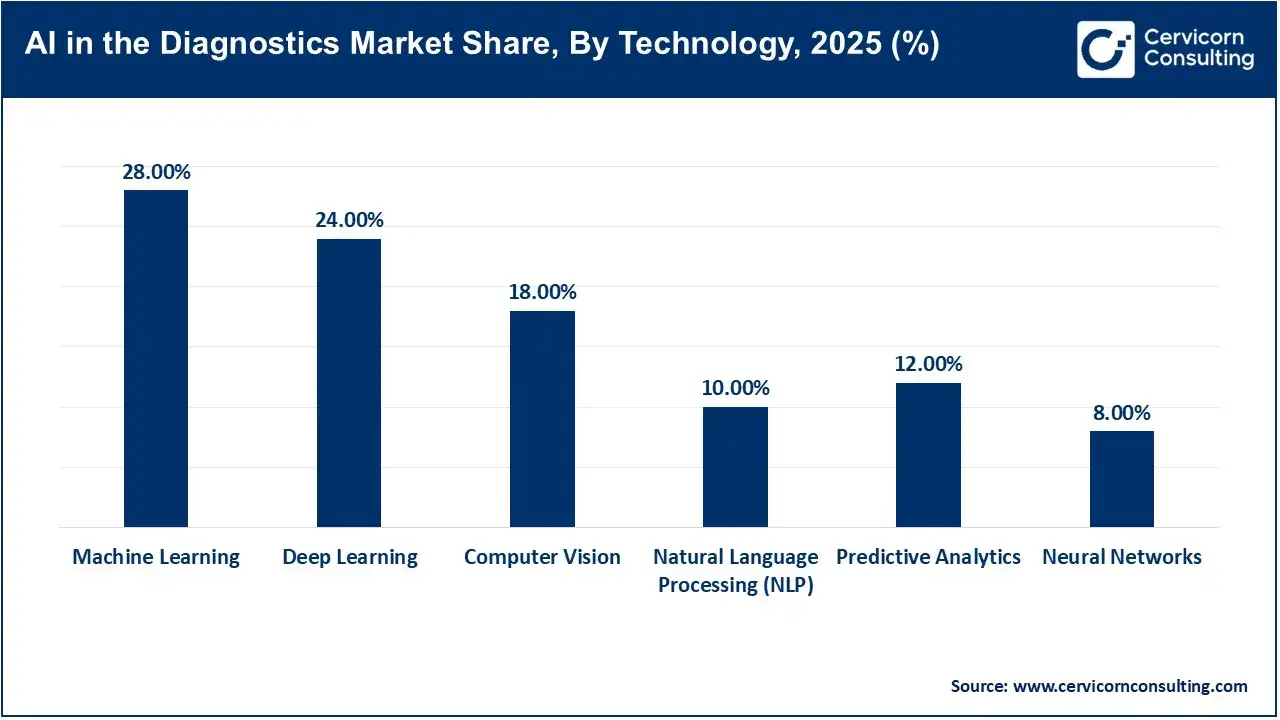
The deep learning segment is anticipated to record the fastest growth during the forecast period due to its powerful ability to analyze medical data based on images. Complex visual features seen in radiological scans, pathology slides, ophthalmic images, and other diagnostic data can be recognized by deep learning algorithms. It is anticipated that when these technologies are used more often for automated anomaly detection, tissue classification, tumor diagnosis, and image analysis, their acceptance across diagnostic specialties will increase.
End-user Analysis
How did the Hospitals & Clinics Segment Secure the Largest Share in the AI in Diagnostics Market?
The hospitals & clinics segment accounted for the largest share of the AI in diagnostics market in 2025, supported by a large amount of patient data and a comprehensive diagnostic infrastructure. AI can be incorporated into current diagnostic workflows in a variety of hospital departments, such as radiology, pathology, cardiology, and laboratory services. Hospitals are encouraged to adopt AI for case prioritization, image analysis, clinical decision support, and workflow automation due to growing patient volumes, pressure to reduce turnaround times, and a lack of skilled healthcare workers. The adoption of AI in hospital settings is further supported by the availability of well-established digital healthcare infrastructure.
AI in Diagnostics Market Share, By End-user, 2025 (%)
| End-user |
Revenue Share, 2025 (%) |
| Hospitals & Clinics |
46% |
| Diagnostic Laboratories |
22% |
| Imaging Centers |
15% |
| Research & Academic Institutes |
7% |
| Pharmaceutical & Biotechnology Companies |
10% |
The diagnostic laboratories segment is expected to witness the fastest growth during the forecast period caused by an increase in diagnostic testing volume and laboratory automation. AI can help labs with workflow optimization, pathological interpretation, quality control, sample analysis, and pattern recognition. AI-based solutions are anticipated to become more significant in laboratory diagnostics as labs concentrate on cutting turnaround times and increasing operational effectiveness while managing higher testing volumes.
Recent Developments
- In March 2026, Quest Diagnostics announced the launch of Quest AI Companion, an AI-powered feature designed to help patients analyze and better understand their laboratory test results. The tool uses AI to review patients’ laboratory data and provide information that can support discussions with healthcare professionals.
- In March 2026, Philips expanded its digital pathology portfolio with cloud-enabled capabilities for the Philips IntelliSite Pathology Solution. The development is intended to support the adoption of digital pathology, improve workflow efficiency, and provide infrastructure for advanced diagnostic and AI applications.
- In May 2026, Roche announced an agreement to acquire PathAI, a company specializing in digital pathology and AI-powered pathology technologies. The acquisition is aimed at strengthening Roche’s AI-driven diagnostics capabilities and supporting more automated and advanced pathology workflows.
Key Companies
Segments Covered
By Component
- Software
- Hardware
- Services
By Technology
- Machine Learning
- Deep Learning
- Computer Vision
- Natural Language Processing (NLP)
- Predictive Analytics
- Neural Networks
By Diagnosis Type
- Radiology
- Pathology
- Cardiology
- Oncology
- Neurology
- Chest & Lung Diseases
- Ophthalmology
- Dermatology
- Genomics
By Type of Modality
- In Vitro Diagnostics
- Molecular Diagnostics
- Immunoassays & Clinical Chemistry
- Point-of-Care Tests
- Diagnostic Imaging
- MRI
- CT-Scan
- Ultrasound
- X-Ray
- PET/SPECT
- Others
- Other Modalities
By End User
- Hospitals & Clinics
- Diagnostic Laboratories
- Imaging Centers
- Research & Academic Institutes
- Pharmaceutical & Biotechnology Companies
By Region
- North America
- Europe
- Asia Pacific
- Latin America
- Middle East & Africa