Multimodal AI Market Size and Growth 2026 to 2035
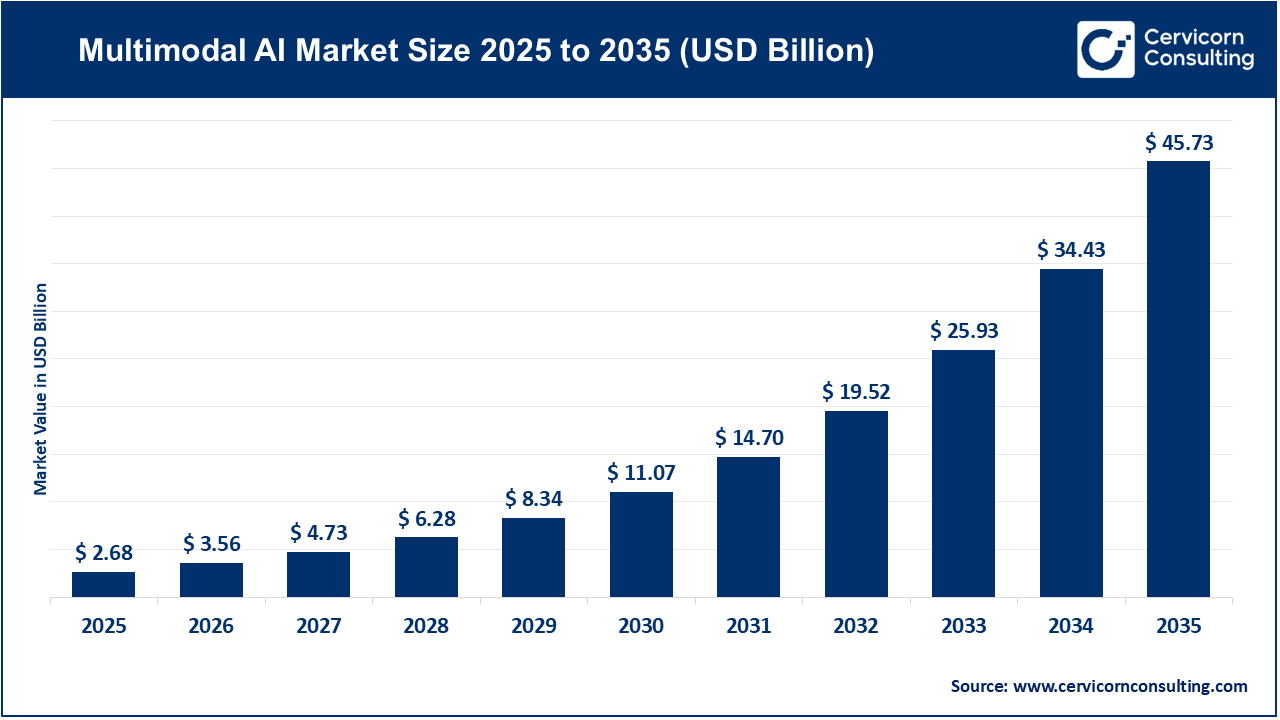
The global multimodal AI market size was valued at USD 2.68 billion in 2025 and is anticipated to hit around USD 45.73 billion by 2035, growing at a compound annual growth rate (CAGR) of 32.8% over the forecast period from 2026 to 2035. The market is poised to grow with the rising prominence of AI-enabled devices alongside offering personalized experiences.
Report Highlights
- North America dominated the multimodal AI market with revenue share of 47% in 2025 owing to the presence of multi-scale companies and start-ups in the region; the United States is seen to be the largest contributor to the region’s market.
- Asia Pacific is seen to grow at the fastest rate during the forecast period; countries such as India and China will play a major role.
- By component, the software segment dominated the market 65% in 2025 owing to the overall requirement of multimodal software for processing advanced technologies.
- By component, the services segment is expected to grow at the fastest rate during the forecast period owing to the growth in professional services involving training and consulting of multimodal AI models.
- By data modality, the text data segment dominated the market 41% with the overall need of content analysis for chatbots.
- By data modality, the speech & voice data segment is projected to witness the fastest rate of growth with rising adoption of virtual assistants in various industries.
- By end use, the media & entertainment segment led the market 26% in 2025 with rising emphasis over creative innovation.
- By end use, the BFSI segment is seen to grow at the fastest rate during the forecast period as multimodal AI solutions are being implemented in ATMs and banks for recognition purposes.
- By enterprise size, the large enterprises segment accounted for revenue share of 59% in 2025 owing to the requirement of data analysis and complex problem solving in such companies.
- By enterprise size, the SMEs segment is seen to grow at the fastest rate due to rising funds and government initiatives for startups.
Multimodal AI Market Major Insights
A multimodal AI market is the technology ecosystem, platform and service that allows AI systems to process, understand and/or generate insights by processing and/or generating from more than one type of digital data. Data types can include text, images, audio, video and environmental sensor data. Multimodal AI models differ from traditional AI models where a single type of input is being processed, because in multimodal AI models multiple types of inputs are being integrated together to produce more complete, context based outputs. The ability to use both types of digital data can provide organizations with a capability to solve complex information systems by interacting with different forms of digital data.
Several industries are now turning to multimodal artificial intelligence as a way to create higher levels of operational effectiveness and also provide more valuable experiences for their users. The health care industry, for example, has been implementing AI to help clinicians with both diagnosing patients and developing treatment plans through the use of AI-based analysis of both electronic health record data and medical images. In another example, the telematics industry has been using Multimodal AI in conjunction with advanced driver assistance systems, so that all three types of data can be combined and analyzed in real time to make driving a vehicle safer.
How Can Emerging Organizations Use Multimodal AI Models?
- Customer support automation: Startups may utilize multimodal AI systems providing text chat interaction, voice recognition and analysis via pictures to interact with customers about their inquiries or support needs. An example would be an AI assistant that could look at a screenshot submitted by a user, listen to their voice complaint, and refer back to a written request to accurately bring resolution to a customer’s problem.
- Product & Visual Search Enhancements: E-commerce businesses could allow customers to upload product image(s) and type in search terms. By doing this, multimodal AI will analyze both the visual input and the written input to find similar or recommend product(s) being sought.
- Marketing & Content Creation: Emerging companies will create promotional material by combining multimodal AI (image generation, writing text, and analyzing videos) to produce social media visuals, captions and campaign materials quickly and with limited team resources.
- Document & Workflow Automation: Organizations that manage invoices, contracts, and/or identity verification documents may utilize multimodal AI to analyze simultaneously scanned documents, handwritten notes, and typed text. This allows for automation of document verification processes, data extraction and compliance checks.
Top Countries to Invest in Multimodal AI: Initiative, Government Support & Insight
| Country |
Government Support |
Private-entities’ Initiatives |
Major Insights |
| United States |
Initiated National AI Research Initiative or secure and reliable AI models |
Open AI, Google & Microsoft are heavily investing in multimodal models. |
The country leads global AI innovation due to strong venture capital funding, advanced research institutions, and a large startup ecosystem focused on enterprise and healthcare AI applications. |
| China |
Central government investment in AI infrastructure, national data platforms, and smart city development |
Technology companies including Baidu, Alibaba, and Tencent are developing multimodal AI platforms for cloud services, search technologies, and autonomous systems |
Technology companies including Baidu, Alibaba, and Tencent are developing multimodal AI platforms for cloud services, search technologies, and autonomous systems |
| United Kingdom |
National AI Strategy and pro innovation regulatory framework |
Companies such as DeepMind and other AI startups are developing advanced multimodal AI systems and large language models |
The UK benefits from strong university research ecosystems and global AI talent concentration |
| India |
IndiaAI Mission and National Strategy for Artificial Intelligence |
Large technology companies and startups including Tata Consultancy Services, Infosys, and emerging AI startups are investing in multilingual and multimodal AI applications |
Government programs supporting AI innovation hubs, startup funding, and digital infrastructure |
| South Korea |
National AI Strategy and smart manufacturing programs |
Companies such as Samsung, Naver, and Kakao are investing in multimodal AI for consumer electronics, robotics, and digital platforms |
Significant government funding for AI research, robotics, and semiconductor innovation |
Multimodal AI Market Dynamics
Driver
Rising Demand in Healthcare Sector for Real-time Support
Multimodal AI solutions for the delivery of clinical decision support, diagnostic accuracy improvement and patient monitoring are gaining traction in the healthcare industry. Multimodal AI systems can analyze multiple types of medical data (images, electronic health records, physician notes, lab results and voice) to generate more comprehensive insights about patient health and to help healthcare providers make quicker decisions regarding patient care. Healthcare organizations are also implementing AI platforms that combine imaging data with clinical data.
An example of such use case are AI powered diagnostic decision tools that are capable of analyzing radiological images alongside the patient's medical history, as well as any pathology information, in order to identify diseases with higher sensitivity and specificity than traditional methods; such as cancer and cardiovascular diseases, at much earlier stages of development. Research has shown that diagnostic tools powered by Artificial Intelligence can reduce the accuracy rate of diagnosis errors by over 20% when evaluating and analyzing complex radiological/diagnostic images.
Restraint
Data Privacy & Security Concerns
Concerns regarding the privacy of data as well as security pose a significant limitation within the Multimodal Artificial Intelligence Market due to the need for a large volume of sensitive data from multiple sources, including, but not limited to; personal medical records, biometric data, images/audio, and financial data. The challenge to manage/protect multiple datasets remains a barrier for many organizations.
The financial services (banking) and healthcare industries have very strict data protection requirements in place, as these industries manage sensitive confidential information; therefore, if multimodal artificial intelligence systems are not adequately secured, there could be a breach of sensitive information due to cybersecurity events or system vulnerabilities.
Opportunity
Emerging Application in Manufacturing & Industrial Automation
Multimodal AI technologies are poised to have a significant impact on manufacturing and industrial automation. Many modern manufacturing environments collect and produce large quantities of data through sensors, cameras, log files, and operational systems. The combination of these various sources allows for an increased level of efficiency as well as the potential for predictability in maintenance. AI-powered monitoring systems can analyze data from sensors monitoring industrial machinery combined with video from surveillance systems and maintenance records.
By using this information together, manufacturers are able to recognize when there is an issue with machinery before it breaks down. In addition, predictive maintenance systems that utilize AI can help to minimize the amount of time that manufacturing equipment is not producing at optimum levels. Quality control is another area of production where multimodal AI is gaining traction. Increasing numbers of manufacturers now rely on computer vision systems to perform inspection of products during the assembly process. When inspection based on vision systems is used together with sensor data and production parameters, manufacturers are able to identify defective products with greater accuracy thus improving the quality consistency of their products.
Challenge
Stricter Regulatory Compliances
Stricter regulatory requirements present a major challenge for the multimodal AI market. Governments and regulatory bodies around the world are increasingly focusing on the ethical and responsible use of artificial intelligence technologies. These regulations aim to ensure transparency, fairness, and accountability in AI driven decision making.
Multimodal AI systems often process sensitive personal data and influence decisions in sectors such as healthcare, finance, employment, and public services. As a result, regulators are introducing guidelines that require organizations to clearly document how AI models are developed, trained, and deployed.
Compliance requirements may include detailed documentation of training datasets, explanations of how algorithms generate decisions, and regular risk assessments to identify potential biases in AI systems. Organizations deploying AI technologies may also be required to conduct independent audits and maintain monitoring systems to ensure ongoing compliance with regulatory standards.
Multimodal AI Market Regional Analysis
Why is North America leading the multimodal AI market?
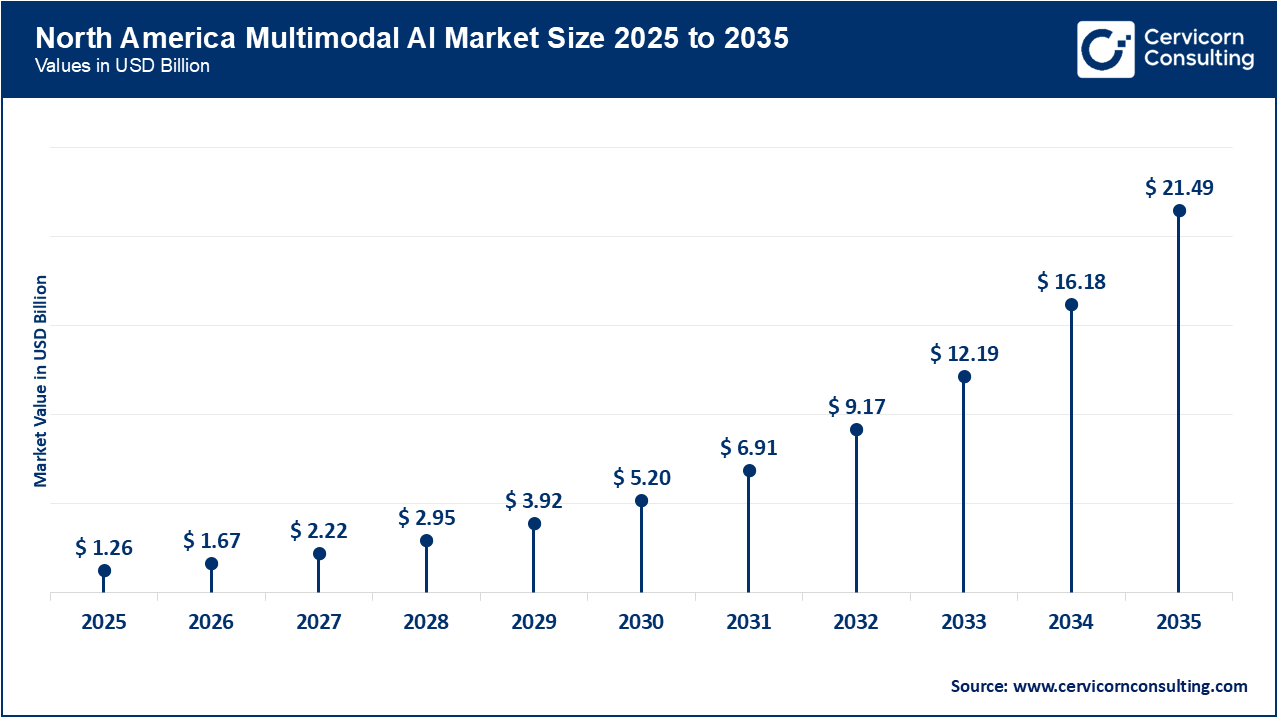
The North America multimodal AI market size was valued at USD 1.26 billion in 2025 and is expected to surpass around USD 21.49 billion by 2035. The North America is likely to remain an industry leader because of excellent digital infrastructure, a strong AI research ecosystem, and a high level of enterprise onboarding of new technologies. Industry leaders also benefit from having major global tech companies operate in the area, extensive cloud computing capabilities and many skilled workers in data science and machine learning. Investments in AI continue to grow rapidly, and as generative AI grows even faster, this region continues to innovate. Many industries including healthcare, finance, automotive, telecommunications, and digital media are developing multimodal AI technologies to be integrated into their products and services.
- According to the 2024 AI Index from the Stanford Institute for Human-Centered Artificial Intelligence, the U.S. attracted more private funding for AI than any country worldwide. In total, private funding for AI in 2023 was over USD 67 billion. This funding environment is speeding up the development of highly advanced AI models that are able to use multiple modalities for understanding language, seeing, and hearing.
Major Private Entities in the United States Promoting Multimodal AI Market
| Private Companies |
Headquarters |
Key Contribution |
| OpenAI |
San Francisco |
Developed models capable of understanding and generating text, images, and audio, which accelerated enterprise adoption of multimodal AI applications. |
| Google |
Mountain View |
Developed multimodal models such as Gemini that integrate text, image, and video processing for enterprise and consumer applications. |
| Microsoft |
Redmond |
Integrates multimodal AI capabilities into Azure AI services and enterprise productivity platforms to enable business adoption. |
| Meta Platforms |
Menlo Park |
Conducts advanced research on multimodal models combining computer vision and language processing for digital platforms. |
| NIVDIA |
Santa Clara |
Provides GPUs and AI computing platforms that power training and deployment of multimodal AI systems worldwide. |
Why is Asia-Pacific poised to witness the fastest growth rate in the multimodal AI market?
The Asia-Pacific multimodal AI market size was estimated at USD 0.59 billion in 2025 and is expected to hit around USD 10.06 billion by 2035. Adoption of new technology solutions, stemming from wide-reaching digitization and a combination of strong government-backed Artificial Intelligence (AI) policies, rapidly expanding start-up ecosystems and large scale investments in high performance compute infrastructures, are contributors to the accelerating rate of adoption throughout Asia-Pacific. China, India, Japan and South Korea are all currently investing in next-generation AI technologies that integrate text, voice, picture and video processing into a unified system.
The Organization for Economic Co-operation and Development (OECD) estimates that Asia-Pacific has a rapidly increasing share of global investments and deployments in AI across the globe, particularly within the e-commerce, healthcare diagnostics, autonomous transport, smart manufacturing and digital financial services. Asia's large population, combined with its large volume of digital data generated and consumed by its citizens is a contributing factor of creating the right conditions for training multimodal AI systems in Asia Pacific.
India Multimodal AI Market Statistics- 2026
- A report by Boston Consulting Group indicates 92% of Indian employees use generative AI tools at work, significantly higher than the global average.
- Around 86% of Indian companies are exploring or implementing AI solutions, demonstrating strong enterprise-level interest in AI deployment across sectors such as BFSI, IT services, healthcare, and manufacturing.
- According to the Stanford AI Index, India accumulated $11.1 billion in private AI investment between 2013 and 2024, with the total reaching $12.3 billion including government investments.
- Government initiatives such as the IndiaAI Mission allocate over ₹10,300 crore to build national AI infrastructure including GPU clusters and AI research platforms.
Multimodal AI Market Segmental Analysis
Component Analysis
The software segment dominated the multimodal AI market in 2025. Software platforms form the core of multimodal AI systems because they enable the integration, training, and deployment of models that process multiple data types such as text, images, and voice simultaneously. Across various types of organizations, there is an accelerating trend in the implementation of AI software frameworks, including large language models and multimodal processing engines, with the aim to streamline workflows and extract insights from intricate datasets. Generative AI platforms have amplified the need for software solutions to integrate both visual and textual comprehension of information.
“An examination of the enterprise technology leaders conducted through industry surveys in 2024 demonstrated that upwards of 60% of organizations conducting experiments utilizing generative AI leveraged multimodal software frameworks to accomplish tasks such as document analysis, image recognition and conversational interfaces.”
Market Share, By Component, 2025 (%)
| Component |
Revenue Share, (%) |
| Software |
65% |
| Services |
35% |
The services segments is expected to witness the fastest rate of growth during the forecast period. The rapid growth of enterprises adopting multiple modes of AI has created an increased demand for specialised consulting, systems integration and model-training services. Many companies do not have the internal capabilities needed to design and implement complex AI systems which integrate many data sources. Consequently, organisations are increasingly using AI consultancies and cloud service providers as sources for implementation, data engineering and governance related to AI.
Data Modality Analysis
In 2025, the text data segment dominated the market in 2025. As text accounts for most of the data generated by organizations, for example, through documents, emails, reports, customer interactions, and online content, it is by far the most popular type of data format used for AI model training and deployment. In many cases multimodal AI systems will use text based data as a primary source of data input to be used in conjunction with other types of data inputs (like images or sound). The increasing number of digital communications and documentation created within enterprises has contributed significantly to this trend toward text based datasets.
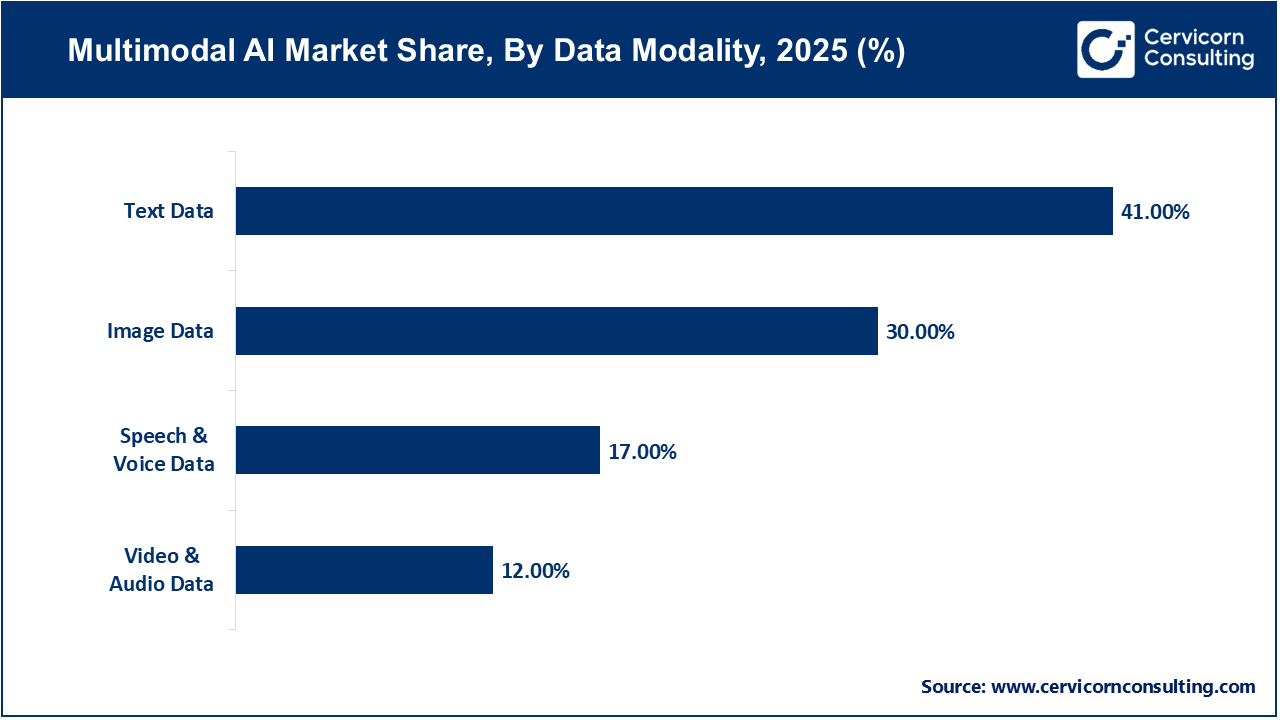
Moreover, the speech & voice data segment is seen to grow at the fastest rate during the forecast period. Growing popularity of voice recognition technology is boosting audio and voice datasets in multimodal AI. Voice assistants, automated telephone assistance systems, and voice command devices all produce an enormous amount of audio data for both analysis with text/visual data. More businesses are implementing AI-based voice analytics in order to assess consumer interaction via telephone, identify sentiment and provide better customer service.
- Based upon current technology adoption studies, over 40% of global internet users have frequent interaction with AI voice digital assistants. Further expanding the presence of voice data in multimodal applications will occur with increased use of speech recognition technology in automotive information systems.
End Use Analysis
The media & entertainment segment dominated the multimodal AI market in 2025. The media and entertainment sectors have become some of the foremost users of multimodal AI applications since they primarily create, distribute and consume content in many different formats, including visual, audio and textual. In order for these companies to analyze and improve the production of their content, develop recommendations for viewers, and generate engagement opportunities with audiences; multimedia data from these different types of content is analyzed and understood through the use of various forms of AI technology.
With new forms of multimodal AI that utilize video, subtitles, images, and sound simultaneously to generate insights into what type of content viewers prefer to watch and automate moderation of content produced; companies are utilizing more and more recommendations generated through the use of AI based recommendation engines that analyze users’ behavioral data across multiple forms of multimedia content.
Market Share, By End Use, 2025 (%)
| End Use |
Revenue Share, 2025 (%) |
| Media & Entertainment |
26% |
| BFSI |
15% |
| IT & Telecommunication |
20% |
| Healthcare |
17% |
| Automotive |
10% |
| Gaming |
7% |
| Others |
5% |
The BFSI segment is seen to grow at the fastest rate during the forecast period. Numerous banks, financial services and insurance entities are increasingly leveraging multimodal artificial intelligence to improve automated customer service processes, enhance risk assessment procedures and detect fraudulent behaviour. Financial organisations are inundated with huge volumes of structured and unstructured data such as transaction records, customer communications, ID documents and biometric information.
Enterprise Size Analysis
The large enterprises segment dominated the market in 2025. Organizations that are larger in size than most have also been using multimodal AI technology primarily due to having the adequate financial resources, technical infrastructure and abundance of data ecosystems necessary for training and deploying advanced AI models. These organizations frequently maintain large scale digital platforms that are creating large quantities of different types of data. As a result, organizations utilize multimodal AI to analyze the datasets generated from these digital platforms with the intention of increasing operational efficiency, automating customer interactions and improving decision-making processes.
Market Share, By Enterprise Size, 2025 (%)
| Enterprise Size |
Revenue Share, 2025 (%) |
| Large Enterprises |
59% |
| SMEs |
41% |
The SMEs segment is expected to grow at the fastest rate during the forecast period. Multimodal artificial intelligence (AI) solutions are becoming increasingly common for small- and medium-sized businesses (SMEs) as more cloud-based AI platforms and software tools are becoming available. The previous high price of AI infrastructure was one of the major obstacles to SMEs adopting AI technology; however, due to the growth of AI as a service platforms and low-code AI tools, AI capabilities can now be easily identified and integrated into the business's internal processes. Many small businesses are currently implementing AI tools to assist with their marketing analytics, customer support automation, document processing, and e-commerce optimization.
Multimodal AI Market Top Companies
North America
- OpenAI
- Microsoft
- Google
- Meta Platforms
- NVIDIA
- Anthropic
- Cohere
Europe
- Mistral AI
- Stability AI
- Aleph Alpha
- Synthesia
- DeepMind
Asia Pacific
- Baidu
- Alibaba Group
- Tencent
- SenseTime
- MiniMax
- Sarvam AI
Multimodal AI Market Recent News
- According to a statement made in March 2026, Air Cargo Technology Company and Cargo Booking Portal Company announced the release of their new artificial intelligence (AI) based operating platform designed for multimodal logistics operations. Cargo.one claims that they are the first company to commercially deploy a multi-modal, AI based operating platform which allows freight forwarders and carriers to run agentic workflows and allows other freight logistics operational data to exist in one comprehensive system.
- In March 2026, DeepSeek announced its newest large language model V4. This is the company's first major product introduction in over a year and will occur within the next few days. The V4 will be a multimodal model that can produce both text and video as well as perform other functions.
Market Segmentation
By Component
By Data Modality
- Image Data
- Text Data
- Speech & Voice Data
- Video & Audio Data
By End Use
- Media & Entertainment
- BFSI
- IT & Telecommunication
- Healthcare
- Automotive
- Gaming
- Others
By Enterprise Size
By Region
- North America
- Asia Pacific
- Europe
- Latin America
- Middle East & Africa