
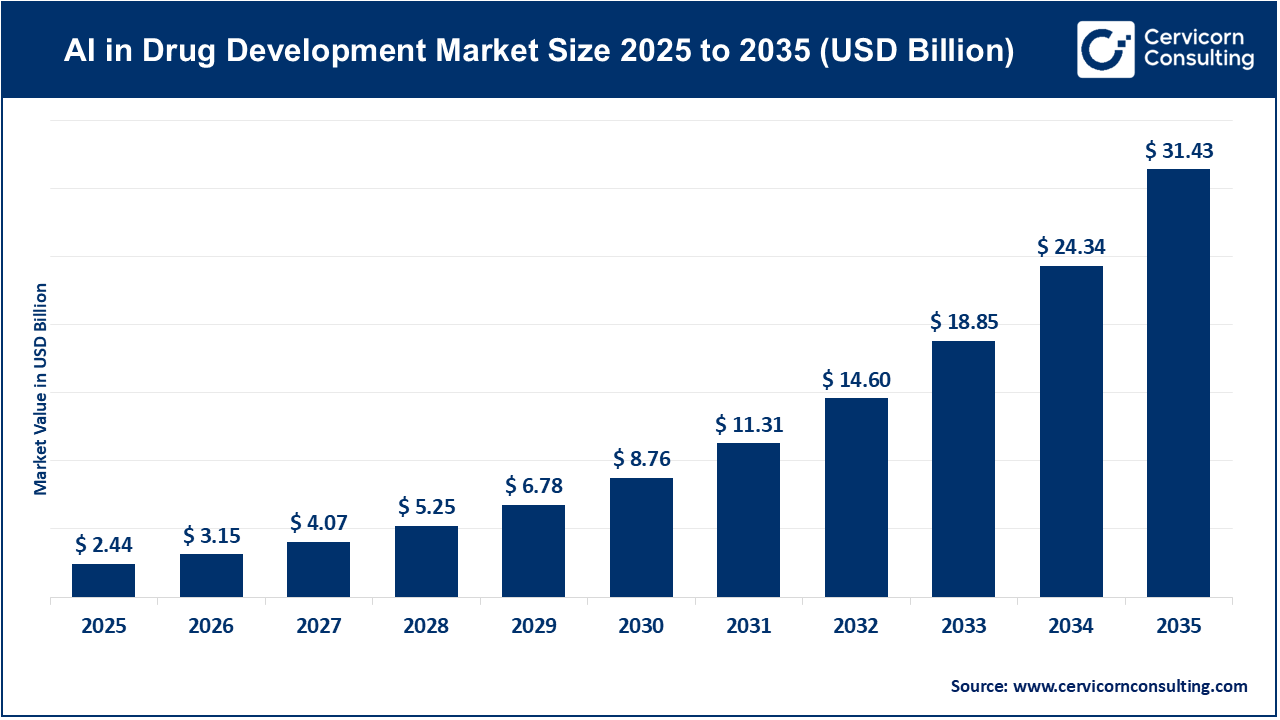
The global AI in drug development market size reached at USD 2.44 billion in 2025 and is expected to be worth around USD 31.43 billion by 2035, exhibiting at a compound annual growth rate (CAGR) of 29.2% over the forecast period from 2026 to 2035. The rise of AI in the drug development market is primarily fueled by the growing need for financial efficiency and cost reduction in clinical trials. Developing a new drug has become more costly, with the average expense nearing USD 2.6 billion to bring a therapy to market. AI offers a notable chance to cut drug discovery costs by 25-40% through techniques such as data analysis and predictive modeling. These AI methods help identify high-risk, toxicity, and efficacy issues during pre-clinical stages, lowering expenses compared to traditional clinical trial processes. Moreover, AI-driven patient stratification and recruitment can reduce clinical trial lengths by up to 20%, saving millions. The sector is also aiming to boost its Return on Investment (ROI).
Another growth factor is the expansion of "Big Data" in biology. The surge in genomic and proteomic data has created vast information pools that AI can interpret effectively. According to datavant, genomics and biomarker data could generate up to 40 exabytes by 2025, and wearable devices may produce over 90 zettabytes worldwide in 2025. These large datasets support mechanics-based drug discovery and drug repurposing. Additionally, advancements in cloud computing and 6G technology provide the infrastructure and connectivity necessary to handle these data volumes.
Growth of strategic partnerships between tech and biotech is driving the AI in drug development market
The increasing growth of strategic partnerships between technology companies and biotechnology organizations is significantly reshaping the competitive landscape of the market. These collaborations are creating a new "tech-bio" hybrid ecosystem, where advanced digital capabilities are integrated directly into pharmaceutical research and development. For example, leading technology players like NVIDIA and Google are evolving from merely service providers to becoming R&D partners by offering high-performance computing (HPC) and specialized biological models such as BioNeMo and AlphaFold. Additionally, AI-related partnerships in the pharmaceutical sector exceeded USD 10 billion in 2023, as Big Pharma aims to leverage the computational expertise of Big Tech to handle the vast amounts of genomic and proteomic data.
Major Companies Driving Strategic Partnerships in AI-Based Drug Development
| Company | Headquarters | AI Technology | Partners | Contribution to Drug Development |
| Isomorphic Labs | United Kingdom | DeepMind AI models (AlphaFold-based protein structure prediction) | Eli Lilly, Novartis | Predicts protein structures and designs new therapeutic molecules |
| Exscientia | United Kingdom | AI-driven drug design automation platform | Sanofi, Merck, Bristol Myers Squibb | Rapid identification and optimization of drug candidates |
| Insilico Medicine | Hong Kong / USA | Generative AI and deep learning for molecular design | Sanofi, Fosun Pharma | AI-generated drug molecules and target identification |
| Recursion Pharmaceuticals | USA | Machine learning + large biological imaging datasets | Roche, Bayer, NVIDIA | High-throughput phenomics for drug target discovery |
| Schrödinger | USA | Physics-based simulation + machine learning | Bristol Myers Squibb, Novartis | Computational modeling and drug candidate optimization |
| Atomwise | USA | Deep learning neural networks for molecular screening | AbbVie, Bayer | Virtual screening of billions of chemical compounds |
How Is AI Transforming Drug Development and Pharmaceutical Innovation?
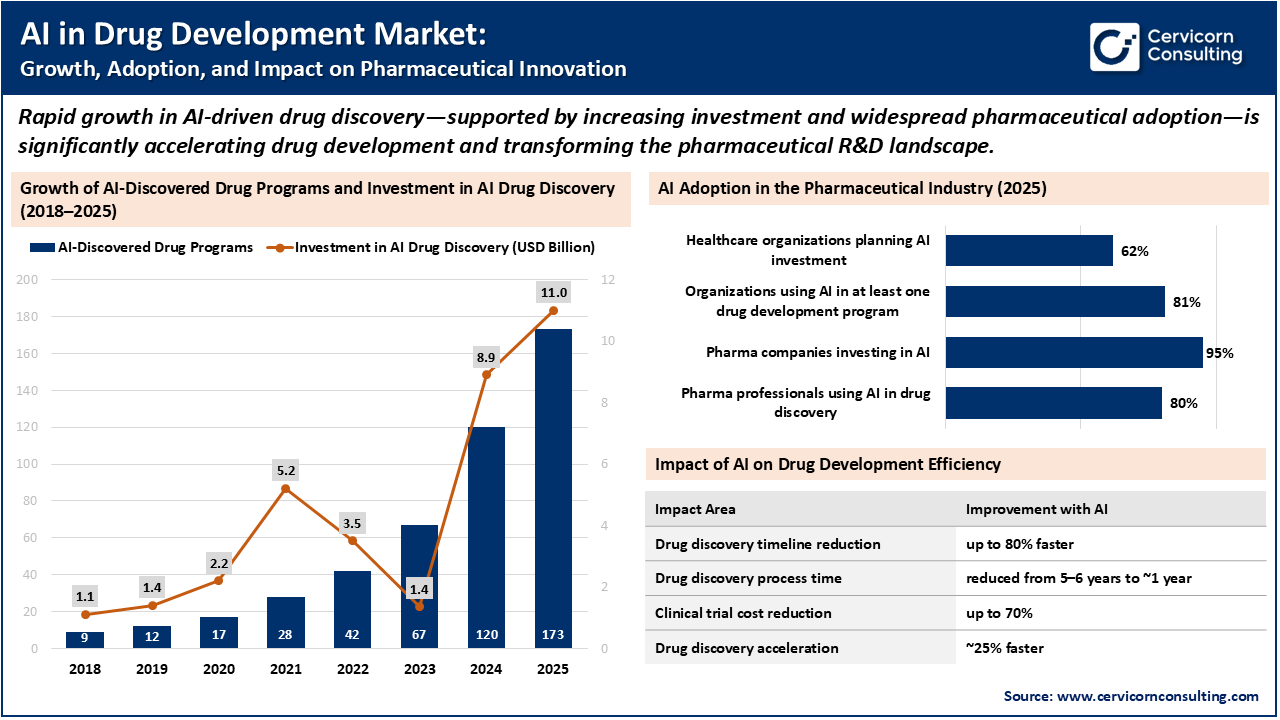
The AI in drug development market is undergoing significant expansion, largely due to increasing investments and the broader adoption of AI technologies within the pharmaceutical sector. Recent data indicates that the number of AI-discovered drug programs has grown from 9 in 2018 to 173 in 2025, while investments have reached around USD 11 billion in 2025. This trend demonstrates a strong confidence in AI-driven drug discovery. At present, the integration of AI into drug development processes has become common among pharmaceutical companies, as organizations seek to enhance research efficiency. These developments are contributing to faster drug discovery, shorter development timelines, and reduced clinical trial costs. As a result, the pharmaceutical R&D landscape is shifting towards more efficient and data-driven approaches, with AI playing a central role in this transformation.
1. Recent Corporate Advances and Launches
The corporate launch is a significant driver of growth in the market. The progress of Insilico Medicine has turned AI-designed drug candidate ISM001-055 into Phase II clinical trials for treating idiopathic pulmonary fibrosis. This marks a major industry milestone, demonstrating that AI can handle discovery from target identification through to human testing. Additionally, the scaling infrastructure of NVIDIA BioNeMo platforms allows companies like Amgen to speed up their protein engineering efforts. This advancement shows that approximately 200% more AI-designed models are now mature, contributing to the expansion of the drug pipeline.
2. Assessment of National Initiatives and Policies
National initiatives and policies are playing an essential role in reshaping the market. For example, the FDA recently introduced its “AI and ML in Drug Development” discussion paper, which offers a vision of how to use AI in clinical trials and manufacturing, focusing on the robustness of models and bias reduction. Meanwhile, other countries like the United Kingdom and China are actively investing in "AI for Healthcare” and scientific research programs. These policies generally aim to support funding for an AI-pharma ecosystem and work towards creating and maintaining momentum for local companies and the pharmaceutical sector.
3. Partnership Developments between Technology and Biopharma
The "mega-partnerships" between technology firms and biopharmaceutical companies represent a major milestone in the market. Recent collaborations, such as NVIDIA and Amgen or Google and Sanofi, all involve commitments of billions of dollars to develop custom AI infrastructure for drug discovery. These partnerships mark a turning point where AI is no longer seen as an "add-on," but as the core infrastructure for modern pharmacology, offering enough computational power to solve complex biological questions.
4. Successful Transition of AI-Driven Candidates to Later Clinical Stages
The successful advancement of AI technological breakthroughs has played a key role in progressing the market. The development of "AlphaFold 3" has transformed the understanding of complex biological interactions among proteins, DNA, and small molecules. This breakthrough has shortened the preclinical stage for many companies by about 18 months, enabling candidates to move to later clinical stages faster, and also decreasing the time-to-market for life-saving medicines.
The AI in drug development market is segmented by region, including North America, Europe, Asia-Pacific, and LAMEA. Here is a brief overview of each region:
The Asia-Pacific AI in drug development market size was accounted for USD 0.49 billion in 2025 and is forecasted to surpass around USD 6.29 billion by 2035. The Asia Pacific region is forecasted to have the highest CAGR by 2035, mainly due to rapid digital transformation and government subsidies for biotechnology in that region. Additionally, the large amount of patient data available there enables the training of diverse and robust AI models, especially related to infectious diseases and oncology. The market highlights a strategic shift: Asia is no longer just a service provider for Western pharmaceutical companies but is beginning to develop its own AI as a service for drug pipelines.
China AI in Drug Development Market: Policy-Driven Innovation and Smart Healthcare Expansion
China is a major player in the global market based on the “Made in China 2025” policy and extensive funding for AI infrastructure and “Smart Healthcare.” Additionally, companies in China, such as XtalPi, lead research programs that combine quantum physics and AI for molecular discovery, often reaching the “hit-to-lead” phase faster than the global average. Furthermore, China holds nearly a 30% share of global publications on AI-drug discovery and has implemented reforms to streamline regulatory approvals for AI-assisted clinical trials to address a significant healthcare burden in the country.
Japan Focusing on Precision Medicine and R&D Efficiency in an Aging Society
Japan leads a 30% aging population, driving the drug discovery and development market towards cost efficiency. This trend has led to the creation of the LINC (Life Intelligence Consortium), which includes over 100 collaborating companies. In response, collaborative initiatives like the Life Intelligence Consortium (LINC) have been formed, bringing together more than 100 pharmaceutical, technology, and academic organizations.
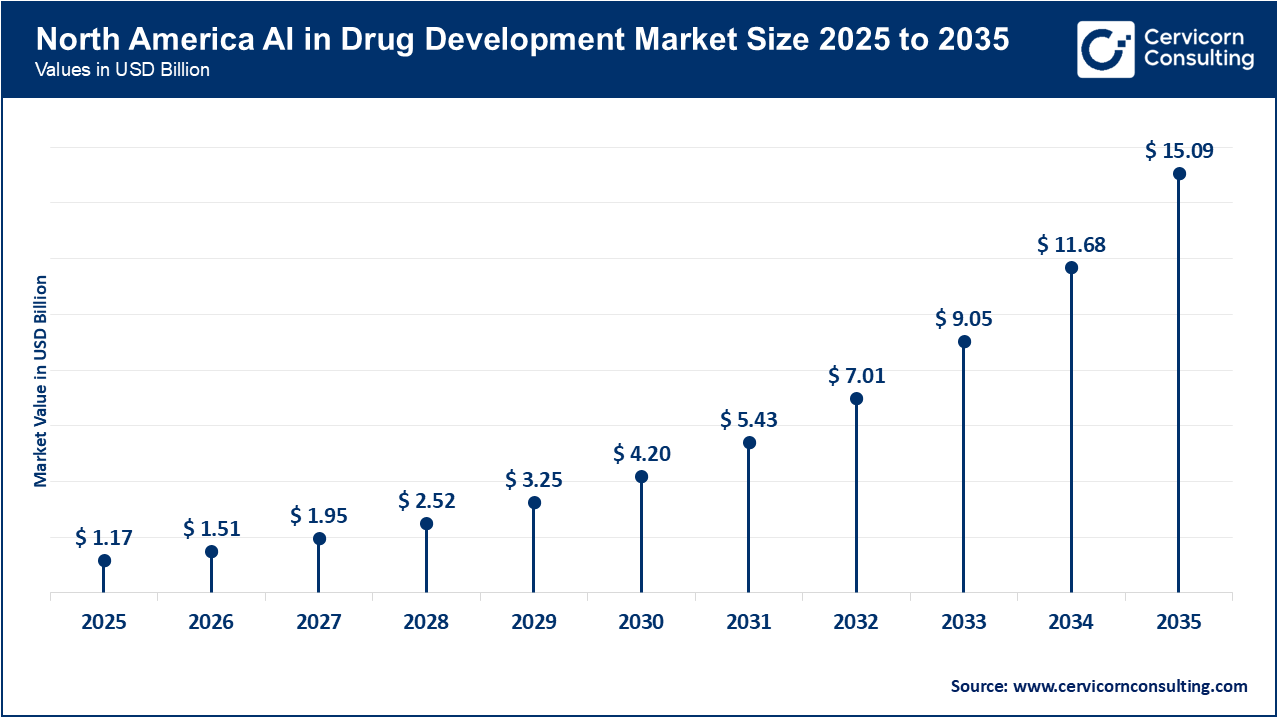
The North America AI in drug development market size was valued at USD 1.17 billion in 2025 and is expected to hit around USD 15.09 billion by 2035. North America holds a significant share due to an established ecosystem of "Big Pharma," elite academic institutions, and a strong venture capital market. The region also benefits from a "fail-fast" culture and cloud-based AI infrastructure, enabling biotech startups to scale rapidly. Recent data for North American AI-biotech firms in 2024 indicate over USD 5 billion invested in private equity, reinforcing the region's leadership in patent filings and clinical-stage AI-discovered drugs.
The Canadian Government's Pan-Canadian AI Strategy has established AI research centers in Toronto and Montreal. It shows a 20% increase in AI-related clinical collaborations in Canada, with a strong focus on deep learning for protein engineering and personalized oncology. This academic-industry collaboration is a key feature of the Canadian AI ecosystem.
United States and Canada: Key data points
The Europe AI in drug development market size was estimated at USD 0.59 billion in 2025 and is projected to hit around USD 7.54 billion by 2035. The European market emphasises data ethics and large-scale public-private partnerships, such as the Innovative Medicines Initiative (IMI). Europe's growth is driven by access to high-quality longitudinal patient data from nationalized healthcare systems, providing valuable training grounds for AI models. While the GDPR enforces stricter rules on patient data access, Europe is experiencing a rise in "Federated Learning" models that enable AI training without moving sensitive data across borders.
Germany and the U.K. AI in Drug Development: A Quantitative Data
AI in Drug Development Market Share, By Region, 2025 (%)
| Region | Revenue Share, 2025 (%) |
| North America | 48% |
| Europe | 24% |
| Asia Pacific | 20% |
| LAMEA | 8% |
The LAMEA AI in drug development market was valued at USD 0.20 billion in 2025 and is anticipated to reach around USD 2.51 billion by 2035. The LAMEA (Latin America, the Middle East, and Africa) is an emerging market where AI adoption is driven by a rising need to modernize healthcare systems and address unique regional healthcare challenges. Although its current market size is smaller than North America or Europe, growth is anticipated as international pharmaceutical companies increasingly target these regions to access diverse clinical trial populations that support advanced and "leapfrog" technologies.
Recent Developments:
The AI in drug development market is segmented into process, therapeutic area, AI technology, application, end-user, and region.
HIT-TO-LEAD Identification stands out as the most prominent segment in the market because it is the most technologically advanced phase, where AI increasingly transforms "hits" into "leads" by optimizing pharmacokinetics. Consequently, AI tools have already cut the time-to-result by 50% during the "lead" stage. This segment's significance is also supported by the abundance of historical data available for training models related to molecular optimization and structure-activity relationships.
AI in Drug Development Market Share, By Process, 2025 (%)
| Process | Revenue Share, 2025 (%) |
| HIT-TO-LEAD Identification | 29% |
| Target Identification & Selection | 18% |
| Lead Optimization | 16% |
| Target Validation | 14% |
| HIT Identification & Prioritization | 13% |
| Candidate Selection & Validation | 10% |
Target Identification & Selection is the fastest-growing process type in the market, largely driven by the surge in large datasets. It aims to reduce the high attrition rates in early-stage drug discovery. The shift toward precision medicine involves AI integrating genomics, proteomics, and transcriptomics to identify specific biomarkers that traditional methods might miss. Recent scientific advances, such as AlphaFold, have attracted significant investment in this area of AI and drug discovery, enabling the identification of more "druggable" targets with improved biological validation.
Oncology remains the leading therapeutic area in the market due to the extensive clinical data and the high commercial value of cancer treatments. Cancer generates vast datasets, including decades of genomic sequencing, pathology imaging, and clinical trials, essential for training stable AI models. Moreover, the direct link between genetic mutations and therapeutic targets makes oncology an ideal field to showcase AI algorithm effectiveness.
AI in Drug Development Market Share, By Therapeutic Area, 2025 (%)
| Therapeutic Area | Revenue Share, 2025 (%) |
| Oncology | 26% |
| Infectious Diseases | 20% |
| Neurology | 14% |
| Metabolic Disease | 12% |
| Cardiovascular Diseases | 10% |
| Immunology | 8% |
| Mental Health Disorders | 6% |
| Others | 4% |
Infectious diseases are the fastest-growing sector in the industry, driven by the rising need for AI to predict viral mutations and antibiotic resistance, especially during the COVID-19 pandemic. This expansion is bolstered by government initiatives and public-private collaborations aimed at establishing rapid response platforms for future health crises. During the pandemic, there was significant investment in infrastructure to support this segment.
The machine Learning (ML) segment is the dominant market leader, primarily because it forms the foundation for predictive modeling, QSAR (quantitative structure-activity relationship), and toxicity prediction. ML algorithms, particularly deep learning and reinforcement learning, serve as the industry's main drivers, generating nearly 65% of the total technology-based revenue. Its flexibility makes ML indispensable in drug development, facilitating the discovery of both small-molecule and large-molecule biologics.
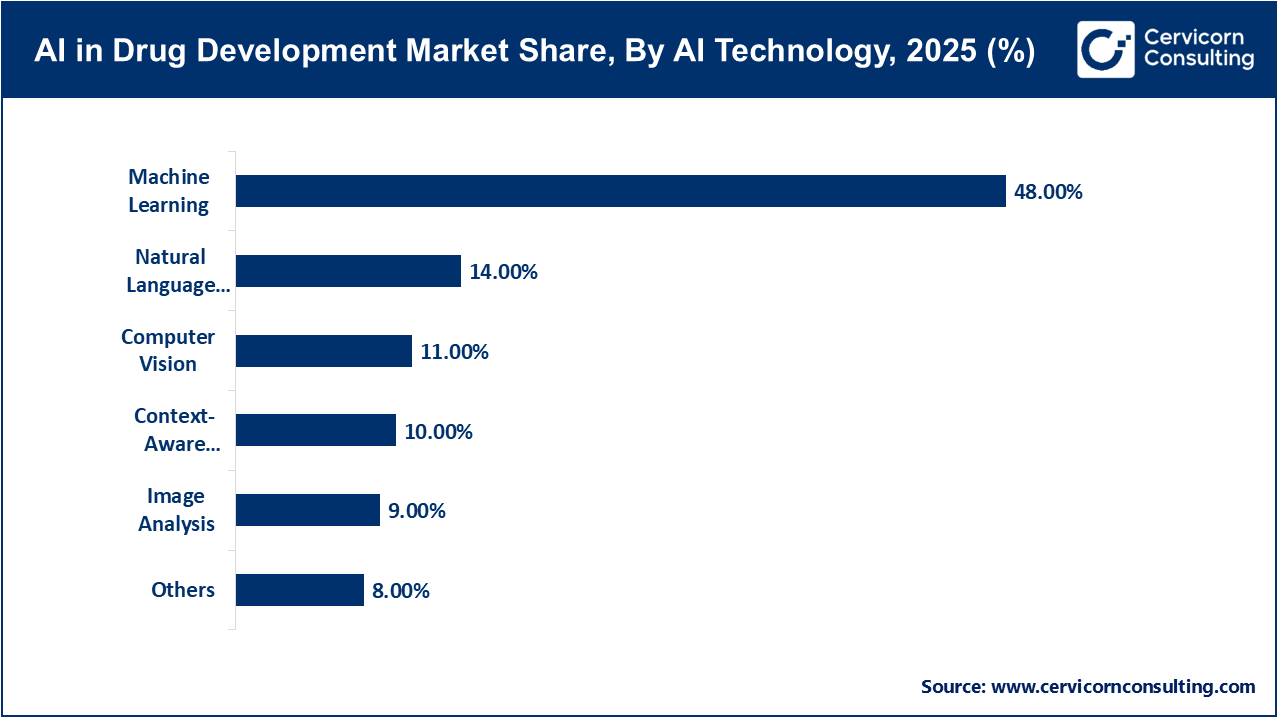
Natural Language Processing (NLP) is the fastest-growing technology in the market, thanks to its ability to extract actionable insights from large volumes of unstructured data, including scientific literature, clinical trial notes, and electronic health records. Advanced NLP systems can analyse and synthesize millions of data points to aid in hypothesis generation and knowledge discovery. The ability to transform unstructured text into useful evidence is positioning NLP as a vital component of modern pharmaceutical intelligence.
Drug optimization and repurposing currently hold the largest market share because they offer a lower-risk entry point for AI, as companies find new uses for existing drugs or optimize previously known compounds. This approach provides immediate ROI and is widely adopted by both Big Pharma and startup biotech firms aiming to maximize value from their current asset libraries.
AI in Drug Development Market Share, By Application, 2025 (%)
| Application | Revenue Share, 2025 (%) |
| Drug optimization and repurposing | 38% |
| Understanding Disease | 22% |
| Safety & Toxicity | 16% |
| Preclinical testing | 14% |
| Others | 10% |
Preclinical research is the fastest-growing sector in the industry, driven by increased use of AI as a substitute for traditional animal testing and for powering computer simulations of human physiology. With rising costs and ethical concerns surrounding animal research, AI-driven "In Silico" preclinical models are becoming the preferred method for assessing safety and efficacy in early-stage studies and reducing time-to-clinical trials.
Pharmaceutical & Biotechnology Companies are the predominant end users in the industry, as they possess substantial capital and proprietary data access to scale AI implementation. Modern "Big Pharma" companies have begun partnering with data firms, where integrating AI is a survival strategy to augment the use of "patent data" or address declining R&D productivity. They maintain their dominance through aggressive Merger and Acquisition (M&A) activities and multi-billion dollar "AI-first" relationships.
AI in Drug Development Market Share, By End-user, 2025 (%)
| End-user | Revenue Share, 2025 (%) |
| Pharmaceutical & Biotechnology Companies | 60% |
| Contract Research Organizations (CROs) | 18% |
| Academic & Research Institutes | 15% |
| Others | 7% |
Academic & Research Institutions are the fastest-growing end users, driven by the increasing availability of open-source AI and government funding for basic research. Academic medical institutions are typically the leading source of novel AI algorithms and actively support collaborations with industry to translate academic innovations into commercial drug candidates and foster a vibrant innovation ecosystem.
By Process
By Therapeutic Area
By AI Technology
By Application
By End-user
By Region
Chapter 1. Market Introduction and Overview
1.1 Market Definition and Scope
1.1.1 Overview of AI in Drug Development
1.1.2 Scope of the Study
1.1.3 Research Timeframe
1.2 Research Methodology and Approach
1.2.1 Methodology Overview
1.2.2 Data Sources and Validation
1.2.3 Key Assumptions and Limitations
Chapter 2. Executive Summary
2.1 Market Highlights and Snapshot
2.2 Key Insights by Segments
2.2.1 By Process Overview
2.2.2 By AI Technology Overview
2.2.3 By Therapeutic Area Overview
2.2.4 By End User Overview
2.2.5 By Application Overview
2.3 Competitive Overview
Chapter 3. Global Impact Analysis
3.1 Russia-Ukraine Conflict: Global Market Implications
3.2 Regulatory and Policy Changes Impacting Global Markets
Chapter 4. Market Dynamics and Trends
4.1 Market Dynamics
4.1.1 Market Drivers
4.1.2 Market Restraints
4.1.3 Market Opportunities
4.1.4 Market Challenges
4.2 Market Trends
Chapter 5. Premium Insights and Analysis
5.1 Global AI in Drug Development Market Dynamics, Impact Analysis
5.2 Porter’s Five Forces Analysis
5.2.1 Bargaining Power of Suppliers
5.2.2 Bargaining Power of Buyers
5.2.3 Threat of Substitute Products
5.2.4 Rivalry among Existing Firms
5.2.5 Threat of New Entrants
5.3 PESTEL Analysis
5.4 Value Chain Analysis
5.5 Product Pricing Analysis
5.6 Vendor Landscape
5.6.1 List of Buyers
5.6.2 List of Suppliers
Chapter 6. AI in Drug Development Market, By Process
6.1 Global AI in Drug Development Market Snapshot, By Process
6.1.1 Market Revenue (($Billion) and Growth Rate (%), 2022-2035
6.1.1.1 HIT-TO-LEAD Identification
6.1.1.2 Target Identification & Selection
6.1.1.3 Lead Optimization
6.1.1.4 Target Validation
6.1.1.5 HIT Identification & Prioritization
6.1.1.6 Candidate Selection & Validation
Chapter 7. AI in Drug Development Market, By AI Technology
7.1 Global AI in Drug Development Market Snapshot, By AI Technology
7.1.1 Market Revenue (($Billion) and Growth Rate (%), 2022-2035
7.1.1.1 Machine Learning
7.1.1.2 Natural Language Processing
7.1.1.3 Computer Vision
7.1.1.4 Context-Aware Processing & Computing
7.1.1.5 Image Analysis
7.1.1.6 Others
Chapter 8. AI in Drug Development Market, By Therapeutic Area
8.1 Global AI in Drug Development Market Snapshot, By Therapeutic Area
8.1.1 Market Revenue (($Billion) and Growth Rate (%), 2022-2035
8.1.1.1 Oncology
8.1.1.2 Infectious Diseases
8.1.1.3 Neurology
8.1.1.4 Metabolic Disease
8.1.1.5 Cardiovascular Diseases
8.1.1.6 Immunology
8.1.1.7 Mental Health Disorders
8.1.1.8 Others
Chapter 9. AI in Drug Development Market, By End User
9.1 Global AI in Drug Development Market Snapshot, By Energy Capacity
9.1.1 Market Revenue (($Billion) and Growth Rate (%), 2022-2035
9.1.1.1 Pharmaceutical & BioAI Technology Companies
9.1.1.2 Contract Research Organizations (CROs)
9.1.1.3 Academic & Research Institutes
9.1.1.4 Others
Chapter 10. AI in Drug Development Market, By Application
10.1 Global AI in Drug Development Market Snapshot, By Application
10.1.1 Market Revenue (($Billion) and Growth Rate (%), 2022-2035
10.1.1.1 Drug Optimization and Repurposing
10.1.1.2 Understanding Disease
10.1.1.3 Safety & Toxicity
10.1.1.4 Preclinical Testing
10.1.1.5 Others
Chapter 11. AI in Drug Development Market, By Region
11.1 Overview
11.2 AI in Drug Development Market Revenue Share, By Region 2024 (%)
11.3 Global AI in Drug Development Market, By Region
11.3.1 Market Size and Forecast
11.4 North America
11.4.1 North America AI in Drug Development Market Revenue, 2022-2035 ($Billion)
11.4.2 Market Size and Forecast
11.4.3 North America AI in Drug Development Market, By Country
11.4.4 U.S.
11.4.4.1 U.S. AI in Drug Development Market Revenue, 2022-2035 ($Billion)
11.4.4.2 Market Size and Forecast
11.4.4.3 U.S. Market Segmental Analysis
11.4.5 Canada
11.4.5.1 Canada AI in Drug Development Market Revenue, 2022-2035 ($Billion)
11.4.5.2 Market Size and Forecast
11.4.5.3 Canada Market Segmental Analysis
11.4.6 Mexico
11.4.6.1 Mexico AI in Drug Development Market Revenue, 2022-2035 ($Billion)
11.4.6.2 Market Size and Forecast
11.4.6.3 Mexico Market Segmental Analysis
11.5 Europe
11.5.1 Europe AI in Drug Development Market Revenue, 2022-2035 ($Billion)
11.5.2 Market Size and Forecast
11.5.3 Europe AI in Drug Development Market, By Country
11.5.4 UK
11.5.4.1 UK AI in Drug Development Market Revenue, 2022-2035 ($Billion)
11.5.4.2 Market Size and Forecast
11.5.4.3 UK Market Segmental Analysis
11.5.5 France
11.5.5.1 France AI in Drug Development Market Revenue, 2022-2035 ($Billion)
11.5.5.2 Market Size and Forecast
11.5.5.3 France Market Segmental Analysis
11.5.6 Germany
11.5.6.1 Germany AI in Drug Development Market Revenue, 2022-2035 ($Billion)
11.5.6.2 Market Size and Forecast
11.5.6.3 Germany Market Segmental Analysis
11.5.7 Rest of Europe
11.5.7.1 Rest of Europe AI in Drug Development Market Revenue, 2022-2035 ($Billion)
11.5.7.2 Market Size and Forecast
11.5.7.3 Rest of Europe Market Segmental Analysis
11.6 Asia Pacific
11.6.1 Asia Pacific AI in Drug Development Market Revenue, 2022-2035 ($Billion)
11.6.2 Market Size and Forecast
11.6.3 Asia Pacific AI in Drug Development Market, By Country
11.6.4 China
11.6.4.1 China AI in Drug Development Market Revenue, 2022-2035 ($Billion)
11.6.4.2 Market Size and Forecast
11.6.4.3 China Market Segmental Analysis
11.6.5 Japan
11.6.5.1 Japan AI in Drug Development Market Revenue, 2022-2035 ($Billion)
11.6.5.2 Market Size and Forecast
11.6.5.3 Japan Market Segmental Analysis
11.6.6 India
11.6.6.1 India AI in Drug Development Market Revenue, 2022-2035 ($Billion)
11.6.6.2 Market Size and Forecast
11.6.6.3 India Market Segmental Analysis
11.6.7 Australia
11.6.7.1 Australia AI in Drug Development Market Revenue, 2022-2035 ($Billion)
11.6.7.2 Market Size and Forecast
11.6.7.3 Australia Market Segmental Analysis
11.6.8 Rest of Asia Pacific
11.6.8.1 Rest of Asia Pacific AI in Drug Development Market Revenue, 2022-2035 ($Billion)
11.6.8.2 Market Size and Forecast
11.6.8.3 Rest of Asia Pacific Market Segmental Analysis
11.7 LAMEA
11.7.1 LAMEA AI in Drug Development Market Revenue, 2022-2035 ($Billion)
11.7.2 Market Size and Forecast
11.7.3 LAMEA AI in Drug Development Market, By Country
11.7.4 GCC
11.7.4.1 GCC AI in Drug Development Market Revenue, 2022-2035 ($Billion)
11.7.4.2 Market Size and Forecast
11.7.4.3 GCC Market Segmental Analysis
11.7.5 Africa
11.7.5.1 Africa AI in Drug Development Market Revenue, 2022-2035 ($Billion)
11.7.5.2 Market Size and Forecast
11.7.5.3 Africa Market Segmental Analysis
11.7.6 Brazil
11.7.6.1 Brazil AI in Drug Development Market Revenue, 2022-2035 ($Billion)
11.7.6.2 Market Size and Forecast
11.7.6.3 Brazil Market Segmental Analysis
11.7.7 Rest of LAMEA
11.7.7.1 Rest of LAMEA AI in Drug Development Market Revenue, 2022-2035 ($Billion)
11.7.7.2 Market Size and Forecast
11.7.7.3 Rest of LAMEA Market Segmental Analysis
Chapter 12. Competitive Landscape
12.1 Competitor Strategic Analysis
12.1.1 Top Player Positioning/Market Share Analysis
12.1.2 Top Winning Strategies, By Company, 2022-2024
12.1.3 Competitive Analysis By Revenue, 2022-2024
12.2 Recent Developments by the Market Contributors (2024)
Chapter 13. Company Profiles
13.1 Insilico Medicine
13.1.1 Company Snapshot
13.1.2 Company and Business Overview
13.1.3 Financial KPIs
13.1.4 Product/Service Portfolio
13.1.5 Strategic Growth
13.1.6 Global Footprints
13.1.7 Recent Development
13.1.8 SWOT Analysis
13.2 Exscientia
13.3 Atomwise
13.4 Schrödinger
13.5 Recursion Pharmaceuticals
13.6 BenevolentAI
13.7 Deep Genomics
13.8 Insitro
13.9 Relay Therapeutics
13.10 XtalPi
13.11 Owkin
13.12 Cyclica
13.13 AbCellera Biologics
13.14 Nimbus Therapeutics
13.15 Gero