Steel Decarbonization Market Size and Growth 2026 to 2035
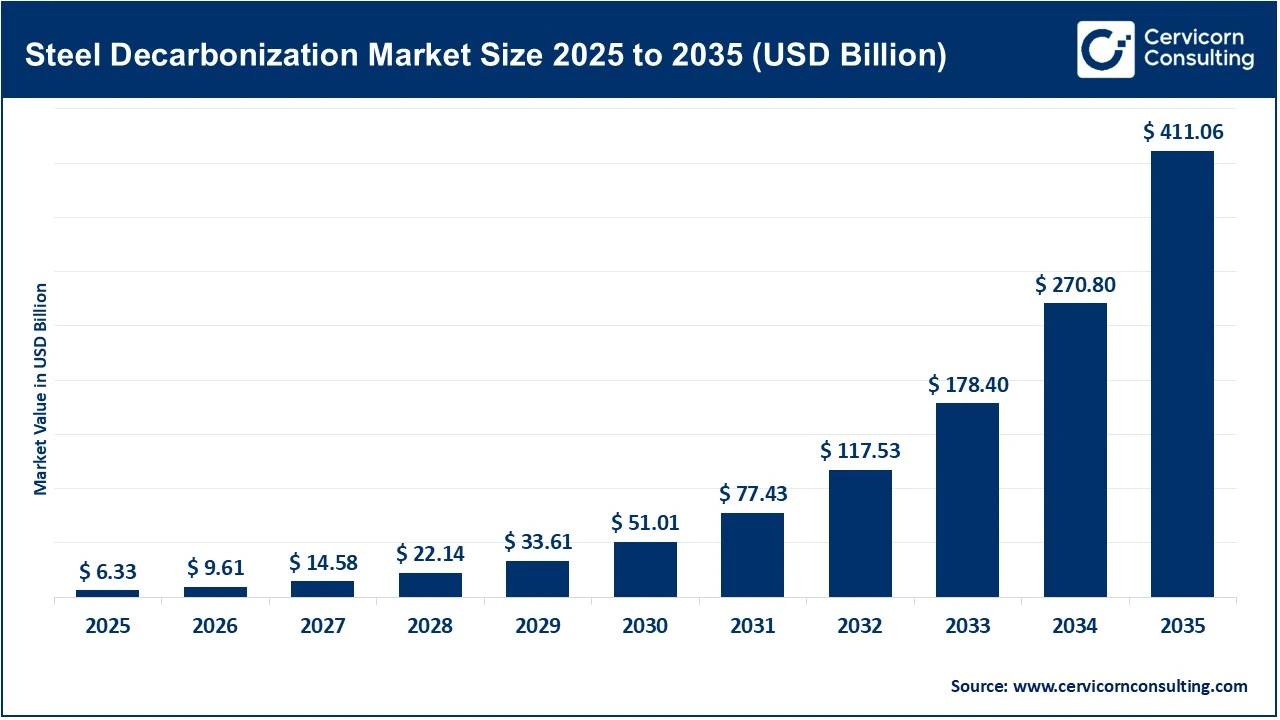
The global steel decarbonization market size was valued at USD 6.33 billion in 2025 and is expected to be worth around USD 411.06 billion by 2035, exhibiting a compound annual growth rate (CAGR) of 51.88% over the forecast period from 2026 to 2035. The primary driver of the steel decarbonisation market is the shift from voluntary corporate social sustainability initiatives to mandatory regulatory frameworks with carbon pricing mechanisms. For instance, the European Union Carbon Border Adjustment Mechanism (CBAM) is a landmark policy that effectively imposes a price on carbon embedded in imported goods into the EU, including high-carbon steel. During its implementation phase, the cost of importing high-carbon steel into the EU is expected to increase by 20% to 30% by 2030. As a result, global steel producers aiming to maintain access to this market are increasingly compelled to adopt low-carbon production technologies. Moreover, internal carbon pricing within Emissions Trading Systems (ETS) has reached critical levels in major markets, such as the EU, where prices are currently in the range of USD 90 to USD 110 per ton.
Another important growth factor is rising demand from downstream industries, especially in the automotive and construction sectors. Leading manufacturers such as Volvo and Mercedes-Benz have committed to long-term supply agreements, regardless of the cost of fossil-free steel, with a 20% to 25% "green premium" over conventional steel prices to secure early supply. Furthermore, government procurement policies such as "Buy Clean" are strongly driving demand, especially in the United States and Europe, and require the use of low-carbon materials in public infrastructure projects. These measures not only stimulate demand but also provide a guaranteed floor for the market for green steel producers.
Report Highlights
- By Region, Asia Pacific leads the regional segment, capturing around 50% of the global steel decarbonization market share, driven by large-scale steel production, strong policy mandates, and ongoing modernization of existing blast furnace infrastructure.
- By product type, the flat steel dominates the market, accounting for 45% share of the market, as it is widely used across automotive, construction, and industrial applications requiring large-volume steel consumption.
- By product type, the specialty steel is the fastest-growing segment with a share at 10%, driven by increasing demand for high-performance and low-carbon materials in advanced applications.
- By steel type, the carbon steel dominates the market with 70% share, supported by its extensive usage across infrastructure, manufacturing, and heavy industries.
- By energy source, the coal with CCUS segment is leading the market, holding at 40% share, as it allows existing steel plants to reduce emissions without complete infrastructure replacement.
- By energy source, the hydrogen is the fastest-growing segment with a share of 15%, driven by its potential to enable near-zero emission steel production.
- By technology, the electric arc furnace (EAF) dominates the market, capturing at 40% share, due to its lower emissions, higher efficiency, and increasing reliance on recycled scrap steel.
- By application, the construction leads the market, accounting for 45% share, driven by continuous infrastructure development and urbanization across emerging economies.
- By application, the energy is the fastest-growing segment with a share of about 10%, fueled by rising investments in renewable energy infrastructure such as wind, solar, and hydrogen projects.
Advancing the Circular Economy by Improving Scrap Recycling in the Steel Decarbonization Sector
Rapid expansion of the circular economy through advanced scrap recycling is a growing trend in the steel decarbonisation market. The concept of "scrap-first" is increasingly central to the steel industry's circular economy strategy. Recycling steel uses approximately one-eighth (1/8) of the energy required to produce steel from iron ore, making it the most immediate route to reducing carbon emissions. However, maintaining the quality of recycled steel remains a critical challenge. To address this, the industry is adopting advanced technologies, including artificial intelligence and sensor-based sorting and melting processes, to effectively remove metals such as copper and tin from scrap.
By 2026, the global trade in high-quality steel is expected to be as strategically important to world markets as the trade in iron ore. In response to rising demand, major economies such as China and EU members are restricting scrap exports to ensure sufficient domestic supply for Electric Arc Furnace (EAF) operations. Furthermore, improvements in scrap collection and sorting efficiency will reduce the steel industry's total energy consumption by an additional 10% by 2030. This reinforces the critical role of the circular economy in industrial decarbonisation.
Statistical Overview of Technical Performance Developments in the Steel Decarbonization Market
Technical performance in the steel decarbonization market is advancing rapidly, driven by the need to reduce carbon emissions while maintaining production efficiency
- Direct Electrolysis of Iron Ore: Technologies such as Molten Oxide Electrolysis (MOE) enable the direct production of liquid iron from ore using electricity, eliminating the need for intermediate processes like Direct Reduced Iron (DRI) and Electric Arc Furnaces (EAF).
- Hydrogen Injection into Blast Furnaces: Recent testing has shown that integrating hydrogen into conventional blast furnace operations can reduce CO2 emissions by up to 20%. This capability offers a unique pathway for younger assets that cannot be retired immediately.
- Carbon Capture, Utilization and Storage (CCUS): Recent advances in solvent-based capture methods have increased carbon capture rates to over 90% in real-world industrial settings. Furthermore, with these technologies, the cost of carbon capture is expected to fall by approximately 15% by 2027, enhancing their economic feasibility for widespread adoption.
What is the Steel Decarbonization Market, and how is it growing?
The steel decarbonization market encompasses the global steel industry’s transition to low-carbon, near-zero-emission production by replacing traditional coal-based methods with cleaner technologies, such as hydrogen-based reduction, electric arc furnaces (EAF), and carbon capture solutions. Steel production is one of the largest industrial sources of CO₂ emissions, contributing nearly 7–9% of global emissions, making decarbonization a critical priority for governments, manufacturers, and investors. This market spans a wide range of solutions, from retrofitting existing blast furnaces with CCUS technologies to building entirely new green steel plants powered by renewable energy and hydrogen.
The market is growing steadily, driven by regulatory pressure, technological innovation, and shifting demand patterns. Governments across regions are introducing carbon pricing mechanisms, emission targets, and incentive programs that are forcing steel producers to rethink conventional production models. At the same time, industries such as construction, automotive, and energy are increasingly demanding low-carbon steel to meet their own sustainability commitments, creating a strong downstream pull.
Top 5 Trends and Technologies
- Hydrogen-Based DRI Adoption: Enables up to 95% emissions reduction by replacing coal with green hydrogen in ironmaking.
- CCUS Integration in Steel Plants: Captures nearly 1.5–2 tons of CO₂ per ton of steel, thereby extending the life of existing assets.
- EAF with Scrap Utilization: Uses over 70% recycled scrap, significantly lowering raw material and energy intensity.
- Green Hydrogen Cost Decline: Electrolyser costs have already dropped by 60% since 2010, accelerating adoption of steel decarbonisation.
- AI & Digital Process Optimization: Reduces energy consumption by 10–15% per plant through real-time monitoring and predictive control.
Steel Decarbonization Market: Global Shift Toward Low-Carbon Steel Production
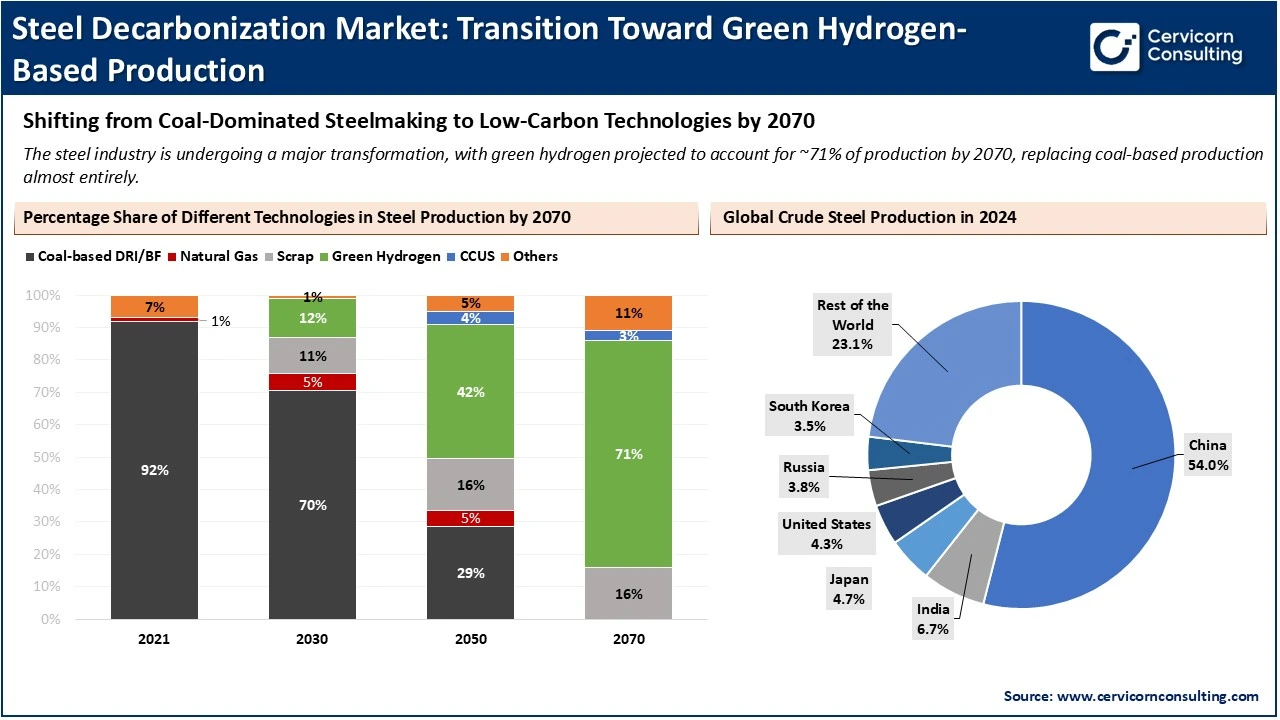
The image illustrates the long-term transformation of the global steel industry, showing a sharp decline in coal-based production from 92% in 2021 to near elimination by 2070, while green hydrogen emerges as the dominant technology with a 71% share. It also presents the current global steel production landscape in 2024, with China leading with approximately 54% share, followed by India, Japan, and the United States, highlighting both the need and the regional responsibilities for decarbonization efforts.
Report Scope
| Area of Focus |
Details |
| Market Size in 2026 |
USD 9.61 Billion |
| Market Size in 2035 |
USD 411.06 Billion |
| CAGR 2026 to 2035 |
51.88% |
| Dominant Region |
Asia-Pacific |
| Key Segments |
Product Type, Steel Type, Energy Source, Technology, Application, Region |
| Key Companies |
ArcelorMittal, Nucor Corporation, POSCO, Thyssenkrupp Steel Europe, SSAB, Tata Steel, JSW Steel, H2 Green Steel, Boston Metal, Liberty Steel Group, China Baowu Steel Group, Nippon Steel Corporation |
Recent Major Milestones
1. Global Corporate Initiative for Net-Zero Steelmakings
Corporate initiatives to achieve net-zero production are a major growth driver for the steel decarbonisation market. A significant milestone occurred in 2024, when H2 Green Steel closed a USD 6.5 billion multi-source financing package for its plant in Boden, Sweden. This is the largest private placement for a green industrial project in Europe, signalling strong confidence from financial markets in large-scale zero-carbon steel production. This development marks a critical transition for green steel from a proof-of-concept phase to commercial viability.
2. Subsidy Frameworks Supporting Industrial Decarbonization
Government subsidy frameworks supporting industrial decarbonisation play a significant role in the steel decarbonisation market. From 2024 to 2025, several European governments have announced major subsidy frameworks, including the German government's USD 2.6 billion grant to Thyssenkrupp for "tkH2steel". The goal of these subsidies is to address the "funding gap" between traditional and green production methods while ensuring that domestic industries remain competitive and aligned with climate targets. Such policy frameworks are essential for enabling the deployment of first-of-a-kind technologies, particularly in capital-intensive sectors like steel manufacturing.
3. Deployment of Large-Scale Hydrogen-Based Direct Reduced Iron (DRI) Facilities
The advancement of Hydrogen-Based Direct Reduced Iron (DRI) technology marks a transformative milestone in the steel decarbonisation market. In 2025, SSAB made the first commercial delivery of fossil-free steel to customers such as Volvo, marking a significant milestone for the H2-DRI-EAF value chain. It demonstrates that high-quality steel can be produced without coking coal while meeting the stringent safety and performance requirements of industries such as the automotive industry. Moreover, this achievement sets a global benchmark, encouraging other steel producers to accelerate their transition to hydrogen-based production technologies.
4. Implementation of Industrial Carbon Capture and Storage (CCUS) Hubs
The implementation of Carbon Capture, Utilization, and Storage (CCUS) infrastructure is another key milestone in the steel decarbonisation market. A particularly significant development is the planned expansion of China’s national carbon market to include the steel sector between 2025 and 2026. This policy effectively introduces carbon pricing across a substantial portion of the global market. As a result, steel producers are increasingly incentivised to phase out inefficient blast-furnace operations and adopt cleaner technologies. Additionally, the establishment of industrial CCUS hubs, which allow multiple plants to share infrastructure for transporting and storing captured CO2, is underway.
Steel Decarbonization Market Regional Analysis
The steel decarbonization market is segmented by region into North America, Europe, Asia-Pacific, and LAMEA. Here is a brief overview of each region:
Asia-Pacific Steel Decarbonization Market: Driven by Leading Policy Mandates and Industrial Modernization
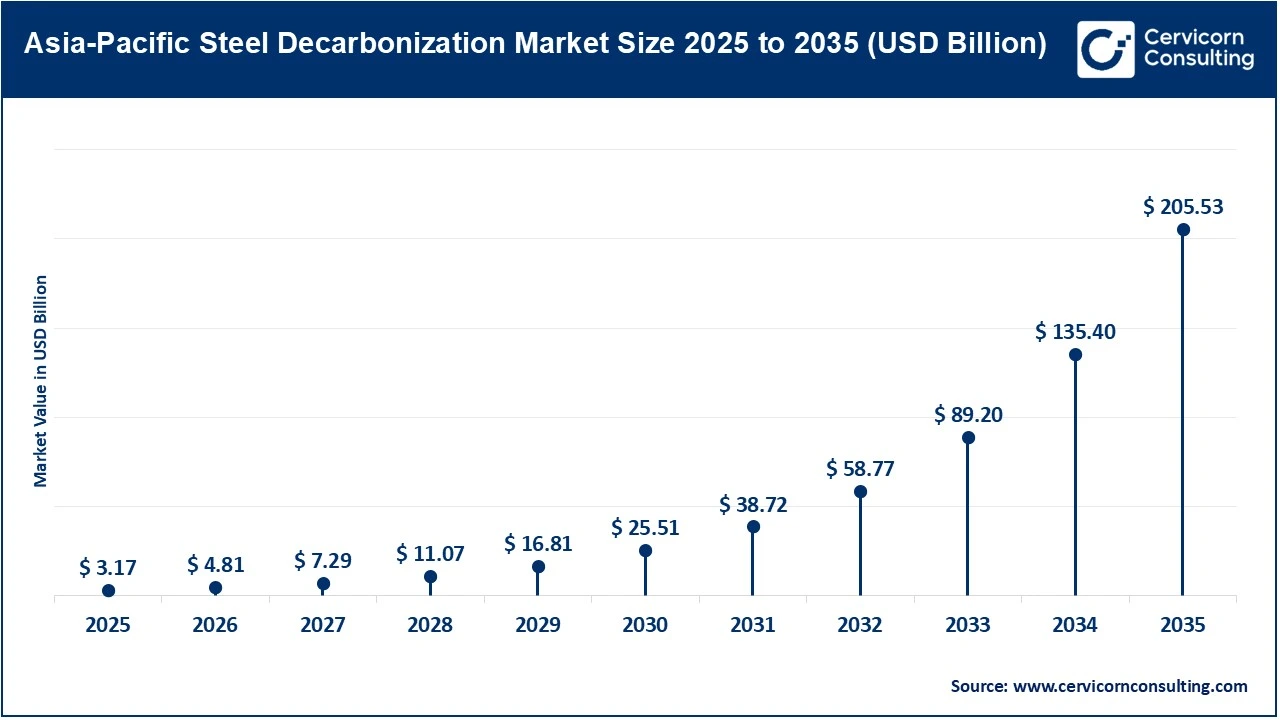
The Asia-Pacific steel decarbonization market size was valued at USD 3.17 billion in 2025 and is expected to hit around USD 205.53 billion by 2035.
Asia Pacific, led by China and India, holds a dominant position in the steel decarbonization market, driven by ambitious government policies and large-scale industrial modernization. China’s “Dual Carbon” targets aim to peak carbon emissions by 2030 and have initiated over USD 150 billion in planned technological upgrades, while India is focused on utilizing its newly launched National Green Hydrogen Mission to reduce its reliance on imported coking coal. By early 2026, local players will work to decarbonize existing assets while maintaining the scale required for their vast domestic infrastructure projects.
China is Lead to Global Green Steel Production on a large scale
China's growing shift toward green manufacturing is the most significant factor in global industry emissions.
- China has a crude steel capacity of 1.03 billion metric tons, with a stated goal of transitioning 30% to EAF or hydrogen-based routes by 2035.
- China has the world’s largest steel-CCUS pilot project underway, aiming to capture 500,000 tons of CO2 annually.
- Industry leaders such as Baowu Steel are experimenting with blending up to 35% hydrogen into existing blast furnaces as a viable pathway to reduce emissions in the short term.
India to Decarbonize Steel Sector by Hydrogen-Compatible Infrastructure
India, the world’s second-largest steel producer, aims to expand its capacity to over 300 million tons by 2030 while advancing its net-zero commitments.
- The Indian Government has budgeted USD 2.4 billion for its National Green Hydrogen Mission (NGHM) to support subsidies for domestic electrolysis and storage infrastructure.
- India is converting its coal-based DRI plants to natural gas as an intermediate step towards a transition to 100% hydrogen.
- The Steel Scrap Recycling Policy will drive EAFs to use up to 50% scrap-based feedstock by 2030 to mitigate primary ore production.
Japan Innovates Change through Advanced Hydrogen Injection Technologies
Japan is advancing its "COURSE50" and "Super COURSE50" initiatives to reduce blast furnace emissions by injecting hydrogen at high temperatures.
- Japanese mills are leading in injecting hydrogen to replace coke in traditional furnaces, aiming for a 30% reduction in CO2 per ton of steel without full furnace reconstruction.
- Japan is making significant investments in offshore wind to support local hydrogen generation for its coastal steel plants.
- Japan is taking the lead in the G7 to agree on definitions of "Green Steel" to avoid market fragmentation.
North America Steel Decarbonization Market: Driven by Incentive-Led Growth and Sustainable Demand
The North America steel decarbonization market size was estimated at USD 1.08 billion in 2025 and is projected to garner around USD 69.88 billion by 2035. North America is largely driven by government incentives and increasing demand for sustainable materials. The Inflation Reduction Act (IRA) in the United States plays a central role, particularly through the 45V tax credit, which offers up to USD 3 per kilogram for clean hydrogen production. This has significantly improved the commercial viability of hydrogen-based Direct Reduced Iron (DRI) processes. In addition, federal "Buy Clean" procurement policies require that government-funded infrastructure use low-carbon steel. These initiatives have created a strong and reliable demand base, leading to rapid capacity expansion. Between 2024 and 2026, the region is expected to see approximately 25% growth in Electric Arc Furnace (EAF) capacity, reinforcing its transition toward cleaner steelmaking methods.
The USA is increasing the demand for Low-Carbon Steel through the Inflation Reduction Act
The United States, supported by a massive federal subsidy framework, is positioning itself as a leader in the low-carbon steel market.
- Nearly 70% of U.S. steel is already produced in EAFs, which have a carbon footprint 75% lower than the global average.
- The IRA will make green hydrogen competitive with fossil fuels by 2027.
- The "Buy Clean" program will direct billions of federal dollars towards low-carbon-intensity steel with trusted Environmental Product Declarations (EPDs).
Canada is Leverage Abundant Hydro-Electric Energy for Sustainable Steelmaking
Canada is well-positioned to leverage its abundant hydroelectric resources to support the transition to a new generation of low-carbon EAF and DRI steel production facilities.
- Canada's largest steel producers are receiving federal support to transition from coal-fuelled steelmaking to EAFs and aim to achieve a 60% emissions reduction by 2028.
- More than 80% of Canada's grid is already powered by non-emitting energy sources, providing a significant "green premium" on steel made via EAFs in the North American market.
- Canada has implemented a federal carbon tax that provides a clear economic price signal, facilitating rapid technology adoption.
Europe Steel Decarbonization Market: Driven by Regulatory Pressure and First-Mover Advantage
The Europe steel decarbonization market size was reached at USD 1.39 billion in 2025 and is forecasted to hit around USD 90.43 billion by 2035. Europe continues to act as a global, well-established hub for steel decarbonization, driven by stringent environmental regulations and carbon pricing mechanisms. The gradual phase-out of free allowances under the EU Emissions Trading System (ETS), combined with the implementation of the Carbon Border Adjustment Mechanism (CBAM), is significantly increasing the cost of producing conventional steel. With carbon prices expected to exceed USD 100 per ton, traditional blast furnace operations are becoming economically unviable. This regulatory pressure has accelerated investment in next-generation technologies, particularly hydrogen-based steelmaking projects across the Nordics and Germany. By 2026, the European market is expected to begin some of the world's first commercial-scale deliveries of "Green Steel" under multi-billion-euro Climate Protection Contracts for Difference (CCfDs).
UK to Pioneer Net-Zero Clusters and Industrial Decarbonization
The U.K. is adopting a cluster-based approach to steel production by integrating it with regional carbon-storage and hydrogen-distribution networks to support low-carbon manufacturing.
- Tata Steel UK and British Steel have announced a transition plan to replace EAFs with blast furnaces, supported by UK Government grants totalling more than £500 million.
- The U.K. is committed to a fully decarbonised power grid by 2035, which is key to making EAF-based heavy industry feasible.
- The East Coast and South Wales clusters are beginning to link steel plants to North Sea carbon storage and distribution sites.
Germany to Set the Standard for Low-CO2 Green Automotive Steel
Germany is focusing on high-value green steel to service its premium automotive sector.
- This flagship project aims to replace all blast furnaces with DRI-EAF pathways by 2033.
- BM, Mercedes-Benz, and VW have already signed multi-year supply contracts for green steel to meet their 2030 sustainability goals.
- The German government is using Carbon Contracts for Difference to fund the operational cost difference between introducing green steel and grey steel for early adopters.
Steel Decarbonization Market Share, By Region, 2025 (%)
| Region |
Revenue Share, 2025 (%) |
| Asia Pacific |
50% |
| Europe |
22% |
| North America |
17% |
| LAMEA |
11% |
LAMEA Steel Decarbonization Market: Driven by Resource Advantage and Emerging Export Hubs
The LAMEA steel decarbonization market was valued at USD 0.70 billion in 2025 and is anticipated to reach around USD 45.22 billion by 2035. The LAMEA region is leveraging its natural resources to position itself as a major player in "Green Iron". Countries such as Brazil and the UAE benefit from abundant high-grade iron ore and access to low-cost renewable energy, including solar, hydro, and biomass. Rather than simply exporting raw DRI and pig iron to countries with high carbon costs, these countries are increasingly moving up the value chain by producing low-carbon DRI or pig iron for export.
United Arab Emirates to Accelerate Decarbonization via Solar-Powered Hydrogen
- The UAE is advancing steel decarbonization by scaling up commercial production, leveraging its vast solar energy potential to support low-carbon steel manufacturing.
- The company is partnering with Masdar to pilot the region's first green hydrogen steel, produced from 100% solar.
- The UAE is working to become a supplier to the European market by utilizing its port locations to avoid CBAM tariffs, earned by low-carbon certified processes.
Brazil to Capture High-Quality Iron Ore and Bio-Energy
Brazil is well-positioned to secure a first-mover advantage in the green pig iron market by leveraging its high-grade iron ore and abundant sustainable biomass.
- Brazilian producers are world leaders in using charcoal from sustainably managed forests, and therefore, these forests can also be considered carbon sinks.
- Brazil's iron ore is among the highest quality globally in terms of purity, which is essential for the efficient operation of DRI-EAF processes.
- The country is developing green hydrogen hubs in the Northeast to produce "Green HBI" (Hot Briquetted Iron) for export to Europe.
Steel Decarbonization Market Segmental Analysis
The steel decarbonization market is segmented into product type, steel type, energy source, technology, application, and region.
Product Type Analysis
Flat steel is the dominant product segment in the market, largely because it is the primary material used across the automotive, appliance, and heavy machinery industries. These sectors were among the earliest to adopt net-zero targets, significantly driving demand for low-carbon flat steel. Additionally, flat steel is essential for manufacturing automotive components and structural elements used in renewable energy infrastructure, such as wind turbines.
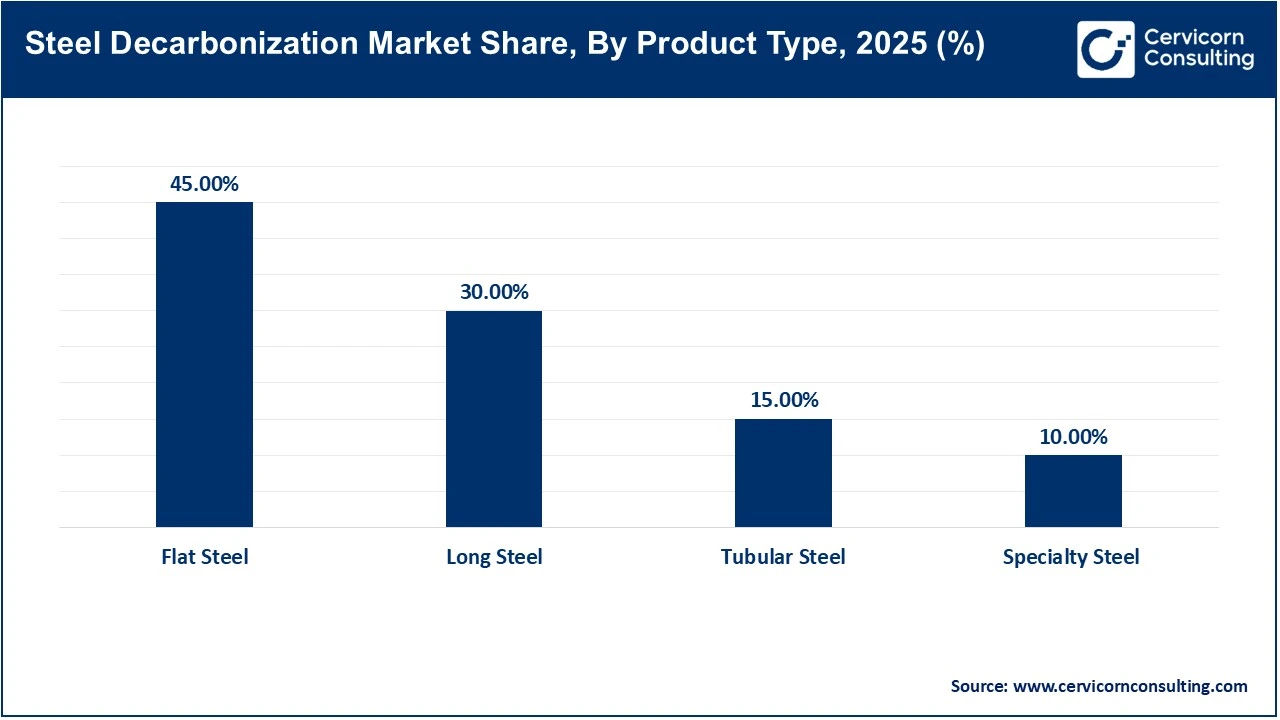
Specialty steel is the fastest-growing segment in the market, primarily due to high demand for high-performance materials across aerospace, defence, and hydrogen economy applications. These applications require steels capable of withstanding extreme heat, pressure, and corrosion, qualities necessary for hydrogen storage tanks and high-performance turbine components. The growing adoption of high-strength, low-alloy (HSLA) steels for lighter electric vehicles is also driving specialty steel growth above the overall segment growth rate.
Steel Type Analysis
Carbon steel is the dominant steel type in the market, largely because it underpins global infrastructure development, including applications in buildings, bridges, and pipelines. Its cost-effectiveness and large-scale production make it the most widely used steel type worldwide. Despite the availability of advanced materials, rapid urbanisation continues to sustain strong demand for carbon steel, making it a primary focus for large-scale decarbonisation initiatives.
Steel Decarbonization Market Share, By Steel Type, 2025 (%)
| Steel Type |
Revenue Share, 2025 (%) |
| Carbon Steel |
70% |
| Stainless Steel |
20% |
| Alloy Steel |
10% |
Stainless steel is the fastest-growing segment of the market because of its durability, corrosion resistance, and full recyclability, which align with circular economy principles. As industries shift towards sustainable, long-term materials, demand for stainless steel will increase dramatically, particularly in water treatment, renewable energy infrastructure, and high-end consumer products.
Energy Source Analysis
Coal with CCUS is the dominant energy source in the market, largely due to the large number of existing blast furnace assets, especially in Asia, that cannot be economically replaced in the short term. CCUS technology enables producers to retrofit these factories and reduce emissions by as much as 90%, despite the billions of dollars already invested in sunk capital. As a result, it serves as a critical transitional or "bridge" technology of choice for the current decade.
Steel Decarbonization Market Share, By Energy Source, 2025 (%)
| Energy Source |
Revenue Share, 2025 (%) |
| Coal with CCUS |
40% |
| Natural Gas |
25% |
| Renewable Energy |
20% |
| Hydrogen |
15% |
Hydrogen is the fastest-growing energy source in the market, as it is the only pathway to near-zero emissions in steel production. Green hydrogen production costs are projected to dip below USD 2/kg by 2027, and the pipeline of hydrogen-based steel projects has increased by more than 300% over the past two years. Additionally, hydrogen provides a solution to decarbonising the primary ironmaking process and will attract the highest levels of investment in new capacity.
Technology Analysis
Electric Arc Furnace (EAF) technology holds a dominant position in the market because it's flexible, has lower emissions, and is compatible with renewable energy sources. EAFs are widely used for recycling scrap steel and can be efficiently integrated with a Direct Reduced Iron (DRI) module. Furthermore, their significantly lower capital intensity requirements than traditional blast furnaces make them more attractive for expanding brownfield operations or developing greenfield projects.
Steel Decarbonization Market Share, By Technology, 2025 (%)
| Technology |
Revenue Share, 2025 (%) |
| Electric Arc Furnace (EAF) |
40% |
| BF-BOF with CCUS |
30% |
| Hydrogen-Based DRI |
20% |
| Other Technologies |
10% |
Hydrogen-based Direct Reduced Iron (DRI) is the fastest-growing technology in the market, mainly because it completely removes the need for coking coal in the iron ore reduction process. Although EAFs may produce the lowest-carbon-intensity steel during secondary production, significant investments in facilities such as H2 Green Steel and various "Hybrid" initiatives are advancing hydrogen-based DRI as the future of primary steelmaking. Additionally, continuous advancements in process efficiency, along with strong R&D and venture capital support, further contribute to its rapid growth.
Application Analysis
The construction sector is the dominant application segment in the market because it’s the largest consumer of steel globally. High demand for rebar, structural sections, and roofing components in both residential and commercial development anchors the steel market. Furthermore, the increasing adoption of green building certifications such as LEED and BREEAM is tightening restrictions on embodied carbon, driving the construction sector's demand for low-carbon steel.
Steel Decarbonization Market Share, By Application, 2025 (%)
| Application |
Revenue Share, 2025 (%) |
| Construction |
45% |
| Automotive |
20% |
| Machinery |
15% |
| Energy |
10% |
| Others |
7% |
The energy and utilities sector is the fastest-growing application segment of the market, driven by the global energy transition towards renewable energy and electrification. Building one offshore wind turbine can require several thousand tons of steel. Demand for solar arrays, new transmission towers, and hydrogen pipelines is rising. Steel demand for renewable energy infrastructure is growing nearly twice as fast as in traditional construction, reflecting global demand for electrification and energy security.
Steel Decarbonization Market Top Companies
Recent Developments
- In December 2025, JSW Steel partnered with renewable energy providers to integrate green power into its operations, supporting its long-term goal of reducing carbon emissions intensity.
- In December 2025, China Baowu Steel Group launched a near-zero emission steel production line using hydrogen-based reduction and EAF technology, with a capacity of around 1 million tons annually.
- In April 2025, Boston Metal introduced its industrial-scale molten oxide electrolysis (MOE) technology, enabling steel production with zero direct carbon emissions and preparing for commercialization by 2026.
Market Segmentation
By Product Type
- Flat Steel
- Long Steel
- Tubular Steel
- Specialty Steel
By Steel Type
- Carbon Steel
- Stainless Steel
- Alloy Steel
By Energy Source
- Coal with CCUS
- Natural Gas
- Renewable Energy
- Hydrogen
By Technology
- Electric Arc Furnace (EAF)
- BF-BOF with CCUS
- Hydrogen-Based DRI
- Other Technologies
By Application
- Construction
- Automotive
- Machinery
- Energy
- Others
By Region
- North America
- APAC
- Europe
- LAMEA