Solar Hydrogen Panel Market Size, Growth, Forecast 2026 To 2035
The global solar hydrogen panel market size was accounted for USD 16.74 million in 2025 and is expected to reach around USD 41.58 million by 2035, exhibiting a compound annual growth rate (CAGR) of 9.5% over the forecast period 2026 to 2035.
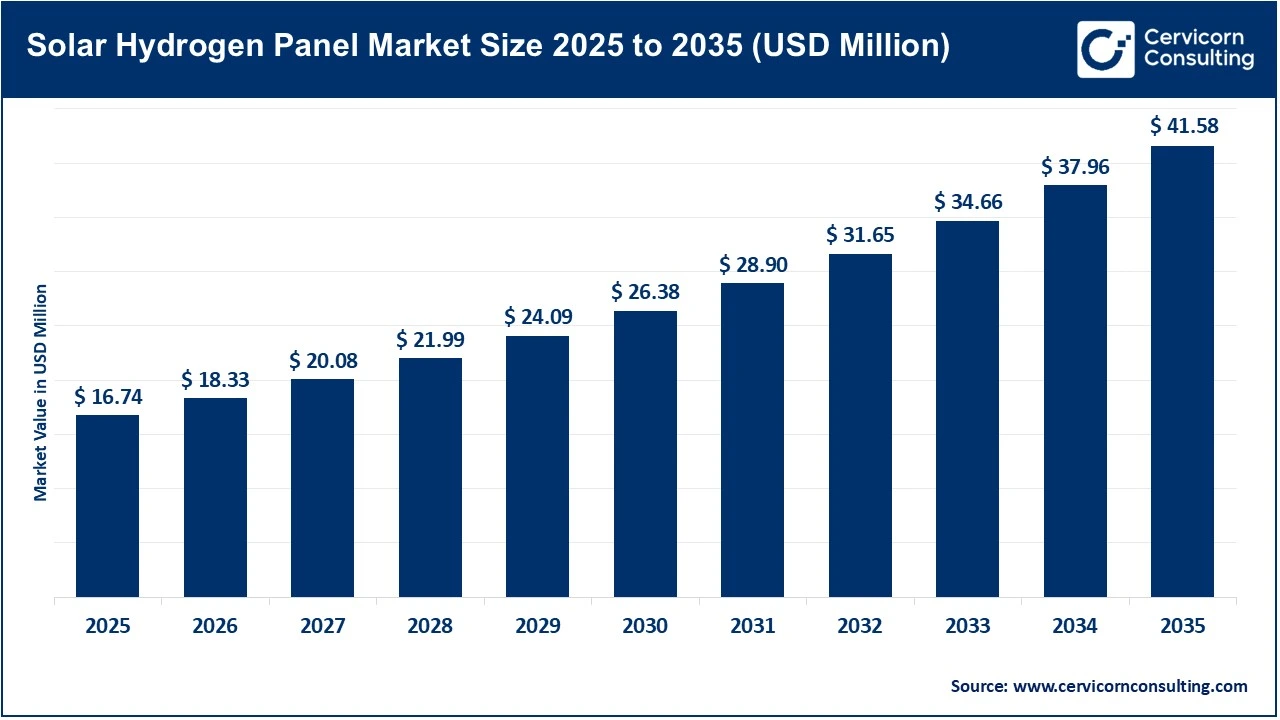
The solar hydrogen panel market is being driven by the accelerating global transition toward clean energy, increasing investments in green hydrogen production, and supportive government decarbonization policies. More than 1,000 hydrogen-related policy measures have been announced worldwide since 2020, while over 200 committed low-emission hydrogen projects are currently under development, highlighting strong institutional support for hydrogen technologies. The International Energy Agency (IEA) estimates that hydrogen project investments could increase low-emission hydrogen production capacity by up to five times by 2030, creating significant opportunities for solar hydrogen panel deployment. Additionally, the cost of producing hydrogen from renewable electricity is projected to decline by around 30% by 2030 due to falling solar power and electrolyzer costs, improving the commercial viability of solar-to-hydrogen systems. Growing demand for green hydrogen in fertilizer production, heavy industry, energy storage, shipping, and transportation is further accelerating adoption, as industries seek low-carbon alternatives to fossil fuels and solutions for hard-to-abate emissions.
Report Highlights
- Europe leads the global market with an estimated 38.5% share, supported by aggressive decarbonization policies, hydrogen strategies, and substantial renewable energy investments.
- North America accounts for approximately 27.8% of the market, driven by hydrogen hub development, clean energy incentives, and industrial decarbonization initiatives.
- Amorphous silicon solar cells dominate the technology segment, accounting for approximately 42.8% of the market share due to their commercial maturity, lower manufacturing costs, and suitability for large-scale hydrogen generation applications.
- By end-use, the industrial segment holds the largest market share at approximately 51.6%, driven by growing hydrogen demand from steel, chemical, refining, and fertilizer industries.
What are Solar Hydrogen Panels?
Solar hydrogen panels are innovative renewable energy systems that use sunlight and water to produce green hydrogen directly, without relying on fossil fuels or conventional electricity-driven electrolysis. Unlike traditional solar photovoltaic panels that generate electricity, solar hydrogen panels integrate advanced photoelectrochemical or photocatalytic technologies to convert solar energy into hydrogen through water-splitting reactions.
The hydrogen produced can be stored and later used as a clean fuel for transportation, industrial processes, power generation, and long-duration energy storage. By combining solar energy harvesting and hydrogen production into a single system, solar hydrogen panels offer a sustainable solution for reducing carbon emissions, enhancing energy security, and supporting the global transition toward a low-carbon hydrogen economy.
Decarbonization & Net-Zero Mandates Driving the Solar Hydrogen Panel Market
Global decarbonization commitments and net-zero emission mandates are significantly accelerating the adoption of solar hydrogen panel technologies, as governments and industries seek carbon-free alternatives for sectors that are difficult to electrify. Solar hydrogen panels enable the direct production of green hydrogen using solar energy, supporting emission reduction targets across transportation, heavy industry, power generation, and chemical manufacturing. More than 70% of global CO2 emissions are now covered by national net-zero pledges, creating strong regulatory pressure for clean hydrogen deployment. Hydrogen is increasingly recognized as a critical decarbonization tool because it can reduce emissions in steelmaking, refining, shipping, and other hard-to-abate industries where renewable electricity alone is insufficient. As countries implement carbon pricing mechanisms, renewable energy mandates, and hydrogen strategies, investments in solar-based hydrogen production systems continue to rise, strengthening demand for solar hydrogen panels and related infrastructure.
Regional Impact of Decarbonization & Net-Zero Mandates on the Solar Hydrogen Panel
| Region |
Key Decarbonization & Hydrogen Initiatives |
Market Impact |
| Europe |
Europe accounts for over 61% of the global green hydrogen market and has established extensive hydrogen deployment programs, including more than 400 hydrogen projects under regional initiatives. |
Very High – Strongest demand for solar hydrogen panels due to aggressive net-zero targets and industrial decarbonization efforts. |
| North America |
The region is among the fastest-growing hydrogen markets, supported by clean hydrogen incentives, tax credits, and national net-zero strategies in the U.S. and Canada. |
High – Growing investments in green hydrogen hubs and renewable-powered hydrogen production facilities. |
| Asia-Pacific |
Countries such as Japan, South Korea, China, India, and Australia have adopted dedicated hydrogen strategies to enhance energy security and achieve carbon neutrality goals. |
High – Rapid expansion of renewable energy capacity is creating significant opportunities for solar hydrogen technologies. |
| Latin America |
The region generates approximately 60% of its electricity from renewable sources, with Chile targeting 25 GW of electrolyzer capacity by 2030. |
Medium to High – Strong renewable resource availability supports future solar hydrogen panel deployment. |
| Middle East & Africa |
Several countries are investing in large-scale green hydrogen export projects to diversify economies and support global decarbonization efforts. |
Medium – Emerging market with substantial long-term growth potential due to abundant solar resources. |
Solar Hydrogen Panel Market Dynamics
Market Drivers
1. Rising Demand for Green Hydrogen and Energy Storage
The growing need for green hydrogen as a clean energy carrier is significantly boosting the solar hydrogen panel market. Global hydrogen demand reached nearly 100 million tonnes in 2024, with increasing adoption across industrial and energy sectors. Industries are seeking sustainable alternatives to conventional hydrogen produced from natural gas, while utilities are exploring hydrogen for long-duration energy storage. Solar hydrogen panels enable direct hydrogen generation using renewable energy, reducing dependence on grid electricity and lowering carbon footprints. This trend positions solar hydrogen technology as an attractive solution for future energy systems and industrial decarbonization initiatives.
2. Declining Renewable Energy Costs and Technological Advancements
The continuous decline in solar energy costs and ongoing technological advancements are significantly driving the solar hydrogen panel market. Over the past decade, the cost of solar photovoltaic electricity has fallen by nearly 90%, making renewable-powered hydrogen production increasingly economical. Simultaneously, innovations in photoelectrochemical cells, catalysts, nanomaterials, and integrated solar-to-hydrogen systems are improving conversion efficiency, durability, and operational performance. Global solar PV additions exceeded 430 GW in 2023, demonstrating rapid renewable deployment. These advancements reduce green hydrogen production costs and enhance system reliability, supporting broader adoption across industrial, commercial, and energy storage applications.
Market Restraints
1. High Capital Costs and Limited Commercial Scale
One of the primary restraints affecting the solar hydrogen panel market is the high cost associated with research, development, manufacturing, and deployment. Many solar hydrogen panel technologies remain in the demonstration or pilot stage, limiting economies of scale and increasing production costs. Green hydrogen production costs can still be 2–4 times higher than conventional grey hydrogen in many regions. Advanced materials, specialized catalysts, and integrated hydrogen generation systems require substantial investments, making adoption challenging for cost-sensitive users. These economic disadvantages continue to slow commercialization and restrict market penetration.
2. Low Conversion Efficiency and Technology Maturity
The relatively low solar-to-hydrogen conversion efficiency of many solar hydrogen panel systems remains a significant barrier to market growth. While technological advancements continue, several solutions are still under development and often achieve efficiencies below 10–15% under commercial operating conditions. Performance degradation, material stability issues, and operational challenges can affect long-term reliability and increase maintenance requirements. Furthermore, the lack of standardized manufacturing processes and limited operational experience create uncertainty among investors and end users, reducing confidence in large-scale adoption and delaying project implementation.
Market Opportunities
1. Expansion of Green Hydrogen Infrastructure
The rapid development of global hydrogen infrastructure presents substantial opportunities for the solar hydrogen panel market. More than 1,500 hydrogen projects have been announced globally, spanning production, storage, transportation, and fueling infrastructure. Governments and private organizations are investing heavily to support clean energy transitions. As hydrogen ecosystems expand, demand for sustainable and decentralized hydrogen generation technologies is expected to increase. Solar hydrogen panels offer the advantage of producing hydrogen directly at the point of use, reducing transportation costs and infrastructure dependency while creating opportunities across industrial and mobility applications.
2. Emerging Demand from Hard-to-Abate Industries
Industries such as steel, cement, chemicals, shipping, and aviation are under increasing pressure to reduce carbon emissions, creating significant opportunities for solar hydrogen technologies. Heavy industry accounts for approximately 30% of global energy-related CO2 emissions, highlighting the need for low-carbon alternatives. These sectors often require high-temperature processes or energy-dense fuels that are difficult to electrify using conventional renewable power alone. Solar hydrogen panels can provide a sustainable source of green hydrogen for industrial feedstock and fuel applications, opening new growth avenues as environmental regulations become stricter.
Market Challenges
1. Lack of Hydrogen Distribution and Storage Infrastructure
Despite growing interest in green hydrogen, inadequate hydrogen storage, transportation, and distribution infrastructure remains a major challenge for the solar hydrogen panel market. According to international energy agencies, existing hydrogen pipeline networks total less than 6,000 kilometers globally, limiting large-scale hydrogen deployment. Hydrogen requires specialized equipment and safety measures due to its physical properties, increasing infrastructure complexity and costs. Many regions still lack sufficient storage facilities and refueling networks, creating barriers for end users and slowing the widespread adoption of solar hydrogen technologies.
2. Competition from Alternative Green Hydrogen Technologies
The solar hydrogen panel market faces intense competition from established green hydrogen production technologies, particularly photovoltaic-powered electrolysis and wind-powered electrolysis systems. Electrolyzer capacity announcements worldwide now exceed 500 GW by 2030, reflecting strong industry confidence in these mature technologies. These alternatives benefit from proven performance, larger-scale deployment, and declining production costs. Continuous reductions in solar photovoltaic and electrolyzer prices have improved their economic competitiveness, making it difficult for emerging solar hydrogen panel technologies to gain market share and attract large-scale commercial investments.
Solar Hydrogen Panel Market Regional Analysis
The solar hydrogen panel market is segmented by region into North America, Europe, Asia-Pacific, Latin America, and LAMEA. Here is a brief overview of each region:
North America Solar Hydrogen Panel Market: Driven by Growing Green Hydrogen Investments, Strong Clean Energy Policies, and Expanding Industrial Decarbonization Initiatives
The North America solar hydrogen panel market size was valued at USD 4.65 million in 2025 and is expected to exceed around USD 11.56 million by 2035. The North America market is experiencing significant growth due to increasing investments in green hydrogen production, supportive government policies promoting clean energy adoption, and rising demand for low-carbon fuels across industrial and transportation sectors. The region is actively pursuing net-zero emission targets, encouraging the deployment of renewable hydrogen technologies to decarbonize hard-to-abate industries. Growing solar power capacity, advancements in hydrogen production technologies, and the development of hydrogen hubs are further strengthening market expansion. Additionally, increasing public and private sector funding for clean hydrogen projects is accelerating commercialization and infrastructure development across the region.
United States: Strong hydrogen policy support, expanding clean energy investments, and large-scale hydrogen hub development continue driving market growth.
- The U.S. Department of Energy allocated USD 7 billion for the development of regional clean hydrogen hubs, accelerating hydrogen production and distribution infrastructure.
- The country installed more than 50 GW of new solar capacity in 2024, strengthening the renewable energy base required for solar-powered hydrogen generation.
- The U.S. aims to reduce clean hydrogen production costs to USD 1 per kilogram within a decade through its Hydrogen Shot initiative, improving commercial viability.
Canada: Expanding hydrogen strategies, abundant renewable resources, and growing clean technology investments support market growth.
- Canada launched a national hydrogen strategy targeting leadership in the global hydrogen economy and supporting large-scale clean hydrogen deployment.
- More than 80% of Canada's electricity generation comes from non-emitting sources, providing a strong foundation for renewable hydrogen production.
- The country has announced over CAD 10 billion in hydrogen and clean energy investments across multiple provinces.
Asia-Pacific (APAC) Solar Hydrogen Panel Market: Driven by Rapid Renewable Energy Expansion, National Hydrogen Strategies, and Growing Industrial Decarbonization Efforts
The Asia-Pacific solar hydrogen panel market size was estimated at USD 4.12 million in 2025 and is predicted to surpass around USD 10.23 million by 2035. The Asia-Pacific market is emerging as the fastest-growing regional market, supported by large-scale renewable energy deployment, ambitious hydrogen roadmaps, and increasing investments in clean energy infrastructure. Countries across the region are accelerating hydrogen adoption to enhance energy security, reduce dependence on fossil fuel imports, and achieve carbon neutrality goals. Rising industrial demand for green hydrogen in steel, chemicals, refining, and transportation sectors is creating significant opportunities for solar hydrogen technologies. Furthermore, abundant solar resources, declining renewable energy costs, and strong government support for hydrogen innovation are accelerating market development throughout the region.
China: Massive renewable energy deployment, strong hydrogen investments, and carbon neutrality goals continue driving market growth.
- China accounts for more than 50% of global solar PV manufacturing capacity, providing a strong foundation for solar-powered hydrogen production.
- The country targets carbon neutrality by 2060, encouraging substantial investments in green hydrogen and renewable energy projects.
- China has announced over 300 hydrogen-related projects, making it one of the world's largest hydrogen investment markets.
India: Expanding solar capacity, National Green Hydrogen Mission, and industrial decarbonization initiatives support growth.
- India launched the National Green Hydrogen Mission with an allocation of approximately USD 2.4 billion to accelerate domestic hydrogen production.
- The country targets 5 million metric tonnes of green hydrogen production annually by 2030.
- India has surpassed 100 GW of installed solar power capacity, creating favorable conditions for solar hydrogen generation.
Europe Solar Hydrogen Panel Market: Driven by Ambitious Net-Zero Targets, Strong Green Hydrogen Policies, and Large-Scale Renewable Energy Investments
The Europe solar hydrogen panel market size reached at USD 6.44 million in 2025 and is forecasted to grow around USD 16.01 million by 2035.
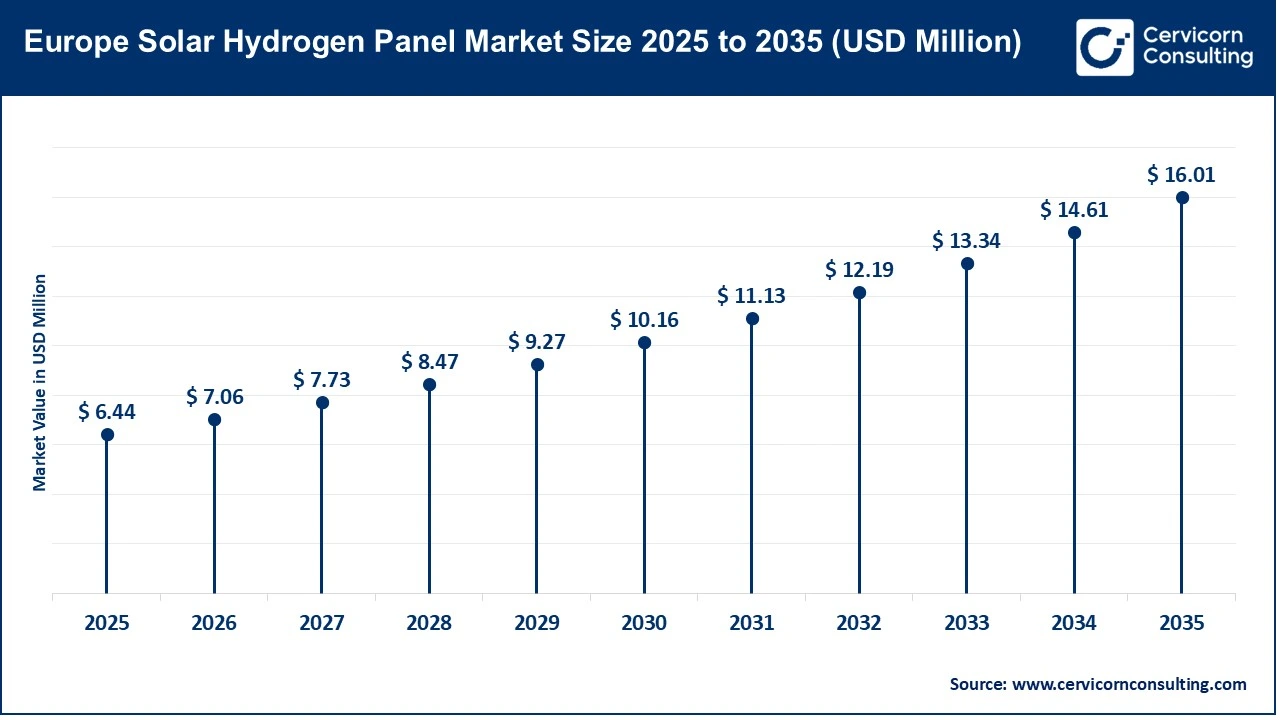
Europe represents one of the most advanced markets for solar hydrogen panel technologies, supported by aggressive decarbonization goals, comprehensive hydrogen strategies, and substantial investments in renewable energy infrastructure. The region is focused on reducing dependence on fossil fuels while accelerating the transition toward a climate-neutral economy. Strong policy frameworks such as the European Green Deal and the REPowerEU Plan are encouraging the deployment of green hydrogen across industrial, transportation, and power sectors. Additionally, expanding solar energy capacity, carbon reduction regulations, and public-private partnerships are driving demand for solar-based hydrogen production technologies throughout the region.
Germany: Hydrogen leadership, industrial decarbonization efforts, and strong renewable energy investments continue driving market growth.
- Germany targets 10 GW of domestic electrolysis capacity by 2030, making it one of Europe's largest hydrogen markets.
- The country has allocated more than EUR 18 billion toward hydrogen development through national and European funding initiatives.
- Germany aims to achieve climate neutrality by 2045, accelerating demand for green hydrogen in steel, chemicals, and heavy industry.
France: Strong government support, clean energy transition, and industrial hydrogen adoption drive market growth.
- France plans to invest more than EUR 9 billion in hydrogen development as part of its national hydrogen strategy.
- The country aims to install approximately 6.5 GW of electrolyzer capacity by 2030 to support green hydrogen production.
- France's commitment to carbon neutrality by 2050 is accelerating the adoption of low-carbon hydrogen technologies.
Solar Hydrogen Panel Market Share, By Region, 2025 (%)
| Region |
Revenue Share, 2025 (%) |
| Europe |
38.5% |
| North America |
27.8% |
| Asia-Pacific |
24.6% |
| LAMEA |
9.1% |
LAMEA (Latin America, Middle East & Africa) Solar Hydrogen Panel Market: Driven by Abundant Solar Resources, Growing Green Hydrogen Export Projects, and Increasing Clean Energy Investments
The LAMEA solar hydrogen panel market was valued at USD 1.52 million in 2025 and is anticipated to reach around USD 3.78 million by 2035. The LAMEA market is gaining momentum due to exceptional solar energy potential, expanding green hydrogen initiatives, and increasing government efforts to diversify energy sources and reduce carbon emissions. The region is emerging as a strategic hub for renewable hydrogen production owing to its vast land availability, favorable climatic conditions, and competitive renewable energy costs. Growing investments in hydrogen export infrastructure, industrial decarbonization projects, and international partnerships are further supporting market expansion. As global demand for green hydrogen rises, LAMEA is positioned to become a major supplier of renewable hydrogen and related technologies.
Brazil: Expanding renewable energy capacity, hydrogen export ambitions, and industrial decarbonization efforts drive market growth.
- Brazil generates approximately 85% of its electricity from renewable sources, providing a strong foundation for green hydrogen production.
- The country has announced more than USD 30 billion in proposed green hydrogen investments across ports and industrial hubs.
- Brazil's strong solar and wind resources are attracting large-scale hydrogen production projects targeting domestic and export markets.
Saudi Arabia: Mega-scale hydrogen projects, economic diversification, and net-zero goals accelerate market development.
- Saudi Arabia is developing the NEOM Green Hydrogen Project, expected to produce up to 600 tonnes of green hydrogen daily upon completion.
- The Kingdom targets net-zero emissions by 2060, encouraging investments in renewable hydrogen technologies.
Solar Hydrogen Panel Market Segmental Analysis
The solar hydrogen panel market is segmented into technology, end-use, and geography.
Technology Analysis
Amorphous Silicon Solar Cells dominate the solar hydrogen panel market due to their relatively low manufacturing costs, flexibility, and suitability for large-area applications. These cells can effectively operate under varying light conditions and are easier to integrate with hydrogen production systems compared to many advanced alternatives. Their established production ecosystem and commercial availability have accelerated adoption across pilot and demonstration projects. Additionally, ongoing investments in renewable hydrogen generation and distributed energy systems continue to support demand, making amorphous silicon technology the preferred choice for current solar hydrogen panel deployments.
Solar Hydrogen Panel Market Share, By Technology, 2025 (%)
| Technology |
Revenue Share, 2025 (%) |
| Amorphous Silicon Solar Cells |
42.8% |
| Nano Solar Cells |
28.4% |
| Platinum-Loaded Barium Tantalum Oxynitride (PBTO) |
18.1% |
| Others |
10.7% |
Nano Solar Cells are expected to be the fastest-growing segment in the solar hydrogen panel market owing to their superior light absorption capabilities, higher theoretical conversion efficiencies, and potential for low-cost manufacturing. Advances in nanotechnology are enabling improved photocatalytic performance and enhanced solar-to-hydrogen conversion rates, making these cells increasingly attractive for next-generation hydrogen production systems. Research institutions and clean energy companies are investing heavily in nano-material innovations to improve efficiency and durability. As commercialization progresses and performance improves, nano solar cells are anticipated to gain significant market traction over the coming years.
End-use Analysis
The Industrial segment dominates the solar hydrogen panel market due to the growing use of green hydrogen in refining, chemical manufacturing, steel production, and other energy-intensive industries. Industrial facilities are under increasing pressure to reduce carbon emissions and comply with sustainability regulations, driving demand for renewable hydrogen solutions. Solar hydrogen panels offer industries a pathway to produce clean hydrogen directly from renewable energy sources, reducing dependence on fossil-fuel-based hydrogen. The sector's large hydrogen consumption volumes and ongoing decarbonization initiatives continue to position industrial applications as the largest contributor to market revenue.
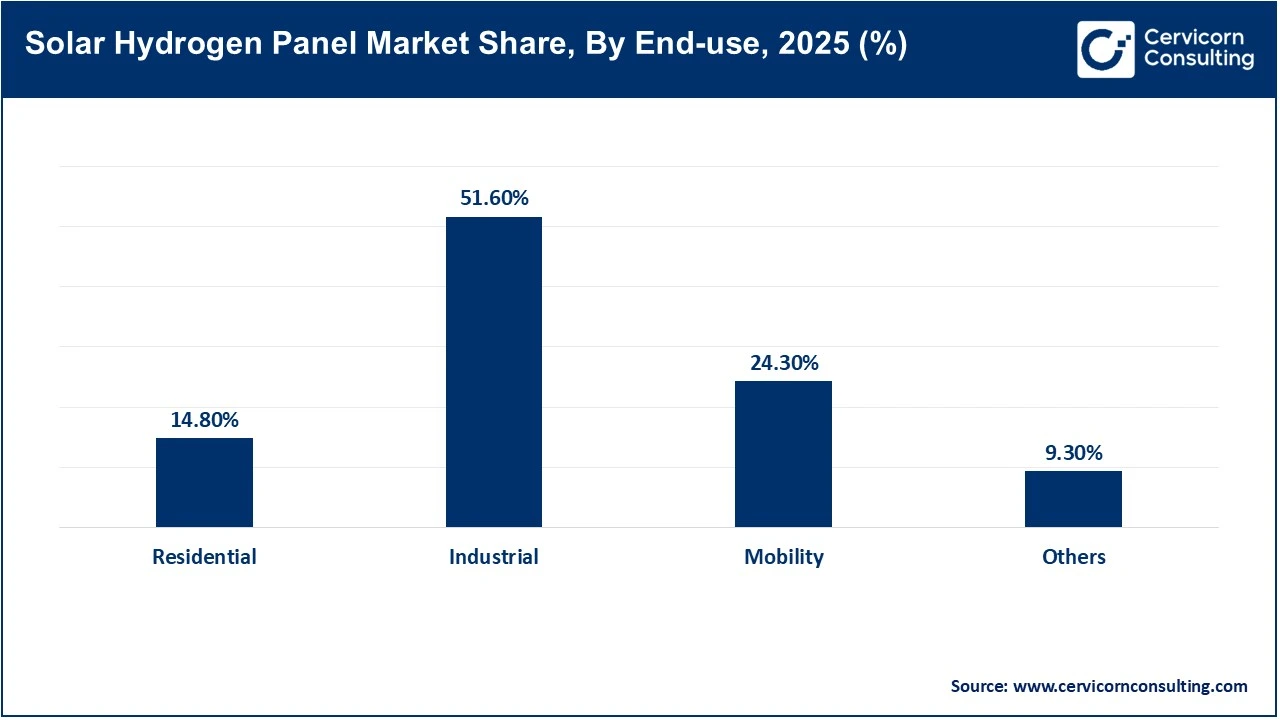
The Mobility segment is projected to be the fastest-growing end-use segment as governments and transportation companies accelerate investments in hydrogen-powered mobility solutions. Fuel-cell vehicles, buses, trucks, trains, and maritime transport are increasingly being adopted to reduce emissions and meet stringent environmental regulations. Solar hydrogen panels provide a sustainable source of green hydrogen that can support refueling infrastructure and decentralized hydrogen production. Growing investments in hydrogen fueling stations, advancements in fuel-cell technology, and expanding zero-emission transportation initiatives are expected to drive strong growth in mobility-related applications throughout the forecast period.
Solar Hydrogen Panel Market Top Companies
Recent Developments
- In August 2025, SunHydrogen, Inc. successfully demonstrated the live operation of its commercial-scale 1.92 m² hydrogen module, producing renewable hydrogen directly from sunlight and water. The milestone marked a significant step toward commercial deployment of the company's solar hydrogen panel technology and validated the scalability of its photoelectrochemical hydrogen production platform.
- In February 2025, Hysata Pty Ltd. signed an agreement with ACWA Power to conduct commercial-scale demonstrations of its high-efficiency capillary-fed electrolyzer technology in Saudi Arabia. The collaboration aims to lower green hydrogen production costs and accelerate large-scale renewable hydrogen deployment in the Middle East.
- In 2025, Fusion Fuel Green PLC continued expanding its HEVO solar-to-hydrogen technology platform through integrated green hydrogen projects focused on decentralized hydrogen production for industrial and mobility applications.
Market Segmentation
By Technology
- Amorphous Silicon Solar Cells
- Nano Solar Cells
- Platinum-Loaded Barium Tantalum Oxynitride (PBTO)
- Others
By End-use
- Residential
- Industrial
- Mobility
- Others
By Geography
- North America
- Europe
- Asia-Pacific
- LAMEA