Fertilizer Market Size, Growth, Forecast 2026 To 2035
The global fertilizer market size was estimated at USD 216.52 billion in 2025 and is projected to exceed around USD 282.54 billion by 2035, growing at a compound annual growth rate (CAGR) of 2.7% over the forecast period from 2026 to 2035. The fertilizer market is driven by the rising global population and increasing food demand, necessitating higher agricultural productivity.
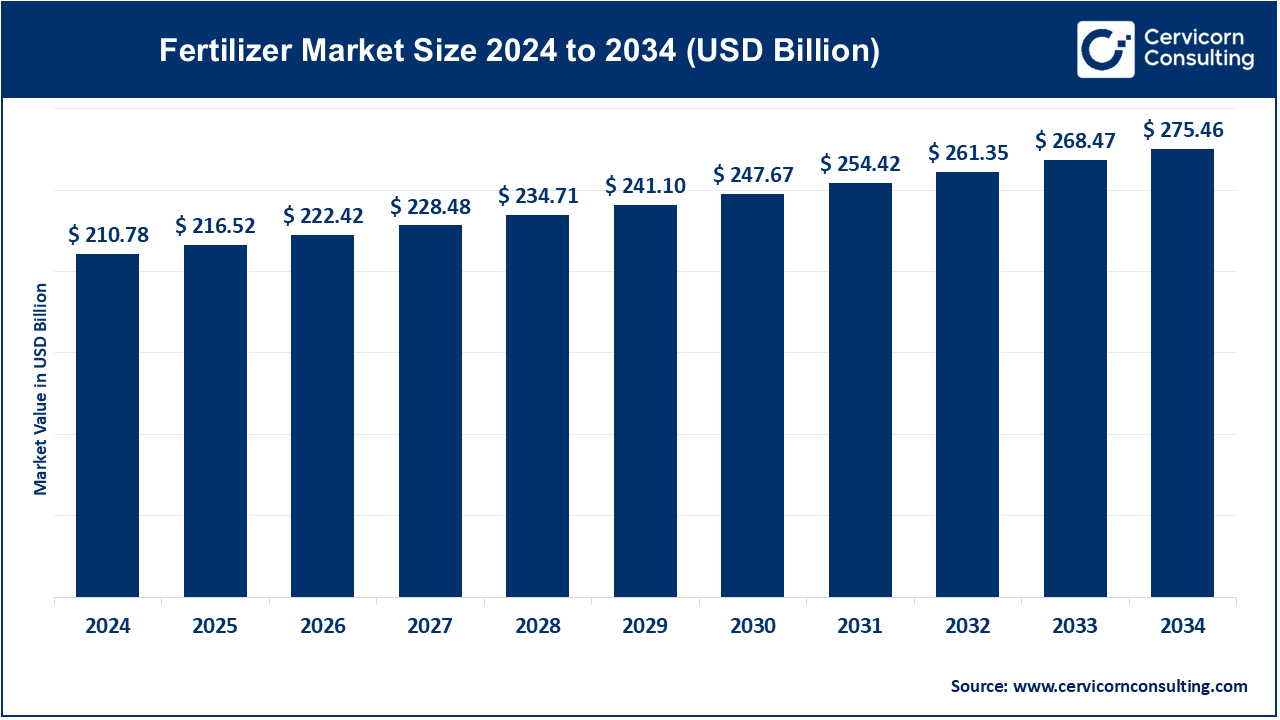
Farmers are increasingly adopting fertilizers to address soil nutrient deficiencies and enhance crop yields. Key regions such as Asia-Pacific lead the market due to extensive agricultural activities in countries like India and China. These countries rely heavily on fertilizers to support their agricultural economies and ensure food security. Additionally, there is a growing shift towards sustainable and eco-friendly fertilizers, fueled by environmental regulations and consumer awareness about reducing chemical impacts on soil and water. Organic and bio-based fertilizers are gaining traction, especially in Europe and North America, where sustainable farming practices are widely promoted. The market also sees significant technological advancements, such as precision farming and controlled-release fertilizers, enabling efficient nutrient delivery and minimizing waste.
Fertilizers are substances that provide essential nutrients to plants, enhancing their growth and productivity. They are used to replenish soil nutrients depleted by farming and ensure optimal crop yield. Fertilizers can be broadly categorized into organic and inorganic types. Organic fertilizers, derived from natural sources like compost, manure, and bone meal, improve soil structure and long-term fertility. Inorganic fertilizers, also known as chemical fertilizers, are synthesized from minerals and chemicals, offering precise nutrient delivery for rapid plant growth. These fertilizers are further divided into nitrogen-based, phosphorus-based, potassium-based, and multi-nutrient varieties, catering to the specific needs of different crops and soil types.
Report Highlights
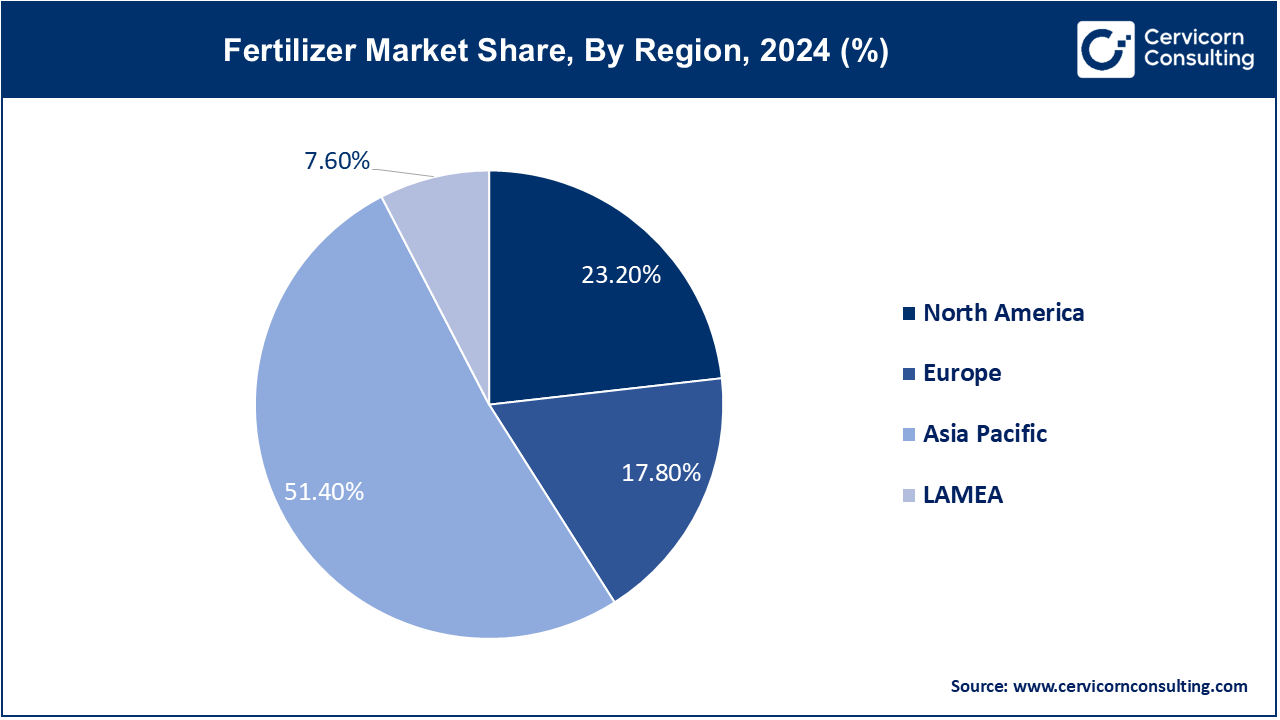
- Asia Pacific held 51% share in 2025 while dominating the market owing to the strong agricultural dependence, suitable subsidies for fertilizers and significant consumption of the same in China and India.
- North America held 23% of share while holding second-largest position in the market due to high adoption of farming technologies and large-scale commercial agriculture practices.
- By type, the organic fertilizers segment led the market with 91% share owing to rising demand for sustainable farming and soil health restoration.
- By form, the solid form segment held 82% share in 2025 with its longer shelf life and ease of storage and cost-effectiveness.
Fertilizer Market Consumption, Production and Investment Outlook (2025-2026)
- As indicated by the International Fertilizer Association, worldwide fertilizer usage will increase to approximately 205 million tonnes of nutrient needs by 2025–2026, as food supply continues to rise globally.
- The United Nations' Food and Agriculture Organization reported a strong rebound in fertilizer usage after the global fertilizer supply disruption (2022). In 2024, total amounts of fertilizer consumed worldwide exceeded 206 million tonnes, indicating a continuation of steady growth until 2026.
- Nutrien Ltd. became the largest potash producer globally with 20+ million tonnes annual potash capacity and Third-largest nitrogen fertilizer producer with 7+ million tonnes ammonia capacity.
- Yara International maintained 200 infrastructure points and 10,800 retail outlets globally.
- Southeast Asia is the top fertilizer customer in the world today with over 63 million tonnes of nutrients consumed each year. China and surrounding countries are primarily responsible for their high fertilizer demand through their intensive agricultural production practices.
- South Asia uses around 39 million tonnes of fertilizer annually, with India leading the way because of its large population and increasing government subsidies. Brazil also uses approximately 41 million tonnes of fertilizers each year and ranks as one of the largest agricultural nutrients markets in the world.
- Brazil is investing heavily to reduce import dependence, with projects aiming to produce 500,000 tonnes of fertilizer annually from sugarcane waste by 2026.
Fertilizer Investment and Capacity Expansion
| Country |
Investment |
Capacity Targets |
| Brazil |
Bio-fertilizer production from sugarcane waste to reduce import dependence |
Approximately 5,00,000 tonnes annually |
| South Africa |
New ammonia and urea plants to improve fertilizer self-sufficiency |
Large-scale regional capacity expansion underway |
| Middle East |
Expansion of ammonia and urea production using low-cost natural gas |
Major export-oriented capacity additions by 2026 |
| India |
Government-backed revival of urea plants and new fertilizer complexes |
Several million tonnes of new urea capacity being added by 2026 |
| Saudi Arabia |
Expansion of world-scale ammonia and phosphate production projects |
- |
Green Ammonia Investments Worldwide
- The ACME Group announced its intent in March 2024 to invest US$3 billion in Indian green ammonia projects over FY2025, aiming to build a portfolio of 10 million tonnes of green ammonia capacity by 2030 to become a significant global supplier.
- OCIOR Energy entered into an agreement with KBR Inc. For its Odisha project's green ammonia technology in July 2024, with a daily production capacity of 600 metric tons (TPD) which will be among India's first large-scale green ammonia developments.
- AM Green Ammonia announced final investment decision (FID) in August 2024 for its project in Kakinada, India, targeting a capacity of 1 million tonnes per annum (MTPA) by 2026 and a capacity of 5 MTPA by 2030 which is one of the largest green ammonia projects underway globally.
- HygeNo Green Energies announced an investment of US$2.5 billion across the next three years for various green hydrogen and ammonia projects in India, with its Odisha plant on course to produce 1.1 MTPA of green ammonia by 2030.
- RWE AG announced in September 2024 an offtake agreement with AM Green Ammonia to secure up to 250,000 tonnes of green ammonia annually from India starting in 2027, signaling increasing demand from European industries for the compound.
Top 5 Government Initiatives Boosting Fertilizer Production
| Country |
Initiative |
Impact on Production |
| India |
Nutrient Based Subsidy (NBS) Scheme Expansion |
India increased subsidy allocations for phosphatic and potassic fertilizers to stabilize domestic production and reduce import dependency. Subsidy outlay crossed ₹1.67 lakh crore in FY2025. |
| United States |
USDA Fertilizer Production Expansion Program (FPEP) |
The U.S. Department of Agriculture allocated over $900 million to support independent fertilizer manufacturing capacity and improve supply chain resilience. |
| Germany |
EU Green Deal Industrial Fertilizer Support |
Germany, under EU decarbonization policies, increased support for low-carbon ammonia and green hydrogen-linked fertilizer production facilities. |
| China |
National Food Security & Fertilizer Stabilization Policy |
China expanded urea and phosphate production quotas while prioritizing fertilizer security to support over 127 million hectares of cultivated land. |
| Brazil |
National Fertilizer Plan (Plano Nacional de Fertilizantes) |
Brazil aims to reduce fertilizer import dependence from 85% to 45% by 2050, increasing domestic nitrogen and phosphate investments. |
Fertilizer Market Growth Factors
- Population Growth and Food Demand: As global population rises, there is an increasing need for higher agricultural productivity to meet food demand. Fertilizers play a crucial role in enhancing crop yields and ensuring food security, particularly in densely populated regions where agricultural intensification is essential for food production.
- Expansion of Agricultural Land: Efforts to expand arable land and reclaim degraded soils in developing regions drive the demand for fertilizers. Fertilizers help improve soil fertility and productivity, enabling farmers to maximize yields from newly cultivated or previously underutilized lands.
- Technological Advancements: Ongoing innovations in fertilizer formulations and application technologies contribute to market growth. Advanced fertilizers, such as controlled-release fertilizers and micronutrient-enriched products, improve nutrient efficiency, reduce nutrient losses, and enhance crop resilience to environmental stresses, thereby optimizing agricultural output.
- Government Support and Subsidies: Many governments offer subsidies and support programs to promote fertilizer use among farmers. These initiatives, especially prevalent in emerging economies, aim to increase agricultural productivity, improve farmer income, and ensure food security. Government policies that encourage modern agricultural practices, including efficient fertilizer use, stimulate market growth and adoption rates.
- Environmental Concerns: Heightened awareness of environmental sustainability influences fertilizer market dynamics. There is a growing demand for eco-friendly fertilizers and sustainable farming practices that minimize environmental impact, such as organic fertilizers and bio-based alternatives.
Fertilizer Market Recent Trends
- Technological Advancements in Fertilizer Formulations: Innovations in fertilizer technology, including enhanced efficiency fertilizers (EEFs) and specialty fertilizers, drive market growth. These advancements improve nutrient uptake by crops, reduce nutrient losses to the environment, and cater to specific soil and crop requirements, thereby increasing agricultural productivity.
- Increasing Adoption of Precision Agriculture: Precision agriculture technologies, such as GPS-guided equipment and sensor-based monitoring systems, optimize fertilizer application. This trend minimizes input wastage, enhances nutrient management, and improves crop yield and quality, supporting sustainable agricultural practices.
- Rising Demand for Organic and Bio-based Fertilizers: Growing consumer preference for organic food and sustainable farming practices boosts the demand for organic and bio-based fertilizers. These products, derived from natural sources like compost, manure, and biochar, contribute to soil health, reduce environmental impact, and cater to the expanding organic farming sector.
- Expansion in Emerging Markets: Increasing urbanization and rising disposable incomes in emerging markets, particularly in Asia-Pacific and Latin America, present opportunities for market expansion. Rising demand for food products and agricultural intensification drive fertilizer consumption, supported by government initiatives and investments in agricultural infrastructure.
- Focus on Nutrient Recovery and Recycling: The shift towards circular economy principles promotes opportunities in nutrient recovery and recycling technologies. Innovations in nutrient recovery from waste streams and the development of nutrient-efficient fertilizers facilitate sustainable nutrient management practices, reduce dependency on mined resources, and mitigate environmental impacts associated with fertilizer production and use.
Report Scope
| Area of Focus |
Details |
| Market Size in 2026 |
USD 222.42 Billion |
| Market Size in 2035 |
USD 282.54 Billion |
| Market Growth Rate |
CAGR of 2.7% from 2026 to 2035 |
| Largest Region |
Asia-Pacific |
| Fastest Growing Region |
North America |
| Segment Covered |
By Type of Fertilizers, Type, Nutrient Content, Application, Crop Type, Regions |
Fertilizer Market Dynamics
Drivers
Climate Change Adaptation and Resilience:
- Climate change impacts, such as erratic weather patterns and extreme events, drive the adoption of fertilizers that enhance crop resilience. Fertilizers fortified with stress-tolerant traits or drought-resistant properties help mitigate climate risks, ensuring stable agricultural production and food security amidst changing climatic conditions.
Global Trade and Market Liberalization:
- Liberalization of global trade policies and agreements facilitates the exchange of fertilizers across borders, enabling access to a diverse range of products and technologies. Free trade agreements and market integration initiatives streamline supply chains, reduce trade barriers, and promote competitive pricing, fostering market growth and accessibility to advanced fertilizers worldwide.
Restraints
Environmental Regulations and Sustainability Concerns:
- Stringent environmental regulations aimed at reducing nutrient runoff, water pollution, and greenhouse gas emissions pose challenges for fertilizer manufacturers. Compliance with environmental standards increases production costs and necessitates investments in eco-friendly technologies, impacting profitability and operational efficiency.
Volatility in Raw Material Prices:
- Fluctuations in prices of raw materials such as natural gas (used in nitrogen fertilizer production), phosphate rock, and potash affect fertilizer manufacturing costs. Market volatility and geopolitical factors influencing raw material supply chains can lead to price instability, affecting profit margins and strategic planning within the fertilizer industry.
Opportunities
Integration of Digital Agriculture Technologies:
- The opportunity lies in integrating digital agriculture technologies such as big data analytics, artificial intelligence (AI), and Internet of Things (IoT) in fertilizer management. These technologies enable precise and real-time monitoring of soil health, crop nutrient requirements, and weather conditions. Farmers can optimize fertilizer application schedules, reduce input costs, and improve yields, thereby enhancing overall farm productivity and sustainability.
Development of Sustainable and Biodegradable Fertilizers:
- There is a growing opportunity in the development of sustainable and biodegradable fertilizers that minimize environmental impact. Innovations focus on bio-based fertilizers derived from renewable sources, organic residues, or microbial processes. These fertilizers enhance soil health, reduce nutrient runoff and greenhouse gas emissions, and align with consumer preferences for environmentally friendly agricultural practices. Government incentives and consumer demand for eco-friendly products further drive opportunities for manufacturers investing in sustainable fertilizer solutions.
Challenges
Resistance to Fertilizer Overuse and Nutrient Saturation:
- Overuse and improper application of fertilizers can lead to nutrient saturation in soils, resulting in environmental degradation, nutrient runoff into water bodies, and eutrophication. Addressing farmer behavior and promoting balanced nutrient management practices are ongoing challenges to mitigate these environmental impacts.
Sustainable Nutrient Management in Intensive Agriculture:
- Intensive agriculture practices demand efficient nutrient management to sustain soil health and productivity. Balancing nutrient inputs with crop requirements while minimizing environmental impacts requires integrated approaches, including precision agriculture technologies, nutrient recovery systems, and tailored fertilizer formulations. Developing and promoting sustainable nutrient management practices remains a critical challenge amid increasing global food demand and environmental sustainability goals.
Fertilizer Market Segmental Analysis
Type of Fertilizers Analysis
Nitrogenous Fertilizers: These fertilizers are rich in nitrogen, essential for leaf and stem growth. Trends indicate a growing preference for urea and ammonium nitrate due to their high nitrogen content and cost-effectiveness. Innovations focus on improving nitrogen use efficiency to minimize environmental impact and optimize crop yields in intensive farming systems.
Phosphatic Fertilizers: High in phosphorus, these fertilizers are crucial for root development, flowering, and seed formation. Market trends show increasing use of phosphoric acid-based fertilizers like diammonium phosphate (DAP) and triple superphosphate (TSP) due to their solubility and ease of application. There is a push towards developing phosphorus-efficient fertilizers to address global phosphorus scarcity concerns.
Potassic Fertilizers: These fertilizers provide potassium, essential for overall plant health, water regulation, and disease resistance. Demand trends favor potassium chloride (MOP) and potassium sulfate (SOP) for their ability to supply potassium efficiently to crops. Innovations focus on enhancing nutrient uptake efficiency and minimizing chloride toxicity in sensitive crops.
Micronutrient Fertilizers: These fertilizers supply essential trace elements like zinc, iron, manganese, copper, and boron, vital for specific plant functions such as enzyme activation and photosynthesis. Market trends indicate a rise in demand for chelated micronutrient fertilizers, which enhance nutrient availability and uptake by plants, especially in soils with micronutrient deficiencies.
Others: This category includes specialty fertilizers such as organic and bio-based products, which are gaining popularity due to their environmental benefits and suitability for organic farming practices. Trends show increasing consumer demand for organic fertilizers derived from natural sources like compost, manure, and plant residues, driven by concerns over synthetic chemical use and environmental sustainability.
Nutrient Content Analysis
Single Nutrient Fertilizers: These fertilizers provide only one type of nutrient, such as nitrogen, phosphorus, or potassium. Trends show a steady demand for single-nutrient fertilizers tailored to specific crop needs or soil deficiencies, offering simplicity in nutrient management and cost-effectiveness in agricultural applications.
Multi-nutrient Fertilizers: These fertilizers blend multiple nutrients in varying ratios to meet the comprehensive nutritional requirements of crops. Market trends indicate a growing preference for balanced fertilizers that optimize nutrient uptake and enhance crop yields. Innovations focus on developing customized blends that cater to specific soil conditions and crop types, promoting efficient nutrient use and sustainable agricultural practices.
Type Analysis
Solid Fertilizers: The solid fertilizers segment has generated highest market share of 82% in 2025. These fertilizers are in granular or powdered form, applied directly to the soil. Trends indicate a preference for solid fertilizers due to their ease of handling, storability, and precise application methods such as broadcast spreading and drilling. Innovations focus on developing coated and slow-release solid fertilizers to improve nutrient efficiency and reduce environmental impact through controlled nutrient release.
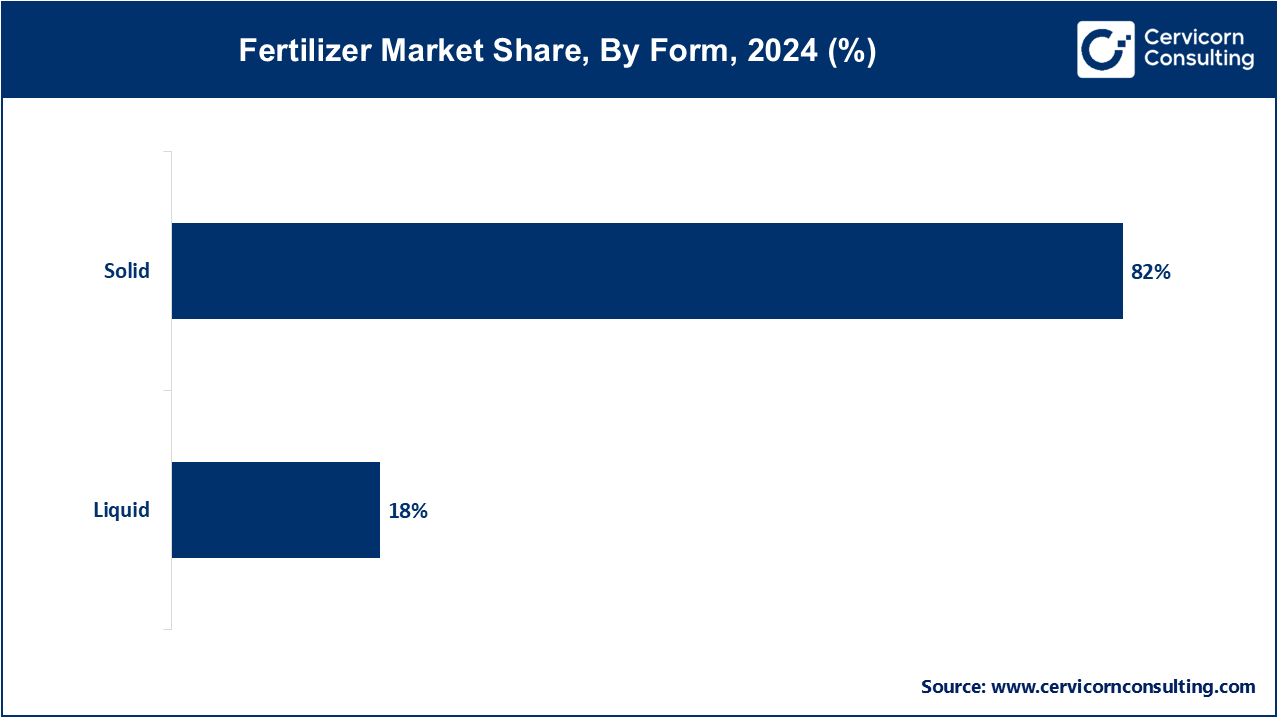
Liquid Fertilizers: The liquid fertilizers segment has garnered market size of 18% in 2025. These fertilizers are in liquid form, applied via irrigation systems or foliar spraying. Market trends show increasing adoption of liquid fertilizers for their rapid nutrient uptake by plants and ease of application in precision agriculture. There is a growing demand for liquid fertilizers formulated with micronutrients and bio-stimulants to enhance crop nutrition and productivity, particularly in intensive cropping systems.
Others: This category includes specialty fertilizers such as gaseous fertilizers (e.g., ammonia), which are applied through specialized equipment for soil and plant treatment. Trends focus on developing innovative application technologies and formulations for niche agricultural applications, including controlled-release fertilizers, biodegradable fertilizers, and fertilizers tailored for specific soil conditions and crop needs.
Crop Type Analysis
Cereals & Grains: Fertilizers for cereals and grains focus on balanced nutrients to support yield and quality. Trends include the adoption of nitrogenous fertilizers for higher grain production and phosphatic fertilizers for root development. Sustainable practices and precision agriculture technologies are increasingly integrated to optimize nutrient use efficiency and mitigate environmental impacts.
Oilseeds & Pulses: Fertilizers aim to enhance oil and protein content crucial for oilseeds and pulses. Trends show increased use of potassic fertilizers for seed quality improvement and micronutrient fertilizers to address specific crop health needs. There is a growing emphasis on integrated nutrient management systems to tailor fertilizer applications according to crop growth stages and soil conditions.
Fruits & Vegetables: Fertilizers for fruits and vegetables emphasize micronutrients essential for flavor, color, and nutritional value. Trends include the rising popularity of organic fertilizers derived from natural sources to meet consumer preferences for pesticide-free produce. Innovations focus on bio-stimulants and soil conditioners that improve nutrient uptake efficiency and enhance crop resilience against diseases and pests.
Others: Specialty crops such as coffee and spices require tailored fertilizers to optimize quality and yield. Trends indicate a shift towards sustainable fertilization practices and precision agriculture technologies for optimal crop management. Market developments also highlight the importance of nutrient balance and soil health management to support the unique nutritional and growth requirements of specialty crops.
Fertilizer Market Regional Analysis
Why Asia-Pacific is dominating in the fertilizer Market?
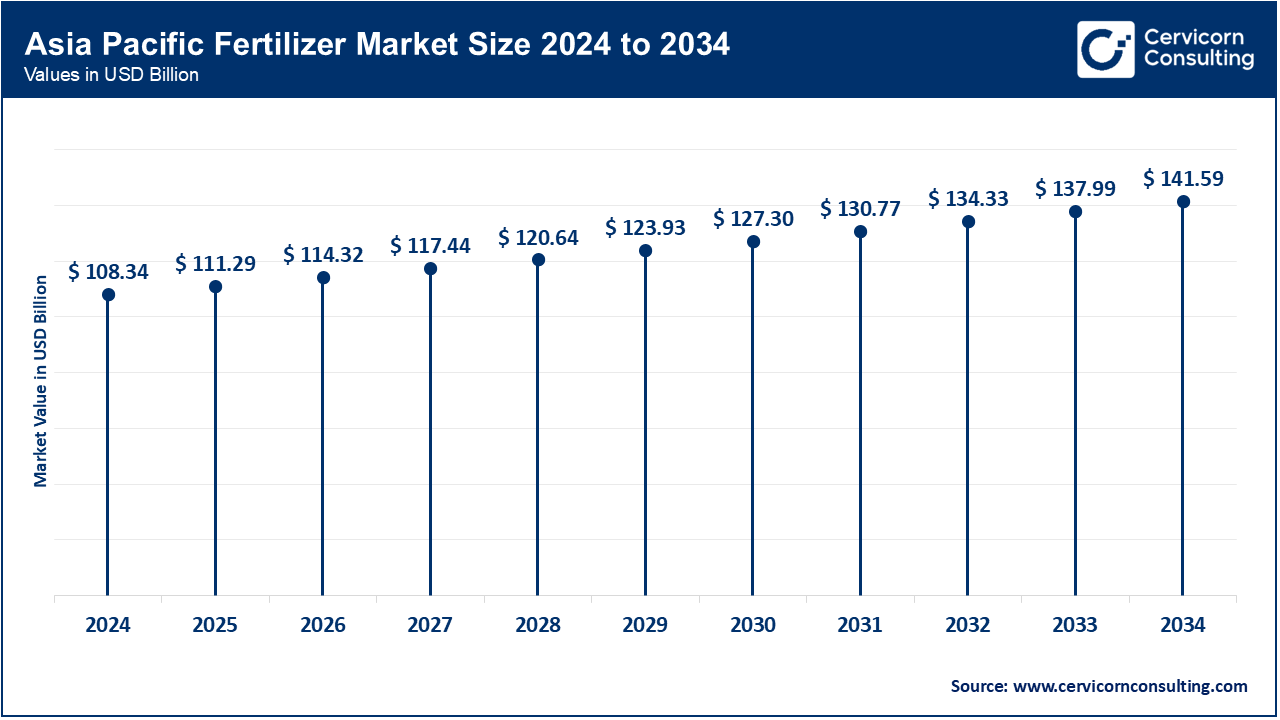
The Asia-Pacific fertilizer market size is registered USD 110.43 billion in 2025 and is forecasted to reach around 144.10 billion by 2035. Asia-Pacific leads global fertilizer consumption, driven by increasing agricultural intensification and initiatives to enhance food security. There is a growing trend towards balanced nutrition in fertilizers, tailored to meet diverse crop needs and soil conditions. Government support through subsidies and investments in agricultural infrastructure and technology further boosts fertilizer use across the region, ensuring agricultural productivity and resilience against climate challenges.
India Fertilizer Market Trends
- In FY2025, India utilized over 64 million metric tons of fertilizer products, establishing it as one of the world’s top consumers of fertilizer.
- Nearly 57% of India’s total fertilizer demand is sourced from urea due to its essentiality in food grain cultivation.
- For the purpose of stabilizing affordability for farmers, Indian fertilizer subsidy allocation in FY2025 reached beyond 1.67 lakh crore.
- The total domestic urea output in India surpassed 31 million metric tons in 2025 following capacity additions within the eastern and northern regions.
- Adoption of nano urea, which consists of single or combination doses of nitrogen and is available in one liter or 500 ml bottle sizes, has greatly increased across India, with Indian Farmers Fertilizer Cooperative Limited having sold in excess of 220 million bottles recently.
Why North America is experiencing rapid growth in the fertilizer Market?
The North America fertilizer market size is recorded USD 49.80 billion in 2025 and is projected to surpass around USD 64.68 billion by 2035. The fertilizer market in North America is characterized by advanced adoption of precision agriculture technologies, facilitating precise fertilizer applications through GPS-guided equipment and data analytics. There is a growing emphasis on sustainable practices, with increasing demand for organic fertilizers and controlled-release nutrients. Stringent environmental regulations also play a crucial role in shaping fertilizer formulations and nutrient management practices, influencing market dynamics and product innovations.
U.S. Fertilizer Market Trends
- Nitrogen fertilizer production reached approximately 36 million metric tons in 2024, solidifying its status as one of the largest domestic fertilizer producers in the world.
- Nearly 40% of U.S. fertilizer consumption was dedicated to corn production, illustrating strong dependence on agriculture for demand.
- Use of precision agriculture techniques surged by over 18% in 2025, contributing directly to an increased demand for nutrient specialty blends.
- U.S. ammonia plants saw increased utilization of greater than 87% in 2025 as low natural gas prices provided an economic benefit. Controlled-release fertilizer products continue to grow at a rate of nearly 8%-10% annually, mainly driven by the demand from high-value crops.
Europe Fertilizer Market Trends
The Europe fertilizer market size is measured USD 38.97 billion in 2025 and is estimated to reach around 50.86 billion by 2035. In Europe, there is a notable shift towards organic farming practices, driving the demand for organic and bio-based fertilizers. The region places a strong focus on improving nutrient use efficiency and reducing nitrogen and phosphorus runoff to minimize environmental impact. Integration of smart farming technologies and digital solutions is gaining traction to enhance fertilizer application precision and support sustainable agriculture initiatives across diverse landscapes.
Germany Fertilizer Market Trends
- Germany continues to remain as one of the major fertilizer producers across Europe with a significant market share especially in nitrogen and specialty fertilizer markets.
- Germany has amplified its investment in pilot projects on green ammonia in the span of two years from 2024-2025, with investments up by more than 1.5 billion.
- German consumption of organic fertilizers has shown a sharp growth of around 9% in 2025 in view of evolving EU environmental standards.
- The market for potash in Germany is crucial and has approximately a share of 10-12% in the overall global potash production.
LAMEA Fertilizer Market Trends
The LAMEA region focuses on expanding arable land and improving soil fertility, contributing to robust demand for essential nutrients like nitrogen, phosphorus, and potassium. Market liberalization policies and trade agreements facilitate fertilizer imports and technological advancements, supporting agricultural productivity. With climate resilience a priority, there is increasing adoption of fertilizers designed to enhance crop tolerance to environmental stresses, reinforcing food security measures in the region.
Global Fertilizer Market Top Companies
- K+S Group
- OCI Nitrogen
- EuroChem Group AG
- CF Industries Holdings, Inc.
- Israel Chemicals Ltd (ICL)
- Nutrien Ltd.
- The Mosaic Company
- Yara International ASA
- Sinofert Holdings Limited
- Agrium Inc.
- PotashCorp (Potash Corporation of Saskatchewan Inc.)
- PhosAgro
- Uralkali
- IFFCO (Indian Farmers Fertiliser Cooperative Limited)
- Coromandel International Limited
Key players like Nutrien, Yara International, and CF Industries dominate the market due to their extensive production capacities, global distribution networks, and continuous innovation in fertilizer products and technologies. These companies leverage economies of scale to influence pricing and market dynamics, while also investing heavily in research and development to maintain leadership through advanced nutrient formulations and precision agriculture solutions.
Recent Developments
- In 2023, Coromandel has launched Cumist Calcium, an organic specialty fertilizer aimed at enhancing soil health and nutrient efficiency. This new product expands Coromandel's specialty fertilizer portfolio, catering to the increasing demand for sustainable and effective agricultural solutions.
- In 2022, ICL signed a significant agreement with India Potash Limited (IPL) to supply 1 million metric tons of Polysulphate through 2026. This partnership aims to support India's organic agriculture program by providing sustainable fertilization solutions.
- In 2022, K+S has entered an agreement with Cinis Fertilizer for synthetic SOP production, with K+S supplying Cinis Fertilizer's entire MOP needs. In return, K+S may purchase up to 600,000 tons of SOP annually from Cinis Fertilizer, enhancing its market position in specialty fertilizers.
- In 2022, ICL signed framework agreements with customers in India and China to supply 600,000 and 700,000 metric tons of potash, respectively, in 2022 at $590 per ton. These agreements reflect ICL's strategic focus on expanding its market presence and meeting growing demand in key Asian markets.
Report Segmentation
By Type of Fertilizers
- Nitrogenous
- Phosphatic
- Potassic
- Micronutrient
- Others
By Type
By Nutrient Content
- Single Nutrient
- Multi-nutrient
By Application
- Solid Fertilizers
- Liquid Fertilizers
- Others
By Crop Type
- Cereals & Grains
- Oilseeds & Pulses
- Fruits & Vegetables
- Others
By Region
- North America
- APAC
- Europe
- LAMEA