Microchips Market Size and Growth Factors 2026 to 2035
The global microchips market size was estimated at USD 609.32 billion in 2025 and is projected to be worth around USD 1,059.71 billion by 2035, exhibiting a compound annual growth rate (CAGR) of 5.7% over the forecast period from 2026 to 2035.
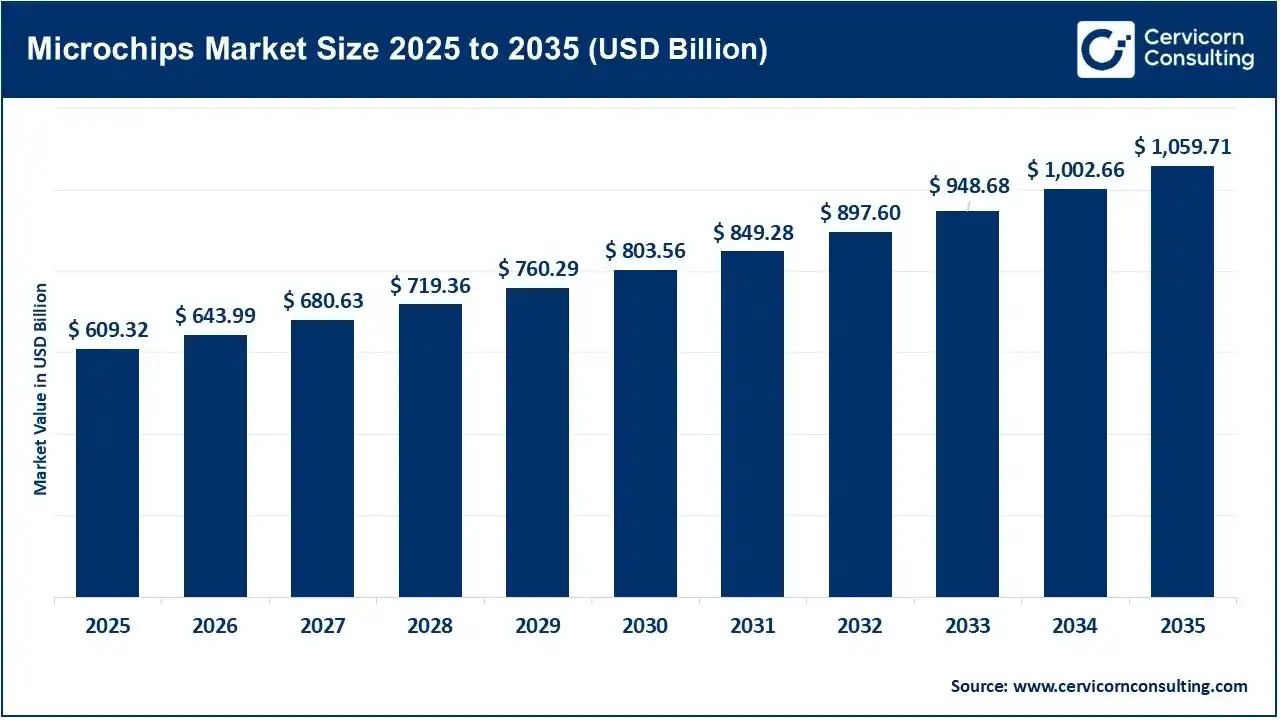
The rapid adoption of artificial intelligence (AI), high-performance computing, cloud infrastructure, and data centers is a major driver of microchip demand, increasing requirements for processors, GPUs, memory, connectivity, and power-management chips. AI infrastructure is particularly chip-intensive: a single AI server rack can contain more than 4,500 packaged semiconductors, with semiconductors accounting for over 95% of the rack’s value. Semiconductor Industry Association (SIA) estimates that annual chip revenue deployed in AI data centers could exceed USD 1.2 trillion by 2028. Meanwhile, global semiconductor sales reached USD 791.7 billion in 2025, up 25.6% year over year, demonstrating the strong underlying demand for advanced chip technologies.
Another important growth factor is the increasing integration of microchips into automotive electronics, autonomous driving systems, electric vehicles, IoT devices, industrial automation, smartphones, and connected consumer products. Automotive semiconductor demand has been particularly significant, with automotive chip sales growing 15.0% in 2023, according to the Semiconductor Industry Association. The expansion of software-defined vehicles, electrification, advanced driver-assistance systems, and connected devices is increasing the number and sophistication of chips required per product. At the same time, the rollout of 5G and emerging 6G networks, edge computing, robotics, and smart manufacturing is creating additional demand for specialized processing, sensing, connectivity, and control chips.
Market Overview & Projections
- Market Size (2026): USD 609.32 Billion
- Market Size (2035): USD 1,059.71 Billion
- Growth Rate (CAGR): 5.7%
- Leading Region: Asia-Pacific (55.2% share)
Report Highlights
- Asia-Pacific dominated the global microchips market with 55.2% market share in 2025, supported by its extensive semiconductor manufacturing, electronics production, memory, foundry, and supply-chain ecosystem.
- Microprocessors (MPUs) represented 22.8% of the market, making them the leading chip-type segment due to their extensive deployment across PCs, servers, enterprise computing, and embedded systems.
- Processing functions captured 31.7% of the market, making processing the largest functional segment as AI, cloud computing, edge computing, automation, and connected devices increase computational requirements.
- Smartphones and tablets accounted for 23.7% market share, supported by high semiconductor integration across application processors, memory, connectivity, sensors, graphics, security, and power-management systems.
- 6–14 nm technology accounted for 25.8% of the market, reflecting strong utilization across high-performance processors, connectivity chips, automotive electronics, and advanced embedded applications.
- OEMs represented 34.6% of the end-user market, reflecting their substantial semiconductor requirements across automotive, consumer electronics, industrial equipment, telecommunications, and computing products.
What Are Microchips?
Microchips are miniature electronic circuits fabricated primarily on semiconductor materials such as silicon, containing transistors and other components that perform processing, memory, control, sensing, communication, and power-management functions. They are fundamental components in smartphones, computers, vehicles, industrial equipment, medical devices, data centers, AI systems, and virtually all modern electronic products.
Recent Milestones
| Year |
Company |
Milestone |
| 2026 |
Intel |
Intel 18A-P entered risk production, advancing its leading-edge semiconductor process for next-generation computing. |
| 2026 |
NVIDIA & TSMC |
NVIDIA and TSMC announced the use of accelerated AI computing and AI models to improve chip design, lithography, process simulation, and fab operations. |
| 2026 |
Micron |
Micron demonstrated the world's first 512GB DDR5 server memory module, reaching speeds of up to 9,200 MT/s. |
| 2026 |
Micron |
Micron demonstrated the world's first 512GB DDR5 server memory module, reaching speeds of up to 9,200 MT/s. |
| 2025 |
MicronTSMC |
Micron reached 60,000 lifetime patents and shipped HBM4 to key customers, alongside its 1γ DRAM technology and SOCAMM module. |
| 2025 |
TSMC |
TSMC demonstrated a 0.43 μm-pitch quad-photodiode CMOS image sensor using advanced 3D wafer-stacking technologies. |
| 2025 |
Global Semiconductor Industry |
Worldwide semiconductor revenue reached approximately USD 793 billion, increasing 21% year over year, with AI semiconductors accounting for nearly one-third of total sales |
Microchips Market Dynamics
Market Drivers
1. AI and High-Performance Computing Adoption
Growing deployment of AI workloads is accelerating demand for advanced microchips, including GPUs, AI accelerators, processors, and high-bandwidth memory. AI semiconductors are expected to represent approximately 30% of total semiconductor revenue in 2026, highlighting the increasing importance of AI infrastructure. Hyperscalers are expanding AI computing capacity, while enterprises are adopting generative AI and machine-learning applications, increasing demand for specialized chips capable of handling intensive computational workloads efficiently.
2. Automotive Electronics and Edge Computing
Increasing electronic content in vehicles is expanding demand for microprocessors, microcontrollers, system-on-chips, and sensing components. Automotive micro components using 20-nanometer-or-smaller nodes could grow at approximately 24% annually through 2030, reaching around USD 18 billion. Software-defined vehicles, advanced driver-assistance systems, electrification, and edge AI are increasing semiconductor content per vehicle while creating demand for chips capable of real-time processing, improved energy efficiency, and enhanced connectivity.
Market Restraints
1. Rising Manufacturing Costs
Advanced microchip manufacturing requires sophisticated lithography equipment, specialized materials, cleanrooms, advanced packaging, and highly controlled production environments, increasing capital and operating expenditure. Leading-edge 3–5 nm fabrication facilities can consume approximately 200–300 MW of electricity at scale, while a semiconductor fabrication facility can require around 10 million gallons of water daily. These substantial resource requirements can increase manufacturing costs and restrict expansion in regions with constrained energy, water, or semiconductor-supporting infrastructure.
2. Volatile Component Pricing
Fluctuations in semiconductor supply and demand can create significant pricing pressure throughout the electronics supply chain. In 2026, DRAM prices are projected to increase by approximately 125%, while NAND flash prices could rise by 234%, reflecting substantial supply-demand imbalances. Such volatility can increase component costs for electronics manufacturers, reduce profit margins, complicate procurement planning, and encourage companies to redesign products or postpone production when chip prices become difficult to absorb.
Market Opportunities
1. Edge AI and Intelligent Automotive Systems
The transition from centralized cloud processing toward edge AI is creating opportunities for microchips capable of performing inference, sensing, security, and control directly within connected devices. Automotive applications represent an important opportunity because vehicles increasingly require localized processing for driver assistance, automated functions, and real-time decision-making. Advanced automotive micro components below 20 nm are projected to reach approximately USD 18 billion by 2030, supporting demand for specialized processors, microcontrollers, and system-on-chip architectures.
2. AI-Optimized Chip Architectures
Increasing demand for customized accelerators, application-specific processors, and advanced memory architectures is creating opportunities for purpose-built microchips. Hyperscaler spending on AI infrastructure is expected to increase by more than 50% in 2026, supporting demand for AI accelerators, custom processors, networking chips, and memory solutions. Semiconductor developers can capitalize on this trend by creating chips optimized for specific workloads such as AI inference, model training, data processing, networking, and energy-efficient computing.
Market Challenges
1. Water and Energy Availability
Microchip fabrication faces growing challenges related to water availability and energy consumption because semiconductor manufacturing requires large quantities of ultrapure water and highly reliable electricity. Research indicates that at least 40% of existing semiconductor facilities are located in watersheds projected to experience high or extremely high water-stress risk during 2030–2040. These constraints can complicate facility expansion, increase operating costs, create production risks, and require manufacturers to invest in water recycling and energy-efficiency technologies.
2. Climate-Related Supply-Chain Disruptions
Microchip production depends on globally distributed supplies of critical raw materials and specialized components, making the industry vulnerable to climate-related disruptions. Approximately 32% of global semiconductor production could depend on copper supplies exposed to climate disruption by 2035, potentially increasing to 58% by 2050 under higher-emission scenarios. Such exposure creates challenges for securing raw materials, maintaining uninterrupted production, diversifying suppliers, and developing geographically resilient semiconductor supply chains.
Microchips Market Regional Analysis
The microchips market is segmented by region into North America, Europe, Asia-Pacific, Latin America, and LAMEA. Here is a brief overview of each region:
Asia-Pacific (APAC) Microchips Market: Driven by Electronics Manufacturing, AI Computing, Semiconductor Capacity Expansion, Automotive Electrification, and Government-Led Localization
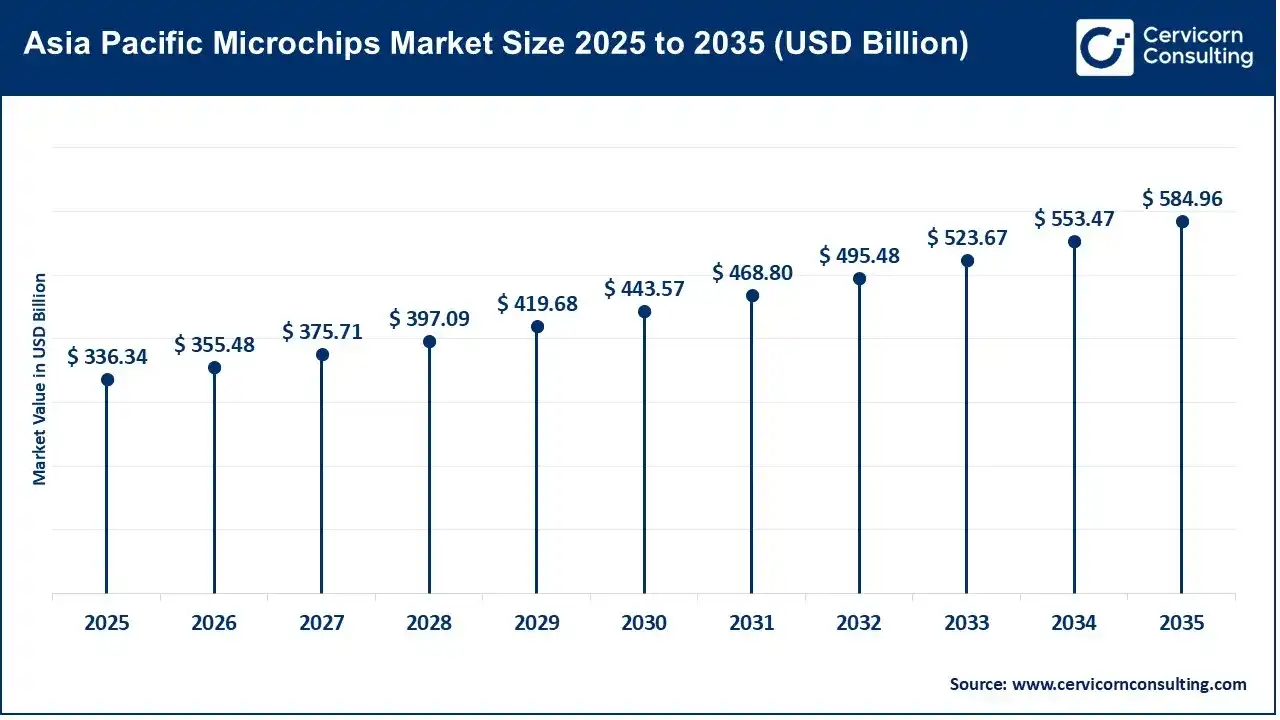
The Asia-Pacific microchips market size was valued at USD 336.34 billion in 2025 and is expected to reach around USD 584.96 billion by 2035. Asia-Pacific is the largest and most strategically important region, supported by extensive electronics manufacturing, strong consumer electronics demand, advanced semiconductor ecosystems, AI infrastructure expansion, automotive electrification, and government-backed semiconductor localization. China, Taiwan, South Korea, Japan, India, and Southeast Asian economies collectively cover major parts of the semiconductor value chain, from chip design and fabrication to memory, equipment, materials, assembly, and testing. Asia-Pacific accounted for more than 52% of global semiconductor revenue, reflecting the region's exceptional manufacturing and consumption base.
China: Large Electronics Manufacturing Base, Domestic Chip Localization, AI Computing, and Expanding Fabrication Capacity Drive Market Demand
- China remains the largest semiconductor device market in Asia-Pacific, accounting for approximately 51.62% of regional semiconductor-device revenue in 2025.
- Chinese semiconductor manufacturing capacity reached approximately 10.1 million wafers per month in 2025, representing around one-third of global capacity and strengthening domestic availability of logic, memory, and other microchips.
- Increasing AI adoption is driving demand for processors, accelerators, memory, networking chips, and specialized AI microchips across cloud computing and enterprise applications.
Japan: Semiconductor Materials, Manufacturing Equipment, Automotive Electronics, and Advanced Chip Development Support Market Growth
- Japan maintains a strategically important position through its strengths in semiconductor materials, manufacturing equipment, sensors, power semiconductors, automotive electronics, and precision technologies.
- Japan's semiconductor manufacturing capacity was projected to reach approximately 4.7 million wafers per month, representing around 3% year-over-year growth, supporting continued domestic production and supply-chain development.
North America Microchips Market: Driven by AI Infrastructure, Data Center Expansion, Automotive Electrification, Advanced Manufacturing, and Supply-Chain Localization
The North America microchips market size was estimated at USD 149.28 billion in 2025 and is forecasted to hit USD 259.63 billion by 2035. North America is a major market, supported by strong demand from AI computing, cloud infrastructure, data centers, automotive electronics, industrial automation, telecommunications, aerospace, and defense. The region combines a large technology-consuming base with advanced semiconductor design, research, manufacturing, and packaging capabilities. The United States remains the primary regional hub, while Canada is strengthening its position in specialized semiconductor technologies, photonics, advanced packaging, and AI infrastructure. In 2025, U.S.-headquartered semiconductor companies accounted for 53.4% of worldwide semiconductor sales, highlighting the region's importance within the global semiconductor ecosystem.
United States: AI Computing, Data Centers, Domestic Manufacturing, Automotive Electronics, and Advanced R&D Drive Market Demand
- AI infrastructure expansion is increasing demand for GPUs, CPUs, ASICs, high-bandwidth memory, networking chips, and advanced packaging, particularly across hyperscale data centers.
- U.S. semiconductor companies invested USD 76.8 billion in R&D during 2025, supporting development of advanced processors, AI accelerators, memory technologies, sensors, and specialized microchips.
- More than USD 770 billion in private-sector semiconductor investments have been announced across the United States since 2020, covering fabrication facilities, advanced packaging, semiconductor materials, and equipment.
Canada: AI Infrastructure, Advanced Packaging, Photonics, Automotive Electronics, and Specialized Semiconductor Technologies Support Market Development
- Canada is developing a specialized semiconductor ecosystem focused on advanced packaging, photonics, AI hardware, telecommunications, automotive technologies, aerospace, and defense applications.
- A major semiconductor packaging initiative in Quebec has a total project value of approximately USD 662 million, strengthening Canada's advanced semiconductor manufacturing and commercialization capabilities.
Europe Microchips Market: Driven by Automotive Electronics, Industrial Automation, AI Edge Computing, Semiconductor Localization, and Advanced Manufacturing Technologies
The Europe microchips market size was accounted for USD 73.73 billion in 2025 and is projected to surpass USD 128.22 billion by 2035. Europe is an important market, supported by its strong automotive and industrial electronics base, semiconductor equipment and materials capabilities, advanced research infrastructure, and increasing efforts to strengthen regional supply-chain resilience. The region is particularly well positioned in automotive, industrial, power, sensing, embedded, and specialized semiconductor applications, while investment in AI and advanced manufacturing is creating additional demand for high-performance and edge-processing chips. EU semiconductor value-chain revenues reached an estimated EUR 93 billion in 2025, increasing from EUR 53 billion in 2019.
Germany: Automotive Electronics, Industrial Automation, Power Semiconductors, and Embedded Computing Drive Market Demand
- Germany represents a major European semiconductor demand center, with 27.89% of Europe's semiconductor-device market in 2025, supported by its large automotive and industrial manufacturing base.
- The country's automotive industry generates substantial demand for MCUs, sensors, power-management chips, connectivity components, and processing systems as vehicles become increasingly electrified and software-defined.
Netherlands: Semiconductor Equipment, Advanced Manufacturing, AI, and High-Precision Technologies Support Market Development
- The Netherlands plays a strategically important role in Europe's microchip ecosystem through its semiconductor manufacturing-equipment, photonics, lithography, and high-precision technology capabilities.
- The country is projected to record the fastest semiconductor-device market growth in Europe, with a 6.1% CAGR through 2035, supported by advanced semiconductor technologies and expanding demand.
Microchips Market Share, By Region, 2025 (%)
| Region |
Revenue Share, 2025 (%) |
| Asia-Pacific |
55.2% |
| North America |
24.5% |
| Europe |
12.1% |
| LAMEA |
8.2% |
LAMEA (Latin America, Middle East & Africa) Microchips Market: Driven by AI Infrastructure, Electronics Manufacturing, Semiconductor Localization, Smart Cities, Automotive Electronics, and Digital Transformation
The LAMEA microchips market was valued at USD 49.96 billion in 2025 and is anticipated to reach USD 86.90 billion by 2035. LAMEA is an emerging market supported by expanding electronics consumption, telecommunications infrastructure, AI adoption, data-center development, automotive electronics, industrial digitization, and government-led semiconductor initiatives. Brazil and Mexico provide important demand and manufacturing bases in Latin America, while the UAE and Saudi Arabia are rapidly developing AI and digital infrastructure in the Middle East. African markets are creating additional demand through telecommunications, fintech, cloud computing, energy systems, and connected technologies. The region is gradually moving beyond dependence on imported electronics toward greater participation in semiconductor design, packaging, testing, and specialized manufacturing.
Latin America: Electronics Manufacturing, Automotive Demand, Semiconductor Localization, and Digital Transformation Support Market Development
- Brazil represents a major semiconductor market in LAMEA, supported by consumer electronics, automotive electronics, telecommunications, industrial equipment, and growing domestic semiconductor capabilities.
- Brazil's semiconductor industry announced BRL 24.8 billion in investments in R&D, production-capacity expansion, and factory development, strengthening the country's participation in the global semiconductor value chain.
- In 2025, Brazil's foreign direct investment inflows increased from USD 63 billion to USD 77 billion, providing a broader investment environment for technology, manufacturing, and industrial projects.
Middle East: AI Data Centers, Smart Cities, Cloud Infrastructure, and Economic Diversification Accelerate Microchip Demand
- The Middle East is becoming an important source of demand for high-performance microchips as governments and technology investors expand AI computing, cloud infrastructure, smart cities, and digital services.
- Regional data-center capacity is projected to increase from approximately 1 GW in 2025 to 3.3 GW within five years, creating substantial requirements for processors, GPUs, memory, networking chips, and power-management components.
- Saudi Arabia is developing dedicated AI-data-center infrastructure, including financing programs for facilities with minimum 10 MW IT loads, supporting large-scale deployment of AI computing hardware.
Microchips Market Segmental Analysis
The microchips market is segmented into chip type, technology, function, device, end user, and geography.
Chip Type Analysis
Microprocessors remain a major chip category because they provide general-purpose computing capabilities across PCs, servers, enterprise systems, embedded platforms, and increasingly AI-enabled devices. The broad computer microchip market shows CPUs accounting for approximately one-third of revenue, reflecting their established role across computing infrastructure. Demand is supported by increasing processing requirements, multicore architectures, cloud computing, and enterprise digitization. However, specialized accelerators are gradually taking a larger role in workloads that previously depended primarily on conventional processors.
Microchips Market Share, By Chip Type, 2025 (%)
| Chip Type |
Revenue Share, 2025 (%) |
| Microprocessors (MPUs) |
22.8% |
| Microcontrollers (MCUs) |
9.7% |
| Digital Signal Processors (DSPs) |
4.1% |
| Graphics Processing Units (GPUs) |
13.6% |
| Application-Specific Integrated Circuits (ASICs) |
10.9% |
| Field-Programmable Gate Arrays (FPGAs) |
5.6% |
| Memory Chips |
18.7% |
| System-on-Chip (SoC) |
7.8% |
| Analog and Mixed-Signal Chips |
5.4% |
| Others |
1.4% |
Microcontrollers are expected to experience strong growth as connected and automated devices increasingly require localized control and processing. MCUs combine processing, memory, and peripherals in compact architectures, making them suitable for automotive electronics, industrial automation, IoT devices, appliances, and smart equipment. Increasing adoption of edge intelligence is further improving their value proposition by enabling real-time control without continuous cloud connectivity. The proliferation of connected devices and electronic content in vehicles is expected to sustain strong demand for increasingly capable and energy-efficient microcontrollers.
Technology Analysis
The 5 nm-and-below category represents the leading edge of semiconductor manufacturing and is increasingly important for high-performance processors, AI accelerators, premium mobile chips, and advanced computing systems. Leading-edge logic capacity is expanding rapidly, with industry forecasts indicating that 7 nm-and-below capacity was expected to grow 16% in 2025, reaching approximately 2.2 million wafers per month. Higher transistor density enables improved performance and energy efficiency, making advanced nodes increasingly important for computationally intensive applications.
Microchips Market, By Technology, 2025 (%)
| Technology |
Revenue Share, 2025 (%) |
| 5 nm and Below |
21.6% |
| 6–14 nm |
25.8% |
| 15–28 nm |
22.4% |
| 29–65 nm |
18.9% |
| Above 65 nm |
11.3% |
The 6–14 nm segment is expected to expand strongly because it offers a balance between performance, power efficiency, manufacturing complexity, and cost. These nodes remain suitable for processors, connectivity chips, automotive electronics, industrial systems, and various high-performance applications. While the newest AI processors increasingly use more advanced nodes, significant volumes of sophisticated electronics can still be produced at 6–14 nm. Continued demand for high-performance computing and expanding advanced-node capacity are supporting this technology category across multiple application areas.
Function Analysis
Processing represents the largest functional category because microprocessors, GPUs, MCUs, DSPs, and specialized accelerators perform the computational operations required by modern electronic systems. Increasing workloads from AI, cloud computing, edge applications, automation, and connected devices are raising demand for computational capacity. In 2025, data-processing applications recorded more than 40% year-over-year growth within the semiconductor industry, highlighting the strong expansion of processing requirements. Continued adoption of AI and high-performance computing is expected to reinforce this functional segment.
Microchips Market, By Function, 2025 (%)
| Function |
Revenue Share, 2025 (%) |
| Processing |
31.7% |
| Memory |
21.9% |
| Connectivity |
11.6% |
| Sensing |
7.8% |
| Power Management |
9.4% |
| Control and Logic |
7.1% |
| Security |
4.2% |
| Signal Processing |
4.8% |
| Others |
1.5% |
Memory is expected to remain one of the fastest-growing functional categories as AI, cloud computing, data analytics, and high-performance servers require increasingly large and faster memory pools. AI systems require both high-bandwidth memory and conventional system memory to process large datasets efficiently. Industry data indicates that DRAM revenue surpassed $150 billion in 2025, having nearly tripled from its 2023 market low. Increasing memory intensity per computing system is therefore strengthening demand for DRAM, HBM, NAND, and other memory technologies.
Device Analysis
Smartphones and tablets remain major microchip-consuming devices because they integrate application processors, GPUs, memory, connectivity, power-management, sensing, security, and display-related components. Increasing AI functionality is adding dedicated processing capabilities for on-device inference, imaging, voice processing, and personalization. Manufacturers are also prioritizing energy efficiency because battery limitations constrain mobile computing performance. Increasing computational requirements, advanced camera systems, 5G connectivity, and AI-enabled applications are sustaining substantial demand for increasingly integrated and energy-efficient microchip architectures in mobile devices.
Microchips Market, By Device, 2025 (%)
| Device |
Revenue Share, 2025 (%) |
| Smartphones and Tablets |
23.7% |
| PCs and Laptops |
13.8% |
| Wearable Devices |
4.6% |
| Smart Home Devices |
4.1% |
| Automotive Electronics |
16.2% |
| Industrial Equipment |
9.8% |
| Servers and Data Storage Systems |
15.1% |
| Networking Equipment |
6.4% |
| Medical Devices |
3.7% |
| Others |
2.6% |
Smart-home devices are expected to expand rapidly as households adopt connected lighting, appliances, security systems, thermostats, speakers, cameras, and energy-management equipment. These products require microchips for sensing, wireless communication, processing, security, and power control. Growing interoperability between connected devices is encouraging more sophisticated local processing and edge intelligence. The increasing adoption of AI-enabled home assistants and automated systems is also raising semiconductor content per device, supporting demand for low-cost, low-power, and highly integrated microchip solutions.
End User Analysis
OEMs represent the dominant end-user category because they directly integrate microchips into finished electronic products, vehicles, industrial equipment, appliances, and communication systems. Increasing semiconductor content across modern products makes chip selection a critical part of product architecture, performance, energy efficiency, and security. OEM demand is also being strengthened by AI-enabled electronics and connected products that require more sophisticated processing capabilities. Long product-development cycles and qualification requirements encourage OEMs to establish structured semiconductor sourcing and design relationships.
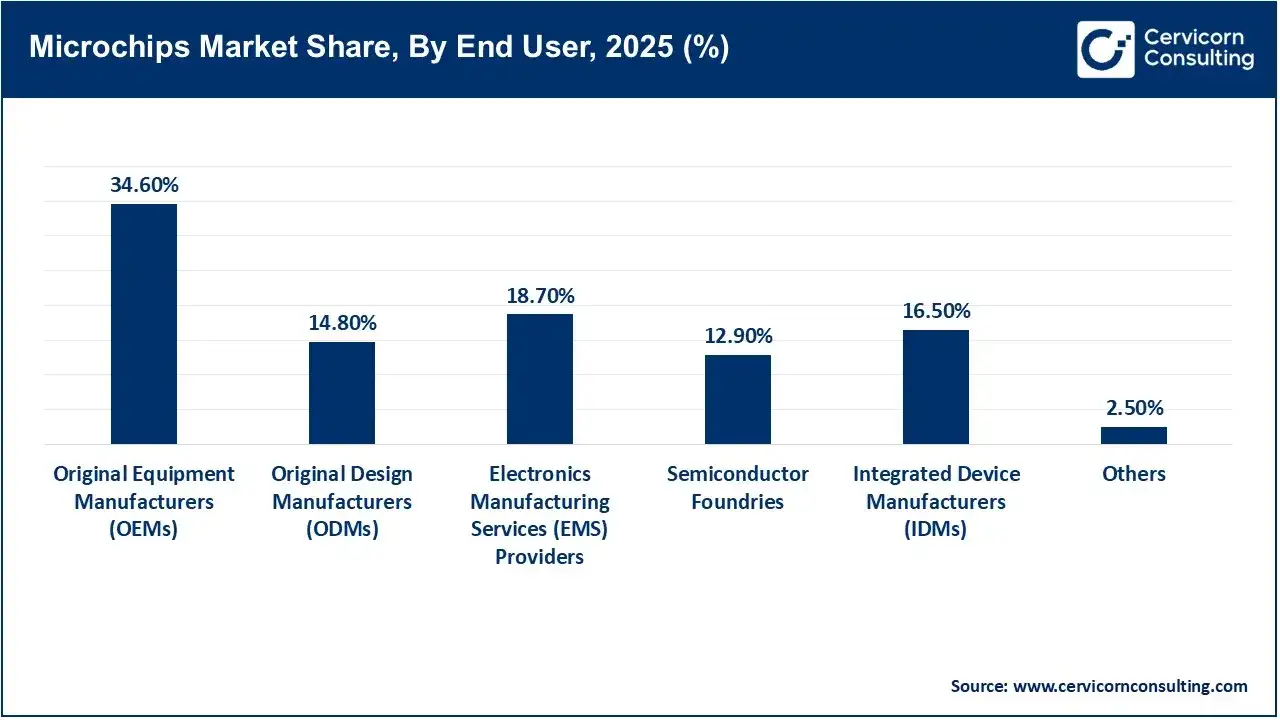
EMS providers remain a major end-user group because they manufacture and assemble electronic products for multiple industries, creating significant recurring demand for microchips. Increasing outsourcing of electronics production enables manufacturers to manage complex component procurement, assembly, testing, and supply chain requirements. The growing complexity of boards containing processors, memory, connectivity, power-management, and security chips is increasing the value of sophisticated manufacturing services. Expansion of consumer electronics, industrial systems, automotive electronics, and communications equipment therefore supports continued microchip demand through EMS channels.
Microchips Market Top Companies
Segments Covered
By Chip Type
- Microprocessors (MPUs)
- Microcontrollers (MCUs)
- Digital Signal Processors (DSPs)
- Graphics Processing Units (GPUs)
- Application-Specific Integrated Circuits (ASICs)
- Field-Programmable Gate Arrays (FPGAs)
- Memory Chips
- System-on-Chip (SoC)
- Analog and Mixed-Signal Chips
- Others
By Technology
- 5 nm and Below
- 6–14 nm
- 15–28 nm
- 29–65 nm
- Above 65 nm
By Function
- Processing
- Memory
- Connectivity
- Sensing
- Power Management
- Control and Logic
- Security
- Signal Processing
- Others
By Device
- Smartphones and Tablets
- PCs and Laptops
- Wearable Devices
- Smart Home Devices
- Automotive Electronics
- Industrial Equipment
- Servers and Data Storage Systems
- Networking Equipment
- Medical Devices
- Others
By End User
- Original Equipment Manufacturers (OEMs)
- Original Design Manufacturers (ODMs)
- Electronics Manufacturing Services (EMS) Providers
- Semiconductor Foundries
- Integrated Device Manufacturers (IDMs)
- Others
By Geography
- North America
- Europe
- Asia-Pacific
- LAMEA