Industrial Automation and Control Systems Market Size and Growth Outlook 2026 to 2035
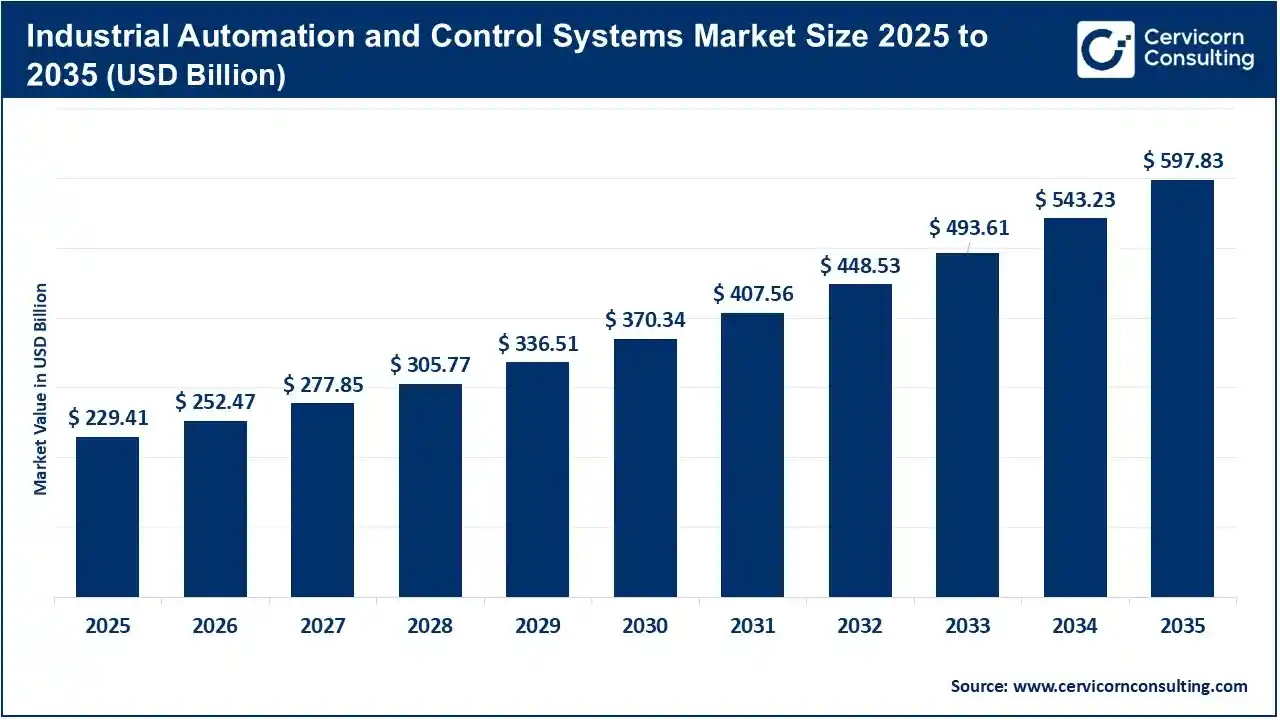
The global industrial automation and control systems market size was valued at USD 229.41 billion in 2025 and is expected to reach around USD 597.83 billion by 2035, exhibiting a compound annual growth rate (CAGR) of 10.1% over the forecast period 2026 to 2035. The increasing adoption of smart manufacturing, robotics, IIoT, and connected control systems is a major driver of industrial automation demand as manufacturers seek higher productivity, precision, flexibility, and real-time monitoring.
According to the International Federation of Robotics (IFR), 542,000 industrial robots were installed globally in 2024, more than double the level recorded a decade earlier, while the global operational stock reached 4.66 million robots, an increase of nearly 9% year over year. Manufacturing automation is also becoming more widespread geographically, with Asia accounting for 74% of new robot deployments in 2024. The growing integration of AI, machine vision, edge computing, digital twins, and predictive analytics into automation platforms is further shifting factories from isolated automation toward connected and increasingly autonomous operations. The World Economic Forum highlights this transition toward intelligent industrial operations, where humans and intelligent systems increasingly collaborate in real time.
Labor shortages, rising production complexity, quality requirements, and the need for resilient manufacturing are further accelerating investments in automation and control systems. Robot density reached 177 robots per 10,000 manufacturing employees globally in 2024, while Western Europe reached 267 robots per 10,000 employees, North America 204, and Asia 131, demonstrating increasing automation penetration across major manufacturing regions. Collaborative robotics is also expanding within automation environments, with 64,542 collaborative robots installed in 2024, representing 11.9% of industrial robot installations and a 12% increase from 2023.
Report Highlights
- Asia-Pacific accounted for 38.3% of the market, supported by extensive manufacturing automation, industrial robotics, and smart-factory adoption.
- North America held 29.1%, driven by industrial digitalization, factory modernization, reshoring, and integration of connected control systems.
- Control Valves represented 24.3% of the component segment, reflecting their broad deployment across process industries and automated production environments.
- Industrial Robots held 21.7%, supported by increasing demand for automated material handling, assembly, welding, inspection, and repetitive manufacturing tasks.
- DCS accounted for 35.7% of the control-system segment, reflecting extensive deployment across continuous-process and large-scale industrial operations.
- Manufacturing contributed 18.7% of the vertical segment, supported by automation across assembly, machining, quality inspection, material handling, and production control.
- Automotive represented 13.9%, driven by automated assembly, robotics, machine vision, flexible production, and electrification-related manufacturing processes.
What is the Industrial Automation and Control Systems Market?
The Industrial Automation and Control Systems (IACS) market comprises technologies, hardware, software, and services used to automatically monitor, control, optimize, and coordinate industrial processes and manufacturing operations. It includes PLCs, DCS, SCADA, HMI, RTUs, industrial robots, sensors, drives, control valves, safety systems, industrial networks, and automation software, increasingly integrated with IIoT, edge computing, AI, digital twins, and cloud platforms. These systems enable real-time process control, predictive maintenance, quality improvement, energy optimization, worker safety, and greater production flexibility across industries such as automotive, chemicals, oil & gas, pharmaceuticals, food & beverage, electronics, utilities, and mining.
In emerging manufacturing economies, automation investment is also strengthening; India installed 9,120 industrial robots in 2024, up 7%, with automotive applications accounting for approximately 45% of installations. These trends are encouraging manufacturers to modernize PLCs, SCADA, DCS, HMI, industrial networks, safety systems, sensors, drives, and robotic platforms to improve operational efficiency and enable more flexible production.
Recent Milestones
| Date |
Company |
Milestone |
| September 2026 |
Schneider Electric |
Introduced EcoStruxure Foxboro Software Defined Automation, described as an open, software-defined DCS designed to support interoperability, cybersecurity, AI/ML integration, and autonomous operations. |
| August 2026 |
Siemens |
Announced the creation of a unified Automation organization combining Factory Automation, Motion Control, Process Automation, and Customer Services, effective October 1, 2026. |
| June 2026 |
Schneider Electric & HPE |
Launched Industrial Automation Modernization as a Service, combining EcoStruxure Automation Expert with HPE hybrid-cloud infrastructure to modernize automation alongside existing PLC and DCS systems. |
| June 2026 |
ABB |
Launched Automation Extended, enabling customers to add AI, advanced analytics, predictive maintenance, and other digital capabilities to existing DCS platforms without disrupting core control operations. |
| May 2026 |
Rockwell Automation |
Its 2026 smart-manufacturing study found that 95% of APAC manufacturers considered digital transformation essential to competitiveness, while 71% planned to increase AI/ML use over the following 12 months. |
| March 2026 |
Siemens |
Introduced 26 new edge, automation, and control technologies at its Siemens RXD Summit, including enhanced PLC capabilities and AI-enabled industrial technologies. |
| April 2026 |
ABB |
Reported that its Automation business introduced the Automation Extended program as an evolution of its DCS offering, enabling progressive adoption of advanced analytics and AI while maintaining existing system integrity. |
Industrial automation and Control Systems Market Dynamics
Market Drivers
1. Expansion of Smart Manufacturing and Robotics
The transition toward smart factories is increasing demand for PLCs, SCADA, DCS, HMI, robotics, sensors, and connected control platforms. Manufacturers are deploying automation to improve production consistency, reduce manual intervention, and enable real-time decision-making. The International Federation of Robotics reported that China accounted for 54% of global industrial robot installations in 2024, with 295,000 units installed, highlighting the scale of automation adoption in manufacturing. Integration of AI, IIoT, edge computing, and machine vision is further expanding the role of industrial control systems.
2. Rising Focus on Industrial Energy Efficiency
Growing electricity costs, decarbonization targets, and pressure to optimize industrial operations are encouraging companies to deploy automation systems for energy monitoring and intelligent process control. Advanced control platforms can continuously measure equipment performance, identify inefficient operating conditions, and optimize motors, pumps, compressors, and production processes. The International Energy Agency reports that industrial energy-management programs can deliver more than 10% average energy savings within the first three years, demonstrating a significant incentive for manufacturers to integrate automated energy-management and control capabilities.
Market Restraints
1. High Initial Investment and Integration Costs
Industrial automation projects require substantial upfront expenditure on controllers, sensors, robotics, industrial networks, software, engineering, cybersecurity, installation, and employee training. Costs become particularly challenging when manufacturers must integrate modern automation with older equipment and proprietary control architectures. Small and medium-sized manufacturers can therefore face longer investment-recovery periods than large enterprises. The complexity of connecting operational technology with enterprise systems also increases engineering requirements, while inconsistent industrial protocols can create additional interoperability expenses during automation modernization projects.
2. Cybersecurity Risks in Connected Industrial Systems
Greater connectivity between PLCs, SCADA, DCS, IIoT devices, cloud platforms, and remote-access systems increases the potential attack surface for industrial facilities. Legacy control equipment can be particularly difficult to protect because many systems were designed before cybersecurity became a major requirement. A 2025 SANS ICS/OT survey covering more than 330 professionals found that 21.5% of organizations reported a cybersecurity incident during the previous year, while nearly half of affected organizations experienced operational outages. These risks can discourage rapid automation deployment.
Market Opportunities
1. AI-Enabled Autonomous Industrial Control
The integration of artificial intelligence with industrial automation creates opportunities for predictive maintenance, anomaly detection, adaptive process optimization, machine vision, and increasingly autonomous production. AI can analyze large volumes of sensor and operational data and support faster responses to changing production conditions. The World Economic Forum's Global Lighthouse Network had 189 advanced technology-driven manufacturing sites by 2025, illustrating the expanding ecosystem of digitally enabled factories. This creates opportunities for automation vendors to develop AI-enabled PLCs, DCS platforms, industrial analytics, and autonomous control solutions.
2. Energy Optimization and Industrial Sustainability
The increasing emphasis on industrial decarbonization creates opportunities for automation suppliers to combine process control with energy-management, emissions monitoring, and optimization capabilities. Automation systems can coordinate equipment operation according to energy consumption, production demand, and efficiency targets, helping manufacturers reduce unnecessary energy use. The IEA estimates that aligning industrial companies toward the efficiency performance of the top 25% of firms could potentially reduce industrial energy costs in member countries by up to USD 600 billion annually, creating substantial incentives for intelligent monitoring and control solutions.
Market Challenges
1. Legacy-System Modernization and Interoperability
A major challenge is integrating modern automation technologies with legacy PLCs, DCS, SCADA platforms, machines, and industrial networks that were not designed for cloud connectivity or modern data architectures. Manufacturers often need to modernize systems without interrupting production, making migration technically complex and costly. The World Economic Forum identifies lack of standardized protocols across supply chains as an obstacle to end-to-end visibility, while seamless IT-OT interoperability remains difficult. This creates technical challenges for unified data exchange and coordinated industrial control.
2. Shortage of Specialized Automation and Digital Skills
Industrial automation increasingly requires expertise spanning controls engineering, robotics, networking, data analytics, AI, cybersecurity, and industrial software. Finding personnel with this combination of operational-technology and digital skills can slow implementation and increase dependence on system integrators and specialized vendors. The challenge becomes more significant as factories move from conventional automation toward connected and intelligent architectures. Companies therefore need continuous workforce training alongside technology investments, while automation providers must simplify engineering environments and provide more standardized tools to reduce dependence on highly specialized technical expertise.
Regional Analysis
The industrial automation and control systems market is segmented by region into North America, Europe, Asia-Pacific, Latin America, and LAMEA. Here is a brief overview of each region:
North America Industrial Automation and Control Systems Market: Driven by Smart Manufacturing, Robotics Adoption, Reshoring, Automotive Automation, and Digital Industrialization
The North America industrial automation and control systems market size was valued at USD 66.76 billion in 2025 and is expected to hit USD 173.97 billion by 2035. North America is a highly advanced market, supported by smart manufacturing initiatives, reshoring of production, industrial robotics, IIoT adoption, and modernization of legacy control infrastructure. The United States remains the primary technology hub, while Canada benefits from automation across automotive, mining, energy, and food processing, and Mexico is gaining investment through nearshoring and manufacturing expansion. In 2025, the United States recorded 307 robots per 10,000 manufacturing employees, reflecting the region's substantial automation penetration and continued requirement for sophisticated control, robotics, sensing, and industrial networking technologies.
United States: Smart Manufacturing, Industrial AI, Reshoring, Robotics, and Legacy-System Modernization Drive Demand
- 13,500 robots were installed in the U.S. automotive industry in 2025, reinforcing automotive manufacturing as an important application area for industrial automation and control technologies.
- Food and beverage automation is expanding beyond traditional robotics applications, with robot installations in the U.S. food industry increasing by 30% in 2025, creating opportunities for hygienic automation, machine vision, sensors, and automated material handling.
Canada: Advanced Manufacturing, Automotive, Mining Automation, Energy Modernization, and Industrial Digitization Support Adoption
Canada's manufacturing robot density reached approximately 241 robots per 10,000 manufacturing employees, demonstrating substantial automation penetration across industrial production.
Automotive manufacturing accounted for approximately 47% of Canada's industrial robot installations, making automated assembly, welding, inspection, and material handling important areas of technology deployment.
Asia-Pacific (APAC) Industrial automation and Control Systems Market: Driven by Smart Manufacturing, Robotics, Electronics Production, Industrial AI, and Factory Modernization
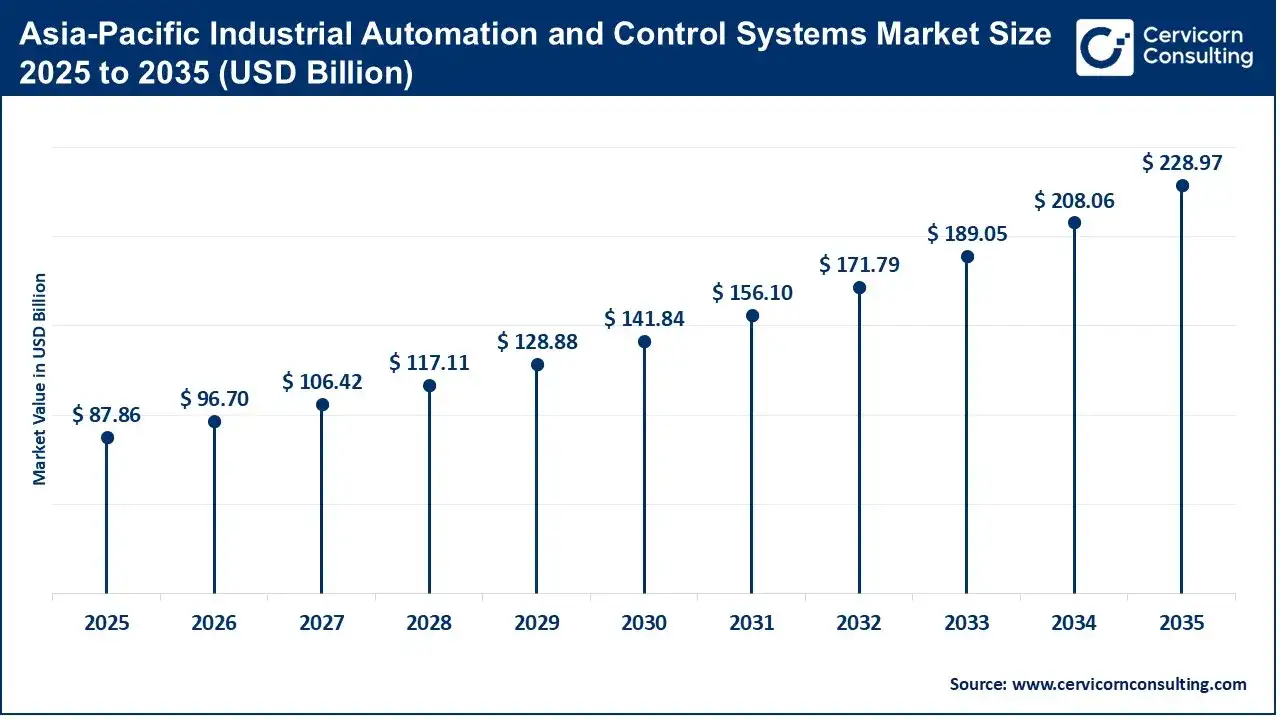
The Asia-Pacific industrial automation and control systems market size was estimated at USD 87.86 billion in 2025 and is projected to surpass around USD 228.97 billion by 2035. Asia-Pacific is a major and rapidly evolving market, supported by large manufacturing bases, expanding electronics and semiconductor production, smart-factory initiatives, robotics adoption, and increasing investments in AI-enabled industrial technologies. China, Japan, South Korea, India, Taiwan, and Southeast Asia are important automation centers, with demand spanning automotive, electronics, chemicals, pharmaceuticals, food processing, metals, and energy. Asia accounted for 74% of global industrial robot deployments in 2024, demonstrating the region's central role in industrial automation adoption.
China: Large Manufacturing Base, Robotics, Electronics Production, AI Integration, and Smart Factories Drive Market Demand
- Chinese manufacturers' share of their domestic industrial robot market increased to 57% in 2024, highlighting the strengthening domestic automation ecosystem and growing availability of locally developed technologies.
- The country's operational industrial robot stock surpassed 2 million units in 2024, creating substantial demand for automation software, industrial networking, maintenance, control-system upgrades, and digitalization.
Japan: Advanced Robotics, Automotive Automation, Electronics, Precision Manufacturing, and Factory Modernization Support Market Growth
- Japan installed approximately 44,500 industrial robots in 2024, maintaining its position as one of the world's largest robotics markets.
- The country's operational industrial robot stock reached approximately 450,500 units in 2024, supporting continued demand for control-system modernization, robotics integration, sensors, and industrial software.
- Japan's aging workforce is encouraging manufacturers to increase automation, particularly across automotive, electronics, machinery, food processing, and logistics applications.
Europe Industrial automation and Control Systems Market: Driven by Industry 4.0, High Automation Penetration, Automotive Modernization, AI Integration, and Manufacturing Resilience
The Europe industrial automation and control systems market size was accounted for USD 55.98 billion in 2025 and is forecasted to hit USD 145.87 billion by 2035. Europe is a highly automated and technologically mature market, supported by Industry 4.0 adoption, advanced manufacturing, robotics, industrial AI, energy-efficiency initiatives, and modernization of production infrastructure. Germany, Italy, France, Spain, the United Kingdom, Switzerland, and the Netherlands represent important automation centers, while nearshoring and manufacturing-resilience initiatives are creating additional demand for robotics, PLCs, SCADA, DCS, sensors, and industrial software.
Germany: Industry 4.0, Automotive Electrification, Robotics, AI, and Advanced Manufacturing Drive Market Demand
- Germany recorded 449 industrial robots per 10,000 manufacturing employees in 2024, placing it among the world's most automated manufacturing economies.
- Germany had 278,881 operational industrial robots in 2024, creating a substantial installed base requiring control-system modernization, industrial networking, software upgrades, and predictive-maintenance solutions.
- Automotive manufacturers and suppliers are increasingly automating battery and electric-drive production, creating demand for precision robotics, motion control, machine vision, and automated inspection.
Italy: SME Automation, Machinery Manufacturing, Automotive, and Flexible Production Support Market Development
- Italy installed 8,783 industrial robots in 2024, making it Europe's second-largest national market for annual robot installations.
- The country's extensive base of small and medium-sized manufacturers is encouraging adoption of flexible automation, collaborative robotics, machine vision, and digitally connected production equipment.
Industrial automation and Control Systems Market Share, By Region, 2025 (%)
| Region |
Revenue Share, 2025 (%) |
| Asia-Pacific |
38.3% |
| North America |
29.1% |
| Europe |
24.4% |
| LAMEA |
8.2% |
LAMEA Industrial automation and Control Systems Market: Driven by Manufacturing Modernization, Oil & Gas Automation, Nearshoring, Smart Infrastructure, and Industrial Digitalization
The LAMEA industrial automation and control systems market was valued at USD 18.81 billion in 2025 and is anticipated to reach USD 49.02 billion by 2035. LAMEA represents an emerging and increasingly diversified market, supported by manufacturing modernization, oil and gas investments, energy infrastructure, mining, food processing, automotive production, and smart-city development. Brazil is an important automation center in Latin America, while Saudi Arabia and the UAE are accelerating industrial digitalization across the Middle East. In the Middle East and Africa, Industrial IoT represented 46.32% of industrial automation revenue in 2024, highlighting the growing importance of connected sensors, real-time monitoring, analytics, and intelligent control architectures.
Latin America: Manufacturing Modernization, Automotive Production, Mining, Food Processing, and Nearshoring Support Automation Adoption
- Brazil is the leading country in LAMEA manufacturing automation, supported by its diversified industrial base spanning automotive, food and beverage, chemicals, mining, pulp and paper, and energy.
- Automotive manufacturing is encouraging adoption of robotic assembly, welding, machine vision, PLCs, industrial networks, and automated inspection systems.
Middle East: Oil & Gas Modernization, Economic Diversification, Smart Infrastructure, and Advanced Manufacturing Accelerate Adoption
- The Middle East represented 65.64% of Middle East and Africa industrial automation revenue in 2024, reflecting its leading position within the subregion.
- Oil and gas remained a major automation application, accounting for 27.53% of Middle East and Africa industrial automation revenue in 2024, supporting demand for process control, instrumentation, SCADA, safety systems, and predictive monitoring.
Segmental Analysis
The industrial automation and control systems market is segmented into component, control system, vertical, and geography.
Component Analysis
Control valves dominate the component segment because they are essential for regulating flow, pressure, temperature, and other process variables across industrial operations. Their extensive deployment in oil and gas, chemicals, power generation, water treatment, and manufacturing supports strong demand. Increasing adoption of smart valves, digital monitoring, IIoT connectivity, and predictive maintenance is further strengthening their importance. Control valves account for approximately 24.3% of the component segment, supported by growing requirements for precise process regulation and automated industrial operations.
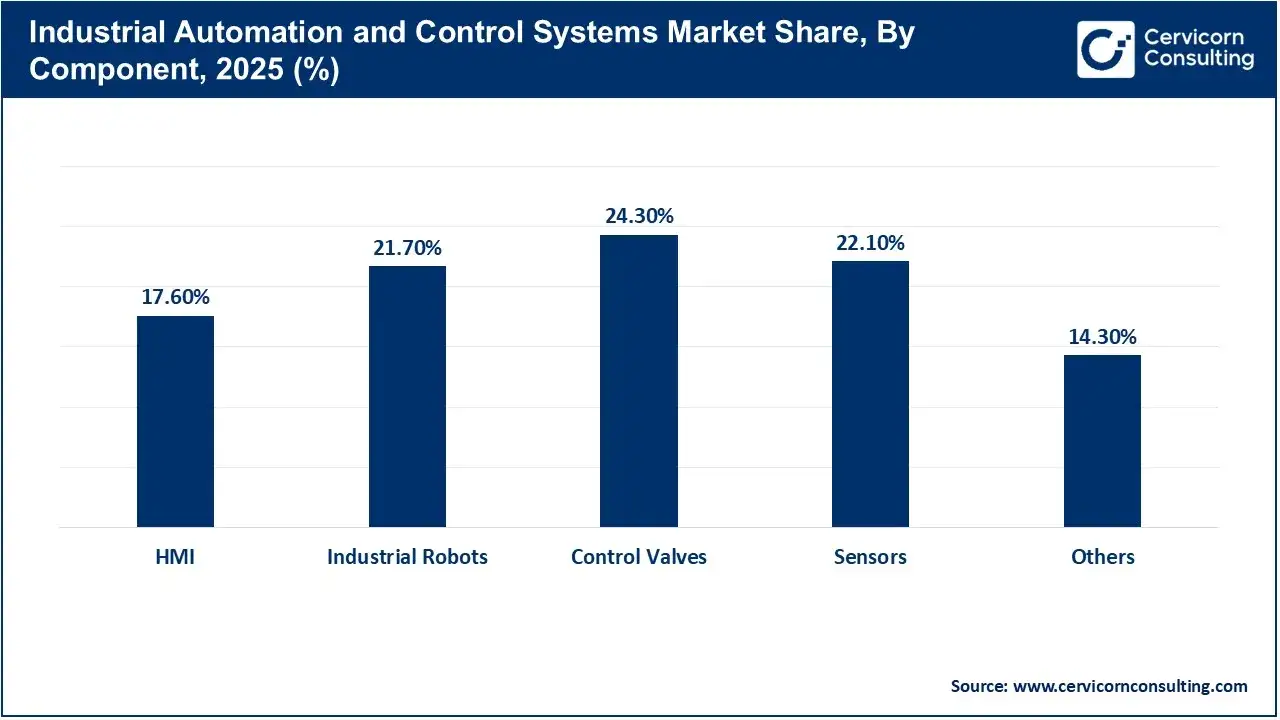
Industrial robots represent the fastest-growing component segment as manufacturers increasingly automate assembly, welding, material handling, packaging, inspection, and other repetitive processes. Growing adoption of collaborative robotics, machine vision, artificial intelligence, and flexible robotic systems is expanding automation across manufacturing environments. Demand is further supported by labor shortages, requirements for higher production accuracy, and increasing investments in smart factories. Industrial robots account for approximately 21.7% of the component segment and are expected to experience strong expansion as flexible and intelligent automation becomes more widespread.
Control System Analysis
Distributed Control Systems dominate the control-system segment because they provide integrated monitoring and automated control across complex continuous and batch industrial processes. They are particularly important for applications requiring high reliability, process stability, safety, and centralized supervision. Extensive utilization across oil and gas, chemicals, power generation, pharmaceuticals, and other process industries supports their leading position. DCS represents approximately 35.7% of the control-system segment, supported by modernization of process facilities and integration with advanced analytics, IIoT connectivity, and increasingly intelligent process-control capabilities.
Industrial automation and Control Systems Market, By Control System, 2025 (%)
| Control System |
Revenue Share, 2025 (%) |
| DCS |
35.7% |
| PLC |
31.4% |
| SCADA |
23.6% |
| Others |
9.3% |
SCADA is the fastest-growing control-system segment due to increasing demand for remote monitoring, real-time data acquisition, centralized visualization, and supervisory control of geographically distributed assets. Its applications are expanding across utilities, water infrastructure, transportation, renewable energy, pipelines, and industrial facilities. Cloud connectivity, edge computing, advanced analytics, and improved cybersecurity are further enhancing SCADA functionality. SCADA accounts for approximately 23.6% of the control-system segment, while increasing deployment of remotely monitored infrastructure is creating additional opportunities for expansion.
Vertical Analysis
Manufacturing dominates the vertical segment because industrial facilities extensively deploy PLCs, robotics, sensors, HMIs, control valves, SCADA, and other automation technologies throughout production operations. Automotive, electronics, machinery, consumer products, and other manufacturing industries are investing in automated production to improve throughput, quality, flexibility, and operational visibility. Increasing adoption of smart factories, IIoT, machine vision, and AI-enabled production systems is further supporting demand. Manufacturing represents approximately 18.7% of the vertical segment, making it the largest application area for industrial automation and control systems.
Industrial automation and Control Systems Market, By Vertical, 2025 (%)
| Vertical |
Revenue Share, 2025 (%) |
| Manufacturing |
18.7% |
| Automotive |
13.9% |
| Energy & Utilities |
12.6% |
| Oil & Gas |
11.8% |
| Chemical |
10.2% |
| Food & Beverage |
7.6% |
| Mining & Metal |
6.8% |
| Transportation |
5.2% |
| Aerospace & Defense |
4.7% |
| Healthcare |
4.4% |
| Others |
4.1% |
Healthcare is the fastest-growing vertical as pharmaceutical production, medical-device manufacturing, laboratories, hospitals, and healthcare facilities increasingly adopt automation to improve precision, quality, safety, and operational efficiency. Automation is expanding across pharmaceutical processing, laboratory workflows, sterile environments, medical-device production, automated material handling, and robotic applications. Increasing regulatory requirements and demand for consistent production processes are supporting technology adoption. Healthcare currently represents approximately 4.4% of the vertical segment, while increasing digitalization and automation across healthcare operations are supporting comparatively rapid growth.
Top Companies
Segments Covered
By Component
- HMI
- Industrial Robots
- Control Valves
- Sensors
- Others
By Control System
By Vertical
- Aerospace & Défense
- Automotive
- Chemical
- Energy & Utilities
- Food & Beverage
- Healthcare
- Manufacturing
- Mining & Metal
- Oil & Gas
- Transportation
- Others
By Geography
- North America
- Europe
- Asia-Pacific
- LAMEA