Japan Physical AI Market Size, Growth, Forecast 2026 to 2035
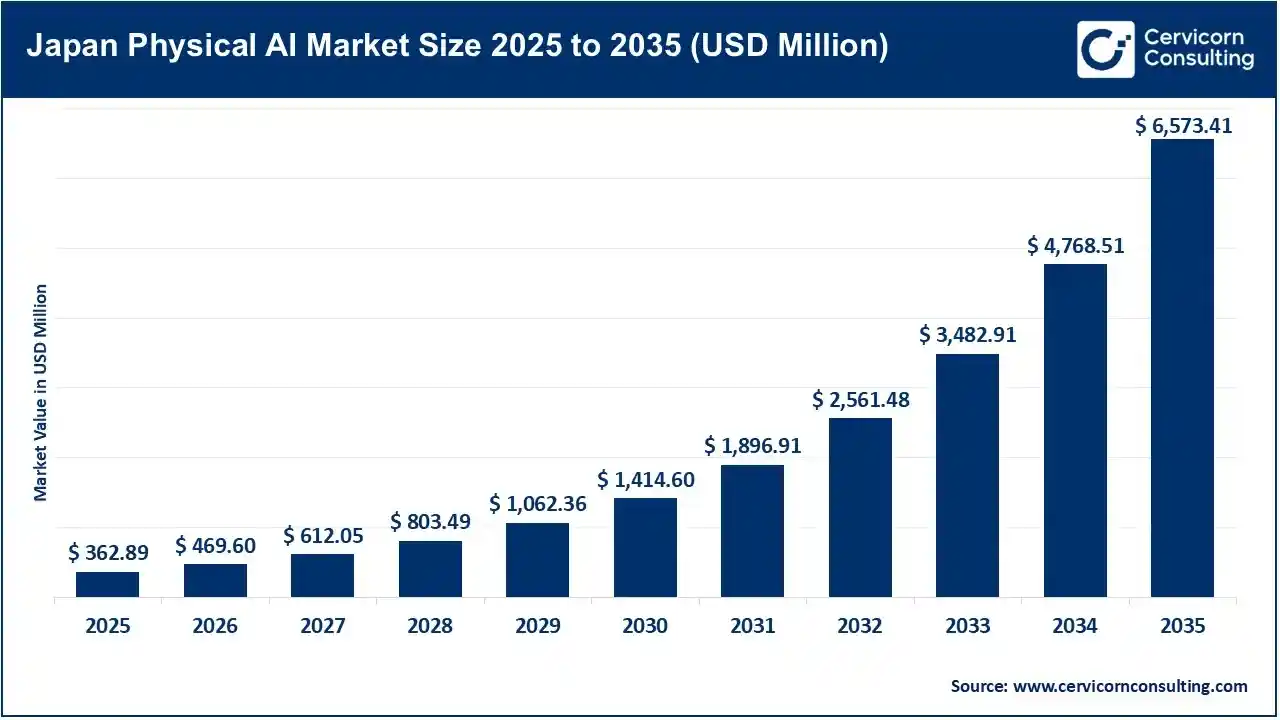
The Japan physical AI market size was valued at USD 307.30 million in 2025 and is expected to be worth around USD 6,764.02 million by 2035, expanding at a compound annual growth rate (CAGR) of 36.2% during the forecast period from 2026 to 2035. The rapid convergence of artificial intelligence, advanced robotics, and smart manufacturing is accelerating the growth of Japan's Physical AI market. Physical AI refers to AI systems embedded in physical machines such as industrial robots, humanoid robots, drones, autonomous vehicles, and intelligent equipment that can perceive, reason, and interact with real-world environments.
Report Highlights
- By component, the hardware segment dominated the market with a 57% share in 2025, driven by substantial investments in robotics hardware, AI processors, sensors, actuators, LiDAR, and high-performance computing required to build intelligent physical systems.
- By component, the software segment accounted for 30% of the Japan physical AI market in 2025, supported by rising adoption of AI models, computer vision, digital twins, autonomous navigation, and machine learning platforms that enable intelligent decision-making.
- By deployment, the on-device AI segment held the largest 53% market share in 2025 due to its ability to deliver real-time processing, ultra-low latency, enhanced operational reliability, and stronger data privacy for mission-critical AI applications.
- By deployment, the cloud-based AI segment represented 47% of the market in 2025, driven by increasing demand for centralized AI model training, robot fleet management, digital twin simulation, and large-scale data analytics.
- By technology, computer vision captured the largest 40% share in 2025, as intelligent robots increasingly rely on visual perception, object recognition, navigation, and AI-powered inspection for autonomous operations.
- By technology, the speech and natural language processing (NLP) segment accounted for 22% of the market in 2025, supported by growing deployment of service robots and AI systems requiring natural human-machine communication.
- By robot type, industrial robots led the Japan physical AI market with a 38% share in 2025, fueled by widespread adoption across advanced manufacturing, automotive production, factory automation, and precision engineering.
- By robot type, service robots represented 18% of the market in 2025, owing to increasing adoption across healthcare, hospitality, retail, logistics, and elderly care applications requiring intelligent automation.
- By application, the manufacturing & automotive segment emerged as the leading application in 2025, supported by Japan's advanced industrial base and growing investment in AI-powered production systems, smart factories, and autonomous manufacturing technologies.
- By application, the healthcare segment accounted for 17% of the market in 2025, driven by increasing adoption of surgical robots, rehabilitation systems, AI-assisted patient care, and intelligent healthcare automation.
How Are Japanese Manufacturers Accelerating Physical AI Adoption?
Physical AI has been rapidly adapted by manufacturers in Japan and is being implemented in the production processes to establish an automated and efficient production system by incorporating AI, robotics, automation and real-time data analysis. The robust industrial robots framework in the country combined with the ever-growing labor shortage and demand for high-accuracy manufacturing has prompted industries to focus on adopting AI-enabled factories that exhibit sensing, learning and self-deciding capabilities from traditional automation.
For example, a world renowned automobile producer Toyota Motor Corporation is integrating AI, industrial robotics, and digital manufacturing technologies to enhance production efficiency and achieve autonomous manufacturing. Another industrial robot company Fanuc Corporation is developing AI-enabled industrial robot that perform predictive maintenances and automated machine vision for manufacturers.
Japan Physical AI Patent Analysis
| Company / Organization |
Patent Focus Area |
Strategic Significance |
| Toyota Motor Corporation |
Autonomous systems, AI mobility, robotics, intelligent manufacturing |
Toyota has been actively expanding its AI and robotics intellectual property to support autonomous mobility, smart factories, and next-generation intelligent systems. |
| Sony Group Corporation |
AI perception systems, sensors, robotics, spatial intelligence |
Sony’s strong patent portfolio in imaging sensors and AI technologies supports the development of machines capable of understanding and interacting with real-world environments. |
| Fanuc Corporation |
Industrial robotics, robot control systems, automation intelligence |
Fanuc’s patents strengthen Japan’s industrial robotics leadership by enabling robots with improved adaptability, efficiency, and autonomous decision-making. |
| Mitsubishi Electric Corporation |
Factory automation, intelligent control systems, industrial AI |
Mitsubishi Electric focuses on integrating AI with automation systems to develop smarter and more connected manufacturing environments. |
| Yaskawa Electric Corporation |
Motion control, industrial robots, robotic automation |
Yaskawa’s patent activities support advanced robotics solutions for manufacturing, healthcare, and industrial automation applications. |
| Hitachi Ltd. |
AI platforms, industrial intelligence, autonomous systems |
Hitachi’s AI-related patents support applications combining physical systems, industrial data, and intelligent decision-making technologies. |
| Fujitsu Limited |
AI computing, machine learning, industrial AI platforms |
Fujitsu’s patent development supports AI infrastructure required for large-scale deployment of intelligent physical systems. |
| Panasonic Holdings Corporation |
Robotics, smart devices, AI-enabled automation |
Panasonic’s intellectual property focuses on integrating AI with consumer electronics, manufacturing systems, and intelligent devices. |
Japan Physical AI Market Dynamics
Driver
Rising Demand for Intelligent Automation and Robotics Across Industries
The increasing automation, robotics and AI-driven automation in Japan's industrial landscape is a significant factor fueling the growth of the Physical AI market. Aging population and labor shortage in Japan have escalated the need for smart systems for both manufacturing, logistics, and health and service sectors. The market growth is driven by the increasing adoption of the fully-automated decision making and smart manufacturing process by Industries.
Key Instances
- Toyota Motor Corporation is strengthening its robotic, AI and smart factory solutions toward the creation of AI powered automation systems in manufacturing, and future vehicles.
- Fanuc Corporation is expanding its portfolio of AI powered industrial robots that include predictive maintenance solutions, visual inspection capabilities, and adaptive robotic applications.
- Yaskawa Electric Corporation has implemented smart technology, AI and machine learning in its robots and motion control devices, toward futuristic factory automation.
- Mitsubishi Electric is focusing on designing the full stack automation technology for the factory, and developing AI-driven factory automation platform that involves robots, IoT technology, and real-time data analysis.
Restraint
High Development Costs and Technical Complexity
Despite strong technological capabilities, the high cost and complexity associated with developing and deploying Physical AI systems remain significant barriers in Japan. Advanced AI robots require expensive hardware components, high-performance computing systems, sensors, specialized software, and continuous maintenance.
Small and medium-sized enterprises, which represent a significant portion of Japan’s industrial sector, may face challenges in adopting these technologies due to limited investment capacity and shortage of skilled AI professionals. Additionally, achieving reliable performance in unpredictable real-world environments remains technically challenging compared with traditional automation systems.
Opportunity
Expansion of Humanoid Robotics & AI Manufacturing
The strong robotics foundation, a developed manufacturing infrastructure and strong backing from the government for digital transformation in Japan pave the way for a blooming physical AI market. In addition, growing demand for embodied AI, human-robot, self-driving cars and AI-powered industrial systems can be an opening for a large number of new revenue streams across manufacturing, healthcare, logistics, agriculture and public services.
- Honda Motor Company's ongoing research into humanoid robotics and intelligent mobile systems continue to reflect its long history in robotics as exemplified by the famous ASIMO robot project.
- Sony Group applies its expertise in sensing technology, AI, entertainment technology and robotics into development of intelligent systems that interact with the physical world.
- Preferred Networks is developing both AI technologies for industrial automation, robotics and autonomous systems with the main application area being deep learning in manufacturing.
Segmental Analysis
Component Analysis
The hardware component was the largest segment for the Japan physical AI market and captured a share of 57% in 2025. This increase is a result of the increased funding in R&D for creating sophisticated and intelligent machines powered by physical AI, necessitating high investments for advanced hardware solutions such as sensors, cameras, actuators, robotic arms, edge AI processors, AI accelerators, servo motors, controllers, LiDAR, force-torque sensors and high-performance computing.
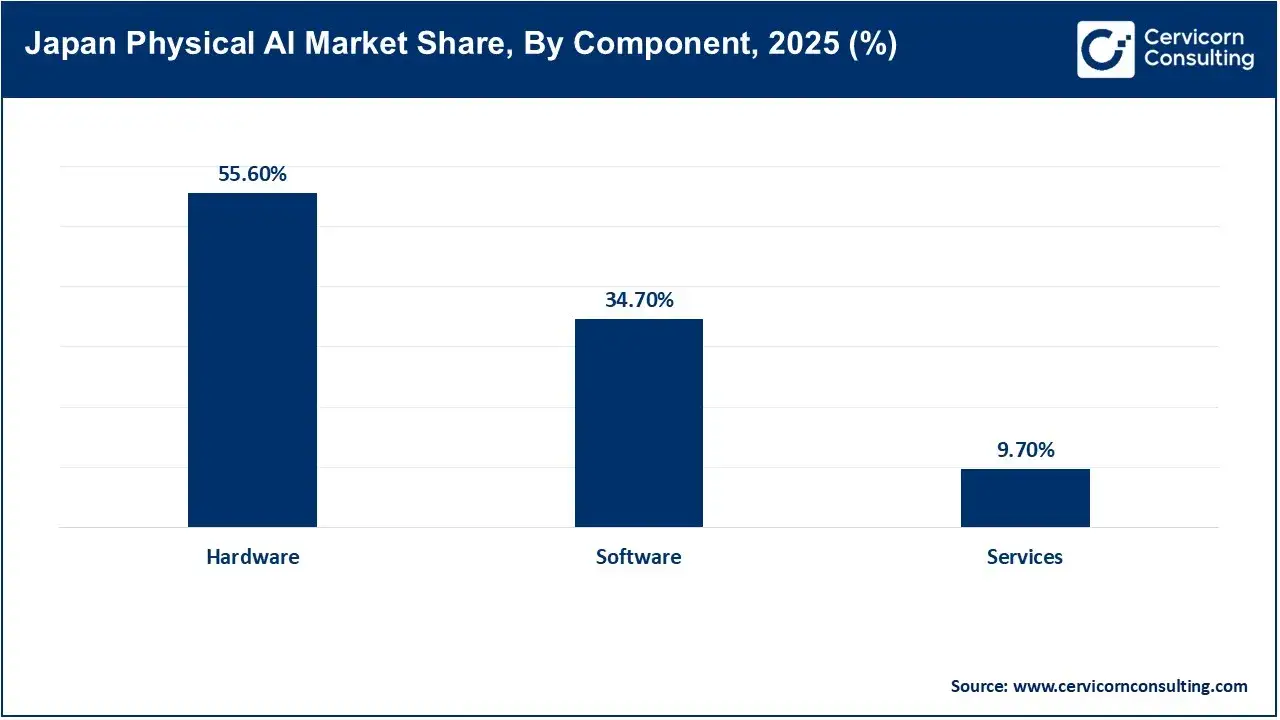
The software segment represented 30% of the market in 2025, supported by growing demand for intelligent algorithms that enable machines to perceive, reason, learn, and make autonomous decisions. Physical AI systems increasingly rely on advanced software capable of integrating computer vision, machine learning, natural language processing, sensor fusion, motion planning, and reinforcement learning to operate safely in dynamic environments. As robots become more autonomous, software is evolving from basic control systems to AI-native platforms capable of continuously learning from real-world interactions.
Japanese companies are investing heavily in AI software to complement their leadership in robotics hardware. Organizations such as Preferred Networks, Fujitsu, NEC Corporation, Sony Group, Hitachi Ltd., and SoftBank Robotics are developing AI models, perception engines, digital twin platforms, autonomous navigation software, and industrial AI applications that enhance the intelligence of physical systems.
Deployment Analysis
In 2025, the on-device AI segment constituted a majority share of 53% in the Japan physical AI market. In general, on-device AI segment holds a strong position due to growing demands for real-time decision-making, ultra-low latency, operational reliability and heightened data privacy. All these features are crucial for a physical AI system that works within a volatile real world. The on-device AI is critical for applications like industrial robot, autonomous mobile robot (AMR), humanoid robot, medical robots and autonomous vehicles because a tiny lag in communication might impact the safety and efficiency of their operations.
Japan Physical AI Market Share, By Deployment, 2025 (%)
| Deployment |
Revenue Share, 2025 (%) |
| Cloud-based AI |
50.80% |
| On-device |
49.20% |
In 2025, the cloud-based AI segment dominated 47% of the market. It is boosted by the growing demand for training massive AI models in data centers and large scale centralized robot management systems, as well as cloud computing infrastructure, advance data analysis services. Cloud platform enables enormous amounts of operational data collected from multiple distributed robots and devices to be analyzed and processed. Large-scale learning, robot fleet management, distributed robot software update, virtual twin simulation and enterprise-wide operations optimization would strongly favor this deployment model.
Technology Analysis
The computer vision technology was the leading segment and accounted for 40% share in the Japan Physical AI market in the year 2025. High resolution images/videos captured with the cameras, LiDARs and depth sensors are processed by sophisticated image processing algorithms and deep learning models to enable machines understand object, surrounding environment, maneuver through changing conditions and act upon the acquired information in a physical state.
Hence, computer vision solutions provide the robots to get high precise view of the environment so they can behave in a physical setting autonomously. Growing investment in advanced robotic systems, smart factories, Autonomous Vehicles and precise manufacturing in the Japan are the major factors contributing towards the high adoption of computer vision in the year 2025 in various applications to establish smart automation.
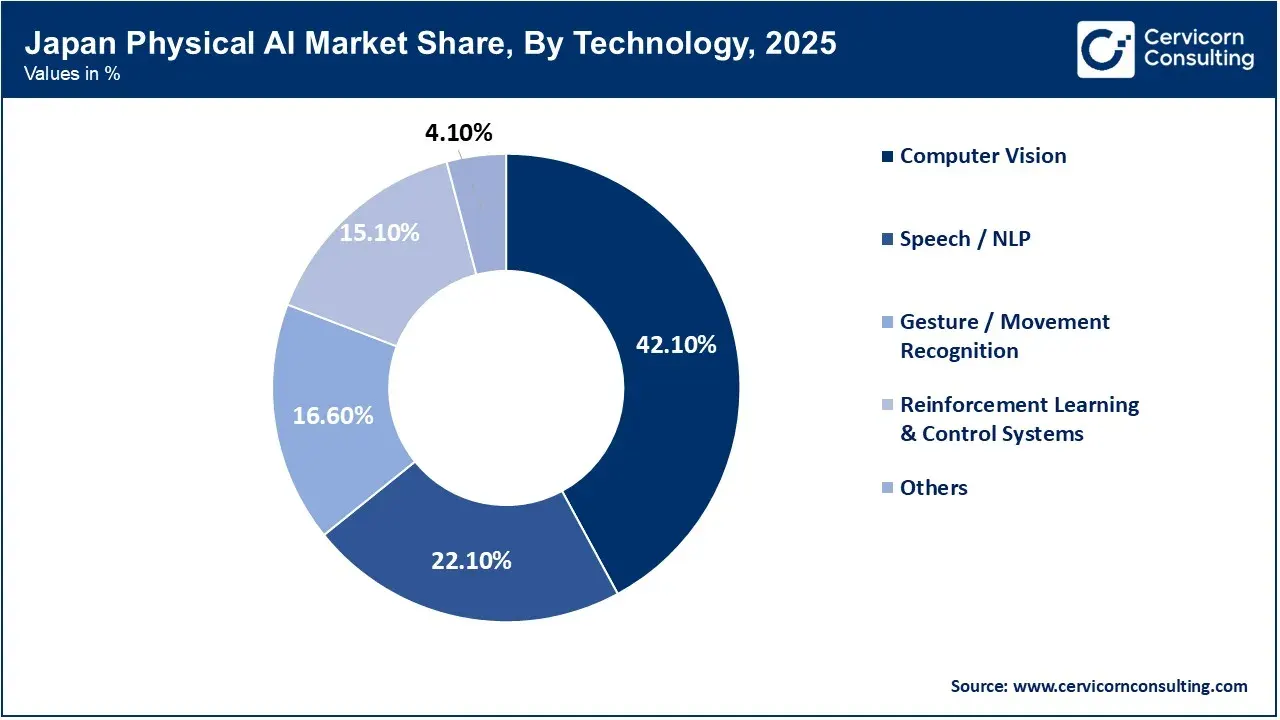
The speech and natural language processing (NLP) segment represented 22% of the market in 2025, driven by increasing demand for intuitive human-machine interaction across service robots, healthcare assistants, customer support systems, and collaborative industrial robots. Speech recognition and NLP technologies enable Physical AI systems to understand spoken language, interpret user intent, respond naturally, and execute commands without requiring complex programming or manual controls. These capabilities are becoming increasingly important as robots transition from controlled industrial environments to customer-facing and human-centric applications.
Robot Type Analysis
With 38% of the share Japan physical AI market in 2025, the industrial robots segment is the most significant robot type segment. The dominance is primarily attributed to Japan's long-standing prominence in the industrial robotics sector. The country has also historically led in terms of advanced manufacturing and factory automation.
They are expected to perform intelligent activities including autonomous material handling, adaptive assembly, visual quality control, predictive maintenance, and real-time production planning. The robots will use a combination of AI-powered computer vision capabilities, edge computing, sensor fusion technology, and machine learning techniques to constantly monitor the entire production environment, make decisions independent of humans, and optimize factory operations with minimal supervision.
Japan Physical AI Market Share, By Robot Type, 2025 (%)
| Robot Type |
Revenue Share, 2025 (%) |
| Industrial Robots |
37.80% |
| Service Robots |
13.50% |
| Humanoids/Social Robots |
13.60% |
| Cobots |
12.40% |
| Exoskeletons/Prosthetics |
8.10% |
| Mobile Robots/Drones |
14.60% |
In 2025, the service robots segment stood at 18% of the market due to an increasing demand for smart automation solutions from the healthcare sector, hotels and restaurant industry, retail chains, the logistics segment, and also public facilities and elderly care. Service robots differ from industrial robots, as they do not serve in the closed premises of a production workshop, but operate together with people in a variable environment.
Modern service robots are equipped with AI, machine vision, and speech recognition system, as well as natural language understanding system and autonomous navigation systems, thus they are capable to handle tasks related to customer support, medical care, cleanliness maintenance, delivering cargo and ensuring security.
Application Analysis
The manufacturing & automotive industry held largest share of the Japan physical AI market in 2025 due to the countries strong global footprint as a producer of vehicles, machinery, electronic devices and the presence of a highly advanced manufacturing base. The integration of physical AI in the manufacturing & automotive sector is driving the creation of intelligent and autonomous production systems, providing AI-based automated quality inspection and control and AI for real-time operation monitoring, analysis and optimization such as digital twin simulation.
Japan Physical AI Market Share, By Application, 2025 (%)
| Application |
Revenue Share, 2025 (%) |
| Healthcare |
17.70% |
| Manufacturing & Automotive |
23.40% |
| Logistics & Warehousing |
14% |
| Retail & Hospitality |
12.20% |
| Defense & Security |
9.40% |
| Agriculture |
8.10% |
| Education & Research |
9.60% |
| Others |
5.6% |
The healthcare segment represented 17% of the market in 2025, supported by increasing demand for intelligent medical technologies, robotic-assisted treatment, rehabilitation systems, and AI-powered patient care solutions. Japan's rapidly aging population, growing healthcare expenditure, and shortage of medical professionals are encouraging hospitals and healthcare providers to adopt Physical AI technologies that improve treatment quality, reduce caregiver workloads, and enhance patient outcomes. AI-enabled medical robots are increasingly being deployed for surgical assistance, rehabilitation therapy, elderly care, hospital logistics, patient monitoring, and diagnostic support.
Which Government Policies Are Advancing Physical AI Development in Japan?
- AI Strategy: Japan is trying to foster the growth of AI research, industrial usage, research workforce, and Responsible AI in Japan by promoting advanced AI models, robotic intelligence, etc needed for physical artificial intelligence applications.
- Moonshot Program: The Moonshot Program is an ambitious R&D program funded by the Japanese government that aims to develop technologies to resolve problems including those for next-generation robotic intelligence, Artificial Intelligence, and human–robot collaboration technologies. The objectives include developing independent robots in complex natural environments.
- The Robot Revolution Initiative (RRI): The program that drives robotic industrial adoption by uniting government agencies, private sector industry, robotic technology vendors and research institute to improve the industrial automation robot industry, innovate robotics technology and facilitate connected manufacturing.
Japan Physical AI Startup Ecosystem
| Startup |
Primary Focus Area |
Physical AI Application |
| Preferred Networks Inc. |
Deep learning, industrial AI, robotics intelligence |
Autonomous robots, smart manufacturing, AI-powered industrial systems |
| Sakana AI |
Generative AI and advanced machine learning |
AI models, intelligent agents, future embodied AI systems |
| ABEJA Inc. |
AI platforms and computer vision |
AI-powered automation, manufacturing intelligence, retail robotics |
| ExaWizards Inc. |
AI transformation and robotics solutions |
Elderly care AI, industrial automation, intelligent systems |
| Tier IV Inc. |
Autonomous driving technology |
Self-driving systems, autonomous mobility platforms |
| Ascent Robotics |
Autonomous systems and robotics AI |
Industrial automation, autonomous mobility, intelligent machines |
| HACARUS Inc. |
Edge AI and lightweight machine learning |
AI inspection systems, industrial automation |
Competitive Landscape
- Toyota Motor Corporation: Toyota’s investment in Physical AI includes autonomous mobility, AI- enabled manufacturing processes, robotic research, and advanced industrial robot and intelligent factory systems enabling better interaction between humans and machines.
- Fanuc Corporation: Fanuc is increasing its global leadership in industrial automation through developments such as AI-enhanced robotics, Predictive maintenance (PdM) systems, and the latest generation of Intelligent manufacturing systems used in factories across the world.
- Sony Group Corporation: Sony is an enabler of Physical AI due to the advancements being made in image sensors, AI processing and imaging, robotic technology, perception systems enabling machines to sense and interpret environments and smart camera technologies for human perception tasks.
- SoftBank Robotics: SoftBank Robotics is focused on AI based robotics solutions for humans and collaborative machines in retail, service, commercial spaces.
- Yaskawa Electric Corporation: Yaskawa continues its role in enabling the adoption of physical AI in industry with leading industrial robots and advanced motion control systems along with intelligence for manufacturing automation.
- Honda Motor Co., Ltd.: Honda is making developments in humanoid robotics, autonomous driving, intelligent machines to enhance human potential, with an ongoing investment in human-centric AI.
- Hitachi Ltd.: Hitachi integrates AI, digital twins, Industrial analytics, and automation systems to develop comprehensive intelligent solutions in its Physical AI portfolio for industry and the infrastructure behind it.
- Panasonic Holdings Corporation: Panasonic leverages and develops AI, robotics, and automation solutions to boost operational efficiency across manufacturing, healthcare, and smart technology segments.
Recent News
- May 2026, FANUC announced a strategic collaboration with Google to integrate advanced AI technologies, including Gemini Enterprise, into industrial robots. The partnership aims to enable robots to understand human instructions, recognize objects, and autonomously perform manufacturing tasks, marking a shift from programmed automation toward AI-driven physical intelligence in factories.
- June 2026, Japan’s Ministry of Economy, Trade and Industry (METI), together with NEDO, launched a project focused on developing a domestic multimodal foundation model for AI robots and Physical AI applications. The initiative aims to utilize industrial data generated across Japan to build AI systems capable of supporting next-generation robotics and autonomous machines.
Segments Covered
By Component
- Hardware
- Software
- Services
By Deployment
By Technology
- Computer Vision
- Speech / NLP
- Gesture / Movement Recognition
- Reinforcement Learning & Control Systems
- Others (multi-modal AI, biomimetic robotics)
By Robot Type
- Industrial Robots
- Service Robots
- Humanoids/Social Robots
- Cobots
- Exoskeletons/Prosthetics
- Mobile Robots/Drones
By Application
- Healthcare
- Manufacturing & Automotive
- Logistics & Warehousing
- Retail & Hospitality
- Defense & Security
- Agriculture
- Education & Research
- Others