Embodied AI Market Size, Growth, Forecast 2026 to 2035
The global embodied AI market size was valued at USD 3.98 billion in 2025 and is expected to surpass around USD 68.51 billion by 2035, reflecting a compound annual growth rate (CAGR) of 32.9% over the forecast period from 2026 to 2035.
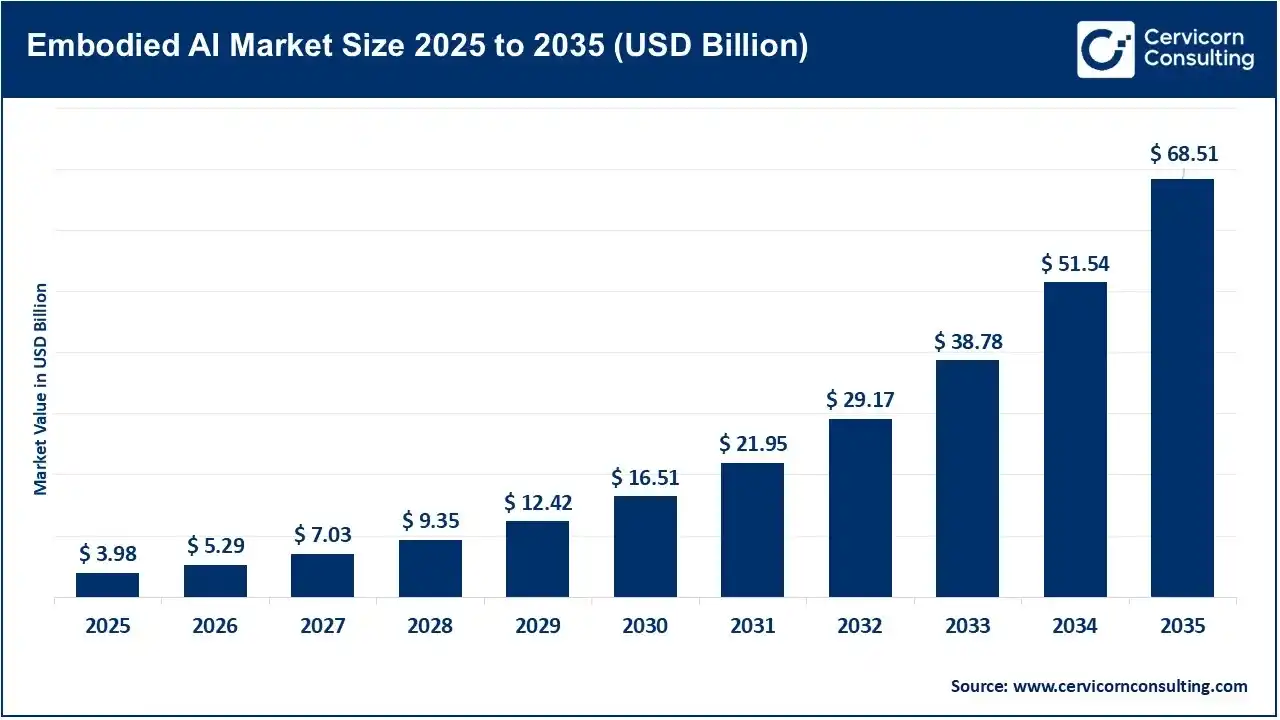
The embodied AI market is gaining strong momentum as artificial intelligence moves beyond software into robots, autonomous machines, vehicles, and other systems capable of perceiving and physically interacting with real-world environments. Advances in multimodal foundation models, vision-language-action models, computer vision, edge AI processors, reinforcement learning, and simulation are enabling machines to understand their surroundings and execute increasingly complex tasks with less human intervention. The underlying robotics installed base provides a significant platform for this transition: the International Federation of Robotics reported approximately 542,000 industrial robots installed globally in 2024, while the worldwide operational stock reached about 4.66 million units, up 9% year over year. Asia accounted for 74% of new industrial robot deployments, highlighting particularly strong automation adoption across major Asian manufacturing economies.
Growth is further driven by labor shortages, rising manufacturing automation, demand for flexible logistics, advances in generative AI, falling computing costs, and increasing investment in humanoid and general-purpose robotics. According to the World Economic Forum’s Future of Jobs Report 2025, 86% of surveyed employers expect AI and information-processing technologies to transform their businesses by 2030, while 58% expect robotics and autonomous systems to have a transformative impact. The expanding developer ecosystem is also accelerating commercialization; NVIDIA reported in 2025 that more than 2 million developers were using its robotics stack, supported by over 1,000 hardware, software, and sensor partners and more than 7,000 edge-AI customers. Together, stronger AI models, increasingly capable robotic hardware, workforce pressures, and large-scale industrial automation are expanding embodied AI applications across manufacturing, logistics, healthcare, agriculture, transportation, retail, and household assistance.
Report Highlights
- Regional Leadership: North America dominated the Embodied AI Market with 38.6% share, supported by advanced robotics, AI innovation, and physical AI investments.
- Asia-Pacific Growth: Asia-Pacific held 31.8% market share, driven by large-scale manufacturing automation, robotics production, government initiatives, and humanoid robot development.
- Product Leadership: Robots dominated the product type segment with 45.8% share, supported by industrial automation, humanoid robotics, and autonomous robotic applications.
- Service Robots: Service robots accounted for 28.6% market share, supported by increasing deployment across healthcare, logistics, retail, hospitality, and household applications.
- Embodiment Leadership: Level 2 interactive and semi-autonomous systems dominated with 46.5% share, reflecting strong demand for reliable human-supervised intelligent automation.
- Advanced Autonomy: Level 3 advanced and fully autonomous systems held 26.2% share, supported by multimodal AI, spatial reasoning, and autonomous decision-making.
- End-Use Leadership: Manufacturing and industrial automation dominated with 28.7% share, driven by intelligent robotics, machine vision, flexible automation, and smart factories.
What is an Embodied AI?
Embodied AI refers to artificial intelligence integrated into physical agents—such as robots, humanoids, autonomous vehicles, drones, and smart machines—that can perceive their surroundings, reason about the physical world, make decisions, and perform actions in real time. Unlike conventional AI that primarily processes digital information, embodied AI combines technologies such as computer vision, multimodal and vision-language-action (VLA) models, reinforcement learning, sensors, actuators, spatial reasoning, and robotics to connect intelligence with physical action. This enables machines to learn from interactions, adapt to unfamiliar environments, manipulate objects, navigate spaces, and collaborate with humans, making embodied AI increasingly important for manufacturing, logistics, healthcare, transportation, agriculture, and consumer robotics.
Recent Milestones
| Date |
Company |
Recent Milestone |
| July 2026 |
Google DeepMind |
Introduced Gemini Robotics 2, advancing full-body humanoid control, dexterous manipulation, embodied reasoning, multi-step tasks, and robot safety capabilities. |
| April 2026 |
Google DeepMind |
Released Gemini Robotics-ER 1.6, improving spatial reasoning and multi-view understanding to support more autonomous real-world robotic tasks. |
| June 2025 |
Google DeepMind |
Introduced Gemini Robotics On-Device, allowing its VLA technology to operate locally on robots with general-purpose dexterity and rapid task adaptation. |
| March 2025 |
NVIDIA |
Expanded NVIDIA Cosmos with new world foundation models and synthetic-data tools designed to accelerate training of robots and autonomous vehicles. |
| March 2025 |
NVIDIA |
Introduced GR00T N1, an open foundation model designed for generalist humanoid robots and adaptable robotic manipulation tasks. |
| March 2025 |
Google DeepMind |
Launched Gemini Robotics and Gemini Robotics-ER, bringing Gemini-based multimodal reasoning into physical robots through VLA and embodied-reasoning models. |
| January 2025 |
NVIDIA |
Launched the Cosmos World Foundation Model platform, providing generative world models and data-processing capabilities for physical AI and autonomous-system development. |
Embodied AI Market Dynamics
Market Drivers
1. Rapid Adoption of Robotics and Industrial Automation
Growing deployment of industrial robots, autonomous mobile robots, and intelligent machines is a major driver for embodied AI. According to the International Federation of Robotics, approximately 542,000 industrial robots were installed globally in 2024, more than double the installations recorded ten years earlier. The global operational stock reached about 4.66 million robots, increasing 9% year-over-year. Embodied AI enhances these systems with perception, reasoning, navigation, manipulation, and adaptive decision-making capabilities, supporting adoption across manufacturing, logistics, automotive, healthcare, and warehousing.
2. Advances in Generative AI, Edge Computing, and Multimodal Models
Rapid progress in multimodal foundation models, vision-language-action models, AI accelerators, and edge computing is significantly improving robots' ability to understand and interact with physical environments. NVIDIA reported that more than 2 million developers were using its robotics stack in 2025, while Jetson technology supported over 7,000 edge-AI customers. Additionally, 86% of employers surveyed by the World Economic Forum expect AI and information-processing technologies to transform their businesses by 2030, strengthening investment in intelligent autonomous systems.
Market Restraints
1. High Development and Deployment Costs
The high cost of advanced processors, sensors, actuators, batteries, robotic platforms, system integration, training, and maintenance can restrict embodied AI adoption, particularly among smaller enterprises. Advanced humanoid robots additionally require substantial investments in AI training infrastructure and real-world testing before commercial deployment. For perspective, NVIDIA launched its Jetson AGX Thor developer kit at USD 3,499, illustrating the expense of advanced edge-AI computing even before complete robotic hardware and integration are considered. Consequently, achieving attractive returns on investment remains difficult for lower-volume or less repetitive applications.
2. Safety, Reliability, and Regulatory Concerns
Embodied AI systems operate directly in physical environments, meaning perception or decision-making errors can cause equipment damage or potentially harm people. Ensuring reliable operation across unpredictable environments therefore requires extensive testing, safety controls, cybersecurity, and regulatory compliance. This becomes increasingly important as robots gain greater autonomy. Although 58% of employers surveyed by the World Economic Forum expect robotics and automation to transform their businesses by 2030, commercial deployment must simultaneously address human-robot interaction, accountability, data privacy, and operational safety requirements.
Market Opportunities
1. Expansion of Humanoid and General-Purpose Robots
Humanoid and general-purpose robots represent a significant opportunity because embodied AI can enable machines to perform diverse tasks within environments originally designed for humans. Opportunities are emerging across factories, warehouses, healthcare facilities, retail operations, and eventually households. Investment momentum is already substantial: Reuters reported that robotics companies attracted more than USD 2.26 billion globally during Q1 2025, with over 70% directed toward companies developing specialized task-oriented robots. Continued improvements in foundation models and robotic hardware could gradually expand this investment toward increasingly versatile embodied systems.
2. Growing Adoption Across Emerging Industrial Economies
Rapid industrial automation in Asia creates significant opportunities for embodied AI providers offering intelligent robots, AI processors, sensors, simulation platforms, and automation software. Asia represented approximately 74% of worldwide industrial robot installations in 2024, while China alone accounted for around 54%, installing approximately 295,000 industrial robots. China's domestic robot manufacturers also increased their home-market share to 57%. This large installed robotics ecosystem provides a strong foundation for integrating embodied intelligence into manufacturing, logistics, automotive production, electronics, agriculture, and other automation-intensive industries.
Market Challenge
1. Limited Real-World Training Data and Generalization
A major technical challenge is enabling embodied AI systems to perform reliably outside controlled training environments. Robots must understand complex three-dimensional spaces, unfamiliar objects, changing lighting, human behavior, and unexpected physical interactions. Unlike text-based AI, collecting physical interaction data is expensive and time-consuming because robots must execute and record real-world actions. Consequently, simulation, synthetic data, reinforcement learning, and world models are increasingly important. Despite these difficulties, the robotics developer ecosystem has already expanded beyond 2 million developers, accelerating efforts to improve general-purpose robotic intelligence.
2. Shortage of Specialized Robotics and AI Talent
Developing embodied AI requires expertise spanning artificial intelligence, robotics engineering, computer vision, mechanical engineering, control systems, embedded computing, and sensor technologies, creating a complex multidisciplinary talent requirement. The World Economic Forum identifies AI and big data, networks and cybersecurity, and technological literacy as the three fastest-growing skill areas through 2030. Meanwhile, 58% of surveyed employers expect robotics and automation to transform their organizations. Competition for professionals capable of integrating AI models with reliable physical systems could therefore constrain development speed and large-scale commercialization.
Regional Analysis
The embodied AI market is segmented by region into North America, Europe, Asia-Pacific, Latin America, and LAMEA. Here is a brief overview of each region:
Why does North America dominates the embodied AI market?
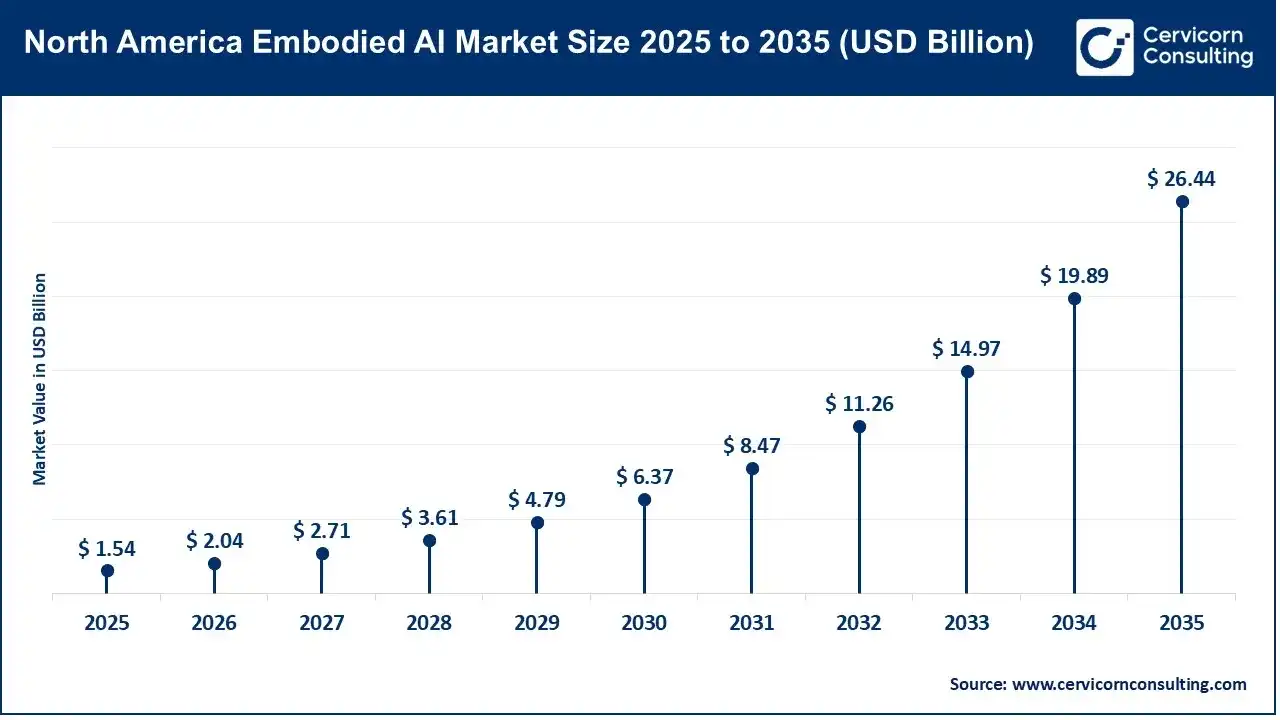
The North America embodied AI market size was accounted for USD 1.54 billion in 2025 and is forecasted to hit around USD 26.44 billion by 2035. North America dominates the market owing to its advanced artificial intelligence ecosystem, strong robotics research capabilities, widespread industrial automation, and presence of leading technology and robotics companies. The region benefits from rapid development of multimodal foundation models, vision-language-action models, autonomous systems, humanoid robots, and AI-enabled edge computing platforms. Companies such as NVIDIA, Tesla, Google DeepMind, Boston Dynamics, Figure AI, and Apptronik are advancing physical AI platforms and intelligent robotic systems. Increasing adoption across manufacturing, logistics, automotive, healthcare, defense, retail, and household applications is strengthening regional demand. Federal initiatives supporting artificial intelligence, advanced manufacturing, semiconductor development, and robotics research further encourage innovation, while collaboration among technology companies, universities, research laboratories, manufacturers, and startups accelerates commercialization of embodied AI technologies.
United States: Leadership in Physical AI, Humanoid Robotics, Advanced Computing, and Federal AI Research Drives Market Growth
- U.S. factories installed approximately 34,200 industrial robots in 2024, accounting for 68% of robot installations across the Americas.
- Industrial robot installations in the United States declined 9% in 2024, while the country remained the Americas’ largest robotics market.
- More than 50,000 industrial robots were installed across the Americas in 2024, supporting the broader U.S.-centered embodied automation ecosystem.
Canada: Strong AI Research Ecosystem, Robotics Innovation, and Advanced Manufacturing Support Market Expansion
- Canada committed more than CAD 443 million to the second phase of its Pan-Canadian Artificial Intelligence Strategy.
- Canada’s Sovereign AI Compute Strategy includes up to CAD 2 billion for domestic AI computing infrastructure and innovation capabilities.
- Canada’s 2026 AI for All Strategy targets an additional CAD 200 billion in economic growth through broader AI development and adoption.
Why is Asia-Pacific represents a major growth in the embodied AI market?
The Asia-Pacific embodied AI market size was estimated at USD 1.27 billion in 2025 and is projected to exceed around USD 21.79 billion by 2035. Asia-Pacific represents a major growth center, supported by its extensive manufacturing base, high adoption of industrial robotics, rapidly expanding artificial intelligence ecosystem, and increasing investment in humanoid and autonomous robots. China, Japan, South Korea, and India are strengthening physical AI capabilities across automotive, electronics, logistics, healthcare, and smart manufacturing. The region benefits from established robotics supply chains, semiconductor manufacturing capabilities, growing AI research, and government programs supporting intelligent automation. Asia accounted for approximately 74% of global industrial robot deployments in 2024, demonstrating the region’s strong foundation for embodied AI adoption. Increasing integration of multimodal AI, machine vision, autonomous navigation, and intelligent manipulation is expected to accelerate deployment across industrial and service applications.
China: Massive Robotics Deployment, Physical AI Strategy, and Humanoid Robot Development Drive Market Growth
- China installed approximately 295,000 industrial robots in 2024, representing 54% of worldwide installations and strengthening its embodied AI ecosystem.
- China's operational industrial robot stock reached approximately 2 million units in 2024, around 4.5 times larger than Japan's installed base.
- Domestic manufacturers captured approximately 57% of China's industrial robot installations in 2024, rising substantially from 30% in 2020.
Japan: Global Robotics Manufacturing Leadership, Automotive Automation, and Advanced Human-Robot Collaboration Support Market Expansion
- Japan installed approximately 44,500 industrial robots in 2024, maintaining its position as the world's second-largest industrial robot market.
- Japanese manufacturers represented approximately 38% of global robot production, reinforcing the country's strategic importance in advanced robotics and embodied AI.
- Japan's automotive industry installed approximately 13,000 robots in 2024, increasing 11% and reaching its highest installation level since 2020.
South Korea: World's Highest Robot Density, Advanced Electronics Manufacturing, and Strong Automation Adoption Strengthen Market Development
- South Korea recorded the world's highest robot density at approximately 1,220 industrial robots per 10,000 manufacturing employees, highlighting intensive factory automation.
- South Korea installed approximately 30,600 industrial robots during 2024, maintaining its position among the world's largest industrial robotics markets.
- Robot density in South Korea increased by approximately 7% annually since 2019, supported by its electronics and automotive manufacturing industries.
Why is Europe represents a significant share in the embodied AI market?
The Europe embodied AI market size was valued at USD 0.89 billion in 2025 and is projected to hit around USD 15.35 billion by 2035. Europe represents a significant market, supported by its highly automated manufacturing sector, established robotics industry, advanced automotive ecosystem, and growing investments in artificial intelligence and smart factories. Germany, Italy, France, Spain, and the United Kingdom are advancing AI-enabled robotics across automotive manufacturing, logistics, healthcare, aerospace, and industrial production. The region benefits from strong engineering expertise, collaborative robotics research, Industry 4.0 initiatives, and increasing development of autonomous and human-centric robotic systems. Europe accounted for approximately 16% of global industrial robot deployments in 2024, while growing adoption of machine vision, edge AI, intelligent manipulation, and autonomous navigation is creating a strong foundation for embodied AI commercialization.
Germany: European Robotics Leadership, Automotive Automation, and Advanced Manufacturing Drive Embodied AI Adoption
- Germany installed 26,982 industrial robots in 2024, representing approximately 32% of European installations and maintaining regional robotics leadership.
- Germany remained the fifth-largest industrial robot market globally in 2024, providing a strong installed base for embodied AI deployment.
- Germany's automotive sector installed approximately 6,100 industrial robots in 2024, supporting continued adoption of intelligent and increasingly autonomous production systems.
Italy: Strong Manufacturing Base, Industrial Robotics Adoption, and Machinery Sector Support Market Development
- Italy installed approximately 8,783 industrial robots in 2024, maintaining its position as the second-largest robotics market in Europe.
- Industrial robot installations in Italy declined approximately 16% during 2024, although the country retained a significant European automation footprint.
- Italy accounted for roughly 10% of European robot installations in 2024, highlighting its importance in regional manufacturing automation and robotics.
Embodied AI Market Share, By Region, 2025 (%)
| Region |
Revenue Share, 2025 (%) |
| North America |
38.6% |
| Asia-Pacific |
31.8% |
| Europe |
22.4% |
| LAMEA |
7.2% |
LAMEA Embodied AI Market is Developing Steadily
The LAMEA embodied AI market was valued at USD 0.29 billion in 2025 and is anticipated to reach around USD 4.93 billion by 2035. The LAMEA market is developing steadily, supported by industrial digitalization, increasing adoption of robotics, government-backed artificial intelligence programs, and investments in smart manufacturing and autonomous systems. Latin America is witnessing greater automation across automotive, food processing, mining, agriculture, and logistics, while the Middle East is investing heavily in AI, robotics, smart cities, and autonomous mobility as part of economic diversification programs. Africa represents an emerging opportunity, particularly across mining, agriculture, logistics, healthcare, and infrastructure. Countries including Brazil, Saudi Arabia, the UAE, and South Africa are strengthening their AI ecosystems through research initiatives, digital infrastructure, industrial modernization, and technology investments, creating favorable conditions for long-term adoption of embodied AI.
Brazil: Automotive Manufacturing, Industrial Automation, and Expanding Robotics Adoption Support Embodied AI Growth
- Brazil installed approximately 2,100 industrial robots in 2024, accounting for a significant share of robotics deployments across Latin American manufacturing industries.
- Brazil represented approximately 29% of industrial robot installations across the Americas excluding North America, supported primarily by automotive manufacturing and related industries.
- Brazil's automotive industry remained its largest industrial robotics customer, creating opportunities for AI-enabled manipulation, inspection, assembly, and autonomous production systems.
Saudi Arabia: Vision 2030, Large-Scale AI Investment, Smart Cities, and Robotics Development Accelerate Market Expansion
- Saudi Arabia's Project Transcendence reportedly involves investment of up to USD 100 billion, supporting AI infrastructure, startups, data centers, and advanced technologies.
- Saudi Arabia launched HUMAIN in 2025 to develop AI infrastructure, models, data centers, and related capabilities across the country's technology ecosystem.
- Saudi Arabia's Vision 2030 initiatives are accelerating adoption of AI, autonomous systems, robotics, and smart infrastructure across industrial and commercial applications.
Segmental Analysis
The embodied AI market is segmented into product type, level of embodiment, end-use industry, and geography.
Product Type Analysis
The robots segment dominates the Embodied AI Market, driven by widespread adoption of humanoid robots, industrial robots, collaborative robots, and autonomous robotic platforms across manufacturing, logistics, healthcare, and retail. Robots provide an ideal physical platform for integrating perception, reasoning, manipulation, navigation, and adaptive learning capabilities. Growing enterprise demand for automation of repetitive, hazardous, and precision-intensive activities is strengthening adoption. Continuous advancements in robotic mobility, dexterous manipulation, multimodal AI, and human-robot collaboration are further supporting the segment’s market leadership.
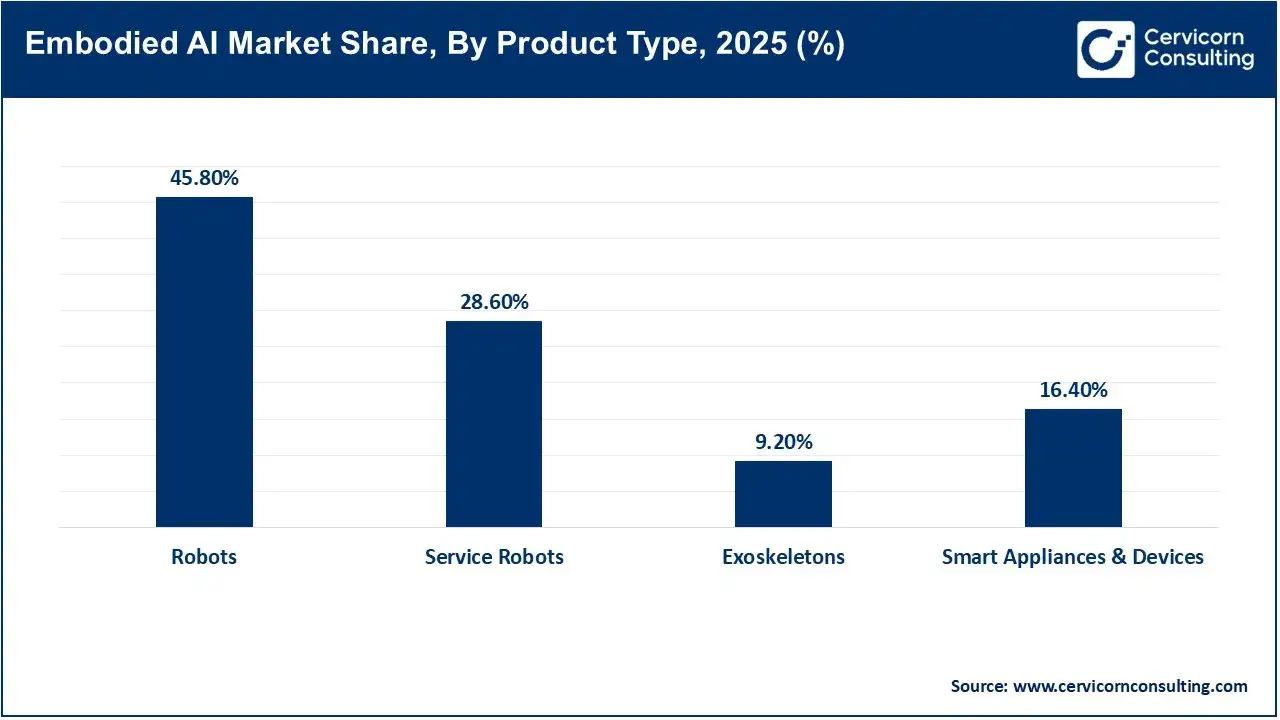
The service robots segment is expected to witness rapid growth, supported by expanding applications across healthcare, hospitality, logistics, retail, professional cleaning, security, and household assistance. Embodied AI allows service robots to understand dynamic surroundings, communicate naturally with users, navigate independently, and adapt their actions according to changing situations. Integration of foundation models, vision-language-action systems, improved sensors, and autonomous navigation technologies is increasing their versatility. Growing demand for personalized services and automation of labor-intensive activities is expected to accelerate commercial deployment.
Level of Embodiment Analysis
The Level 2 (Interactive/Semi-Autonomous Embodied Intelligence) segment dominates the market, owing to its balance between autonomous functionality and human supervision. These systems can perceive surroundings, interact with users, navigate environments, and execute predefined or adaptive tasks while retaining human oversight for complex decisions. Their comparatively manageable safety and operational requirements make them suitable for factories, warehouses, healthcare facilities, and commercial environments. Growing adoption of collaborative robotics and semi-autonomous machines is further strengthening demand for Level 2 embodied intelligence solutions.
Embodied AI Market, By Level of Embodiment, 2025 (%)
| Level of Embodiment |
Revenue Share, 2025 (%) |
| Level 1 – Basic Embodied Intelligence |
27.3% |
| Level 2 – Interactive/Semi-Autonomous Embodied Intelligence |
46.5% |
| Level 3 – Advanced/Fully Autonomous Embodied Intelligence |
26.2% |
The Level 3 (Advanced/Fully Autonomous Embodied Intelligence) segment is expected to experience the fastest growth, driven by advancements in multimodal foundation models, reinforcement learning, spatial reasoning, world models, and autonomous decision-making. Level 3 systems are designed to interpret complex environments, independently plan actions, learn from interactions, and adapt to unfamiliar situations with limited human intervention. Their potential applications span humanoid robotics, autonomous logistics, transportation, defense, and intelligent manufacturing, making advanced autonomy an important direction for next-generation embodied AI development.
End-Use Industry Analysis
The manufacturing & industrial automation segment dominates the Embodied AI Market, supported by extensive use of intelligent robots for assembly, material handling, welding, inspection, machine tending, packaging, and production-line operations. Embodied AI allows industrial machines to move beyond rigid programming by combining environmental perception, autonomous decision-making, and adaptive physical control. Manufacturers are increasingly pursuing flexible automation capable of handling product variations and changing operating conditions. Integration with digital twins, machine vision, edge computing, and smart factories further strengthens embodied AI adoption across industrial environments.
Embodied AI Market, By End-Use Industry, 2025 (%)
| End-Use Industry |
Revenue Share, 2025 (%) |
| Manufacturing & Industrial Automation |
28.7% |
| Logistics & Supply Chain |
16.4% |
| Automotive & Transportation |
13.8% |
| Healthcare |
10.7% |
| Defense & Security |
7.5% |
| Consumer & Household |
6.4% |
| Retail & E-commerce |
5.2% |
| Agriculture |
4.3% |
| Construction & Mining |
3.2% |
| Education & Research |
2.1% |
| Others |
1.7% |
The healthcare segment is expected to witness the fastest growth, driven by increasing applications of embodied AI in surgical robotics, rehabilitation systems, assistive robots, hospital logistics, patient monitoring, and intelligent exoskeletons. These technologies can combine physical interaction with AI-based perception and decision-making to support healthcare professionals and improve patient assistance. Growing demand for personalized rehabilitation, automated hospital operations, elderly care, and precision medical procedures is creating significant opportunities. Advances in safe human-robot interaction and adaptive robotic control are further supporting healthcare adoption.
Embodied AI Market Top Companies
Recent Developments
- In July 2026, NVIDIA introduced Isaac GR00T 1.7, a vision-language-action model pretrained on approximately 32,000 hours of human demonstrations and 8,000 hours of simulation. The model improves long-horizon reasoning, task decomposition, generalization, and cross-embodiment deployment, strengthening NVIDIA’s end-to-end platform for developing and deploying humanoid robot intelligence.
- In July 2026, Tesla advanced preparations for Optimus humanoid robot production at its Fremont facility, installing first-generation production lines. Initial Optimus units are expected to operate within Tesla’s Optimus Academy, where robots will collect real-world training data and support development of additional capabilities before broader commercial deployment.
- In April 2026, Google DeepMind introduced Gemini Robotics-ER 1.6, an upgraded embodied reasoning model designed for real-world robotic tasks. The model enhances spatial reasoning and multi-view environmental understanding, enabling robots to interpret physical environments more accurately and execute increasingly autonomous activities across industrial and general-purpose robotics applications.
Market Segmentation
By Product Type
- Robots
- Humanoid Robots
- Industrial Robots
- Collaborative Robots (Cobots)
- Autonomous Mobile Robots (AMRs)
- Service Robots
- Autonomous Systems
- Autonomous Vehicles
- Autonomous Drones/UAVs
- Unmanned Ground Vehicles
- Exoskeletons
- Medical & Rehabilitation Exoskeletons
- Industrial Exoskeletons
- Military Exoskeletons
- Smart Appliances & Devices
By Level of Embodiment
- Level 1 – Basic Embodied Intelligence
- Level 2 – Interactive/Semi-Autonomous Embodied Intelligence
- Level 3 – Advanced/Fully Autonomous Embodied Intelligence
By End-Use Industry
- Manufacturing & Industrial Automation
- Logistics & Supply Chain
- Automotive & Transportation
- Healthcare
- Defense & Security
- Retail & E-commerce
- Consumer & Household
- Agriculture
- Construction & Mining
- Education & Research
- Others
By Geography
- North America
- Europe
- Asia-Pacific
- LAMEA