Carbon Dioxide Removal Market Size, Growth, Forecast 2026 to 2035
The global carbon dioxide removal market size was recorded at USD 727.78 million in 2025 and is expected to be worth around USD 2,565.41 million by 2035, accelerating a compound annual growth rate (CAGR) of 13.43% during the forecast period 2026 to 2035. The carbon dioxide removal (CDR) market is rapidly expanding due to increasing government policies, corporate sustainability goals, and climate commitments. Countries are introducing tax incentives and funding programs to accelerate technology adoption.
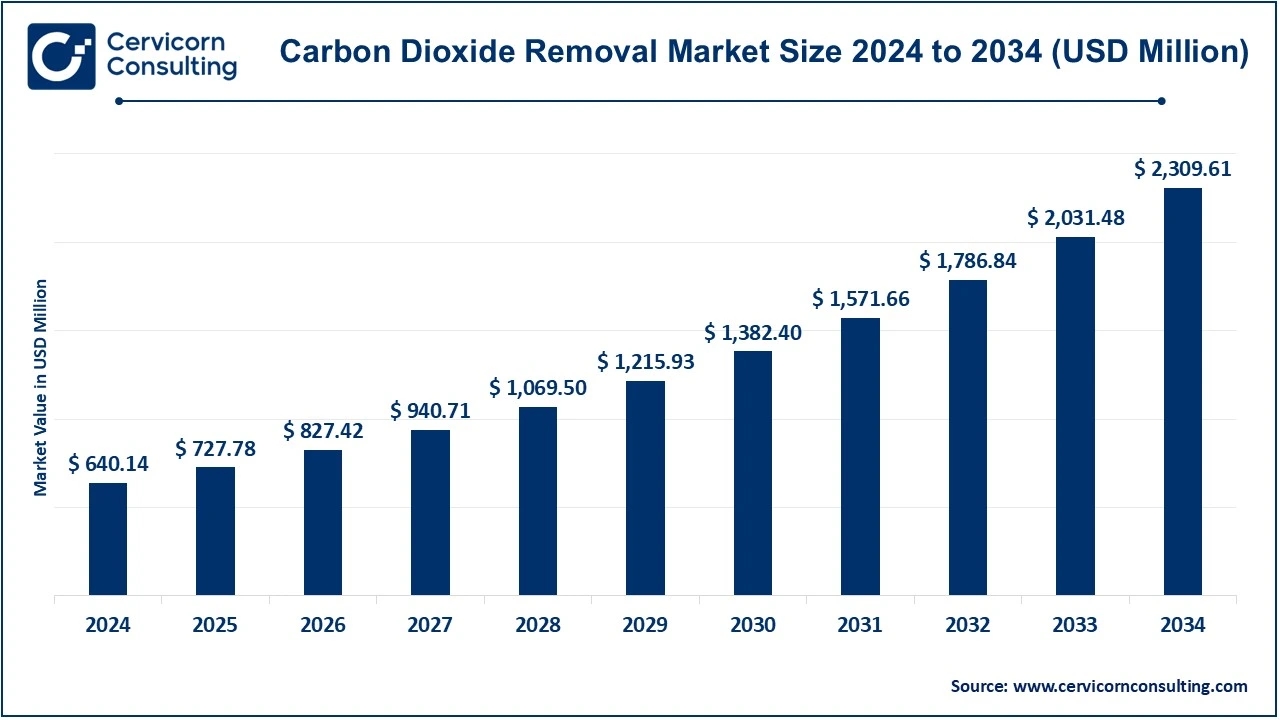
The carbon dioxide removal (CDR) market is booming as the world rallies around various campaigns to combat climate change and also achieve zero net emissions. So here is the broad outline of technologies and solutions, such as direct air capture (DAC), bioenergy with carbon capture and storage (BECCS), an approach that combines ocean-based removals with enhanced weathering, which are aimed at either capturing or removing CO2 from ambient air. Businesses investing in net-zero strategies drive demand for carbon removal solutions, making it an attractive sector for investment. Growing awareness and climate action initiatives by organizations like the UN and World Economic Forum further boost CDR adoption. Market growth is coming from commitments to sustainability, carbon pricing mechanisms, and increased investments in clean technologies from governments and corporates alike. The innovations in new efficiencies and scalability of capture systems, combined with supportive policies, nourish expansion of the market. Yet, high capital costs, energy consumption, and regulations are some of the challenges faced in a CDR deployment. Demand for scalable climate solutions will increase the CDR market as its key player in realizing international carbon neutrality targets.
Report Highlights
- By region, North America dominates the carbon dioxide removal (CDR) market with a 55.70% revenue share in 2025, supported by strong policy incentives, advanced carbon capture infrastructure, and significant investments in climate technologies.
- By product, the direct air capture (DAC) segment leads the market with a 42.10% share in 2025, driven by its growing adoption for removing atmospheric CO₂ and its integration into large-scale carbon removal projects.
- By application, the technology sector holds a leading position in 2025, reflecting increasing deployment of carbon removal solutions across digital infrastructure and industrial innovation ecosystems.
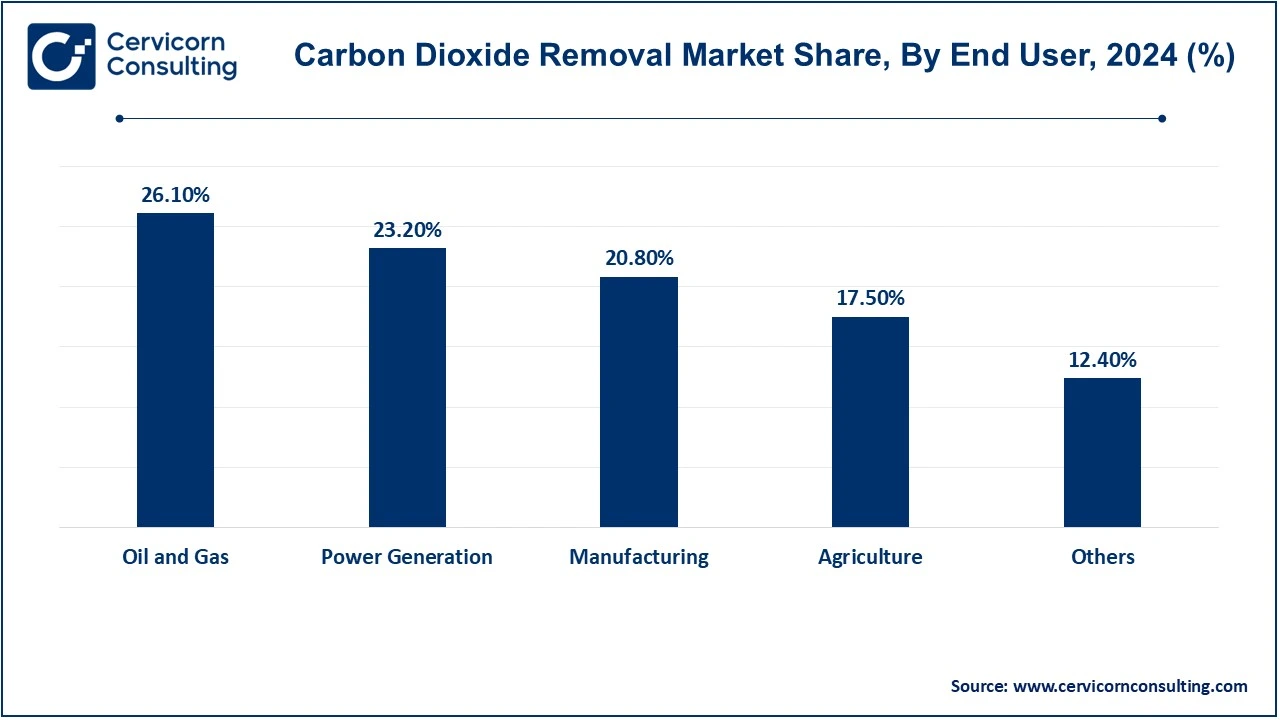
- By end user, the oil and gas segment accounts for the highest share at 26.10% in 2025, primarily due to the use of captured CO₂ in enhanced oil recovery and emissions management strategies.
What is a Carbon Dioxide Removal (CDR)?
Carbon Dioxide Removal (CDR) refers to various methods used to capture and store excess CO2 from the atmosphere to reduce climate change. Natural approaches include afforestation (planting trees), soil carbon sequestration, and ocean-based carbon absorption. Technological methods involve Direct Air Capture (DAC), bioenergy with carbon capture and storage (BECCS), and mineralization. These solutions help lower global temperatures, improve air quality, and support sustainability efforts. CDR is vital for achieving net-zero emissions and limiting global warming to 1.5°C. The Intergovernmental Panel on Climate Change (IPCC) emphasizes that removing billions of tons of CO2 annually is necessary to offset industrial emissions. Governments and corporations are investing heavily in CDR technologies, and policies like carbon credits encourage companies to adopt these solutions.
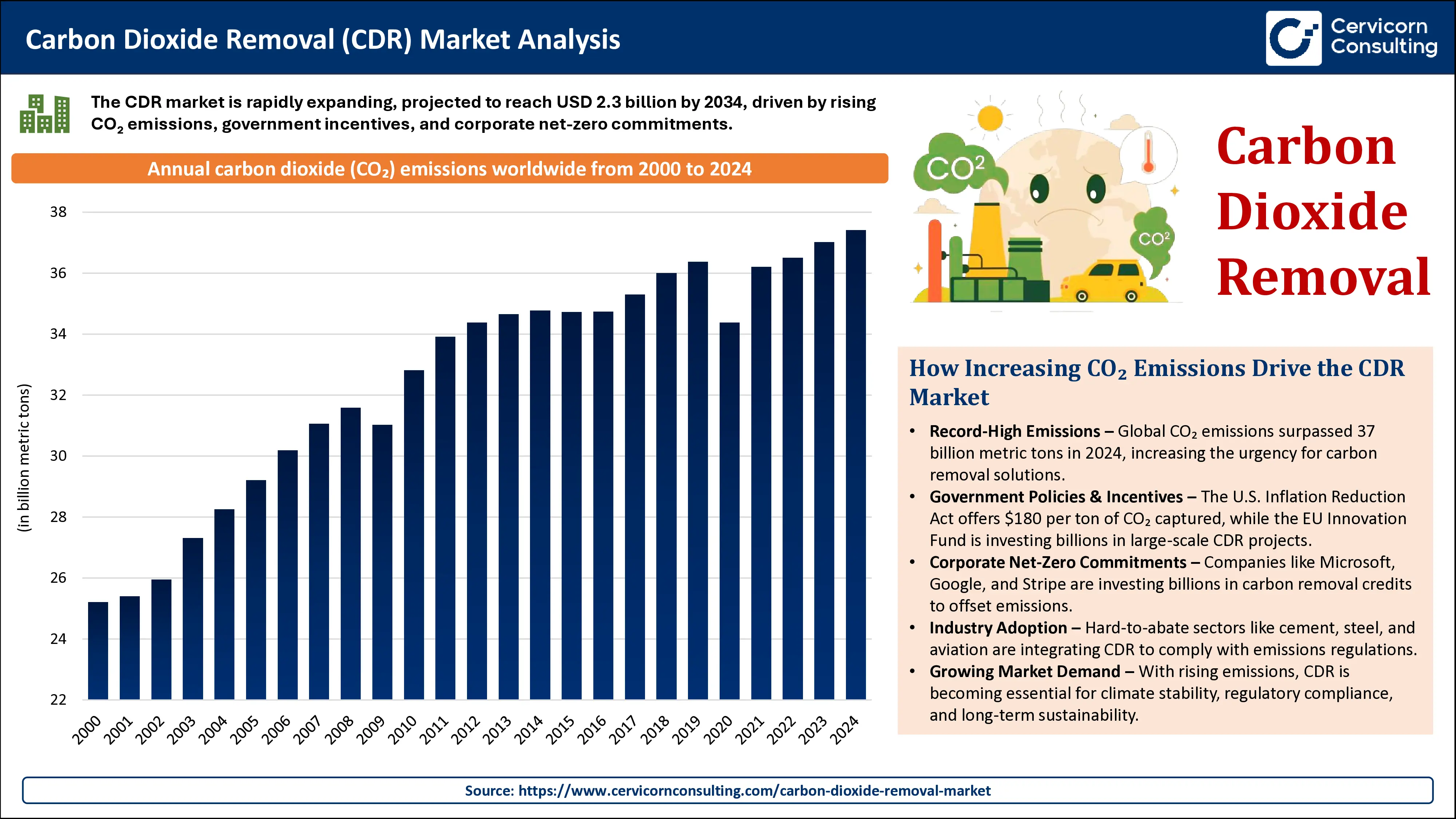
Key Insights Beneficial to the Carbon Dioxide Removal (CDR) Market
- Governments worldwide have pledged over USD 10 billion in funding for CDR technologies.
- Direct Air Capture (DAC) capacity is projected to increase 5x by 2030.
- Over 1,500 companies globally have committed to net-zero emissions, driving CDR adoption.
- Nature-based solutions contribute 30% of total CDR efforts, combining reforestation and soil carbon capture.
- Carbon credit markets exceeded USD 1 billion in transactions in 2023, supporting corporate investments in CDR.
Top 5 Carbon Removal Projects Globally (2026)
- Climeworks – Mammoth DAC Plant (Iceland): As one of the world's largest direct air capture (DAC) operations to date, Climeworks' Mammoth project is designed to extract 36,000 metric tons of CO from the air annually, powered by geothermal energy and sequestering it underground via mineralisation through its Carbfix partnership.
- Occidental Petroleum – STRATOS DAC Project (United States): Located in Texas, Occidental Petroleum's STRATOS facility is one of the largest direct air capture projects in the world, designed to capture 500,000 tons of CO annually in its initial phase, which could potentially grow into a multi-million ton carbon removal hub.
- NEOM Green Hydrogen & Carbon Capture (Saudi Arabia) - While fundamentally a green hydrogen project, the massive NEOM development in Saudi Arabia includes large-scale carbon reduction and is designed with the future integration of carbon removal technologies. With an investment exceeding $8.4 billion and 2.2 GW of electrolyzer capacity, it is being developed as the world’s largest integrated clean energy and carbon management ecosystem.
- Deep Sky – Deep Sky Alpha (Canada): Deep Sky recently made headlines as the first company in North America to issue verified direct air capture (DAC) carbon credits. The company's pilot plant, which can remove 3,000 tons annually, is notable for integrating several different DAC technologies under one verification framework.
- Stockholm Exergi (Sweden): The BECCS project is expected to remove 800,000 tons of CO from the atmosphere annually by capturing biogenic carbon emissions from biomass energy generation. It's widely considered one of the most significant large-scale BECCS projects in Europe and has also secured various long-term carbon removal purchase agreements.
Carbon Dioxide Removal Market Growth Factors
- Net-Zero Commitments: Countries and corporations are moving in the direction of reaching net-zero emissions by mid-century, and as such, many will increase their demands for technologies that will bring carbon emissions to zero. The requirements are particularly pressing in aviation, shipping, and heavy industry, where the hard-to-abate emissions must be offset in some way. Many of the CDR technologies provide viable options for meeting such commitments. Like the UK and the EU, which have incorporated CDR into national climate plans, and companies such as Microsoft that aim for "carbon negativity," investing in projects that actively remove CO2 from the atmosphere, this report states, These urgencies, quickly turned into policies, funds and mandates, have affected the CDR market.
- Carbon Pricing Mechanisms: Carbon taxes and emission trading systems were introduced, which provided financial incentives for industries to either reduce emissions or adopt removal technologies. Putting a price on carbon would make carbon capture economically viable as a business case for example private sector or government buy-back schemes under carbon taxation with high carbon prices such as the EU compared to the rest of the world. Revenues sought in carbon pricing often end up being directed to financing climate innovation, thus contributing to further enhancing the market.
- Technological Developments: Continuous research and development are increasing CDR technologies' yields, scale, and cost-effectiveness. Innovations such as modular direct air capture systems and optimized bioenergy processes raise the entry barriers to using this technology.
- Government Support: Around the globe, the governments are aware of the roles played by CDR technologies, so they really go more than just by saying that they bring about policies, grants, and subsidies. Take, for example, how the Inflation Reduction Act of the U.S. provides tax credits for direct air capture projects and how the EU supports equivalent initiatives through its Innovation Fund. This boost seems not just to hasten deployment but also to take off some burden of financial risk for private investors.
- Corporate Sustainability Goals: Corporates add to their strategy’s sustainability initiatives; carbon neutrality, carbon negativity, and the like appear in many of their targets. For example, several big names, such as Amazon, Google, and Apple, would include investments in carbon removal projects as part of their environmental, social, and governance (ESG)-related goals. Such investments are conditioned by brand reputation and investor expectations.
Carbon Dioxide Removal Market Recent Trends
- Climate Change Awareness- Increased awareness about the risk from climate change has triggered governments, industries, and consumers to act. Increasingly, reports of organizations like the IPCC are urging large-scale carbon removal as part of the efforts to meet the 1.5°C target, turning CDR as an immediate priority.
- Increased Investment: The rapid growth in venture capital and private equity investments has transformed the CDR market. Clime works, Carbon Engineering, and a host of other businesses have raised staggering amounts of money, which will enable them to commercialize and massively scale their operations.
- Integration with Renewable Energy: Most CDR technologies need to be energized greatly by renewable energy resources. These would go well with renewable energy sources-the example is the consumption of air capture plants with large scale wind, solar, or geothermal energy facilities, which drastically decrease the carbon footprints of processing, making the technology much more viable. This also encourages collaborations between the renewable energy and carbon capture and storage (CCS) sectors and promotes the market.
- Demand for Negative Emissions: Climate models such as IPCC-represented invariably provide evidence of necessity for negative emissions to bring temperatures under control worldwide. Some sectors cannot be fully decarbonized despite stringent actions to reduce emissions. This situation warrants the necessity of CDR technologies; hence it will become more or less inevitable in the long-term climate strategies.
- Soil and Ocean Sequestration Potential: Cost-effective and scalable carbon removal approaches include those based on nature, for example soil carbon sequestration and ocean alkalinization. Their additional co-benefits such as enhanced soil fertility, or ocean health, favour their adoption by policy-makers and others seeking co-benefits.
Report Scope
| Area of Focus |
Details |
| Market Size in 2026 |
USD 827.42 Million |
| Projected Market Size in 2035 |
USD 2,565.41 Million |
| Expected CAGR (2026 to 2035) |
13.43% |
| Dominant Region |
North America |
| High-growth Region |
Asia Pacific |
| Key Segments |
Product, Application, End User, Region |
| Key Companies |
Arca, Blue Planet Systems, Bussme Energy AB, Carbfix hf., Carbicrete, Carbofex Ltd., Carbon Engineering Ltd., CarbonCure Technologies Inc., CarbonFree, Cella Mineral Storage Inc., Charm Industrial, Climeworks, Ebb Carbon, Global Thermostat, HEIMDAL, Neustark Ag, Novocarbo GmbH, Oregon Biochar Solutions, Pacific Biochar Benefit, Wakefield BioChar |
Carbon Dioxide Removal Market Dynamics
Drivers
Circular Economy Initiatives
- Nowadays, CO2 capture finds growing significance in many industrial applications involving the generation of sustainable fuels or construction and synthetic materials, as well as chemicals. Such integration creates additional income sources, while promoting circular economies, consideration of waste and efficiency of resources.
Public-Private Partnerships
- Joint initiatives between governments and private parties are emerging as important drivers for CDR technologies; Mission Innovation, for example, is an example of such collaboration by the Carbon Capture Coalition, where collective efforts aimed at pooling resources and sharing expertise speed up development. These partnerships lessen investment risk and incubate innovation, creating an encouraging environment for implementation of CDR technologies.
Restraints
High Implementation Cost
- CDR technologies are typically very expensive and therefore difficult to deploy at larger scales. Direct air capture (DAC) systems remove CO2 for prices between $100 and $600 per ton. These costs stem from advanced materials needing sophisticated engineering and substantial energy; unlike emission reduction technologies, CDR technologies do not yield immediate revenue.
Energy Intensity
- Most of the processes for CDR such as DAC and BECCS, require a lot of energy input to work. When their source of energy is not renewable, both methods will in turn offset their emission reductions with increased emissions during the running process. A reconnection to renewables may be necessary yet in logistical terms, it can be really challenging and expensive. The energy requirement for DAC might be almost equal to the electricity generation of small countries at a larger scale.
Opportunities
Adaptation to Regulatory Requirements
- Nevertheless, every government in this world imposes harsher constraints for carbon emissions-from compulsory reports and reduction targets-to give boost for the CDR compliance with these and avoid penalties. Truly, there are some industry sectors where the regulations become tight, for example: power generation, manufacturing, and aviation industries that really drives demand for efficient carbon removal methods.
Global Collaborations
- International agreements such as the Paris Accord support the development of CDR in the pathway toward achieving climate goals. These collaborations between countries enable the sharing of knowledge, funds, or both toward joint ventures that stimulate scaling capacity and adoption of CDR technologies.
Challenges
Limited Infrastructure
- Absence of a well-developed infrastructure in the realm of capture, transport, and storage above CO2 actually hinders CDR technologies to a great extent. After the capture of CO2, it must then be routed to sites where it is to be put, such as geological formations, requiring construction of lengthy pipeline networks. Building-up such entirely new infrastructures involves enormous investments and takes long time periods.
Regulatory and Policy Uncertainty
- The lack of global standards and long-term policies on carbon removals means that the market environment, fragmented and uncertain in nature, has consequences on carbon removals. For example, inconsistent carbon pricing mechanisms and different definitions on "permanent storage" make project planning and investment complicated issues. And without well-defined incentives or mandates, companies are reluctant to go far and enjoy their resources on CDR projects.
Carbon Dioxide Removal Market Regional Analysis
The carbon dioxide removal market is segmented into various regions, including North America, Europe, Asia-Pacific, andLAMEA. Here is a brief overview of each region:
What factors driving the North America leadership in the carbon dioxide removal market?
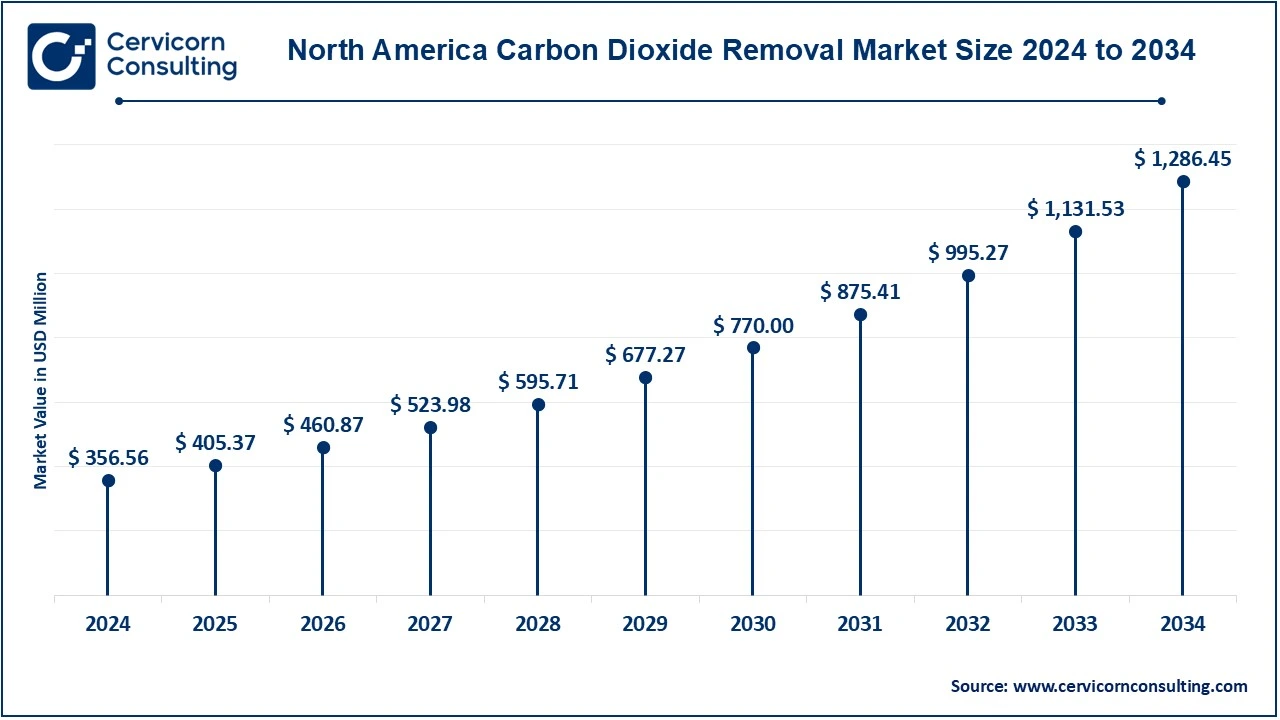
The North America carbon dioxide removal market size was estimated at USD 405.37 million in 2025 and is projected to hit around USD 1,428.94 million by 2035. The considered region North America ranks among the very best and largest regions in the CDR market due to a strong commitment from the government and corporate sectors toward climate change mitigation. The U.S. is a significant player with policies such as the Inflation Reduction Act that provides tax credits for carbon capture technologies including direct air capture (DAC) and bioenergy with carbon capture and storage (BECCS).
United States Carbon Dioxide Removal Market Analysis:
- The United States is one of the most invested and advanced markets for carbon dioxide removal (CDR), supported by a range of policies, strong private sector involvement and ambitious net-zero goals.
- The U.S. appropriated more than USD 3.5 billion for Direct Air Capture (DAC) hubs under the Bipartisan Infrastructure Law, representing the largest public funding effort in the world for CDR.
- The Department of Energy selected several DAC hub projects with a planned capture capacity of more than 2 million metric tons of CO annually.
- Further boosting economics of DAC projects is an increased value for the enhanced 45Q tax credit to up to USD 180/ton with permanent storage, passed under the Inflation Reduction Act.
- The U.S. currently represents over 35% of the world's CO2 removal project pipeline pipeline, including projects from major players such as Climeworks, Occidental Petroleum, Heirloom Carbon Technologies and CarbonCapture Inc., while private sector demand is accelerating, with a growing number of offtake agreements signed by major corporations such as Microsoft, Google and Stripe.
- CDR will play a key role in reaching the U.S. target of net-zero by 2050 by targeting sectors where CO2 emission reductions are hard to achieve and offsetting unavoidable residual emissions.
Europe Carbon Dioxide Removal Market Trends
It has led the world in the CDR market and resulted from the ambitious climate targets and strong regulatory frameworks. It is the European Union's Green Deal and the European Climate Law that legally opened the doors to major investments in CDR technologies. From direct air capture (DAC) to ocean alkalinization and bioenergy with carbon capture and storage (BECCS), multiple initiatives in carbon removal are supported in the area.
Why is Asia Pacific hit rapid growth for the carbon dioxide removal market?
The carbon dioxide removal market is poised for rapid growth in the Asia-Pacific region due to commercial activity in the region and rapid increase in CO2 emissions. Carbon removal measures such as lowering CO2 emissions will have to be taken up by countries like China, India and Japan to meet their national climate targets. As the largest emitter of CO2 in the world, China has invested heavily in CDR technologies, focusing on carbon capture, use and storage (CCUS).
India Carbon Dioxide Removal Market Analysis:
- Growing climate pledges, significant industrial emission load, and a greater push for carbon capture and bio-based sequestration approaches suggest that India will evolve into a powerful carbon dioxide removal market in the near future.
- India, with ambitious targets to reach net-zero emissions by 2070 and reduce GDP’s emission intensity by 45% by 2030, will necessitate a large carbon removal supply and thereby driving the adoption of scalable CDR technologies.
- The country contributes more than 2.9 billion metric tons of CO annually and is among the top 3 globally by emitting this gas - which translate to large opportunity size for carbon dioxide removal and carbon sequestration technology to cater.
- Unlike U.S., the CDR ecosystem in India today predominantly remains inclined towards nature-based solutions, bio-char and agriculture, soil carbon and enhanced weathering approaches although the attention towards engineered CDR solution like Direct Air Capture(DAC) will keep rising over the years.
- National oil companies like Oil and Natural Gas Corporation and Indian Oil Corporation are actively pursuing carbon capture, utilisation and storage (CCUS) initiatives while the Indian private sector with major industrial groups like Reliance and Adani looking at incorporating carbon removal into their green energy plans, represent huge opportunity for the CDR industry.
- Furthermore, the agriculture sector holds a particularly large potential with carbon sequestration through bio-char and in agricultural soil contributing significant chunk given 140 million+ acres of agricultural land in India.
LAMEA Presents a Huge and Growing Potential for the Carbon Dioxide Removal Market
The LAMEA region presents a huge and growing potential for CDR market, but there are also specific emerging challenges in this region. This resource-rich region has forests, stretches of land for potential agricultural biochar production and other endogenic resources that could generate solutions in possible carbon-removal activities.
Carbon Dioxide Removal Market Segmental Analysis
The carbon dioxide removal market is segmented into product, application, end user and region. Based on product, the market is classified into biochar, direct air capture (DAC), microalgae, BECCS, ocean alkalinization, and enhanced/carbon mineralization. Based on application, the market is classified into finance sector, technology sector, and others. Based on end user, the market is classified into oil and gas, power generation, manufacturing, agriculture, and others.
Product Analysis
Microalgae: Microalgae-based carbon dioxide removal (CDR) is the capture and bio-based application of produced CO2. Biomass produced via photosynthesis can be converted into biofuels, animal feeds, or bioplastics, whereby these organisms increased their multiplication rates converting them into having better carbon fixation rates than terrestrial plants having a lower range for that particular physiological process. Microalgae cultivation takes place in photobioreactors or open ponds where controlled conditions are used to maximize the uptake of CO2.
BECCS: Biomass is an energy production and carbon capture technology that integrates bioenergy with carbon capture to generate net-negative emissions. Such biomass includes agricultural residues or dedicated energy crops, which absorbed atmospheric CO2 during their growth. While they are used for energy production, resulting emissions are taken into geological formations where they would remain stored underground.
Ocean Alkalinization: Ocean alkalinization is a new approach of removing carbon dioxide from the atmosphere through the improvement of alkaline waters to enjoy the benefits of the natural process of increased absorption of CO2 through oceans. The addition of alkaline salts like limestone and other minerals into seawater will improve the ability of the oceans to absorb CO2 from the atmosphere. Thus, the salts will convert most of such absorption into stable bicarbonate ions, which will maybe be stored in oceans for centuries.
Enhanced/Carbon Mineralization: Enhanced/mineralized carbon refers to an increase in speed or rate during standard CO2 outcomes from reactions with minerals to form stable carbonates. This is a form of weathering, as can occur geologically or industrially, in which CO2 is injected into calcium or magnesium-rich rock. Over time, CO2 binds with these minerals, thus permanently storing it inside as solid carbonates. Enhanced mineralization accelerates this reaction, either by adding a specific catalyst or creating ideal conditions, such as high pressure and temperature.
Direct Air Capture (DAC): DAC constitutes one of the most popular methods available and currently under active research and project implementation for the removal of CO2 from the atmosphere. Direct Air Capture technology entails chemical processing for direct CO2 capture from ambient air, usually using large-scale machinery that traps CO2 on solid sorbents or liquid solutions. CO2 is compressed and stored underground (within geological formations) or converted to synthetic fuels, chemicals, or building materials once captured.
Biochar: Biochar is a carbon-dense material that results from the heating of organic biomass (such as agricultural waste) in the absence of oxygen through pyrolysis. Pyrolysis locks carbon in a solid, stable storage form for periods of hundreds to thousands of years, making biochar a method of carbon sequestration. In addition, biochar improves soils through improved moisture, nutrient retention, and general soil health while reducing reliance on synthetic fertilizers, which are carbon delegating.
Application Analysis
Finance Sector: The finance sector deals with giving life to investments, risk management, and the development of policies to grow the CDR market. The financial institutes now are more about the recognition of carbon removals into their sustainability agendas. Asset managers, banks, and investment firms are rolling carbon credits and CDR technologies into their portfolios to align them more correctly with environmental, social, and governance (ESG) objectives. With the advent of carbon markets, where purchase carbon credits from CDR projects, there is also a financial incentive toward large-scale deployment.
Technology Sector: In fact, the technology domain happens to lead the innovation in the commercial carbon dioxide removal sector. All way from artificial intelligence or advanced materials to any kind of tech, these companies have been busy developing and optimising the required systems for capturing and storing atmospheric CO2. Emerging technologies such as direct air capture (DAC), carbon mineralization and bioenergy with carbon capture and storage (BECCS) are greatly enhanced by cutting-edge computing, machine learning, and automation to improve efficiency and scalability. Tech companies are innovating in carbon utilization: capturing CO2 and turning it into profitable products such as sustainable fuels, chemicals, and building materials.
End User Analysis
Based on end user, the CDR market is segmented into power generation, oil and gas, manufacturing, agriculture, and others. The oil and gas segment has dominated the market in 2025.
Carbon Dioxide Removal Market Top Companies
Recent Developments
- In 2024, Climeworks launched the largest operational direct air capture (DAC) facility globally in Iceland, with the goal of extracting significant amounts of CO2 from the atmosphere.
- In 2024, CarbiCrete established a collaboration with 3Degrees to facilitate the removal of carbon dioxide from the atmosphere, aiming for a sustainable future and an emission-free environment.
- In 2024, Drax Group formed a partnership with C-Zero to reduce CO2 emissions in the environment.
- In 2024, Equatic unveiled plans to build the largest ocean-based carbon removal facility in Singapore, intending to remove 109,500 tonnes of CO2 and produce 3,600 tonnes of carbon-negative hydrogen each year, starting in 2026.
Market Segmentation
By Product
- Biochar
- Direct Air Capture (DAC)
- Microalgae
- BECCS
- Ocean Alkalinization
- Enhanced/Carbon Mineralization
By Application
- Finance Sector
- Technology Sector
- Others
By End User
- Oil and Gas
- Power Generation
- Manufacturing
- Agriculture
- Others
By Region
- North America
- APAC
- Europe
- LAMEA