AI Supercomputer Market Size, Growth, Forecast 2026 to 2035
The global AI supercomputer market size was valued at USD 3.28 billion in 2025 and is expected to be worth around USD 24.62 billion by 2035, exhibiting a compound annual growth rate (CAGR) of 22.3% over the forecast period from 2026 to 2035.
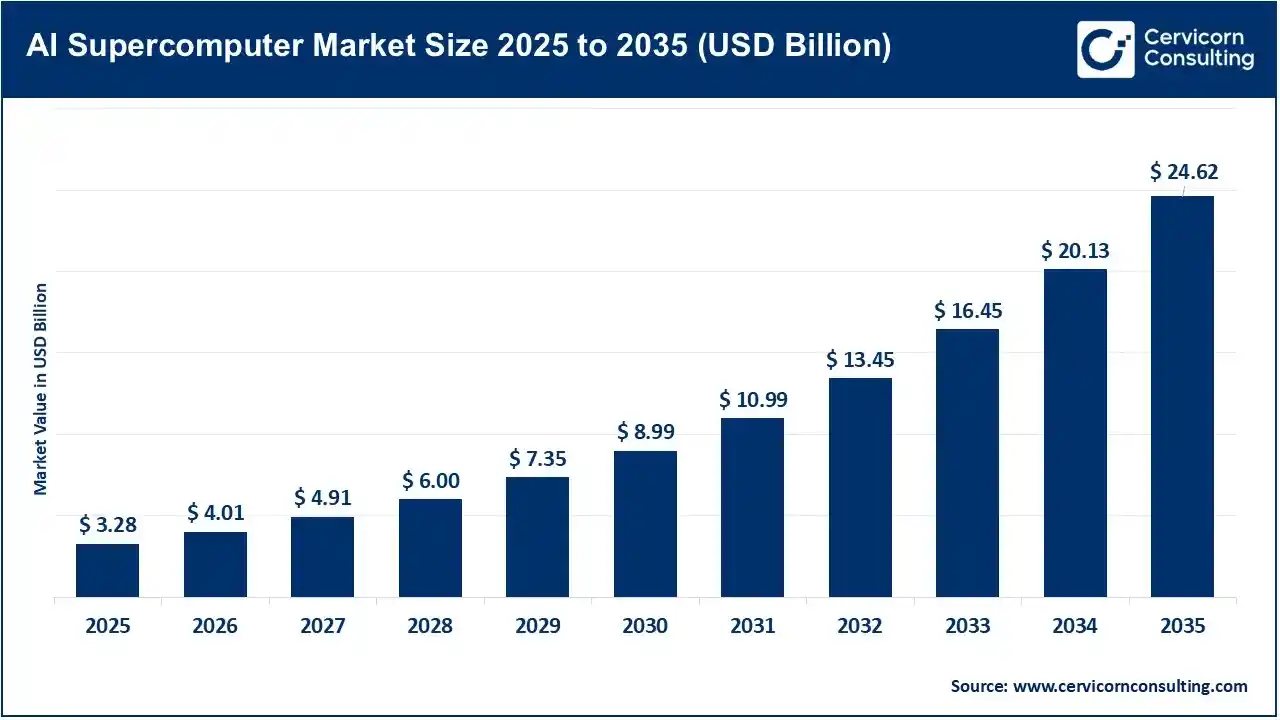
The rapid adoption of generative AI, large language models (LLMs), multimodal AI, and foundation models is a major driver of the AI supercomputer market, as organizations require unprecedented computing power to train and deploy increasingly complex AI models. Modern AI training clusters now rely on tens of thousands of GPUs interconnected through ultra-high-speed networking to reduce training time from months to weeks. According to the latest TOP500 rankings, 255 of the world's 500 fastest supercomputers use accelerator technologies, reflecting the industry's accelerating shift toward GPU-accelerated AI computing. Furthermore, NVIDIA technologies power over 400 of the TOP500 systems (81%), highlighting the growing preference for AI-optimized supercomputing architectures across research institutions, hyperscalers, and enterprises. These advancements are enabling breakthroughs in drug discovery, climate modeling, autonomous systems, robotics, and scientific simulation while significantly increasing investments in next-generation AI infrastructure.
Another key growth factor is the massive global expansion of AI data center infrastructure, supported by increasing government investments, sovereign AI initiatives, and hyperscale cloud deployments. AI workloads are dramatically increasing power and compute requirements, driving demand for liquid-cooled, energy-efficient AI supercomputers capable of supporting large-scale model training and inference. BloombergNEF projects that U.S. data centers could account for approximately 20% of national electricity consumption by 2035, compared with about 5.9% today, primarily due to AI infrastructure expansion. Separately, Gartner forecasts that AI workloads will consume approximately 175 TWh of data center electricity in 2026, an 84% increase over 2025, with AI-optimized servers expected to consume more electricity than conventional servers by 2027. These trends are accelerating investments in exascale computing systems, advanced networking technologies, high-bandwidth memory, and sustainable cooling solutions, creating significant long-term growth opportunities for the AI supercomputer market.
Report Highlights
- North America led the AI Supercomputer Market with 42.8% share, supported by hyperscale AI infrastructure, advanced semiconductor manufacturing, and strong public-private AI investments.
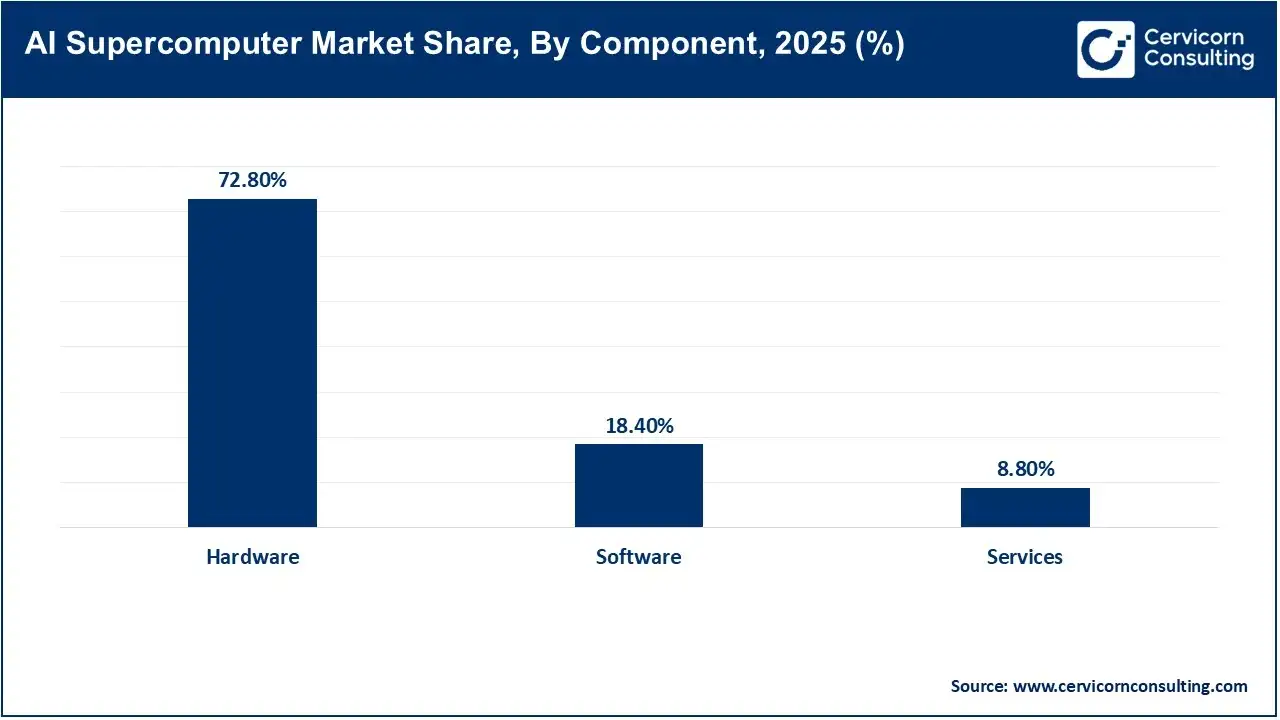
- Hardware dominated the component segment with 72.8% market share, driven by growing demand for GPUs, AI accelerators, high-speed networking, and advanced cooling technologies.
- On-Premises deployment accounted for 61.5% of the market, as enterprises prioritized security, performance, regulatory compliance, and dedicated AI computing infrastructure.
- GPU-Based processors captured 68.9% market share, owing to superior parallel computing performance for generative AI, deep learning, and large language model training.
- AI Model Training held the largest application share at 34.6%, fueled by expanding foundation model development, enterprise AI adoption, and scientific computing workloads.
- Cloud Service Providers represented 39.2% of the market, driven by rapid expansion of AI cloud platforms, hyperscale data centres, and AI-as-a-Service offerings.
What is an AI Supercomputer?
An AI supercomputer is an ultra high performance computing (HPC) system specifically designed to train, fine-tune, and deploy large-scale artificial intelligence models by combining thousands of CPUs, GPUs, AI accelerators, high-bandwidth memory, and ultra-fast networking into a single integrated platform. Unlike conventional supercomputers focused primarily on scientific simulations, AI supercomputers are optimized for massive parallel processing required by generative AI, large language models (LLMs), computer vision, robotics, autonomous systems, climate modeling, and drug discovery. These systems can perform exascale computing more than one quintillion (10¹⁸) calculations per second enabling organizations to process enormous datasets and significantly reduce AI model training time while improving inference performance and scalability.
Recent Milestones
| Date |
Milestone |
Market Significance & Statistics |
| June 2026 |
China's LineShine became the world's fastest supercomputer |
LineShine achieved 2.198 exaflops, becoming the first system to exceed 2 exaflops and the fifth exascale computer globally, demonstrating rapid advancements in AI supercomputing performance. |
| June 2026 |
NVIDIA expanded its dominance in AI supercomputing |
NVIDIA technologies powered over 400 of the TOP500 systems (81%), while 90% of newly added systems adopted NVIDIA technologies, highlighting strong AI infrastructure adoption. |
| June 2026 |
Accelerator adoption reached a record level |
The TOP500 reported 277 GPU/accelerator-based supercomputers, up from 255 six months earlier, reflecting growing demand for AI-optimized computing platforms. |
| November 2025 |
Europe deployed its first exascale AI supercomputer |
The JUPITER Booster entered the TOP500 with 1.000 exaflop performance, becoming Europe's first exascale system and strengthening regional AI research capabilities. |
| July 2026 |
NVIDIA donated a DGX GB300 AI supercomputer to the U.S. Naval Postgraduate School |
The system integrates 72 Blackwell Ultra GPUs, 36 Grace CPUs, 20 TB GPU memory, and 576 TB/s memory bandwidth, supporting AI research, defence simulations, and digital twin applications. |
AI Supercomputer Market Dynamics
Market Drivers
1. Rapid Expansion of Generative AI and Foundation Models
The explosive growth of generative AI, large language models (LLMs), and multimodal AI is significantly increasing demand for AI supercomputers capable of training trillion-parameter models. Hyperscalers and research organizations are investing heavily in GPU clusters with advanced networking and memory architectures. According to Gartner, global AI spending is projected to increase by 47% in 2026 to approximately USD 2.59 trillion, with AI infrastructure accounting for more than 45% of total AI spending, making AI-optimized computing platforms the largest investment category.
2. Rising Investments in AI Infrastructure and Sovereign Computing
Governments and cloud providers are accelerating investments in sovereign AI infrastructure to strengthen technological independence and national competitiveness. Countries are deploying exascale supercomputers and AI data centers to support scientific research, defense, healthcare, and industrial AI applications. The latest TOP500 rankings show that 277 of the world's 500 fastest supercomputers now use GPUs or accelerators, compared with 255 systems just six months earlier, demonstrating the rapid global transition toward AI-focused high-performance computing infrastructure.
Market Restraints
1. High Capital and Operational Costs
Building AI supercomputers requires substantial investment in GPUs, high-speed interconnects, cooling infrastructure, storage, and energy systems, creating significant barriers for many enterprises. Beyond acquisition costs, operating these systems demands considerable electricity and maintenance expenses. Research analyzing AI supercomputers indicates that leading AI clusters have evolved into multi-billion-dollar assets, with frontier systems requiring hundreds of megawatts of power, making affordability a major restraint for widespread deployment.
2. Power Availability and Grid Constraints
The increasing computational intensity of AI workloads is placing unprecedented pressure on electricity grids, making power availability a critical bottleneck for AI supercomputer expansion. AI-optimized servers consume significantly more energy than conventional computing infrastructure, requiring advanced cooling and reliable power supplies. Gartner forecasts that global data center electricity consumption will reach 565 TWh in 2026, increasing 26% year over year, while AI-optimized servers will account for 31% of total data center power consumption, highlighting growing infrastructure constraints.
Market Opportunities
1. Expansion of AI Cloud Services and AI-as-a-Service
The rapid adoption of AI-as-a-Service is creating substantial opportunities for AI supercomputer providers as enterprises increasingly access AI infrastructure through hyperscale cloud platforms instead of building their own clusters. Cloud providers continue expanding AI-optimized servers, networking, and storage capacity to support enterprise AI workloads. Gartner estimates that AI infrastructure spending will exceed USD 1.43 trillion in 2026, representing the largest segment of worldwide AI investment and creating significant opportunities for AI supercomputer vendors.
2. Growing Demand Across Scientific and Industrial Applications
Beyond generative AI, AI supercomputers are increasingly supporting drug discovery, climate modeling, autonomous vehicles, semiconductor design, robotics, and digital twins. These compute-intensive applications require large-scale parallel processing and real-time simulation capabilities. Studies of AI supercomputers show that computational performance has been doubling approximately every nine months between 2019 and 2025, illustrating the accelerating demand for increasingly powerful AI computing systems across commercial and research sectors.
Market Challenges
1. Semiconductor Supply Chain and Advanced Chip Availability
AI supercomputer deployment depends heavily on advanced GPUs, AI accelerators, high-bandwidth memory, and specialized networking components, making supply chain disruptions a persistent challenge. Strong demand from hyperscalers often exceeds manufacturing capacity, extending delivery times and increasing procurement costs. Gartner notes that AI semiconductors are expected to account for nearly 30% of total semiconductor revenue in 2026, while hyperscaler investment in AI infrastructure is projected to increase by more than 50%, intensifying supply constraints.
2. Sustainability and Cooling Requirements
As AI supercomputers become larger and denser, managing heat generation, energy efficiency, and environmental impact becomes increasingly challenging. Operators must deploy advanced liquid-cooling technologies, optimize power utilization, and secure sustainable energy sources while maintaining performance. BloombergNEF projects that U.S. data centers could account for nearly 20% of national electricity consumption by 2035, compared with approximately 5.9% today, emphasizing the long-term sustainability challenges facing AI supercomputer deployments.
Regional Analysis
The AI supercomputer market is segmented by region into North America, Europe, Asia-Pacific, Latin America, and LAMEA. Here is a brief overview of each region:
Why does North America dominates the AI supercomputer market?
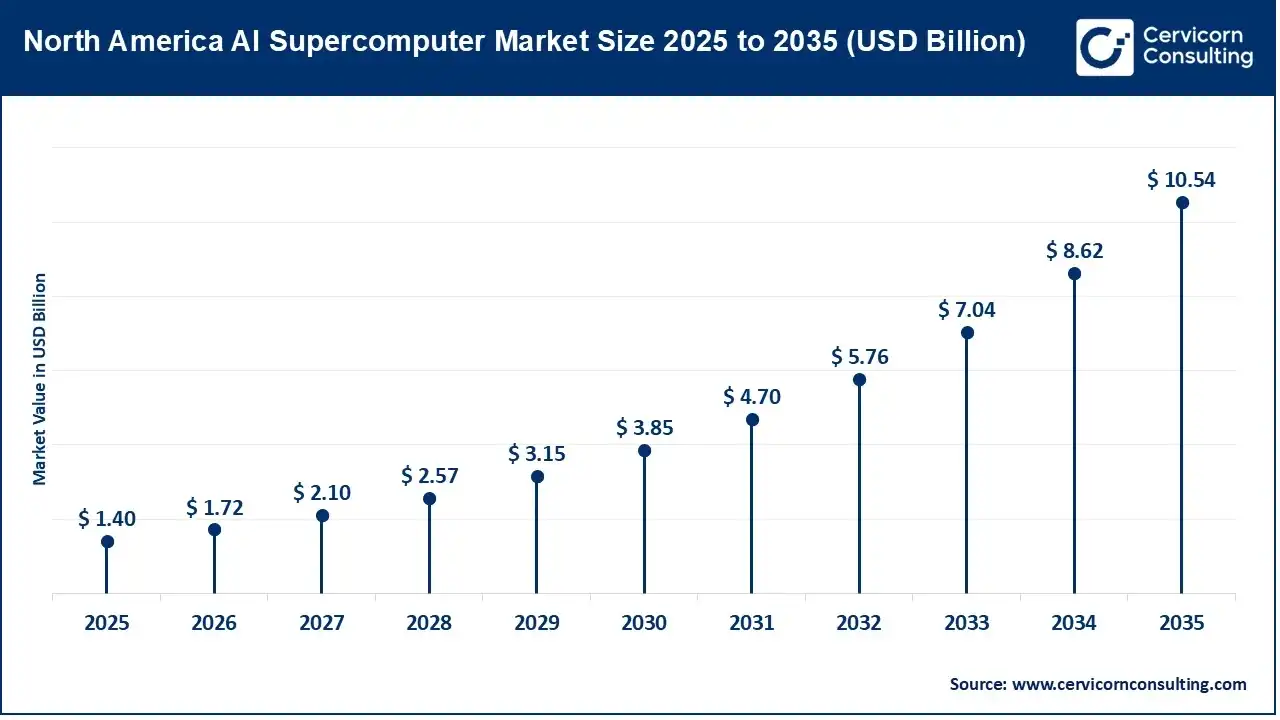
The North America AI supercomputer market size was valued at USD 1.40 billion in 2025 and is predicted to reach around USD 10.54 billion by 2035. North America dominates the market owing to its concentration of hyperscale cloud providers, advanced semiconductor companies, world-leading research laboratories, and substantial public and private investments in artificial intelligence infrastructure. The region is witnessing rapid expansion of AI data centres to support generative AI, large language models (LLMs), scientific computing, and enterprise AI applications. Government initiatives such as the U.S. CHIPS and Science Act, Department of Energy exascale computing programs, and Canada's Sovereign AI Compute Strategy continue to accelerate AI infrastructure deployment. Strong collaboration among cloud service providers, GPU manufacturers, universities, and national laboratories, combined with growing adoption of liquid-cooled AI clusters and high-speed networking technologies, reinforces North America's leadership in next-generation AI supercomputing.
United States: AI Infrastructure Expansion, Exascale Computing Leadership, and Semiconductor Innovation Drive Market Growth
- According to the TOP500 Supercomputer List, the United States operates more than 170 of the world's 500 fastest supercomputers, maintaining the world's largest high-performance computing infrastructure for AI research and enterprise applications.
- The CHIPS and Science Act provides over USD 52 billion to strengthen domestic semiconductor manufacturing, advanced computing technologies, and AI infrastructure, accelerating deployment of next-generation AI supercomputers.
Canada: National AI Strategy, Sustainable Computing Infrastructure, and Sovereign AI Investments Support Market Expansion
- Canada became the first country to launch a national AI strategy and continues strengthening AI supercomputing capabilities through the CAD 2 billion Canadian Sovereign AI Compute Strategy supporting domestic AI infrastructure.
- According to the Government of Canada, approximately 84% of Canada's electricity is generated from non-emitting sources, providing a sustainable energy foundation for AI supercomputing facilities and hyperscale data centres.
Why is Asia-Pacific fastest-growing region for AI supercomputer market?
The Asia-Pacific AI supercomputer market size was estimated at USD 1.04 billion in 2025 and is forecasted to grow USD 7.78 billion by 2035. Asia-Pacific is the fastest-growing market, driven by aggressive government investments in artificial intelligence, expanding hyperscale cloud infrastructure, and strong semiconductor manufacturing capabilities. Countries across the region are accelerating deployment of AI supercomputers to support generative AI, scientific research, healthcare, smart manufacturing, and national security applications. National AI strategies, sovereign computing initiatives, and substantial investments in exascale computing are strengthening regional competitiveness. The presence of leading semiconductor manufacturers, rapidly growing AI startups, and collaborations between governments, research institutes, and technology companies continue to position Asia-Pacific as a global hub for next-generation AI supercomputing infrastructure.
China: Government AI Leadership, Exascale Computing, and Domestic AI Chip Development Accelerate Market Growth
- China operates the second-largest number of TOP500 supercomputers globally, supported by extensive government investments in exascale computing, scientific research, and sovereign AI infrastructure.
- According to the TOP500 June 2026 rankings, China's LineShine became the world's fastest supercomputer, delivering 2.198 exaflops, making it the first system to exceed 2 exaflops.
- China's New Generation Artificial Intelligence Development Plan and continued investments in domestic AI processors, cloud infrastructure, and national computing centres are accelerating deployment of indigenous AI supercomputing capabilities.
Japan: Advanced HPC Leadership, Semiconductor Innovation, and Research Excellence Strengthen AI Supercomputing
- The Fugaku supercomputer, developed by RIKEN and Fujitsu, continues to rank among the world's most powerful supercomputers, delivering approximately 442 petaflops of LINPACK performance.
- Government support through the AI Strategy 2022 and continued investments in next-generation semiconductor technologies, AI research, and advanced computing infrastructure are strengthening Japan's AI supercomputer ecosystem.
What are the driving factors of Europe AI supercomputer market?
The Europe AI supercomputer market size reached at USD 0.64 billion in 2025 and is projected to hit around USD 4.78 billion by 2035. Europe represents a major market, supported by large-scale public investments in exascale computing, strong scientific research capabilities, and the European Union's commitment to digital sovereignty. The region is accelerating deployment of AI supercomputers to advance generative AI, healthcare, climate modelling, advanced manufacturing, and scientific discovery. Programs such as the EuroHPC Joint Undertaking, the AI Factories initiative, and national AI strategies are expanding world-class supercomputing infrastructure across member states. Strong collaboration among governments, research institutions, semiconductor companies, and cloud providers continues to strengthen Europe's position as a global hub for high-performance AI computing.
Germany: EuroHPC Leadership, Industrial AI Adoption, and Exascale Computing Drive Market Growth
- Germany hosts JUPITER, Europe's first exascale supercomputer, delivering approximately 1 exaflop of AI computing performance through the EuroHPC Joint Undertaking.
- Germany's AI Strategy commits over EUR 5 billion to strengthen artificial intelligence research, high-performance computing infrastructure, semiconductor innovation, and industrial AI adoption.
France: Sovereign AI Investments, Research Excellence, and Advanced Computing Infrastructure Support Market Expansion
- France continues expanding AI supercomputing through the Jean Zay supercomputer, which delivers more than 125 petaflops of AI performance for research, generative AI, and scientific computing workloads.
- The French government has committed over EUR 2.5 billion under its National AI Strategy to strengthen sovereign AI capabilities, advanced computing infrastructure, and AI innovation ecosystems.
AI Supercomputer Market Share, By Region, 2025 (%)
| Region |
Revenue Share, 2025 (%) |
| North America |
42.8% |
| Asia-Pacific |
31.6% |
| Europe |
19.4% |
| LAMEA (Latin America, Middle East & Africa) |
6.2% |
Why is LAMEA witnessing steady growth in the AI supercomputer market?
The LAMEA AI supercomputer market was valued at USD 0.20 billion in 2025 and is anticipated to reach around USD 1.53 billion by 2035. The LAMEA market is witnessing steady growth, supported by increasing digital transformation initiatives, expanding hyperscale data centre investments, and rising government focus on artificial intelligence and high-performance computing. Countries across the region are investing in national AI strategies, scientific research, smart cities, and sovereign digital infrastructure to strengthen AI capabilities. Growing cloud adoption, partnerships with global technology providers, and investments in advanced semiconductor and computing infrastructure are accelerating AI supercomputer deployment for healthcare, energy, financial services, education, and public sector applications.
Saudi Arabia: Vision 2030, Sovereign AI Investments, and Large-Scale Computing Infrastructure Drive Market Growth
- Saudi Arabia has committed USD 100 billion through initiatives such as Project Transcendence to accelerate artificial intelligence, advanced computing infrastructure, semiconductor technologies, and digital economy development.
- The Kingdom's Vision 2030 strategy prioritizes AI, cloud computing, and high-performance computing, supported by investments from SDAIA, Aramco, and national research institutions to expand sovereign AI capabilities.
Brazil: Expanding Research Infrastructure, National AI Strategy, and Cloud Investments Support Market Expansion
- Brazil's National Artificial Intelligence Strategy (EBIA) promotes investments in high-performance computing, AI research, scientific innovation, and digital transformation across public and private sectors.
- Brazil hosts Latin America's largest data centre market, accounting for over 40% of the region's installed data centre capacity, supporting increasing demand for AI supercomputing and cloud-based AI services.
Segmental Analysis
The AI supercomputer market is segmented into component, deployment, processor type, application, end user, and geography.
Component Analysis
The hardware segment dominates the AI supercomputer market due to the high capital investment required for GPUs, CPUs, AI accelerators, high-bandwidth memory, networking equipment, storage systems, and advanced cooling infrastructure. AI supercomputers rely on thousands of interconnected processors to execute complex AI workloads, making hardware the largest revenue contributor. Continuous investments by hyperscalers, governments, and research organizations in exascale computing facilities and AI data centers further strengthen hardware demand, while rapid advancements in GPU architectures continue driving infrastructure upgrades globally.
The software segment is expected to register the fastest growth during the forecast period as organizations increasingly adopt AI frameworks, cluster orchestration platforms, workload schedulers, and performance optimization tools. The rising complexity of large language models and distributed AI training requires intelligent resource management, automation, and security solutions to maximize hardware utilization. Growing deployment of AI factories, cloud-native AI platforms, and containerized workloads is accelerating demand for software that improves scalability, operational efficiency, and seamless integration across heterogeneous AI supercomputing environments.
Deployment Analysis
The on-premises segment dominates the AI supercomputer market because government agencies, research laboratories, defence organizations, and hyperscale enterprises require complete control over sensitive datasets, infrastructure security, and computing resources. Large-scale AI model training also benefits from dedicated high-performance clusters with predictable latency and maximum processing capability. Organizations handling confidential research, healthcare, semiconductor design, and national security applications continue investing in privately managed AI supercomputing infrastructure to ensure regulatory compliance, performance optimization, and long-term operational reliability.
AI Supercomputer Market, By Deployment, 2025 (%)
| Deployment |
Revenue Share, 2025 (%) |
| On-Premises |
61.5% |
| Cloud-Based |
28.7% |
| Hybrid |
9.8 a2 |
The cloud-based segment is projected to witness the fastest growth owing to increasing adoption of AI-as-a-Service and on-demand access to high-performance computing resources. Cloud deployment enables enterprises to utilize advanced AI supercomputers without investing in expensive infrastructure while offering flexible scalability for training and inference workloads. Expanding AI cloud offerings from hyperscale providers, combined with growing enterprise adoption of generative AI applications, are accelerating migration toward cloud-based AI supercomputing platforms across industries.
Processor Type Analysis
The GPU-based segment holds the largest market share because graphics processing units provide exceptional parallel processing capabilities required for deep learning, large language models, computer vision, and scientific simulations. Modern AI supercomputers integrate thousands of GPUs connected through ultra-high-speed networking to accelerate AI model training and inference. Continuous innovations in GPU architecture, memory bandwidth, and energy efficiency have established GPUs as the preferred processing technology for hyperscalers, research institutions, and enterprise AI deployments worldwide.
AI Supercomputer Market, By Processor Type, 2025 (%)
| Processor Type |
Revenue Share, 2025 (%) |
| GPU-Based |
68.9% |
| CPU-Based |
12.7% |
| AI Accelerator-Based (ASICs, NPUs, TPUs) |
13.6% |
| Heterogeneous Computing Systems |
4.8% |
The AI accelerator-based segment is anticipated to grow at the fastest rate due to increasing adoption of application-specific integrated circuits (ASICs), neural processing units (NPUs), and tensor processing units (TPUs) optimized for AI workloads. These processors deliver higher performance per watt than traditional computing architectures while reducing latency and operational costs. Rising deployment of custom AI chips by cloud providers and semiconductor companies is expanding accelerator adoption for generative AI, inference, and next-generation AI supercomputing systems.
Application Analysis
The AI model training segment dominates the market as training foundation models, multimodal AI systems, and large language models requires enormous computational resources, high-speed interconnects, and distributed GPU clusters. Organizations developing advanced AI models invest heavily in AI supercomputers capable of processing massive datasets and billions of model parameters. Increasing investments from hyperscale cloud providers, research institutions, and AI developers continue making model training the largest workload driving demand for AI supercomputing infrastructure.
AI Supercomputer Market, By Application, 2025 (%)
| Application |
Revenue Share, 2025 (%) |
| AI Model Training |
34.6% |
| AI Inference |
18.3% |
| Scientific Research & Simulation |
15.4% |
| High-Performance Computing (HPC) |
11.2% |
| Generative AI |
12.8% |
| Autonomous Systems |
4.6% |
| Others |
3.1% |
The Generative AI segment is expected to experience the highest growth because enterprises are rapidly deploying AI-powered content generation, coding assistants, digital twins, synthetic data generation, and conversational AI applications. These workloads require high-performance AI supercomputers for efficient training and inference at scale. Increasing enterprise investment in foundation models, multimodal AI platforms, and autonomous AI agents is significantly accelerating demand for advanced AI computing systems optimized specifically for generative AI applications.
End User Analysis
Cloud service providers represent the largest end-user segment as hyperscale companies invest billions of dollars in AI supercomputing infrastructure to support enterprise AI services, foundation model development, and AI cloud platforms. Their large-scale data centers integrate thousands of GPUs and AI accelerators capable of delivering computing resources to millions of customers globally. Continuous expansion of AI infrastructure by leading cloud providers is reinforcing their dominant position within the AI supercomputer market while supporting rapid enterprise AI adoption.
AI Supercomputer Market, By End User, 2025 (%)
| End User |
Revenue Share, 2025 (%) |
| Cloud Service Providers |
39.2% |
| Research Institutes & Universities |
17.4% |
| Government & Defence |
15.8% |
| Healthcare & Life Sciences |
8.6% |
| Banking, Financial Services & Insurance (BFSI) |
6.5% |
| Automotive & Transportation |
5.4% |
| Manufacturing |
4.1% |
| Others |
3.0% |
The healthcare & life sciences segment is projected to register the fastest growth due to increasing use of AI supercomputers for genomics, protein structure prediction, drug discovery, precision medicine, medical imaging, and clinical research. AI-enabled biomedical applications require immense computational performance to analyze complex biological datasets and accelerate scientific breakthroughs. Rising investments in computational biology, pharmaceutical research, and AI-assisted diagnostics are driving rapid adoption of AI supercomputing solutions across healthcare and life sciences institutions.
AI Supercomputer Market Top Companies
Recent Developments
- In March 2026, NVIDIA Corporation launched the Vera CPU, purpose-built for agentic AI and large-scale AI training, delivering up to twice the efficiency of traditional rack-scale CPUs while enabling next-generation AI supercomputers.
- In July 2026, Advanced Micro Devices, Inc. (AMD) announced full production of its Helios AI rack-scale system featuring MI455X accelerators and Venice CPUs, strengthening its position in AI supercomputing and hyperscale data centre infrastructure.
- In February 2026, Intel Corporation expanded its AI supercomputing portfolio by introducing next-generation Xeon processors with enhanced AI acceleration, higher memory bandwidth, and improved performance for HPC and enterprise AI workloads.
- In July 2026, Hewlett Packard Enterprise (HPE) introduced the HPE Cray Supercomputing GX5000 powered by 6th Gen AMD EPYC processors, delivering higher compute density and direct liquid cooling for AI-driven scientific computing.
Market Segmentation
By Component
- Hardware
- Compute Nodes (CPU, GPU, AI Accelerators)
- High-Speed Networking
- Memory
- Storage Systems
- Cooling & Power Infrastructure
- Software
- AI Frameworks
- Cluster Management Software
- Resource Scheduling & Orchestration
- Performance Monitoring & Optimization
- Services
- Consulting
- Deployment & Integration
- Support & Maintenance
- Managed Services
By Deployment
- On-Premises
- Cloud-Based
- Hybrid
By Processor Type
- GPU-Based
- CPU-Based
- AI Accelerator-Based (ASICs, NPUs, TPUs)
- Heterogeneous Computing Systems
By Application
- AI Model Training
- AI Inference
- Scientific Research & Simulation
- High-Performance Computing (HPC)
- Generative AI
- Autonomous Systems
- Others
By End User
- Cloud Service Providers
- Research Institutes & Universities
- Government & Defence
- Healthcare & Life Sciences
- Banking, Financial Services & Insurance (BFSI)
- Automotive & Transportation
- Manufacturing
- Others
By Geography
- North America
- Europe
- Asia-Pacific
- LAMEA