AI Agents in Healthcare Market Size, Growth, Forecast 2026 to 2035
The global AI agents in healthcare market size was estimated at USD 1.09 billion in 2025 and is expected to surpass around USD 34.83 billion by 2035, exhibiting a compound annual growth rate (CAGR) of 41.4% over the forecast period from 2026 to 2035.
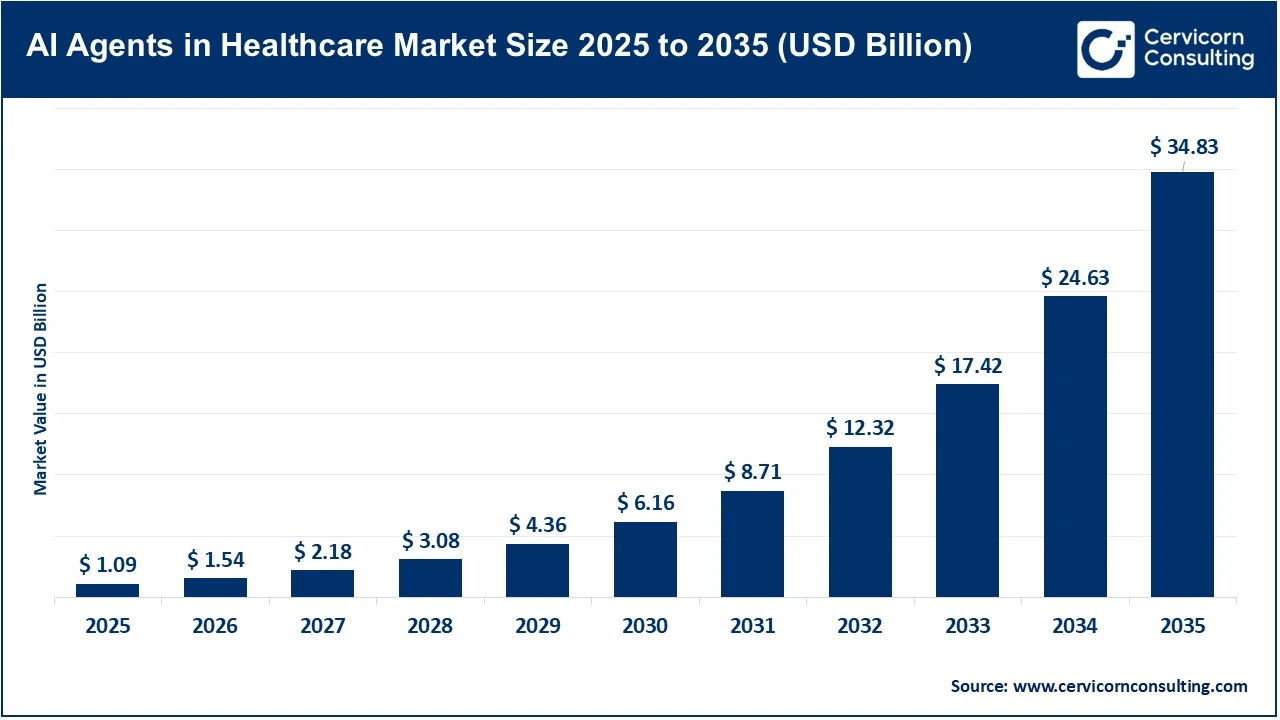
The AI agents in healthcare market is being driven by the healthcare sector’s urgent need to reduce administrative burden, improve clinical productivity, and address workforce shortages through more autonomous AI systems. Adoption momentum is accelerating as 85% of healthcare leaders surveyed by McKinsey said their organizations were exploring or had already adopted generative AI in 2024, while 50% of US healthcare organizations reported implemented gen AI by late 2025 and 19% had already reached agentic AI maturity, with another 51% pursuing agentic AI proofs of concept. On the provider side, physician acceptance is also strengthening: the AMA found 66% of physicians were already using AI in practice in 2024, up from 38% in 2023, and 57% identified administrative automation as AI’s top opportunity. Growth is further supported by expanding use cases in clinical documentation, revenue-cycle management, care coordination, patient engagement, and decision support, alongside broader healthcare AI investment, rising FDA-cleared AI tools, and growing demand for integrated multi-agent workflows that can improve efficiency, responsiveness, and care delivery outcomes.
Report Highlights
- North America held the largest regional share of 41.8%, supported by advanced healthcare IT infrastructure, strong AI adoption, and early agentic AI deployment.
- By function, diagnosis & early detection segment has captured revenue share of 28.6%, driven by rising AI use in imaging, disease screening, and clinical prioritization.
- By offering, single-agent systems dominated with 63.4% share, as healthcare organizations prefer focused AI tools that are easier to integrate and govern.
- By agent architecture, pattern recognition agents accounted for a 34.8% revenue share, supported by their strong use in diagnostics, imaging interpretation, anomaly detection, and predictive healthcare analytics.
- By applicatiom, clinical applications captured the largest share at 39.5%, reflecting growing adoption of AI agents in diagnosis, treatment planning, and care coordination.
- By end user, healthcare providers led the market with 43.7% share, driven by rising deployment of AI agents in hospitals, clinics, and health systems.
What is AI Agents in Healthcare?
AI agents in healthcare are autonomous or semi-autonomous software systems that use technologies such as generative AI, machine learning, natural language processing, and reasoning models to perform healthcare tasks with limited human intervention. Unlike traditional healthcare AI tools that support a single task, AI agents can understand context, make decisions, coordinate across systems, and execute multi-step workflows such as patient triage, clinical documentation, prior authorization, care navigation, claims handling, treatment support, and follow-up communication. These agents are increasingly being adopted across providers, payers, and health-tech organizations to improve operational efficiency, reduce manual workload, and support faster, more personalized care delivery.
Benefits of AI Agents in Healthcare
- Reduces documentation and administrative burden: AI-enabled documentation, coding, and workflow agents can cut routine processing time for administrative tasks by 50%–70%, helping clinicians spend less time on paperwork and more on patient care.
- Improves physician productivity and patient interaction: In a Sutter Health evaluation of ambient AI documentation, 93% of physicians said the tool helped them give patients their full attention during visits, highlighting gains in both workflow efficiency and care quality.
- Saves clinician time at scale: At Cleveland Clinic, an ambient AI scribe reduced physicians’ note-review and writing time by 2 minutes per appointment and 14 minutes per day, demonstrating how AI agents can create measurable productivity gains across large provider networks.
- Supports faster, end-to-end healthcare workflows: McKinsey notes that AI agents can manage complex workflows such as prior authorization, patient scheduling, claims follow-up, and care coordination with limited human intervention, helping providers and payers reduce delays and improve service responsiveness
- Helps address burnout and workforce pressure: AI agents are being adopted partly to combat rising clinician burnout and labor shortages; healthcare organizations are increasingly using AI to automate repetitive back-office and front-office work so staff can focus on higher-value clinical and patient-facing tasks.
Report Scope
| Area of Focus |
Details |
| Market Size in 2026 |
USD 1.54 Billion |
| Market Size in 2035 |
USD 34.83 Billion |
| CAGR 2026 to 2035 |
41.40% |
| Dominant Region |
North America |
| Highest Growth Region |
Asia-Pacific |
| Key Segments |
Function, Offering, Agent Architecture, Application, End User, Region |
| Key Companies |
Oracle, Microsoft, IBM, Google, Amazon Web Services, NVIDIA, NextGen Invent, Automation Anywhere, Innovaccer, SoundHound AI, CitiusTech, Databricks |
Market Dynamics
Market Drivers
1. Rising administrative burden and need for workflow automation
AI agents are gaining traction in healthcare because providers and payers are under heavy pressure to automate labor-intensive workflows such as documentation, prior authorization, coding, scheduling, and claims follow-up. McKinsey reports that 50% of US healthcare organizations had already implemented generative AI by 2026, while 19% had reached agentic AI maturity and 51% were pursuing agentic AI proofs of concept. This reflects strong demand for AI systems that can execute multi-step tasks, reduce staff workload, and improve operational efficiency across revenue cycle and care coordination functions.
2. Growing physician adoption and workforce-efficiency pressures
The healthcare sector is facing persistent clinician burnout, staff shortages, and pressure to improve productivity without compromising care quality, making AI agents attractive for task delegation and decision support. According to the American Medical Association, 66% of physicians were already using AI in practice in 2024, up from 38% in 2023, and 57% identified administrative automation as AI’s biggest opportunity. AI agents that handle note generation, patient messaging, intake, and clinical workflow orchestration are therefore becoming a practical tool for freeing clinician time and supporting more scalable care delivery.
Market Restraints
1. Trust, safety, and clinical accountability concerns
A major restraint for the AI agents in healthcare market is the concern that autonomous systems may make flawed recommendations, produce biased outputs, or operate without clear accountability in high-stakes clinical settings. McKinsey notes that healthcare leaders still rank AI safety, trust, and governance among the top barriers to broader deployment. Concerns are reinforced by real-world incidents involving AI-enabled medical devices and clinical software, where questions remain around oversight, liability, and validation. This slows adoption, particularly for agentic systems expected to take actions rather than simply provide recommendations.
2. Data quality, interoperability, and fragmented healthcare IT systems
AI agents depend on access to clean, connected, and context-rich data across EHRs, claims systems, imaging platforms, and patient communication channels. In practice, healthcare organizations still struggle with fragmented records, inconsistent coding, and poor interoperability, which limits agent performance and scalability. McKinsey highlights integration as a growing implementation barrier, while broader healthcare data-quality research continues to identify incomplete, inconsistent, and siloed data as a core obstacle to reliable AI deployment. Without strong governance and interoperable infrastructure, even advanced AI agents can underperform or create workflow disruption instead of efficiency gains.
Market Opportunities
1. Large opportunity in prior authorization, claims, and denial management
One of the biggest near-term opportunities for AI agents lies in payer-provider administrative workflows, especially prior authorization, claims adjudication, denial prevention, and appeals. These areas are highly repetitive, rules-driven, and costly, making them well suited for multi-step AI agents. KFF reported that insurers on HealthCare.gov denied 20% of all claims in 2024, while HFMA noted provider denial rates averaged nearly 12% in 2025. With such high friction in reimbursement workflows, AI agents that can gather documentation, generate submissions, track payer responses, and support appeals represent a major value-creation opportunity.
2. Expansion of AI-enabled diagnostics and clinical decision support
Another strong opportunity is the use of AI agents to coordinate diagnosis, monitoring, and decision support across imaging, triage, care navigation, and personalized treatment workflows. The FDA’s expanding list of AI-enabled medical devices shows how rapidly healthcare AI is moving into clinical use, with more than 1,000 AI-enabled devices authorized in the US and the list continuing to grow. As these tools proliferate, AI agents can act as orchestration layers that interpret outputs, route insights to clinicians, trigger follow-ups, and integrate recommendations into workflows, creating a broader market beyond standalone AI models.
Market Challenges
1. Regulatory complexity and evolving compliance requirements
A major challenge for the market is that healthcare AI agents operate in a tightly regulated environment where clinical safety, data privacy, explainability, and post-deployment monitoring are all under increasing scrutiny. The FDA issued draft guidance in January 2025 for AI-enabled device software functions, signaling that oversight is becoming more structured but also more demanding. For companies deploying agentic systems across clinical and administrative workflows, the challenge is not only building capable tools but also maintaining auditability, validation, and compliance as regulations evolve across regions and use cases.
2. Privacy, cybersecurity, and misuse risks in autonomous systems
Healthcare AI agents often require access to highly sensitive patient records, payer data, clinician notes, and operational systems, which creates substantial privacy and cybersecurity risks. Recent research highlights vulnerabilities such as data poisoning, insecure data sharing, and weak governance around AI-enabled healthcare workflows. A 2025 review on healthcare AI security found that attackers with access to only 100–500 samples could compromise healthcare AI systems in some scenarios, while privacy studies continue to flag inconsistent standards and weak infrastructure across organizations. These risks can slow enterprise adoption and raise implementation costs for vendors and providers alike.
Segmental Analysis
The AI agents in healthcare market is segmented into function, offering, agent architecture, application, end user, and geography.
Function Analysis
Diagnosis & early detection is the dominating function segment in the AI agents in healthcare market because it sits at the center of clinical value creation and directly influences patient outcomes, care quality, and treatment timelines. Healthcare organizations are increasingly deploying AI agents to analyze medical images, lab results, pathology data, and patient histories to identify abnormalities earlier and support disease prioritization. The segment also benefits from strong provider demand for reducing diagnostic errors, accelerating case triage, and integrating AI into frontline clinical workflows where the return on improved speed and accuracy is most visible.
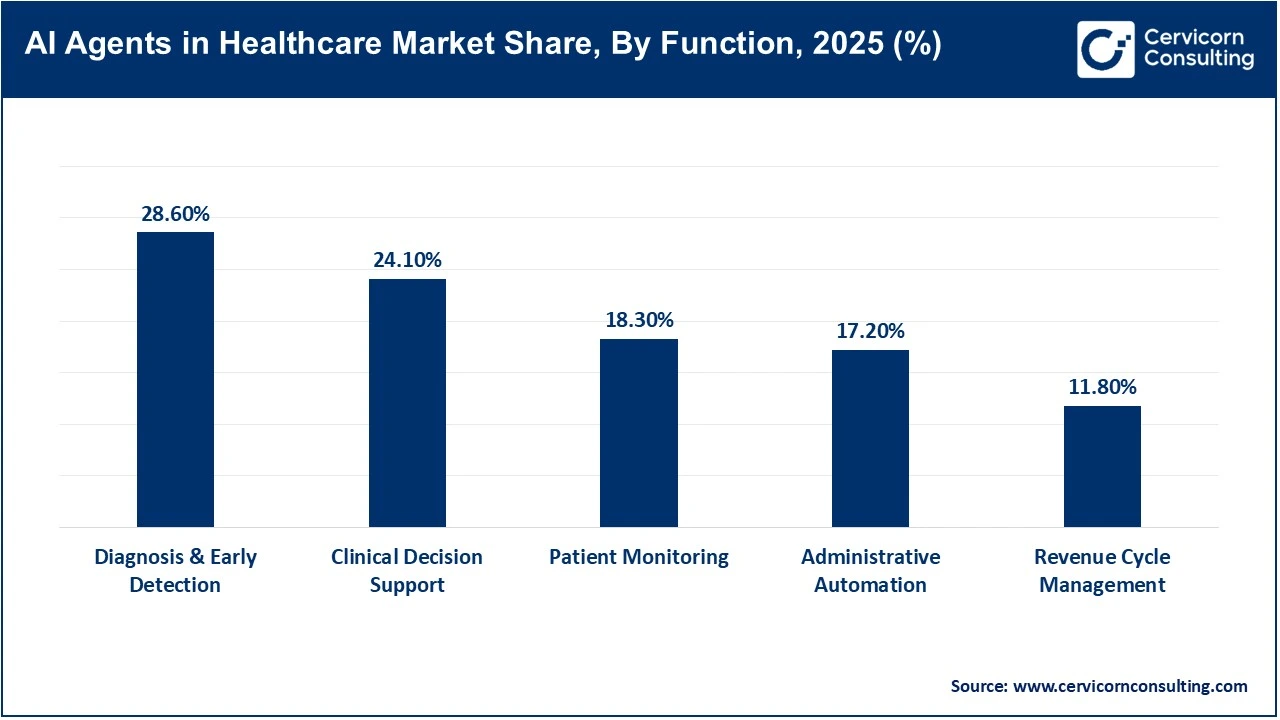
Patient monitoring is emerging as the fastest-growing function segment as healthcare systems shift toward continuous, proactive, and decentralized care delivery. AI agents are increasingly being used to track patient vitals, symptoms, medication adherence, and disease progression across inpatient, outpatient, and home-based settings. The rise of chronic disease management, remote care programs, hospital-at-home models, and wearable-connected health ecosystems is accelerating demand for intelligent monitoring agents that can detect deterioration, trigger alerts, and coordinate follow-up actions. This makes patient monitoring a high-growth area as providers seek to move from episodic care toward real-time intervention and longitudinal patient oversight.
Offering Analysis
Single-agent systems currently dominate the AI agents in healthcare market because they are easier to deploy, integrate, govern, and scale within existing healthcare IT environments. Most early healthcare AI implementations have focused on solving specific pain points such as documentation, scheduling, claims processing, coding support, or image analysis, which align well with a single-agent architecture. Hospitals and payers often prefer these systems during the initial stages of adoption because they offer lower implementation complexity and clearer workflow boundaries. Their focused task orientation also makes them easier to validate, monitor, and align with compliance requirements in operational and clinical settings.
AI Agents in Healthcare Market, By Offering, 2025 (%)
| Offering |
Revenue Share, 2025 (%) |
| Single-Agent Systems |
63.4% |
| Multi-Agent Systems |
36.6% |
Multi-agent systems are the fastest-growing offering segment because healthcare organizations are moving beyond isolated automation toward coordinated, end-to-end workflow orchestration. These systems enable multiple specialized agents to collaborate across functions such as triage, documentation, care coordination, billing, and patient communication, making them well suited for complex healthcare environments. As providers and payers seek more integrated AI deployments, multi-agent architectures offer greater flexibility, scalability, and contextual intelligence than single-purpose tools. Their ability to manage interdependent tasks across clinical and administrative workflows is positioning them as the next major growth engine in healthcare agent adoption.
Agent Architecture Analysis
Pattern recognition agents dominate the architecture segment because they are deeply embedded in some of healthcare’s most mature AI use cases, especially imaging analysis, disease detection, risk scoring, patient monitoring, and anomaly identification. These agents are well suited for interpreting structured and unstructured medical data at scale, making them highly valuable in radiology, pathology, cardiology, and population health workflows. Their dominance also reflects that healthcare AI adoption initially focused on diagnostic support and predictive analytics rather than fully autonomous workflow execution. As a result, pattern recognition remains the foundational architecture underpinning many current healthcare AI agent deployments.
AI Agents in Healthcare Market, By Agent Architecture, 2025 (%)
| Agent Architecture |
Revenue Share, 2025 (%) |
| Pattern Recognition Agents |
34.8% |
| Contextual Agents |
24.7% |
| Conversational Agents |
22.1% |
| Predictive Agents |
18.4% |
Contextual agents are expected to be the fastest-growing architecture segment because healthcare decisions increasingly require systems that can understand patient history, workflow context, care pathways, and role-specific clinical nuance rather than simply identify patterns. These agents can synthesize information across EHRs, physician notes, lab reports, prior interactions, and operational systems to support more adaptive and personalized decision-making. Their value is especially strong in care coordination, patient communication, triage, and longitudinal disease management, where context matters as much as prediction. As healthcare organizations pursue more human-like, workflow-aware AI, contextual agents are gaining strategic importance across both clinical and administrative use cases.
Application Analysis
Clinical applications dominate the AI agents in healthcare market because they directly influence diagnosis, treatment planning, monitoring, and care coordination, making them central to the core mission of healthcare delivery. AI agents used in clinical settings can support disease detection, prioritize cases, assist clinicians with decision-making, and streamline care pathways, creating tangible value in both patient outcomes and operational efficiency. This segment also benefits from growing provider interest in embedding AI into frontline care workflows rather than limiting it to back-office automation. As healthcare organizations seek more intelligent and responsive care models, clinical applications remain the most strategically important area of adoption.
AI Agents in Healthcare Market, By Application, 2025 (%)
| Application |
Revenue Share, 2025 (%) |
| Clinical Applications |
39.5% |
| Administrative Applications |
27.2% |
| Patient Engagement |
19.1% |
| Drug Discovery & Research |
14.2% |
Patient engagement is emerging as the fastest-growing application segment as healthcare systems place greater emphasis on access, communication, self-management, and continuity of care outside traditional clinical settings. AI agents are increasingly being deployed as virtual assistants, follow-up coordinators, symptom checkers, onboarding tools, and care navigation companions that help patients interact more effectively with providers and health systems. Rising consumer expectations for digital-first experiences, combined with the need to improve adherence, reduce missed appointments, and support chronic care journeys, is accelerating demand for patient-facing AI agents. This positions patient engagement as a major growth opportunity in the market’s next phase.
End User Analysis
Healthcare providers dominate the end-user landscape because hospitals, clinics, and health systems are the primary environments in which AI agents are deployed to support clinical and operational workflows. Providers face daily pressure to improve patient throughput, reduce clinician burden, optimize documentation, enhance diagnosis, and coordinate care more efficiently, all of which create strong demand for AI agents. They also have direct access to the patient, workflow, and data infrastructure needed to embed these systems into real-world care delivery. Because of this central role in diagnosis, treatment, and administration, healthcare providers remain the leading adopters across the market.
AI Agents in Healthcare Market, By End User, 2025 (%)
| End User |
Revenue Share, 2025 (%) |
| Healthcare Providers |
43.7% |
| Healthcare Payers |
18.6% |
| Pharmaceutical & Biotechnology Companies |
17.4% |
| Government & Public Health Organizations |
11.2% |
| Research Institutes & Academic Centers |
9.1% |
Pharmaceutical and biotechnology companies are emerging as the fastest-growing end-user segment as AI agents gain traction in drug discovery, trial design, medical information workflows, pharmacovigilance, and commercial operations. These organizations are increasingly exploring agentic AI to automate research-heavy, data-intensive, and highly iterative processes where speed and knowledge synthesis are critical. AI agents can help coordinate scientific literature review, patient cohort identification, clinical trial support, and internal knowledge workflows, making them attractive beyond traditional provider settings. As life sciences companies expand AI investment across R&D and commercialization functions, this segment is poised for rapid growth within the broader healthcare agent ecosystem.
Regional Analysis
The AI agents in healthcare market is segmented by region into North America, Europe, Asia-Pacific, Latin America, and LAMEA. Here is a brief overview of each region:
Why does North America dominates in the AI Agents in Healthcare Market?
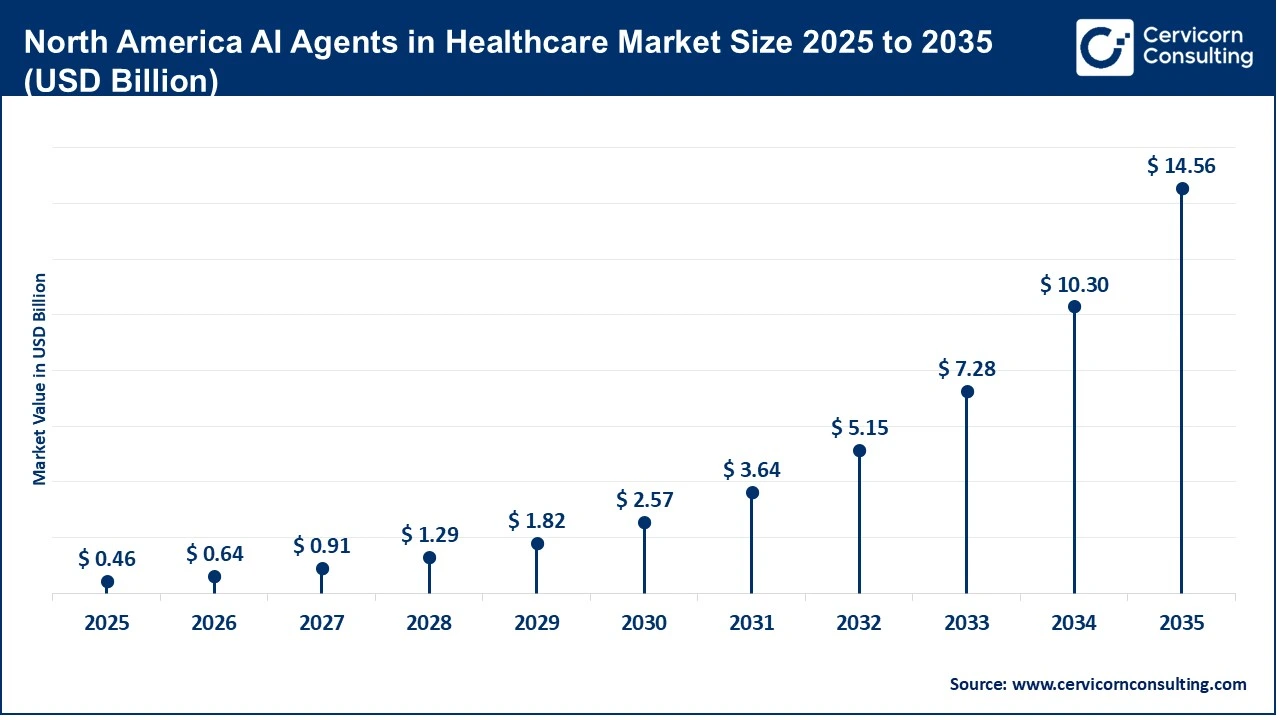
The North America AI agents in healthcare market size was valued at USD 0.46 billion in 2025 and is predicted to exceed around USD 14.56 billion by 2035. The North America market is witnessing strong growth due to the region’s advanced healthcare IT ecosystem, rising generative and agentic AI adoption across providers and payers, and increasing demand for workflow automation, clinical productivity, and patient engagement solutions. The region benefits from high EHR penetration, strong cloud and data infrastructure, and the presence of leading healthcare AI developers, hyperscalers, and health-tech innovators. Healthcare organizations in North America are increasingly moving beyond pilot projects toward scaled AI deployment in areas such as documentation, care coordination, revenue cycle management, and clinical decision support. In addition, growing physician familiarity with AI, rising investment in healthcare AI platforms, and the expanding regulatory focus on safe and responsible AI use are strengthening commercialization opportunities for agent-based healthcare solutions across the region.
United States: Strong provider adoption, rising agentic AI maturity, and a robust healthcare technology ecosystem continue to drive market growth.
- 50% of U.S. healthcare organizations surveyed by McKinsey had already implemented generative AI by late 2025, indicating rapid movement from experimentation to deployment.
- 19% of surveyed U.S. healthcare organizations had reached agentic AI maturity, while 51% were actively pursuing agentic AI proofs of concept, highlighting growing interest in multi-step autonomous workflows.
- 81% of U.S. physicians reported using AI professionally in 2026, up sharply from 38% in 2023, reflecting a major increase in clinician familiarity with AI-enabled tools.
Canada: Expanding digital health modernization, strong public healthcare infrastructure, and growing AI innovation capacity support market development.
Canada is emerging as an important growth market for AI agents in healthcare due to its ongoing healthcare digitalization efforts, strong academic research ecosystem, and rising focus on improving care access, workflow efficiency, and public health system resilience. The country’s universal healthcare model creates a favorable environment for AI agents that can support triage, virtual care coordination, documentation, and resource optimization across large provider networks.
Why is Asia-Pacific emerging as a high-growth region in the AI Agents in Healthcare Market?
The North America AI agents in healthcare market size was estimated at USD 0.24 billion in 2025 and is forecasted to surpass around USD 7.56 billion by 2035. The Asia-Pacific market is emerging as a high-growth region due to rising healthcare digitalization, expanding use of generative AI across patient and provider workflows, and increasing pressure on health systems to improve efficiency, access, and care coordination. Countries across the region are facing a combination of aging populations, chronic disease burdens, clinician shortages, and uneven healthcare access, which is accelerating interest in AI agents for triage, documentation, patient engagement, remote monitoring, and administrative automation. The region also benefits from strong momentum in hospital digital transformation, government-backed health-tech modernization programs, and growing AI adoption among consumers and clinicians.
India: Strong consumer AI readiness, rising healthcare digital adoption, and growing demand for coordinated care are accelerating market growth.
- 78% of Indian consumers surveyed by Bain used generative AI to better understand diagnoses and treatment options, indicating unusually high consumer readiness for AI-enabled healthcare interactions in the region.
- 73% of Indian consumers reported using generative AI to prepare for doctor appointments, showing strong acceptance of AI as a pre-consultation and navigation tool within the care journey.
- 72% of Indian consumers said they use generative AI to navigate the healthcare system, highlighting the opportunity for AI agents in appointment support, care coordination, and patient engagement.
Why is Europe hits notable growth in the AI Agents in Healthcare Market?
The Europe AI agents in healthcare market size reached at USD 0.29 billion in 2025 and is forecasted to hit around USD 9.20 billion by 2035. The Europe market is gaining strong momentum as healthcare systems across the region accelerate digital transformation, expand AI adoption in clinical and administrative workflows, and build regulatory frameworks to support safe deployment of AI in health. Growth is being supported by rising demand for workflow automation, diagnostic support, patient engagement, and resource optimization across hospitals and public health systems. Europe also benefits from a structured policy environment, including the EU AI Act, the European Health Data Space (EHDS), and Commission-led healthcare AI initiatives that aim to improve interoperability, data access, and responsible AI integration. As providers face workforce shortages, aging populations, and cost pressures, AI agents are increasingly positioned as tools to support care coordination, decision-making, triage, documentation, and patient communication across the region.
Germany: Strong hospital digitalization, industrial AI capabilities, and growing clinical AI adoption continue to support market expansion.
- Nearly three-quarters of EU countries already use AI-assisted diagnostics in healthcare, particularly in medical imaging, disease detection, and clinical decision support, reflecting the broader European environment in which Germany is a major adopter of hospital AI tools.
- The WHO Europe assessment found that 63% of EU member states already use AI chatbots for patient engagement, highlighting expanding opportunities for conversational and workflow-based AI agents in provider and care-navigation settings.
- Europe’s digital health push is being reinforced by the European Health Data Space (entered into force in 2025), which is expected to improve access to reusable health data for AI development, testing, and deployment across member states including Germany.
United Kingdom: Expanding NHS AI deployment, strong health-tech innovation, and rising demand for productivity-enhancing automation are strengthening the market outlook.
The United Kingdom is emerging as a key market for AI agents in healthcare due to the NHS’s growing focus on productivity, waiting-list reduction, diagnostic efficiency, and digital patient services. The country has a mature health-tech ecosystem, strong academic AI capabilities, and active experimentation with AI-enabled triage, imaging, administrative automation, and virtual care support.
AI Agents in Healthcare Market Share, By Region, 2025 (%)
| Region |
Revenue Share, 2025 (%) |
| North America |
41.80% |
| Europe |
26.40% |
| Asia-Pacific |
21.70% |
| LAMEA |
10.10% |
Why is LAMEA gaining momentum in the AI Agents in Healthcare Market?
The LAMEA AI agents in healthcare market was valued at USD 0.11 billion in 2025 and is anticipated to reach USD 3.52 billion by 2035. The LAMEA market is gaining momentum as healthcare systems across Latin America, the Middle East, and Africa accelerate digital transformation, expand telehealth and hospital IT investments, and seek more scalable ways to address clinician shortages, fragmented care access, and rising chronic disease burdens. AI agents are increasingly relevant in the region for patient engagement, administrative automation, virtual assistance, documentation, and triage, particularly where healthcare providers need to improve efficiency without proportionally increasing staffing. The market is being supported by growing government-led digital health initiatives, stronger cloud and data infrastructure in key countries, and rising adoption of AI-enabled diagnostics and workflow tools. In the Middle East, national AI strategies and healthcare modernization programs are creating favorable conditions for rapid deployment, while Latin American markets are benefiting from increased use of AI in clinical decision support, imaging, and telemedicine workflows.
Top Companies
Recent Developments
- In February 2026, Oracle added order-creation capabilities to its Oracle Health Clinical AI Agent, enabling ambient AI to draft clinical orders such as labs, imaging, medications, and follow-up appointments. The update expanded Oracle’s healthcare agent capabilities beyond note generation and strengthened its role in clinician workflow automation.
- In March 2025, Microsoft launched Dragon Copilot, a unified voice AI assistant for healthcare that combines ambient listening, dictation, note creation, medical information retrieval, and task automation for clinicians. In October 2025, Microsoft further extended Dragon Copilot with nursing workflows and partner extensibility, broadening its healthcare agent footprint.
- In May 2025, IBM expanded its partnership with Oracle to bring watsonx Orchestrate to Oracle Cloud Infrastructure, enabling multi-agent AI workflows across enterprise environments. While not healthcare-specific, the move is relevant to healthcare organizations adopting multi-agent orchestration for administrative, care, and operational workflows.
Market Segmentation
By Function
- Diagnosis & Early Detection
- Clinical Decision Support
- Patient Monitoring
- Administrative Automation
- Revenue Cycle Management
By Offering
- Single-Agent Systems
- Multi-Agent Systems
By Agent Architecture
- Pattern Recognition Agents
- Contextual Agents
- Conversational Agents
- Predictive Agents
By Application
- Clinical Applications
- Administrative Applications
- Patient Engagement
- Drug Discovery & Research
By End User
- Healthcare Providers
- Healthcare Payers
- Pharmaceutical & Biotechnology Companies
- Government & Public Health Organizations
- Research Institutes & Academic Centers
By Geography
- North America
- Europe
- Asia-Pacific
- LAMEA