Responsible AI Market Size and Growth 2026 To 2035
The global responsible AI market size was valued at USD 1.42 billion in 2025 and is expected to be worth around USD 68.93 billion by 2035, exhibiting a compound annual growth rate (CAGR) of 47.6% over the forecast period from 2026 to 2035. The growth of the responsible AI market is primarily driven by the rapid enterprise adoption of AI and generative AI, which has heightened concerns about bias, transparency, hallucinations, cybersecurity, and compliance risks. As AI moves from experimentation to mission-critical business operations, enterprises are investing in governance frameworks to ensure models are explainable, auditable, and trustworthy. According to Stanford’s 2025 AI Index, 78% of organizations reported using AI in 2024, up from 55% a year earlier, significantly increasing the need for monitoring, fairness testing, and AI risk controls. In parallel, enterprise spending on generative AI accelerated sharply, rising to USD 37 billion in 2025 from USD 11.5 billion in 2024, driving stronger demand for responsible AI tools to govern large-scale deployments.
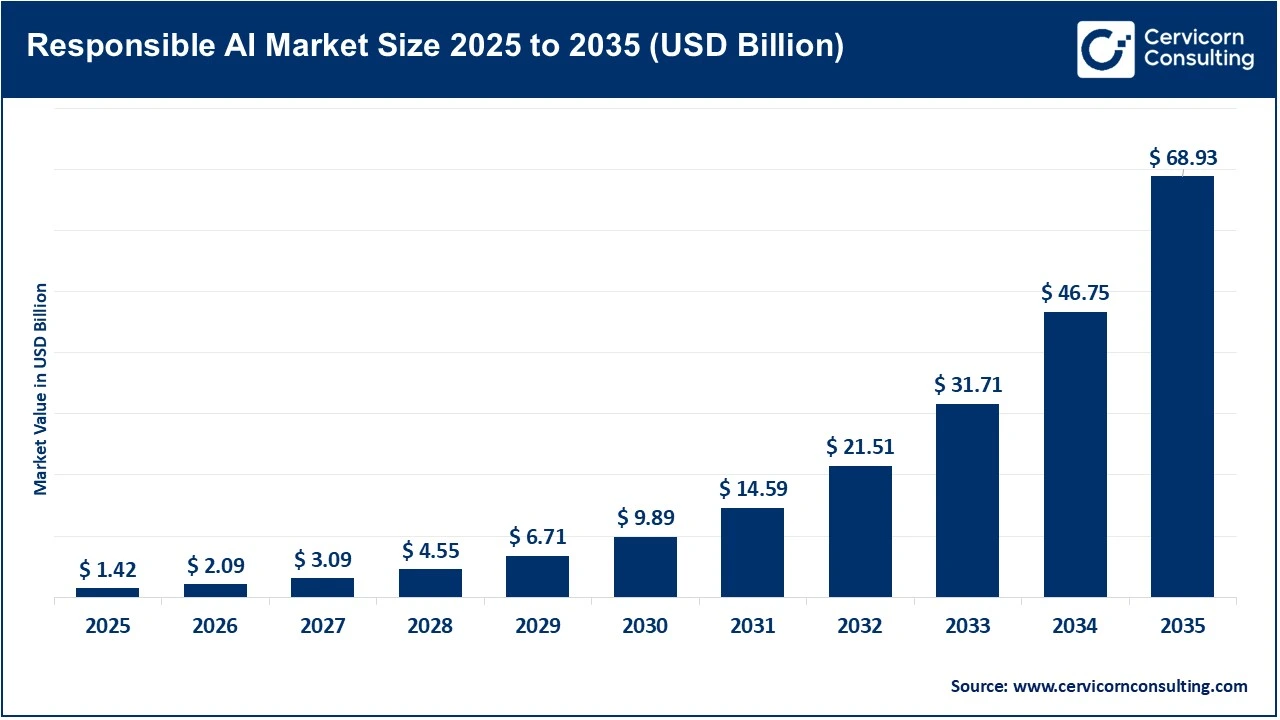
Another major growth factor is the rising regulatory and reputational pressure surrounding AI deployment. Governments and regulators are introducing frameworks focused on transparency, accountability, privacy, and risk management, forcing organizations to operationalize Responsible AI practices. Businesses are also reacting to financial losses caused by unmanaged AI risks. An EY survey of 975 global enterprises found that nearly all large firms deploying AI experienced some AI-related financial loss, including compliance failures, flawed outputs, and bias-related issues. Research shows that only about 20% of enterprises have mature AI risk and cybersecurity controls, while 61% of IT leaders report increased AI-related threats linked to uncontrolled AI adoption. These challenges are accelerating investments in responsible AI platforms, governance software, auditing, and monitoring systems.
Report Highlights
- North America led the global market with a share of 38.6%, supported by strong AI investments, advanced cloud ecosystems, expanding AI governance regulations, and the presence of leading technology companies.
- Software segment dominated the market with a share of 72.4%, supported by strong enterprise demand for AI governance platforms, bias detection tools, explainability solutions, and model monitoring systems.
- Cloud-based deployment held the largest market share of 48.7%, owing to scalable SaaS-based Responsible AI solutions, lower infrastructure costs, and increasing integration with enterprise AI ecosystems.
- Regulatory Compliance & Reporting emerged as the leading application segment with 22.4% market share, fueled by growing regulatory scrutiny, enterprise accountability requirements, and compliance with evolving AI governance frameworks.
- BFSI dominated the industry vertical segment with 24.8% market share, as financial institutions increasingly invest in explainable, fair, and compliant AI systems for fraud detection, credit scoring, and risk assessment.
What is Responsible AI and Its Applications?
Responsible AI refers to the development, deployment, and management of artificial intelligence systems in a manner that is ethical, transparent, fair, secure, explainable, and accountable, ensuring that AI technologies operate without bias, privacy violations, or unintended harmful consequences. Responsible AI frameworks are designed to improve trust, regulatory compliance, and risk management while maintaining human oversight over automated decision-making. Its applications span multiple industries, including fraud detection and risk analytics in BFSI, clinical decision support and diagnostics in healthcare, recruitment and HR decision-making, customer experience personalization, content moderation, autonomous systems and robotics, regulatory compliance monitoring, and generative AI governance for large language models (LLMs) to ensure safe, transparent, and reliable AI operations.
Tightening Global Regulations and Compliance Driving the Responsible AI Market
The increasing enforcement of AI regulations worldwide is becoming a major catalyst for the Responsible AI market, as organizations are under pressure to ensure transparency, fairness, explainability, and risk management in AI systems. Governments are introducing stricter frameworks to reduce bias, protect privacy, and prevent harmful AI outcomes, especially in high-risk sectors such as healthcare, banking, recruitment, and public services. The implementation of the European Union’s AI Act, widely considered the world’s first comprehensive AI regulation, is pushing enterprises to invest in AI governance platforms, bias monitoring, model documentation, and compliance auditing tools to avoid legal and reputational risks. Additionally, fragmented regulatory environments across the U.S., Europe, and Asia are forcing multinational organizations to adopt standardized Responsible AI frameworks, accelerating enterprise spending on governance and compliance technologies.
Some of the key factors of this growth
- 693 AI-related bills were passed across 45 U.S. states in 2024, compared with 191 in 2023, reflecting rapidly tightening AI oversight.
- The EU AI Act entered into force in August 2024, with key obligations for prohibited AI systems beginning in February 2025 and additional compliance requirements for high-risk and general-purpose AI systems phased in through 2025–2027.
- Under the EU AI Act, companies can face penalties of up to 7% of global annual turnover for non-compliance, increasing demand for Responsible AI solutions.
Report Scope
| Area of Focus |
Details |
| Market Size in 2026 |
USD 2.09 Billion |
| Market Size in 2035 |
USD 68.93 Billion |
| CAGR 2026 to 2035 |
47.60% |
| Dominant Region |
North America |
| Fastest Growing Region |
Asia-Pacific |
| Key Segments |
Component, Deployment Type, Application, Industry Vertical, Region |
| Key Companies |
Microsoft, IBM, Google (DeepMind), Amazon Web Services (AWS), Salesforce, Accenture, DataRobot, Credo AI, Holistic AI, TruEra (Snowflake), Fractal Analytics, HCLTech |
Recent Major Milestones
1. European Union’s AI Act Implementation
The implementation of the EU AI Act has become one of the most significant milestones driving the responsible AI market by creating legally enforceable requirements around transparency, risk management, explainability, and accountability for AI systems. The regulation introduces a risk-based framework, requiring organizations deploying high-risk AI systems to maintain documentation, human oversight, bias mitigation, and compliance monitoring. As companies operating in Europe or serving EU customers must comply regardless of headquarters location, enterprises are increasingly investing in AI governance software, model monitoring, and auditing platforms to reduce regulatory exposure. This milestone is accelerating global adoption of responsible AI solutions, as many firms are standardizing governance practices across regions rather than maintaining fragmented compliance systems.
2. Microsoft’s 2025 Responsible AI Transparency Expansion
In 2025, Microsoft expanded its Responsible AI governance efforts through its annual responsible AI Transparency Report, highlighting scaled deployment of internal governance systems and customer-facing safety tools for generative AI. The company reported reviewing over 1,300 generative AI use cases and expanding responsible AI tooling for risk detection, transparency, and model oversight. As one of the largest enterprise AI providers globally, Microsoft’s investment in responsible AI is influencing enterprise purchasing behavior, encouraging customers to adopt governance platforms and compliance frameworks alongside AI deployment. This milestone is helping normalize responsible AI as a core enterprise software layer rather than an optional ethical consideration.
3. U.S. and UK Government-Led Frontier AI Safety Testing
A recent milestone shaping the Responsible AI market is the collaboration between leading AI companies including Microsoft, Google, and xAI and government institutions such as the U.S. Center for AI Standards and Innovation (CAISI) and the UK AI Security Institute for pre-deployment AI testing. These partnerships focus on evaluating advanced AI systems for reliability, misuse risks, safety vulnerabilities, and unexpected behaviors before commercial release. This initiative is driving demand for responsible AI tools, including model testing, adversarial risk assessment, safety monitoring, and governance frameworks, particularly among enterprises developing or deploying frontier AI systems.
4. Europe’s 2025 AI Continent Action Plan for Trustworthy AI
In April 2025, the European Commission launched the AI Continent Action Plan to strengthen Europe’s position in trustworthy and human-centric AI development. The initiative emphasizes responsible AI deployment across healthcare, education, industry, and public services while prioritizing transparency, democratic safeguards, and regulatory compliance. By combining AI innovation incentives with governance expectations, the program is encouraging organizations to invest in Responsible AI infrastructure, including fairness testing, explainability systems, and compliance automation. This milestone is expanding market opportunities beyond compliance-driven sectors and into mainstream enterprise AI adoption.
Regional Analysis
The responsible AI market is segmented by region into North America, Europe, Asia-Pacific, Latin America, and LAMEA. Here is a brief overview of each region:
North America Responsible AI Market: Driven by Expanding AI Regulations, Enterprise Generative AI Adoption, and Strong Technology Ecosystem
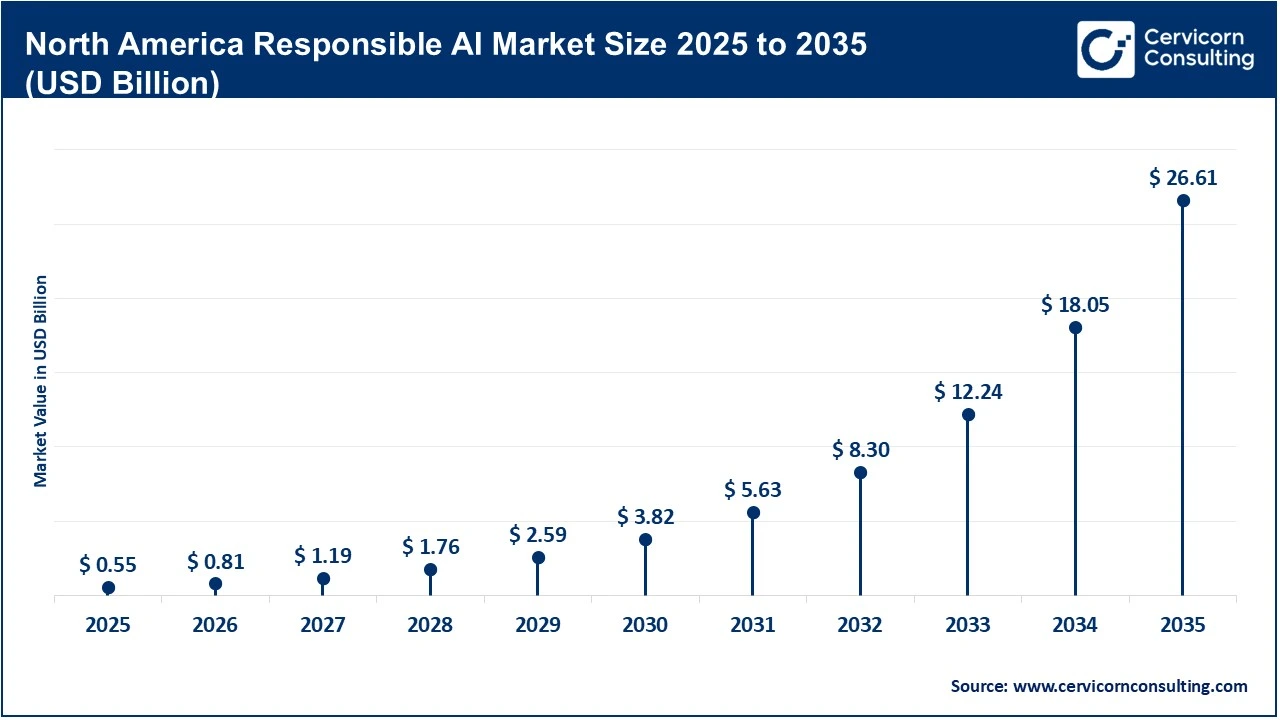
The North America responsible AI market size was accounted for USD 0.55 billion in 2025 and is forecasted to grow around USD 26.61 billion by 2035. The North America is highly developed, supported by widespread enterprise AI adoption, increasing regulatory scrutiny, and the strong presence of major technology companies, cloud providers, and AI governance vendors. The region is witnessing rapid demand for responsible AI platforms as enterprises increasingly deploy generative AI, machine learning, and automated decision-making systems across regulated sectors such as BFSI, healthcare, government, and retail. Rising concerns around algorithmic bias, AI transparency, cybersecurity, hallucinations, and privacy risks are accelerating investments in explainability, model monitoring, governance, and compliance solutions. Additionally, growing collaboration between governments, research institutions, and technology firms on AI safety testing and governance frameworks continues strengthening regional market growth.
United States: Strong enterprise AI adoption, expanding AI governance regulations, and leadership in cloud and generative AI ecosystems continue driving market expansion.
- The U.S. accounts for one of the largest shares of global AI investment, with major technology firms including Microsoft, Google, Amazon, IBM, and OpenAI actively expanding Responsible AI capabilities.
- More than 690 AI-related bills were introduced across U.S. states in 2024, increasing enterprise demand for AI governance, compliance, and risk monitoring solutions.
Canada: Expanding AI governance initiatives, strong academic AI research, and increasing enterprise adoption support market growth.
- Canada is strengthening Responsible AI development through government-backed ethical AI frameworks and AI commercialization programs.
- Leading research institutions and universities are expanding trustworthy AI research in fairness, explainability, and ethical machine learning applications.
Asia-Pacific Responsible AI Market: Driven by Rapid AI Adoption, Government AI Governance Initiatives, and Expanding Digital Transformation
The Asia-Pacific responsible AI market size was estimated at USD 0.32 billion in 2025 and is projected to surpass around USD 15.65 billion by 2035. The Asia-Pacific market is expanding rapidly due to increasing enterprise AI adoption, government-led AI governance initiatives, and accelerating digital transformation across major economies. Organizations across healthcare, BFSI, manufacturing, retail, and telecommunications are increasingly deploying AI and generative AI solutions, creating stronger demand for transparency, bias mitigation, explainability, and compliance tools. Governments across the region are actively introducing ethical AI frameworks, risk management guidelines, and national AI strategies to encourage responsible deployment while maintaining innovation. Rising investments in smart cities, industrial automation, digital public services, and AI-enabled customer engagement are further accelerating the adoption of responsible AI platforms and governance solutions.
China: Strong government-led AI policies, rapid enterprise AI deployment, and expanding AI governance frameworks continue driving market expansion.
- China is strengthening Responsible AI through national AI governance principles focused on algorithm transparency, content regulation, and generative AI oversight.
- Rapid adoption of AI across manufacturing, fintech, surveillance, healthcare, and e-commerce is increasing demand for model monitoring and risk management solutions.
Japan: Growing focus on trustworthy AI, advanced robotics ecosystem, and increasing enterprise automation support market growth.
- Japan is expanding Responsible AI adoption through government-supported human-centric AI initiatives and ethical AI deployment frameworks.
- Strong use of AI in robotics, automotive, manufacturing, and healthcare is increasing demand for explainable and safety-focused AI systems.
Europe Responsible AI Market: Driven by Stringent AI Regulations, Ethical AI Adoption, and Expanding Enterprise Governance Investments
The Europe responsible AI market size reached at USD 0.41 billion in 2025 and is expected to reach around USD 19.92 billion by 2035. The Europe market is experiencing strong growth, supported by stringent regulatory frameworks, rising enterprise adoption of ethical AI practices, and increasing investment in trustworthy AI ecosystems. The region benefits from proactive government policies focused on transparency, accountability, privacy, and risk mitigation in AI deployment. The implementation of the EU AI Act is significantly accelerating demand for AI governance platforms, explainability tools, compliance monitoring, and bias detection solutions across regulated industries such as BFSI, healthcare, automotive, and government. Additionally, growing adoption of generative AI, increased focus on digital sovereignty, and expanding collaboration between governments, enterprises, and research institutions on trustworthy AI are further strengthening market growth.
Germany: Strong industrial AI adoption, advanced manufacturing ecosystem, and growing emphasis on trustworthy AI governance continue driving market expansion.
- Germany is increasingly integrating Responsible AI into Industry 4.0, smart manufacturing, automotive systems, and industrial automation to ensure safe and explainable AI deployment.
- The country’s strong automotive sector is accelerating demand for AI safety, transparency, and compliance solutions for autonomous mobility and predictive systems.
United Kingdom: Growing AI regulation efforts, strong fintech ecosystem, and expanding AI safety initiatives support market growth.
- The UK is strengthening Responsible AI adoption through the AI Safety Institute and increasing government focus on trustworthy and secure AI deployment.
- Strong adoption of AI across financial services, healthcare, and public sector applications is driving demand for AI governance and compliance solutions.
Responsible AI Market Share, By Region, 2025 (%)
| Region |
Revenue Share, 2025 (%) |
| North America |
38.6% |
| Europe |
28.9% |
| Asia-Pacific |
22.7% |
| LAMEA |
9.8% |
LAMEA Responsible AI Market: Driven by Expanding Digital Transformation, Emerging AI Governance Frameworks, and Increasing Public-Sector AI Adoption
The LAMEA responsible AI market was valued at USD 0.14 billion in 2025 and is anticipated to hit around USD 6.76 billion by 2035. The LAMEA market is gradually expanding, supported by increasing digital transformation, growing enterprise AI adoption, and rising government focus on ethical and secure AI deployment. Organizations across banking, healthcare, energy, retail, telecommunications, and government sectors are increasingly implementing AI-powered solutions, creating demand for transparency, bias mitigation, explainability, and governance systems. Governments across the region are introducing national AI strategies, data privacy laws, and digital governance initiatives to ensure responsible AI use while encouraging innovation. Growing investments in smart cities, fintech ecosystems, public-sector digitalization, and cloud infrastructure are further accelerating Responsible AI adoption.
Brazil: Expanding enterprise AI adoption, fintech growth, and emerging AI regulatory frameworks continue driving market expansion.
- Brazil is witnessing growing demand for Responsible AI solutions due to increasing AI adoption across banking, retail, healthcare, and public administration sectors.
- Expanding fintech and digital banking ecosystems are increasing the need for explainable and compliant AI systems in fraud detection and customer analytics.
Saudi Arabia: Strong government-led AI transformation, smart city investments, and Vision 2030 initiatives support market growth.
- Saudi Arabia is expanding AI deployment through Vision 2030, increasing demand for trustworthy and transparent AI systems across government and enterprise sectors.
- Investments in smart cities, digital healthcare, and intelligent public infrastructure are accelerating adoption of Responsible AI governance solutions.
Segmental Analysis
The responsible AI market is segmented into component, deployment type, application, industry vertical, and geography.
Component Analysis
The software segment dominates the Responsible AI market because enterprises are prioritizing scalable governance, explainability, bias detection, compliance monitoring, and AI risk management platforms. Organizations deploying generative AI and machine learning models require automated tools that continuously monitor model behavior, ensure regulatory compliance, and improve transparency across AI lifecycles. Large technology vendors and AI platform providers are integrating Responsible AI software directly into enterprise AI ecosystems, further strengthening adoption. The increasing need for model observability, audit trails, and governance automation across regulated industries continues to support software segment leadership.
Responsible AI Market Share, By Component, 2025 (%)
| Component Segment |
Revenue Share, 2025 (%) |
| Software |
72.4% |
| Services |
27.6% |
The services segment is projected to grow the fastest due to rising enterprise demand for responsible AI consulting, implementation, governance, and compliance support. Many organizations lack internal expertise to operationalize AI ethics frameworks and comply with emerging regulations such as the EU AI Act. As a result, enterprises are increasingly relying on consulting firms and managed service providers for AI audits, risk assessments, model validation, and governance integration. Rapid generative AI adoption is also creating strong demand for customized Responsible AI deployment and monitoring services across industries.
Deployment Type Analysis
The cloud-based segment dominates the Responsible AI market, driven by growing adoption of SaaS-based AI governance and monitoring platforms. Cloud deployment enables enterprises to scale AI oversight, automate compliance reporting, and continuously monitor models across distributed environments with lower infrastructure costs. Major cloud providers such as Microsoft Azure, AWS, and Google Cloud are embedding Responsible AI capabilities into their AI ecosystems, accelerating enterprise adoption. The flexibility, scalability, and ease of integration offered by cloud-based platforms make them the preferred deployment model for organizations rapidly expanding AI operations.
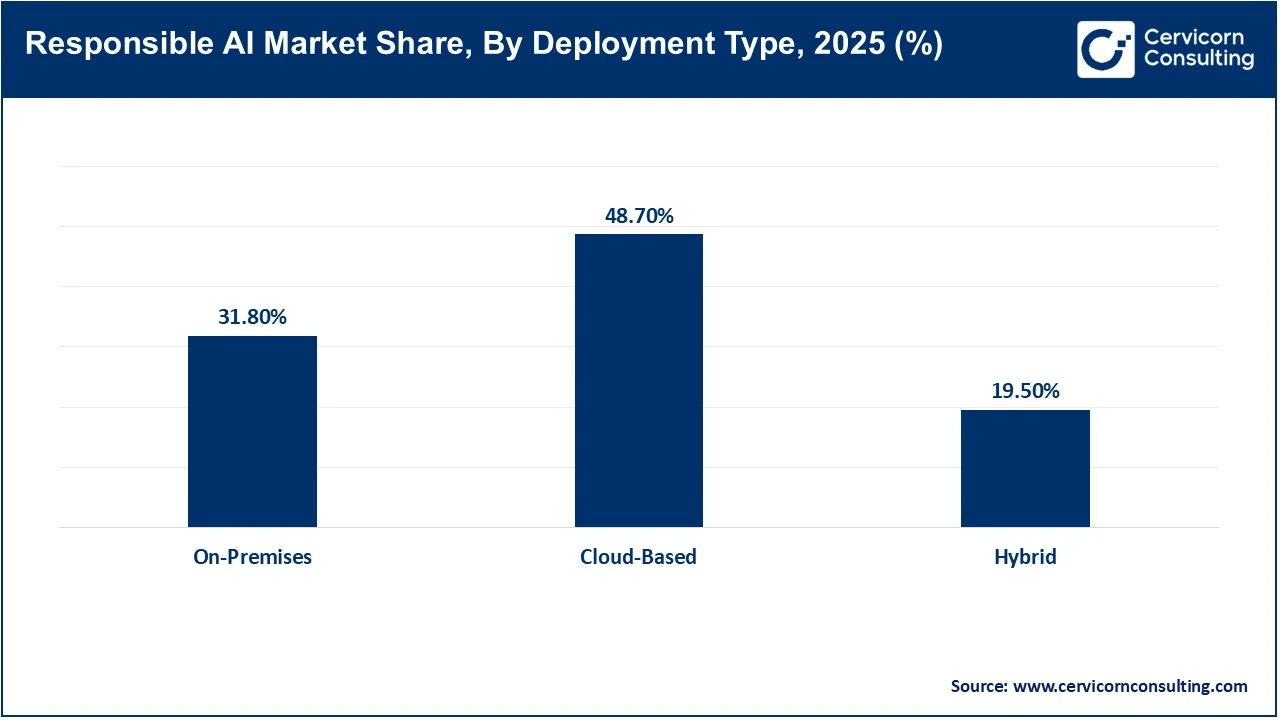
The hybrid deployment segment is expected to grow at the fastest pace as enterprises seek to balance scalability with regulatory and data security requirements. Organizations operating in highly regulated industries such as banking, healthcare, and government increasingly prefer hybrid environments that combine cloud-based AI governance with secure on-premises infrastructure. Hybrid deployment allows sensitive data and high-risk AI workloads to remain within enterprise-controlled systems while leveraging cloud scalability for analytics and monitoring. The increasing complexity of enterprise AI ecosystems and cross-border data regulations is significantly accelerating hybrid deployment adoption.
Application Analysis
The regulatory compliance and reporting segment dominates the Responsible AI market due to the rapid expansion of AI governance regulations worldwide. Enterprises are investing heavily in compliance management, auditability, documentation, and explainability tools to align with evolving legal frameworks such as the EU AI Act and industry-specific AI guidelines. Organizations deploying AI in sensitive areas including finance, healthcare, and public services require robust reporting systems to reduce legal, operational, and reputational risks. Growing regulatory scrutiny and increasing enterprise accountability are continuously strengthening demand for compliance-focused Responsible AI solutions.
Responsible AI Market, By Application, 2025 (%)
| Application |
Revenue Share, 2025 (%) |
| Regulatory Compliance & Reporting |
22.4% |
| Fraud Detection & Risk Analytics |
18.9% |
| Generative AI Governance & LLM Monitoring |
14.7% |
| Customer Experience & Personalization |
12.1% |
| Healthcare & Clinical Decision Support |
10.5% |
| Content Moderation & Safety |
8.6% |
| Recruitment & HR Decision-Making |
6.5% |
| Autonomous Systems & Robotics |
6.3% |
The generative AI governance and LLM monitoring segment is witnessing the fastest growth as organizations rapidly adopt large language models and generative AI applications across business operations. Enterprises are increasingly concerned about hallucinations, misinformation, intellectual property risks, cybersecurity vulnerabilities, and biased outputs generated by AI systems. This has created strong demand for governance platforms capable of monitoring prompts, model behavior, content safety, and AI reliability in real time. The explosive growth of enterprise generative AI deployment is significantly accelerating investments in Responsible AI monitoring and governance technologies.
Industry Vertical Analysis
The BFSI segment dominates the Responsible AI market because financial institutions operate in highly regulated environments where transparency, fairness, and model accountability are critical. Banks and insurers extensively use AI for fraud detection, credit scoring, underwriting, customer analytics, and risk assessment, increasing the need for explainable and compliant AI systems. Regulatory pressure on algorithmic bias and automated decision-making is driving significant investment in AI governance and monitoring solutions. Additionally, the financial sector’s early adoption of AI continues to support its dominant market position.
Responsible AI Market, By Industry Vertical, 2025 (%)
| Industry Vertical |
Revenue Share, 2025 (%) |
| BFSI (Banking, Financial Services & Insurance) |
24.8% |
| Healthcare & Life Sciences |
18.6% |
| Government & Public Sector |
13.5% |
| IT & Telecommunications |
11.8% |
| Retail & E-commerce |
9.4% |
| Manufacturing |
7.8% |
| Automotive & Mobility |
5.9% |
| Media & Entertainment |
4.3% |
| Others |
3.9% |
The healthcare and life sciences segment is projected to witness the fastest growth due to rising adoption of AI-driven diagnostics, clinical decision support, drug discovery, and patient monitoring systems. Healthcare organizations require responsible AI frameworks to ensure patient safety, transparency, ethical decision-making, and compliance with strict healthcare regulations. Growing concerns about biased medical algorithms, data privacy, and explainability are prompting hospitals and healthcare providers to invest in AI governance platforms. The rapid digital transformation of healthcare and expanding use of generative AI in clinical applications are further driving segment growth.
Top Companies
Recent Developments
- In May 2025, Microsoft expanded its Responsible AI governance capabilities through updated Azure AI safety and governance tools, including enhanced content safety, model evaluation, and transparency controls for generative AI applications. The development strengthens Microsoft’s enterprise Responsible AI ecosystem for regulated and large-scale AI deployments.
- In February 2025, IBM expanded its watsonx.governance platform with advanced monitoring, compliance automation, and risk detection capabilities for generative AI systems. The enhancement helps enterprises improve model transparency, bias mitigation, and regulatory readiness across AI lifecycles.
- In April 2025, Google DeepMind strengthened frontier AI safety efforts by expanding model evaluation frameworks and red-teaming capabilities for advanced AI systems. The initiative supports safer deployment of generative AI while improving reliability, alignment, and transparency.
Market Segmentation
By Component
By Deployment Type
- On-Premises
- Cloud-Based
- Hybrid
By Application
- Fraud Detection & Risk Analytics
- Customer Experience & Personalization
- Recruitment & HR Decision-Making
- Healthcare & Clinical Decision Support
- Autonomous Systems & Robotics
- Content Moderation & Safety
- Generative AI Governance & LLM Monitoring
- Regulatory Compliance & Reporting
By Industry Vertical
- BFSI (Banking, Financial Services & Insurance)
- Healthcare & Life Sciences
- Government & Public Sector
- IT & Telecommunications
- Retail & E-commerce
- Manufacturing
- Automotive & Mobility
- Media & Entertainment
- Others
By Region
- North America
- Europe
- Asia-Pacific
- LAMEA