Sovereign AI Market Size and Growth Outlook 2026 to 2035
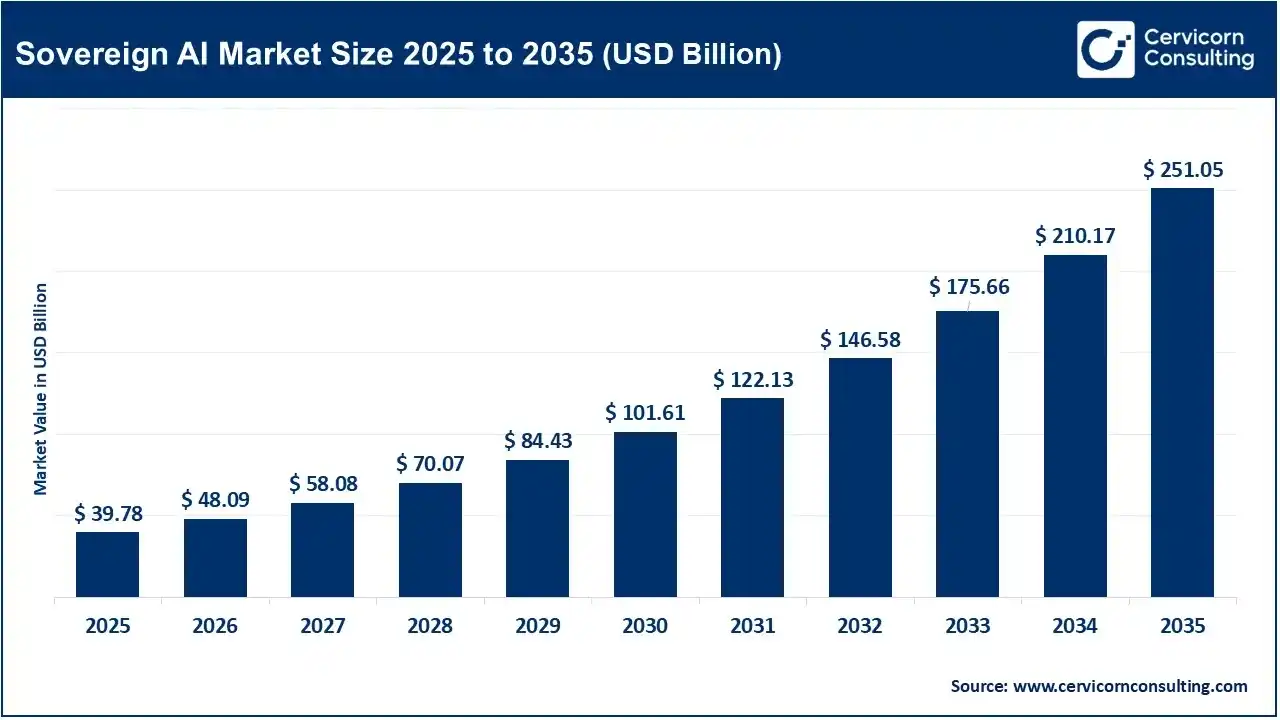
The global sovereign AI market size was valued at USD 39.78 billion in 2025 and is projected to grow from USD 48.09 billion in 2026 to nearly USD 252.05 billion by 2035, registering a CAGR of 20.2% over the 2026 to 2035 period. The sovereign AI market is growing as enterprises and governments want more authority over AI models, data, computing power, and infrastructure within their own borders. Investments in domestic AI capabilities are being encouraged by growing worries about cybersecurity, data privacy, national security, and reliance on foreign technology suppliers. The market is expanding due to the increasing use of generative AI and the need for safe, locally controlled AI solutions.
- In March 2026, NVIDIA announced updates with Microsoft to support sovereign AI and physical AI systems through Microsoft Foundry, NVIDIA open models, and Azure Local, helping organizations meet strict data-sovereignty requirements.
Report Highlights
- By region, North America dominated the market with a 38.9% market share in 2025.
- By region, Middle East & Africa is the fastest-growing regional segment, expanding at a CAGR of 25.0% from 2026 to 2035.
- By sovereignty architecture, infrastructure sovereignty dominated the market with a 34.0% market share in 2025.
- By sovereignty architecture, model sovereignty is the fastest-growing segment, with its market share expected to increase from 18.0% in 2025 to 23.1% by 2035.
- By component, hardware dominated the market with a 49.0% market share in 2025.
- By component, software is the fastest-growing segment, with its market share expected to increase from 34.0% in 2025 to 40.0% by 2035.
- By deployment, on-premises dominated the market with a 43.0% market share in 2025.
- By deployment, sovereign cloud is the fastest-growing segment, expanding at a CAGR of 23.2% from 2026 to 2035.
- By AI technology/AI workload, generative AI dominated the market with a 36.0% market share in 2025.
- By AI technology/AI workload, predictive AI was the second-largest segment, accounting for a 24.0% market share in 2025.
- By application, government & public services dominated the market with a 23.0% market share in 2025.
- By application, defense & national security was the second-largest segment, accounting for an 18.0% market share in 2025.
Recent Trends
- Growing focus on national AI infrastructure: Governments are investing in domestic computing infrastructure and AI capabilities.
- Rise of sovereign cloud platforms: Demand is increasing for cloud environments that keep sensitive data within national borders.
- Expansion of government AI initiatives: Public-sector organizations are adopting locally governed AI solutions for critical applications.
- Increasing emphasis on data sovereignty: Stricter data protection and localization requirements are driving demand for sovereign AI.
- Development of local AI models: Countries are increasingly supporting homegrown foundation models and AI ecosystems.
- Strategic partnerships between governments and technology companies: Public-private collaborations are accelerating sovereign AI infrastructure and deployment.
Market Dynamic
Driver: Why Is Data Control Driving Sovereign AI Adoption?
Governments and businesses are being encouraged to embrace AI systems that can be built, hosted, and managed domestically due to growing concerns about sensitive data, cybersecurity, regulatory compliance, and reliance on foreign AI platforms. This is especially crucial for industries that handle sensitive or strategically significant data, as more control over data and AI infrastructure can lessen reliance on outside sources.
- In July 2026, HCLTech announced plans to establish an AI data center at the upcoming Odisha Sovereign AI Park, supporting the development of India’s domestic AI infrastructure. The initiative demonstrates how technology companies are helping build locally controlled infrastructure to support sovereign AI capabilities.
Restraint: Why Can High Infrastructure Costs Restrict Sovereign AI Growth?
Significant investments in modern computer systems, AI accelerators, data centers, energy, cybersecurity, and specialist personnel are necessary to develop sovereign AI capabilities. Building autonomous AI ecosystems can become more expensive and complex due to these infrastructure needs, especially for companies with limited domestic resources.
- In January 2026, Larsen & Toubro Vyoma announced the development of a green data center designed to provide AI-ready infrastructure for demanding computing workloads. The project highlights the significant infrastructure investment required to support large-scale AI deployment.
Opportunity: How Can Sovereign AI Strengthen Local AI Ecosystems?
Opportunities to create localized AI models, secure cloud platforms, AI data centers, and solutions compliant with national laws and languages are being created by domestic technology enterprises because of the shift toward sovereign AI. Governments, academic institutions, and tech firms working together can hasten the creation of autonomous AI ecosystems.
- In August 2026, Larsen & Toubro announced a strategic partnership with Together AI to develop an AI factory in India using NVIDIA technology. The partnership can strengthen domestic AI computing capabilities and create a foundation for locally developed and deployed AI solutions.
Regional Analysis
North America Sovereign AI Market
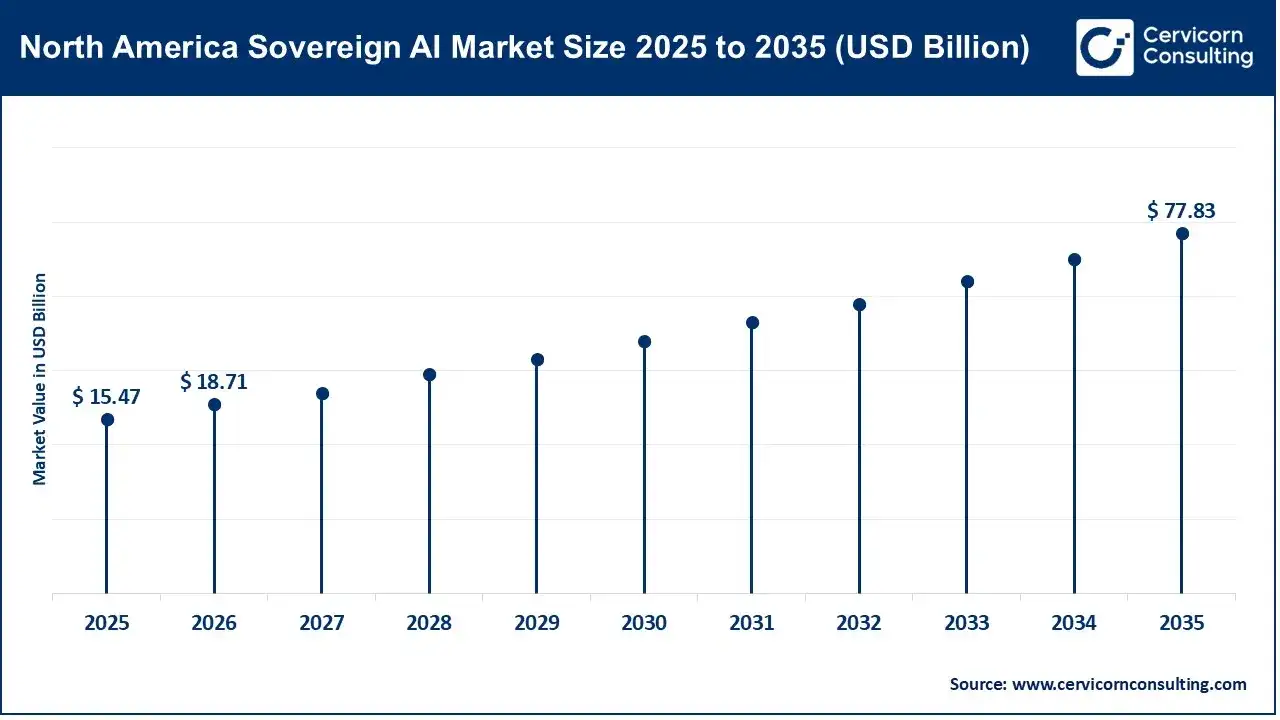
- Market Size (2025): USD 15.47 Billion
- Market Size (2035): USD 77.83 Billion
- CAGR (2026-2035): 17.2%
Europe Sovereign AI Market
- Market Size (2025): USD 10.47 Billion
- Market Size (2035): USD 62.76 Billion
- CAGR (2026-2035): 19.10%
Asia-Pacific Sovereign AI Market
- Market Size (2025): USD 8.43 Billion
- Market Size (2035): USD 70.29 Bilion
- CAGR (2026-2035): 21.2%
LAMEA Sovereign AI Market
- Market Size (2025): USD 5.13 Billion
- Market Size (2035): USD 40.17 Billion
- CAGR (2026-2035): 20.6%
North America segment dominated the regional market with a market share of 38.9% in 2025. This dominance is driven by robust AI infrastructure, sophisticated computing power, and large AI technology investments. Regional adoption is being aided by the presence of large tech firms and cloud providers. The expansion of the market is also being aided by government initiatives to improve domestic AI capabilities. An established AI ecosystem and strong R&D capabilities are also bolstering the region's market position.
Middle East & Africa segment is the fastest-growing regional segment, expanding at a CAGR of 25.0% from 2026 to 2035. The growth is driven by rising spending on digital transformation, data centers, sovereign cloud platforms, and AI infrastructure. Governments are concentrating on strengthening their own AI capacities and lowering their dependency on outside infrastructure. Regional expansion is being further supported by the increasing use of AI in strategic sectors and public services. Regional AI ecosystems are also being developed thanks to growing collaborations between governments and tech companies.
Sovereign AI Market Share, By Region, 2025 (%)
| Region |
Revenue Share, 2025 (%) |
Revenue Share, 2035 (%) |
| North America |
38.90% |
31% |
| Europe |
27% |
25% |
| Asia-Pacific |
21.20% |
28% |
| LAMEA |
12.90% |
16% |
Segmental Analysis
Sovereignty Architecture Analysis
Infrastructure sovereignty segment dominated the market with a market share of 34.0% in 2025. This dominance is driven by the growing need for safe, locally managed computing power and AI infrastructure. Growing investments in high-performance computing and AI-ready data centers are helping the market. Demand is being further bolstered by an increased emphasis on data security and national control over AI infrastructure. The expansion of the segment is also being aided by the growing deployment of specialized computing infrastructure for sensitive workloads.
Sovereign AI Market Share, By Sovereignty Architecture, 2025 (%)
| Sovereignty Architecture |
Revenue Share, 2025 (%) |
Revenue Share, 2035 (%) |
| Data Sovereignty |
27% |
23% |
| Infrastructure Sovereignty |
34% |
29% |
| Model Sovereignty |
18% |
23.10% |
| Platform/Operational Sovereignty |
13% |
16.90% |
| End-to-End Sovereignty |
8% |
8% |
Model sovereignty segment is the fastest-growing segment, increasing its market share from 18.0% in 2025 to 23.1% by 2035. This growth is driven by growing demand for AI models created and managed locally. Governments and organizations want to improve control over AI development and lessen reliance on outside models. The market is being further supported by rising investments in regional AI solutions. Adoption is also being fueled by an increasing need for AI models that are compatible with regional languages, laws, and security specifications.
Component Analysis
Hardware segment dominated the market with a market share of 49.0% in 2025. This dominance is driven by the increasing need for high-performance computing infrastructure to handle AI tasks. The market is being supported by rising demand for AI accelerators, processors, servers, and data center equipment. Hardware adoption is also being strengthened by investments in domestic AI computing infrastructure. Demand is also being supported by the requirement for scalable computing power to manage increasingly complex AI workloads.
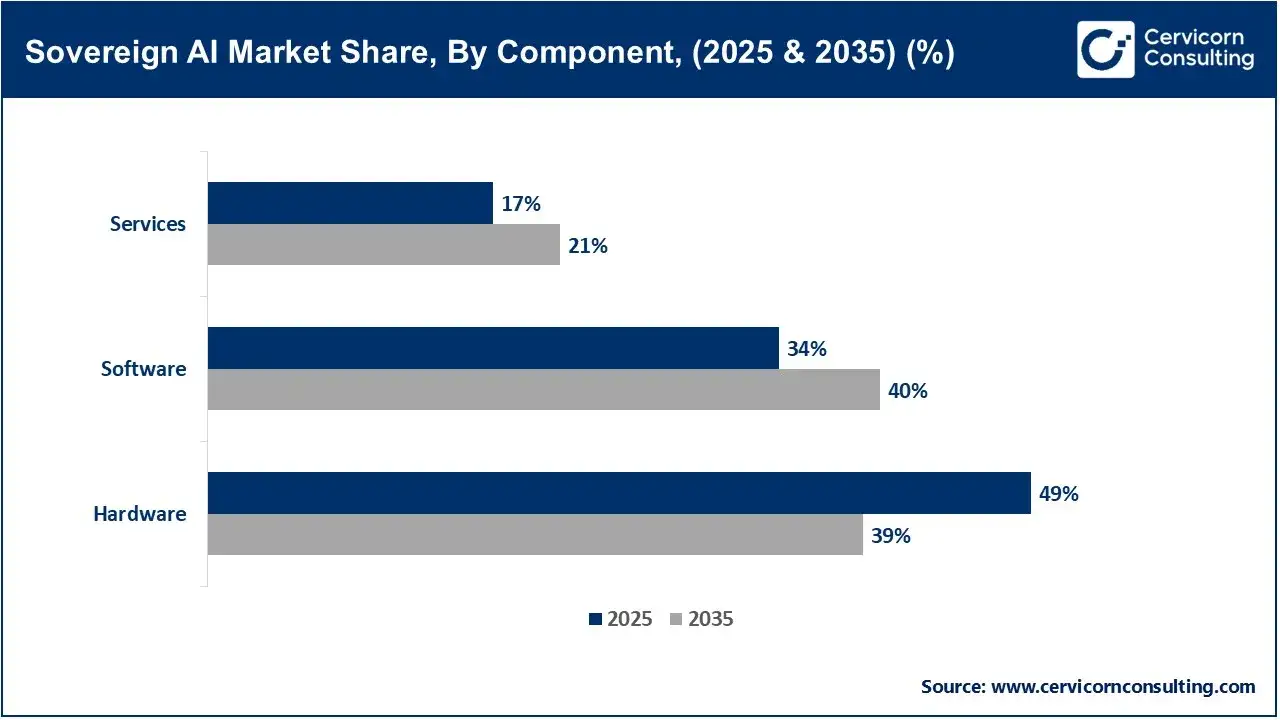
Software segment is the fastest-growing segment, increasing its market share from 34.0% in 2025 to 40.0% by 2035. The growth is driven by growing demand for safe software environments and independent AI platforms. The market is being supported by the growing use of AI governance, model management, and security tools. Expansion is also aided by the growing development of locally managed AI platforms. Software adoption is also being fueled by a greater focus on managing AI models, data, and workloads in controlled environments.
Deployment Analysis
On-premises segment dominated the market with a market share of 43.0% in 2025. This dominance is motivated by the requirement for direct control over infrastructure, AI workloads, and sensitive data. On-premises environments are being adopted by businesses and government organizations to improve security and regulatory compliance. Adoption is further aided by the capacity to manage AI infrastructure in controlled settings. On-premises deployment is also being encouraged by growing worries about third-party infrastructure and data access.
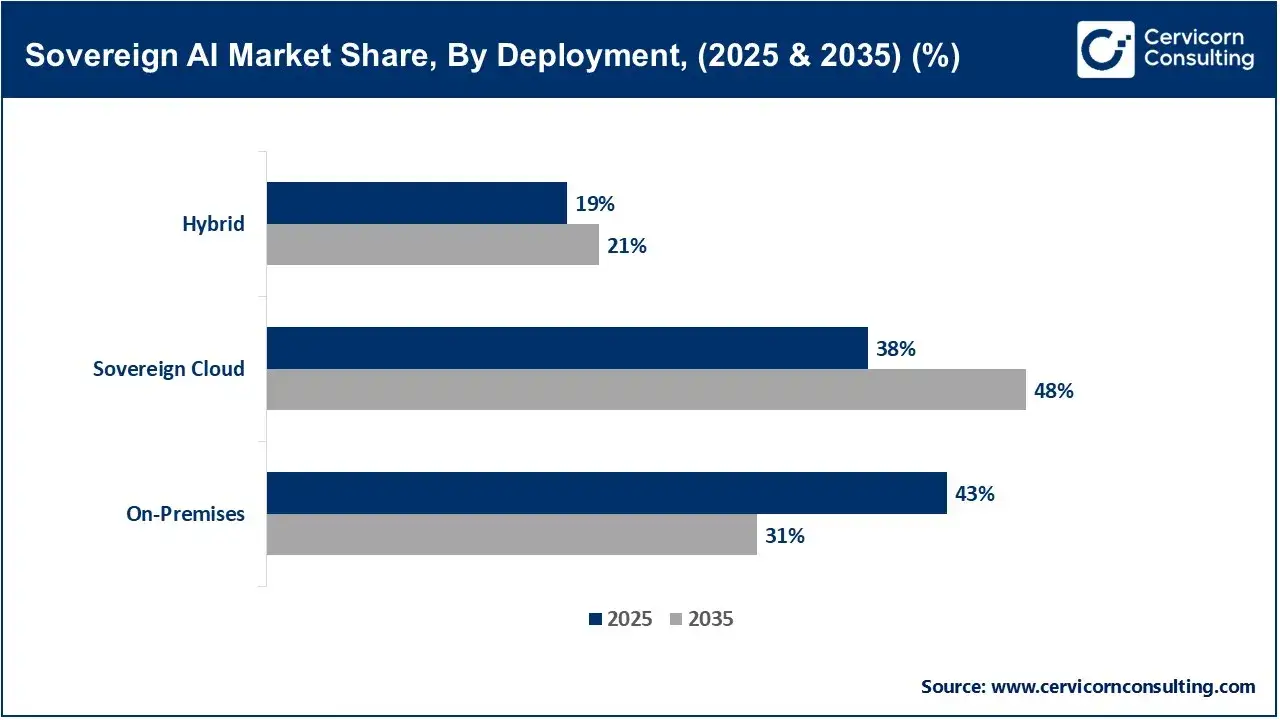
Sovereign cloud segment is the fastest-growing segment, expanding at a CAGR of 23.2% from 2026 to 2035. The growth is driven by increasing demand for cloud environments offering data residency, security, and regulatory control. Sovereign cloud platforms are being used by businesses and governments for sensitive AI workloads. Growing investments in regional cloud infrastructure are contributing to the segment's expansion. Organizations are also being encouraged to move some AI workloads to controlled cloud platforms due to the scalability and flexibility of sovereign cloud environments.
AI Technology/AI Workload Analysis
Generative AI segment dominated the market with a market share of 36.0% in 2025. This dominance is driven by the expanding use of generative AI in business, government, and sensitive applications. The market is being supported by the rising demand for large language models that are locally controlled. Adoption is also being aided by the growing use of generative AI for automation and digital services. Segment growth is also being supported by the need for more control over generative models and the data used to operate and train them.
Sovereign AI Market Share, By AI Technology/AI Workload, 2025 (%)
| AI Technology/AI Workload |
Revenue Share, 2025 (%) |
| Generative AI |
36% |
| Predictive AI |
24% |
| Computer Vision |
15% |
| Natural Language AI/Speech AI |
11% |
| Autonomous AI |
8% |
| Other AI |
6% |
Predictive AI segment was the second-largest segment, accounting for 24.0% of the market in 2025. The growth is driven by increasing use of predictive AI in decision-making, risk assessment, and forecasting. Predictive analytics is being used more and more by businesses and governments for planning and operational effectiveness. Adoption is being aided by growing demand for data-driven decision support systems. Its relevance in a variety of strategic applications is also growing due to its capacity to spot trends and predict possible outcomes.
Application Analysis
Government & public services segment dominated the market with a market share of 23.0% in 2025. This dominance is driven by the requirement to keep control over crucial AI applications and safeguard private government data. The segment is being supported by increasing government investment in digital transformation and autonomous AI capabilities. Adoption is being accelerated by the growing use of AI in administrative procedures and public services. Demand is also being strengthened by the need for reliable AI systems that adhere to legal and security requirements in the public sector.
Sovereign AI Market Share, By Application, 2025 (%)
| Application |
Revenue Share, 2025 (%) |
| Government & Public Services |
23% |
| Defense & National Security |
18% |
| Healthcare |
11% |
| Financial Services |
13% |
| Critical Infrastructure |
12% |
| Manufacturing & Industrial |
9% |
| Telecommunications |
8% |
| Enterprise & Other |
6% |
Defense & national security segment was the second-largest segment, accounting for 18.0% of the market in 2025. The growth is driven by the growing need for secure AI capabilities in intelligence, surveillance, and defense applications. For sensitive national security tasks, governments are concentrating on controlled AI environments. Increasing investments in AI and defense modernization are helping the market. Adoption is also being aided by the growing application of AI for operational planning, situational awareness, and intelligence analysis.
Government Initiatives
- In January 2026, AI Factories Initiative: The European Union’s AI Factories initiative provides access to high-performance computing, data, and technical expertise for AI developers, researchers, and startups. The initiative supports the development of European AI capabilities while improving access to computing resources and reducing dependence on external infrastructure. It also brings together supercomputing resources, talent, and data to accelerate AI development. This creates an important foundation for Europe’s sovereign AI ambitions.
- In July 2026, AI Gigafactories Initiative: The European Commission launched a call to establish AI Gigafactories across Europe to expand large-scale computing capacity for advanced AI development. The initiative is designed to support AI innovation, strengthen European technological capabilities, and improve the region’s strategic autonomy in AI. These facilities are expected to provide the computing power needed to train and operate advanced AI models. The initiative also aims to strengthen Europe’s position in the global AI ecosystem.
- In June 2026, AI grids Initiative: The European Union launched AI.grids to develop sovereign AI models for managing and optimizing energy-grid operations. The project brings together European grid operators and research organizations to develop AI solutions that address regional infrastructure and energy requirements. By focusing on European energy systems, the initiative supports the development of locally governed AI applications. It also demonstrates how sovereign AI can be applied to critical national infrastructure.
- In June 2026, EU Tech Sovereignty Package: The European Commission introduced measures covering cloud computing, AI, semiconductors, and open-source technologies to strengthen Europe’s technological independence. The package aims to develop stronger domestic technology capabilities and reduce strategic reliance on external technology providers. It encourages investment in European technology infrastructure and critical digital capabilities. These measures can support the long-term development of a more independent and resilient European AI ecosystem.
Recent Developments
- In February 2026, IBM, BharatGen, and NxtGen announced a collaboration with the Government of Andhra Pradesh to develop a Swadeshi AI stack, supporting sovereign AI capabilities and AI services tailored to regional languages. The initiative is expected to strengthen locally developed AI infrastructure and expand access to AI technologies suited to India’s specific requirements.
- In April 2026, UK Government launched the Sovereign AI Fund to support high-potential British AI companies and strengthen the country's domestic AI capabilities. The fund is intended to help promising AI businesses scale while supporting the UK’s long-term technological independence.
- In July 2026, IBM and AMD announced a validated deployment pattern combining IBM Sovereign Core with AMD accelerated computing to help organizations deploy sovereign AI workloads with greater control and compliance. The solution provides organizations with an approach for running demanding AI workloads while maintaining stronger control over their data and infrastructure.
- In July 2026, IBM and Sarvam announced a collaboration to advance full-stack sovereign AI for government and regulated enterprises across India, combining IBM Sovereign Core with Sarvam’s India-focused AI stack. The partnership aims to support secure, locally governed AI deployments across public-sector and regulated applications.
- In July 2026, Armor launched Sovereign AI, a governed AI work platform designed to help regulated enterprises operate AI privately while maintaining control over data, policies, spending, and audit trails. The platform addresses the growing need for secure and controlled AI adoption in highly regulated industries.
- In August 2026, IBM and Duality Technologies announced a solution combining IBM Sovereign Core with privacy-enhancing technology to enable AI and analytics across sensitive distributed data without exposing raw information. The development can help organizations use sensitive datasets for AI applications while maintaining privacy and data-control requirements.
Key Companies
Segments Covered
By Sovereignty Architecture
- Data Sovereignty
- Infrastructure Sovereignty
- Model Sovereignty
- Platform/Operational Sovereignty
- End-to-End Sovereignty
By Component
- Hardware
- Software
- Services
By Deployment
- On-Premises
- Sovereign Cloud
- Hybrid
By AI Technology/AI Workload
- Generative AI
- Predictive AI
- Computer Vision
- Natural Language AI/Speech AI
- Autonomous AI
- Other AI
By Application
- Government & Public Services
- Defense & National Security
- Healthcare
- Financial Services
- Critical Infrastructure
- Manufacturing & Industrial
- Telecommunications
- Enterprise & Other
By Region
- North America
- Europe
- Asia-Pacific
- Latin America
- Middle East & Africa