Predictive AI Market Size, Growth, Forecast 2026 to 2035
The global predictive AI market size was estimated at USD 21.84 billion in 2025 and is expected to be worth around USD 155.72 billion by 2035, accelerating at a compound annual growth rate (CAGR) of 21.7% over the forecast period from 2026 to 2035. The predictive AI market is growing due to rising enterprise demand for data-driven forecasting and automated decision-making across sales, supply chains, customer analytics, and risk management. Predictive AI helps organizations use historical and real-time data to forecast demand, detect churn, optimize pricing, and improve operational planning. Adoption is accelerating as enterprises scale AI beyond pilots Deloitte reported worker access to AI increased by 50% in 2025, while the share of companies with 40% or more AI projects in production is expected to double within six months. This shift is increasing demand for predictive AI tools that can support faster and more accurate business decisions.
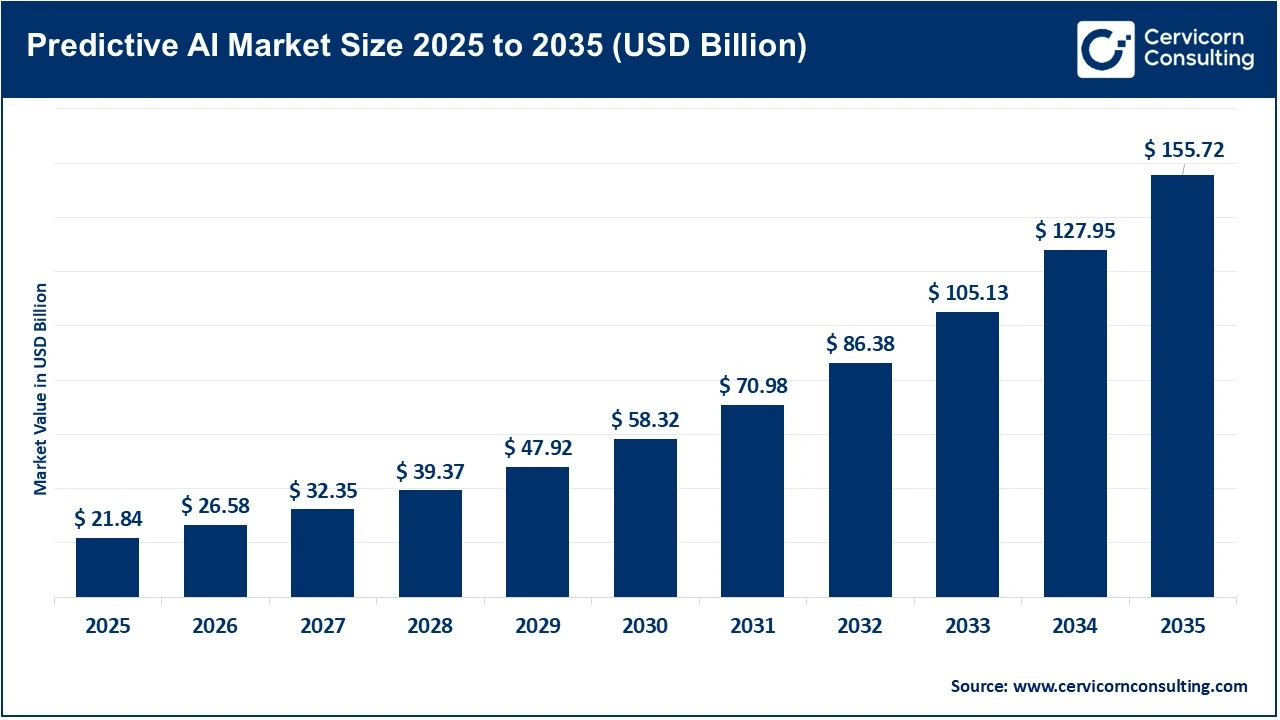
Another major growth factor is the expanding use of predictive AI in high-ROI applications such as fraud detection, predictive maintenance, supply chain optimization, and revenue forecasting. These use cases offer measurable business value by reducing downtime, lowering fraud losses, and improving forecast accuracy. AI adoption is also rising in sales and commercial operations Gartner estimates that 95% of seller research workflows will begin with AI by 2027, up from less than 20% in 2024. In addition, McKinsey found that 87% of executives expect AI to drive revenue growth within three years, showing why enterprises are increasing investments in predictive AI platforms.
Report Highlights
- North America dominated the predictive AI market with 40.2% share, supported by strong enterprise AI adoption, cloud infrastructure, and advanced analytics deployment.
- Software accounted for 68.4% of the market, as predictive AI platforms, analytics engines, and forecasting tools remain the core of enterprise adoption.
- Cloud-based deployment held 49.8% market share, driven by scalability, faster implementation, lower infrastructure costs, and growing use of SaaS-based AI solutions.
- Machine learning led the technology segment with 34.6% share, owing to its broad use in forecasting, fraud detection, churn prediction, and predictive maintenance.
- Demand forecasting captured 19.7% of the application segment, as enterprises increasingly use predictive AI to optimize inventory, production, and supply planning.
- BFSI held 22.8% share of the end-use industry segment, driven by heavy use of predictive AI for fraud analytics, credit risk, and customer intelligence.
What is Predictive AI?
Predictive AI is a branch of artificial intelligence that uses historical data, machine learning, and statistical models to forecast future outcomes, behaviors, risks, or events. It helps organizations identify patterns in large datasets and use them to predict customer demand, equipment failures, fraud, churn, supply chain disruptions, and financial trends. Unlike traditional analytics that explains past events, predictive AI focuses on what is likely to happen next, enabling businesses to make faster, more proactive, and data-driven decisions across operations, sales, marketing, finance, and customer service.
Benefits of Predictive AI
- Improves forecast accuracy and planning efficiency by turning historical and real-time data into demand, inventory, and budget predictions for better operational decisions.
- Reduces risk and fraud exposure by detecting anomalies, suspicious transactions, and potential defaults before they escalate into financial losses.
- Supports predictive maintenance and lowers downtime by identifying machinery or asset failure risks in advance, helping companies avoid costly disruptions.
- Enhances customer retention and personalization through churn prediction, behavior analysis, and recommendation engines that improve engagement and customer lifetime value.
- Accelerates enterprise decision-making as predictive algorithms enable real-time, granular business decisions rather than relying only on periodic reporting.
- Boosts AI-driven business adoption: IBM reports 68% of executives are already experimenting with AI automation, and 37% expect touchless automation for predictive insights by 2027, highlighting growing enterprise reliance on predictive AI.
Report Scope
| Area of Focus |
Details |
| Predictive AI Market Size in 2026 |
USD 26.58 Billion |
| Predictive AI Market Size in 2035 |
USD 155.72 Billion |
| Predictive AI Market CAGR from 2026-2035 |
21.70% |
| Dominant Region |
North America |
| Rapidly Expanding Region |
Asia-Pacific |
| Key Segments |
Component, Deployment Mode, Technology, Application, End-use Industry, Region |
| Key Companies |
IBM Corporation, SAS Institute Inc., Microsoft Corporation, SAP SE, Oracle Corporation, Salesforce, Inc., Alteryx, Inc., RapidMiner, Inc., Dell Technologies, TIBCO Software Inc., MathWorks, Inc., KNIME AG |
Predictive AI Market Dynamics
Market Drivers
1. Rising enterprise demand for predictive decision-making
Organizations are increasingly using predictive AI to improve forecasting, reduce uncertainty, and automate operational decisions across sales, finance, supply chains, and customer management. The market is benefiting from wider enterprise AI adoption, as McKinsey found 88% of organizations now use AI in at least one business function, up from 78% a year earlier. Predictive AI is especially valuable because it converts historical and real-time data into demand forecasts, churn prediction, fraud alerts, and maintenance insights, helping companies improve planning accuracy, speed, and profitability.
2. Expansion of high-ROI use cases across industries
Predictive AI adoption is also being accelerated by its measurable return in areas such as fraud detection, predictive maintenance, inventory optimization, and personalized marketing. Enterprises are prioritizing AI projects that deliver direct operational and financial value, which strongly favors predictive AI deployments. According to McKinsey, 80% of organizations pursuing AI set efficiency as a core objective, while high performers are significantly more likely to redesign workflows around AI. This is driving predictive AI adoption as businesses seek cost savings, lower downtime, and faster data-driven decision-making at scale.
Market Restraints
1. Poor data quality and fragmented infrastructure
A major restraint for the predictive AI market is the lack of clean, connected, and real-time enterprise data needed to train and run reliable prediction models. Predictive AI performance depends heavily on data availability, integration, and governance, but many organizations still operate on siloed systems. A 2026 Confluent-backed study found 72% of IT leaders say poor real-time data infrastructure is blocking AI scale, while 66% cite data lineage uncertainty and 65% cite fragmented data ownership. These issues slow deployments, weaken model accuracy, and reduce business trust in predictive outputs.
2. Governance, explainability, and trust barriers
Predictive AI models often influence pricing, credit risk, fraud scoring, and operational planning, making explainability and governance critical. However, many organizations still lack the controls needed to manage AI responsibly at scale. Recent enterprise AI findings show only 13% of organizations believe they have the right governance in place to manage advanced AI systems, creating hesitation around broader deployment. For predictive AI, this challenge is especially important in regulated sectors such as BFSI and healthcare, where opaque models, biased outputs, and compliance risks can delay adoption and limit production-scale use.
Market Opportunities
1. Scaling AI from pilots into enterprise-wide workflows
One of the biggest opportunities in the predictive AI market lies in moving from isolated pilots to enterprise-wide deployment across core workflows. Many companies already use AI in one function, but a smaller share has embedded it deeply across the business, leaving significant room for predictive AI expansion. McKinsey reports about one-third of organizations have begun scaling AI programs, while 23% are already scaling agentic AI systems in at least one function. This creates strong opportunity for predictive AI vendors offering platforms that integrate forecasting, optimization, and decision intelligence across departments.
2. Growing demand for AI-led revenue growth and workflow transformation
Predictive AI is well positioned to benefit from the shift toward AI as a revenue and growth enabler rather than only a cost-saving tool. Companies increasingly want AI systems that can improve sales conversion, pricing, customer retention, and cross-selling decisions using predictive insights. McKinsey notes that high-performing AI adopters are nearly three times more likely to redesign workflows, and more than one-third of high performers allocate over 20% of digital budgets to AI. This signals strong opportunity for predictive AI solutions that support revenue forecasting, dynamic pricing, and customer intelligence.
Market Challenges
1. Converting experimentation into measurable production impact
Although AI adoption is rising, many enterprises still struggle to move from experimentation to large-scale business impact, which remains a core challenge for the predictive AI market. Predictive models may work in pilot settings, but scaling them across business units requires integration, monitoring, workflow redesign, and change management. McKinsey found that while 88% of organizations use AI in at least one function, only around one-third have begun scaling AI programs, showing a large execution gap. This limits the speed at which predictive AI vendors can convert interest into long-term enterprise contracts and broad deployments.
2. Shortage of mature data, talent, and model operations capabilities
Another major challenge is the shortage of enterprise readiness needed to operationalize predictive AI effectively, including skilled talent, MLOps capability, and strong data engineering foundations. Predictive AI requires continuous model training, validation, monitoring, and integration with business systems, which many organizations are still building. Deloitte’s 2026 enterprise AI survey covered 3,235 global leaders across 24 countries, reflecting how widespread AI interest is, but market execution remains uneven due to organizational readiness gaps. These capability gaps can increase deployment costs, extend timelines, and reduce the success rate of predictive AI projects.
Regional Analysis
The predictive AI market is segmented by region into North America, Europe, Asia-Pacific, Latin America, and LAMEA. Here is a brief overview of each region
Why does North America leads in predictive AI market?
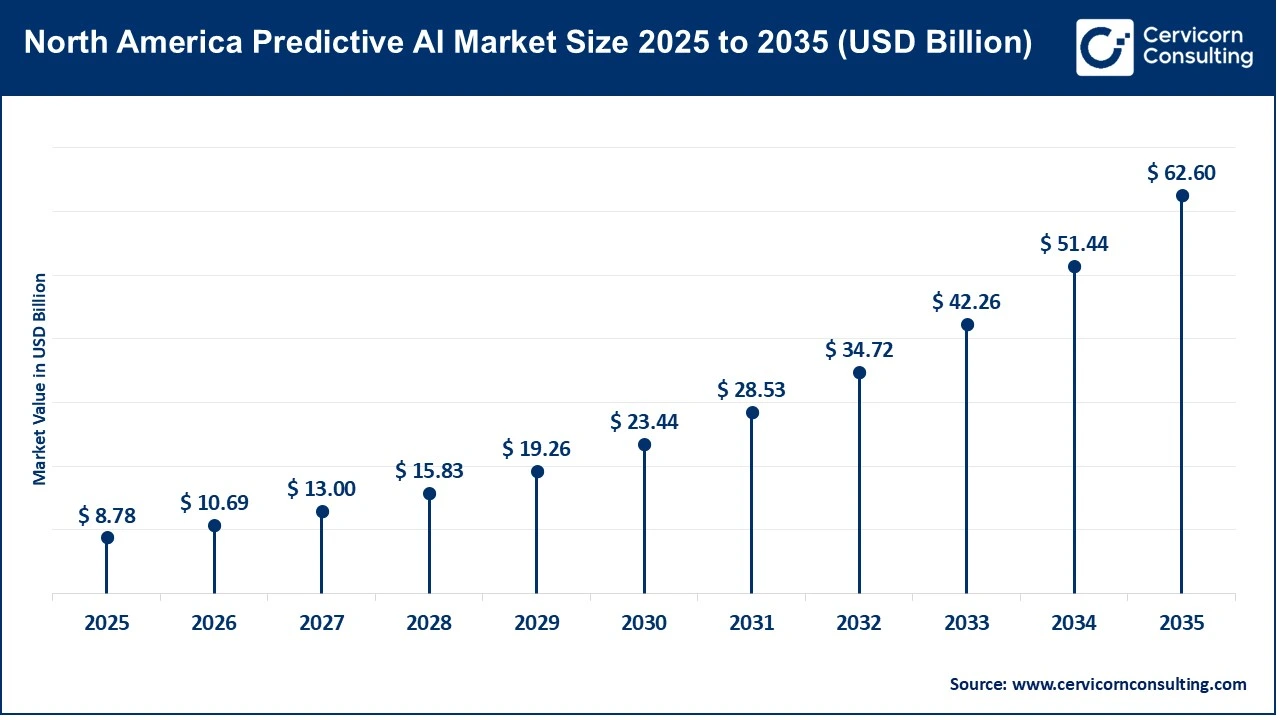
The North America predictive AI market size is set to surge from USD 8.78 billion in 2025 to USD 62.60 billion by 2035. The North America market is witnessing strong growth due to the region’s advanced digital ecosystem, early adoption of enterprise AI, and rising use of predictive analytics across BFSI, healthcare, retail, manufacturing, and telecom. Organizations in the region are increasingly deploying predictive AI to improve fraud detection, demand forecasting, customer behavior analysis, predictive maintenance, and revenue planning. Market growth is also supported by the strong presence of global AI and cloud technology providers, expanding investments in data platforms and automation, and the rapid shift toward AI-led business operations. In addition, North America benefits from mature cloud infrastructure, high enterprise analytics spending, strong venture funding for AI innovation, and growing demand for real-time decision intelligence across both private and public sectors.
United States: Strong enterprise AI adoption, large-scale cloud deployment, and deep use of predictive analytics continue to drive market growth.
- 73% of U.S. companies use AI in some business function, supporting predictive AI adoption across key industries.
- The U.S. recorded 1,143 funded AI companies in 2024, reflecting strong innovation and startup activity.
- Snowflake signed a USD 6 billion AWS deal, highlighting large-scale AI and data infrastructure investment.
Canada: Expanding AI research, rising enterprise adoption, and growing innovation funding support market growth.
- Business AI adoption in Canada rose from 6.1% in mid-2024 to 12.2% in mid-2025.
- 14.5% of Canadian businesses planned to adopt AI within the next year as of September 2025.
- The federal government committed CAD 240 million to Cohere, supporting AI compute and enterprise AI development.
Why is Asia-Pacific fastest growing region for predictive AI market?
The Asia-Pacific predictive AI market size recorded at USD 5.26billion in 2025 and is projected to reach USD 37.53 billion by 2035. The Asia-Pacific market is emerging as one of the fastest-growing regional markets, supported by accelerating digital transformation, rising enterprise adoption of AI-driven analytics, and growing investments in cloud, data centers, and automation platforms. Businesses across China, India, Japan, South Korea, Australia, and Southeast Asia are increasingly using predictive AI for demand forecasting, fraud detection, customer analytics, predictive maintenance, and healthcare decision support. Growth is further supported by strong government AI strategies, the rapid expansion of digital commerce and financial services, and rising industrial automation across manufacturing-heavy economies. In addition, the region benefits from a large digital user base, increasing data generation, improving AI infrastructure, and growing adoption of predictive analytics tools across both public and private sector organizations.
China: Large-scale AI investment, strong cloud and semiconductor ecosystems, and broad enterprise adoption of predictive analytics continue to anchor regional growth.
- China held 36.4% of the Asia-Pacific AI market in 2025, making it the region’s largest country market.
- Strong AI investment and earnings momentum are making China and Taiwan preferred Asia ex-Japan AI markets for investors.
- China’s scale in manufacturing, e-commerce, fintech, and smart-city programs supports wide use of predictive AI in forecasting, risk analytics, and automation.
India: Rapid sovereign AI initiatives, expanding data-center capacity, and rising enterprise AI readiness are accelerating predictive AI adoption.
- 96% of Indian government leaders are actively advancing a sovereign AI strategy, reflecting strong public-sector AI momentum.
- India is now the second-largest data center market in Asia-Pacific, supported by AI adoption and hyperscale cloud expansion.
- India is also emerging as one of the region’s most AI-ready markets in healthcare and enterprise digital transformation.
Why is Europe region growing steadily in th predictive AI market?
The Europe predictive AI market is expected to skyrocket from USD 5.63 billion in 2025 to over USD 40.18 billion by 2035. The Europe market is growing steadily due to rising adoption of AI-driven analytics across manufacturing, BFSI, retail, healthcare, and automotive sectors. Enterprises across the region are increasingly using predictive AI for fraud detection, demand forecasting, predictive maintenance, workforce planning, and customer intelligence. Growth is supported by strong industrial digitalization, expanding cloud adoption, and Europe’s emphasis on trustworthy, compliant, and data-secure AI systems. In addition, supportive public-private innovation programs, rising enterprise AI investments, and increasing demand for operational efficiency and decision automation are helping accelerate predictive AI deployment across both established industries and digitally transforming businesses.
Germany: Strong industrial AI deployment, advanced manufacturing base, and rising enterprise use of predictive analytics support market growth.
- Germany accounted for 27.0% of the Europe AI market in 2025, making it the region’s leading country market.
- The country benefits from deep AI use across automotive, manufacturing, logistics, and industrial automation applications.
- Germany’s strong Industry 4.0 ecosystem supports predictive AI use in maintenance, quality control, and production forecasting.
United Kingdom: Expanding enterprise AI adoption, strong cloud ecosystem, and rising use of predictive AI in retail, finance, and public services drive market growth.
- AI use in the UK has reached a “tipping point”, with businesses moving from experimentation to scaled deployment.
- The UK is seeing predictive AI adoption across retail, workforce planning, customer analytics, and financial services.
- Google estimates AI could raise UK productivity by 20%, strengthening enterprise interest in predictive AI tools.
Predictive AI Market Share, By Region, 2025 (%)
| Region |
Revenue Share, 2025 (%) |
| North America |
40.2% |
| Europe |
25.8% |
| Asia-Pacific |
24.1% |
| LAMEA |
9.9% |
What factors are gaining momentum in the LAMEA predictive AI market?
The LAMEA predictive AI market was valued at USD 2.16 billion in 2025 and is anticipated to reach USD 15.42 billion by 2035. The LAMEA market is gaining momentum as countries across Latin America, the Middle East, and Africa accelerate digital transformation and adopt AI-led analytics across banking, telecom, retail, healthcare, energy, and government services. Enterprises in the region are increasingly using predictive AI for fraud detection, customer analytics, demand forecasting, risk management, and predictive maintenance. Growth is supported by expanding cloud infrastructure, rising AI startup activity, smart-city and e-government initiatives, and stronger public-sector investment in AI readiness. In addition, the region’s growing digital economy, rising data volumes, and increasing focus on automation and operational efficiency are creating favorable conditions for predictive AI deployment across both public and private sectors.
Brazil: Expanding enterprise AI adoption, strong digital banking ecosystem, and growing industrial analytics use continue to support market growth.
- Brazil held 25% of the Latin America AI market in 2025, making it the region’s largest country market.
- Manufacturing accounted for 17.4% of Latin America’s AI end-use demand in 2025, supporting predictive maintenance and production forecasting adoption in Brazil.
- Brazil’s strong fintech, retail, and enterprise cloud ecosystem is accelerating predictive AI use in fraud detection, customer analytics, and demand forecasting.
UAE: Strong sovereign AI investment, hyperscale infrastructure expansion, and rapid enterprise AI adoption are accelerating predictive AI deployment.
- The UAE is expected to register the highest CAGR in the Middle East & Africa AI market through 2033.
- By late 2024, nearly 60% of Middle Eastern firms reported fast AI adoption, though scaling remains uneven across sectors.
- Large AI infrastructure and smart-government investments in the UAE are boosting predictive AI use across finance, energy, logistics, and public services.
Predictive AI Market Segmental Analysis
The predictive AI market is segmented into component, deployment mode, technology, application, end-use industry, and geography.
Component Analysis
The software segment dominates the predictive AI market because it forms the central layer for model development, data processing, forecasting, and decision intelligence. Enterprises use predictive AI software for fraud detection, demand forecasting, churn prediction, pricing optimization, and predictive maintenance across daily workflows. Its dominance is also supported by the growing use of AI platforms, analytics engines, and embedded enterprise applications that allow businesses to deploy predictive models faster, automate decisions, and scale AI capabilities across multiple departments and end-use industries.
Predictive AI Market Share, By Component, 2025 (%)
| Component |
Revenue Share, 2025 (%) |
| Software |
68.4% |
| Services |
31.6% |
The services segment is expected to be the fastest growing as organizations increasingly require support for implementation, integration, customization, governance, and model lifecycle management. Many companies still lack in-house AI talent and rely on external service providers to deploy predictive AI successfully across business functions. As enterprises move from pilot projects to production-scale AI adoption, the need for consulting, managed services, training, and workflow redesign continues to rise. This makes services a high-growth segment, particularly in regulated and data-intensive industries adopting predictive AI at scale.
Deployment Mode Analysis
The cloud-based segment dominates the predictive AI market because it offers scalability, flexibility, and faster deployment for data-heavy AI workloads. Predictive AI applications such as demand forecasting, fraud analytics, customer behavior modeling, and supply chain optimization increasingly run on cloud environments due to easier access to computing resources, centralized data storage, and lower upfront infrastructure costs. Cloud deployment also supports real-time analytics, remote access, and faster software updates, making it highly attractive for enterprises seeking to scale predictive AI across business units, geographies, and large volumes of structured and unstructured data.
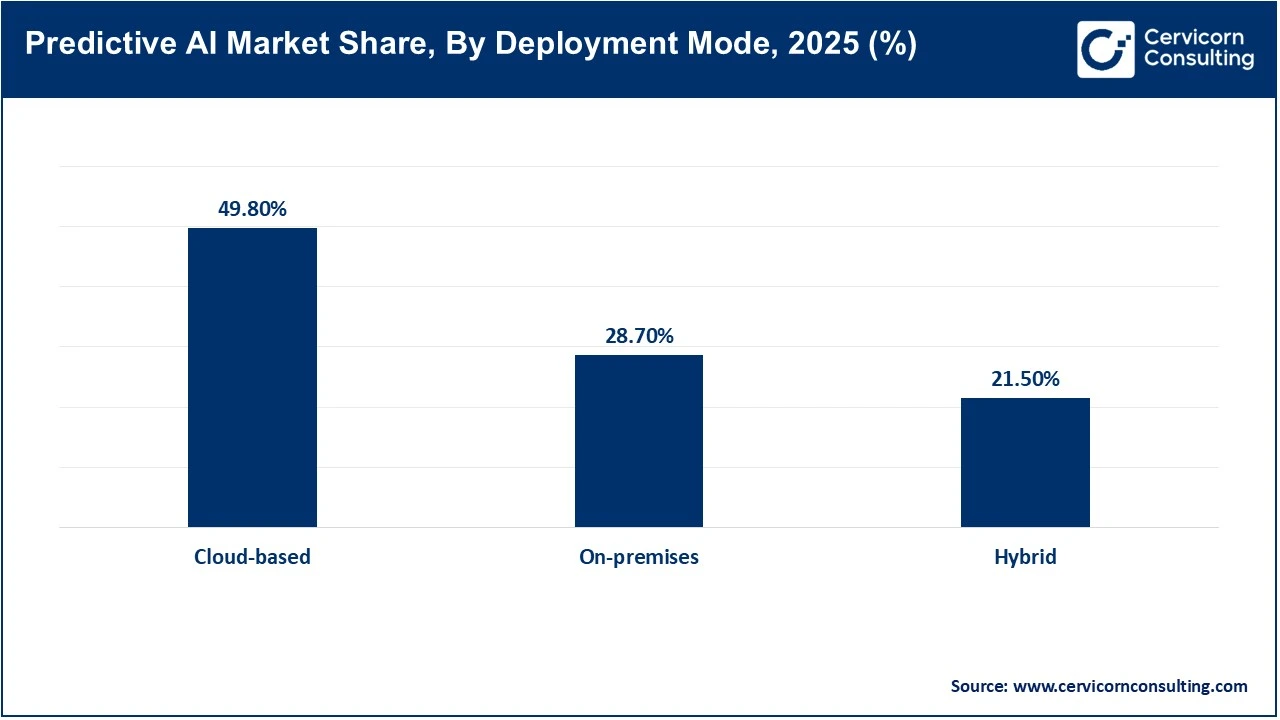
The hybrid deployment segment is projected to grow the fastest because it combines the scalability of cloud platforms with the control and security of on-premises infrastructure. Organizations in BFSI, healthcare, government, and other compliance-sensitive sectors increasingly prefer hybrid models to keep critical data within internal systems while using cloud environments for advanced analytics and model training. This architecture supports data sovereignty, regulatory compliance, and legacy system integration without limiting AI scalability. As enterprises seek more flexible deployment strategies, hybrid environments are becoming a preferred pathway for expanding predictive AI adoption.
Technology Analysis
The machine learning segment dominates the predictive AI market because it is the foundational technology behind most predictive models used in business forecasting and decision-making. Machine learning algorithms enable organizations to analyze historical and real-time data, detect patterns, predict future outcomes, and continuously improve model performance. Common predictive AI applications such as credit scoring, demand planning, customer churn analysis, predictive maintenance, and fraud detection rely heavily on machine learning methods. Its broad applicability, maturity, and compatibility with enterprise analytics platforms make machine learning the most widely adopted technology across predictive AI deployments.
Predictive AI Market, By Technology, 2025 (%)
| Technology |
Revenue Share, 2025 (%) |
| Machine Learning |
34.6% |
| Deep Learning / Neural Networks |
21.8% |
| Natural Language Processing (NLP) |
16.1% |
| Computer Vision |
11.4% |
| Predictive Analytics / Statistical AI |
16.1% |
The deep learning and neural networks segment is expected to be the fastest growing as predictive AI expands into more complex and data-rich use cases. Deep learning models are increasingly used where large datasets, unstructured inputs, and nonlinear relationships require higher analytical sophistication than traditional methods. Applications in healthcare diagnosis, financial risk modeling, industrial monitoring, and customer behavior prediction are driving this growth. As enterprises invest more in GPU computing, advanced AI infrastructure, and high-volume data environments, deep learning is gaining momentum as a powerful technology for next-generation predictive AI solutions.
Application Analysis
The demand forecasting segment dominates the predictive AI market because forecasting future demand is one of the most practical and widely adopted enterprise use cases. Retailers, manufacturers, logistics providers, and consumer goods companies use predictive AI to anticipate product demand, manage seasonal fluctuations, optimize production planning, and reduce stockouts or overstocking. Demand forecasting has become a critical business function in volatile and highly competitive markets where accurate planning directly affects profitability and customer satisfaction. Its broad use across multiple industries makes it the leading application segment within the predictive AI market.
Predictive AI Market, By Application, 2025 (%)
| Application |
Revenue Share, 2025 (%) |
| Demand Forecasting |
19.7% |
| Fraud Detection & Risk Analytics |
15.3% |
| Predictive Maintenance |
13.4% |
| Customer Behavior / Recommendation / Churn Prediction |
14.6% |
| Supply Chain & Inventory Optimization |
11.8% |
| Sales & Revenue Forecasting |
9.7% |
| Healthcare Diagnosis / Clinical Prediction |
8.4% |
| Cybersecurity Threat Prediction |
7.1% |
The predictive maintenance segment is likely to be the fastest growing due to rising adoption of AI in industrial and asset-intensive environments. Predictive AI helps organizations monitor machinery, equipment, and operational systems to identify potential failures before breakdowns occur, reducing downtime and maintenance costs. Manufacturing, energy, transportation, and utilities sectors are increasingly using predictive maintenance to improve reliability, extend asset life, and optimize service schedules. As industrial IoT adoption expands and more equipment becomes sensor-connected, predictive maintenance is emerging as one of the strongest growth applications for predictive AI worldwide.
End-use Industry Analysis
The BFSI segment dominates the predictive AI market because financial institutions generate large volumes of transactional, behavioral, and risk-related data that are highly suitable for predictive modeling. Banks, insurers, and financial service providers use predictive AI for fraud detection, credit scoring, underwriting, claims prediction, default risk analysis, and customer targeting. The sector’s strong focus on risk mitigation, regulatory compliance, and personalized financial services supports continued investment in predictive analytics. Since predictive accuracy can directly improve profitability and reduce financial losses, BFSI remains the most established and dominant end-use industry in the market.
Predictive AI Market, By End-use Industry, 2025 (%)
| End-use Industry |
Revenue Share, 2025 (%) |
| BFSI |
22.8% |
| Healthcare & Life Sciences |
14.7% |
| Retail & E-commerce |
12.9% |
| Manufacturing |
13.8% |
| IT & Telecom |
11.4% |
| Automotive & Transportation |
7.3% |
| Energy & Utilities |
6.1% |
| Government & Defense |
5.2% |
| Media & Entertainment |
3.4% |
| Others |
2.4% |
The manufacturing segment is expected to be the fastest growing as industrial companies increasingly adopt predictive AI to improve operational efficiency and asset performance. Manufacturers use predictive AI for maintenance scheduling, quality control, production forecasting, supply chain planning, and energy optimization across factory environments. The growth of smart factories, industrial automation, and IoT-enabled equipment is creating strong demand for predictive tools that can reduce downtime and improve output reliability. As manufacturing becomes more data-driven and digitally connected, predictive AI is becoming a key technology for modern industrial transformation.
Top Companies
Recent Developments
- In June 2026, IBM launched watsonx.ai v2.4, adding expanded governed model access, multi-tenancy support, and broader machine learning and decision optimization capabilities to help enterprises scale predictive and governed AI workloads.
- In January 2026, SAP launched SAP-RPT-1, a foundation model designed for structured business data that supports predictive tasks such as classification and regression, while also expanding Joule and SAP Business AI capabilities.
- In November 2025, Microsoft added a new Dynamics 365 ERP Analytics MCP server in preview, enabling AI agents to access governed ERP analytics data, metrics, and semantic models for forecasting, planning, and predictive business insights.
- In May 2025, SAS introduced new SAS Viya innovations including SAS Viya Copilot, synthetic data generation tools, and AI agent capabilities to accelerate analytics, predictive modeling, and enterprise decision workflows.
Market Segmentation
By Component
By Deployment Mode
- Cloud-based
- On-premises
- Hybrid
By Technology
- Machine Learning
- Deep Learning / Neural Networks
- Natural Language Processing (NLP)
- Computer Vision
- Predictive Analytics / Statistical AI
By Application
- Demand Forecasting
- Fraud Detection & Risk Analytics
- Predictive Maintenance
- Customer Behavior / Recommendation / Churn Prediction
- Supply Chain & Inventory Optimization
- Sales & Revenue Forecasting
- Healthcare Diagnosis / Clinical Prediction
- Cybersecurity Threat Prediction
By End-use Industry
- BFSI
- Healthcare & Life Sciences
- Retail & E-commerce
- Manufacturing
- IT & Telecom
- Automotive & Transportation
- Energy & Utilities
- Government & Defense
- Media & Entertainment
- Others
By Geography
- North America
- Europe
- Asia-Pacific
- LAMEA