
Content
South Korea Physical AI Market Size to Reach USD 2,064.2 Million by 2035


South Korea Physical AI Market Size and Growth Factors
The South Korea physical AI market size reached at USD 112.5 million in 2025 and is predicted to surge USD 2,064.2 million by 2035; growing at a CAGR of 34.2% during the forecast period of 2026-2035. Rapid advancements in AI-enabled robotics, edge computing, and intelligent automation technologies are accelerating the adoption of physical AI across South Korea's manufacturing, healthcare, logistics, and service industries.
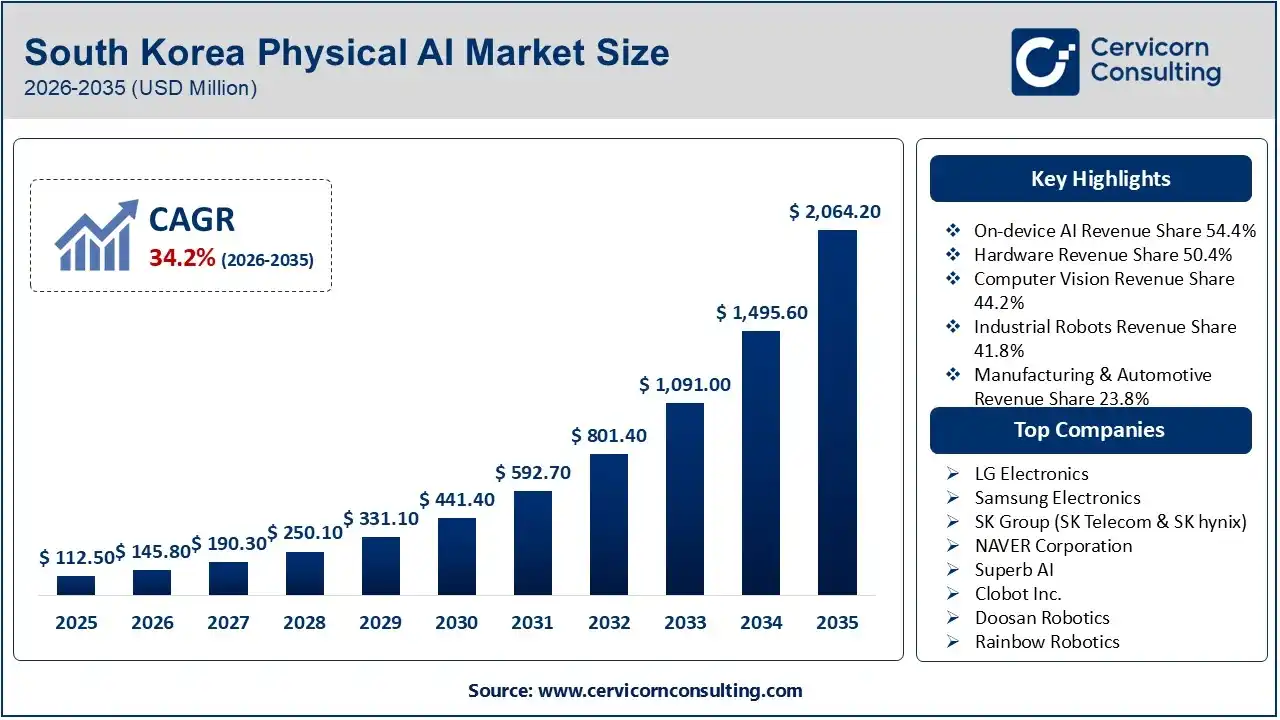
South Korea is poised to become the most promising physical AI innovation environment in Asia due to a growth in investment across autonomous robotics, edge AI computing, intelligent mobility, digital manufacturing. With more workplace labor shortage and aging population, as well as the increasing need for the adoption of industrial automation solutions for higher productivity, process performance, and employee security, businesses are heavily invested in adopting the physical AI.
Technological breakthroughs made in the domain of AI chips, synthetic data, digital twin, high performance computing and vision are further spurring more innovations in physical AI. Government initiatives, private enterprises’ growing adoption of physical AI for industries, healthcare, intelligent vehicles, defense and smart cities, the country is expected to reach new heights.
Key Takeaways
- By deployment, on-device AI dominated the South Korea physical AI market with a 54.4% share in 2025, owing to increasing deployment of edge intelligence across industrial robots, autonomous equipment, and smart manufacturing environments.
- By deployment, cloud-based AI held the second-largest market share of 45.6% in 2025, driven by the growing need for scalable computing infrastructure, remote monitoring, and enterprise-wide AI integration.
- By component, hardware led the market with a 50.4% share in 2025, supported by strong domestic capabilities in semiconductor manufacturing and continuous development of next-generation robotic systems.
- By component, software accounted for a 37.4% share in 2025 and is projected to reach 40.2% by 2035, fueled by increasing adoption of AI perception platforms, autonomous navigation software, and intelligent fleet management solutions.
- By technology, computer vision dominated the market with a 44.2% share in 2025, owing to rising implementation of AI-powered imaging technologies for quality inspection, object recognition, and precision manufacturing.
- By technology, speech and natural language processing held the second-largest share of 20.6% in 2025, supported by growing utilization of voice-enabled human-machine interaction across service robotics and customer-facing applications.
- By robot type/form factor, industrial robots accounted for the largest market share of 41.8% in 2025, driven by increasing automation of production lines and the country's leadership in advanced manufacturing.
- By robot type/form factor, service robots represented 12.9% of the market in 2025, fueled by expanding adoption in elderly care, hospital assistance, commercial facilities, and intelligent delivery services.
- By application, manufacturing & automotive dominated the market with a 23.8% share in 2025, owing to the increasing integration of AI-driven robotics for precision production, predictive maintenance, and operational optimization.
- By application, healthcare held the second-largest share of 17.5% in 2025, driven by rising investments in smart healthcare infrastructure and the growing use of robotic technologies for clinical and patient support applications.
What Opportunities Exist in the South Korea Physical AI?
South Korea has excellent opportunities for growth in the physical AI market owing to its advanced manufacturing base, semiconductor industry and its strong governmental support for digital transformation. Because of the speedy adoption of smart factories, automated machines and AI in its industries, the nation’s market needs intelligent machines and smart sensors in electronics, automobile and logistics industries. Increased investments in AI process chips, hardware, edge computing and 5G is further propelling new use cases of real-time AI in physical world applications.
Also, South Korea with its aging population and rise in need for service automation with a growth in healthcare sector has opportunities to sell AI-powered surgical robots, rehabilitation devices, nursing robot and health-care robots for its population. Moreover, rapid development in E-commerce sector and boom in smart-cities projects along with development in autonomous mobility solutions will continue to boost sale of autonomous mobile robots (AMR’s) and autonomous guided vehicle (AGV’s) and also lead to expansion of smart logistic operations.
What are the Key Areas Highlighting the South Korea Physical AI?
- Government Backing and National AI Strategy: Robust government funding programs, incentives, and national AI strategy for AI, robotics, semiconductors and smart manufacturing.
- Advanced Semiconductor Capabilities: Leading semiconductor players are integrated into the ecosystem to produce high-performance processors, memory, and edge capabilities required for physical AI applications.
- Industrial Automation and Smart Factories: A high growth in adoption of AI driven robots, machine vision, digital twin and autonomous systems for production across manufacturing industries.
- Collaborative Robotics (Cobots): The deployment of co-robots is expanding into electronics, automotive, precision manufacturing, and logistics for a wide range of use cases to boost productivity.
- Automotive and Autonomous Mobility: The growing adoption of physical AI in autonomous cars, intelligent transit systems, warehouse automation, and electric vehicle production.
- Medical and Health Robotics: Demand in the healthcare sector for robotic assistants in surgery, rehabilitation, patient monitoring and patient assistance.
Top Companies
The South Korea physical AI landscape encompasses established global tech giants along with agile robotics and AI software startups fueling its shift toward intelligent automation. Companies such as LG Electronics, Samsung Electronics, SK Group (SK Telecom & SK hynix), NAVER Corporation, Superb AI, Clobot Inc., Doosan Robotics, and Rainbow Robotics are pouring resources into areas like AI processors, edge computing, robotic foundation models, autonomous navigation, computer vision, synthetic data creation, and collaborative robotics.
Through a concerted effort involving sustained R&D, strategic alliances, chip innovation, and the application of AI to manufacturing processes, South Korea is fortifying its stature as a dominant player in physical AI, driving the widespread adoption of intelligent robotics, autonomous vehicles, AI-enhanced manufacturing facilities, and other AI-powered solutions in industries ranging from healthcare and logistics to retail and public infrastructure. The ecosystem being nurtured has a particular strength in developing the foundations for future physical intelligence applications.
Segments Covered
By Deployment
- Cloud-based AI
- On-device AI
By Component
- Hardware
- Software
- Services
By Technology
- Computer Vision
- Speech / Natural Language Processing (NLP)
- Gesture / Movement Recognition
- Reinforcement Learning & Control Systems
- Others
By Robot Type / Form Factor
- Industrial Robots
- Service Robots
- Humanoids/Social Robots
- Cobots
- Exoskeletons/Prosthetics
- Mobile Robots/Drones
By Application
- Healthcare
- Manufacturing & Automotive
- Logistics & Warehousing
- Retail & Hospitality
- Defense & Security
- Agriculture
- Education & Research
- Others
Empower your strategy with expert insights, purchase this premium research@ https://www.cervicornconsulting.com/buy-now/2985
Ask here for more details@ sales@cervicornconsulting.com