South Korea Physical AI Market Size, Growth, Forecast 2026 to 2035
The South Korea physical AI market size was valued at USD 112.5 million in 2025, expected to be worth around USD 2,064.2 million by 2035 and growing at a CAGR of 34.2% during the forecast period of 2026-2035. Strong government support for smart manufacturing, coupled with increasing investments in semiconductor innovation and next-generation robotics, is creating a favorable environment for the expansion of the South Korea physical AI market.
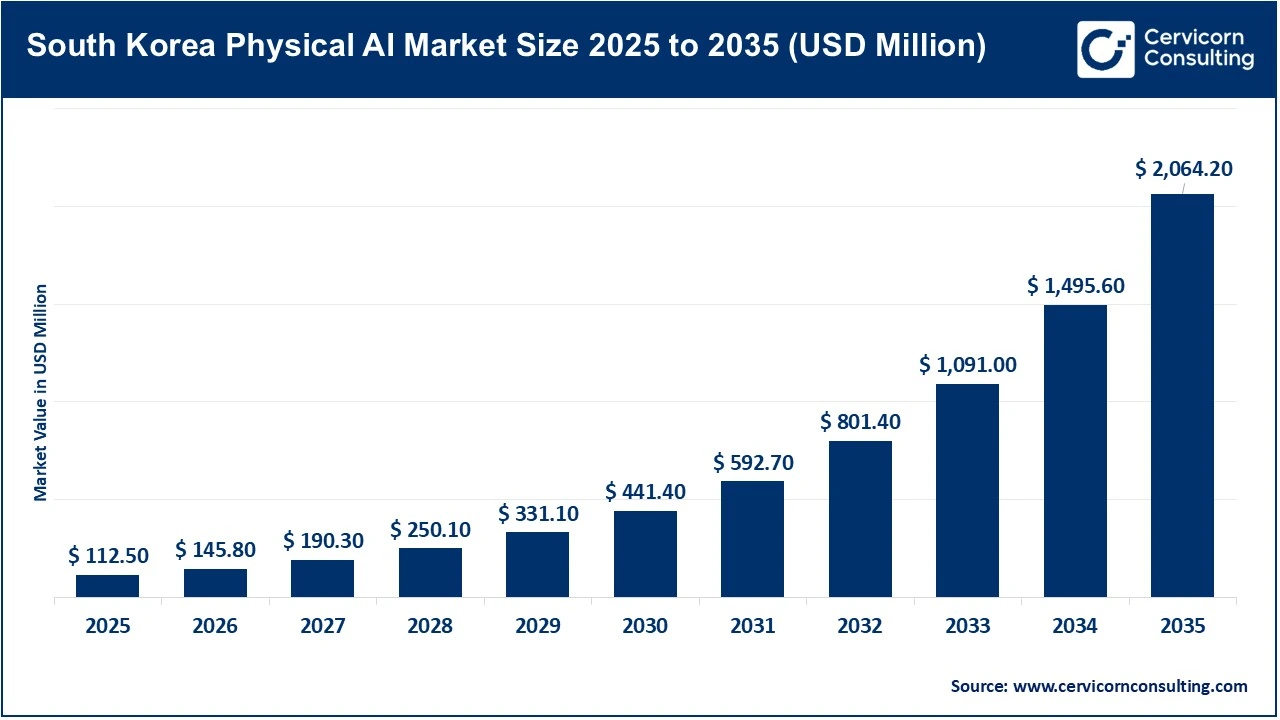
Report Highlights
- By deployment, on-device AI dominated the market with a 54.4% share in 2025, driven by increasing demand for real-time processing, enhanced data security, and autonomous decision-making in intelligent machines.
- By deployment, cloud-based AI held the second-largest market share of 45.6% in 2025, supported by growing adoption of cloud platforms for centralized robot management, digital twins, and predictive analytics.
- By component, hardware led the market with a 50.4% share in 2025, owing to rising investments in AI processors, advanced sensors, robotics, and semiconductor technologies.
- By component, software accounted for a 37.4% share in 2025 and is projected to reach 40.2% by 2035, as advances in generative AI and robot operating systems continue to enhance physical AI capabilities.
- By technology, computer vision dominated the market with a 44.2% share in 2025, driven by its extensive use in robotic inspection, autonomous navigation, and industrial automation.
- By technology, speech and natural language processing held the second-largest share of 20.6% in 2025, fueled by increasing deployment of conversational AI in service robots across healthcare, retail, and hospitality.
- By robot type/form factor, industrial robots accounted for the largest market share of 41.8% in 2025, supported by widespread adoption across South Korea's automotive, semiconductor, and electronics manufacturing industries.
- By robot type/form factor, service robots represented 12.9% of the market in 2025, owing to increasing demand for intelligent automation in healthcare, logistics, hospitality, and public services.
- By application, manufacturing & automotive dominated the market with a 23.8% share in 2025, driven by continuous investments in AI-powered production systems and smart factory initiatives.
- By application, healthcare held the second-largest share of 17.5% in 2025, supported by rising adoption of AI-enabled medical robots and increasing demand for efficient patient care solutions.
Why is Demand for Physical AI Increasing in South Korea?
Physical AI adoption in the South Korea is high given that the country is the leading country in industrial automation with government support and increasing labor scarcity. With 1,012 industrial robots per 10,000 manufacturing workers, South Korea leads the world for industrial robot density, which is nearly six times higher than the global average of 162 robots. Given the extensive usage of AI powered industrial automation in the electronics, automotive and semiconductors industries.
The government also announced the intent to inject more than $2.24 billion in combined public-private funds into the domestic next generation robotics industry by 2030. This will also increase the proportion of local production of core components from 44% to 80% while dismantling 51 regulatory hurdles.
Around 50% of South Korea’s robotics market is dominated by manufacturing robots, while around 16% comes from service robots that have seen rapid development in healthcare, logistics and hospitality applications.
Top Government Funding and Incentives
- The National AI Strategy (2019-2030): The national AI strategy for the long term focuses on how the South Korean economy can become a global leader in AI and support technology spill-over into areas including robots and autonomous systems, smart factories, health and welfare and smart production.
- The AI Semiconductor Strategy (K-Semiconductor Belt): The government is set to foster the nation’s hardware power through AI semiconductor and high-end manufacturing. The strategy emphasizes support for the development of relevant industries such as intelligent production systems such as robot systems, autonomous systems, edge systems and more.
- Digital New Deal: This initiative represents the nation’s plan to facilitate AI through substantial investments into 5G networks, cloud computing, and other infrastructure such as for intelligent robots and self-driving vehicle systems, creating a ‘Digital New Deal.’
- K-Humanoid Alliance (2025): In 2025, MOTIE is launching the K-Humanoid Alliance that aims to integrate robot makers, AI companies, universities and research institutions into an alliance in a bid to commercialize humanoid robots of the future and alleviate the South’s dependence on international robots.
- K-Robot Economy Strategy: This national strategy will improve manufacturing efficiency through the development and commercialization of advanced service robots, collaborative robots (cobots) and autonomous mobile robots (AMRs) along with the implementation of AI to manufacture smart intelligent processes.
Market Dynamics
What Currently Drives the Physical AI Market in South Korea?
South Korea’s physical AI market is dominated by the nation's position at the forefront of advanced manufacturing, robotics and semiconductor production. Many key sectors, including automotive, electronics, logistics, and semiconductor manufacturing, are swiftly integrating AI powered robots, autonomous systems and intelligent machines to bolster their productivity, accuracy and performance efficiencies.
These include smart factories, industrial digitization, and next-generation AI technology- initiatives launched by various governments to promote these advancements and significant investments by major technology giants are fast-tracking the deployment of physical AI across numerous factories and other facilities. The growing shortage of labour associated with South Korea's rapidly ageing population is another driver for adopting physical AI based on its capability of performing sophisticated tasks, requiring physical movement and interaction with other equipment, to overcome human resource limitations.
What is the Major Challenge in South Korea Physical AI Market?
Despite these technical strengths, the market has struggled to take hold as the costs of deploying physical AI systems and embedding them in traditional industrial machinery are steep. Building AI driven robots, smart sensors, Edge Computing (EC) devices and high-powered compute environments requires significant CAPEX, a prohibitive expense for many small to medium businesses.
System interoperability issues, the challenges of data privacy, and security in an interconnected world add further complexities, along with training for a workforce and navigating new AI governance norms. Even a scarcity of specialized AI engineers and robotics talent hinders faster adoption across industries.
What is Shaping the Future of South Korea Physical AI Market?
Future trajectory of South Korea’s physical AI market driven by synergistic evolution of Generative AI, Edge AI, Robotics, Computer Vision, and Digital Twins The physical AI market in Korea is poised to undergo a revolutionary overhaul with a confluence of emerging technological fields, namely Generative AI, Edge AI, sophisticated robotics, advanced computer vision, and the pervasive application of Digital Twins.
From an industrial perspective, the decade ahead will see increasing efforts to automate and intelligence across manufacturing, robotics, smart cities, and the broader socio-economic spectrum, all guided by our capabilities to generate and interpret our surroundings. As South Korea prioritizes development in smart autonomous manufacturing, intelligent robotic solutions including human-robotics interfaces (HRIs), cutting edge AI powered logistics systems, to highly intelligent robotic healthcare solutions, the market is set to witness robust growth.
This support, in conjunction with the mounting appetite across global industries for intelligent automation, decision making with real-time analytics and prediction, and collaboration between humans and machines, will undoubtedly cement Korea as one of the most preeminent global players for physical AI innovation and application in the years to come.
Segmental Analysis
Deployment Analysis
On-device AI garnered the highest market share of 54.4% in the South Korea physical AI market in 2025, the segment’s expansion attributed to high demand for enabling ultra-low latency, guaranteed operation, and greater data security in critical systems by performing AI tasks directly on physical hardware.
Machine manufacturers including consumer electronic device, automotive, semiconductor, and industrial automation equipment providers, are investing in equipping robots, automated machines, and industrial equipment with on-board edge intelligence for enabling in-situ data analysis and quick decision making without requiring uninterrupted connection to the cloud. Deployment of various advanced AI-equipped robotics such as intelligent surveillance, AMRs, cobots, and medical devices has pushed the adoption of on-device AI throughout South Korea.
South Korea Physical AI Market Revenue, By Deployment (US$ Mn)
| Deployment |
2025 |
2026 |
2027 |
| Cloud-based AI |
51.3 |
67 |
88 |
| On-device |
61.2 |
78.8 |
102.3 |
The cloud-based AI segment garnered the second-largest share of 45.6% of the market in 2025. Many organizations utilize cloud platforms for operating remotely controlled robot fleet, conducting analysis of collected operating data and ensuring unified system administration for multiple branches, as well as facilitate digital twins, machine learning based analysis and over-the-air updates of the deployed hardware solutions for minimizing maintenance expenses and optimizing operational activities.
Continuous investments in cloud infrastructure, expanded rollout of 5G connectivity, and increasing number of deployed industrial internet of things (IoT) ecosystem has fueled up the market demand for cloud-based physical AI solution.
Component Analysis
With a 50.4% share of the market in 2025, hardware dominated the South Korea physical AI market. Physical AI hardware, including AI processors, edge computing hardware modules, next generation sensors, cameras, LiDAR systems, robotic manipulators and actuators, communication modules, and embedded solutions, remains at the core of the physical AI ecosystem.
South Korea's leading semiconductor and electronics sectors continue investing heavily in new generation of physical AI hardware such as in robots, autonomous cars, industrial robotics, advanced driver-assistance systems (ADAS) and intelligent medicine to enhance its competitive positions in various industry sectors globally.
South Korea Physical AI Market Revenue, By Component (US$ Mn)
| Component |
2025 |
2026 |
2027 |
| Hardware |
56.7 |
73.2 |
95.2 |
| Software |
42.1 |
54.9 |
72.2 |
| Services |
13.7 |
17.6 |
22.9 |
Software held a market share of 37.4% in 2025 and will witness a faster growth rate compared to hardware, increasing to 40.2% by 2035. Market drivers such as the adoption of robot operating systems, AI perception, navigation algorithms, digital twin software, and predictive maintenance technologies are pushing the physical AI market toward an advanced software ecosystem.
Modern developments in such as foundation models, generative AI, reinforcement learning, autonomous decision making etc., make robots and other physical AI solutions smarter. The option to offer remote software upgrades, the flexibility of remotely learning systems and centralised fleet management will play a pivotal role in physical AI.
Technology Analysis
In 2025, the computer vision segment had the largest share of 44.2%. As an essential enabler of physical AI, computer vision empowers machines to perceive, comprehend, interpret, and interact with their physical surroundings. They provide high-accuracy object identification, product inspection, scene understanding, and robot navigation.
Driven by South Korea’s strong manufacturing sector with its emphasis on semiconductors, consumer goods, automobiles, and precision manufacturing, computer vision has a broad scope in enabling AI in visual inspection systems, robotic guidance, warehouse automation, and defect detection applications.
Higher resolution imaging, advanced camera systems, and deepen learning algorithms offer greater capabilities for computer vision automated solutions.
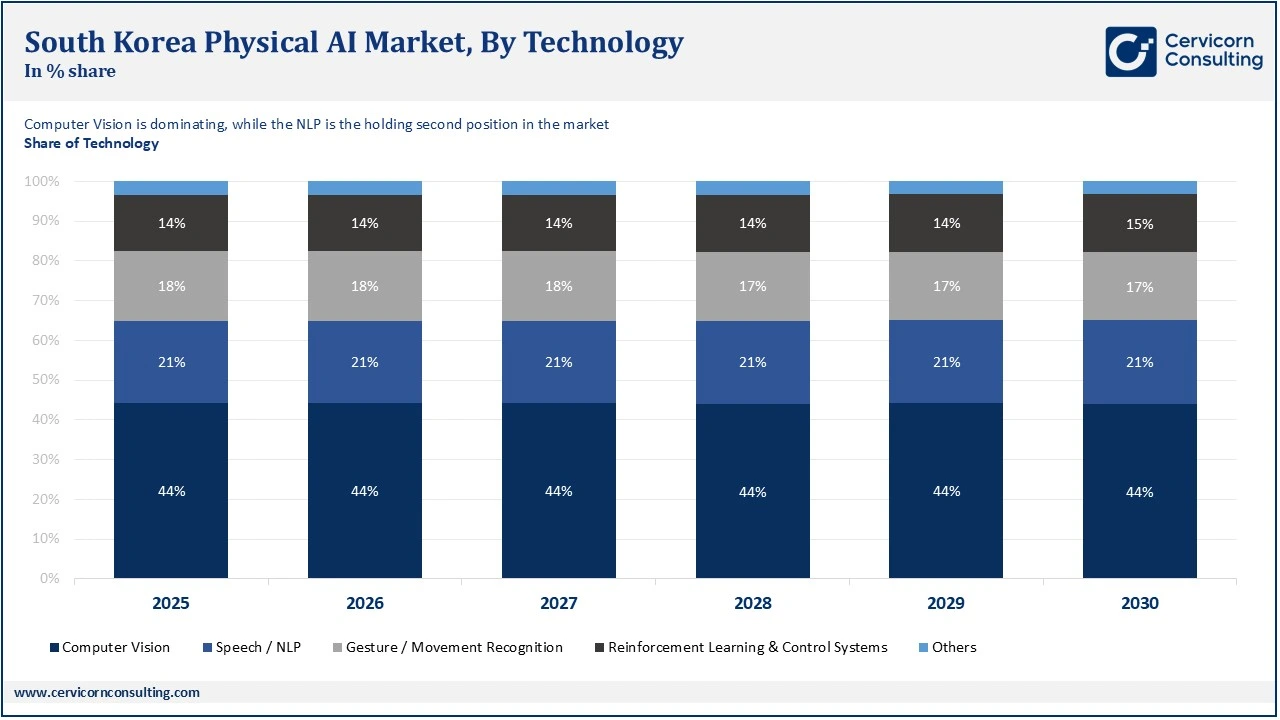
The speech and Natural Language Processing (NLP) segment generated the second-largest revenue share of 20.6% in 2025. Emerging technologies such as larger language models, multilingual speech recognition, conversational AI, and intelligent human-machine interaction will further broaden applications of speech-enabled physical AI solutions.
A variety of industries are deploying service robots in locations such as retail stores, hotels, hospitals, and public facilities that often require Natural Language Processing technology. This facilitates enhanced customer service and operational performance through better interaction between human operators and robots in these scenarios.
Robot Type/Form Factor Analysis
The industrial robots segment had the largest share of the market in 2025 and was accounted to have 41.8% of share. These robot technologies would dominate throughout the projected period owing to the large presence of robots for the production of automobile and manufacturing of electronics, semiconductor and heavy industries across the region.
Many South Korean firms have been incorporating the AI-powered industrial robot to support automated inspections, material handling, precision assembly, quality control, and predictive maintenance, and for managing lack of labor.
South Korea Physical AI Market Revenue, By Robot Type (US$ Mn)
| Robot Type |
2025 |
2026 |
2027 |
| Industrial Robots |
47.0 |
60.7 |
79.0 |
| Service Robots |
14.5 |
18.9 |
24.7 |
| Humanoids/Social Robots |
14.6 |
18.8 |
24.4 |
| Cobots |
13.1 |
17.1 |
22.6 |
| Exoskeletons/Prosthetics |
10.0 |
13.0 |
16.8 |
| Mobile Robots/Drones |
13.3 |
17.3 |
22.8 |
The service robots segment held a share of 12.9% in 2025 and is anticipated to have a significant share by the end of 2035. Increasing demand for robots in sectors such as healthcare, retail, logistics, public administration, hospitality, and elderly care has created demand for the integration of intelligent service robots in different services and applications.
The use of AI in delivery robots, autonomous reception, customer service robots, hospital assistance robots and cleaning robots has become common among different businesses that are looking forward to augment the quality of services and decrease their dependence on the workforce.
Application Analysis
The manufacturing & automotive was the highest application sector, holding 23.8% of the South Korea physical AI market share in 2025. South Korea’s international renowned manufacturing sectors like automotive, semiconductors, consumer electronics, batteries, and shipbuilding kept invest significant amount on AI automated processes to gain improvement on operational effectiveness, product quality, operational flexibility, and global competitiveness.
South Korea Physical AI Market Revenue, By Application (US$ Mn)
| Application |
2025 |
2026 |
2027 |
| Healthcare |
19.7 |
25.4 |
33.2 |
| Manufacturing & Automotive |
26.7 |
34.8 |
45.5 |
| Logistics & Warehousing |
15.6 |
20.1 |
26.1 |
| Retail & Hospitality |
14.1 |
18.5 |
24.3 |
| Defense & Security |
10.3 |
13.2 |
17.2 |
| Agriculture |
9.2 |
12.0 |
15.7 |
| Education & Research |
10.1 |
13.1 |
17.0 |
| Others |
6.8 |
8.7 |
11.3 |
The healthcare segment accounted for the second-largest share of 17.5% in 2025. Hospitals and healthcare providers are increasingly adopting AI-powered surgical systems, rehabilitation robots, autonomous logistics robots, intelligent diagnostic equipment, patient monitoring solutions, and elderly care robots to enhance healthcare delivery.
Rising healthcare expenditures, demographic aging, workforce shortages, and continued modernization of medical infrastructure are encouraging greater deployment of physical AI technologies throughout South Korea's healthcare sector. These solutions are helping improve clinical efficiency, reduce administrative burdens, and support high-quality patient care.
Recent News
- In July 2026, Sunmi Technology, a leader in commercial physical AI announced the opening of its Korea office in Seoul. The company currently has 6.6 million monthly active devices and holds future plans to include tech salons, solution demos and developer meetups.
- South Korea bolstered its international investment cooperation with Qatar to mutually enhance investments in the manufacturing of AI, robotics, AI semiconductors and industrial automation in April 2026, leading to more new opportunities for cross-border commercialization of Physical AI technologies.
South Korea Physical AI Market Top Companies
Segments Covered
By Deployment
- Cloud-based AI
- On-device AI
By Component
- Hardware
- Software
- Services
By Technology
- Computer Vision
- Speech / Natural Language Processing (NLP)
- Gesture / Movement Recognition
- Reinforcement Learning & Control Systems
- Others
By Robot Type / Form Factor
- Industrial Robots
- Service Robots
- Humanoids/Social Robots
- Cobots
- Exoskeletons/Prosthetics
- Mobile Robots/Drones
By Application
- Healthcare
- Manufacturing & Automotive
- Logistics & Warehousing
- Retail & Hospitality
- Defense & Security
- Agriculture
- Education & Research
- Others