
Content
Robotics Market Size to Reach USD 235.78 Billion by 2035 | CAGR of 13.8%


Robotics Market Size and Growth Outlook 2026 To 2035
The global robotics market is expected to grow from USD 64.78 billion in 2025 to around USD 235.78 billion by 2035, advancing at a compound annual growth rate (CAGR) of 13.8% over the forecast period from 2026 to 2035. Growing adoption of industrial automation and smart manufacturing is accelerating demand for robots that improve production efficiency, reduce labour costs, enhance precision, and support continuous operations across industries such as automotive, electronics, food and beverage, and pharmaceuticals.
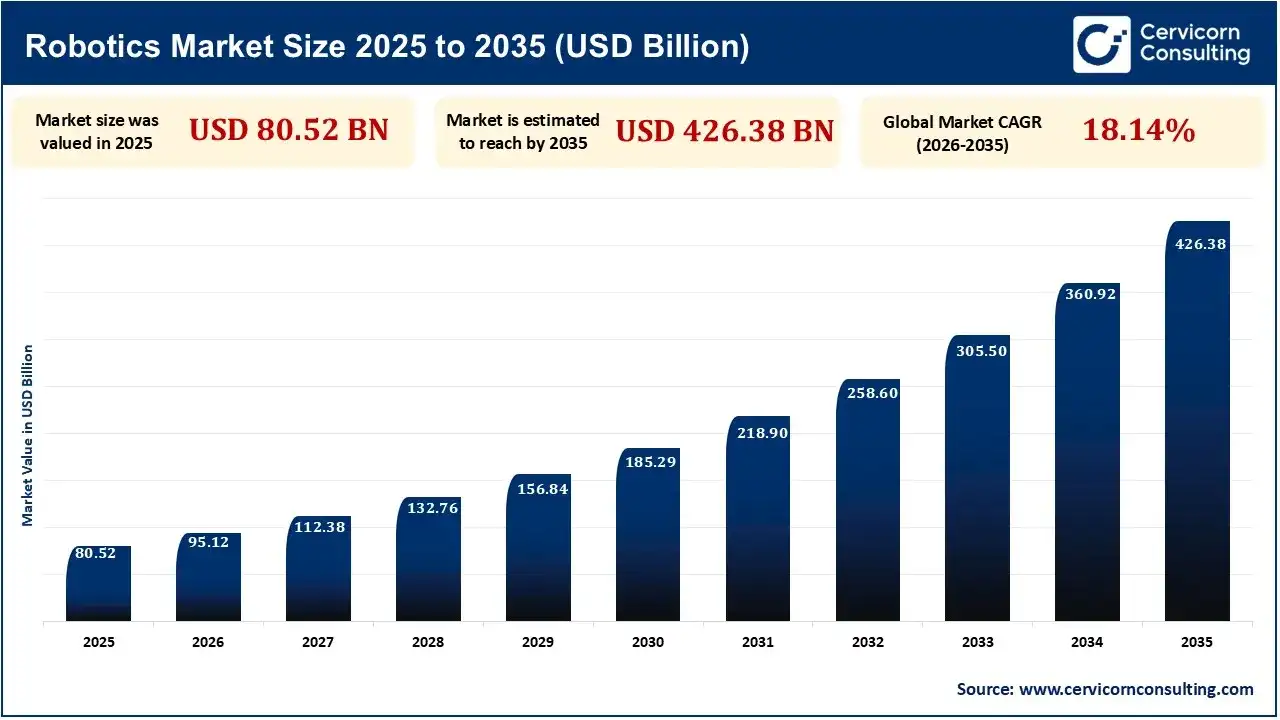
How is Robotics Transforming Industrial and Service Operations?
The robotics market is helping industries to streamline their manufacturing processes and services by automating repetitive, unsafe and highly precise jobs in a way that helps them to boost productivity, efficiency, and workplace safety. This includes robots that are commonly used in the manufacturing industries for work such as material handling, welding, assembly, and inspection, for improving production speed, precision and quality, reducing workplace injuries and facilitating 24/7 working.
Industrial robots offer a significant increase in the production volume, and it is being used in wide-ranging fields such as welding, machining, handling, painting, inspecting, packing, and other areas for minimizing human errors.
The service robot market offers solutions for diverse sectors including healthcare, transportation and logistics, hotels and hospitality, retail, agriculture and defense industries for enhancing customer experience and operational efficiency. With the introduction of AI-based natural language processing, and enhanced autonomous navigation, service robots are performing highly sensitive tasks, thus ushering in an era of intelligent automation.
Key Trends Shaping the Robotics Industry Globally
- Growth in Collaborative Robots (Cobots): Companies are opting for cobots that can work safely alongside humans, providing flexible automation for small and medium-sized businesses (SMBs) and industries where tasks are often changed. Growth in
- Autonomous Mobile Robots (AMRs): AMRs are becoming increasingly popular in warehouses, manufacturing plants, and distribution centers for automating material transport, inventory management, and logistics.
- Increasing integration of Robotics with Industry 4.0: Smart factories are leveraging robotics alongside technologies such as IoT, digital twins, cloud computing, and advanced analytics for connected, data-driven, and highly efficient manufacturing processes.
- Rise of Robotics-as-a-Service (RaaS): The subscription-based model is democratizing robotics access and lowering barriers to entry, making robotics more affordable for companies.
- Advancement in Robot Vision and Sensor Technologies: Innovation in cameras, LiDAR, tactile sensors, and perception systems is making robots more accurate, adaptable, and navigable in complex environments.
- Growing adoption of Robotics in Healthcare: From surgery to rehabilitation to patient care, medical and assistive robots are becoming more prevalent due to rising healthcare needs and innovation.
- Growing trend in AI Foundation Models for Robotics: Startups are creating foundation models that will enable robots to learn multiple tasks and adapt to different scenarios.
Rising Demand for Robotics-as-a-Service (RaaS) Models: Largest Opportunity
A new model for accessing robot technology robotics-as-a-service (RaaS) is now enabling companies to adopt robot technology without a heavy upfront investment. Instead, robotic solutions can be procured through flexible subscription based plans – a concept that offers clear advantages to SMEs, for example. As a result, warehouse automation, delivery drones and robotic systems that can be scaled as needed will drive RaaS implementation around the globe.
This way, firms such as Locus Robotics and Rapyuta Robotics are already using the RaaS model to help the logistics and e-commerce sector utilize autonomous robots to run its warehouses.
These enterprises no longer have to purchase and operate robotic systems themselves. Other robotics manufacturers such as Robotnik Automation are also offering robotics through subscriptions that allow for flexibility across all areas of industry and research. The overall trends clearly show an increasing interest for cost-effective, adaptable, and easily implementable automation.
Robotics Market Regional Outlook
Why did Asia Pacific hold the majority share of the global robotics market?
Asia Pacific held the majority share in the global robotics market in 2025. Asia Pacific’s industrial sector is experiencing massive growth, is the hub for global manufacturing production, and is also increasingly investing in factory automation solutions to enhance efficiency and throughput. Some of the countries like China, Japan, South Korea and Singapore are globally renowned for robotics installation rates as these are major robotics manufacturers and are equipped with sophisticated industrial infrastructure.
There has been growth in robotics utilization in manufacturing facilities such as in automotive assembly, electronics manufacturing, semiconductors production, warehousing, and healthcare.
Additionally, increasing government initiatives in support of digital transformations, the smart manufacturing initiative and AI driven industrial automation, in conjunction with the demand for electric vehicles and smart consumer electronics are fostering the robot installation throughout the Asia Pacific region. The existence of an ample supply of experienced engineers coupled with efficient industrial supply chains ensures its stronghold in the regional markets.
Why is North America expecting the fastest growth in the upcoming year?
In North America, the fastest growth of the market is expected in the upcoming year due to the accelerating commercialization of next generation robotic solutions and due to the increasing focus on investing in the fields of physical AI, humanoid robotics and intelligence automation solutions.
Being an epicenter of innovation, technological companies and startups in this region are developing advanced and sophisticated AI enabled robotic systems that are gaining wide application from the manufacturing to the logistics and from retail and healthcare industries to the defense sectors.
Also, because of the labour shortage, growing operational costs and for the maintenance of resilient supply chains organizations are considering using collaborative and autonomous mobile robots. Investments and funding for robotics research, semiconductor production and warehouse robots coupled with the strategic partnerships and collaborations between technology companies and industrial manufacturers are estimated to be a significant growth driver for the growth of North American market for robotics in the near future.
Robotics Product Portfolio Analysis
Leading companies in the robotics market are expanding their product portfolios to address the growing demand for automation across manufacturing, healthcare, logistics, agriculture, and commercial applications. Their offerings range from industrial robotic arms to AI-powered autonomous mobile robots and cloud-based robotics software platforms.
- ABB Ltd. – Offers articulated robots, collaborative robots (GoFa™ and SWIFTI™), robot controllers, machine vision systems, digital manufacturing software, and RobotStudio® simulation platform.
- FANUC Corporation – Provides industrial robots, collaborative robots (CRX Series), SCARA robots, palletizing robots, CNC systems, factory automation solutions, and intelligent robot software.
- KUKA AG – Develops industrial robots, collaborative robots (LBR iisy and LBR iiwa), autonomous mobile robots (AMRs), manufacturing automation software, and digital production solutions.
- Yaskawa Electric Corporation – Manufactures Motoman industrial robots, collaborative robots (HC Series), welding robots, handling robots, painting robots, and motion control software.
- Universal Robots A/S – Specializes in collaborative robots (UR Series), plug-and-play automation software, AI-enabled programming tools, and ecosystem applications for SMEs.
- Omron Corporation – Offers autonomous mobile robots (LD and HD Series), industrial robots, machine vision systems, AI-enabled controllers, and integrated automation software.
- Teradyne Inc. – Through Universal Robots and Mobile Industrial Robots (MiR), provides collaborative robots, autonomous mobile robots, fleet management software, and AI-driven automation solutions.
- Mobile Industrial Robots (MiR) – Focuses on autonomous mobile robots, fleet management platforms, navigation software, and logistics automation systems.
- Intuitive Surgical, Inc. – Provides robotic-assisted surgical systems (da Vinci®), surgical visualization software, AI-assisted imaging technologies, and healthcare robotics solutions.
- Boston Dynamics, Inc. – Develops quadruped robots (Spot®), warehouse automation robots (Stretch™), humanoid robots (Atlas), and AI-enabled mobility software.
Segments Covered
| Segment | Details |
| By Robot Type |
|
| By Component |
|
| By Application |
|
| By End-use Industry |
|
| By Region |
|
Empower your strategy with expert insights, purchase this premium research@ https://www.cervicornconsulting.com/buy-now/2991
Ask here for more details@ sales@cervicornconsulting.com