
Content
Semiconductor Market to Witness Strong Growth Through 2035


Semiconductor Market Size and CAGR 2026 to 2035
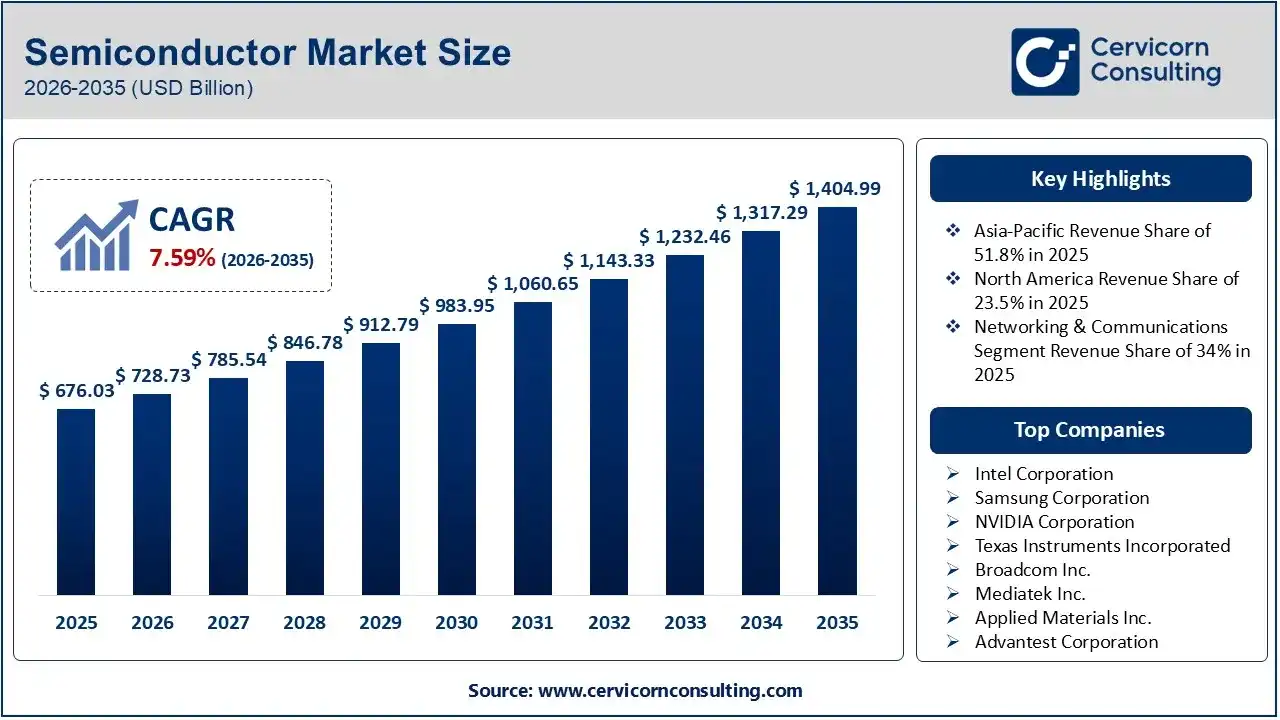
The global semiconductor market size was estimated at USD 676.03 billion in 2025 and is expected to exceed around USD 1,404.99 billion by 2035, growing at a compound annual growth rate (CAGR) of 7.59% from 2026 to 2035.
How Are AI Factories Accelerating Semiconductor Consumption?
AI factories have dramatically expanded demand for power-intensive high-performance silicon based on leading-edge technologies like advanced memory, networking processors and SiC-based devices. The concept involves the rapid expansion of AI computing facilities with thousands of connected GPUs, CPUs, AI accelerators, and high-bandwidth memories.
Unlike conventional data centers which act as data processing and storage hubs, AI factories continuously leverage the large models that they train to compute the intelligence to perform the tasks needed by an AI application.
It seems this is causing capital expenses to remain high across global foundries building advanced nodes, chip packaging facilities making advanced chip interfaces, etc., since AI will continue to draw in compute and memory.
This also raises demand for interconnect products to get information efficiently amongst those disparate compute, storage, memory and other components within the factory. Optical and other chip based solutions that facilitate these interactions will likely be in demand as well. Silicon Carbide (SiC) has also been identified by semiconductor industry sources as continuing to be in high demand to handle all of the power being dumped into each of those compute facilities.
Global Semiconductor Trade Analysis
- Global semiconductor sales reached approximately $627.6 billion in 2024, representing a 19.1% year-over-year increase from $526.8 billion in 2023, marking the industry's highest annual revenue on record, according to the Semiconductor Industry Association (SIA).
- China remained the world's largest importer of semiconductors, with integrated circuit imports valued at more than $385 billion in 2024, despite continued export restrictions on advanced AI chips.
- Taiwan continued to dominate semiconductor exports, accounting for over 60% of global foundry revenue and manufacturing approximately 90% of the world's advanced logic chips (7nm and below) through TSMC.
- South Korea remained the global leader in memory semiconductor exports, with memory chips accounting for nearly one-fifth of the country's total exports in 2024, driven by surging global demand for High-Bandwidth Memory (HBM), DRAM, and NAND flash products.
- Semiconductor exports from South Korea increased by over 40% year-over-year during several months of 2024–2025, supported by AI server deployments and growing investments in hyperscale data centers.
- The United States expanded semiconductor manufacturing investments through the CHIPS and Science Act, allocating approximately $52.7 billion in incentives to strengthen domestic production, research, and supply chain resilience.
Future Outlook
What Will Shape the Global Semiconductor Industry by 2035?
| Future Trends | Expected Impact on the Semiconductor Market by 2035 |
| Artificial Intelligence (AI) Becomes the Largest Demand Driver | AI will remain the primary catalyst for semiconductor demand, accelerating the adoption of GPUs, NPUs, AI ASICs, HBM, and custom AI accelerators across hyperscale data centers, enterprises, robotics, and edge devices. |
| Advanced Process Nodes (<2nm) Gain Commercial Scale | Leading foundries are expected to commercialize 2nm and eventually sub-2nm technologies, enabling higher transistor density, lower power consumption, and improved performance for AI, HPC, and mobile processors. |
| High-Bandwidth Memory (HBM) Experiences Explosive Growth | Increasing AI workloads will significantly boost demand for HBM4, HBM5, and next-generation memory technologies, making advanced memory one of the fastest-growing semiconductor segments. |
| Advanced Packaging Becomes a Competitive Differentiator | Technologies such as 2.5D packaging, 3D stacking, chiplets, CoWoS, Foveros, and hybrid bonding will become mainstream as manufacturers seek performance improvements beyond traditional transistor scaling. |
| Chiplet-Based Architectures Become Industry Standard | Semiconductor companies will increasingly adopt chiplet designs to reduce manufacturing costs, improve scalability, shorten development cycles, and enhance product customization across AI, automotive, and data center applications. |
| Automotive Semiconductor Demand Accelerates | Electric vehicles (EVs), software-defined vehicles (SDVs), autonomous driving, and advanced driver-assistance systems (ADAS) will significantly increase semiconductor content per vehicle, driving demand for logic, power, sensing, and AI chips. |
| Edge AI Drives New Semiconductor Opportunities | AI processing will increasingly shift to edge devices, creating strong demand for low-power AI processors across smartphones, industrial IoT, healthcare devices, wearables, smart cities, and robotics. |
| Regional Manufacturing Diversification Continues | Governments in the U.S., Europe, Japan, India, South Korea, and Southeast Asia will continue investing in domestic semiconductor manufacturing to reduce geopolitical and supply chain risks. |
| Government Incentives Reshape Global Production | Long-term industrial policies such as the U.S. CHIPS Act, European Chips Act, China's semiconductor investment programs, Japan's semiconductor subsidies, and India's Semiconductor Mission will continue attracting fab investments. |
| Power Semiconductors Witness Rapid Expansion | Growing adoption of electric vehicles, renewable energy systems, energy storage, and industrial electrification will increase demand for silicon carbide (SiC) and gallium nitride (GaN) semiconductors. |
| Quantum Computing Spurs Specialized Semiconductor Development | Continued investment in quantum computing will create demand for specialized semiconductor materials, cryogenic electronics, and quantum processor technologies, particularly in research and high-performance computing applications. |
| Sustainability Becomes a Core Manufacturing Priority | Semiconductor manufacturers will increasingly adopt renewable energy, water recycling, carbon reduction technologies, and energy-efficient production processes to meet ESG goals and regulatory requirements. |
| Supply Chain Localization Gains Momentum | Companies will diversify suppliers, establish regional manufacturing hubs, and strengthen domestic production capabilities to improve resilience against geopolitical disruptions and component shortages. |
| AI-Driven Semiconductor Design Becomes Mainstream | Generative AI and electronic design automation (EDA) tools will significantly reduce chip development time, optimize layouts, improve verification efficiency, and accelerate innovation across semiconductor design workflows. |
| Specialized AI Chips Replace General-Purpose Computing | Industry-specific AI accelerators designed for healthcare, finance, robotics, autonomous systems, telecommunications, and industrial automation will become increasingly common, reducing dependence on general-purpose processors. |
| Physical AI Creates New Semiconductor Demand | The expansion of humanoid robots, industrial robotics, autonomous machines, drones, and intelligent manufacturing systems will drive substantial demand for AI processors, sensors, vision chips, and real-time edge computing semiconductors. |
Regional Outlook
Which Regions Will Lead the Next Decade of Semiconductor Manufacturing?
The coming decade in semiconductor manufacturing will be dominated by Asia-Pacific, while the U.S. & Europe are set to expand capabilities driven by government incentives and domestic manufacturing investment. The Asia-Pacific region currently has more than half of the world's total semiconductor manufacturing capacity, supported by foundries, memory makers, assembly and testing service providers and electronic supply chains, particularly Taiwan, South Korea, China, and Japan.
However, escalating geopolitical tensions, a global supply chain realignment effort and rising demand for AI-related chipsets are expected to see countries worldwide injecting hundreds of billions into new fabrication facilities, packaging centers and R&D labs over the next decade to create an increasingly localized landscape for semiconductor production.
Taiwan is projected to maintain its leading position in advanced logic chips by virtue of TSMC (Taiwan Semiconductor Manufacturing Company), whose market share in advanced processes (7nm and below) stands at roughly 90% of all global shipments; this strategic position plays an outsized role in the world of AI and advanced-computer hardware.
South Korea is already the dominant player in global memory market share and HBM, supported by its powerhouse manufacturers (Samsung and SK hynix), and plans to massively increase investment into AI infrastructure.
China will continue to be the largest consumer of semiconductor in terms of revenue while making an even bolder play to increase indigenous chip output, making significant government investment as a core element of its strategy for self-sufficiency through support for the industry which recently amounted to over $47 billion under phase IV of their National Integrated Circuit Industry Investment Fund.
Semiconductor Market Competitive Landscape
- TSMC (Taiwan Semiconductor Manufacturing Company): The world's largest pure-play semiconductor foundry, TSMC is the industry leader in advanced process nodes (3nm and upcoming 2nm) and manufactures chips for major customers including Apple, NVIDIA, AMD, Qualcomm, and Broadcom.
- Samsung Electronics: Samsung is one of the world's leading semiconductor manufacturers, holding a strong position in memory chips, AI semiconductors, advanced foundry services, and next-generation HBM technologies while continuously expanding global fabrication capacity.
- Intel Corporation: Intel remains a major force in the semiconductor industry through its integrated device manufacturing model, expanding foundry business, AI processors, and significant investments in advanced manufacturing facilities across the U.S. and Europe.
- NVIDIA Corporation: NVIDIA dominates the AI semiconductor market with its industry-leading GPUs, which power generative AI, hyperscale data centers, high-performance computing (HPC), autonomous vehicles, and physical AI applications.
- SK hynix Inc.: SK hynix is a global leader in DRAM, NAND flash, and High-Bandwidth Memory (HBM), playing a critical role in supplying memory solutions for AI servers, data centers, and next-generation computing platforms.
- Micron Technology, Inc.: Micron is a key supplier of memory and storage semiconductors, strengthening its position through innovations in HBM, DRAM, NAND flash, and AI-optimized memory products for enterprise and automotive applications.
- Qualcomm Incorporated: Qualcomm is a leading developer of mobile processors and AI-enabled edge computing solutions, driving innovation across smartphones, automotive platforms, IoT devices, and wireless communication technologies.
- Broadcom Inc.: Broadcom is a major supplier of networking, broadband, enterprise storage, and custom AI chips, benefiting from increasing investments in AI infrastructure and hyperscale data centers.
- Advanced Micro Devices (AMD), Inc.: AMD has significantly expanded its presence in AI and data center semiconductors through its EPYC processors, Instinct AI accelerators, and adaptive computing technologies, making it one of NVIDIA's strongest competitors in AI computing.
- Texas Instruments Incorporated: Texas Instruments is a global leader in analog and embedded semiconductor solutions, serving automotive, industrial automation, healthcare, aerospace, and consumer electronics markets through its diversified product portfolio.
Empower your strategy with expert insights, purchase this premium research@ https://www.cervicornconsulting.com/buy-now/2443
Ask here for more details@ sales@cervicornconsulting.com