
Content
AI in Packaging Market Size to Reach $7.97 Billion by 2035


AI in Packaging Market Size, Forecast 2026 to 2035
The global AI in packaging market size calculated at $3.19 billion in 2026 and is expected to reach $7.97 billion by 2035, growing at a CAGR of 10.7% during the forecast period of 2026-2035.
North America led with a 38% share of the market in 2025, driven by rising early adoption and ongoing innovations in technologies, and Asia-Pacific captured d a 27% share of the market in 2025 and is predicted to grow at a 13.6% CAGR, supported by expanding production capacity and factory automation approaches.
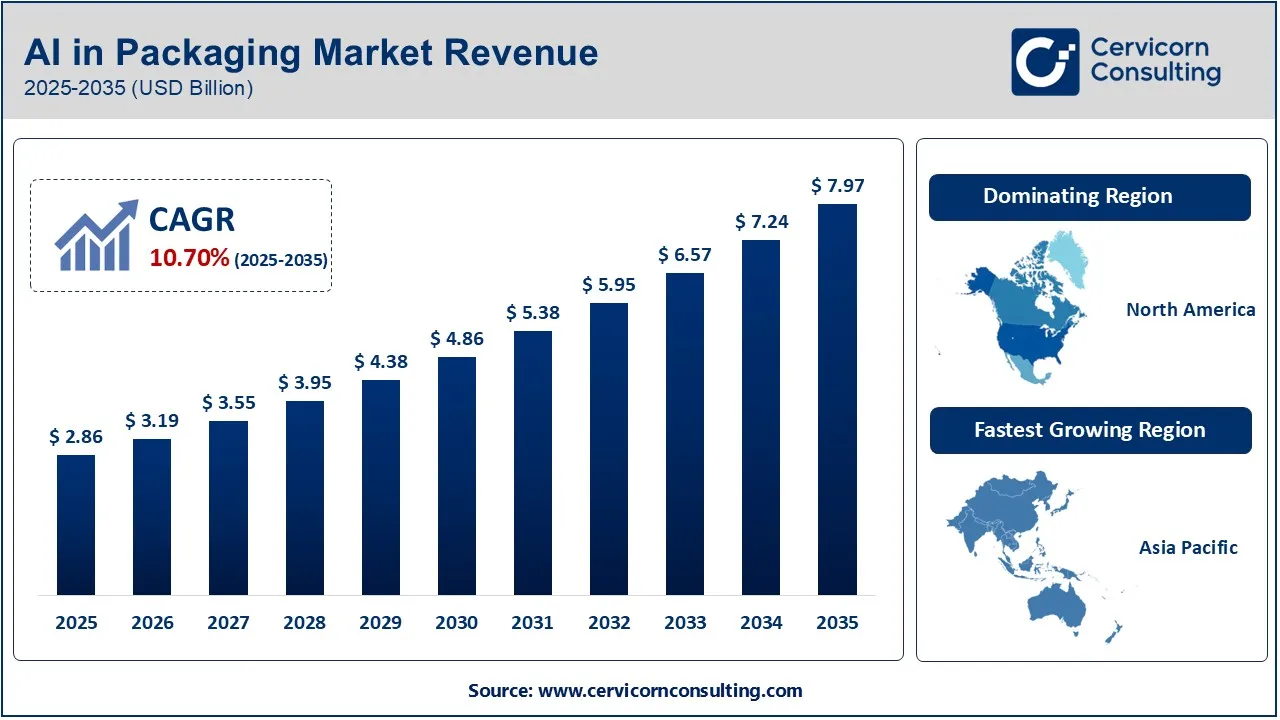
AI in Packaging Market Glimpse
It is defined as the adoption of artificial intelligence, like machine learning, computer vision, and generative AI, to create, produce, inspect, and distribute product packaging and further supports firms to curb waste, accelerate workflows, enhance accuracy, and comply with regulatory and sustainability targets. The overall market growth is primarily fueled by continuous workforce limitations, which force developers to use AI vision systems and elevate quality control by recording defects. With the enforcement of rigorous eco-friendly aims and a focus on consumer demand for recyclable packaging, the industry is pushing AI utilization to choose perfect materials, right-size packages, and optimize recyclability. The emergence of novelty across industrial developments allows tools that evolve visual concepts, 3D mockups, and localized changes rapidly. Recent rollouts are allowing expansive usage, as Nestlé and IBM Research employ generative AI to scan material data and find high-barrier, recyclable mono-material and paper-based options to replace conventional plastic.
Regional Outlook
North America Was Dominant in the Market in 2025
North America held a major share of 38% of the AI in packaging market, motivated by the presence of smart technologies, the evolution of heterogeneous integration, and emerging tighter regulations. Recently, in Canada, the nation executed synchronized co-design and recyclability guidelines across provinces that cover a collaborative statement from Circular Materials, Éco Entreprises Québec, Multi-Material Stewardship Manitoba, SK Recycles, and Recycle BC. On the other hand, many U.S. retailers and logistics leaders strengthened AI-powered sizing and warehouse systems to fit packages more closely to products and eliminate excess material and shipping waste.
Asia-Pacific is projected to grow rapidly
Asia-Pacific accounted for a 27% share of the market in 2025 and is projected to grow rapidly at a 13.6% CAGR in the upcoming years, due to broadening e-commerce approaches, the existence of a powerful semiconductor packaging base, and surging modern production adoption. At interpack China 2026, pan-AI X-ray inspection, like many systems presented, detects foreign bodies down to 0.1 mm, coupled with computer vision for real-time defect and print checks. On the other hand, recent TOKYO PACK 2026 highlighted the rising demand for AI-enabled robotics, inspection, and material improvement to foster recyclable and lower-waste packaging. However, India’s latest events, including Anuga FoodTec India 2026 and CII TG-PackCON, showcased diverse AI-assisted inspection tools for determining flaws, contamination, and seal or weight anomalies at high speeds.
AI in Packaging Market Segmental Outlook
| Market Segment | Dominant Segment | Key Growth Factor |
| By Component | Software | Led by accelerating design prototyping, a growing number of inspection software, and widespread efficiency in streamlining logistics. |
| By AI Technology | Machine Vision and Computer Vision | Supported by their foundational role in determining quality and defects, coupled with significance in label and print verification. |
| By Application | Quality Inspection and Defect Detection | Due to increasing demand for brand security, lowering recalls, and broader assists in higher accuracy and consistency. |
| By Deployment Mode | On-Premises and Edge-Based | Driven by their robust millisecond inspection, reduced bandwidth stress, and a rise in solutions for recipe and design protection. |
| By End Use Industry | Food & Beverages | Motivated by stricter geographical rules, maximizing production capacity, and the prominent role of AI in predicting shelf-life and degradation. |
Developing Trends
- Shifting Towards Material Identification: Day by day, advanced AI models are increasingly screening polymer blends, bio-based coatings, and molecular structures to estimate barrier performance, recyclability, and spoilage before physical prototyping.
- Highlighting Generative Measures: Most of the groups are moving to leverage generative tools and 3D visualization to draft dielines, mockups, and artwork variations faster, along with linking layouts to print specs and variable data.
- Employing Heterogeneous Unification: Due to some concerns in scale-up of single-chip, AI hardware is highly dependent on advanced packaging, including High-Bandwidth Memory (HBM) stacking, chiplets, hybrid bonding, and panel-level packaging, to bolster bandwidth and energy efficiency.
Future Outlook
Specifically, across the food and beverage industry, the AI in packaging market will explore AI-driven robotic arms that manage delicate, irregular, or often changing food products and packaging formats with exceptional adaptability. Alongside this, highly linked models allow monitoring of equipment health and implementation of AI agents to address ingredient or packaging variances. In the pharma domain, AI algorithms have an outstanding role in detecting clear label mistakes, fill-level risks, and seal or leak issues using AI-powered cameras. In particular, a substantial presence of large language models assists in drafting regulatory summaries, translations, and plain-language patient text.
Empower your strategy with expert insights, purchase this premium research@ https://www.cervicornconsulting.com/buy-now/3094
Ask here for more details@ sales@cervicornconsulting.com