
Content
Artificial Intelligence Market Size to Surge USD 7,440.18 Billion by 2035, Reflecting a CAGR of 35.14%


Artificial Intelligence Market Size and Growth Factors 2026 To 2035
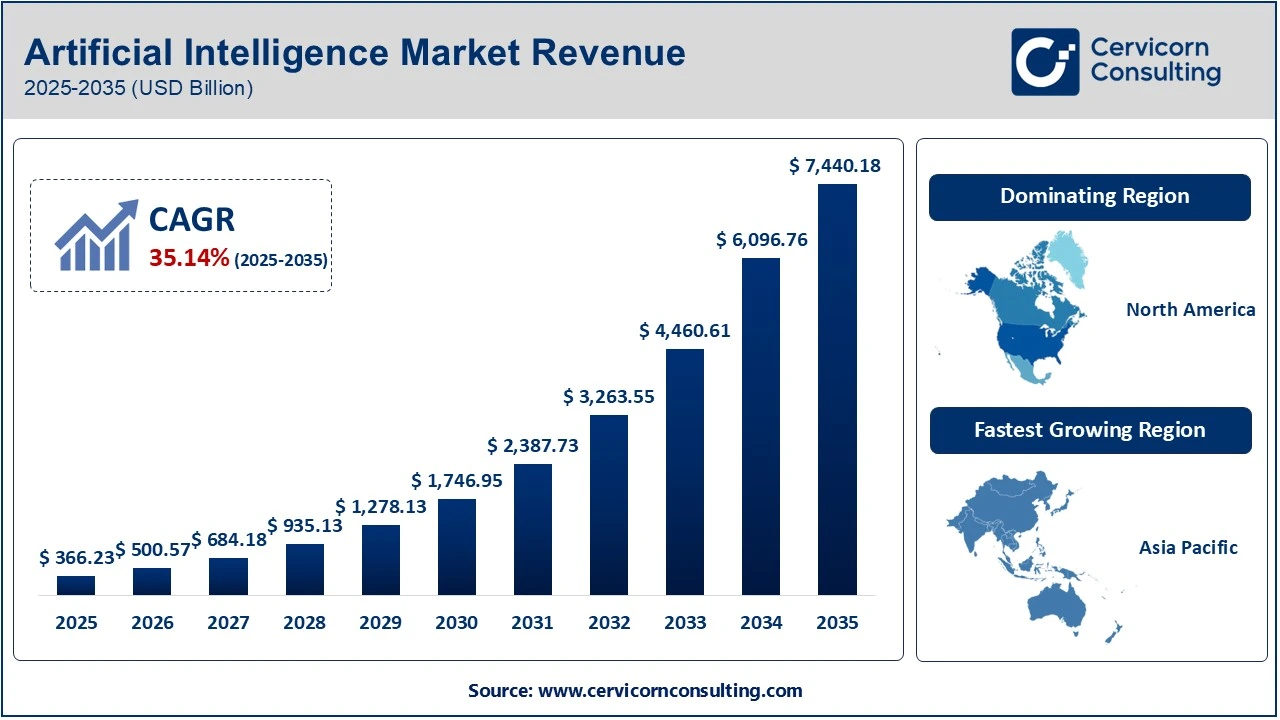
The global artificial intelligence market size was recorded at USD 366.23 billion in 2025 and is projected to surge approximately USD 7,440.18 billion by 2035, expanding at a CAGR of 35.14% during the forecast period from 2026 to 2035. The market growth is primarily driven by the rapid adoption of generative AI, increasing enterprise digital transformation initiatives, expanding investments in AI infrastructure, and the growing integration of AI across healthcare, manufacturing, financial services, retail, and government sectors.
The artificial intelligence (AI) market represents the global system of AI-based technology, hardware, software, and service systems that replicate human-like cognitive functions to analyze data in a pattern-forming way, perceive environmental context, reason with knowledge, make decisions, process language, and solve problems. It incorporates machine learning (ML), deep learning, natural language processing (NLP), computer vision, speech recognition, generative AI, robotics, and other AI technologies that have found application on cloud, on-premise, and hybrid environments.
Advances in computer power, vast increases in big data sets and their access via cloud-based computing platforms, and a wide array of machine and deep learning algorithms will continue to enhance demand. The AI market has therefore emerged as an essential technological engine behind corporate investment, digitisation of operations, and overall sustainable economic development.
Artificial Intelligence Market Statistics
- By technology, the machine learning segment grabbed the major chunk of revenue share i.e. 41.20% in 2025, which is expected to dominate the market share due to widespread use of AI across several industries in prediction analytics, recommendation engine, fraud detection, intelligent automation, etc. This is because of the extensive availability of large datasets and an increased advancement in deep learning techniques.
- By solution, the software segment has garnered significant revenue share of 46.70% in 2025 on account of the rising demand for AI in enterprise software, generative AI, analytics platform and cloud based AI service.
- By function, the operations segment registered a commanding share in revenue in 2025. Businesses are integrating AI in operational workflow, supply chain, manufacturing, and logistic process for increased productivity and reduced operational costs.
- By end-use, the advertising and media segment acquired a share of 21.40% revenue in 2025 due to its increased usage in the media and advertising industry for delivering relevant advertisements, for effective campaign management and audience segmentation.
- The industry report estimates that more than 78% of businesses across the world used AI in their at least one business function in 2025, highlighting its growing adoption in every domain.
- According to our analyst study, global spending on AI-centric systems is predicted to be beyond USD 749 billion by 2028 as global enterprises continue to invest more into the enterprise AI market including hardware, software and services.
- United states led by over 40 prominent AI foundation models launched in 2024 which means other countries were much behind when it comes to creating commercial AI.
Recent Breakthroughs: Every Stakeholder Should Know
- Microsoft Unveils a US$2.5 Billion Enterprise AI Business: In July 2026, Microsoft created Microsoft Frontier Company, with $2.5 billion in funding, to simplify AI adoption in enterprise contexts. The new business empowers organizations to deploy their custom AI models based on their specific needs and preferences, rather than being tethered to one monolithic foundation model, aligning with an ongoing trend toward a multi-model future for enterprise AI.
- AI Now Attracts Nearly Half of Global Venture Capital Investment: Artificial intelligence has secured the title of world’s largest category of technological investment, with global AI investment hitting roughly $202.3B in 2025, representing close to half of all venture capital funding for last year, compared to just 34% in 2024. This tells a compelling story: the AI opportunity is no longer a niche interest but is now mainstream.
- Agentic AI Is Emerging as the Next Growth Engine: AI is rapidly evolving from content generation to autonomous decision-making. Amazon recently committed US$1 billion to accelerate enterprise adoption of agentic AI, deploying specialized engineering teams to help organizations build autonomous AI systems capable of completing complex business workflows with minimal human intervention.
- Scientific Research Is Being Accelerated by Specialized AI Models: AI is becoming an essential tool for scientific innovation. Anthropic recently introduced Claude Science, a dedicated AI research platform designed to assist researchers with complex data analysis, computational modeling, and scientific discovery across life sciences and healthcare applications.
Artificial Intelligence Market Regional Landscape
Why has North America emerged as the largest market for artificial intelligence?
North America emerged as the largest market for artificial intelligence in 2025 with a revenue share of 33.40%. The leading position of this region is due to robust digital infrastructure, considerable investments in AI R&D, and the significant concentration of leading tech companies like Microsoft, Google, NVIDIA, OpenAI and Amazon Web Services.
Ongoing advancements in AI infrastructure, such as massive data centers, powerful chips and cloud technologies, has provided a competitive edge to the region. Also, the adoption of generative AI, AI in enterprises, smart systems and in the healthcare sector along with increased funding from the government and investors fueled the growth of the market in this region.
Why is Asia-Pacific estimated to experience a highest growth rate?
Asia-Pacific held a 30.70% share in the global revenue and it is also estimated to experience a highest growth rate throughout the forecasted period. Factors driving this growth include vast digital transformation initiatives, a rise in AI adoption in sectors like manufacturing, healthcare, finance, retail, smart city developments, and increased support from governments on AI innovation.
China, India, Japan, South Korea, among other countries in the region are investing significantly in AI R&D, semiconductor manufacturing and national AI strategy. Increased number of start-ups, widespread adoption of enterprise AI solutions, higher internet penetration and availability of AI talent will contribute to the region being the main growth engine for the AI market globally in the forecasted years.
Top Companies and Their Recent Activities
| Company | Recent Activity (2025–2026) |
| Microsoft | Expanded Microsoft 365 Copilot and Azure AI services globally while investing billions in AI infrastructure and next-generation data centers. The company also accelerated enterprise AI adoption through strategic collaboration with OpenAI. |
| OpenAI | Launched enterprise-grade AI models and expanded ChatGPT Enterprise capabilities, focusing on reasoning models, AI agents, and large-scale enterprise deployments across multiple industries. |
| Continued expansion of the Gemini AI ecosystem and integrated generative AI across Google Workspace, Cloud AI, and Search, while strengthening enterprise AI offerings through Vertex AI. | |
| Amazon Web Services | Expanded Amazon Bedrock foundation model services and invested heavily in AI infrastructure, custom Trainium chips, and strategic partnerships with leading AI model developers. |
| NVIDIA | Introduced next-generation AI GPUs and AI networking technologies while expanding partnerships with hyperscale cloud providers to support enterprise AI infrastructure globally. |
| IBM | Strengthened its watsonx AI platform through acquisitions and consulting services, focusing on responsible AI, governance, and enterprise automation across regulated industries. |
| Salesforce | Rapidly expanded Agentforce, surpassing US$1.2 billion in annual recurring revenue, while integrating autonomous AI agents across CRM, sales, marketing, and customer service workflows. |
| Oracle | Enhanced Oracle Cloud Infrastructure (OCI) with advanced AI capabilities and partnered with leading AI companies to provide high-performance computing infrastructure for enterprise AI workloads. |
| SAP | Expanded the Joule generative AI assistant across ERP, finance, procurement, and supply chain applications, enabling AI-driven business process automation for enterprise customers. |
| Meta Platforms | Advanced the Llama family of open-source large language models and invested substantially in AI infrastructure to strengthen enterprise and developer adoption worldwide. |
Market Segmentation
By Solution
- Hardware
- Accelerators
- Processors
- Memory
- Network
- Software
- Services
- Managed
- Professional
By Technology
- Deep Learning
- Machine Learning
- Natural Language Processing (NLP)
- Generative AI
- Machine Vision
By Function
- Cybersecurity
- Sales and Marketing
- Operations
- Legal and Compliance
- Human Resource Management
- Finance and Accounting
- Supply Chain Management
By End-use
- Healthcare
- Robot Assisted Surgery
- Virtual Nursing Assistants
- Hospital Workflow Management
- Dosage Error Reduction
- Clinical Trial Participant Identifier
- Preliminary Diagnosis
- Automated Image Diagnosis
- BFSI
- Risk Assessment
- Financial Analysis/Research
- Investment/Portfolio Management
- Others
- Law
- Retail
- Advertising & Media
- Automotive & Transportation
- Agriculture
- Manufacturing
- Others
By Region
- North America
- Europe
- APAC
- LAMEA
Empower your strategy with expert insights, purchase this premium research@ https://www.cervicornconsulting.com/buy-now/2571
Ask here for more details@ sales@cervicornconsulting.com