AI in Packaging Market Overview and Insights 2026 to 2035
The global AI in packaging market size was valued at USD 2.86 billion in 2025 and is expected to exceed around USD 7.97 billion by 2035, growing at a CAGR of 10.7% during the forecast period from 2026 to 2035. This growth is driven by persistent labour shortages and e-commerce and logistics challenges. This is fostering the adoption of sustainable and circular economy approaches that reduce carbon footprints and material waste.
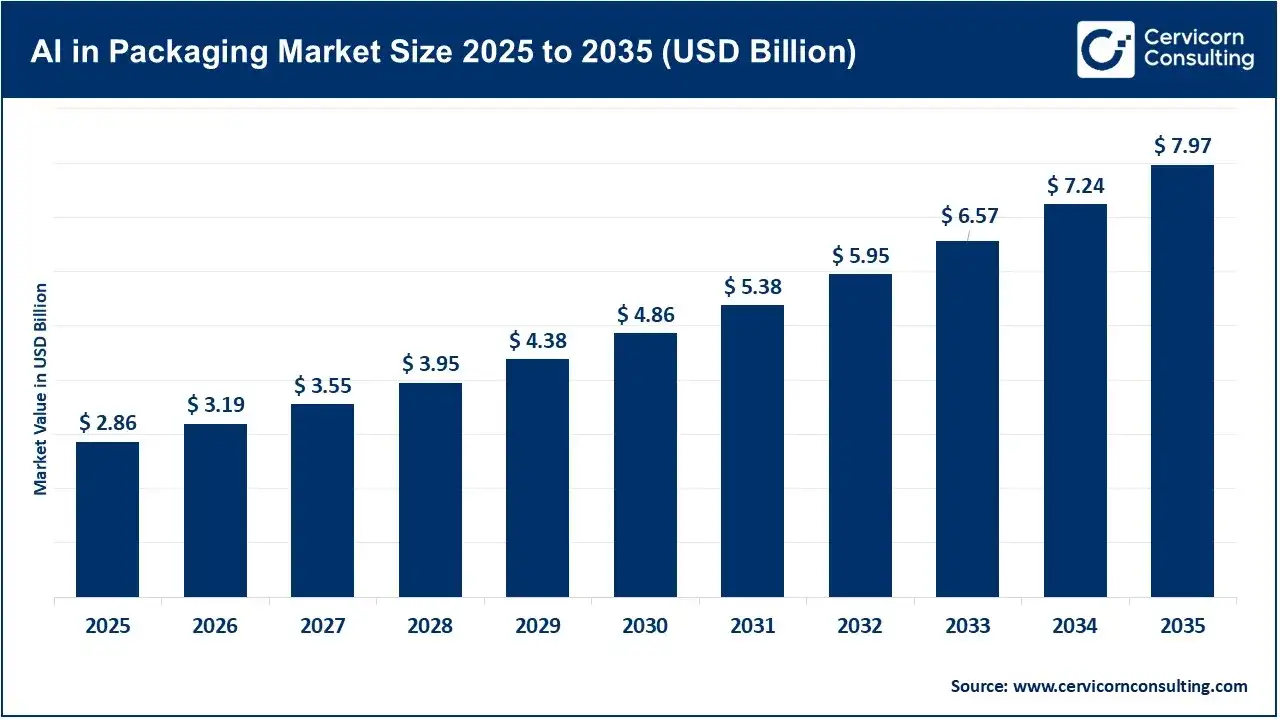
AI in Packaging Market Size & Forecast
- Base Year Market Size (2025): $2.86 billion
- Current Year Market Size (2026): $3.19 billion
- Estimated Year Market Size (2035): $7.97 billion
- Forecast Period CAGR (2026-2035): 10.7%
Report Highlights
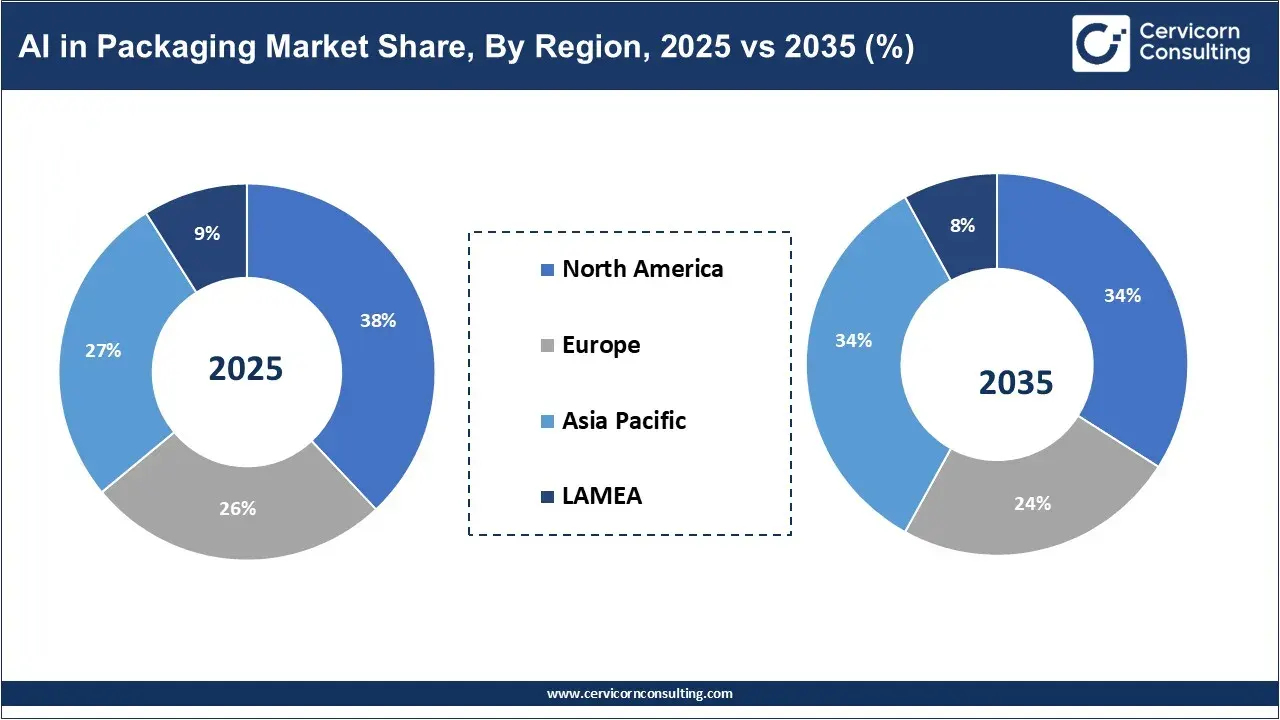
- By region, North America registered dominance with a 38% share of the market in 2025, due to surging early adoption and the presence of advanced technologies.
- By component, software led with a 43% share of the market in 2025, supported by accelerating AI analytics, inspection software and improvements in platforms.
- By AI technology, machine vision and computer vision held the largest share at 30% in 2025, because visual inspection remains foundational and is strengthening other AI applications.
- By application, quality inspection and defect detection dominated with a 28% share of the market in 2025, fueled by advanced inspection use cases and a widespread application base.
- By deployment mode, on-premises and edge-based were dominant with a 42% share of the market in 2025, driven by rising demand for real-time inspection and data-control essentials.
- By end use industry, food & beverages dominated with a 30% share in 2025, supported by massive production volumes and rigorous quality requirements.
What are Ongoing Advances in the AI in Packaging Market?
Firstly, the market is broadly using artificial intelligence and machine learning to enhance, develop, produce, and verify product packages. Major growth factors of the industry are growing complexity in e-commerce, expanding efforts in eco-friendly solutions, and substantial labour limitations. Many global companies are seeking breakthroughs by leveraging generative AI for faster prototyping and continuous modernization in hyper-tailored labels. Furthermore, worldwide research activities are promoting AI-enabled new sensors, such as agri-food packaging integrated with real-time sensors and indicators to trace food quality, monitor expiration bottlenecks, and significantly reduce food wastage. Most of the prominent industries have enforced dynamic QR codes, NFC connectivity, and augmented reality (AR) experiences to boost consumer involvement and product authorization.
Recent Initiatives by Leaders
- November 2026: Kao Industrial (Thailand) and SCG Packaging joined with an emphasis on sustainable packaging, especially mono-material flexible packaging.
- October 2026: Fujifilm collaborated with ePac Flexible Packaging to provide digital flexible packaging for core printing.
- September 2026: Muhammad Rabnawaz received the $540,000 grant to roll out affordable, high-performing, biodegradable and microplastic-free materials via experiments and artificial intelligence-driven machine learning techniques.
- July 2026: Greyparrot raised $27 million in Series B funding to support scaling its AI waste intelligence system and focus on eliminating nearly one million tonnes of waste by 2030.
- July 2026: Intel Corporation and Lens Technology partnered to explore new technologies for advanced semiconductor packaging.
Market Dynamics
Growth Drivers
- Demand for Cost-Efficient & Expansive Solutions: Globally rising demand for affordable and broader accessibility drives AI tools that lower technology expenses, with elevated accessibility and enables CPG players to use AI algorithms.
- Spotlight on Factory Automation: Gradual advances are fueling continuous investments in industrial automation, cloud-based measures, and AI-assisted vision systems to push predictive inspection, anomaly detection, and smart-factory integration.
- Pivoting Towards Custom Design: Accelerating demand for personalization, increasing SKU counts, and shorter production cycles propel the adoption of generative AI that rapidly adapts packaging metrics as per consumer preferences, material stability, and circular eco-friendly aims.
Market Restraints
- Arising Security Concerns: Nowadays, significant use of AI solutions in packaging is highly dependent on vast datasets, such as key parameters and consumer details, which can lead to cyberattacks, data breaches, and unauthorized access.
- Enforcement of Strict Regulations: Stringent data privacy laws, including GDPR and CCPA, with developing product-level sustainability guidelines, are evolving into a huge compliance burden.
- Notable Data Isolation & Silos: Much vital data required for AI-powered tracking, compliance, and automation is frequently dispersed across fragmented business domains and legacy systems, which elevates integration issues.
Key Opportunities
- Sync Among AI & Digital Tasks: The AI in packaging market will have a key opportunity to explore unique AI agents that monitor production schedules, address risks, activate workflows, and align approvals throughout packaging and supply chain sectors.
- Impose High-Pace QC: By using machine learning vision systems, one can find faults, including incorrect registration, colour variation, and unrecognized barcodes at higher speeds, coupled with predictive models that study press conditions to resolve machine wear before downtime appears.
- Designing Via Gen AI: In the future, thousands of pioneers will leverage generative tools that immediately spin up multiple artworks and structural prototypes based on weight, dimensions, and brand rules, compressing the gap between initial concept and digital printing.
Market Challenges
- Need for Higher Investment: Deployment of AI-enabled hardware, machine vision, and smart software infrastructure demands massive capital investment and can be a major pressure for smaller packaging and manufacturing companies.
- Lack of Staff and Talent: The current era is facing a critical shortage of well-qualified operators and technicians handling and troubleshooting AI-enabled tools.
- Concerns-Related Data & Accountability: A rise in AI data delusion, intellectual property risks in generative design, and ambiguous accountability for automated or AI-created packaging errors that restricts full-scale adoption.
AI in Packaging Market Regional Analysis
What Made North America Dominant in the Market in 2025?
In 2025, North America led with a 38% share of the market, propelled by the existence of modern technologies and growth in early adoption, with the enforcement of stringent regulations. Specifically, Canadian companies and research activities strengthened an emphasis on 3D integrated circuits and heterogeneous integration, using AI and high-performance computing demands to boost signal integrity, power control, and thermal-stress management in micro-packaging. Recently, Atlantic Packaging’s MUST program employed IoT sensors and AI in entities to minimize customer stretch-film consumption by roughly 30%.
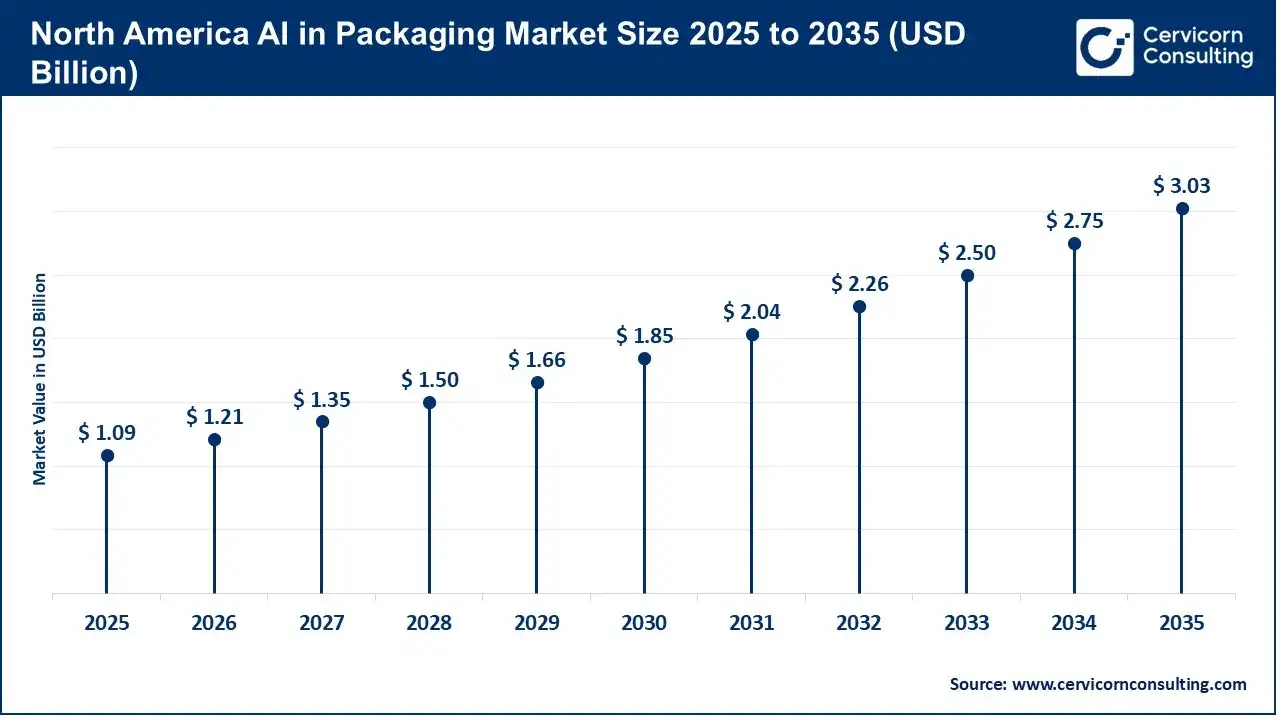
United States Market
- Along with Extended Producer Responsibility (EPR) laws and guidelines for traceability, the U.S. industry experienced growing use of fan-out panel-level packaging (FOPLP), glass-core substrates, multi-chiplet integration, and co-packaged optics (CPO) to boost AI processors. Alongside this, U.S. factories empowered joint robots with AI control systems that significantly adjust to changing product dimensions and material stiffness.
Why is Asia Pacific Expected to Grow Rapidly in the AI in Packaging Market?
Asia Pacific held a 27% share of the market in 2025 and is anticipated to expand at a 13.6% CAGR during the forecast period, driven by strengthening production capacity, packaging output, and factory automation. According to our experts, recent efforts made by Chinese tech firms have massively boosted multi-die chiplet architectures, which achieve near-7nm performance tiers through domestic packaging and reduce production delivery cycles by up to 60%. Among the diverse nations, Taiwan is known as an AI hardware packaging hub, whereas several Taiwanese firms began wafer bumping and chip-scale packaging facilities in Penang in early 2026.
India Market
- Day by day, the Indian pharma industry is witnessing major growth across the market, where AI-driven blister and bulk inspection systems automate high-speed defect detection for tablets, capsules, and end-to-end supply chain transparency. According to the recent Envision 2026 in Bengaluru and the Total Packing Expo 2026 in Chennai, there is an underlined transition towards AI-connected, dynamic production lines that improve line speeds, robotic handling, and predictive maintenance.
AI in Packaging Market Segmentation Analysis
Component Analysis
Software: The software segment captured a dominant share of 43% in 2025, motivated by a surge in inspection software, reducing expenditures, speeding up design. Different tools expedited corrugated and folding carton packaging, with projections up to 85% by analyzing CAD files and PDF quotes automatically. Certain software allowed right-sizing and waste reduction, with polymer and bio-material screening.
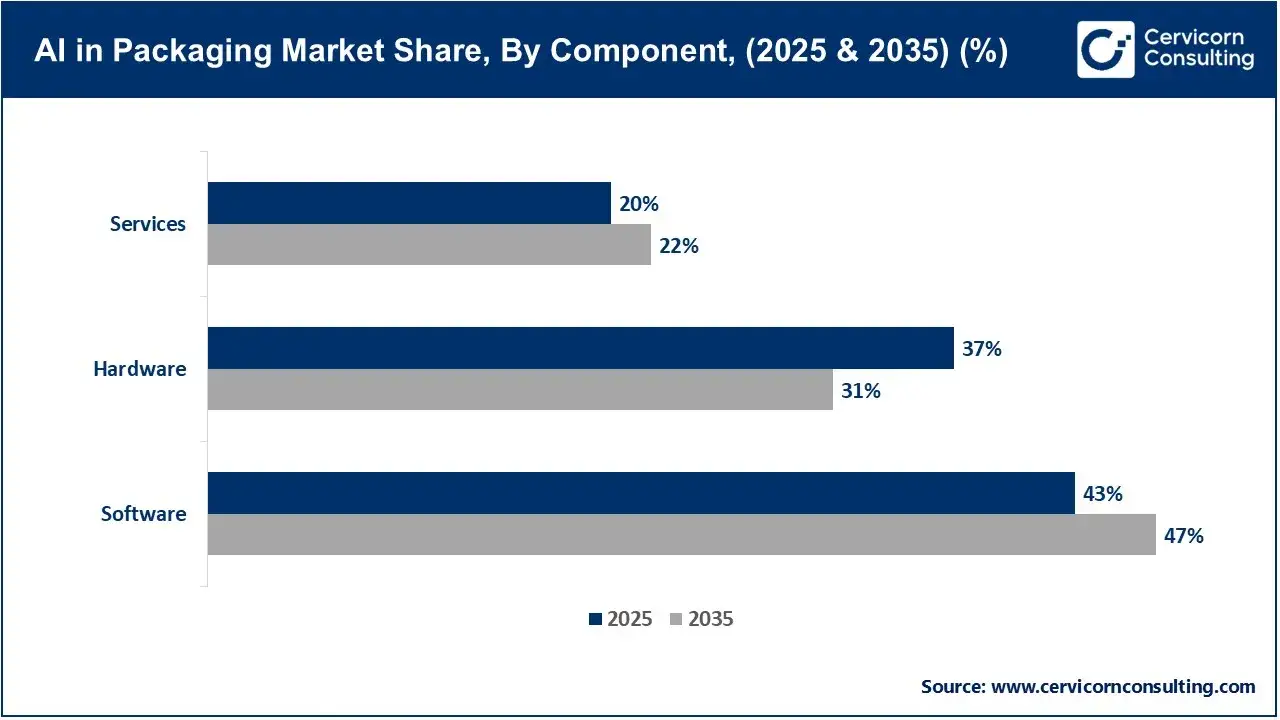
However, the hardware segment held the second-largest share of 37% of the market, due to the notable importance of cameras, sensors, and AI computing across the market. Major adoption of high-speed automated pick-and-place robots, adaptive actuators, and smart sensors accelerates packaging lines & also showcases real-time error detection and quality assurance.
AI Technology Analysis
Machine Vision and Computer Vision: The machine vision and computer vision segment accounted for a 30% share of the AI in packaging market in 2025, because of underlying vision mission and sped-up defect detection. Along with vision-enabled integrations, the recently launched Sony IMX900 sensor and event-based cameras allow tracking and counting ultra-fast moving entities.
AI in Packaging Market Share, By AI Technology, 2025 (%)
| AI Technology |
Revenue Share, 2025 (%) |
Revenue Share, 2035 (%) |
| Machine Vision and Computer Vision |
30% |
27% |
| Machine Learning and Predictive Analytics |
24% |
22% |
| Intelligent Automation and Optimization |
17% |
17% |
| Generative AI |
12% |
20% |
| Natural Language Processing |
8% |
8% |
| Others |
9% |
6% |
Generative AI: The generative AI segment is expected to witness rapid expansion, supported by broader use in artwork and increasing demand for highly tailored approaches. Innovative models support examining supplier PDFs, computing material expenses and MSI metrics, coupled with auto-generation of accurate label quotes in seconds.
Application Analysis
Quality Inspection and Defect Detection: The quality inspection and defect detection segment led with a 28% share of the market, driven by growing demand for brand protection, minimizing recalls, and broadening demand for finding micro-defects. In the last year, players explored convolutional neural networks (CNNs) and transformer-based vision models, with AI inspection platforms achieving nearly 98% to 99%+ accuracy for clear identification of cosmetic and structural concerns.
AI in Packaging Market Share, By Application, 2025 (%)
| Application |
Revenue Share, 2025 (%) |
| Quality Inspection and Defect Detection |
28% |
| Packaging Design and Customization |
18% |
| Predictive Maintenance |
17% |
| Process and Production Optimization |
15% |
| Supply Chain and Inventory Optimization |
10% |
| Sustainability and Recycling Optimization |
7% |
| Others |
5% |
The packaging design and customization segment held the second-largest share of 18% in 2025, fueled by advancing generative design and faster personalization, which demand AI platforms. Ongoing innovations force firms to utilize AI-enhanced simulations and VR software that assess packaging usability, drop durability, and real-world shelf performance digitally, eliminating physical prototypes.
Deployment Mode Analysis
On-Premises and Edge-Based: The on-premises and edge-based segment dominated with a 42% share in 2025, driven by growing demand for real-time defect detection and seeking measures for recipe and design protection. Explored subscription-based modular edge AI solutions have reduced initial costs and enabled small- and medium-sized packaging businesses to unify local robotic control systems and predictive maintenance tools.
Cloud-Based: The cloud-based segment held a 36% share of the AI in packaging market in 2025 and is projected to expand fastest, supported by its scalability, streamlined packaging evolution, and emerging cross-functional collaboration. Most eminent leaders, including Sourceful, Canva, and Adobe, implemented cloud-based generative AI models to allow quick structural and visual iteration from a simple web browser prompt.
End Use Industry Analysis
Food & Beverages: The food & beverages segment captured a major share of 30% of the market in 2025, propelled by expanding production volumes, enforcing rigorous regulatory guidelines, and aiming at substantial waste reduction. Specific rollouts in 2025 emphasized machine learning combined with printed sensors, oxygen scavengers, and freshness indicators to monitor real-time food spoilage, predict shelf life, and optimize entire supply chain traceability.
The healthcare & pharmaceuticals segment accounted for a 17% share of the market in 2025, due to surging demand for traceability, serialization and stricter quality control that elevates AI investment. Along with the pivotal role of AI in EHRs and other healthcare tasks, pharma leaders combined AI with IoT sensors and connectivity that allow real-time tracking of temperature-sensitive biologics, active stability monitoring, and predictive maintenance for packaging machinery.
Recent Developments
- October 2026: IIT Guwahati and Tata Electronics signed an MoU to develop a Centre of Excellence (CoE) and unveil promised training programs in semiconductor Assembly, Testing, Marking, and Packaging (ATMP).
- October 2026: ProAmpac launched ProActive Intelligence Shelf Protect (SP) Series to push preservation of product quality and reduce expensive spoilage.
- October 2026: Südpack Medica introduced a recyclable mono-polyethylene (mono-PE) sterile barrier system as outer packaging for process bags in cell culture and bioprocessing applications.
- October 2026: ACG rolled out RecycloPod PP Ultra, a polypropylene-based blister packaging system that combines high moisture and oxygen barrier protection with design for recyclability.
- September 2026: Markem-Imaje introduced CoLOS® 2D Activate and CoLOS® 2D Engage, powered by Markem-Imaje’s expert consulting services, offering developers a complete solution to generate for GS1 Sunrise 2027 and uncover the full value of connected packaging.
- July 2026: Cadence launched the AuraStack AI Super Agent on Cadence Allegro AI Studio, the world’s first agentic AI platform for printed circuit board (PCB) and advanced packaging design.
Leading Companies
Segments Covered
By Component
- Software
- Hardware
- Services
By AI Technology
- Machine Vision and Computer Vision
- Machine Learning and Predictive Analytics
- Intelligent Automation and Optimization
- Generative AI
- Natural Language Processing
- Others
By Application
- Quality Inspection and Defect Detection
- Packaging Design and Customization
- Predictive Maintenance
- Process and Production Optimization
- Supply Chain and Inventory Optimization
- Sustainability and Recycling Optimization
- Others
By Deployment Mode
- Cloud-Based
- On-premises and Edge-based
- Hybrid
By End Use Industry
- Food & Beverages
- Healthcare & Pharmaceuticals
- Personal Care & Cosmetics
- Household & Home Care Products
- Industrial & Manufacturing
- Consumer Electronics & Electrical Products
- Agriculture & Horticulture
- Other
By Region
- North America
- Europe
- Asia-Pacific
- Latin America
- Middle East and Africa
