Power-to-X Market Size and Growth 2026 to 2035
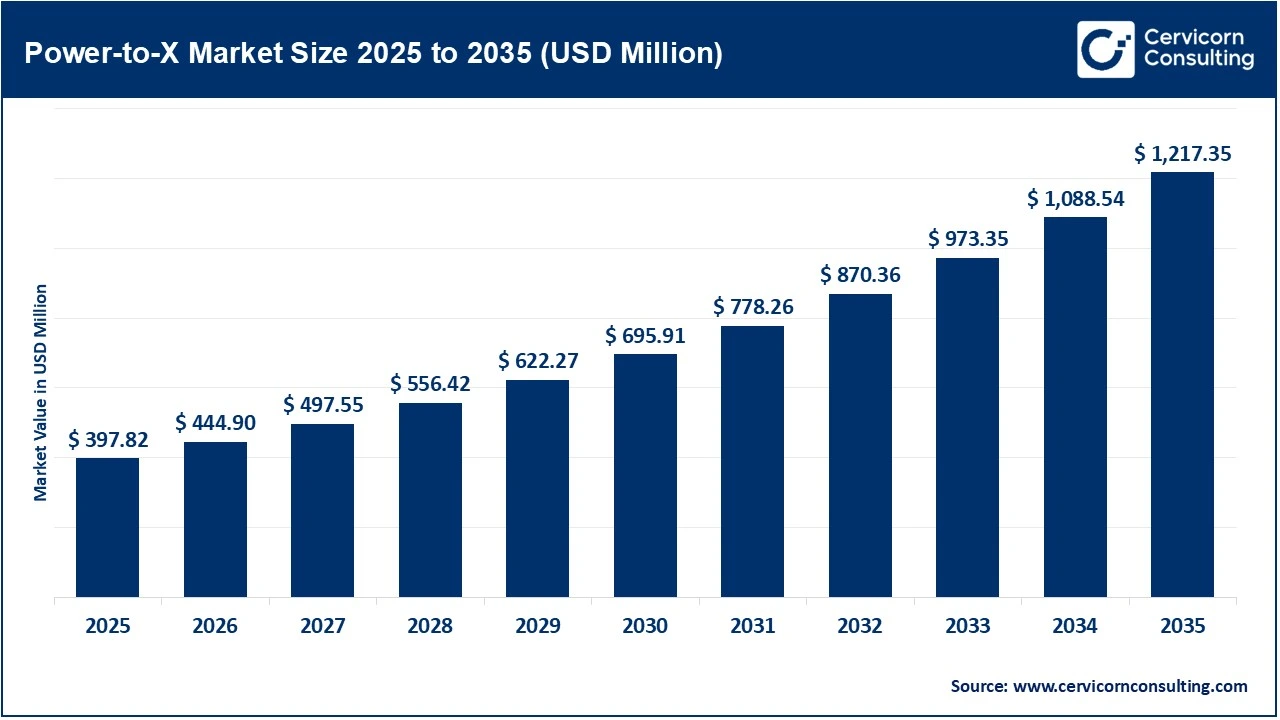
The global power-to-X market size was valued at USD 397.82 million in 2025 and is anticipated to reach around USD 1,217.35 million by 2035, growing at a compound annual growth rate (CAGR) of 11.83% over the forecast period from 2026 to 2035. The ongoing shift in regulations associated to climate change and reducing greenhouse gas emissions creates a stable potential for the power-to-X market to grow.
Report Highlights
- By Region, Europe accounted for revenue share of 40% in 2025 considering the overall efforts in reducing greenhouse gas emission across major countries.
- By Region, Asia Pacific is seen to witness a considerable growth during the forecast period due to continuous industrialization and rising investments in renewable energy infrastructure.
- By Technology, the power-to-H2 segment held revenue share of 48% in 2025 owing to its use in clean fuel production.
- By Technology, the power-to-methanol segment is expected to grow at the fastest rate during the forecast period as it is being widely used in renewable electricity production.
- By End Use, the transportation segment generated highest revenue share of 38% in 2025 with the overall rise in electric vehicles across the globe.
- By End Use, the agriculture segment is expected to grow at the fastest rate during the forecast period with the factors such as increasing sustainable irrigation practices and green ammonia production.
What is Power-to-X Technology & How is the Market Growing?
Power-to-X (PtX) refers collectively to a family of technologies that harness renewable forms of electricity (primarily solar and wind) to produce various types of energy or chemical-based products known as “power”. The basic concept behind PtX revolves around the use of electricity as an enabling mechanism to initiate one or more chemical reactions; electrically-disrupted molecular bonding is normally created through electrolysis, which involves splitting water into hydrogen and oxygen.
The rapid emergence of the PtX marketplace is being driven primarily by the rapid increase in global renewable energy production; solar and wind generation are growing so significantly that they frequently generate excess amounts of electricity during peak production hours. As such, to maximize the overall efficiency and future effectiveness of both renewable energy systems and its resultant outputs there exists increased demand for energy storage solutions.
As an example; governments from countries worldwide have launched national hydrogen missions to promote the development, and utilization, of "green" or "carbon-negative" hydrogen in various transportation modes, large scale industrial applications, and as a power-generation resource for electric-power generation.
Potential Industries to Witness the Integration of Power-to-X Technologies by 2030
- Aviation Industry- Airlines are experiencing growing motivation to use renewable, low carbon fuel sources. For instance, Power-to-X processes will help set renewable fuel sources that support airline operations.
- Maritime Shipping- Shipping companies are transitioning to alternative fuels (i.e., methanol and ammonia) to comply with worldwide regulations for reducing greenhouse gas emissions. Utilizing Power-to-X allows shipping companies to generate these alternative fuels in mass quantities therefore providing a suitable alternative to heavy fuel oils.
- Chemical and Petrochemical Sectors- This sector has been relying on fossil fuel (natural gas and crude oil) sources for the majority of its feedstocks. To address this reliance, utilizing green hydrogen, methanol, and synthetic hydrocarbons, produced by Power-to-X technologies as renewable feedstocks for the production of plastics, solvents, etc. is providing alternative feedstocks to support this industry.
Recent Government Initiatives
| Country |
Initiative/Policy |
Key Highlights |
Impact on Power-to-X Adoption |
| India |
National Green Hydrogen Mission |
The government launched a large-scale mission with an outlay of ₹19,000+ crore to promote green hydrogen production, infrastructure, and exports. |
Strengthens hydrogen production capacity, enabling downstream Power-to-X applications such as ammonia, methanol, and synthetic fuels. |
| European Union |
Hydrogen Strategy under ‘Fit for 55’ |
The EU introduced binding targets for renewable hydrogen use in industry and transport, along with regulatory frameworks. |
Accelerates large-scale PtX deployment across industries, particularly in steel, chemicals, and transportation. |
| Denmark |
Power-to-X Strategy & Subsidy |
Denmark set a target of 4–6 GW of electrolysis capacity by 2030 and launched funding programs. |
Encourages commercialization of PtX fuels such as green hydrogen and e-fuels. |
| Australia |
Future Made in Australia Policy |
A $22.7 billion investment plan supporting renewable hydrogen, low-carbon fuels, and clean manufacturing. |
Drives domestic production of hydrogen and PtX fuels, supports export potential, and builds integrated clean energy supply chains. |
| Morocco |
National Power-to-X Development Framework |
Programs are focused on building regulatory frameworks, investment models, and industrial ecosystems. |
Positions Morocco as a future export hub for green hydrogen and PtX fuels, particularly for European markets due to geographic proximity. |
Power-to-X Market Dynamics
Driver
Rising Demand for Deep Decarbonization
Decarbonizing sectors where electrification cannot occur easily is one of the largest influences on the development of the power-to-X market. In aviation, maritime shipping, steelmaking and chemicals, industries require high-density fuels and high-temperature operations, which cannot be cost-effectively accomplished using electricity alone. Power-to-X technologies solve this problem by converting renewable electricity into hydrogen, methanol, ammonia, and synthetic fuels that can replace fossil fuel sources directly.
One example of this is that liquid fuels are used by the aviation sector for long-haul flights. Synthetic fuels produced from green hydrogen offer an attractive way to reduce emissions. In addition, the steel sector is now moving toward using hydrogen as a reduction agent instead of coal, significantly reducing carbon emissions. Companies and governments are committed to achieving net zero targets, resulting in a rapid increase in these technologies.
Restraint
High Production Costs and Infrastructure Limitations
The power-to-X market faces a multitude of obstacles, primarily due to an expensive production process that requires significant amounts of renewable energy, such as electrolysis to create green hydrogen. Current costs associated with producing green hydrogen, utilizing electrolyzers, carbon capture systems and fuel synthesis technologies are prohibitive at today’s large-scale production levels as compared to producing hydrogen from conventional fossil fuels. Market growth is further limited by inadequate infrastructure to transport and store hydrogen, ammonia and synthetic fuels. Specialized pipelines, storage facilities and distribution networks must be created to facilitate the transportation and storage of hydrogen, ammonia and synthetic fuels. Hydrogen, for example, can only be stored as a gas at extreme high pressures or can be liquefied at extremely low temperatures. Both of these methods create additional complexity and costs in terms of operation.
Opportunity
Expansion of Renewable Energy and Emergence of Integrated Energy Systems
The rapid rise of renewable energy sources, coupled with the need for energy to be stored and used more effectively, presents an excellent opportunity to grow the power-to-X market. The amount of electricity produced from renewable sources, particularly from wind and solar, is increasing at record-breaking levels. One outcome of this is that there is becoming a much greater amount of surplus electricity produced at times when current demand is at its peak. The way in which power-to-X technology provides a meaningful solution to this problem is by converting the surplus electrical energy into fuels that can be stored and transported.
Converting surplus renewable energy to fuels is very helpful for improving the efficiency of our energy systems and providing more reliable electricity generation through increased stability on our electric grid. Additionally, the rise of a worldwide trade in hydrogen presents many opportunities for countries that produce renewable energy to become exporters of hydrogen fuel and other green fuels.
Power-to-X Market Regional Analysis
Europe’s Massive Carbon Capturing Efforts to Sustain its Dominance in the Market
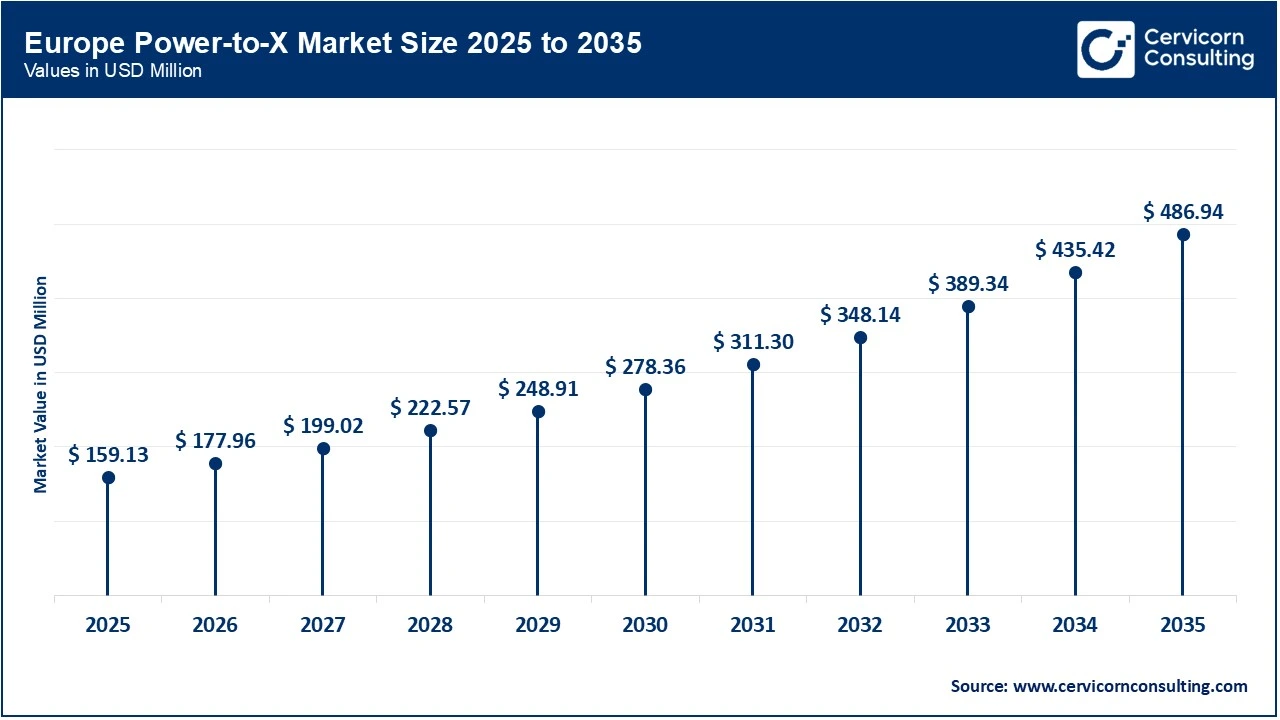
The Europe power-to-X market size was valued at USD 159.13 million in 2025 and is expected to grow around USD 486.94 million by 2035.
Top European Countries to Develop Rapidly in Power-to-X Market
Due to aggressive investments and a policy-driven expansion of carbon capture, utilization and storage (CCUS), Europe has become a global leader in power-to-X technologies. This is important because power-to-X systems depend heavily on CO2 captured from the atmosphere as feedstock for production of synthetic fuels, like methanol or efuels. By scaling-up carbon capture infrastructure with hydrogen production facilities, Europe is building a fully integrated low-carbon ecosystem and solidifying its position at the forefront of the global hydrogen economy.
- The European Union’s Innovation Fund is expected to mobilise approximately €40 billion from 2020-2030 for development of low carbon technologies including CCUS and power-to-X systems. In the last few funding cycles, billions of euros have gone towards multiple large-scale CCCUS related construction projects that involve carbon capture, CO2 transportation and storage infrastructure both within Europe and outside of Europe.
- Europe has a pipeline of projects solidifies its leadership position. Currently, there are more than 190 commercial-scale CCUS projects underway across the continent and targeting areas such as cement, steel and chemicals. It is expected that by 2030, these projects will capture tens of millions of tons of CO₂ per year, with projections far exceeding that in the years to follow.
A significant advantage of regulatory support. Europe has an extensive legislative framework in place to regulate carbon capture, transport and storage. They have developed mechanisms to create financial incentives for industries to use carbon capture technology through increases in the cost of emissions due to carbon pricing. This has encouraged businesses to look for cleaner alternatives and invest in them, while at the same time meeting strict environmental expectations. The revenue from these programs is frequently reinvested into innovation programs or as a funding source for continued development.
Power-to-X Market Share, By Region, 2025 (%)
| Region |
Revenue Share, 2025 (%) |
| North America |
28% |
| Europe |
40% |
| Asia-Pacific |
25% |
| LAMEA |
7% |
Asia Pacific to Boom Rapidly: Industrial Adoption of Power-to-X to Support the Market
The Asia-Pacific power-to-X market size was valued at USD 99.46 million in 2025 and is anticipated to reach around USD 304.34 million by 2035. The Asia Pacific is set to experience considerable growth in the power-to-X industry due to the widespread use of hydrogen and synthetic fuels by large industries in regions such as China, Japan, South Korea and India. The growth of these areas of the power-to-X market is driven by government policies promoting hydrogen development, and also stem from the region’s already strong industrial base where key industries such as refining, chemicals, steel, and fertilizers are already moving toward low carbon fuels.
One of the best indicators of the growth of the power-to-X market is the rapid investment in hydrogen and electrolyzers throughout the Asia Pacific. Asia Pacific has accounted for a large percentage of the global hydrogen industry, and also has over 40% of the world’s electrolyzer capacity reflecting the strong linkage between hydrogen production and industrial activity. Specifically, approximately 65% of the world’s electrolyzers are in use in China, which is a strong indication that China has the majority of the world’s infrastructure for producing hydrogen; and this is directly supporting the development of power-to-X supply chains such as, ammonia, methanol, and synthetic fuels.
Power-to-X Market Segmental Analysis
Technology Analysis
The power-to-H2 segment dominated the market in 2025, as hydrogen is at the centre of the Power-to-X (P2X) value chain and is an input used to create all of the downstream fuels such as ammonia, methanol, and synthetic hydrocarbons. Hydrogen does not represent one part of the overall value chain but rather is where start of the P2X value chain is located. Today, worldwide hydrogen demand is more than 90 million metric tonnes per year with the largest driver of this demand currently being refinery and ammonia manufacturing. There is a significant migration toward producing hydrogen using renewable-powered electrolysis as many industries are transitioning to decarbonise their operations.
As a result, large-scale electrolyzer installations are rapidly expanding, with installations larger than 100 MW becoming commonplace and several projects under construction with gigawatt-scale components. Hydrogen is also becoming an increasingly important fuel in steel manufacturing through the use of hydrogen in direct reduction processes as a means of replacing coal. As hydrogen can be used for a variety of applications, its position as the leading form of energy is becoming more and more secure.
Power-to-X Market Share, By Technology, 2025 (%)
| Technology |
Revenue Share, 2025 (%) |
| Power-to-H2 |
48% |
| Power-to-CO/Formic Acid/Syngas |
12% |
| Power-to-NH3 |
19% |
| Power-to-Methanol |
16% |
| Power-to-H2O2 |
5% |
On the other hand, the power-to-methanol segment is seen to grow at the fastest rate during the forecast period. The acceleration of methanol production from power through use of electricity will occur at a much faster pace than any other form of renewable fuel due to its flexibility and ability to leverage existing infrastructure. Methanol is a liquid at ambient temps, posing much less complex issues for storage, transport and handling. In addition, methanol can be used directly as a fuel; in combination with conventional fuels; or as a feedstock for chemicals manufacturing. The evolving shipping industry is proving to be a major contribution to this demand by significantly increasing the number of methanol-based marine engines, as well as the associated fuel supply infrastructure. Due to its ability to be made from both captured CO2 & renewable H2, methanol lending itself to carbon circularity.
End Use Analysis
In the year 2025, the transportation segment led the power-to-X market. This includes intensive-use sectors such as aviation, maritime shipping, and heavy-duty truck and bus transport. For these types of transportation, high energy density fuels that allow for long ranges of operation are required. Hydrogen, methanol, and ammonia produced through Power-to-X process are being adopted at an accelerating rate by these industries.
For example, hydrogen fuel cell technology is now being used to power buses and trucks, while the aviation industry is investing heavily into sustainable aviation fuels produced from Power-to-X processes. In maritime shipping, many ship operators are moving towards engines that run on methanol or ammonia in order to lower their greenhouse gas emissions.
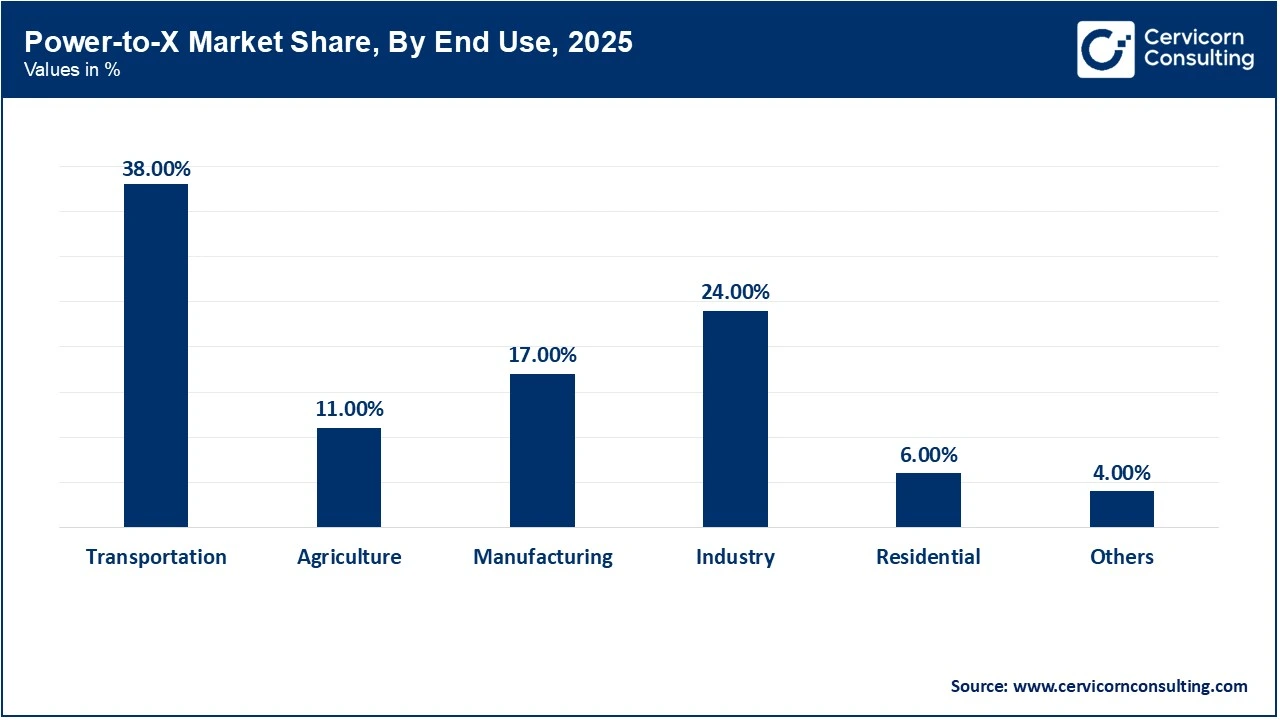
Agriculture is expected to be the fastest-growing end-use segment, driven by the transition toward sustainable fertilizer production. Ammonia is a critical input in fertilizers, and its production is one of the largest sources of industrial emissions. Producing one metric ton of conventional ammonia typically generates between 1.6 and 2 metric tons of carbon dioxide. The shift to green ammonia, produced using renewable hydrogen, significantly reduces these emissions and supports more sustainable agricultural practices.
Recent News
- A major milestone was achieved in May 2025 with the launch of the world’s first commercial-scale e-methanol plant in Denmark, developed by European Energy in partnership with Mitsui. The facility has an annual production capacity of around 42,000 metric tons of e-methanol using renewable energy and captured CO₂.
- In February 2025, StormFisher Hydrogen announced a $50 million partnership with Hy24’s Clean Hydrogen Infrastructure Fund to accelerate the development of Power-to-X fuel projects. The collaboration focuses on scaling production of e-methane, e-methanol, and green hydrogen, highlighting growing investment interest in synthetic fuels and hydrogen-based energy systems.
Power-to-X Market Top Companies
Market Segmentation
By Technology
- Power-to-H2
- Power-to-CO/Formic Acid/Syngas
- Power-to-NH3
- Power-to-Methanol
- Power-to-H2O2
By End Use
- Transportation
- Agriculture
- Manufacturing
- Industry
- Residential
- Others
By Region
- North America
- Asia Pacific
- Europe
- Latin America
- Middle East and Africa