Power SiC Market Size and Growth Factors 2026 to 2035
The global power SiC market size was valued at USD 3.45 billion in 2025 and is projected to grow from USD 4.04 billion in 2026 to nearly USD 16.82 billion by 2035, registering a CAGR of 17.2% over the forecast period 2026 to 2035.
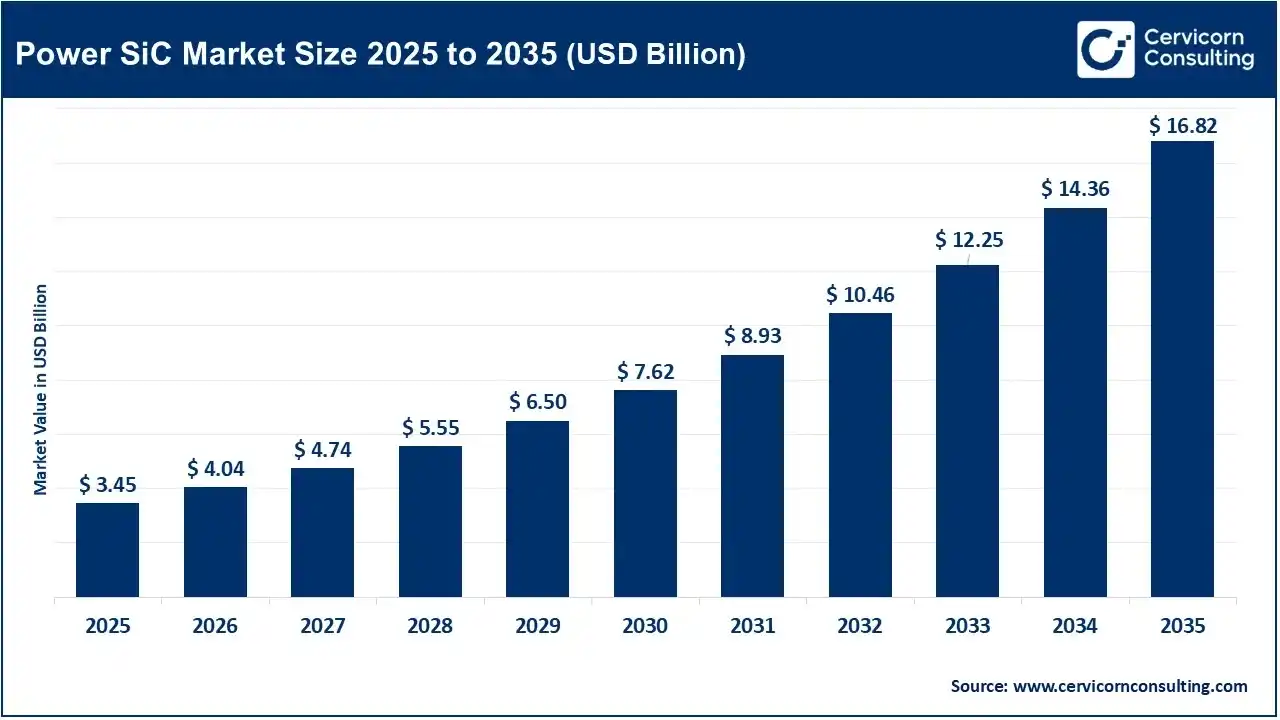
The growing need for energy-efficient power electronics is driving growth in the Power SiC market. The market is expanding because of the growing use of electric cars and fast-charging technologies. New opportunities are being created by the expanding use of solar power, energy storage, and renewable energy systems. Additionally, Power SiC devices outperform traditional silicon devices in terms of efficiency, switching speed, and thermal performance.
- In March 2026, RIR Power Electronics Limited announced the expansion of its product portfolio with new Silicon Carbide (SiC) MOSFETs, targeting high-efficiency applications such as EV charging, solar inverters, energy storage, and industrial equipment.
Report Highlights
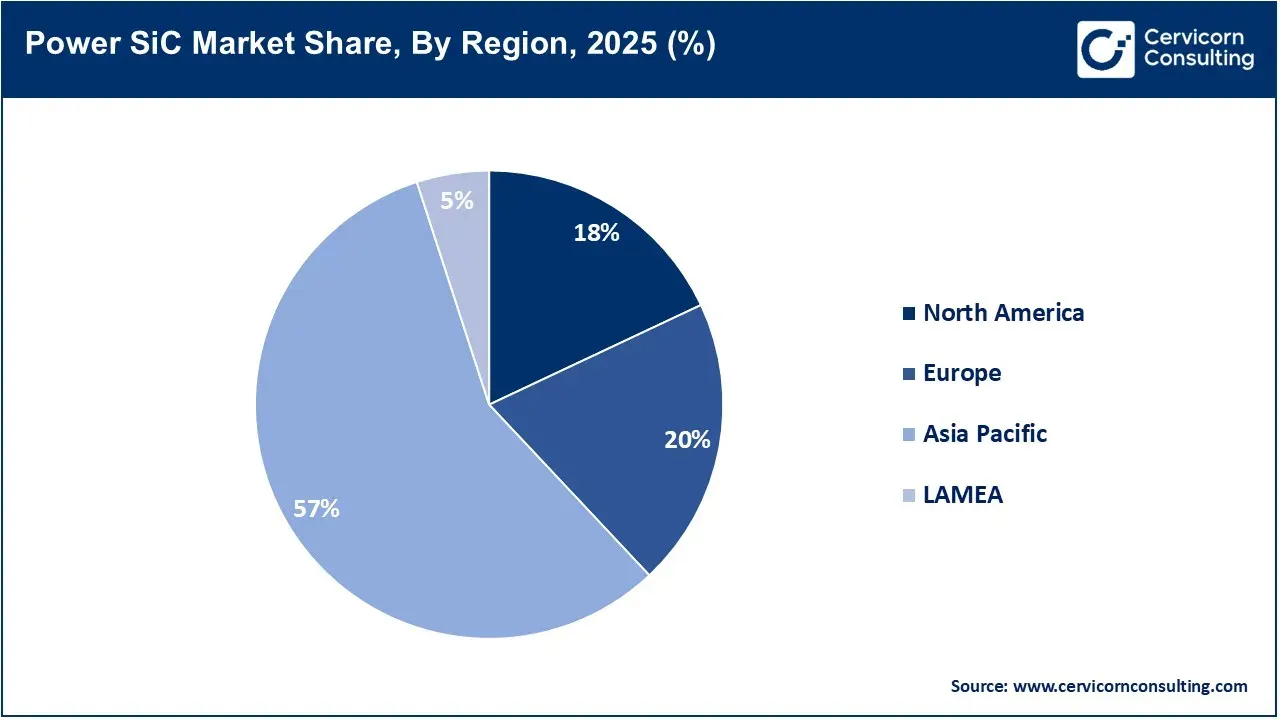
- By region, Asia Pacific dominated the Power SiC market in 2025 with revenue share of 57%, supported by strong automotive manufacturing, expanding EV adoption, and growing semiconductor production.
- By region, North America is expected to grow at the fastest rate, driven by rising EV adoption, charging infrastructure, renewable energy, and semiconductor investments.
- By device type, SiC MOSFETs has accounted for a revenue share of 42% in 2025, owing to their widespread use in EVs, renewable energy, and industrial power systems.
- By device type, SiC power modules are expected to grow at the fastest rate, driven by demand for high-power and energy-efficient power conversion.
- By wafer size, 6-inch (150 mm) wafers has generated revenue share of 62% in 2025, supported by established manufacturing capabilities and widespread commercial use.
- By wafer size, 8-inch (200 mm) wafers are expected to grow at the fastest rate, driven by efforts to improve production efficiency and reduce manufacturing costs.
- By voltage rating, 600–900 V devices dominated the market in 2025, owing to their broad use in EVs, charging systems, solar inverters, and industrial applications.
- By voltage rating, 1,200–1,700 V devices are expected to grow at the fastest rate, driven by rising demand for high-voltage power conversion applications.
- By power rating, 1–10 kW devices dominated the market in 2025, supported by their use in EV charging, solar inverters, and power supplies.
- By power rating, above 50 kW devices are expected to grow at the fastest rate, driven by demand for high-power EV charging, renewable energy, and grid applications.
- By application, electric vehicle powertrains has captured revenue share of 24% in 2025, supported by increasing SiC adoption in traction inverters and onboard chargers.
- By application, EV charging infrastructure is expected to grow at the fastest rate, driven by expanding charging networks and demand for fast charging.
- By end-use industry, automotive and transportation dominated the market in 2025 (revenue share 32%), owing to increasing electrification of vehicles and transportation systems.
- By end-use industry, energy and power are expected to grow at the fastest rate, driven by rising adoption across renewable energy, energy storage, and grid infrastructure.
Recent Trends
- Growing EV adoption: Increasing use of SiC power devices in electric vehicles and charging systems.
- Renewable energy integration: Rising demand for SiC in solar inverters and energy-storage systems.
- Higher power efficiency: Manufacturers are adopting SiC to reduce energy losses and improve thermal performance.
- Advanced SiC technologies: Development of higher-voltage and more efficient SiC MOSFETs is expanding applications.
- Increasing semiconductor investment: Companies are expanding SiC manufacturing capacity to meet growing demand.
- Data center adoption: SiC devices are gaining attention in power supplies and high-efficiency data center infrastructure.
- Industrial electrification: Growing electrification of industrial equipment is increasing demand for efficient SiC-based power solutions.
Market Dynamics
Driver: Why Is EV Adoption Driving the Power SiC Market?
The demand for Power SiC components in DC/DC converters, inverters, and onboard chargers is being driven by the growing use of electric vehicles. Improved thermal performance, reduced power losses, and increased efficiency are all made possible by SiC technology. Adoption is being aided by the growing need for quicker EV charging. Additionally, manufacturers are concentrating on increasing vehicle power efficiency and range.
- In February 2026, Infineon Technologies announced that its CoolSiC MOSFETs were adopted in Toyota’s new bZ4X model, where they are used in the onboard charger and DC/DC converter to improve efficiency and charging performance.
Restraint: Why Does the High Cost of SiC Devices Restrain Market Growth?
One major barrier to market expansion is still the comparatively high cost of producing SiC devices. High-quality SiC substrates, sophisticated machinery, and intricate manufacturing procedures can raise production costs. SiC solutions may be more costly than traditional silicon-based substitutes due to these considerations. Scaling output and increasing manufacturing yields are still crucial for cutting expenses. Adoption in some price-focused applications may still be constrained by cost sensitivity.
- In September 2025, Wolfspeed announced the commercial launch of its 200mm SiC materials portfolio, including 200mm bare wafers and epitaxy. The larger wafer format is intended to improve scalability and quality while supporting the production of high-performance power devices for automotive, renewable energy, and industrial applications.
Opportunity: How Can Renewable Energy Create Opportunities for the Power SiC Market?
Power SiC manufacturers are seeing new opportunities due to the growth of high-power infrastructure, energy storage, and renewable energy. SiC devices can increase solar, wind, and energy storage systems power conversion efficiency. SiC applications are growing outside of the automobile industry due to the growing need for compact and effective power electronics. High-voltage SiC technology adoption may be further aided by increased investment in next-generation renewable energy infrastructure.
- In November 2025, Wolfspeed announced a collaboration with Hopewind to develop next-generation wind-power solutions using SiC technology. Wolfspeed’s 2.3kV SiC module was integrated into Hopewind’s wind-power converter, highlighting the opportunity for SiC in high-efficiency renewable-energy applications.
Regional Analysis
Why did Asia Pacific is dominate the power SiC market?
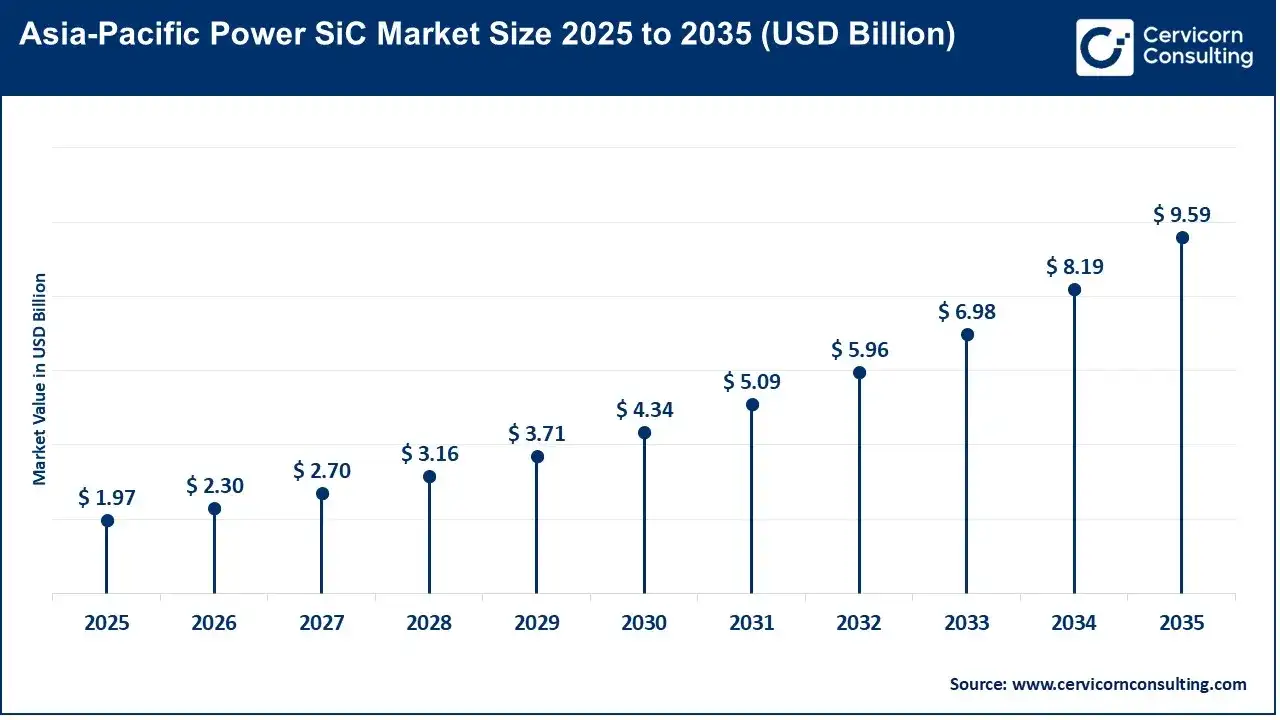
The Asia-Pacific power SiC market size was valued at USD 1.97 billion in 2025 and is projected to reach USD 9.59 billion by 2035. Asia Pacific is dominated the market because of its robust automotive manufacturing base, burgeoning ecosystem for electric vehicles, capacity for producing semiconductors, and increasing use of renewable energy. Regional demand is being supported by rising investments in improved power electronics, electric mobility, SiC manufacturing, and charging infrastructure. The market is being further strengthened by the presence of significant automakers and electronics manufacturers. The region's dominant position is anticipated to be sustained by ongoing industrial expansion and electrification.
Why is North America expected to be the fastest-growing region for the power SiC market?
The North America power SiC market size was valued at USD 0.62 billion in 2025 and is projected to reach USD 3.03 billion by 2035. North America is expected to be the fastest-growing regional market, propelled by the growth of renewable energy, the adoption of electric vehicles, the development of charging infrastructure, and investments in domestic chip production. More prospects for SiC technology are being created by the growing demand for high-efficiency power electronics in data centers, automotive, energy, and industrial applications. Regional adoption is being aided by rising investments in modern semiconductor manufacturing and power infrastructure. Market growth is expected to be accelerated by the ongoing expansion of high-power applications.
Segmental Analysis
Device Type Analysis
SiC MOSFETs dominated the device type segment because they are widely utilized in high-efficiency power conversion applications, industrial motor drives, renewable energy systems, and electric vehicle powertrains. They are appropriate for demanding power electronics applications due to their high switching efficiency, low power losses, and high-temperature operating capability. Their well-established use in industrial and automotive applications sustains their dominant position. SiC MOSFET adoption is being bolstered by increased electrification and the need for energy-efficient power systems.
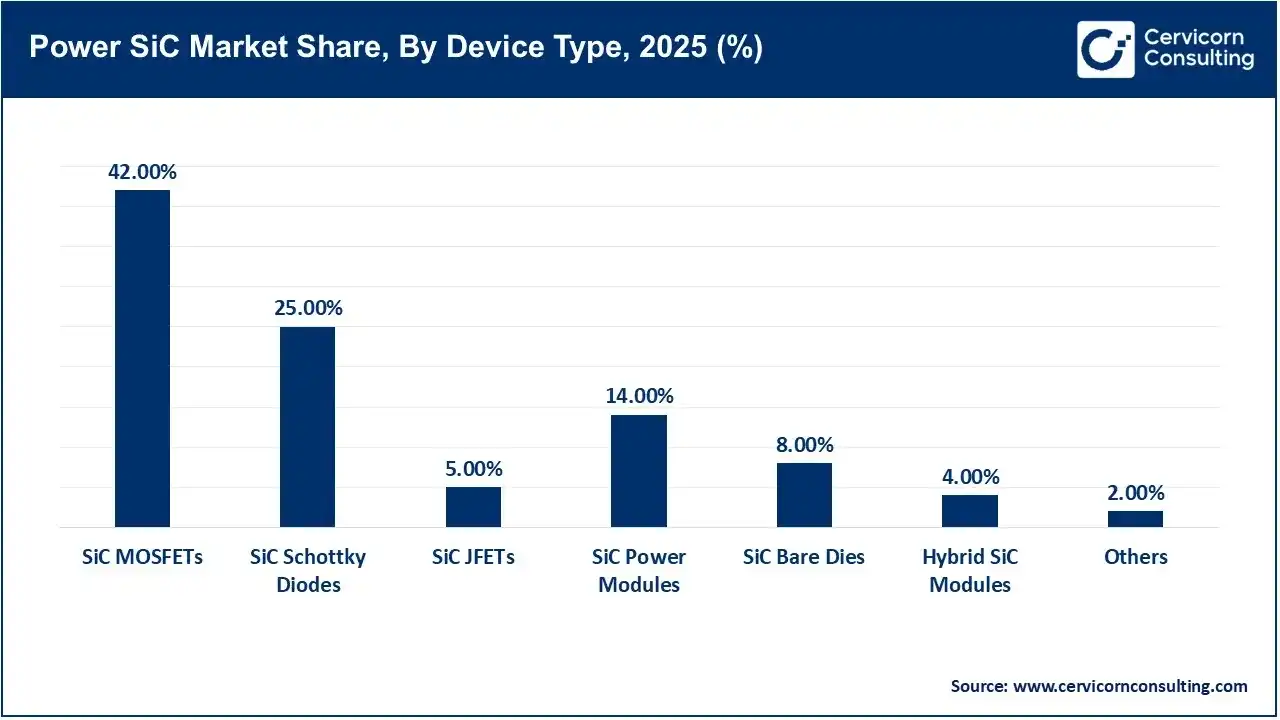
SiC power modules are expected to be the fastest-growing segment, driven by the growing need for power conversion solutions that are high-power, small, and energy-efficient. Higher power density, better thermal performance, and effective power management are all made possible by these modules' integration of several SiC devices. Electric vehicle powertrains, EV charging infrastructure, renewable energy systems, and industrial equipment are all using them more frequently. The adoption of SiC power modules is expected to accelerate due to the growing demand for high-performance power electronics.
Wafer Size Analysis
6-inch (150 mm) wafers dominated the wafer size segment because of their well-established manufacturing infrastructure and extensive application in the production of commercial SiC devices. These wafers offer a balance between device yield, production efficiency, and manufacturing maturity. Adoption is still supported by their well-established position in SiC semiconductor manufacturing. The continued use of 150 mm wafers is also a result of growing investments in SiC production capacity.
Power SiC Market Share, By Wafer Size, 2025 (%)
| Wafer Size |
Revenue Share, 2025 (%) |
| 2-Inch |
2% |
| 3-Inch |
4% |
| 4-Inch |
13% |
| 6-Inch (150 mm) |
62% |
| 8-Inch (200 mm) |
19% |
8-inch (200 mm) wafers are expected to be the fastest-growing segment, driven by the growing trend toward larger wafer sizes in order to lower production costs per device and increase manufacturing efficiency. SiC producers are making investments in the production of 200 mm wafers in order to meet the increasing demand for power semiconductor devices. The shift to larger wafer platforms is being further aided by the growth of electric vehicles, renewable energy systems, and high-power applications. The adoption of 8-inch wafers is expected to pick up speed as production capacity increases.
Voltage Rating Analysis
600–900 V devices dominated the market because they are widely used in solar inverters, industrial power conversion equipment, EV charging systems, and electric vehicle powertrains. For a variety of power electronics applications, these devices offer an efficient blend of switching efficiency, voltage capability, and dependability. The need for SiC devices in this voltage range is being supported by the growing electrification of energy and transportation systems. Their market position is further strengthened by their well-established use in energy and automotive applications.
Power SiC Market Share, By Voltage Rating, 2025 (%)
| Voltage Rating |
Revenue Share, 2025 (%) |
| Up to 600 V |
14% |
| 600–900 V |
27% |
| 900–1,200 V |
36% |
| 1,200–1,700 V |
15% |
| 1,700–3,300 V |
6% |
| Above 3,300 V |
2% |
1,200–1,700 V devices are expected to be the fastest-growing segment, driven by the growing need for applications that require high power and voltage. Energy storage systems, industrial equipment, grid-related applications, renewable energy converters, and EV charging infrastructure are all seeing an increase in the use of these devices. Their integration into sophisticated power conversion systems is supported by their capacity to function at higher voltages while retaining lower power losses. It is anticipated that the development of renewable energy infrastructure and high-power electrification will further quicken segment growth.
Power Rating Analysis
1–10 kW devices are expected to dominate the power rating segment because they are widely used in solar inverters, power supplies, industrial power conversion systems, and EV charging equipment. SiC devices operating in this power range offer enhanced thermal performance, decreased energy losses, and high efficiency. Demand is still supported by their adaptability to a variety of commercial and industrial applications. Growing use of energy-efficient power electronics is bolstering the market's dominant position.
Power SiC Market Share, By Power Rating, 2025 (%)
| Power Rating |
Revenue Share, 2025 (%) |
| Below 1 kW |
12% |
| 1–10 kW |
28% |
| 10–50 kW |
34% |
| Above 50 kW |
26% |
Above 50 kW devices are expected to be the fastest-growing segment, driven by the growing need for high-power applications that call for improved thermal performance, power density, and efficiency. These devices are being more widely used in grid applications, industrial motor drives, energy storage systems, renewable energy converters, rail traction, and EV fast-charging infrastructure. Wider use is being encouraged by SiC technology's capacity to handle high-power operation with lower switching losses. Segment growth is expected to be accelerated by increased electrification and investment in high-power infrastructure.
Application Analysis
Electric vehicle powertrains dominated the application segment because SiC devices are becoming more and more integrated into high-voltage EV powertrain components such as traction inverters and onboard chargers. SiC technology supports compact vehicle designs, lowers energy losses, and increases power conversion efficiency. Adoption is being aided by the growing demand for more efficient electric powertrains and longer driving ranges. This segment's dominant position is being reinforced by the ongoing growth of electric transportation.
EV charging infrastructure is expected to be the fastest-growing application segment, driven by the growing need for quick and effective charging solutions as well as the rapid growth of electric vehicle charging networks. Higher switching frequencies, reduced energy losses, compact system designs, and enhanced thermal performance in charging equipment are all made possible by SiC devices. SiC-based power electronics are becoming more and more in demand as high-power and fast-charging stations are deployed. It is projected that segment growth will be accelerated by ongoing investment in EV charging infrastructure.
End-Use Industry Analysis
Automotive and transportation dominated the end-use industry segment because SiC devices are increasingly being integrated into traction inverters, charging systems, electric cars, and other electrified transportation technologies. In car electrical systems, SiC technology enables increased power density and efficiency. Demand is being supported by the growing electrification of commercial vehicles, passenger cars, and transportation infrastructure. The segment's dominant position is being further strengthened by the ongoing development of electric transportation.
Power SiC Market Share, By End User, 2025 (%)
| End User |
Revenue Share, 2025 (%) |
| Automotive & Transportation |
32% |
| Energy & Power |
19% |
| Industrial |
16% |
| Consumer Electronics |
7% |
| IT & Telecommunications |
5% |
| Aerospace & Defense |
3% |
| Renewable Energy |
11% |
| Data Centers |
5% |
| Others |
2% |
Energy and power are expected to be the fastest-growing end-use industry segment, driven by the growing use of SiC technology in grid infrastructure, energy storage, power conversion, and renewable energy generation. In high-power electrical systems, SiC devices can lower energy losses and increase conversion efficiency. More opportunities are being created by the growth of solar and wind power as well as the growing use of energy storage devices. Segment growth is expected to be further accelerated by rising investment in modern power infrastructure.
Government Initiatives
- In February 2026, Semicon India Programme Expansion: The government highlighted approved semiconductor projects covering SiC fabrication, advanced packaging, and other semiconductor facilities under the Semicon India Programme. These projects are aimed at strengthening domestic chip manufacturing and technology capabilities. Increased local production can support applications across EVs, renewable energy, electronics, and industrial power systems.
- In February 2026, India Semiconductor Mission 2.0: The initiative was announced to strengthen domestic semiconductor equipment, materials, manufacturing, research, and supply chains. It focuses on building a resilient semiconductor ecosystem and encouraging greater participation from Indian companies. This can create a supportive environment for advanced materials and power semiconductor technologies such as SiC.
- In July 2026, Semicon 2.0: The Union Cabinet approved the next phase of India's semiconductor programme, focusing on semiconductor equipment and materials, fabrication, advanced packaging, R&D, and talent development. The programme aims to expand India's semiconductor manufacturing ecosystem and technological capabilities. Greater investment in fabrication and materials can support the long-term development of SiC and other compound semiconductor technologies.
Recent Developments
- In April 2026, ROHM Semiconductor announced the development of its 5th-generation SiC MOSFETs, featuring approximately 30% lower on-resistance during high-temperature operation compared with its previous generation. The technology is aimed at high-temperature applications such as xEV traction inverters. ROHM also plans to expand the product family with additional voltage ratings and package options.
- In June 2026, Mitsubishi Electric announced that it would begin shipping samples of its 5th-generation SiC-MOSFET bare dies. The devices are designed for EV, PHEV, and other electrified-vehicle inverters and eAxles. Their lower on-resistance is intended to improve power efficiency, vehicle range, and inverter miniaturization.
- In January 2026, Mitsubishi Electric announced the shipment of samples of four new trench SiC-MOSFET bare dies for applications including EV traction inverters, onboard chargers, and renewable-energy power systems. The new devices are designed to help reduce power consumption while maintaining high performance. The company also planned demonstrations at industry exhibitions in Japan and other markets.
Top Companies
Segments Covered
By Device Type
- SiC MOSFETs
- SiC Schottky Diodes
- SiC JFETs
- SiC Power Modules
- SiC Bare Dies
- Hybrid SiC Modules
- Others
By Wafer Size
- 2-Inch
- 3-Inch
- 4-Inch
- 6-Inch (150 mm)
- 8-Inch (200 mm)
By Voltage Rating
- Up to 600 V
- 600–900 V
- 900–1,200 V
- 1,200–1,700 V
- 1,700–3,300 V
- Above 3,300 V
By Power Rating
- Below 1 kW
- 1–10 kW
- 10–50 kW
- Above 50 kW
By Application
- Electric Vehicle Powertrains
- EV Charging Infrastructure
- Solar Inverters
- Wind Power Converters
- Energy Storage Systems
- Industrial Motor Drives
- Power Supplies
- Data Center Power Systems
- Rail Traction
- Smart Grid & Power Grid
- Aerospace & Defense
- Consumer Electronics
- Others
By End-Use Industry
- Automotive & Transportation
- Energy & Power
- Industrial
- Consumer Electronics
- IT & Telecommunications
- Aerospace & Defense
- Renewable Energy
- Data Centers
- Others
By Region
- North America
- Europe
- Asia Pacific
- Latin America
- Middle East & Africa