On-Board Charger Market Size and Growth 2026 to 2035
The global on-board charger market size was estimated at USD 8.51 billion in 2025 and is expected to be worth around USD 26.48 billion by 2035, exhibiting a compound annual growth rate (CAGR) of 12.1% over the forecast period from 2026 to 2035. The global on-board charger market growth is primarily driven by the implementation of strict environmental regulations and the adoption of electric vehicles (EVs) in major economies. The OBC provides high voltage to the lithium battery by regulating single-phase AC. For instance, by 2022, EVs in China alone exceeded 10 million on the road, underscoring the scale of the need for efficient charging solutions. In addition to regulatory mandates, the growth of the OBC sector is linked to the growth of public and private charging infrastructure and the on-going challenge to alleviate consumer range anxiety.
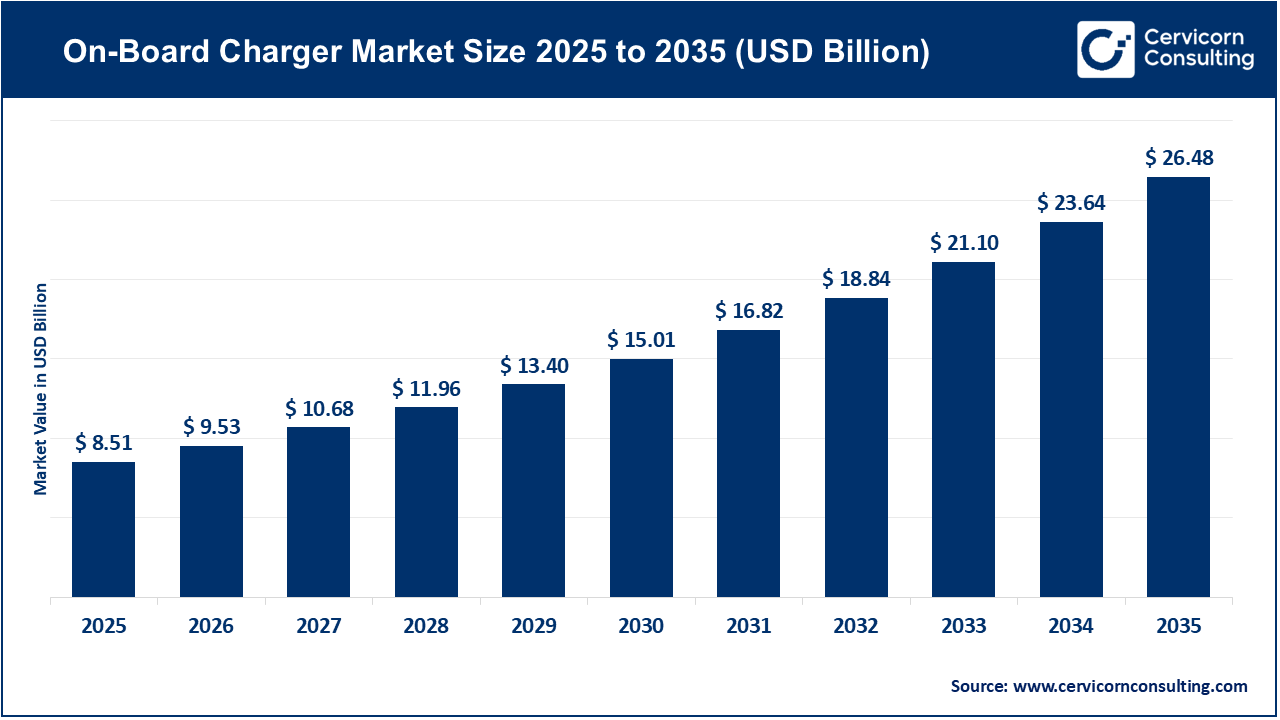
Another growth factor shaping the OBC market is the technological shift toward 800V vehicle architectures. These shift from standard 3.3kW or 6.6kW to 11kW and 22kW three-phase systems, and OEMs increasingly reduce the speed and duration of charging for consumers. At the same time, the opportunity to improve efficiency within its overall high-voltage power electronics suite, which now facilitates a wider energy range and performance, provides a competitive advantage by reducing energy loss during the rectification process.
Report Highlights
- Asia Pacific dominates the global on-board charger market with around 40% share, driven by strong EV adoption and government-backed electrification policies in China, India, and Southeast Asia.
- By vehicle type, the passenger cars segment dominated the market with a 55% share in 2025, driven by high global EV sales and increasing consumer adoption of electric mobility.
- By power type, the less than 11 kW segment led the market with a 43% share in 2025, due to its compatibility with residential charging and widespread use in passenger EVs.
- By power type, the 11 kW to 22 kW segment is gaining traction, driven by demand for faster AC charging solutions in both residential and commercial applications.
- By propulsion type, the battery electric vehicle (BEV) segment dominated with a 66% share in 2025, driven by global decarbonization goals and increasing EV adoption.
- By sales channel, the OEM segment led the market with an 80% share in 2025, as onboard chargers are primarily integrated during vehicle manufacturing.
Adoption of WBG Semiconductor in Charger Design is driving the OBC Market Growth
The increasing use of wide-bandgap (WBG) semiconductor materials such as Silicon Carbide (SiC) and Gallium Nitride (GaN) is the biggest trend in the OBC market. WBG semiconductors are much more efficient in thermal transfer than silicon and can operate at higher switching frequencies. This can significantly reduce the size and weight of passive components, such as inductors and capacitors, resulting in a much higher power density. Using SiC semiconductors enables manufacturers to achieve efficiency levels above 98%, which are critical for reducing runtime losses and maximising the energy delivered to the battery during charging.
Major Adoption Trends in Charges
- EV On-Board Chargers (OBCs): Silicon Carbide (Sic) and Gallium Nitride (GaN) to reduce power losses by up to 50%, which increases range up to 10%, and enables bidirectional charging.
- Fast Charging Infrastructure (DC fast Chargers): Sic dominated high-voltage (>600V) DC fast charging, improving efficiency and reducing the size of cooling.
- Consumer Electronics: GaN is heavily adopted in compact, fast chargers up to 240W for laptops and smartphones.
- Performance Impact: WBG-based charges can improve efficiency by 2-5%, reduce cooling requirements by 30-40%, and decrease converter volume by nearly 50%.
How is the OBC market defined, and what are its end-user applications?
An On-Board Charger (OBC) is a device that performs power electronics and is located on an electric vehicle, converting an external alternating current (AC) source to direct current (DC) to charge the high-voltage battery pack. From an operational standpoint, the OBC uses a specific process to convert from the AC input configuration to the DC charging configuration. The first stage of this process involves filtering the AC input through an EMI filter to ensure compliance and protect the internal components from possible AC fluctuations. The second stage of the OBC has the AC input go through a rectification stage and a PFC circuit to maximize efficiency and limit the current waveform from the input AC to the voltage on the grid.
End-User Applications of On-Board Charger (OBC)
The end users of the OBC market are mainly industries and segments that utilize electric vehicles as part of their operations or personal mobility.
- Passenger Vehicles: Passenger vehicles are largest end user segment, primarily driven by the increasing growth of personal electric mobility. Global EV car sales are growing by 14 million units annually, and most EVs are equipped with 7KW to 22KW OBC systems to support home and public AC charging.
- Commercial Vehicles: These vehicles require higher-capacity 11KW-22KW on-board chargers due to larger battery sizes and frequent usage cycles. Fleet electrification is growing at 25% anually in major markets.
- Electric Buses: Globally, over 600,000+ electric buses are in operation, with heavy deployment in regions like China. These vehicles rely on high-power onboard or depot charging systems for efficient operations.
- Two-Wheelers & Three-Wheelers: In high-density markets like India, where 2W and 3W EVs account for 80-85% of total EV sales. These vehicles primarily use low-power OBCs (<5kW) focused on affordability.
EV Sales Surge and Home Charging Dominance Accelerating OBC Market Growth
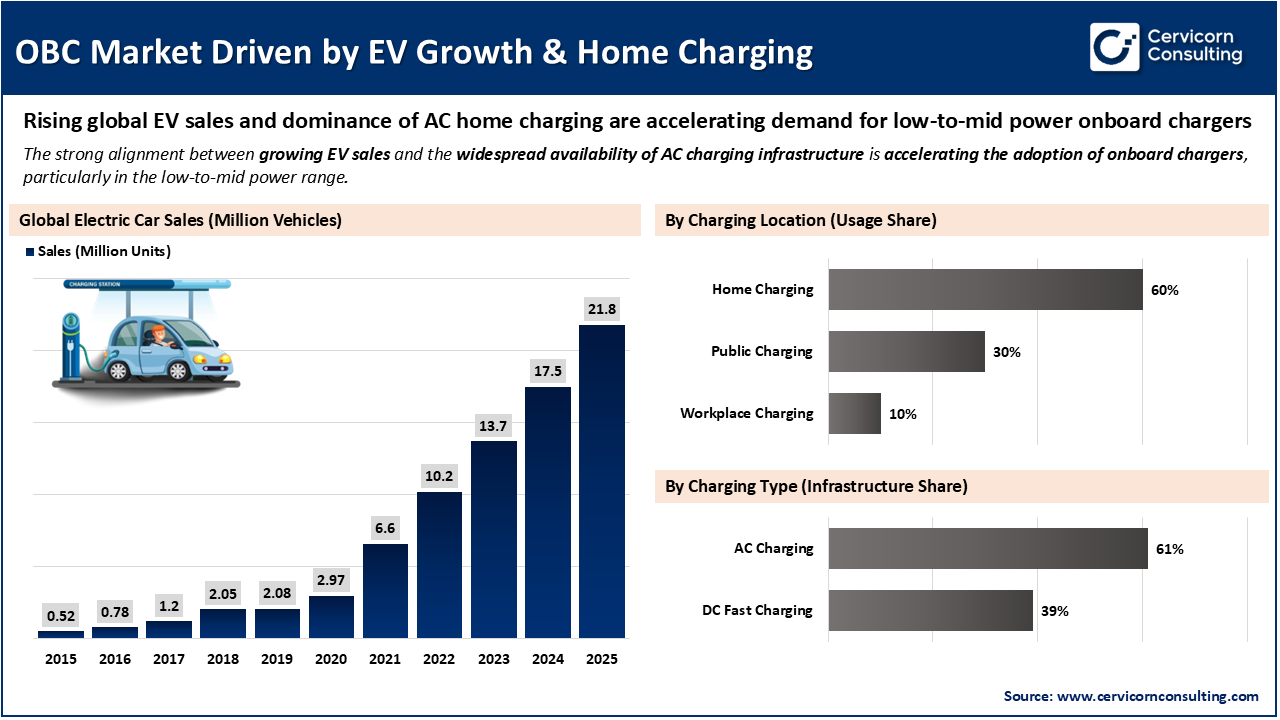
The sharp rise in global electric vehicle sales, projected to reach over 21 million units, combined with the dominance of home-based AC charging (60%), is significantly driving demand for onboard chargers, particularly in the low-to-mid power range used in passenger EVs.
Top 5 Trends and Technologies
- System Integration (Everything in One): There is a tendency towards integrating the OBC with the DC/DC converter and Power Distribution Unit (PDU) into one housing to reduce wiring complexity.
- 800V Architecture Compatibility: As manufacturers are pushing toward high-voltage platforms to enable ultra-fast charging, OBCs must be redesigned to handle inputs of 800V.
- Wireless Charging Interfaces: Early developments are building OBCs that interface with inductive charging pads to address the future terminal needs of autonomous vehicles that will need to recharge without human interference.
- Modular Converter Design: In an effort to drive down research and development costs, companies are now using modular architectures, allowing OEMs to scale the same OBC base platform to other vehicle segments, from small cars to light commercial vehicles.
- Smart Grid Communication (ISO 15118): The addition of smart communication protocols in the electric vehicle's OBC enables "Plug & Charge" functionality to occur.
Report Scope
| Area of Focus |
Details |
| Market Size in 2026 |
USD 9.53 Billion |
| Market Size in 2035 |
USD 26.48 Billion |
| CAGR 2026 to 2035 |
12.10% |
| Dominant Region |
Asia-Pacific |
| Key Segments |
Vehicle Type, Power Type, Propulsion Type, Sales Channel, Region |
| Key Companies |
BYD, Nichicon Corporation, Tesla, Inc., Infineon Technologies AG, Panasonic Corporation, LG Electronics, Lear Corporation, Delphi Technologies, Delta Electronics, Inc., Robert Bosch GmbH, STMicroelectronics, Siemens AG, Eaton Corporation, Kongsberg Automotive, Zhejiang Wanma |
Recent Major Milestones
1. Initiatives in Government Policy & EV Adoption
The significant milestone of the market is the government mandates aimed at phasing out internal combustion engines. For example, as part of the European Union's "Fit for 55" package, they will effectively ban the sale of new petrol and diesel vehicles by 2035. The "Fit for 55" package has a shift to electric mobility. Similarly, in North America, the National Electric Vehicle Infrastructure (NEVI) formula program provides billions in funding to establish a network of charging stations. These initiatives have a direct correlation to the OBC market. These government programs will ensure continued demand for high-reliability OBCs that can interface with a variety of public and private charging infrastructure, requiring manufacturers to invest in universal compatibility and auto grid compliance.
2. Silicon Carbide (SiC) Technological Development
Technological innovation is playing a critical role in shaping the OBC market, particularly with the transition from traditional silicon-based components to Silicon Carbide (SiC) power semiconductors. Silicon Carbide enables OBCs to operate at higher switching frequencies and reduce the size of large components, such as inductors and capacitors. For Si-based OBCs, the switching frequency for MOSFET-based on-board chargers (OBCs) can be reduced by up to 70% when switching to SiC designs, which can result in a 2-4% increase in overall vehicle range based on improved conversion efficiency. In addition, SiC enables a 30% reduction in the overall size of an OBC, which is a significant driver for OEMs constantly seeking optimal vehicle packaging and reduced overall weight.
3. Supply Chain Localization and Strategic Production Expansion
The global OBC market has been significantly impacted by large suppliers that have expanded their production capabilities, particularly in the Asia-Pacific region. Leading suppliers, including BYD and Inovance, have achieved unprecedented scale with the vertical integration of power module and magnetic component manufacturing. Companies that localise up to 50% of their supply chain operations often find an optimal balance, localising key functions while retaining some global elements. In addition, the increasing growth and localization of their supply chain at 78% has controlled the original average selling price (ASP) of a standard 6.6kW OBC, but only 25% feel prepared over the last three years.
4. Formation of High-Voltage 800V Architecture Specifications
The development of an 800v high-voltage system is a major driver in the market, mainly because it started with luxury and performance brands like Porsche and Hyundai-Kia. Based on projections for 2024, the 800V market segment is expected to grow at a CAGR of over 40% through 2030, significantly faster than the overall market. The shift to 800V systems will set the standards for 11kW and 22kW OBCS, as these will be used with larger packs and higher AC charging rates. Capacity will be crucial to meet consumer demands. The creation of these new standards has prompted a reset in OBC R&D efforts, necessitating new tests and components to handle the more demanding conditions of operating at high voltages.
On-Board Charger Market Regional Analysis
The on-board charger (OBC) market is segmented by region into North America, Europe, Asia-Pacific, and LAMEA. Here is a brief overview of each region:
Why does Asia-Pacific dominates the on-board charger market?
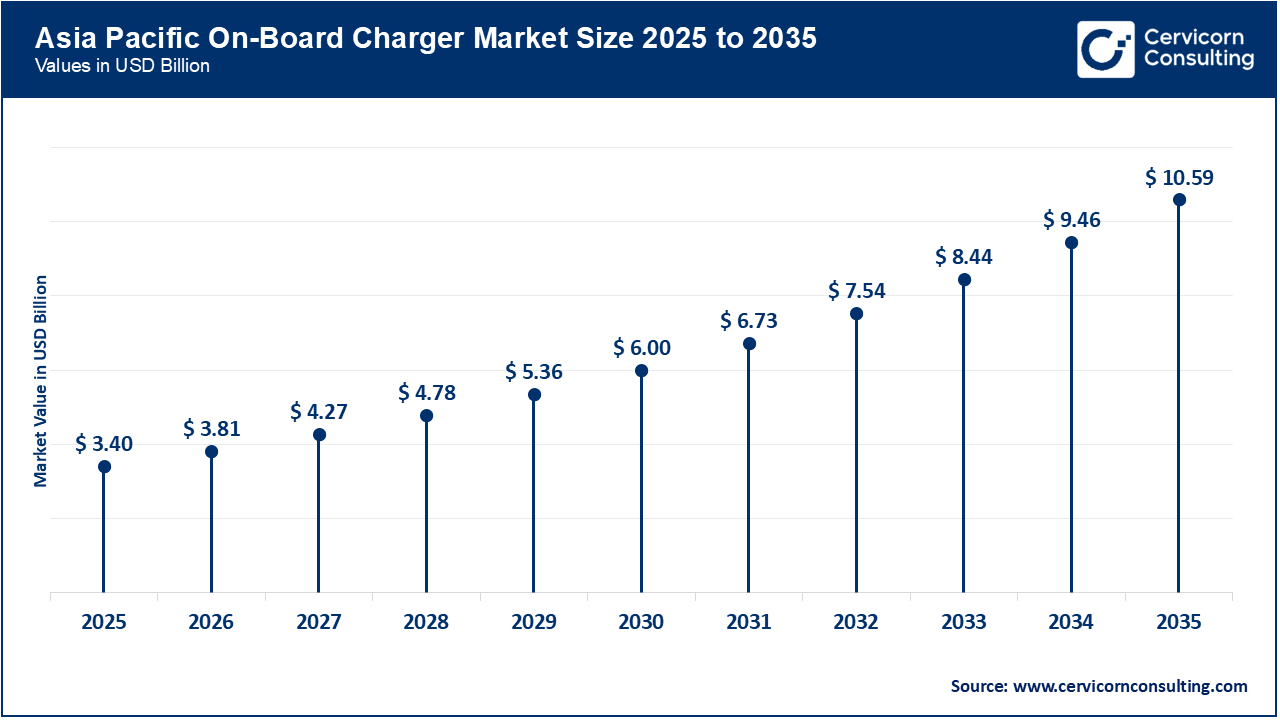
Asia Pacific is the dominant region of the market, mainly because of the increasing adoption of electric vehicles under supportive government policies. In China, the NEV (New Energy Vehicle) policy framework, including consumer subsidies and strict "dual-credit" architectures for manufacturers, has significantly increased EV adoption. Beyond China, the growth is increasing across India and Southeast Asia. In India, the Adoption and Manufacturing of Hybrid and Electric Vehicles (FAME) has increased electrification in the two- and three-wheeler markets, creating unique demand for compact, low-cost 3.3kW OBCs. In Southeast Asia, countries such as Thailand and Indonesia are positioning themselves as the manufacturing Hubs by providing tax incentives for global OEMs to localize production of their power electronics systems.
China, Japan, South Korea: Key Growth Engines
China — Global EV & OBC Leader
- Accounts for over 50% of global EV sales, driving massive OBC demand
- Strong government incentives and NEV (New Energy Vehicle) policies
- Rapid expansion of domestic EV and charging infrastructure
Japan — Technology Innovator
- Focus on high-efficiency and compact OBC systems
- Strong presence of automotive OEMs and power electronics firms
South Korea — Advanced Manufacturing Hub
- Investments in next-generation EV components and battery technologies
- Integration of OBC systems with smart energy solutions
China and India On-Board Charger (OBC) Market: Key Data Points
- China Mandates 800V Architecture: In mid-2025, the Chinese Ministry of Industry and Information Technology (MIIT) issued new standards for all high-end EVs sold in the country to support 800V systems. This prompted OBC manufacturers to accelerate efforts to transition from 650V to 1200V SiC components.
- India's PLI Scheme Supports Local OBC Assembly: By the end of 2025, and under the Production Linked Incentive (PLI) scheme, three major Indian electronics firms partnered with Taiwanese Tier 1s to create OBC assembly lines with a 500,000 unit capacity annually, targeting the Indian two-wheeler and small car markets.
What are the driving factors of North America on-board charger market?
The OBC market in North America is primarily driven by rising consumer demand for large vehicles, particularly new electric SUVs and light-duty trucks. Models like the Ford F-150 Lightning and Chevrolet Silverado EV have very large battery capacities, often exceeding 130 kWh of storage. These high-capacity batteries require an efficient and powerful charging solution to enables practical overnight charge. As a result, there is a well-established preference for 19.2 kW OBCs that can utilize an 80-ampere Level 2 AC circuit's charging infrastructure.
U.S and Canada OBC Market: A Key Data Point
- The United States has surpassed 3 million EVs on the road, with strong year-on-year growth.
- Level 2 charging dominates residential charging, driving adoption of 11 kW–19.2 kW OBC systems.
- Government programs like the iZEV incentive provide up to CAD 5,000 per EV, boosting EV penetration and OBC demand.
- Canada has installed 25,000+ public charging ports, supporting both urban and highway EV usage.
- Large EV models such as the Ford F-150 Lightning feature battery capacities exceeding 130 kWh, requiring high-capacity onboard chargers.
Which factors are influencing the expansion of the Europe on-board charger market?
Europe OBC market growth is mainly policy-driven, supported by strict CO2 emission targets and initiatives such as the European Green Deal. These regulatory frameworks are shifting toward electrification across the automotive sector. Europe is a leader in technological innovation, especially in advanced power electronics. The development of leading European companies such as Bosch, Valeo, and STMicroelectronics is driving advances in SiC-based technologies, enabling the OBC system to determine how to achieve efficiencies greater than 98.5%.
Key Country Insights & Developments
Germany, France, UK — Market Leaders
- Strong EV adoption supported by subsidies and regulations
- Investments in EV production and component manufacturing
EU-Wide Initiatives
- Ban on internal combustion engine (ICE) vehicle sales by 2035
- Expansion of public charging infrastructure across member states
- Focus on vehicle-to-grid (V2G) and smart charging technologies
Market Trend
- Rapid increase in EV penetration across urban regions
- Growing demand for high-power and efficient onboard chargers
Quantitative Insights
- In 2025, Norway reported that 100% of new passenger car sales were electric, with 60% plus incorporating an 11kW or 22kW OBC, which puts strain on the local low-voltage grid.
- France operates 100,000+ public charging stations, with a focus on widespread AC infrastructure.
- STMicroelectronics opened its Catania integrated SiC substrate manufacturer, aiming to supply 40% of the OBC chips needed by European OEMs.
- Valeo announced its 4th Gen "Combo" unit, which integrates an 11kW OBC and a 2.5DC/DC converter in a package 30% smaller than their 3rd Gen unit.
- Germany’s previous reliance on fiscal support became evident when the termination of USD 4,500 per-vehicle subsidies triggered a 4-percentage-point market share decline.
On-Board Charger (OBC) Market Share, By Region, 2025 (%)
| Region |
Revenue Share, 2025 (%) |
| Asia Pacific |
40% |
| Europe |
30% |
| North America |
24% |
| LAMEA |
6% |
LAMEA On-Board Charger (OBC) Market: Driven by Building Transportation Networks with Local Manufacturing Incentives
The LAMEA region is the fastest-growing region of the OBC market, although it starts from a lower baseline. The growth of these regions is increased by investments in transportation infrastructure and increasing efforts to localize EV manufacturing. In the Middle East, countries such as Saudi Arabia and the United Arab Emirates are investing heavily in domestic EV brands as part of their "Vision 2030" initiatives. Recently, Ceer Motors announced it will partner with global tech providers to design high-efficiency OBCs to utilize in its domestic EV production.
Recent developments:
- Latin America, led by Brazil, is witnessing EV sales growth of 30% annually, though from a smaller base.
- Saudi Arabia aims to produce 500,000 EVs annually by 2030, driving localized OBC manufacturing demand.
- The region overall contributes <10% of global EV sales, but is expected to grow at the fastest CAGR due to infrastructure investments and localization efforts.
- The UAE’s strong focus on smart city development and clean energy is supporting advanced EV infrastructure and high-efficiency OBC integration.
On-Board Charger Market Segmental Analysis
The on-board charger (OBC) market is segmented into component, deployment, technology, function, enterprise, end user, and region.
Vehicle Type Analysis
Passenger car segment is the dominant segment in the OBC market, mainly due to the high volume of production of mass-market EVs such as Tesla Model 3 and Volkswagen ID series. These vehicles require millions of chargers annually, making passenger sector standardization around charging requirements have led to significant economies of scale and a reduction in unit costs for 6.6 kW and 11 kW chargers. Additionally, the passenger vehicles play the leading role in global decarbonization policies, making them the predominant revenue stream for OBC suppliers.
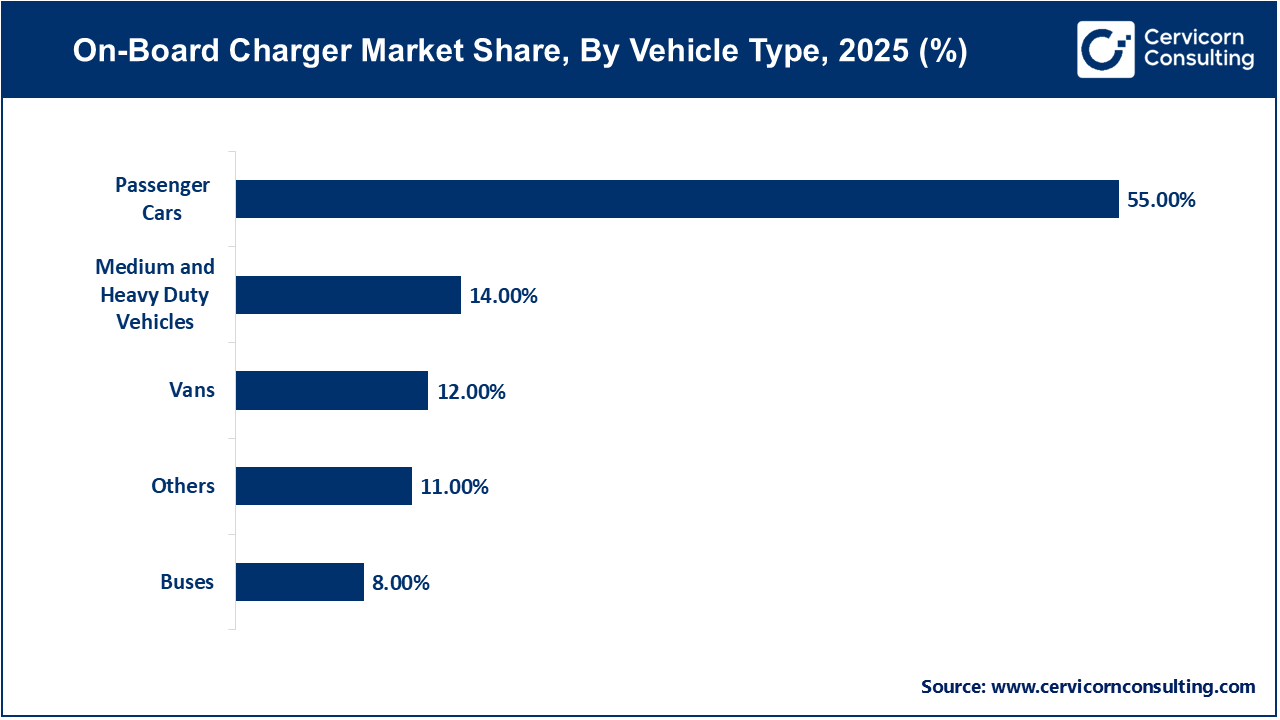
Buses are the fastest-growing vehicle type in the market, primarily driven by “green city” programs and the rapid electrification of public transit fleets worldwide. Electric buses utilize custom-produced, high-durability OBCs that handle demanding duty cycles and frequent charging. Although the absolute unit volumes are lower than those of passenger cars, the bus market has greater power requirements, often over 22 kW for overnight depot charging and costs for heavy-duty parts, resulting in a greater CAGR for market value.
Power Type Analysis
The less than 11 kW segment plays a significant role in driving the on-board charger market. This is largely due to the increasing adoption of electric passenger vehicles and the prevalence of home-based charging solutions. Most electric vehicles are now equipped with 6–11 kW onboard chargers, which provide an effective balance between cost, efficiency, and charging speed. The ability of these chargers to operate with standard residential AC power removes the need for costly fast-charging infrastructure, making them the preferred option for daily charging. Furthermore, the lower system costs and ease of integration make this segment particularly appealing to OEMs focused on mass-market electric vehicle production. In emerging markets, where charging infrastructure is still in the early stages of development, the less than 11 kW segment continues to be the main contributor to market growth.
On-Board Charger (OBC) Market Share, By Power Type, 2025 (%)
| Power Type |
Revenue Share, 2025 (%) |
| Less than 11 kW |
43% |
| 11 kW to 22 kW |
30% |
| More than 22 kW |
27% |
11 kW to 22 kW power range is the fastest-growing segment of the OBC market, primarily driven by the greater battery capacity of modern EVs and the availability of three-phase AC power, particularly in regions like Europe. As consumers require faster charging times and vehicles with 800V architectures become available, the limitations of sub-11 kW chargers have become increasingly evident. Moreover, the 11 - 22 kW chargers are becoming the new standard for premium and long-range BEVs due to their ability to fully charge a vehicle in less time than it would take to charge at lower power.
Propulsion Type Analysis
Battery Electric Vehicles (BEVs) are the largest propulsion type in the OBC market, mainly because they rely exclusively on their on-board systems for AC charging. In a BEV, the OBC is a highly important component for efficiency, contributing to the vehicle's overall energy consumption, and its reliability is important for daily user mobility. As global mandates for zero-emission vehicles gain momentum, BEV production has outpaced other electric propulsion types. The BEV segment has also served as the main testing ground for advanced features such as 800V capability and bi-directional power flow since they represent the most obvious benefits to pure electric vehicle owners.
On-Board Charger (OBC) Market Share, By Propulsion Type, 2025 (%)
| Propulsion Type |
Revenue Share, 2025 (%) |
| Battery Electric Vehicle |
66% |
| Plug-in Hybrid Electric Vehicle |
34% |
Plug-in Hybrid Electric Vehicle (PHEV) segment is the fastest-growing type of the market, primarily due to the smaller battery size in hybrids. The growth in PHEV sales, particularly in China and across parts of Europe, has created an important and growing section for specialized and compact OBC units. The inherent design of hybrid vehicles will always face cost constraints, so these chargers need to be very lightweight yet price-competitive. These fit into the multiple engines in hybrid vehicles, which contain both an internal combustion engine and an electric motor.
Sales Channel Analysis
Original Equipment Manufacturers (OEMs) hold the largest share of the market segment, mainly because they produce highly integrated, safety-critical components of the vehicle's powertrain that require precise coordination with the Battery Management System (BMS) and the vehicle's thermal management system. As a result, OEMs provide certified automotive components that are easier to install into the vehicle's architecture, limiting the options for third-party components for on-board charging in vehicles on the line.
On-Board Charger (OBC) Market Share, By Sales Channel, 2025 (%)
| Sales Channel |
Revenue Share, 2025 (%) |
| Original Equipment Manufacturer (OEM) |
80% |
| Aftermarket |
20% |
Aftermarket segment represents the fastest-growing market, primarily driven by sales of services and specialized upgrades. As the global fleet of electric vehicles grows, demand for replacement OBCs and repairs will rise, and a new, developing niche for aftermarket upgrades will emerge. However, aftermarket replacement brings technical hurdles, including proprietary communication protocols and complicated cooling, so the growth will primarily occur at authorized service centres and specialist retrofitters, not in retail for the general consumer.
On-Board Charger Market Top Companies
Recent Developments by Major Companies
- In April 2025, Delta announced a 5,500W server redundant power supply, to achieving over 97% efficiency using advanced SiC or GaN semiconductor technology.
- In September 2025, STMicroelectronics introduced advancements in OBC architecture through a new single-stage design approach, helping reduce system complexity, cost, and improve reliability in EV charging systems.
- In March 2025, Siemens AG partnered with automotive OEMs to integrate smart charging technologies, supporting advanced onboard charger ecosystems.
Market Segmentation
By Vehicle Type
- Passenger Cars
- Medium and Heavy Duty Vehicles
- Vans
- Buses
- Others
By Power Type
- Less than 11 kW
- 11 kW to 22 kW
- More than 22 kW
By Propulsion Type
- Battery Electric Vehicle
- Plug-in Hybrid Electric Vehicle
By Sales Channel
- Original Equipment Manufacturer (OEM)
- Aftermarket
By Region
- North America
- APAC
- Europe
- LAMEA