Industrial Valves Market Size, Growth Outlook 2026 to 2035
The global industrial valves market size was valued at USD 101.78 billion in 2025 and is projected to grow from USD 106.79 billion in 2026 to nearly USD 164.54 billion by 2035, registering a CAGR of 5.1% from 2026 to 2035. The industrial valves market is expanding because of increased industrial automation, infrastructure expansion, and the growing requirement for effective fluid flow management in a variety of industries, including manufacturing, chemicals, oil and gas, power generation, water and wastewater, and pharmaceuticals. Demand for dependable valves that can enhance operational effectiveness, safety, and process control is being driven by rising investments in energy infrastructure and process industries.
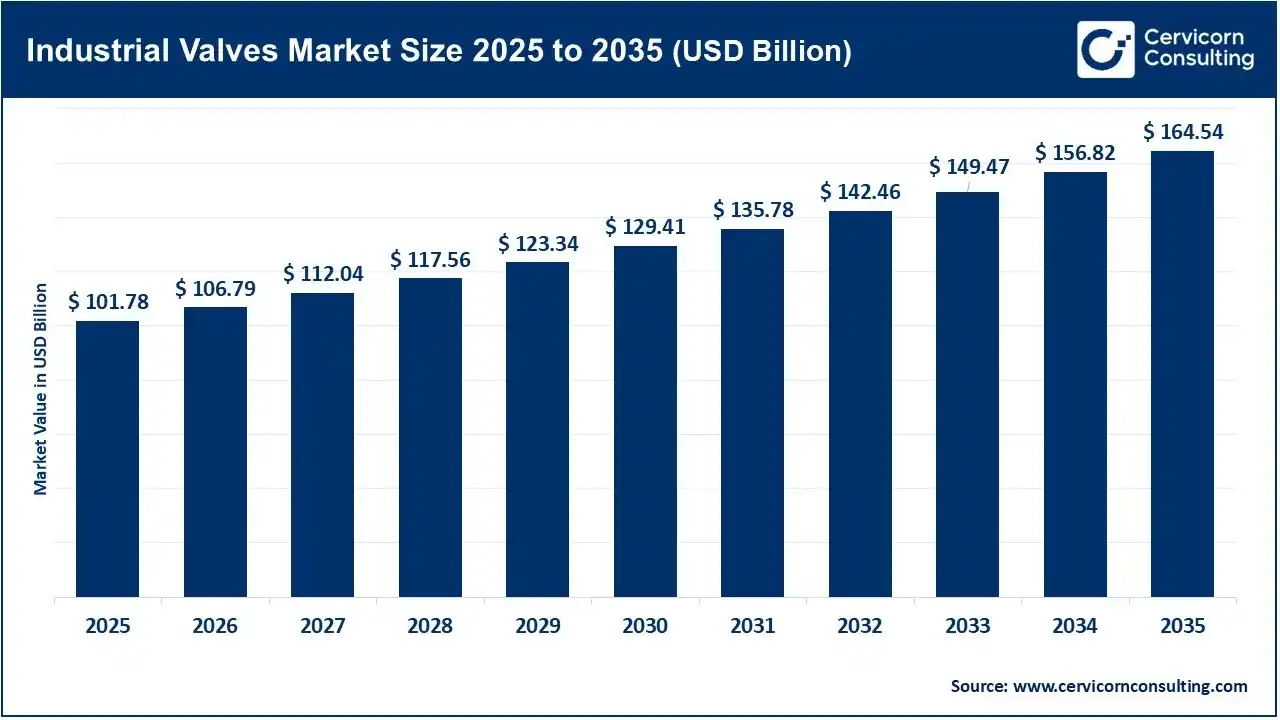
By facilitating remote monitoring, predictive maintenance, and accurate flow management, the use of smart and automated valves is contributing to market expansion. Additionally, new opportunities for valve makers are being created by the growth of industrial facilities and water treatment projects.
- In April 2026, Emerson introduced the fisher svx steam conditioning valve, designed to provide precise pressure and temperature control in combined-cycle power plants and other demanding industrial applications. The new valve focuses on efficiency, reliability, reduced noise and vibration, and improved maintenance, highlighting the growing demand for advanced valve solutions across power generation and industrial process applications.
Report Highlights
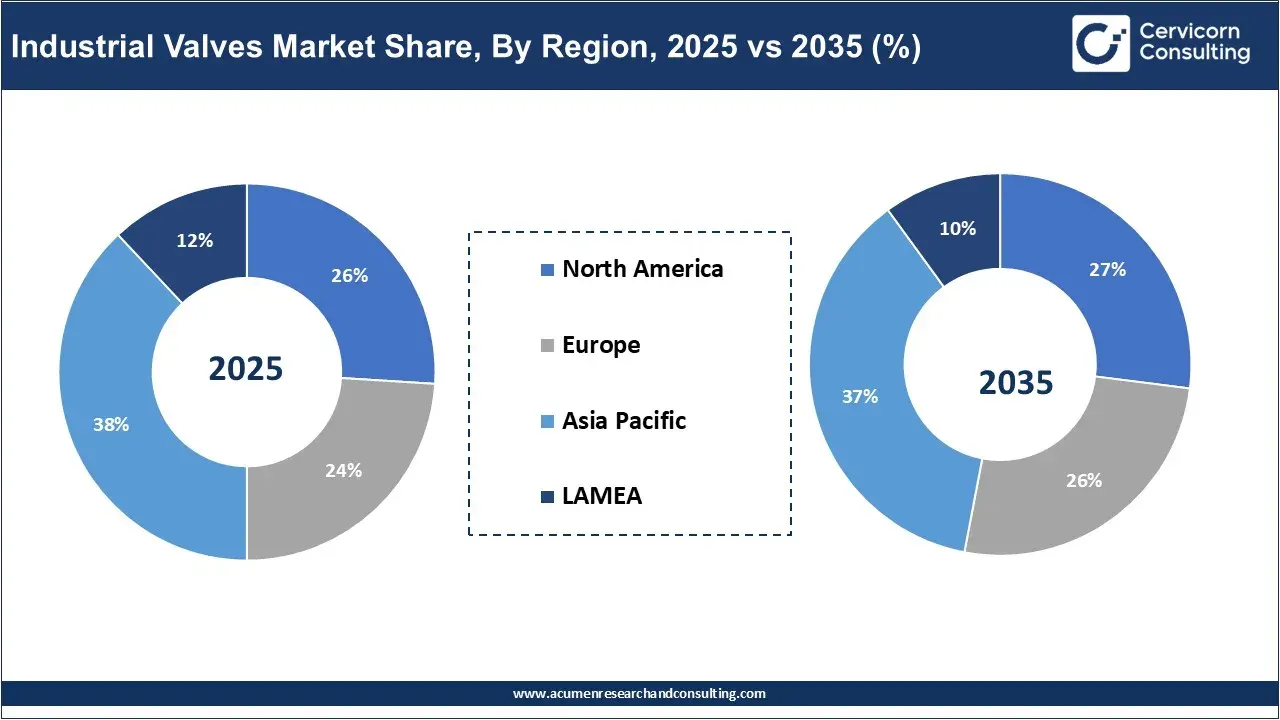
- By region, Asia pacific dominated the market in 2025 with revenue share of 38%, supported by rapid industrialization and infrastructure development.
- By region, North America is expected to grow at the fastest rate, driven by energy investments, industrial automation, and smart valve adoption.
- By valve type, ball valves dominated the market in 2025 (Revenue Share 22%) , owing to their reliable shut-off performance and wide industrial use.
- By valve type, check valves are expected to grow at the fastest rate, driven by rising demand for backflow protection.
- By valve operation, manual valves accounted for a revenue share of 38% in 2025, owing to their simple design and ease of installation.
- By valve operation, electric valves are expected to grow at the fastest rate, driven by increasing industrial automation and remote control.
- By material, steel dominated the market in 2025, supported by its strength and durability.
- By material, alloy-based valves are expected to grow at the fastest rate, driven by demand for corrosion-resistant solutions.
- By valve size, the 1–6 inches segment dominated the market in 2025, owing to its wide range of industrial applications.
- By valve size, the above 48 inches segment is expected to grow at the fastest rate, driven by large-scale infrastructure and pipeline projects.
- By end-use industry, the oil & gas segment dominated the market in 2025, due to extensive valve use across oil and gas operations.
- By end-use industry, water & wastewater is expected to grow at the fastest rate, driven by rising investments in water treatment.
- By technology, conventional valves dominated the market in 2025, owing to their proven performance and wide adoption.
- By technology, smart valves are expected to grow at the fastest rate, driven by digitalization, monitoring, and predictive maintenance.
Recent Trends
- Smart And Automated Valves: Increasing adoption of smart valves with sensors, actuators, and digital controls for real-time monitoring and precise flow management.
- Growing Demand for Energy-Efficient Valves: Industries are increasingly choosing valve solutions that reduce energy losses and improve overall process efficiency.
- Expansion of Industrial Automation: Automation across manufacturing and process industries is driving demand for electronically controlled and remotely operated valves.
- Rising Adoption of Predictive Maintenance: Connected valves are being integrated with monitoring systems to identify potential failures early and reduce unplanned downtime.
- Increasing Demand for Corrosion-Resistant Valves: Chemical, oil and gas, and water treatment industries are adopting advanced materials and coatings to improve valve durability.
- Growth of Sustainable Infrastructure: Expansion of water treatment, renewable energy, and environmentally focused industrial projects is creating demand for reliable and efficient valve systems.
Market Dynamics
Driver: Rising Industrial Automation And Process Efficiency
Demand for sophisticated valves that can precisely, dependably, and automatically control fluid and gas flow is being driven by the increasing use of industrial automation. To increase production and operational safety, industries such as oil and gas, chemicals, mining, power generation, pharmaceuticals, and water treatment are progressively combining automated valves with control systems. Industries are being encouraged to replace traditional valves with smart and automated solutions due to the need to lower energy usage, minimize process disruptions, and enhance asset performance. The demand for industrial valves is rising as a result of this trend in both new construction and renovation projects.
- In April 2026, Valmet strengthened its flow-control capabilities in Australia by inaugurating a new service center and manufacturing unit in sydney, supporting valves, pumps, automation, maintenance, and digital services for process industries, including mining, metals, refining, chemicals, and renewable energy.
Restraint: High Maintenance & Lifecycle Costs
Industrial valve adoption may be hampered by high lifecycle costs and maintenance needs, especially in harsh operating environments. Corrosion, erosion, high pressure, extreme temperatures, and continuous operation can all affect valves used in mining, oil and gas, chemical processing, and power production, necessitating more frequent inspections and replacements. Additionally, production downtime, safety hazards, and higher maintenance costs may arise from valve failures. These challenges may increase the cost of installing and maintaining modern valve systems, especially for smaller industrial operators.
- In December 2025, Valmet announced an agreement to acquire severn group, highlighting the importance of specialized severe-service valve technologies for demanding industrial applications across energy, refining, chemicals, mining, and power industries.
Opportunity: Expansion of Advanced Flow Control & Valve Automation
Industrial valve makers are benefiting greatly from the growing emphasis on digitalization, predictive maintenance, and effective flow control. Smart valves with sensors, digital monitoring, and automated actuation can support predictive maintenance and provide real-time operational information. The need for specialized valves that can function in harsh environments is increasing due to the growth of mining, energy, chemicals, water treatment, and renewable energy projects. The transition to intelligent industrial infrastructure can help manufacturers that integrate valves with automation, digital services, and lifetime support.
- In July 2026, Valmet completed the acquisition of severn group, strengthening its flow control business with severe-service valve technologies and expanding its capabilities across refining, energy, metals, chemicals, mining, and other process industries.
Regional Analysis
Asia Pacific: Industrial Expansion and Infrastructure Investments Drive Market Leadership
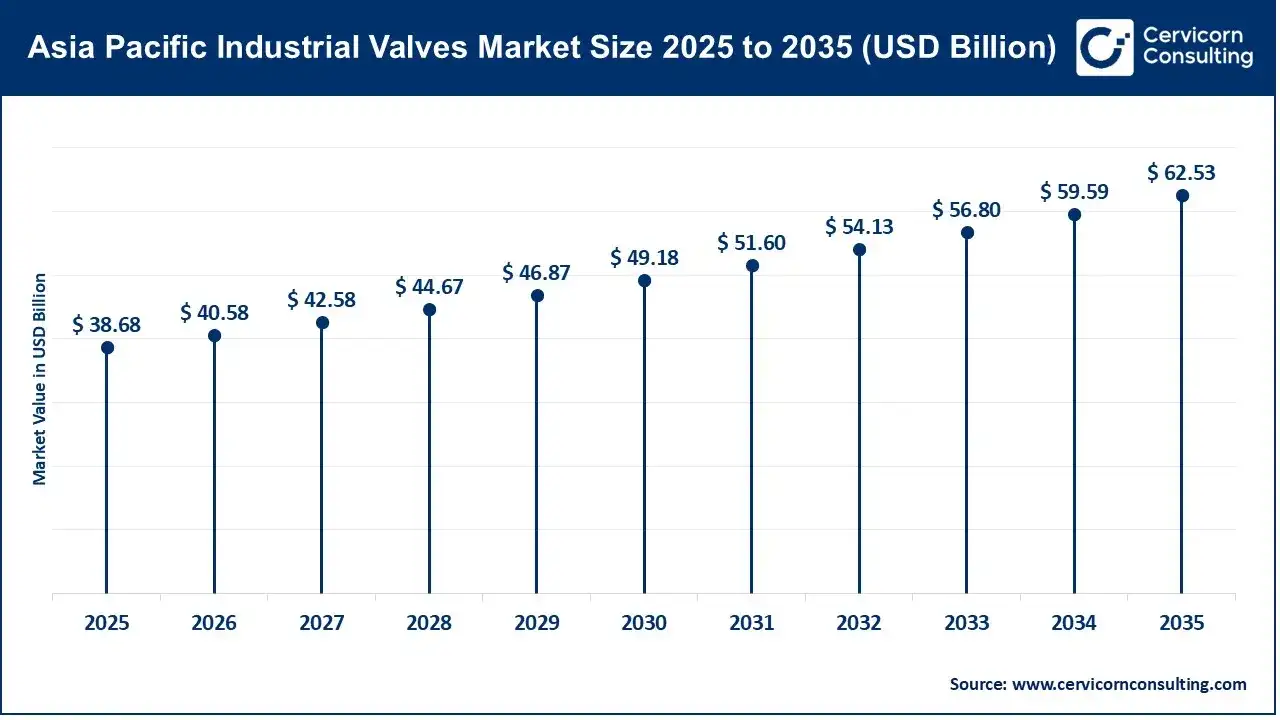
The Asia-Pacific industrial valves market size was estimated at USD 38.68 billion in 2025 and is expected to surpass USD 62.53 billion by 2035. Asia Pacific dominated the market in 2025 because major economies are rapidly industrializing, developing their infrastructure, and expanding their manufacturing and energy facilities. Oil and gas, chemicals, power generation, water treatment, mining, and manufacturing industries all have significant demand in the region. Flow-control equipment is in high demand due to growing investments in pipelines, water infrastructure, urban development, and industrial facilities. The region's dominant position is further reinforced by the existence of sizable manufacturing bases and growing industrial capacity.
North America: Energy Modernization and Smart Industrial Technologies Accelerate Growth
The North America industrial valves market size was valued at USD 26.46 billion in 2025 and is projected to reach USD 42.78 billion by 2035. North America is expected to be the fastest-growing region. Regional demand is being supported by growing investments in energy infrastructure, lng facilities, natural gas pipelines, water treatment, factory modernization, and industrial automation. Automated and smart valve technologies are also being used by industries more frequently to improve maintenance, safety, and process efficiency. It is anticipated that further opportunities for industrial valve makers will arise from ongoing infrastructure improvements and the growth of sophisticated industrial facilities.
Segmental Analysis
Valve Type Analysis
Ball valves dominated the industrial valves market in 2025 because of their low pressure drop, dependable shut-off performance, and suitability for managing liquids, gases, and other process fluids. They are extensively utilized in the oil and gas, chemical, power, water, and manufacturing sectors due to their compact size and capacity to offer fast and tight flow isolation. The demand for ball valves is also being supported by expanding industrial infrastructure and the replacement of outdated flow-control systems. They are also favored for critical industrial applications because of their robustness and very low maintenance requirements.
The check valves segment is expected to be the fastest-growing market. Pipelines, water and wastewater systems, oil and gas facilities, power plants, and chemical processing units are adopting them due to the growing need for dependable backflow protection. Pumps, compressors, and other equipment are shielded against reverse fluid flow and potential damage by check valves. It is anticipated that their use in industrial facilities will grow as pipeline networks and utility infrastructure expand.
Valve Operation Analysis
Manual valves dominated the industrial valves market in 2025 due to their affordable operation, straightforward design, and ease of installation. They are frequently employed in applications that do not require frequent automated control, especially for maintenance and isolation. Water treatment, oil and gas, chemical processing, manufacturing, and utility systems all frequently use manual valves. Their broad use in industrial facilities is still supported by their simple design and reduced operating complexity.
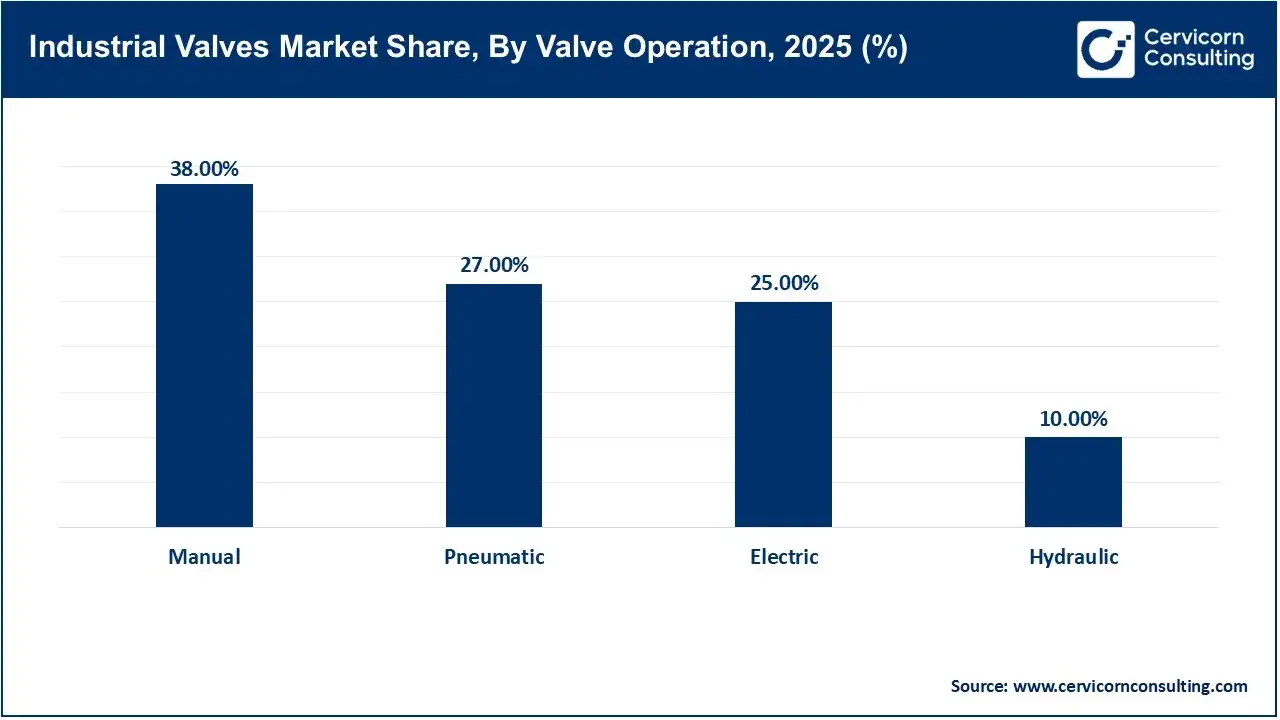
The electric segment is expected to be the fastest-growing segment. The growing use of electrically powered valves is being driven by increasing industrial automation and the requirement for accurate remote flow control. Automated opening and closing, process monitoring, and integration with industrial control systems are all possible with electric actuators. The trend toward efficient and digitally connected operations further supports their expanding use in the manufacturing, water treatment, energy, and process industries.
Material Analysis
Steel dominated the industrial valves market in 2025 because of its exceptional strength, resilience, and capacity to tolerate harsh pressure and temperature conditions. Oil and gas, power generation, chemical processing, water treatment, and heavy industrial applications all make extensive use of carbon steel and stainless steel valves. Steel valves are appropriate for a variety of fluid-handling systems and provide dependable performance under demanding working conditions. Market demand is still supported by their proven industrial applications and availability in a variety of specifications.
The alloy-based segment is expected to be the fastest-growing segment in the market. The adoption of specialty alloys is being encouraged by the growing demand for valves that can function under high pressures and temperatures and in corrosive conditions. Compared with traditional materials, nickel alloys, copper alloys, and other modern materials offer improved strength, durability, and resistance to corrosion. New growth prospects are being created by their expanding use in demanding industries such as chemical processing, oil and gas, and power generation.
Valve Size Analysis
The 1–6 inches segment dominated the industrial valves market in 2025 because it is widely used in commercial infrastructure, manufacturing plants, water systems, chemical facilities, and general industrial processes. These valves are easier to install and maintain and are appropriate for a variety of flow-control and isolation applications. They can be applied to both new projects and replacement tasks due to their adaptability. This segment's dominance is sustained by steady demand from a variety of industrial sectors.
Industrial Valves Market Share, By Valve Size, 2025 (%)
| Valve Size |
Revenue Share, 2025 (%) |
| Up To 1 Inch |
12% |
| 1–6 Inches |
32% |
| 6–12 Inches |
22% |
| 12–24 Inches |
17% |
| 24–48 Inches |
11% |
| Above 48 Inches |
6% |
The above 48 inches segment is expected to be the fastest-growing segment. The need for large-diameter valves is being driven by rising investments in large-scale pipelines, water infrastructure, energy projects, and industrial facilities. High-volume fluid flows across important transmission and distribution networks must be managed by these valves. The need for oversized valve solutions is anticipated to rise further due to the expansion of large industrial projects and growing infrastructure development.
End-Use Industry Analysis
The oil & gas segment dominated the industrial valves market in 2025, as valves are widely used in operations related to exploration, production, refining, processing, transportation, and storage. Crude oil, natural gas, refined products, and other process fluids all depend on valves to regulate their flow and pressure. Demand is still supported by rising investments in upstream operations, lng facilities, pipeline infrastructure, and refining capacity. The segment's position is further strengthened by the requirement for dependable and safety-focused flow-control technology.
The water & wastewater segment is expected to be the fastest-growing segment. The need for dependable flow-control solutions is being driven by rising investments in desalination facilities, water treatment plants, wastewater management systems, and distribution networks. Water is regulated, isolated, and directed throughout treatment and distribution processes using industrial valves. Continued adoption is anticipated to be supported by growing concerns about water availability, modern infrastructure, and effective water management.
Technology Analysis
Conventional valves dominated the industrial valves market in 2025 due to their proven application in a variety of industrial settings. Many facilities choose them because of their easy-to-use operational mechanisms, wide availability, and compatibility with current infrastructure. In the oil and gas, water, chemical, power, and manufacturing sectors, conventional valves are widely utilized for fundamental flow control, isolation, and pressure management. Their market position is being supported by the growth of industrial facilities and the ongoing replacement of existing equipment.
Industrial Valves Market Share, By Technology, 2025 (%)
| Technology |
Revenue Share, 2025 (%) |
| Conventional Valves |
48% |
| Automated Valves |
30% |
| Smart Valves |
14% |
| Iot-Enabled Valves |
8% |
The smart valves segment is expected to be the fastest-growing segment. The need for valves with sensors, digital connectivity, diagnostics, and real-time monitoring capabilities is being driven by growing industrial digitization. By supporting predictive maintenance and providing information about operational conditions, smart valves can help companies increase productivity and decrease unscheduled downtime. Adoption across process industries is anticipated to accelerate due to their growing integration with automation and industrial control systems.
Government Initiatives
- In March 2026, the union cabinet approved the government of india's bharat audyogik vikas yojana (bhavya) to build 100 plug-and-play industrial parks with ready infrastructure, underground utilities, drainage, shared treatment facilities, testing labs, and other industrial services. The growth of manufacturing infrastructure is anticipated to support the demand for industrial valves used in fluid, gas, steam, water, and process-flow applications.
- In March 2026, nicdc was assigned to spearhead the implementation of bhavya, with an emphasis on investment-ready industrial parks with integrated utilities and infrastructure. Additional uses for industrial valves in manufacturing, utility, water, and process systems may arise from the growth of these industrial ecosystems.
- In May 2026, dpiit released operational guidelines for creating investment-ready industrial parks with integrated infrastructure, utility systems, testing facilities, logistics, and sustainable industrial services under the bhavya implementation framework. The need for industrial valves in manufacturing and utility networks may rise as a result of such infrastructure growth.
Recent Developments
- In February 2026, Flowserve announced an agreement to acquire trillium flow technologies’ valves division, strengthening its valve and actuation portfolio for nuclear power, traditional power generation, industrial, and critical infrastructure applications. The acquisition is expected to expand flowserve’s capabilities in mission-critical flow-control solutions and aftermarket services.
- In January 2026, Emerson released fisher valvelink pro software, designed to configure, calibrate, and diagnose fisher fieldvue dvc7k digital valve controllers. The software provides diagnostic alerts and offline testing capabilities to support proactive valve maintenance and improve reliability.
- In April 2026, Emerson introduced the fisher ic2 cryogenic top-entry control valve, designed for extremely low-temperature applications, including lng production, hydrogen liquefaction, and air separation. The valve focuses on reducing energy losses and leakage while providing reliable performance in demanding cryogenic environments.
- In April 2026, Emerson introduced the fisher svx steam conditioning valve, designed for precise pressure and temperature control in combined-cycle power plants and other critical process environments. The valve combines high-pressure durability, reduced noise and vibration, and easier maintenance for demanding steam applications.
- In July 2026, Emerson launched the tescom rc-x motorized injection rate control valve, designed for accurate and repeatable chemical dosing in offshore refineries. The valve helps reduce chemical waste, downtime, and maintenance requirements while supporting flow assurance in high-pressure applications.
Key Companies
Segments covered
By Valve Type
- Ball Valves
- Gate Valves
- Butterfly Valves
- Globe Valves
- Check Valves
- Plug Valves
- Diaphragm Valves
- Safety Valves
- Pressure Relief Valves
- Needle Valves
- Pinch Valves
- Others
By Valve Operation
- Manual
- Pneumatic
- Electric
- Hydraulic
By Material
- Steel
- Carbon Steel
- Stainless Steel
- Cast Iron
- Ductile Iron
- Alloy-Based
- Nickel Alloys
- Copper Alloys
- Other Alloys
- Plastic
- Others
By Valve Size
- Up To 1 Inch
- 1–6 Inches
- 6–12 Inches
- 12–24 Inches
- 24–48 Inches
- Above 48 Inches
By Pressure Range
- Up to 50 Bar
- >50–350 Bar
- >350–700 Bar
- >700–1
- 000 Bar
- >1
- 000 Bar
By End-Use Industry
- Oil & Gas
- Water & Wastewater
- Energy & Power
- Chemical & Petrochemical
- Pharmaceutical
- Food & Beverage
- Mining & Metals
- Pulp & Paper
- Marine
- Automotive
- Construction
- Agriculture
- Others
By Technology
- Conventional Valves
- Automated Valves
- Smart Valves
- Iot-Enabled Valves
By Region
- North America
- Europe
- Asia pacific
- Latin America
- Middle east & Africa