Industrial Filtration Market Size and Growth 2026 to 2035
The global industrial filtration market size was valued at USD 41.58 billion in 2025 and is expected to exceed around USD 67.49 billion by 2035, exhibiting a compound annual growth rate (CAGR) of 4.96% over the forecast period from 2026 to 2035. The industrial filtration market is primarily driven by stricter environmental regulations and the global need to reduce pollution across various sectors. Governments are implementing tougher standards for emissions and wastewater treatment, pushing manufacturers to adopt advanced filtration technologies to eliminate particulates and harmful contaminants. This urgency is supported by alarming environmental data—about 99% of the global population faces unsafe air pollution levels, which significantly heighten health risks and encourage industries to pursue cleaner production methods. Rapid industrial growth and urbanization, especially in developing economies, further increase demand, as sectors such as chemicals, power, and manufacturing expand and require filtration to ensure product quality, protect equipment, and comply with regulations. The rising need for clean water and wastewater treatment in industrial processes also plays a crucial role, particularly in liquid filtration used for purification and separation.
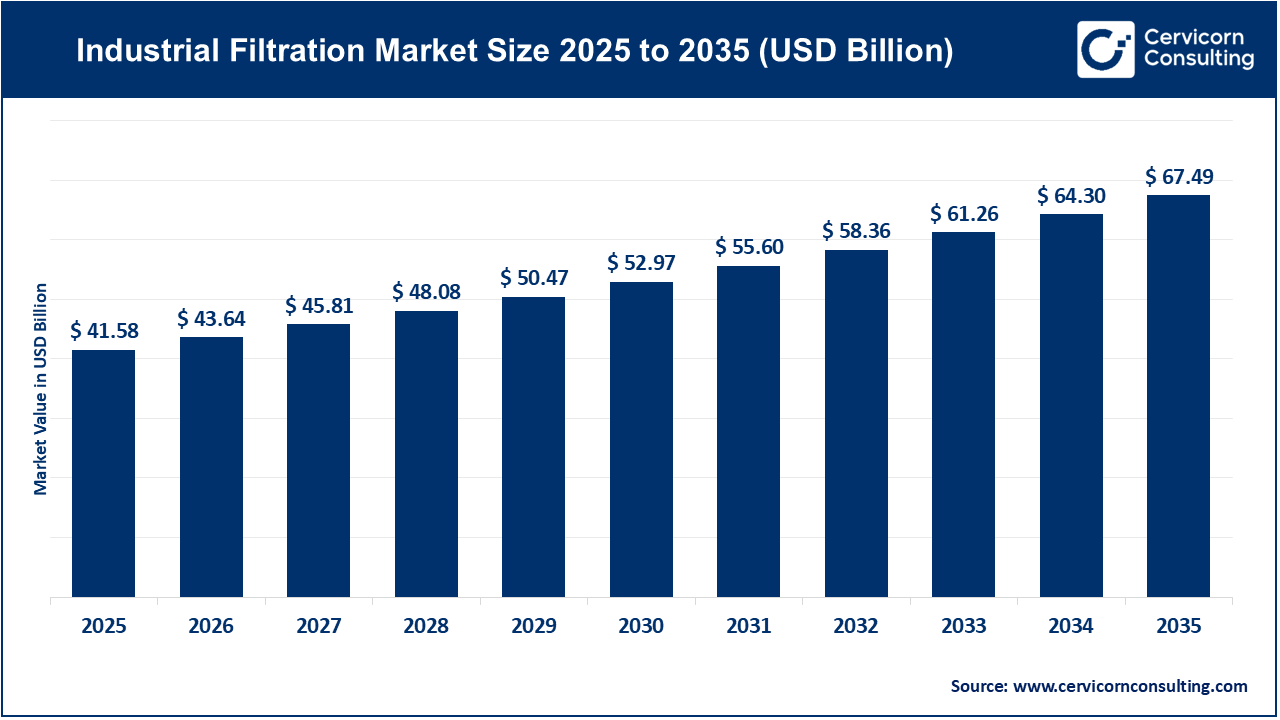
From a technological standpoint, growth is driven by rising industrial production, infrastructure projects, and improvements in filtration efficiency. For example, liquid filtration systems account for about 65-68% of industrial filtration applications, underscoring their strong presence in process industries. Sectors such as chemicals and petrochemicals account for over 27% of end-use demand, underscoring their heavy reliance on filtration to handle complex, hazardous substances. Innovations such as membrane filtration, nanofiber media, and IoT-enabled smart systems are enhancing operational efficiency, cutting downtime, and enabling real-time process monitoring. Along with greater focus on worker safety, product purity, and contamination prevention, these technological advances are promoting wider industry adoption. Additionally, expanding urban infrastructure and industrial activities are increasing the need for high-performance filtration systems capable of removing microcontaminants and improving overall quality.
Report Highlights
- By Region, North America leads with 36.4% share, supported by strict environmental regulations and advanced industrial infrastructure.
- By Region, Asia-Pacific follows with 28.7% share and is the fastest-growing region, driven by rapid industrialization and government-led environmental initiatives.
- By Type, the liquid filtration dominates market, accounting for 66.2% share, driven by strong demand in wastewater treatment, food processing, and chemical industries.
- By Filter Media, the non-woven fabric accounted for a highest revenue share of 27.8%, owing to its cost-effectiveness, durability, and wide industrial applicability.
- By Product, the bag filters dominate market with 24.3% share, widely used in heavy industries like cement, mining, and power generation for dust collection.
- By End Use, the chemicals & petrochemicals is the leading segment with 19.8% share, due to extensive filtration needs across multiple processing stages.
Role of Process Filtration in Food & Beverage Industry Driving Industrial Filtration Market
Process filtration in the food and beverage industry is a major driver of growth in the industrial filtration market, as manufacturers increasingly prioritise product purity, safety, and regulatory compliance. Filtration systems are deeply integrated into production processes such as dairy processing, beverage clarification, and water purification, removing microorganisms, suspended solids, and other contaminants without compromising taste or nutritional value. The surge in global consumption of packaged and processed foods, along with stricter hygiene standards, has prompted companies to adopt advanced technologies such as membrane and sterile air filtration. These systems not only enhance production efficiency and shelf life but also reduce contamination risks and product recalls, making filtration an essential component of modern food processing infrastructure.
The Significance of Industrial Filtration and Core Company Strategies
Industrial filtration is essential across industries because it directly affects operational reliability, product quality, regulatory compliance, and environmental protection. For example, in the food processing industry, filtration systems remove bacteria and suspended particles during milk or juice processing, ensuring safe consumption and extending shelf life. In heavy industries such as cement and steel, air filtration systems capture dust and fine particulates, preventing air pollution and protecting worker health. Similarly, in oil & gas and chemical manufacturing, liquid filtration removes impurities that could damage equipment or compromise reactions. Without effective filtration, companies face higher maintenance costs, production losses, regulatory penalties, and safety risks—making filtration a core part of industrial infrastructure rather than just an add-on.
Key Strategies
- Technology Innovation: Parker-Hannifin Corporation develops advanced membrane and nanofiber filtration systems to improve efficiency in chemical and pharmaceutical processes.
- Smart Filtration (IoT Integration): Donaldson Company, Inc. uses connected filtration systems that monitor filter life and performance in real time, reducing downtime in manufacturing plants.
- Product Customization: MANN+HUMMEL Group designs industry-specific filtration solutions, such as tailored air filtration for automotive manufacturing and cleanroom environments.
- Sustainability Focus: Eaton Corporation offers reusable and energy-efficient filtration systems that help industries reduce waste and water consumption.
Report Scope
| Are of Focus |
Details |
| Market Size in 2026 |
USD 43.64 Billion |
| Market Size in 2035 |
USD 67.49 Billion |
| CAGR 2026 to 2035 |
4.96% |
| Dominant Region |
North America |
| Fastest Growing Region |
Asia-Pacific |
| Key Segments |
Type, Product, Industry, Region |
| Key Companies |
MANN+HUMMEL Group, Donaldson Company, Inc., Pentair plc, Ahlstrom-Munksjö Oyj, Camfil AB, Parker-Hannifin Corporation, Eaton Corporation, 3M Company, Cummins Filtration, Alfa Laval AB, Filtration Group Corporation, Danaher Corporation |
Recent Major Milestones
1. Stricter Government Emission Regulations (India & Global Initiatives)
One of the most significant recent milestones is the implementation of stricter emission norms by regulatory bodies such as the Central Pollution Control Board (CPCB) in India. These updated standards require industries to control air and water pollution at the source, driving widespread adoption of advanced filtration systems across the manufacturing, power, and chemical sectors. This regulatory push is accelerating demand for high-efficiency filters, such as bag filters, HEPA systems, and membrane filtration systems, as companies upgrade existing infrastructure to remain compliant. As a result, filtration is no longer optional but embedded in industrial operations, significantly expanding market penetration across developing economies.
2. Rapid Growth of Filter Bag and Air Filtration Technologies
Recent industrial developments show strong momentum in the adoption of filter bags and air filtration, particularly in heavy industries such as cement, steel, and power generation. The filter bag segment alone exceeded USD 8.1 billion in 2024, with gas filtration dominating due to its critical role in capturing hazardous emissions. This milestone reflects a shift towards high-efficiency particulate capture technologies, driven by industrial pollution control requirements. The growing deployment of pulse jet filters (projected to generate around USD 3.4 billion in revenue in 2024) highlights how industries are investing in cost-effective, high-performance filtration solutions, thereby boosting overall industrial filtration demand.
3. Rise of Smart and IoT-Enabled Filtration Systems
A major technological milestone is the emergence of smart filtration systems integrated with IoT and real-time monitoring. Industries are increasingly deploying intelligent filtration solutions that track filter performance, predict maintenance needs, and optimize energy use. This trend aligns with broader industrial automation and Industry 4.0 adoption. For instance, smart air purification and filtration technologies are expanding rapidly, with connected systems enabling higher operational efficiency and reduced downtime. These innovations are driving market growth by shifting filtration from a passive system to an active, data-driven component of industrial processes, improving ROI and encouraging further adoption.
4. Sustainability Initiatives and Microplastic Filtration Programs
Environmental sustainability initiatives are also emerging as a key milestone, particularly efforts to reduce microplastic pollution through enhanced filtration at wastewater and recycling facilities. Recent global recommendations emphasize installing advanced filtration technologies to prevent microplastic leakage into ecosystems. This has prompted industries and municipalities to invest in finer filtration solutions capable of capturing microscopic contaminants. These initiatives are broadening the application of industrial filtration beyond traditional uses, creating new demand streams in water treatment, recycling, and circular economy systems—thereby strengthening long-term market growth.
Industrial Filtration Market Regional Analysis
The industrial filtration market is segmented by region into North America, Europe, Asia-Pacific, Latin America, and LAMEA. Here is a brief overview of each region:
North America Industrial Filtration Market: Driven by Technological Modernization and Regulatory Standards
The North America industrial filtration market size was valued at USD 15.14 billion in 2025 and is expected to reach around USD 24.57 billion by 2035.
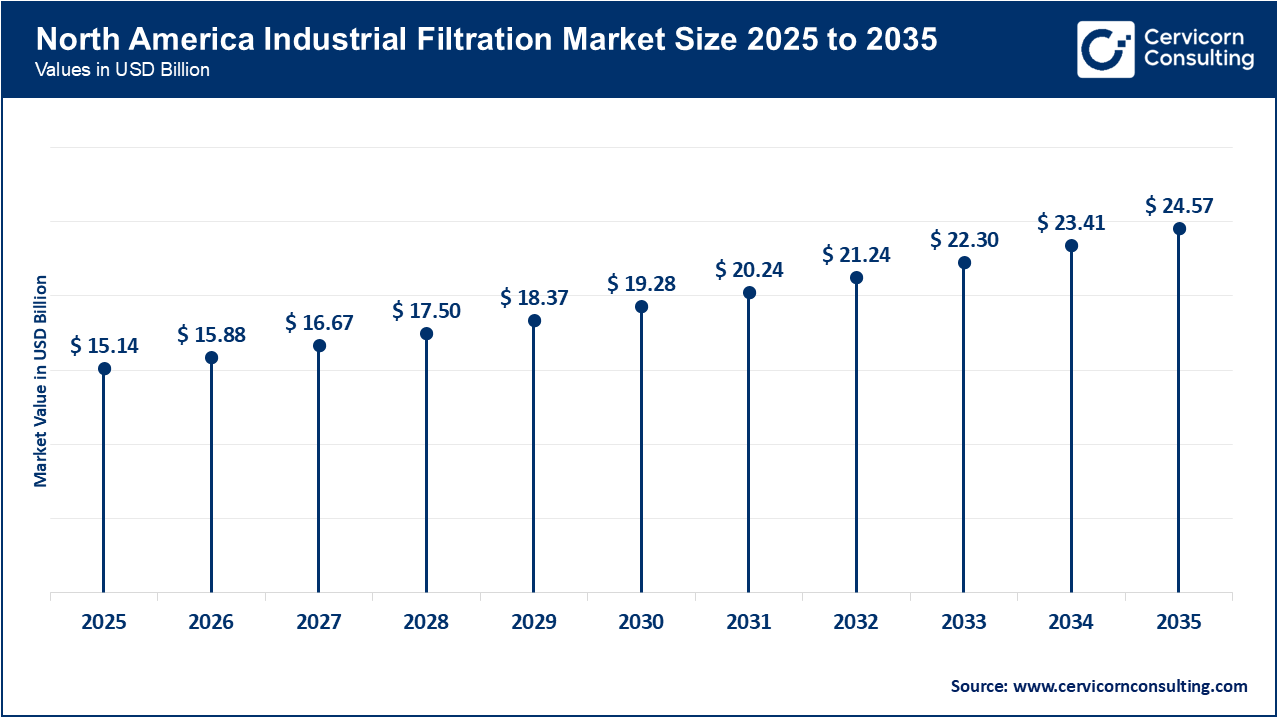
North America is a mature market characterized by strict environmental regulations and continuous technological advancements. Industries are upgrading filtration systems to meet stringent standards for emissions, water quality, and product purity. High demand from pharmaceuticals, semiconductors, and advanced manufacturing sectors is driving adoption of high-performance filtration technologies. Infrastructure modernization and regulatory pressure are key growth drivers, particularly in water treatment and industrial emissions control.
United States: Infrastructure Modernization and High-Tech Industry Demand
The United States is a leading market due to strong regulatory enforcement and rapid growth in high-tech industries requiring ultra-pure filtration systems. Aging infrastructure replacement is also a major factor driving demand.
- USD 55 billion allocated for water infrastructure upgrades
- Industrial filtration demand rising with about 12% annual growth
- Strong demand from semiconductor and data center industries
- Increasing adoption of advanced filtration for PFAS removal
Canada: Resource Industries and Water Recycling Focus
Canada’s filtration demand is largely driven by its mining and oil sands industries, where water treatment and reuse are critical for environmental compliance.
- Oil sands operations targeting 80–90% water reuse
- Strong demand for filtration in mining and resource extraction
- Adoption of filtration systems in remote industrial sites
- Increasing focus on sustainable water management practices
Asia-Pacific (APAC) Industrial Filtration Market: Driven by Rapid Industrialization and Environmental Compliance
The Asia-Pacific industrial filtration market size was estimated at USD11.93 billion in 2025 and is forecasted to grow around USD 19.37 billion by 2035. Asia-Pacific is the dominant and fastest-growing region, supported by rapid industrialization, urban expansion, and increasing environmental regulations. Countries such as China and India are witnessing strong demand across manufacturing, chemicals, power generation, and water treatment industries. Rising industrial output and stricter pollution norms are pushing industries to adopt advanced filtration systems for both air and liquid applications. Government-led initiatives focused on water conservation, pollution control, and infrastructure development are accelerating adoption. China’s push toward water recycling and India’s large-scale investments in water infrastructure are key growth enablers.
China: Industrial Expansion and Water Recycling Initiatives
China is a global leader in industrial production, driving strong demand for filtration systems across chemicals, electronics, and manufacturing sectors. The country is also investing heavily in wastewater treatment and desalination to address water scarcity and pollution.
- Industrial filtration demand growing at about 15% annually in key sectors
- Target to increase recycled water use by 20% in water-stressed cities
- Desalination capacity expected to reach about 3 million m³/day by 2025
- High demand for filtration in coal-to-chemical and semiconductor industries
India: Government Missions and Clean Water Infrastructure
India’s industrial filtration market is driven by large-scale government initiatives to improve water access and reduce industrial pollution. Rapid industrialization and strict wastewater discharge norms are boosting adoption across sectors.
- Jal Jeevan Mission with USD 40+ billion investment in water infrastructure
- Strong demand from pharmaceuticals, food processing, and power sectors
- Expansion of Zero Liquid Discharge (ZLD) compliance in industries
- Growing adoption of filtration in municipal and industrial wastewater treatment
Europe Industrial Filtration Market: Driven by Sustainability and Circular Economy Initiatives
The Europe industrial filtration market size reached at USD 10.02 billion in 2025 and is expected to hit around USD 16.27 billion by 2035. The Europe market is shaped by strict environmental regulations and sustainability goals under frameworks such as the EU Green Deal. Industries are adopting advanced filtration systems to reduce emissions, improve energy efficiency, and support circular economy practices. Countries such as Germany and United Kingdom are leading in adoption due to their strong industrial base. The region is also seeing technological innovation in filtration systems, particularly in resource recovery and energy-efficient processes, supporting long-term market growth.
Germany: Industrial Strength and Advanced Filtration Engineering
Germany is a key market driven by its strong chemical and automotive industries, where filtration is essential for process efficiency and environmental compliance.
- High demand from chemical and automotive sectors
- Adoption of smart filtration under Industry 4.0 initiatives
- Growing use of filtration in hydrogen and energy sectors
- Strong export base for advanced filtration systems
United Kingdom: Water Infrastructure and Pharmaceutical Demand
The UK market is driven by investments in water infrastructure and increasing demand from pharmaceutical and utility sectors.
- Rising investment in water treatment and desalination projects
- Strong demand for high-purity filtration in pharma industry
- Focus on achieving Net Zero and sustainability targets
- Expansion of advanced wastewater treatment facilities
Industrial Filtration Market Share, By Region, 2025 (%)
| Region |
Revenue Share, 2025 (%) |
| North America |
36.4% |
| Europe |
24.1% |
| Asia-Pacific |
28.7% |
| LAMEA |
10.8% |
LAMEA Industrial Filtration Market: Driven by Industrial Expansion and Resource-Based Industries
The LAMEA industrial filtration market was valued at USD 4.49 billion in 2025 and is anticipated to reach around USD 7.29 billion by 2035. Latin America is an emerging market driven by growth in mining, agriculture, and manufacturing industries. Countries such as Brazil and Mexico are leading demand, with filtration systems playing a key role in improving operational efficiency and meeting environmental standards. Government initiatives and industrial investments are gradually increasing adoption of filtration technologies across the region. The Middle East, particularly Saudi Arabia and United Arab Emirates, is a major hub for advanced filtration technologies used in water treatment and energy sectors. Government-led initiatives and infrastructure investments are significantly boosting demand for filtration systems, especially in desalination and oil & gas industries.
Brazil: Water Infrastructure and Industrial Filtration Expansion
Brazil’s filtration market is supported by investments in water treatment and strong demand from mining and industrial sectors.
- Over 600 desalination systems installed for water access
- Strong demand from mining and pulp & paper industries
- Increasing adoption in agricultural water treatment
- Expected about 20% growth in water infrastructure spending
Saudi Arabia: Vision 2030 and Mega Desalination Projects
Saudi Arabia is heavily investing in desalination and water treatment as part of its long-term sustainability goals.
- Target for 90% desalination capacity based on advanced filtration
- Development of large-scale RO plants with high capacity
- Strong government support under Vision 2030
- Increasing demand from oil & gas and petrochemical industries
Industrial Filtration Market Segmental Analysis
The Industrial Filtration market is segmented into type, product type, technology, distribution channel, application, end users, and geography.
Type Analysis
Liquid filtration dominates the market due to its critical role in maintaining process efficiency, product purity, and regulatory compliance across industries such as food & beverage, pharmaceuticals, chemicals, and wastewater treatment. Industries rely heavily on liquid filtration systems to remove suspended solids, microorganisms, and chemical contaminants from process fluids, ensuring consistent product quality and protecting downstream equipment. The growing global emphasis on water scarcity and reuse has further strengthened demand for liquid filtration, as industries invest in advanced systems to recycle and treat wastewater within production cycles.
Industrial Filtration Market Share, By Type, 2025 (%)
| Type Segment |
Revenue Share, 2025 (%) |
| Liquid |
66.2% |
| Air |
33.8% |
Air filtration, on the other hand, is the fastest-growing segment, driven by stringent emission control regulations and rising awareness of workplace air quality. Industries such as cement, mining, and power generation are rapidly deploying advanced air filtration technologies to control particulate emissions and comply with environmental standards. The growing focus on reducing carbon footprints and improving occupational health is accelerating the adoption of high-efficiency air filters, including dust collectors and HEPA systems. As industrialization expands, particularly in emerging economies, the demand for air filtration solutions is expected to increase significantly.
Filter Media Analysis
Non-woven fabric is the dominant filter media segment due to its flexibility, cost-effectiveness, and wide applicability in both liquid and air filtration systems. It is extensively used in industrial filtration because it offers high dirt-holding capacity, durability, and adaptability to different filtration requirements. Industries prefer non-woven materials for their ability to balance performance and cost, making them suitable for large-scale operations such as dust collection, liquid purification, and general industrial processing.
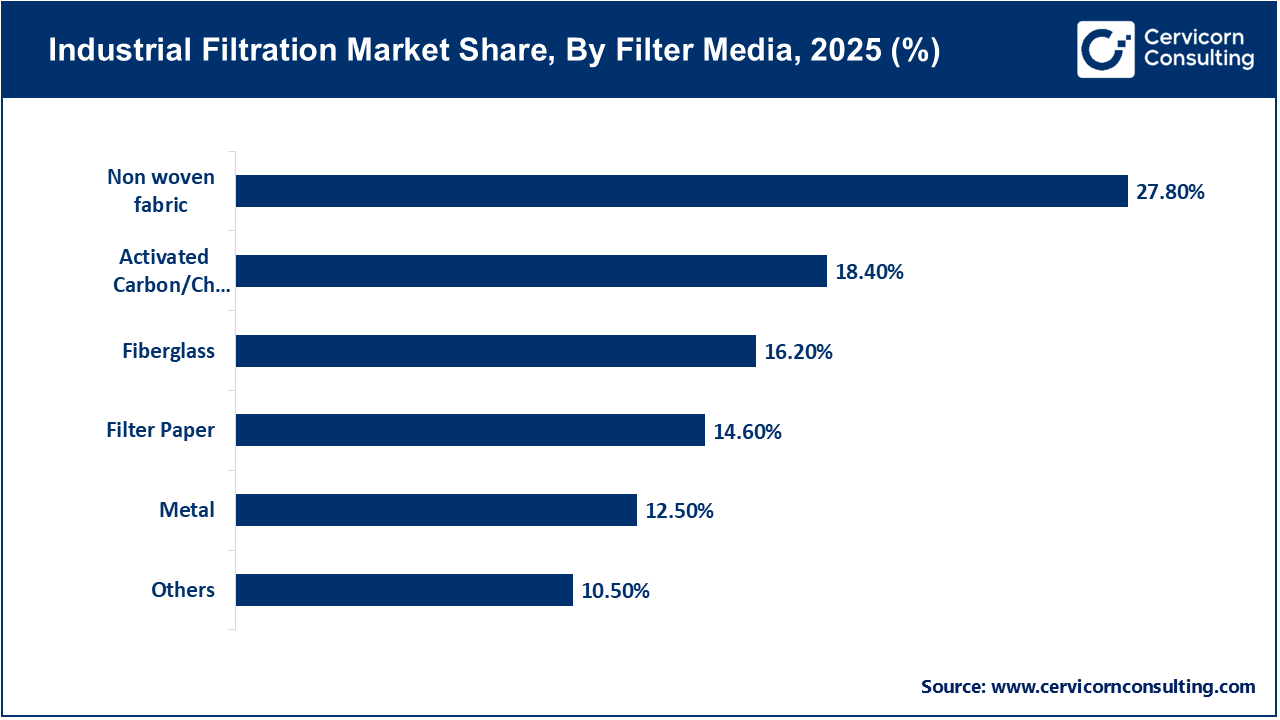
Activated carbon/charcoal is the fastest-growing filter media segment, primarily due to its superior adsorption properties, which enable effective removal of gases, odors, and dissolved contaminants. Its increasing use in air purification systems and water treatment processes is driving rapid adoption, especially in industries dealing with hazardous emissions and chemical processing. Additionally, rising environmental concerns and stricter regulations regarding volatile organic compounds (VOCs) and toxic substances are further boosting demand for activated carbon-based filtration solutions.
Product Analysis
Bag filters dominate the product segment as they are widely used for dust collection in heavy industries such as cement, steel, and power generation. Their high dust-holding capacity, cost-effectiveness, and ability to handle large volumes of air make them a preferred solution for industrial emission control. These filters are essential for maintaining compliance with environmental standards and ensuring efficient plant operations, which contributes to their strong market presence.
Industrial Filtration Market, By Product, 2025 (%)
| Product |
Revenue Share, 2025 (%) |
| Bag Filter |
24.3% |
| Cartridge Filter |
16.8% |
| Filter Press |
12.4% |
| Depth Filter |
10.6% |
| Electrostatic Precipitator |
14.2% |
| Drum Filter |
6.8% |
| HEPA |
9.7% |
| ULPA |
2.6% |
| Others |
2.6% |
HEPA (High-Efficiency Particulate Air) filters are the fastest-growing product segment, driven by increasing demand for high-purity environments in industries such as pharmaceuticals, food processing, and electronics manufacturing. These filters can remove extremely fine particles, including bacteria and viruses, making them critical for cleanroom applications. Growing awareness of airborne contamination and the need for stringent hygiene standards are accelerating the adoption of HEPA filtration systems across multiple sectors.
Industry Analysis
The chemicals & petrochemicals industry dominates the market due to its heavy reliance on filtration systems for handling complex chemical processes and hazardous materials. Filtration is required at multiple stages, including raw material processing, intermediate separation, and final product purification. Strict environmental and safety regulations further drive the need for advanced filtration solutions in this sector, making it one of the largest contributors to market demand.
Industrial Filtration Market, By Industry, 2025 (%)
| Industry |
Revenue Share, 2025 (%) |
| Food & Beverage |
13.5% |
| Power Generation |
15.2% |
| Chemicals & Petrochemicals |
19.8% |
| Oil & Gas |
12.6% |
| Metal & Mining |
11.4% |
| Pharmaceuticals |
10.2% |
| Automotive |
8.7% |
| Others |
8.6% |
The pharmaceutical industry is the fastest-growing segment, driven by rising global demand for medicines, vaccines, and biologics. This industry requires highly controlled and sterile environments, where even minor contamination can compromise product quality. As a result, pharmaceutical manufacturers are investing heavily in advanced filtration technologies such as membrane filtration and HEPA systems. The expansion of pharmaceutical manufacturing facilities and rising regulatory standards are significantly boosting the adoption of industrial filtration systems in this sector.
Industrial Filtration Market Top Companies
Recent Developments
- In February 2026, CECO Environmental announced a $2.2 billion acquisition of Thermon Group to expand its industrial filtration and environmental solutions portfolio into thermal and process systems, strengthening its position as a global industrial solutions provider.
- In January 2026, researchers at Rice University introduced a next-generation filtration material that can remove PFAS (“forever chemicals”) up to 100 times faster, offering a breakthrough for industrial water treatment and environmental remediation applications.
- In April 2026, Honeywell partnered with Dangote Group to deploy advanced petrochemical processing technologies at its refinery complex, thereby supporting large-scale industrial production and driving demand for high-performance filtration systems in petrochemical operations.
Market Segmentation
By Type
By Filter Media
- Activated Carbon/Charcoal
- Filter Paper
- Fiberglass
- Non woven fabric
- Metal
- Others
By Product
- Bag Filter
- Cartridge Filter
- Filter Press
- Depth Filter
- Electrostatic Precipitator
- Drum Filter
- HEPA
- ULPA
- Others
By Industry
- Food & Beverage
- Power Generation
- Chemicals & Petrochemicals
- Oil & Gas
- Metal & Mining
- Pharmaceuticals
- Automotive
- Others
By Geography
- North America
- Europe
- Asia-Pacific
- LAMEA