Membrane Filtration Market Size and Growth 2026 to 2035
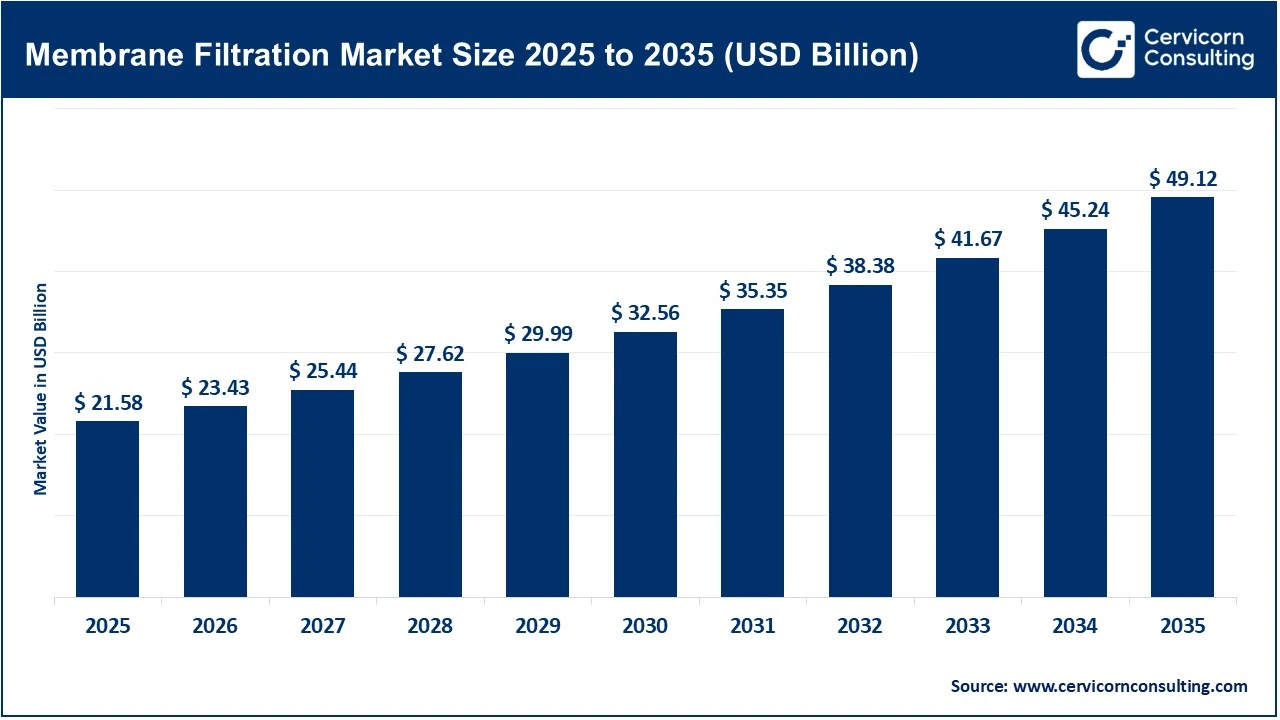
The global membrane filtration market size was estimated at USD 21.58 billion in 2025 and is expected to be worth around USD 49.12 billion by 2035, growing at a compound annual growth rate (CAGR) of 8.57% over the forecast period from 2026 to 2035. The overall demand for water purification with lower energy consumption across industries has offered a potential driver to the membrane filtration market.
Report Highlights
- By Region, Asia Pacific dominated the membrane filtration market in 2025, the overall rise in textile and chemical industries in Asian countries has promoted the market’s presence.
- By Region, North America is observed to grow rapidly in the market during the forecast period with the presence of funding programs for wastewater treatment and sustainability goals.
- By Membrane Material, the polymeric segment dominated the market in 2025 with revenue share of 69% due to its cost-effectiveness and flexibility of fabrication.
- By Membrane Material, the ceramic segment is expected to grow at the fastest rate during the forecast period with the rising demand from pharmaceutical and food industries.
- By Module Design, the spiral wound segment accounted highest revenue share of 42% in 2025 due to its high-efficiency in water and wastewater treatment.
- By Module Design, the hollow fiber segment is expected to grow at the fastest rate due to its ability of ultrafiltration in industrial processes.
- By Technology, the reverse osmosis segment led the market with revenue share of 40% in 2025 owing to the rising adoption in large-scale infrastructure-based projects.
- By Technology, the nanofiltration segment is seen to grow at the fastest rate with its overall demand in industrial water treatment.
- By Application, the water and wastewater segment held highest revenue share of 44% in 2025 with the overall changes is regulatory compliances for municipal and industrial sectors.
- By Application, the pharmaceutical segment is expected to grow at the fastest rate during the forecast period owing to the rising expansion of biopharmaceutical production.
Membrane Filtration Market Outlook
There are several types of membrane filtration technologies microfiltration, ultrafiltration, nanofiltration and reverse osmosis that enable different levels of separation from suspended solids and microorganisms to completely removing dissolved salts and micropollutants. The membranes used in each type of technology come in different materials and designs for various uses in many end-use industries including, water and wastewater treatment, food and beverage production, pharmaceutical manufacturing & chemical processing and industrial production. Membrane filtration is an important part of modern infrastructure/industry because it enables water reuse, desalination and high purity/water production processes.
Membrane Pricing Variations (Global Pricing Range)
| Membrane Type |
Price Range |
Cost Driver |
Global Buyers |
| Microfiltration |
$10-$50 |
Commodity grade |
Municipal utilities and food processors |
| Ultrafiltration |
$20-$100 |
Industrial usage |
Water treatment plants and pharmaceutical |
| Nanofiltration |
$30-$130 |
Selective separation |
Chemical processing and textile industry |
| Ceramic membranes |
$500-$1400 |
Chemical resistance |
Biopharma and specialty chemicals |
Expert panel at Cervicorn Consulting offer detailed benchmarking for consumer behavior of membrane filtration market; contact us today@ sales@cervicornconsulting.com
Membrane Filtration Market Dynamics
Driver
Rising Global Water Stress and Demand for High-Purity Treatment
A major factor driving the growth of the membrane filtration market is the increasing global stress on the world's water supply. The demand for freshwater has increased due to rapid urbanization and population growth. Meanwhile, manufacturing activities produce large amounts of contaminated wastewater.
“Global water usage is projected to increase by 20-30% by the year 2050, which will only increase pressure on current water supplies. Membrane filtration technologies have become more popular due to their ability to effectively remove contaminants; typically over 99% for bacteria, viruses, and dissolved solids. This applies to both municipal and industrial applications.”
There are many industries that use ultra-pure water; pharmaceutical, semiconductor and food processing are just a few examples. These and other industries have put additional demand on the membrane filtration market for products that can produce ultra-pure water. In addition, many industries have an objective to recycle or reuse 50-80% of the water they use, which is also driving growth in advanced membrane systems.
Restraint
High Operational Costs and Membrane Fouling Challenges
The market’s high demand faces serious constraints due to high operating costs and performance-related issues like membrane fouling and scaling. Membrane fouling is caused by organic build-up of matter, microbes, and suspended solids, which decreases system efficiency/increases maintenance. Studies show that fouling can cause 20-to-40-percent of the total performance loss in reverse osmosis systems resulting in a significant decrease in system productivity and operation costs.
Energy consumption is a significant concern also, particularly in reverse osmosis systems where energy can account for more than 30% of total operating costs. A growing number of cleaning cycles, chemicals used, and membrane replacements make the total lifecycle cost much greater than anticipated and thus a barrier to further adoption in cost-sensitive areas/and small systems. Because of the variability of feed water quality, operators typically need to invest in pre-treatment systems, further pushing up both capital and operating costs.
Opportunity
Expansion of Water Reuse, Industrial Recycling, and Emerging Contaminant Treatment
There are a number of factors that contribute to growth in the membrane filtration market, including the continued growth of initiatives promoting water reuse; industrial recycling efforts; and the increased need to manage emerging contaminants. Water agencies and industries around the world are making significant strides in improving overall management and sustainability of water resources. Wastewater reuse has rapidly become a key part of many programs aimed at bridging the supply and demand gap. Many high-volume water users in certain industrial sectors will adopt reuse as their primary means of water supply, resulting in long-term demand for advanced membrane filtration technologies.
In addition, advancements in digital monitoring, predictive maintenance (using artificial intelligence), and energy-efficient membrane designs will create a multitude of ways to optimize costs and improve performance of membrane filtration. The result is that these advancements will improve reliability, minimize downtime, and create new opportunities for applications of membrane filtration.
Membrane Filtration Market Regional Analysis
Urbanization & Industrialization to Support Asia Pacific’s Dominance: China to Lead the Market
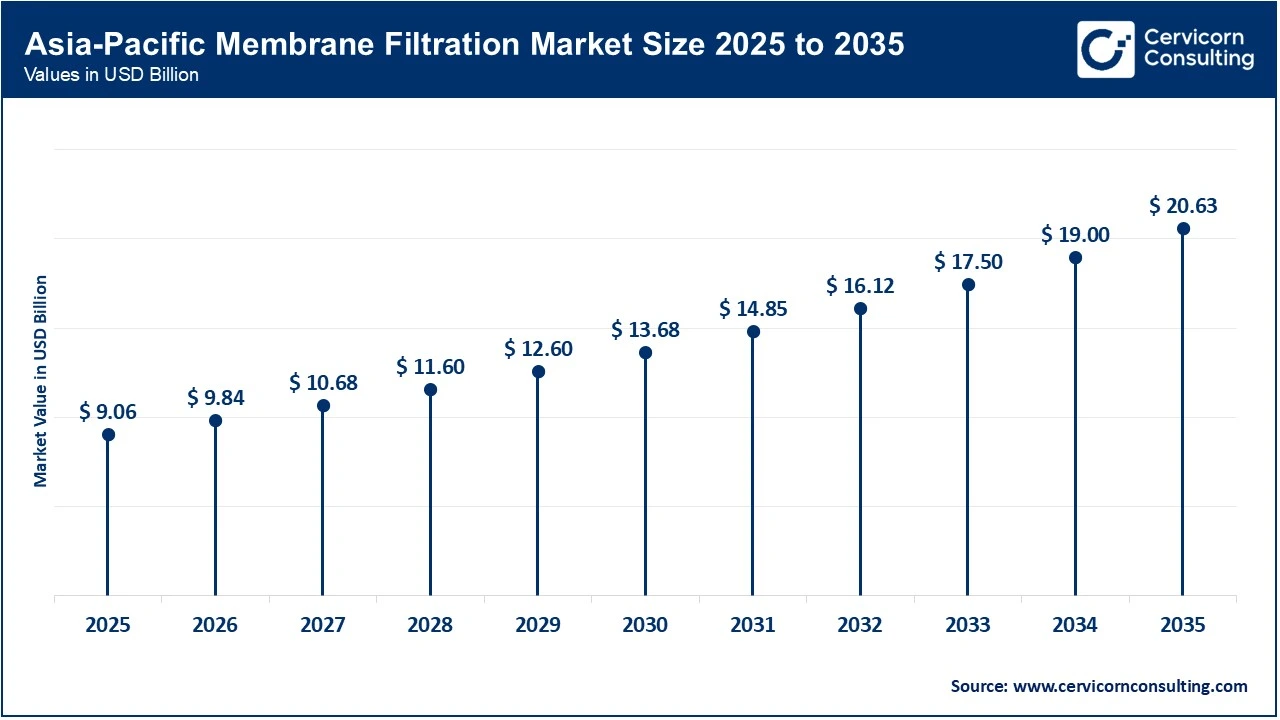
The Asia-Pacific membrane filtration market size was estimated at USD 9.06 billion in 2025 and is projected to surpass around USD 20.63 billion by 2035.
Asia Pacific dominated the membrane filtration market in 2025, due to rapid urban growth, high levels of industrial activity, and increasing strain being placed on available water resources, with China more than likely being the biggest contributor to this trend. Other factors that apply to this region include the high population density, the growth of the manufacturing sector and the growing requirements for sustainable treatment of water resources. In the past 10 years, urbanization in Asia Pacific has increased very quickly, which will cause water usage to rise sharply as well as raises in wastewater from these same entities.
“In China alone, over 900 million people live in cities which translates into over 65% of the population living in urban areas and therefore, continuing to populate urban areas will result in approximately 65 - 70 billion cubic meters of municipal wastewater being created each year, which will necessitate the replacement or re-development of existing wastewater treatment infrastructure.”
China Membrane Filtration Market Analysis
China is the leader in membrane filtration market due to its position as a global hub for manufacturing. The country uses approximately 580 - 600 billion cubic meters of water per year; industrial use makes up approximately 15 - 20% of China's entire water usage. Industrial activities such as chemicals, textiles, power generation, electronics, and pharmaceuticals are the main contributors to the high demand for water and the resulting waste discharge from these industries.
China's industrial waste discharge exceeds 50 billion cubic meters annually and requires significant advanced treatment to be reused or disposed of. Industries such as textile and chemical have some of the highest levels of pollutant contaminants and therefore provide an increased need for high-quality filtration technologies like reverse osmosis and nanofiltration.
Country-level Cost Benchmarking for Membrane used for Filtration:
| Country |
Pricing Advantage |
Buyers’ Index |
| China |
15-19% Cheaper (compared to global average price) |
Municipal utilities, industrial manufacturing, exports |
| India |
10-15% Cheaper |
Municipal projects, pharma, food processing |
| South Korea |
Near to average global pricing |
Electronics, semiconductor, industrial |
| Japan |
Premium range of pricing |
Municipal, high-tech industries, specialty chemicals |
How Does Regulatory Approach Supports the Membrane Filtration Market in North America?
The North America membrane filtration market size was valued at USD 5.61 billion in 2025 and is anticipated to hit around USD 12.77 billion by 2035. North America is experiencing rapid growth in the membrane filtration market due in part to the development of strict and developing regulatory systems, especially in the United States and Canada, where there is a high level of regulation around water quality, environmental protection, and industrial discharge. These regulations not only require increased levels of treatment efficiency, they also encourage companies and municipalities to invest in advanced technologies for filtration and to use reverse osmosis, ultrafiltration, and nanofiltration as a method of filtrationuling within their facilities.
Under the Safe Drinking Water Act, the Environment and Wildlife Services Agency has created detailed guidelines regarding the removal of contaminants (including pathogens, heavy metals, and newly emerging micropollutants) from public water systems. There are now approximately 300 million Americans who depend upon public water systems and the need to comply with these regulations have led to a general increase in the installation of membrane based filtration systems, especially ultrafiltration and reverse osmosis systems.
Top Funding Programs in North America to Promote Membrane Filtration Market’s Growth
- Clean Water State Revolving Fund (CWSRF)
The Clean Water CWSRF program provides low-interest loans to state and local governments to help with wastewater treatment facilities and other projects as they relate to the quality of water. The program also supports many new technologies like advanced granular media filtration and membrane type filtration; the annual funding for this program is around $2–3 billion and is geared toward helping to upgrade municipal and industrial wastewater treatment facilities.
- Drinking Water State Revolving Fund (DWSRF)
The DWSRF program is a major source of financing provided by the federal and state governments to improve the infrastructure of drinking water through the use of high-performance filtration technologies. This program emphasizes priority to small and rural communities, thus increasing the demand for compact and efficient membrane filtration systems.
- Infrastructure Investment and Jobs Act (IIJA) – Water Funding
This is one of the largest investments in U.S. water infrastructure, providing over $50 billion to be used to improve and maintain drinking water, wastewater and stormwater facilities. Many of the investments will be used to remove contaminants (especially PFAS) and modernize facilities resulting in a significant demand for advanced membrane filtration systems.
- Title XVI Water Reclamation and Reuse Program
This program is administered through the U.S. Department of the Interior and provides funding to support recycling and reuse of water through various projects, especially in areas with limited water supplies. Much of the funding provides resources for planning and designing facilities that will incorporate membrane filtration to treat wastewater for reuse.
Membrane Filtration Market Share, By Region, 2025 (%)
| Region |
Revenue Share, 2025 (%) |
| North America |
26% |
| Europe |
24% |
| Asia-Pacific |
42% |
| LAMEA |
8% |
Membrane Filtration Market Segmental Analysis
Membrane Material Analysis
The polymeric segment led the market in 2025. Polymeric membrane market share was primarily due to their low-cost basis, flexibility of membranes, and ability to be utilized in a variety of different industries. Based on the large number of installations that use polymeric membranes, these membranes are compatible with reverse osmosis, ultrafiltration and microfiltration technologies. Materials such as PVDF and polyethersulfone are often used for membrane manufacture due to their high resistance to chemicals (pH range of 2–11) and durability, making these materials suitable for applications such as wastewater treatment and for industrial uses. Further, polymeric membranes account for approximately 60% of the global microfiltration and ultrafiltration membrane systems, which demonstrates their growing use across multiple industries.
Membrane Filtration Market Share, By Membrane Material, 2025 (%)
| Membrane Material |
Revenue Share, 2025 (%) |
| Ceramic |
22% |
| Polymeric |
69% |
| Others |
9% |
Ceramic membranes segment is seen to grow at the fastest rate due to their extreme durability and capability to function in extreme conditions. They are able to withstand temperatures of 300 to 500°C and chemical pH ranges from 0 to 14. Both of these features make ceramic membranes well-suited for industrial applications that have severe chemical properties such as the chemical and pharmaceutical industries. In addition to their high temperature and pH resistance, ceramic membranes also demonstrate extensive operational lives of 10 or more years when used in chemically aggressive environments, resulting in reduced frequency of replacement and significantly lower life-cycle costs. Even though ceramic membranes are typically 3 to 5 times more expensive than polymeric membranes, ceramic membrane filtration solutions are being increasingly adopted by industries where there are significant contamination risks or stringent product quality standards.
Module Design Analysis
The spiral wound segment dominated the membrane filtration market in 2025. The majority of reverse osmosis modules used on the market are spiral wound. The combination of their compact design and high packing density (400 - 800 ft2) within an 8-inch diameter housing results in excellent productive capacity for limited space. Approximately 55% of the membranes utilized for Reverse Osmosis are spiral wound, with major market segments including seawater desalination and large water treatment facilities. Furthermore, due to their high filtration efficiency and comparatively lower capital cost than other types of membranes, spiral wound membranes are adequately suited to meet the needs of both municipal and industrial water treatment applications.
Membrane Filtration Market Share, By Module Design, 2025 (%)
| Module Design |
Revenue Share, 2025 (%) |
| Spiral Wound |
42% |
| Tubular Systems |
16% |
| Plate & Frame |
11% |
| Hollow Fiber |
31% |
The hollow fiber membrane segment is expected to grow at the fastest rate, due to their very large surface areas and the high level of filtration efficiency. Depending on the manufacturer’s design, these systems can provide surface area densities up to 3000m²/m³ and significantly increase throughput and performance. They are commonly utilized for ultrafiltration as well as in membrane bioreactor (MBR) systems, mainly for wastewater treatment, because they have the ability to remove high levels of pathogens (> 99.9%) and operate under low-pressure conditions, making them very attractive for decentralized and large-scale applications.
Technology Analysis
The reverse osmosis (RO), dominating the membrane filtration market is currently the most common form for generating high-purity water and desalinating seawater because of its ability to remove up to 99% of dissolved salts and impurities from the water. Reverse osmosis systems represent approximately 60% of the new desalination facilities being built globally versus thermal systems, indicating that RO is the preferred technology due to its efficiency and adaptability as it is used for large (commercial) and small residentialapplications. Additionally, improvements in membrane material have decreased energy consumption for operation by reducing it from greater than 10 kilowatt-hours (kWh) per cubic meter (m³) to below 3 kWh/m³, significantly increasing energy efficiency.
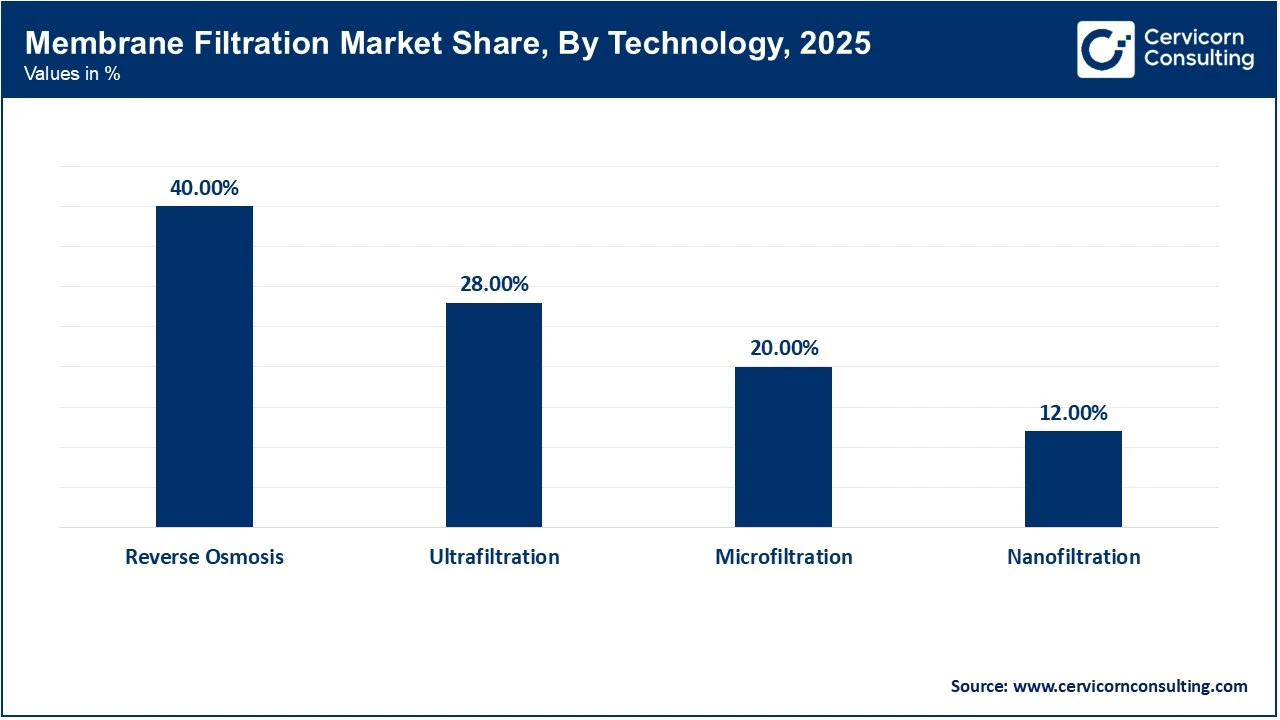
Being the fastest growing segment in the market for the forecast period, the nanofiltration (NF) is receiving increasing attention primarily because NF membranes have the ability to selectively remove divalent ions and micropollutants at lower operating pressures than RO membranes. NF membranes normally have operating pressures of 5–20 bar, which is much lower than the operating pressures for RO systems, resulting in a reduction in energy consumption.
NF membranes achieve 90–98% rejection of divalent ions, making them very suitable for use in applications such as water softening, industrial water reuse, or selective separation processes. In many applications, NF requires less than 30%–40%of the amount of energy that is required for RO, making it an energy-efficient alternative to RO for mid-level purification needs.
Application Analysis
The water and wastewater segment dominated the membrane filtration market in 2025. As many as 2.2 billion people lack access to clean drinking water worldwide, and this has created an even growing need for advanced filtration technologies to remove contaminants from these supplies. Municipalities and industry both utilize membrane systems as part of their water treatment processes, including turbidity removal and advanced purification techniques. For example, ultrafiltration can remove over 99.9% of all pathogens from a given sample, and microfiltration can maintain turbidity levels below 5 NTU for municipal treated water supplies.
Membrane Filtration Market Share, By Membrane Material, 2025 (%)
| Application |
Revenue Share, 2025 (%) |
| Water & Wastewater |
44% |
| Food & Beverages |
21% |
| Pharmaceutical |
11% |
| Industrial Processing |
16% |
| Others |
8% |
The pharmaceutical segment will see significant growth in the coming years due to the increased use of high-purity filtration in drug manufacturing and bioprocess. Membrane filtration systems are critical to sterile filtration, protein separation, and production of vaccines. Recently, membrane-based processes used in biologics have grown approximately 28% within the pharma ultrafiltration segment, which is driving overall demand and continued growth. Furthermore, specialized membranes provide significantly greater flux capabilities for manufacturers of pharmaceutical products.
Recent News
- Toray Industries, in January 2026 announced the launch of a new high-efficiency membrane filtration module integrating ultrafiltration with advanced pretreatment capabilities. The product is designed to enhance durability and filtration performance in large-scale water treatment applications, addressing rising global demand for efficient and low-maintenance filtration systems.
- Alfa Laval in August 2023 introduced an advanced membrane filtration solution tailored for the plant-based protein industry. The system focuses on improving yield, purity, and energy efficiency in food processing operations, supporting the growing shift toward sustainable and alternative protein production.
Membrane Filtration Market Top Companies
Market Segmentation
By Membrane Material
By Module Design
- Spiral Wound
- Tubular Systems
- Plate & Frame
- Hollow Fiber
By Technology
- Reverse Osmosis
- Ultrafiltration
- Microfiltration
- Nanofiltration
By Application
- Water & Wastewater
- Food & Beverages
- Pharmaceutical
- Industrial Processing
- Others
By Region
- North America
- Asia Pacific
- Europe
- Latin America
- Middle East & Africa