Hydrogen Transportation Market Size, Growth, Forecast 2026 to 2035
The global hydrogen transportation market size was valued at USD 1.52 billion in 2025 and is expected to hit around USD 15.94 billion by 2035, reflecting a compound annual growth rate (CAGR) of 26.5% over the forecast period from 2026 to 2035. The hydrogen transportation market is being driven by the global push toward decarbonization of the mobility sector, particularly in heavy-duty transportation where battery-electric solutions face limitations related to range, payload, and charging times. Hydrogen fuel cell vehicles (FCEVs) offer fast refueling and longer driving ranges, making them attractive for trucks, buses, rail, marine, and future aviation applications. According to the International Energy Agency (IEA), global hydrogen demand exceeded 97 million tonnes in 2023 and is expected to approach 100 million tonnes in 2024, while hydrogen demand in road transportation increased by approximately 55% in 2023, led by the deployment of fuel-cell trucks and buses in China and other major markets. Governments across Europe, Asia-Pacific, and North America are supporting hydrogen adoption through subsidies, zero-emission vehicle mandates, and investments in hydrogen production and refueling infrastructure, accelerating commercialization of hydrogen-powered transport solutions.
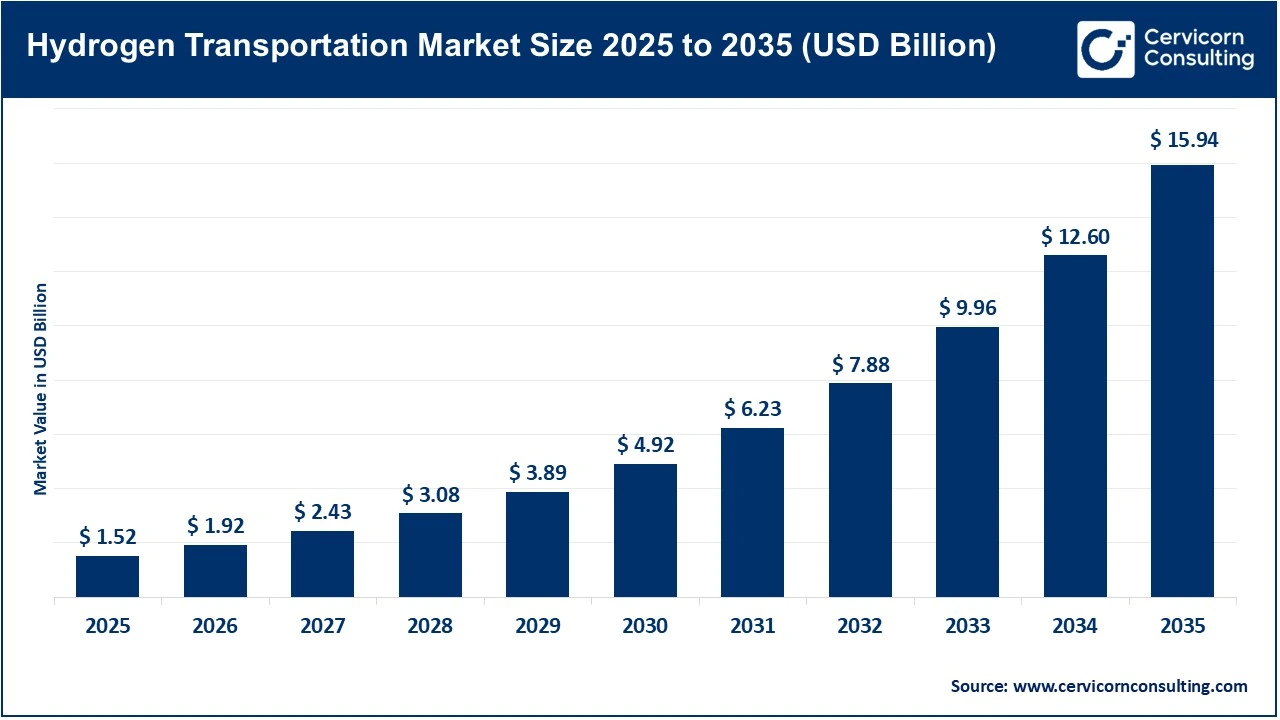
Another major growth factor is the rapid expansion of the hydrogen value chain, including electrolyzer capacity, storage systems, and fueling networks. The IEA reports that installed water electrolyzer capacity reached 1.4 GW by the end of 2023 and could expand significantly over the coming decade as countries invest in low-emission hydrogen production. In parallel, hydrogen fueling infrastructure is growing rapidly, with the global hydrogen fueling station market projected to expand substantially through the next decade. Automotive manufacturers such as Toyota, Hyundai, BMW, Daimler Truck, and Honda continue to invest in fuel-cell technology, particularly for long-haul commercial vehicles where hydrogen’s higher energy density provides operational advantages. Furthermore, the IEA highlights freight corridors, truck fleets, and public transportation networks as priority areas for hydrogen deployment, creating strong demand for hydrogen-powered mobility solutions worldwide.
Report Highlights
- Asia-Pacific dominated the Hydrogen Transportation Market with 48.2% share, driven by extensive fuel-cell vehicle deployment and hydrogen infrastructure investments.
- Trucks led the vehicle type segment with 42.8% share, owing to increasing adoption in long-haul freight and logistics operations.
- Fuel Cell Electric Vehicles (FCEVs) dominated the technology segment with 89.6% share, supported by high efficiency and zero-emission performance.
- Gray Hydrogen accounted for 61.8% of the fuel type segment, due to established production infrastructure and lower production costs.
- Road Transportation held the largest mode share at 84.3%, driven by growing deployment of hydrogen-powered trucks, buses, and fleets.
- Long-Haul Transportation led the distance segment with 46.9% share, supported by hydrogen's long range and fast refueling advantages.
What is hydrogen transportation?
Hydrogen transportation refers to the use of hydrogen as an energy carrier or fuel to power vehicles and transport systems. Hydrogen is primarily utilized through fuel cell technology, where hydrogen reacts with oxygen to generate electricity, emitting only water vapor as a byproduct, or through hydrogen internal combustion engines (H2-ICE). The technology is gaining traction as a low-emission alternative to conventional fossil-fuel-powered transportation, particularly in applications requiring long driving ranges, heavy payload capacity, and rapid refueling. Hydrogen transportation plays a significant role in global decarbonization efforts across road, rail, marine, and aviation sectors.
Growing Decarbonization Policies and Government Subsidies & Investments Driving Market Growth
The hydrogen transportation market is experiencing significant growth due to increasingly stringent decarbonization policies and substantial government investments aimed at achieving net-zero emission targets. Governments across Europe, North America, and Asia-Pacific are introducing incentives, tax credits, and funding programs to accelerate the deployment of hydrogen-powered vehicles and supporting infrastructure. According to the International Energy Agency (IEA), hydrogen demand in road transportation increased by approximately 55% in 2023, reflecting growing adoption of fuel-cell buses, trucks, and commercial vehicles. Additionally, global investment commitments in low-emission hydrogen projects have accelerated rapidly, with final investment decisions for hydrogen projects doubling during 2024. These initiatives are creating favorable market conditions for hydrogen transportation by reducing technology costs, encouraging fleet electrification, and expanding hydrogen refueling networks.
Major Government Hydrogen Initiatives Supporting Transportation
| Region |
Investment |
Transportation-Focused Objective |
| European Union |
EUR 18+ billion |
Develop renewable hydrogen production and hydrogen refueling corridors for trucks, buses, rail, and maritime transport |
| United States |
USD 7 billion |
Establish Regional Clean Hydrogen Hubs to support fuel-cell vehicles and hydrogen infrastructure |
| Japan |
USD 20+ billion (public-private investment) |
Expand hydrogen supply chains and increase deployment of fuel-cell vehicles and commercial transport |
| South Korea |
USD 30+ billion |
Accelerate adoption of hydrogen vehicles and nationwide hydrogen refueling station development |
| China |
Multi-billion-dollar national and provincial subsidies |
Deploy 50,000+ fuel-cell vehicles and establish hydrogen transportation clusters |
| Germany |
EUR 9+ billion |
Support green hydrogen production and hydrogen mobility infrastructure projects |
| India |
USD 2.3+ billion |
Promote green hydrogen production and adoption in buses, trucks, railways, and logistics |
| United Kingdom |
GBP 2+ billion |
Support hydrogen-powered buses, heavy-duty vehicles, and rail transportation |
| Canada |
Multi-billion-dollar investments |
Expand hydrogen use in freight transportation and public transit systems |
| Australia |
AUD 8+ billion |
Develop hydrogen mobility solutions for mining, freight, and regional transportation sectors |
Recent Major Milestones
1. Daimler Truck Demonstrates Large-Scale Real-World Fuel Cell Truck Operations (2025)
In September 2025, Daimler Truck announced that five Mercedes-Benz GenH2 fuel-cell trucks had collectively surpassed 225,000 kilometers in customer operations with companies including Air Products, Amazon, Holcim, and INEOS. The trials demonstrated that hydrogen-powered heavy-duty trucks can achieve long ranges and fast refueling while integrating into normal logistics operations. This milestone is significant because heavy-duty trucking is one of the most challenging sectors to decarbonize, and successful commercial demonstrations reduce concerns about vehicle reliability, operating performance, and fleet adoption. As logistics operators gain confidence in hydrogen technology, demand for fuel-cell trucks, hydrogen production, and refueling infrastructure is expected to increase, accelerating overall market growth.
2. China Expands Hydrogen Vehicle Subsidies and Demonstration Programs (2025)
In April 2025, China allocated an additional CNY 2.34 billion (USD 321 million) to hydrogen fuel-cell vehicle demonstration projects, bringing total funding under the program to more than CNY 5.11 billion (USD 700 million) over three years. The initiative supports hydrogen vehicle deployment, fueling infrastructure, and regional hydrogen transportation ecosystems across multiple city clusters. This milestone is driving market growth by lowering adoption costs for fleet operators, encouraging vehicle purchases, and creating economies of scale for manufacturers. China’s continued financial support is helping establish one of the world's largest hydrogen transportation ecosystems and accelerating commercialization of fuel-cell trucks, buses, and logistics vehicles.
3. Air Products Expands Heavy-Duty Hydrogen Refueling Infrastructure in Germany (2024–2025)
Air Products received government funding to build and operate two large-scale hydrogen refueling stations in North Rhine-Westphalia, Germany. These stations are designed to serve medium- and heavy-duty commercial vehicles and support the expansion of hydrogen freight transportation corridors. Infrastructure availability remains one of the biggest barriers to hydrogen vehicle adoption; therefore, investments in high-capacity refueling networks directly address range and fueling concerns among fleet operators. As more hydrogen stations become operational, transportation companies are more likely to invest in fuel-cell trucks and buses, creating a positive cycle of vehicle deployment and infrastructure expansion.
4. Expansion of China's Hydrogen Fuel Cell Vehicle City Clusters (2025)
China's hydrogen fuel cell vehicle (HFCV) city cluster program continued to expand through 2025, covering five major clusters comprising 44 cities focused on hydrogen vehicle deployment, infrastructure development, and industrial collaboration. The initiative integrates local governments, vehicle manufacturers, hydrogen suppliers, and infrastructure providers to create complete hydrogen mobility ecosystems. This milestone is accelerating market growth by concentrating investments in strategic regions, improving supply-chain coordination, and increasing fuel-cell vehicle utilization rates. The cluster approach also enables faster technology commercialization and provides a scalable model that other countries may replicate to promote hydrogen transportation adoption.
Regional Analysis
The hydrogen transportation market is segmented by region into North America, Europe, Asia-Pacific, Latin America, and LAMEA. Here is a brief overview of each region:
North America Hydrogen Transportation Market: Driven by Strong Decarbonization Policies, Expanding Hydrogen Infrastructure Investments, and Growing Adoption of Fuel Cell Commercial Vehicles
The North America hydrogen transportation market size was estimated at USD 0.28 billion in 2025 and is forecasted to grow USD 2.89 billion by 2035. The North America market is among the most advanced globally, supported by aggressive decarbonization targets, substantial government funding for clean hydrogen projects, and increasing deployment of fuel-cell vehicles across commercial transportation sectors. The region is witnessing rising adoption of hydrogen-powered trucks, buses, and fleet vehicles as governments and private companies seek alternatives to diesel-powered transportation. Investments in hydrogen production facilities, hydrogen hubs, and refueling infrastructure are accelerating market development, while partnerships between automakers, energy companies, and logistics operators are strengthening the hydrogen mobility ecosystem.
United States: Large-Scale Hydrogen Hub Investments, Growing Fuel Cell Vehicle Deployment, and Federal Clean Energy Incentives Fuel Market Growth
- The U.S. government committed USD 7 billion to establish Regional Clean Hydrogen Hubs under the Bipartisan Infrastructure Law, creating large-scale hydrogen production, storage, and transportation networks.
- California operates one of the world's largest hydrogen mobility ecosystems, accounting for the majority of U.S. hydrogen refueling stations and fuel-cell vehicle deployments.
- The U.S. transportation sector contributes approximately 29% of total greenhouse gas emissions, creating strong demand for zero-emission transportation technologies such as hydrogen fuel-cell vehicles.
Canada: National Hydrogen Strategy, Clean Transportation Investments, and Strong Renewable Energy Resources Support Market Expansion
- Canada launched its national hydrogen strategy with the goal of becoming a leading global producer and exporter of low-carbon hydrogen while promoting domestic transportation applications.
- The country has announced multi-billion-dollar public and private investments in hydrogen production, infrastructure, and fuel-cell mobility projects.
- The transportation sector accounts for approximately 22% of Canada's greenhouse gas emissions, encouraging greater investment in hydrogen-powered mobility solutions.
Asia-Pacific (APAC) Hydrogen Transportation Market: Driven by National Hydrogen Strategies, Rapid Fuel Cell Vehicle Deployment, and Large-Scale Investments in Hydrogen Infrastructure
The Asia-Pacific hydrogen transportation market size was estimated at USD 0.73 billion in 2025 and is forecasted to grow USD 7.68 billion by 2035.
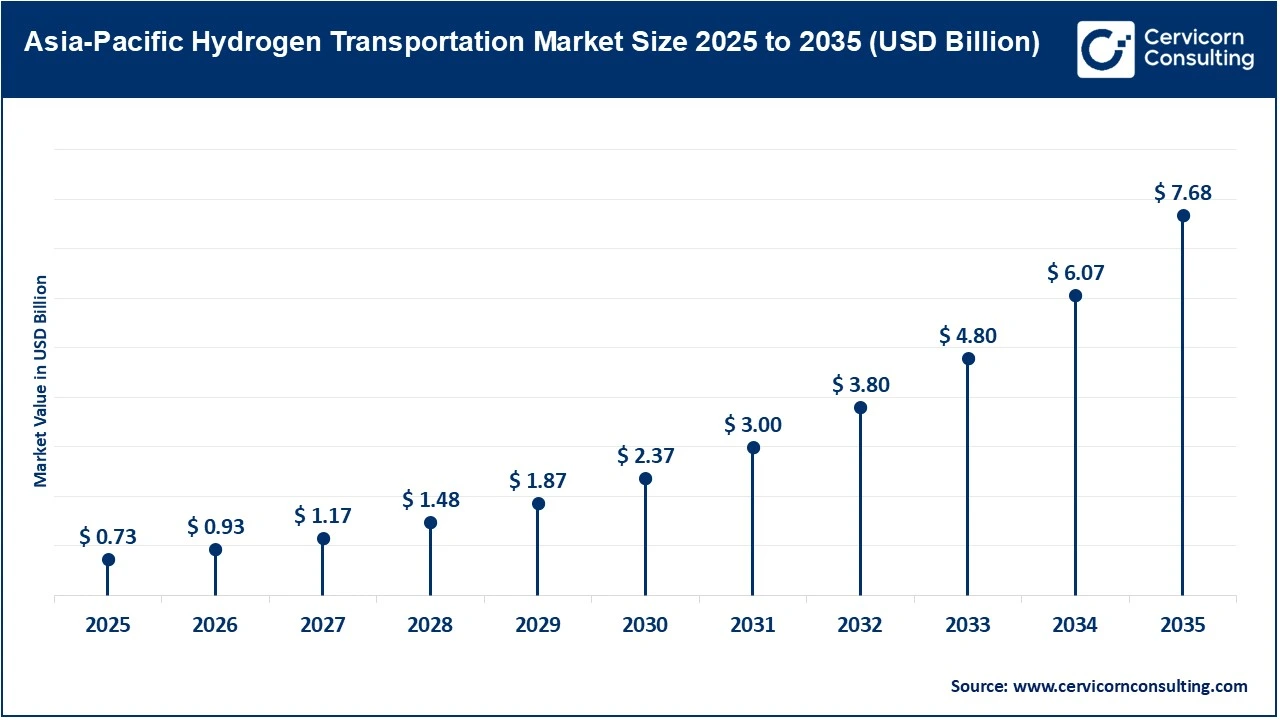
The Asia-Pacific market represents the largest and most dynamic regional market, supported by ambitious government hydrogen roadmaps, substantial investments in hydrogen production and refueling infrastructure, and strong adoption of fuel-cell vehicles across commercial transportation applications. Countries such as China, Japan, South Korea, and Australia are leading global hydrogen mobility initiatives through subsidies, vehicle deployment targets, and infrastructure development programs. The region is witnessing growing demand for hydrogen-powered buses, trucks, trains, and passenger vehicles as governments seek to reduce dependence on fossil fuels and achieve carbon neutrality goals.
China: Large-Scale Government Support, Expanding Fuel Cell Vehicle Fleets, and Hydrogen City Cluster Programs Drive Market Leadership
- China is the world's largest hydrogen transportation market, supported by national and provincial subsidies for fuel-cell vehicles and hydrogen infrastructure development.
- The country targets deployment of 50,000+ fuel-cell vehicles by 2025 under its Medium- and Long-Term Hydrogen Industry Development Plan.
- China has established five national hydrogen fuel-cell vehicle demonstration city clusters covering 44 cities, promoting vehicle adoption and infrastructure expansion.
- The government allocated more than CNY 5.1 billion (approximately USD 700 million) to support hydrogen fuel-cell vehicle demonstration projects and ecosystem development.
Japan: Advanced Fuel Cell Technology, Strong Government Commitment, and Early Commercialization Strengthen Market Growth
- Japan remains a global pioneer in hydrogen mobility through its long-term hydrogen economy strategy and extensive support for fuel-cell technologies.
- The Japanese government aims to increase hydrogen consumption to approximately 12 million tonnes annually by 2040, significantly expanding transportation demand.
- Japan has invested more than USD 20 billion in public-private hydrogen initiatives focused on production, infrastructure, and mobility applications.
Europe Hydrogen Transportation Market: Driven by Ambitious Decarbonization Targets, Expanding Hydrogen Corridor Networks, and Strong Public-Private Investments
The Europe hydrogen transportation market size reached at USD 0.42 billion in 2025 and is projected to hit around USD 4.37 billion by 2035. Europe is one of the leading regions in the hydrogen transportation market, supported by aggressive climate policies, large-scale investments in green hydrogen production, and growing deployment of hydrogen-powered trucks, buses, trains, and maritime vessels. The region's commitment to achieving climate neutrality by 2050 has accelerated the adoption of zero-emission transportation technologies, with hydrogen playing a critical role in decarbonizing heavy-duty and long-distance transport. Government funding, cross-border hydrogen corridor initiatives, and partnerships between vehicle manufacturers, energy companies, and infrastructure providers are strengthening the regional hydrogen ecosystem.
Germany: National Hydrogen Strategy, Industrial Leadership, and Expanding Refueling Infrastructure Drive Market Growth
- Germany has committed more than EUR 9 billion through its National Hydrogen Strategy to accelerate hydrogen production, infrastructure development, and transportation adoption.
- The country is investing heavily in hydrogen-powered trucks, buses, trains, and logistics networks to reduce emissions from heavy-duty transportation.
- Germany hosts one of Europe's largest hydrogen refueling networks and continues expanding hydrogen stations along major freight corridors.
France: Green Hydrogen Investments and Clean Mobility Programs Support Transportation Decarbonization
- France has announced more than EUR 7 billion in hydrogen-related investments to accelerate low-carbon hydrogen production and transportation applications.
- National policies prioritize hydrogen deployment in public transportation, heavy-duty vehicles, and industrial mobility sectors.
- Hydrogen-powered buses and regional train projects are receiving substantial government support as part of France's emissions reduction strategy.
Hydrogen Transportation Market Share, By Region, 2025 (%)
| Region |
Revenue Share, 2025 (%) |
| Asia-Pacific |
48.2% |
| Europe |
27.4% |
| North America |
18.1% |
| LAMEA |
6.3% |
LAMEA Hydrogen Transportation Market: Driven by Green Hydrogen Investments, Emerging Hydrogen Export Hubs, and Government-Led Clean Mobility Initiatives
The LAMEA hydrogen transportation market was valued at USD 0.10 billion in 2025 and is anticipated to reach USD 1 billion by 2035. The LAMEA market is emerging as a strategic growth region, supported by abundant renewable energy resources, large-scale green hydrogen investments, and increasing government efforts to diversify energy systems and reduce transportation emissions. Countries across the Middle East are investing heavily in hydrogen production and export infrastructure, while Latin American nations are leveraging low-cost renewable energy to establish competitive green hydrogen ecosystems. Although hydrogen vehicle adoption remains at an early stage compared to Europe and Asia-Pacific, ongoing investments in hydrogen hubs, refueling infrastructure, and pilot mobility projects are expected to accelerate market development.
Saudi Arabia: Mega Green Hydrogen Projects and National Energy Diversification Drive Market Development
- Saudi Arabia is developing one of the world's largest green hydrogen projects through the NEOM Green Hydrogen Company initiative, with planned production of approximately 600 tonnes of green hydrogen per day upon completion.
- The country's Vision 2030 strategy prioritizes clean energy investments and hydrogen-based economic diversification.
- Large-scale hydrogen production projects are expected to support future deployment of hydrogen-powered transportation and logistics solutions.
United Arab Emirates: National Hydrogen Strategy and Clean Mobility Investments Support Adoption
- The UAE is investing significantly in low-carbon hydrogen production as part of its long-term net-zero emissions strategy.
- Government-backed hydrogen initiatives aim to position the country among the leading global hydrogen producers by 2031.
- Hydrogen mobility pilot projects are being explored for public transportation, logistics, and industrial vehicle applications.
Hydrogen Transportation Market Segmental Analysis
The hydrogen transportation market is segmented into vehicle type, technology, fuel type, mode of transportation, distance, and geography.
Vehicle Type Analysis
Trucks dominate the hydrogen transportation market due to their high energy requirements, long operating distances, and need for rapid refueling, where hydrogen fuel-cell technology offers clear advantages over battery-electric alternatives. Heavy-duty freight operators are increasingly adopting hydrogen-powered trucks to meet emissions regulations while maintaining payload capacity and operational efficiency. Government-backed hydrogen corridor projects across Europe, China, and North America are further supporting deployment. Major manufacturers such as Daimler Truck, Hyundai, and Toyota are actively commercializing fuel-cell trucks, reinforcing the segment's leading market position.
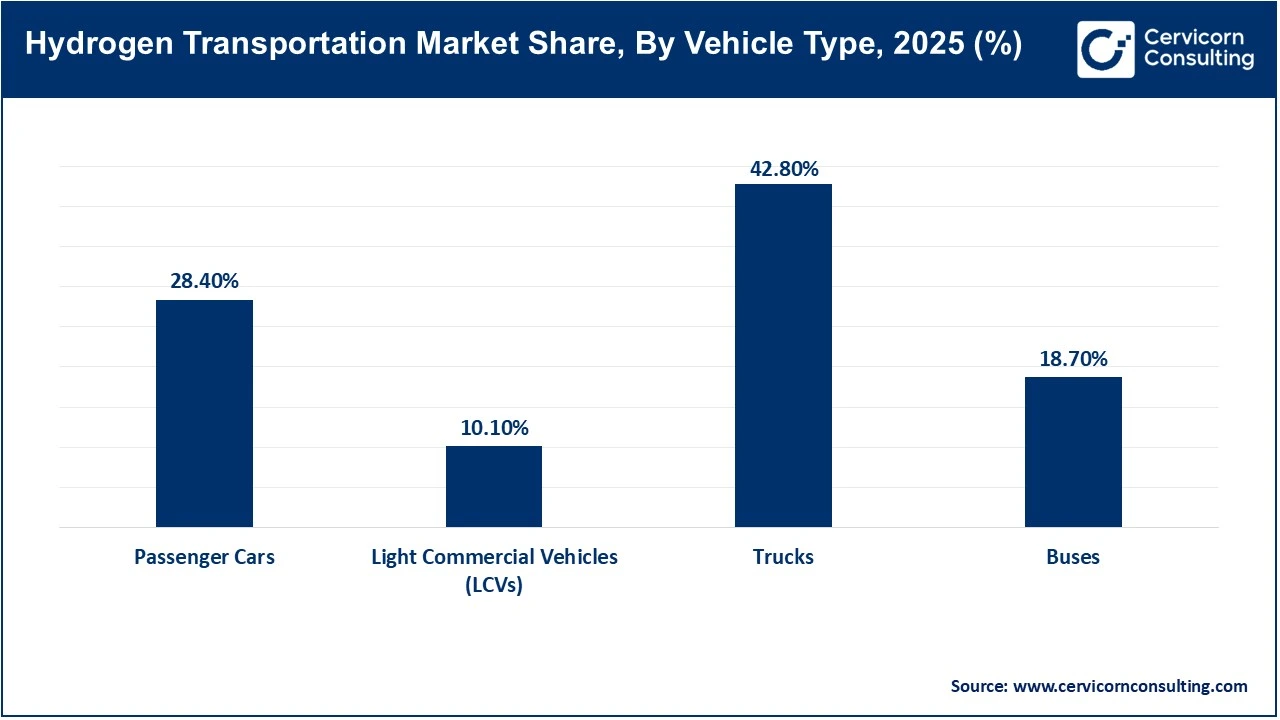
The buses segment is expected to witness the fastest growth owing to increasing investments in zero-emission public transportation systems. Municipal transit agencies are adopting hydrogen fuel-cell buses because they provide longer ranges and shorter refueling times than battery-electric buses, making them suitable for intensive daily operations. Governments in Europe, China, South Korea, and India are funding hydrogen bus deployment programs to reduce urban emissions. As hydrogen refueling infrastructure expands and public transit decarbonization targets become more stringent, hydrogen-powered buses are expected to experience rapid adoption globally.
Technology Analysis
Fuel Cell Electric Vehicles (FCEVs) represent the dominant technology segment because they offer zero tailpipe emissions, high efficiency, and extended driving ranges. FCEVs are particularly effective in commercial transportation applications where minimizing downtime is critical. Continuous investments from automotive manufacturers and governments have accelerated fuel-cell technology development and deployment. Furthermore, expanding hydrogen refueling networks and declining fuel-cell system costs are strengthening adoption across passenger vehicles, buses, and heavy-duty trucks. These advantages have positioned FCEVs as the preferred hydrogen transportation technology worldwide.
Hydrogen Transportation Market, By Technology, 2025 (%)
| Technology |
Revenue Share, 2025 (%) |
| Fuel Cell Electric Vehicles (FCEVs) |
89.6% |
| Hydrogen Internal Combustion Engine (H2-ICE) Vehicles |
10.4% |
Hydrogen Internal Combustion Engine vehicles are emerging as the fastest-growing technology segment due to their ability to leverage existing engine manufacturing capabilities and supply chains. H2-ICE technology allows manufacturers to adapt conventional internal combustion engines for hydrogen fuel with relatively lower development costs compared to fuel-cell systems. This approach is gaining traction in heavy-duty transportation, construction equipment, and commercial vehicle applications. As industries seek practical and cost-effective decarbonization pathways, hydrogen ICE technology is attracting increasing investment and commercial interest.
Fuel Type Analysis
Gray hydrogen currently dominates the market because it remains the most widely available and cost-effective hydrogen source. Produced primarily from natural gas through steam methane reforming, gray hydrogen benefits from established production infrastructure and large-scale industrial availability. Many early hydrogen transportation projects continue to rely on gray hydrogen due to lower fuel costs and supply reliability. Despite environmental concerns associated with carbon emissions during production, gray hydrogen maintains a significant market share while the industry gradually transitions toward cleaner hydrogen alternatives.
Hydrogen Transportation Market, By Fuel Type, 2025 (%)
| Fuel Type |
Revenue Share, 2025 (%) |
| Gray Hydrogen |
61.8% |
| Blue Hydrogen |
21.5% |
| Green Hydrogen |
16.7% |
Green hydrogen is expected to be the fastest-growing fuel type segment due to increasing global focus on sustainability and carbon neutrality. Produced using renewable electricity through electrolysis, green hydrogen offers a near-zero-emission fuel pathway for transportation applications. Governments worldwide are introducing incentives, subsidies, and large-scale renewable hydrogen production targets to accelerate adoption. Falling renewable energy costs and growing investments in electrolyzer capacity are improving commercial viability. As transportation operators prioritize low-carbon fuels, green hydrogen demand is projected to expand rapidly over the coming decade.
Mode of Transportation Analysis
Road transportation dominates the hydrogen transportation market due to widespread adoption opportunities across passenger cars, buses, trucks, and commercial fleets. The sector benefits from the most developed hydrogen vehicle ecosystem, including vehicle manufacturing, refueling infrastructure, and government support programs. Long-haul freight transportation is particularly well-suited for hydrogen fuel-cell technology because of its range and refueling advantages. Continuous investments by vehicle manufacturers and policymakers are driving large-scale commercialization, making road transportation the largest contributor to hydrogen transportation demand globally.
Hydrogen Transportation Market, By Mode of Transportation, 2025 (%)
| Mode of Transportation |
Revenue Share, 2025 (%) |
| Road Transportation |
84.3% |
| Rail Transportation |
7.1% |
| Marine Transportation |
5.2% |
| Aviation Transportation |
3.4% |
Aviation is anticipated to be the fastest-growing transportation mode segment as the industry seeks solutions to achieve long-term decarbonization targets. Hydrogen is increasingly viewed as a promising alternative fuel for future aircraft because of its high energy density and potential to significantly reduce emissions. Aerospace companies, research institutions, and governments are investing heavily in hydrogen-powered aircraft development and demonstration programs. As technological advancements improve storage and propulsion systems, hydrogen aviation is expected to experience substantial growth from pilot projects toward commercial deployment.
Distance Analysis
Long-haul transportation accounts for the largest market share because hydrogen technology is particularly advantageous for vehicles operating over extended distances. Fuel-cell systems provide longer driving ranges and significantly faster refueling compared to battery-electric alternatives, minimizing operational downtime. Freight trucks, intercity buses, and logistics fleets increasingly favor hydrogen solutions for demanding transportation routes. Growing investments in hydrogen corridors and high-capacity refueling stations are further supporting adoption. These operational benefits make long-haul transportation the dominant segment within the hydrogen transportation market.
Hydrogen Transportation Market, By Distance, 2025 (%)
| Distance |
Revenue Share, 2025 (%) |
| Long Haul |
46.9% |
| Medium Haul |
33.5% |
| Short Haul |
19.6% |
The medium-haul segment is expected to register the fastest growth as fleet operators seek practical low-emission solutions for regional transportation networks. Medium-haul routes are increasingly adopting hydrogen-powered trucks and buses because they balance operational flexibility, infrastructure accessibility, and fuel efficiency. Expanding hydrogen refueling networks and government incentives are encouraging commercial fleet operators to transition away from diesel-powered vehicles. Additionally, medium-haul applications often serve as an intermediate step toward broader hydrogen adoption, creating strong growth opportunities across regional logistics and passenger transportation services.
Hydrogen Transportation Market Top Companies
Recent Developments
- In February 2025, Toyota introduced its third-generation fuel cell system designed for commercial vehicles, offering improved durability, fuel efficiency, and lower operating costs. The development strengthens Toyota’s hydrogen mobility portfolio and supports wider adoption of fuel-cell trucks, buses, rail, and marine transportation applications.
- In October 2025, Hyundai began construction of a new hydrogen fuel cell manufacturing facility in Ulsan, South Korea, with a planned annual production capacity of 30,000 fuel-cell systems. The investment enhances hydrogen component supply capabilities and supports large-scale deployment of hydrogen-powered transportation solutions globally.
- In September 2025, Daimler Truck announced that its Mercedes-Benz GenH2 fuel-cell trucks had collectively exceeded 225,000 kilometers in customer operations. The milestone demonstrates the operational viability of hydrogen-powered long-haul freight transportation and supports broader fleet adoption.
Market Segmentation
By Vehicle Type
- Passenger Cars
- Light Commercial Vehicles (LCVs)
- Trucks
- Buses
By Technology
- Fuel Cell Electric Vehicles (FCEVs)
- Hydrogen Internal Combustion Engine (H2-ICE) Vehicles
By Fuel Type
- Green Hydrogen
- Blue Hydrogen
- Gray Hydrogen
By Mode of Transportation
- Road Transportation
- Rail Transportation
- Marine Transportation
- Aviation Transportation
By Distance
- Short Haul
- Medium Haul
- Long Haul
By Geography
- North America
- Europe
- Asia-Pacific
- LAMEA