Hydrogen Aircraft Market Size and Growth 2026 to 2035
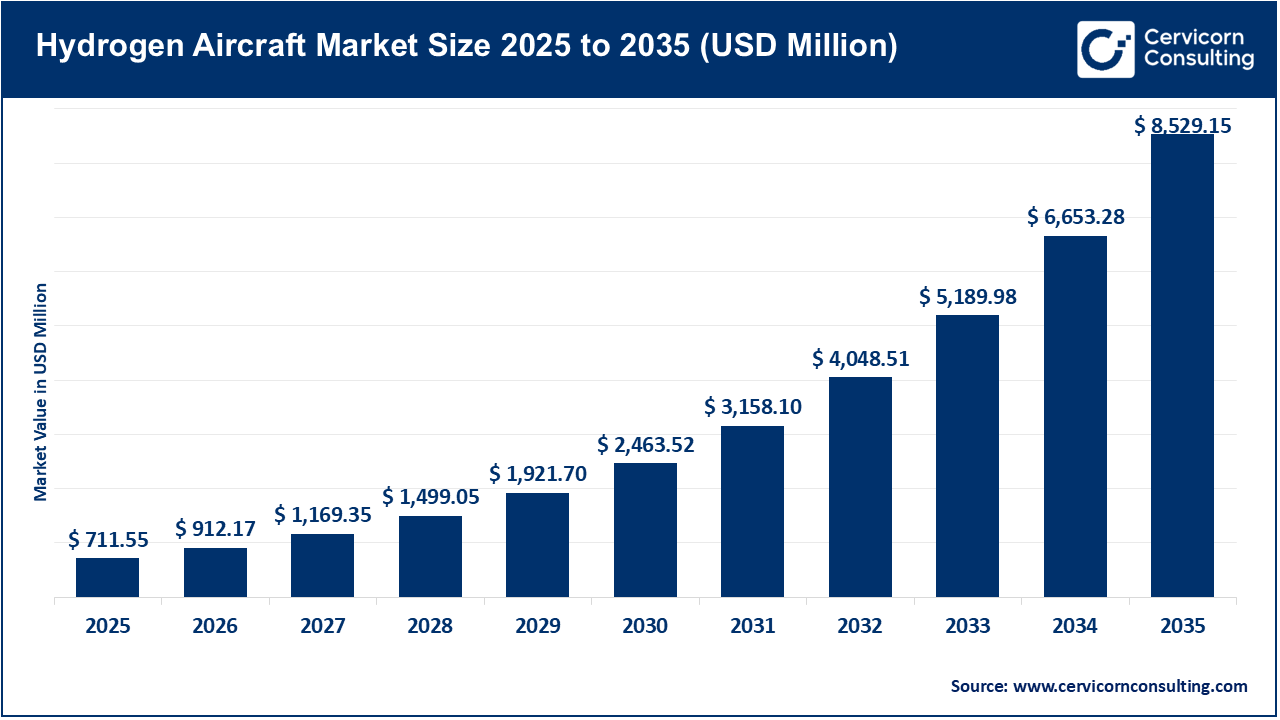
The global hydrogen aircraft market size was estimated at USD 711.55 million in 2025 and is expected to be worth around USD 8,529.15 million by 2035, exhibiting a compound annual growth rate (CAGR) of 28.2% over the forecast period from 2026 to 2035. The primary drivers of growth in the hydrogen aircraft market are increasingly stringent environmental regulations and the global commitment to net-zero emissions. Governments worldwide are implementing policies, including carbon pricing and investment incentives, to support the green transition. For example, regulatory initiatives such as the European Union's "Fit for 55" package and the ReFuelEU Aviation mandate are strongly pushing airlines to revise their long-term fleet strategies. In 2025, the total value of aviation-related R&D subsidies has exceeded USD 5 billion as governments and industry stakeholders aim to meet interim 2030 goals. This regulatory pressure is reflected in the planned removal of free carbon allowances under the European Union’s EU Emissions Trading System, which is expected to significantly increase the operating costs of conventional jet-fuel aircraft relative to subsidized green hydrogen alternatives by the late 2020s.
Rapid technological advances in cryogenic storage systems are another significant growth factor for the market, as these systems can store liquid hydrogen at -253 °c. Cryogenic fuel storage has become a major focus of development within hydrogen aviation. With continuous advances in tank weight reduction and boil-off management, long-range hydrogen-powered flight is becoming increasingly feasible. For instance, the number of patents related to cryogenic engineering for aerospace applications has risen by over 20% per year since 2020, indicating a concerted effort to achieve higher energy-to-weight efficiency.
Report Highlights
- By Region, North America dominates the regional segment, capturing around 41% of the Hydrogen Aircraft Market, due to strong aerospace R&D activity and early adoption of hydrogen propulsion technologies.
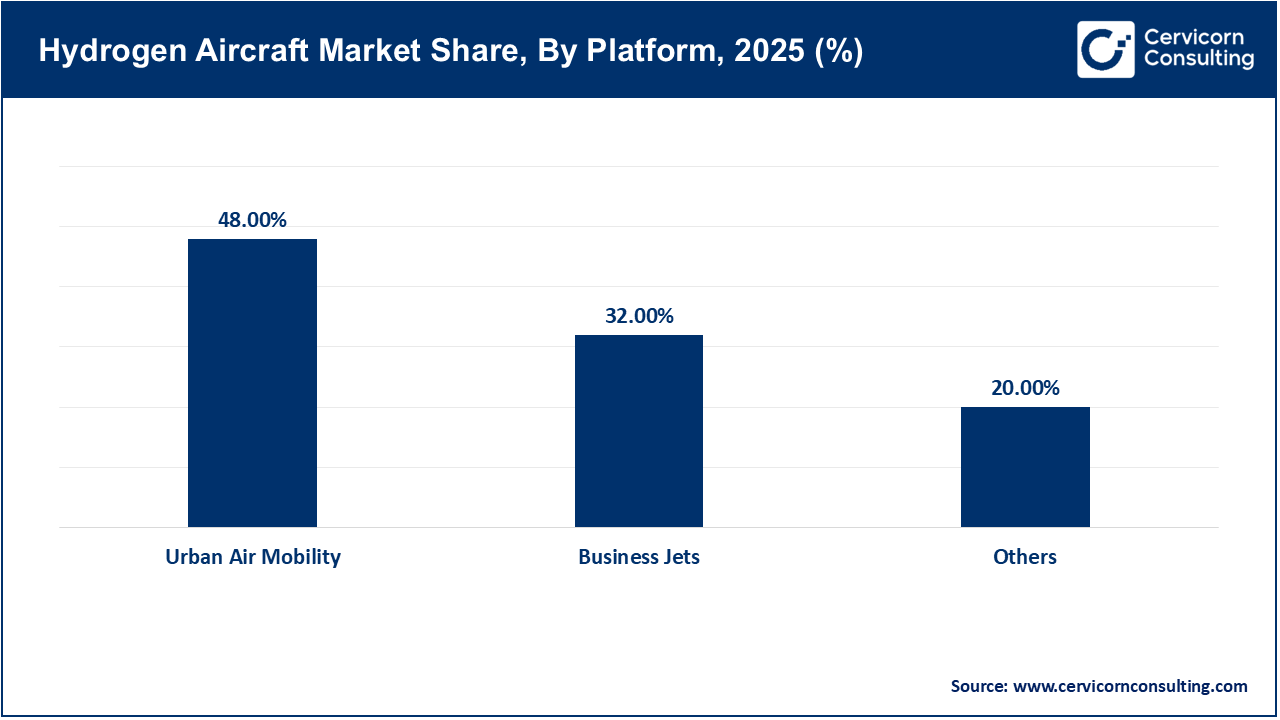
- By platform, the urban air mobility (UAM) dominates the market, accounting for 48% share, driven by strong demand for short-distance and rapid eVTOL deployment.
- By platform, the business jets is the fastest-growing segment, with 32% share, supported by rising corporate sustainability commitments and early adoption of liquid hydrogen technologies.
- By power source, the hydrogen combustion dominates the market, representing around 58% share, due to its compatibility with existing turbine engines and lower integration complexity.
- By range, the short haul (<1000 km) dominates the market, capturing at 49% share, as it aligns with early-stage deployment feasibility and regional aviation routes.
- By technology, the hybrid electric aircraft dominates the market, accounting for 60% share, due to operational flexibility and lower certification risk.
- By application, the commercial aviation segment capturing highest revenue share of 54%, due to a large fleet size and regulatory decarbonization mandates.
Integrated Green Hydrogen Ecosystems in Airport Design
The integration of green hydrogen ecosystems into airport infrastructure is emerging as a significant trend in the hydrogen aircraft market. The industry is increasingly moving towards the "Hydrogen Hub" model, where airports become central hubs for hydrogen production, storage, and distribution. This trend is particularly important for airports in developing countries, where well-crafted policy frameworks can help ensure equitable and environmentally sustainable transitions. Incorporating renewable energy sources such as solar and wind power into airport operations reduces carbon footprints while creating new socio-economic opportunities.
In regions such as Africa, airports including Johannesburg and Tambo (JNB) and Mombasa Moi (MBA) are developing sustainable infrastructure in countries where finance and ageing infrastructure are limiting innovation. Furthermore, in 2026, at least 15 international airports are expected to launch formal liquid hydrogen refuelling programmes, underscoring the industry's growing commitment to building a network of hydrogen-capable airports.
Top 5 Trends and Technologies
- Hydrogen Combustion Turbines: Around 40% of engine programmes are exploring hydrogen-combustion retrofits to accelerate adoption on existing aircraft platforms.
- Green Hydrogen Supply Chains: Aviation projects aim to reduce production costs to below USD 2–3/kg by 2030 to enable commercial viability.
- Hydrogen-Electric Regional Aircraft: About 60% of prototypes are focused on short-haul routes under 1000 km for early deployment.
- Hydrogen Airport Infrastructure: Over 50 hydrogen-ready airports in Europe are planned to support early refuelling networks.
- Lightweight Hydrogen Tanks: New composites reduce storage weight by 10–15%, improving aircraft range and efficiency.
How can hydrogen be used to power aircraft?
There are two main ways to extract energy from hydrogen and use it to power an aircraft. One of the most prominent uses is hydrogen fuel cells. In this process, hydrogen and oxygen are combined in a fuel cell to produce water while generating electricity, effectively reversing the electrolysis process. Like a battery, the fuel cell converts chemical energy into electrical energy, which can power an electric motor in either a fully electric or a hybrid-electric aircraft configuration.
Several hydrogen fuel cell-powered aircraft are currently under development, reflecting growing industry interest in this propulsion technology. However, the adoption of fuel cells in aviation remains constrained by the limited amount of usable power that can be generated. These challenges are linked to factors such as fuel cell efficiency, system weight, propeller performance, thermal management requirements, motor capability, power-distribution efficiency, and the additional weight of electrical components.
Global Aviation Hydrogen Demand Projection
| Year |
Hydrogen Demand (Mt H₂/year) |
Share of Total Aviation Energy (%) |
Development Stage |
| 2025 |
0.1 |
<1% |
Pilot projects and early demonstrations |
| 2030 |
2 |
5–10% |
Initial commercial adoption and blending with e-fuels |
| 2035 |
7 |
10–20% |
Entry of hydrogen-powered aircraft into service |
| 2040 |
20 |
25–40% |
Scaling of infrastructure and fleet expansion |
| 2050 |
55 |
60–80% |
Widespread adoption and near full-scale deployment |
The table shows that hydrogen demand in aviation is expected to remain minimal until 2030, reflecting the early stage of technology development and limited commercial deployment. From 2035 onward, demand rises more rapidly as hydrogen-powered aircraft enter service and supporting infrastructure expands. The sharp increase between 2040 and 2050 signals a transition phase in which hydrogen becomes a major aviation fuel, driven by stricter decarbonisation targets and the scaling of production. By 2050, hydrogen could account for the majority of aviation energy use, highlighting its critical role in achieving long-term emissions reduction in the sector.
Recent Major Milestones
1. Successful Prototype Flight Testing and Performance Validation
Successful prototype flight testing and performance validation are playing an essential role in shaping the hydrogen aircraft market. During 2024 and 2026, the industry achieved several critical operational milestones. For example, successful flight tests of 40-seat regional aircraft powered by fuel cells have confirmed the technical feasibility of megawatt-scale propulsion systems. These flights provided essential data on power conversion efficiency and thermal management at high altitudes. Additionally, in early 2026, the industry achieved a 60-minute flight using a special, dried-liquid hydrogen cooling system that achieved 98% efficiency. This validation is essential for building an airline's trust and securing the long-term order for mass production.
2. National Hydrogen Aviation Strategies and Government Grant Programs
The introduction of national hydrogen aviation strategies, increasingly aligned with broader clean energy and decarbonisation programmes, is a major growth driver for the market. For example, Canada’s commitment to achieving net-zero emissions by 2050 involves significant investment in clean energy and public procurement of green technologies. In addition, the UK and EU have introduced major grant programmes, such as the Clean Aviation Joint Undertaking, which has committed more than USD 3.5 billion to hydrogen flight demonstrators. Both industry and government initiatives are investing not only in financial support but also in the regulatory frameworks required for this industry to enter markets. However, government-backed programmes are expected to reduce the time-to-market for hydrogen startups by as much as 24 months through faster certification pathways.
3. Strategic Partnerships for Supply Chain Integration
Strategic partnerships to improve supply chain integration are becoming essential to the growth of the hydrogen aircraft market. Aerospace OEMs are increasingly collaborating with energy companies to secure a consistent supply of green hydrogen and with specialised engineering firms to develop critical components such as cryogenic tanks. A recent review of patent activity shows growing international participation, reflecting strong interest from established industry players and new entrants. These partnerships are essential for overcoming infrastructure challenges often associated with hydrogen adoption, particularly the “chicken and egg” issue involving hydrogen fueling infrastructure and aircraft deployment.
4. Technology Advancements in High-Power-Density Fuel Cell Stack Development
Rapid advancements in high-power-density fuel cell stack technology are significantly driving growth in the hydrogen aircraft market. Industry innovation is increasingly focused on improving power density while reducing system weight, both of which are critical to enabling hydrogen-electric propulsion systems to compete with conventional gas turbine engines in performance and efficiency. Fuel cell integration is becoming a prime growth sector, with significant protections for newly designed bipolar plates and membrane electrode assemblies. Moreover, the latest generation of aerospace-grade fuel cells has achieved a 15% improvement in power-to-weight ratio compared to 2023. This improvement allows fuel cell systems to support larger aircraft platforms while extending operational range and efficiency.
Hydrogen Aircraft Market Regional Analysis
The hydrogen aircraft market is segmented by region into North America, Europe, Asia-Pacific, and LAMEA. Here is a brief overview of each region:
Asia-Pacific Hydrogen Aircraft Market: Driven by Rapidly advancing decarbonization through Large Infrastructure Investments
The Asia-Pacific hydrogen aircraft market size was estimated at USD 135.19 million in 2025 and is expected to be worth around USD 1,620.54 million by 2035. The Asia-Pacific market is growing repidly, due to strong government-mandated decarbonization and the modernization of ageing regional fleets that have issues with air quality compliance. Countries such as China, Japan, and South Korea are focusing on hydrogen aviation not just as an environmental necessity, but also as an industrial strategy to reduce reliance on imported fossil fuels. For instance, the first domestic four-seat hydrogen fuel-cell-powered aircraft flight in Northeast China indicates that the region has moved from technology demonstrations to commercial regional flights. In addition, the development of "Hydrogen Valleys" in Australia and India is creating a localized supply of green hydrogen, which plays a significant role in the cost of operating hydrogen-powered regional routes.
China to Lead Global Hydrogen Aviation through Large-Scale Infrastructure Expansion
China is leveraging its considerable industrial capacity to build an extensive hydrogen aviation ecosystem, with a focus on energy security and cost control in manufacturing.
- China has built more than 400 hydrogen refueling stations to lay the groundwork for hydrogen-based infrastructure at airports.
- Under its 14th Five-Year Plan, China has designated hydrogen energy as a "future industry" and aims to deploy 50,000 hydrogen fuel cell vehicles on the road, creating potential cross-sector cost efficiencies for the adoption of aviation fuel cells.
- The Commercial Aircraft Corporation of China (COMAC) has already tested multiple unmanned hydrogen-powered demonstrator aircraft and is targeting the launch of a 20-seat commercial prototype by 2028.
India: Scaling Green Hydrogen Production for Domestic Aviation Growth
India aims to become a low-cost producer of green hydrogen to reduce its growing aviation sector's dependence on volatile global oil markets.
- The National Green Hydrogen Mission has USD 2.4 billion allocated to produce 5 million metric tons of green hydrogen per year by 2030.
- Domestic air passenger traffic in India is expected to double by 2030, creating a significant market for hydrogen-powered regional aircraft serving Tier-2 and Tier-3 cities.
- Strategic partnerships are being formed between Indian conglomerates such as Adani Group and international aerospace companies to establish liquid hydrogen storage solutions for hot and humid environments.
North America Hydrogen Aircraft Market: Driven by Private Sector Investment and Technology Innovation in Zero-Emission Propulsion
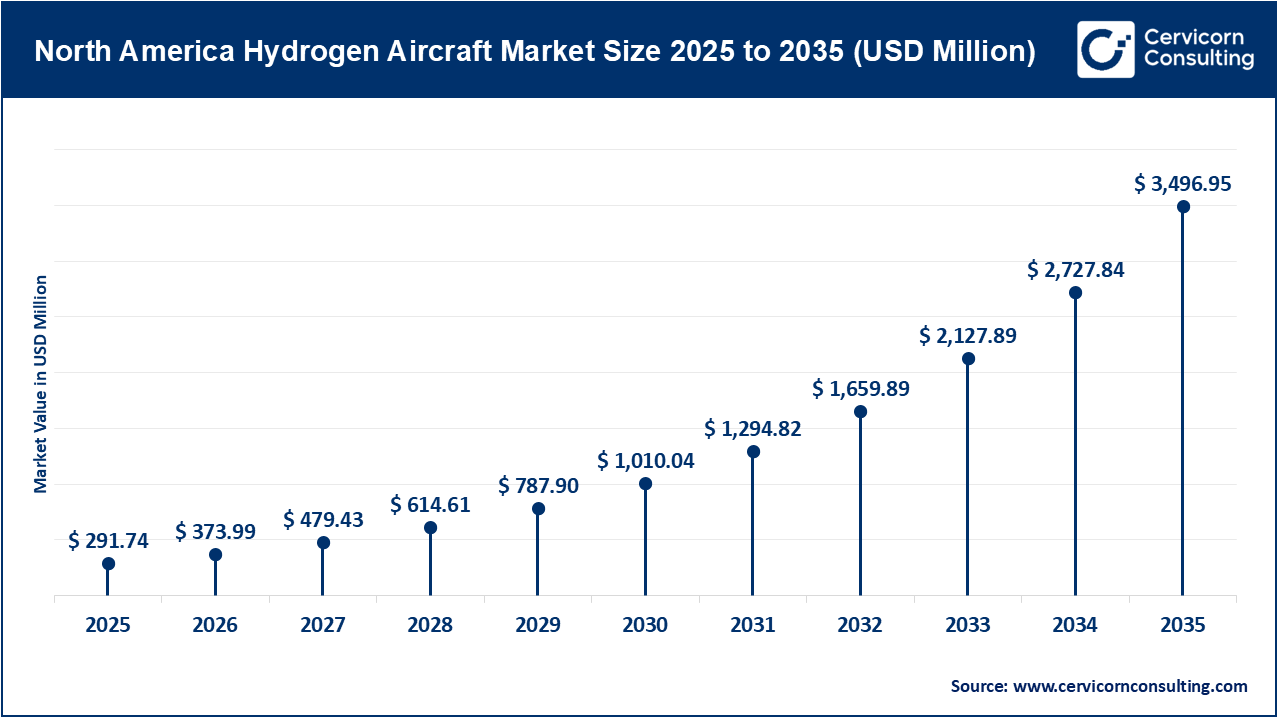
The North America hydrogen aircraft market size was estimated at USD 291.74 million in 2025 and is projected to surpass around USD 3,496.95 million by 2035.
The North America market is marked by a robust private-sector investment ecosystem and a focus on retrofitting existing airframes. The United States has emerged as a major hub for hydrogen propulsion startups, which have raised over USD 1.5 billion in venture capital and other private equity between 2022 and 2025. Rapid advances in modular hydrogen powertrain solutions for regional turboprop aircraft, such as the De Havilland Canada Dash, are accelerating the adoption of hydrogen aviation in North America. In addition, regional operators are leading in hydrogen retrofit technologies, with more than 600 units under Letters of Intent (LOIs) for hydrogen conversion kits as of late 2023.
United States: Pioneering Hydrogen Propulsion Systems and Federal Investment Tax Credits
In the United States, the market is adopting a retrofit-first approach, with federal tax incentives helping to reduce transition risks for regional carriers.
- Under the Inflation Reduction Act (IRA), the production tax credit of up to USD 3/kg for green hydrogen could begin to close the traditional price spread with Jet-A fuel.
- The U.S. Department of Energy (DOE) is now funding seven regional “Hydrogen Hubs” with almost USD 7 billion in federal funding, and they are co-located with major aviation gateways.
- In the U.S., startups like ZeroAvia and Universal Hydrogen have in excess of 1,500 orders for engines, creating the “largest commercial pipeline for hydrogen propulsion in the world.”
Canada: Leveraging Clean Energy Resources for Regional Hydrogen Aviation Corridors
Canada plans to utilize its abundant sources of hydroelectric and wind energy to develop regional hydrogen corridors, especially in Quebec and British Columbia.
- The Port of Montreal and Vancouver International Airport are developing integrated hydrogen ecosystems that provide maritime and aviation refuelling from a single green hydrogen supply.
- Canada’s Hydrogen Strategy projects the creation of 350,000 jobs and contributes USD 50 billion to GDP by 2050, with aviation identified as a priority sector for decarbonizing hard-to-abate industries.
- Regional operators such as Harbour Air are testing electric propulsion systems and planning to adopt hydrogen fuel cells for longer coastal routes.
Europe Hydrogen Aircraft Market: Driven by Stringent Environmental Regulations and the ReFuelEU Aviation Framework
The Europe hydrogen aircraft market size was valued at USD 220.58 million in 2025 and is expected to hit around USD 2,644.04 million by 2035. Europe is the global center for hydrogen aviation development, supported by strong environmental mandates. Initiatives such as the European Green Deal and the ReFuelEU Aviation framework are accelerating the transition to low-emission aviation through a combination of carbon pricing mechanisms under the Emissions Trading System (ETS) and regulatory mandates for zero-emission ground operations. Europe has the highest density of hydrogen-ready airports, and the "Hydrogen Hub at Airports" initiative involves over 50 major hubs throughout Europe. In addition, the European Union has allocated USD 3 billion to develop hydrogen-electric powertrains through the Clean Aviation Joint Undertaking.
United Kingdom: Projecting Leadership through the Jet Zero Strategy and Innovation Grants
The United Kingdom is establishing itself as a global leader in aerospace R&D and certification and aims to be the first country to operate commercial hydrogen flights.
- The UK Government's Jet Zero strategy targets zero-emission domestic flights by 2040, establishing a clear regulatory framework for the adoption of hydrogen-powered aircraft.
- The Aerospace Technology Institute has allocated over USD 200 million to hydrogen aviation projects, including the development of high-power-density cryogenic motor technologies.
- Cranfield University and Bristol Airport are serving as living labs for hydrogen ground handling, where refueling systems for 19-seat hydrogen aircraft are being tested, with turnaround times under 20 minutes.
Germany: Leading in Engineering Excellence in Hydrogen-Electric Powertrain Technology
Germany is Europe’s center of hydrogen engineering, focusing on the integration of fuel cells and high-performance electric motors.
- The German Aerospace Center (DLR) operates the BALIS test field, the world’s first facility for testing megawatt-class hydrogen fuel cell powertrains, supporting the advancement of hydrogen aviation technologies.
- Germany’s National Hydrogen Strategy has allocated EUR 9 billion in funding, with a significant share directed toward aviation innovation through the Aviation Research Program (LuFo).
- Stuttgart Airport is piloting the Hydrogen Airport concept, integrating on-site electrolysis with hydrogen ground support equipment and aircraft refueling infrastructure.
Hydrogen Aircraft Market Share, By Region, 2025 (%)
| Region |
Revenue Share, 2025 (%) |
| North America |
41% |
| Europe |
31% |
| Asia Pacific |
19% |
| LAMEA |
9% |
LAMEA Hydrogen Aircraft Market: Driven Growing Capabilities to Produce Green Hydrogen and Develop Strategic Hubs
The LAMEA hydrogen aircraft market was valued at USD 64.04 million in 2025 and is anticipated to reach around USD 767.62 million by 2035. The LAMEA region is gradually establishing itself as the "engine room" of the hydrogen aircraft market by leveraging its significant renewable energy assets to produce green hydrogen. In this region, the strategic development of export-oriented hydrogen hubs provides low-cost fuel to support international long-haul carriers. In the Middle East, countries such as the UAE and Saudi Arabia are investing billions in solar-to-hydrogen facilities to produce hydrogen at under USD 2 per kg by 2030. The LAMEA region is expected to contribute nearly 20% of the global green hydrogen supply by 2040 in terms of volume. Furthermore, Brazil is evaluating bio-hydrogen production from ethanol as a unique secondary pathway to decarbonize regional aviation in South America.
Brazil: Integrating Bio-Hydrogen Potential into a Sustainable Aviation Value Chain
Brazil has a unique "dual-pathway" approach that leverages its leadership in biofuels and advances green hydrogen production.
- Brazil is the world’s second-largest ethanol producer, enabling cost-effective bio-hydrogen production via steam reforming, a lower-cost alternative to conventional electrolysis.
- Embraer, the world’s third-largest aircraft manufacturer, is advancing hydrogen aviation through its Energia family, which includes hydrogen-electric and hydrogen-combustion aircraft concepts for the 19–50-seat segment.
- The Brazilian government has identified the Northeastern region as a strategic green hydrogen export hub, attracting more than USD 20 billion in announced investments to strengthen the country’s hydrogen infrastructure.
UAE: Positioning it as a Global Leader in Hydrogen Export and Strategic Aviation Hubs
The UAE is a major hub in the future global hydrogen trade, ensuring that its major aviation hubs remain strategically important in a low-carbon economy.
- Masdar plans to produce 1 million tonnes of green hydrogen annually by 2030, with a significant share for aviation applications.
- Dubai International Airport is collaborating with international partners to assess the feasibility of liquid hydrogen infrastructure for wide-body aircraft operations.
- The National Hydrogen Strategy aims to secure 25% of the global low-carbon hydrogen market by 2030 and to position itself as a primary supplier of fuel for global carriers.
Hydrogen Aircraft Market Segmental Analysis
The hydrogen aircraft market is segmented into platform, power source, range, technology, application, and region.
Platform Analysis
The Urban Air Mobility (UAM) platform currently holds the dominant market share, primarily because its operational requirements align well with the advantages of hydrogen fuel cell technology. The short distances of intra-city travel and zero-noise operations pair well with hydrogen fuel cells, making UAM an ideal early platform for hydrogen-powered aircraft. The frequency of these flights will help build the required base for hydrogen infrastructure in urban centres. The UAM segment is expected to achieve the highest volume of hydrogen-powered units by 2030, and more than 500 orders for different eVTOL aircraft designs have already been placed and are awaiting production or delivery.
The business jets segment is expected to be the fastest-growing platform in the market, driven mainly by growing sustainability commitments among corporate aviation operators and high-net-worth individuals. This segment is better positioned to reduce the initial high costs associated with hydrogen fuel, making it a strong early adopter of liquid hydrogen technology. The business jet segment has grown by up to 30% year-over-year in commitments to zero-emission flight programs, as companies are looking to offset their carbon footprint ahead of tighter corporate ESG rules.
Power Source Analysis
Hydrogen combustion currently represents the dominant power source segment due to its compatibility with existing gas turbine architectures. This approach offers aircraft manufacturers and maintenance providers a relatively low barrier to adoption, as hydrogen can be integrated into modified combustion engines while utilizing operational expertise and existing infrastructure. This enables the aviation industry to reduce emissions without requiring a complete redesign of propulsion systems.
Hydrogen Aircraft Market Share, By Power Source, 2025 (%)
| Power Source |
Revenue Share, 2025 (%) |
| Hydrogen Combustion |
58% |
| Hydrogen Fuel Cell |
42% |
Hydrogen fuel cells are expected to be the fastest-growing segment of the market, supported by their high energy conversion efficiency and their ability to eliminate nitrogen oxide and particulate emissions. Fuel cell technology is rapidly adapting for regional and commuter aircraft applications, where advances in fuel cell stack design are steadily improving performance. Moreover, fuel cell integration claims are growing faster than in any other propulsion-related domain and reflect a massive R&D push towards this technology for a "true zero" solution to achieve fully zero-emission air travel.
Range Analysis
Short Haul (<1000 km) accounts for the largest share of the market because hydrogen storage limitations and fuel-system weight constraints are more manageable on shorter routes. This range aligns closely with existing regional aviation networks, particularly turboprop operations, making it the most practical entry point for deploying hydrogen aircraft.
Hydrogen Aircraft Market Share, By Range, 2025 (%)
| Range |
Revenue Share, 2025 (%) |
| Short Haul (<1000 Km) |
49% |
| Medium Haul (1000 Km-2000 Km) |
32% |
| Long Haul (>1000 Km) |
19% |
Medium Haul (1000 km-2000 km) is projected to grow fastest in the market, driven primarily by improvements in liquid hydrogen storage technologies and the aviation industry's shift towards decarbonising high-traffic narrow-body routes. This range offers a balance between operational efficiency and energy density, with liquid hydrogen's energy density providing a comparative advantage over battery-electric alternatives. As cryogenic tank technology improves, airlines are looking to replace the narrow-body fleets they have relied on for many years with hydrogen-powered aircraft on these high-traffic routes.
Technology Analysis
Hybrid electric aircraft technology is the market leader due to its robust safety net and operational flexibility during this transition period. Hybrid aircraft can use hydrogen fuel cells, combustion, batteries, and conventional fuels, allowing them to operate in environments where hydrogen infrastructure is still under development. This dual-power capability reduces operational risk and improves certification feasibility, and hydrogen aircraft prototypes currently in development are based on hybrid architectures.
Hydrogen Aircraft Market Share, By Technology, 2025 (%)
| Technology |
Revenue Share, 2025 (%) |
| Hybrid Electric Aircraft |
60% |
| Full Hydrogen Powered Aircraft |
40% |
Full hydrogen-powered aircraft is the fastest-growing application in the market as the aviation industry moves towards achieving “true zero” emissions, thereby reducing future carbon offset obligations and associated taxation costs. Operators' demand for zero-fossil-fuel solutions is growing, and the development of dedicated hydrogen airframes is also increasing rapidly by 2023. In addition, the number of "clean-sheet" full-hydrogen aircraft has doubled since 2024, indicating a healthy level of optimism about the long-term supply of green hydrogen.
Application Analysis
Commercial application is the dominant segment in the market, primarily due to its large share of passenger travel and the public visibility of airline emissions. Commercial airlines face growing pressure from both passengers and regulatory authorities to adopt zero-emission technologies and reduce their environmental impact. In 2025, commercial carriers are expected to issue letters of intent for over 1,000 hydrogen aircraft, representing the largest share of the overall addressable market.
Hydrogen Aircraft Market Share, By Application, 2025 (%)
| Application |
Revenue Share, 2025 (%) |
| Commercial |
54% |
| Military |
26% |
| Cargo |
20% |
Cargo applications are the fastest-growing segment in the market, owing to the structured, scheduled nature of freight operations, which makes them well-suited for early deployment of hydrogen infrastructure. Cargo hubs can be converted into hydrogen centers more easily than complex passenger terminals, while lower sensitivity to cabin noise allows for more flexible and aggressive propulsion designs.
Hydrogen Aircraft Market Top Companies
Recent Developments
- In April 2026, ZeroAvia, Inc. introduced a major regulatory milestone after the FAA issued final special conditions for its ZA600 hydrogen-electric propulsion system, supporting its path toward commercial certification.
- In January 2025, H2FLY GmbH introduced enhanced hydrogen-electric flight testing through its HY4 demonstrator aircraft, advancing fuel cell integration for regional aviation applications.
- In July 2024, Joby introduced a hydrogen-electric demonstration flight achieving over 500 miles range, showcasing extended-range capabilities of hydrogen propulsion systems.
Market Segmentation
By Platform
- Urban Air Mobility
- Business Jets
- Others
By Power Source
- Hydrogen Combustion
- Hydrogen Fuel Cell
By Range
- Short Haul (<1000 Km)
- Medium Haul (1000 Km-2000 Km)
- Long Haul (>1000 Km)
By Technology
- Hybrid Electric Aircraft
- Full Hydrogen Powered Aircraft
By Application
- Commercial
- Military
- Cargo
By Region
- North America
- APAC
- Europe
- LAMEA