Hydrogen Infrastructure Market Size, Growth Insights 2026 to 2035
The global hydrogen infrastructure market size was valued at USD 7.63 billion in 2025 and is expected to surpass around USD 19.57 billion by 2035, exhibiting a compound annual growth rate (CAGR) of 9.9% over the forecast period 2026 to 2035. The expansion of low-emissions hydrogen production is driving demand for dedicated pipelines, storage facilities, transportation systems, compression equipment, and refueling stations.
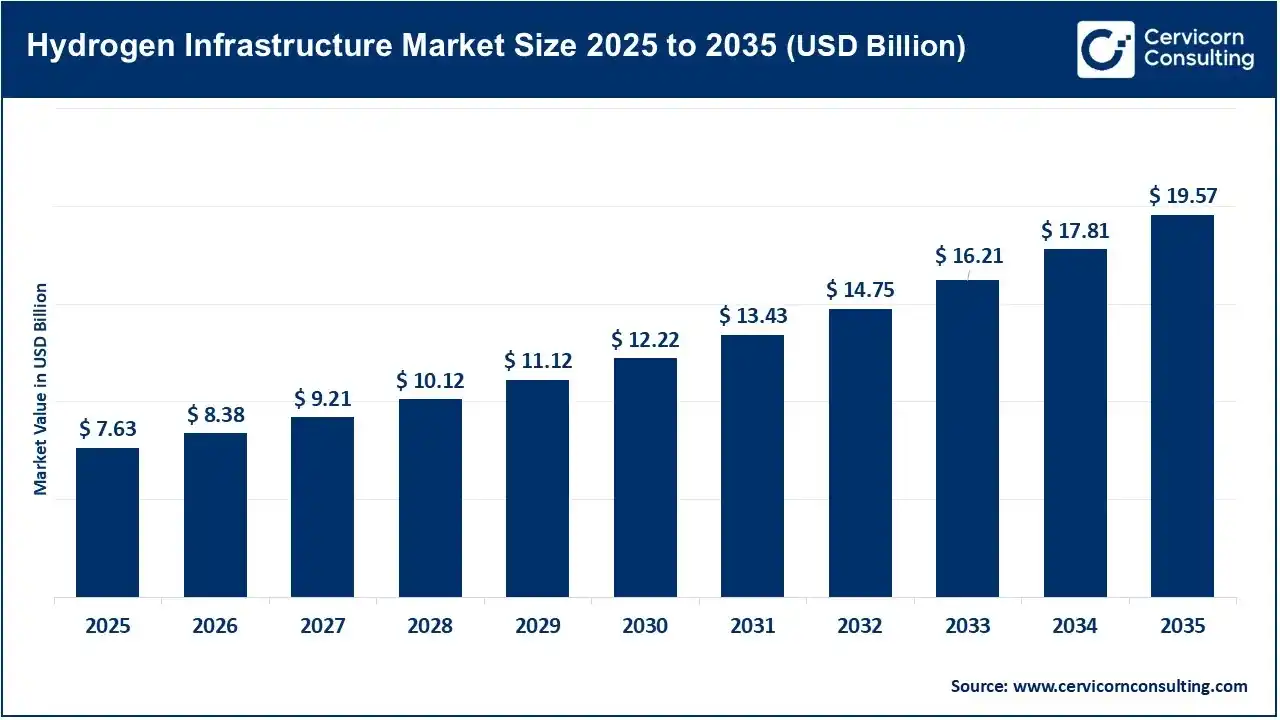
Global hydrogen demand surpassed 100 million tonnes in 2025, while low-emissions hydrogen production increased 20% to nearly 1 Mt. Installed electrolyzer capacity also surpassed 4 GW in 2025, having doubled during the year, creating additional requirements for supporting infrastructure. The IEA reports that more than 40,000 km of hydrogen pipeline projects have been announced through 2035, although only 9% is currently operational or has committed investment, indicating substantial infrastructure development potential.
Government decarbonization policies, industrial hydrogen demand, cross-border hydrogen trade, and growing investment in clean hydrogen projects are further accelerating infrastructure deployment. The Hydrogen Council reported in September 2026 that committed clean-hydrogen investment exceeded USD 130 billion across more than 570 projects, with 90% of these projects under construction or operational. Distribution infrastructure is becoming particularly important as hydrogen production and consumption become geographically separated; announced underground hydrogen-storage projects could provide around 11 TWh of capacity by 2035, while approximately 170 ammonia and 130 methanol port terminals are already operating globally. Growing hydrogen use in refining, fertilizers, steel, shipping, power generation, and heavy transportation is therefore creating demand for integrated production-to-consumption infrastructure.
Report Highlights
- North America led the global hydrogen infrastructure market with a 34.6% share in 2025, driven by hydrogen hubs, industrial demand, storage projects, and government-backed infrastructure investment.
- Pipelines dominated the hydrogen infrastructure market, accounting for 21.9% of the market in 2025, supported by industrial decarbonization and large-scale hydrogen transmission requirements.
- Storage is identified as the fastest-growing infrastructure segment, supported by increasing requirements for renewable-energy balancing, seasonal storage, and hydrogen hub development.
- More than 40,000 km of hydrogen pipeline projects have been announced through 2035, although only 9% is currently operational or backed by committed investment.
- Announced underground hydrogen-storage projects could provide 11 TWh of capacity by 2035, with large-scale salt-cavern projects under construction in the U.S., Germany, and China.
- Around 170 ammonia and 130 methanol terminals are already operating globally, providing an existing infrastructure base for emerging hydrogen-derived fuel trade.
What is Hydrogen Infrastructure?
Hydrogen infrastructure refers to the interconnected physical equipment, facilities, networks, and systems used to produce, compress, store, transport, distribute, and dispense hydrogen. It includes electrolyzers and production plants, compression systems, pipelines, tube trailers, liquefaction facilities, storage tanks and underground storage, hydrogen terminals, refueling stations, and associated monitoring and safety systems. The infrastructure connects hydrogen production with end users such as refineries, chemical plants, steel facilities, power generation, shipping, and hydrogen-powered vehicles.
Recent Milestones
| Year |
Organization |
Recent Milestone |
| 2026 |
IEA |
Announced hydrogen pipeline projects exceeded 40,000 km by 2035, with operational or committed-investment length increasing 70% from the previous review. |
| 2026 |
Hydrogen Council |
Clean-hydrogen committed investment reached USD 130 billion across 570+ projects, representing 6.9 million tonnes per annum of committed capacity. |
| 2026 |
India – National Green Hydrogen Mission |
India awarded 3,000 MW/year of electrolyzer manufacturing capacity to 15 companies and 862,000 tonnes/year of green-hydrogen production capacity to 18 companies. |
| 2026 |
India – Hydrogen Refueling Infrastructure |
Five pilot projects were sanctioned involving 37 hydrogen-fueled vehicles and 9 hydrogen refueling stations across 10 routes. |
| 2026 |
IEA |
Announced underground hydrogen-storage projects could provide approximately 11 TWh of capacity by 2035, with large-scale salt caverns under construction in the US, Germany, and China. |
| 2026 |
Japan |
Construction began on Japan's first commercial-scale liquefied-hydrogen import terminal, supporting emerging international hydrogen supply chains. |
| 2026 |
India – Green Hydrogen Hubs |
Kandla, Paradip, and Tuticorin were designated as Green Hydrogen Hubs to support production, distribution, and export infrastructure. |
Hydrogen Infrastructure Market Dynamics
Market Drivers
1. Rising Clean Hydrogen Deployment
Growing investment in clean hydrogen production is stimulating demand for pipelines, storage, transportation, compression, and refueling infrastructure. The Hydrogen Council reported in September 2026 that more than 570 clean-hydrogen projects had been announced with 6.9 Mtpa of committed capacity, while operational capacity reached approximately 1.7 Mtpa. Expansion of production facilities increasingly requires integrated infrastructure connecting hydrogen supply with industrial clusters, ports, mobility networks, and energy systems, supporting broader infrastructure deployment across major hydrogen-producing and consuming regions.
2. Industrial Decarbonization and Energy Security
Hydrogen infrastructure is increasingly being developed to decarbonize difficult-to-electrify industries while improving energy and feedstock security. More than 60% of committed clean-hydrogen investment is located in regions where energy security and industrial growth are at least as important as decarbonization objectives. This is encouraging investments in localized production, storage, transport networks, and hydrogen derivatives. Refining, chemicals, steel, fertilizers, shipping, and heavy-duty mobility are creating geographically concentrated demand centers that can support dedicated infrastructure hubs.
Market Restraints
1. High Infrastructure and Financing Costs
Hydrogen infrastructure requires substantial upfront investment because pipelines, storage facilities, liquefaction systems, specialized transport equipment, and refueling stations must often be developed before demand reaches sufficient utilization levels. Financing is particularly difficult in emerging markets where high borrowing costs increase project economics pressure. The IEA identifies high costs and financing barriers among the major obstacles to hydrogen deployment, with many projects still unable to secure final investment decisions despite policy support and announced development plans.
2. Limited Utilization and Uncertain Demand
Infrastructure developers face difficulty committing capital when future hydrogen demand and long-term offtake volumes remain uncertain. In 2025, new low-emissions hydrogen offtake agreements totaled approximately 1.7 Mtpa, but only around 20% of newly signed volumes were supported by firm contractual commitments. Low utilization can significantly weaken the economics of pipelines, terminals, storage facilities, and refueling stations, creating a coordination problem where infrastructure investment depends on demand while demand itself depends on infrastructure availability.
Market Opportunities
1. Development of Hydrogen Import and Export Corridors
International hydrogen trade creates opportunities for specialized ports, terminals, pipelines, ammonia handling facilities, and hydrogen conversion infrastructure. The IEA reports approximately 170 ammonia terminals and 130 methanol terminals already operating globally, providing potential foundations for hydrogen-derived fuel supply chains. Japan has also begun construction of its first commercial-scale liquefied-hydrogen import terminal. Expansion of maritime hydrogen trade could therefore encourage infrastructure investment around major ports and establish international hydrogen corridors.
2. Underground Hydrogen Storage and Pipeline Conversion
Repurposing existing natural-gas infrastructure and developing underground hydrogen storage offer opportunities to reduce the cost and time associated with building completely new networks. Announced underground hydrogen-storage projects could provide approximately 11 TWh of capacity by 2035, while Germany has completed the world's longest natural-gas pipeline repurposing project for hydrogen. Such approaches can support seasonal energy storage, balance variable renewable generation, and connect large production centers with industrial demand.
Market Challenges
1. Regulatory and Certification Fragmentation
Different countries and regions are developing varying standards for hydrogen production, carbon intensity, transportation, certification, safety, and trade. This fragmentation can complicate cross-border projects and increase compliance requirements for infrastructure operators. The IEA notes that 66 countries currently have national hydrogen strategies, but implementation remains uneven. Establishing compatible certification systems, safety standards, permitting procedures, and infrastructure regulations will be important for enabling international hydrogen networks and reducing uncertainty for project developers.
2. Technical Challenges in Transport and Storage
Hydrogen's low volumetric energy density, material compatibility requirements, compression needs, and the energy intensity of liquefaction create technical challenges for infrastructure operators. For shipping hydrogen in forms requiring conversion back to pure hydrogen, the IEA estimates minimum costs of around USD 2/kg of hydrogen and energy consumption above 10 kWh/kg, exceeding 30% of hydrogen's energy content. These characteristics increase operating complexity and make infrastructure design highly dependent on transportation distance and end-use requirements.
Hydrogen Infrastructure Market Regional Analysis
The hydrogen infrastructure market is segmented by region into North America, Europe, Asia-Pacific, Latin America, and LAMEA. Here is a brief overview of each region:
North America Hydrogen Infrastructure Market: Driven by Clean Hydrogen Hubs, Industrial Decarbonization, Energy Security, Heavy-Duty Mobility, and Large-Scale Federal Investment
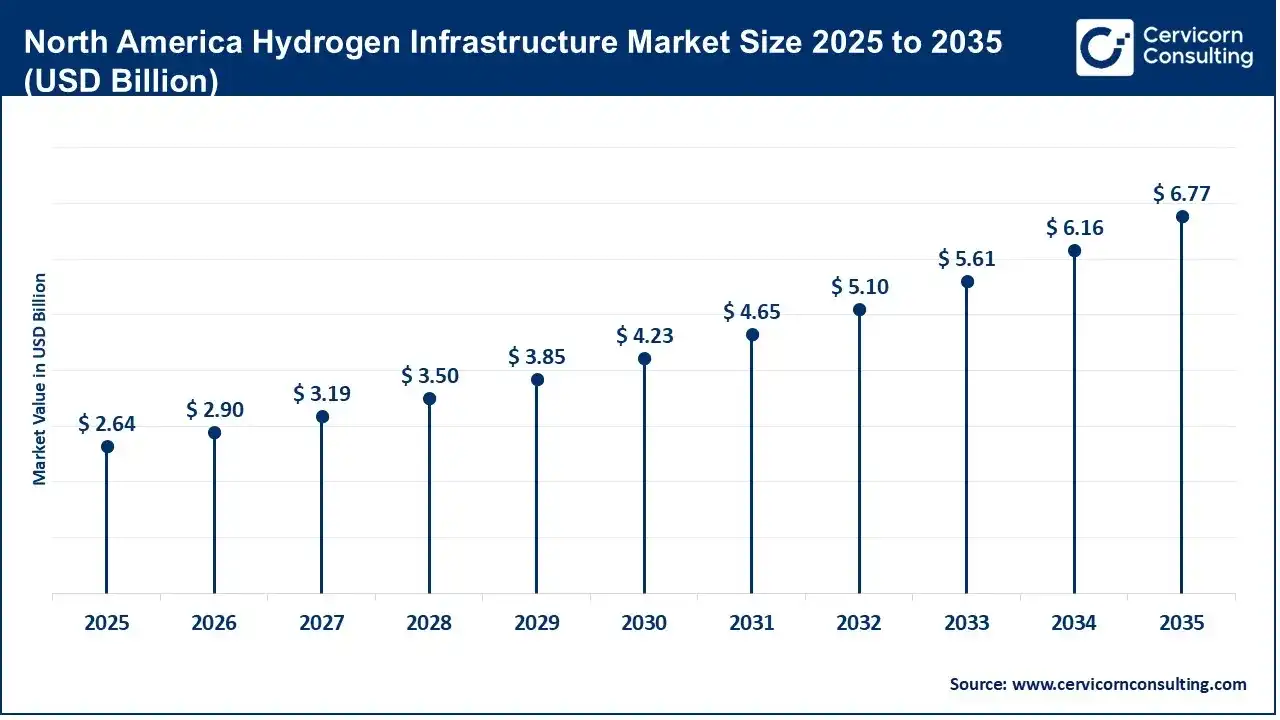
The North America hydrogen infrastructure market size was valued at USD 2.64 billion in 2025 and is predicted to surge USD 6.77 billion by 2035. North America is a major market, supported by large-scale government funding, established natural-gas infrastructure, abundant renewable and nuclear energy resources, industrial hydrogen consumption, and growing demand from heavy-duty transportation. The U.S. Department of Energy selected seven Regional Clean Hydrogen Hubs, with USD 7 billion in federal funding, designed to connect hydrogen production, storage, delivery, and end-use infrastructure. These hubs are expected to leverage nearly USD 50 billion in additional recipient investment, creating a broad ecosystem across industrial, transportation, power, and energy-storage applications.
United States: Hydrogen Hubs, Industrial Decarbonization, Federal Incentives, and Transportation Infrastructure Drive Market Development
- The U.S. has selected seven Regional Clean Hydrogen Hubs spanning the Gulf Coast, Midwest, California, Pacific Northwest, Appalachian, Heartland, and Mid-Atlantic regions, establishing a foundation for interconnected hydrogen infrastructure.
- The Infrastructure Investment and Jobs Act allocated USD 9.5 billion for hydrogen initiatives, including USD 8 billion for regional hydrogen hubs, USD 1 billion for electrolyzer R&D, and USD 500 million for hydrogen manufacturing and recycling R&D.
- The DOE awarded USD 1.66 billion in loan guarantees to Plug Power in January 2025 to support up to six facilities producing and liquefying low-carbon hydrogen across the U.S.
Canada: Regional Hydrogen Hubs, Clean-Fuel Development, Industrial Applications, and Refueling Infrastructure Support Market Expansion
- Canada's hydrogen ecosystem is developing around regional hubs, with the Edmonton Region Hydrogen Hub comprising more than 25 projects spanning the hydrogen value chain.
- The Edmonton hub has launched a 5,000 Hydrogen Vehicle Challenge, targeting deployment of 5,000 hydrogen-powered vehicles such as buses, trucks, and agricultural equipment in Western Canada within five years.
Asia-Pacific (APAC) Hydrogen Infrastructure Market: Driven by China’s Electrolyzer Leadership, Import-Oriented Japan and Korea, India’s Green Hydrogen Expansion, Industrial Demand, and Emerging Hydrogen Trade Corridors
The Asia-Pacific hydrogen infrastructure market size was estimated at USD 1.88 billion in 2025 and is forecasted to hit around USD 4.81 billion by 2035. Asia-Pacific is a leading and highly diverse region, supported by large industrial hydrogen demand, strong government policies, extensive manufacturing capabilities, and growing investment in clean hydrogen supply chains. China accounts for the largest share of committed hydrogen investment at approximately USD 44.5 billion, representing around 1.9 Mtpa of committed hydrogen capacity, while Japan and South Korea are concentrating investment on distribution and end-use infrastructure. India is emphasizing domestic green hydrogen production, whereas Southeast Asia is developing production and export opportunities.
China: Electrolyzer Manufacturing, Industrial Hydrogen Demand, Hydrogen Pipelines, and Energy Security Drive Infrastructure Development
- China accounted for nearly three-quarters of new global electrolysis installations in 2025, reinforcing its position as the region's largest electrolyzer deployment market.
- China began construction of the world's longest hydrogen pipeline, strengthening the country's hydrogen transmission infrastructure and connecting production areas with major industrial demand centers.
India: Green Hydrogen Production, Refining and Fertilizers, Electrolyzer Manufacturing, and Emerging Distribution Networks Drive Growth
- India's low-emissions hydrogen procurement tenders have surpassed 1 Mtpa, with more than 0.3 Mtpa contracted as of Q1 2026, primarily supported by refining and fertilizer applications.
- India is developing hydrogen infrastructure around existing industrial demand centers, particularly refineries and fertilizer facilities, creating opportunities for production, storage, pipelines, and transportation systems.
- The country's emphasis on domestic green hydrogen production is strengthening demand for electrolyzers, renewable-energy integration, compression systems, storage equipment, and hydrogen distribution infrastructure.
Europe Hydrogen Infrastructure Market: Driven by EU Hydrogen Targets, Cross-Border Pipeline Development, Industrial Decarbonization, Renewable Hydrogen Production, and Emerging Import Corridors
The Europe hydrogen infrastructure market size was accounted for USD 2.14 billion in 2025 and is expected to surpass USD 5.50 billion by 2035. Europe is a major hydrogen infrastructure development region, supported by EU decarbonization policies, industrial hydrogen demand, cross-border pipeline planning, renewable energy deployment, and efforts to diversify energy supplies. The region is moving toward an integrated hydrogen network connecting production hubs, industrial clusters, storage facilities, ports, and end users. The IEA reports that Europe represents less than 20% of global committed electrolysis capacity but approximately 45% of estimated investment, reflecting the region's relatively high capital intensity. The EU is also establishing dedicated regulatory frameworks for hydrogen infrastructure and cross-border transmission.
Germany: Hydrogen Backbone Development, Industrial Decarbonization, Storage, and Pipeline Repurposing Drive Infrastructure Expansion
- Germany completed the world's longest natural-gas pipeline repurposing project for hydrogen, strengthening the economic case for converting existing gas infrastructure.
- Germany is one of Europe's key hydrogen infrastructure markets because of its large steel, chemicals, refining, and manufacturing sectors and comparatively limited domestic renewable-hydrogen resources.
- The country is participating in the European Hydrogen Bank's third auction through EUR 1.7 billion of national funding, alongside Spain, supporting renewable-hydrogen production and associated infrastructure.
Netherlands: Port Infrastructure, Hydrogen Import Corridors, Industrial Clusters, and Offshore Energy Integration Support Growth
- The Netherlands is developing hydrogen infrastructure around the Rotterdam industrial and port cluster, supporting future imports, storage, distribution, refining, chemicals, and synthetic-fuel production.
- The country's strategic ports provide opportunities to handle hydrogen derivatives such as ammonia and methanol and connect international supply with European industrial consumers.
Hydrogen Infrastructure Market Share, By Region, 2025 (%)
| Region |
Revenue Share, 2025 (%) |
| North America |
34.6% |
| Asia-Pacific |
28.1% |
| Europe |
24.6% |
| LAMEA |
12.7% |
LAMEA Hydrogen Infrastructure Market: Driven by Gulf Hydrogen Hubs, Renewable Energy Potential, Industrial Decarbonization, Export Corridors, and Emerging Green Hydrogen Projects
The LAMEA hydrogen infrastructure market was valued at USD 0.97 billion in 2025 and is anticipated to reach USD 2.49 billion by 2035. LAMEA is an emerging market, with development concentrated in the Middle East, Latin America, and selected African countries. The Middle East benefits from established oil and gas infrastructure, large industrial clusters, sovereign investment capacity, and strategic export locations, while Latin America offers abundant renewable resources and relatively low-carbon electricity systems. Africa provides significant solar and wind potential but faces financing and infrastructure constraints. In Africa, hydrogen consumption reached 3.1 million tonnes in 2024, with Egypt accounting for nearly half of regional demand.
Middle East: Large-Scale Green Hydrogen Projects, Existing Energy Infrastructure, Export Hubs, and Industrial Demand Drive Market Development
- The MENA region had 127 announced hydrogen projects at the end of 2025, with more than 95% focused on green hydrogen, creating opportunities for electrolyzers, storage, pipelines, ammonia terminals, and export infrastructure.
- Saudi Arabia is advancing the NEOM Green Hydrogen project, with its 2.2 GW electrolyzer facility entering commissioning in August 2026, supporting large-scale hydrogen and ammonia production infrastructure.
Latin America: Renewable Energy Resources, Mining, Fertilizers, Industrial Decarbonization, and Export Potential Support Infrastructure Expansion
- Latin America and the Caribbean could produce more than 7 Mtpa of low-emissions hydrogen by 2030 based on announced projects, although only around 0.1% of this pipeline had reached operation, construction, or FID in the IEA's assessment.
- Approximately 60% of the region's electricity generation comes from renewable sources, creating a strong foundation for renewable hydrogen production and electrolyzer deployment.
Hydrogen Infrastructure Market Segmental Analysis
The hydrogen infrastructure market is segmented into infrastructure type, component, end use industry, and geography.
Infrastructure Type Analysis
Hydrogen Distribution Infrastructure dominates because large hydrogen projects increasingly require networks that connect production facilities with industrial clusters, storage sites, ports, and end users. Pipelines are particularly important for high-volume, continuous hydrogen supply, while distribution systems also include compression and delivery infrastructure. The IEA reports that more than 40,000 km of hydrogen pipeline projects have been announced for development through 2035, demonstrating the scale of transmission and distribution infrastructure planned globally.
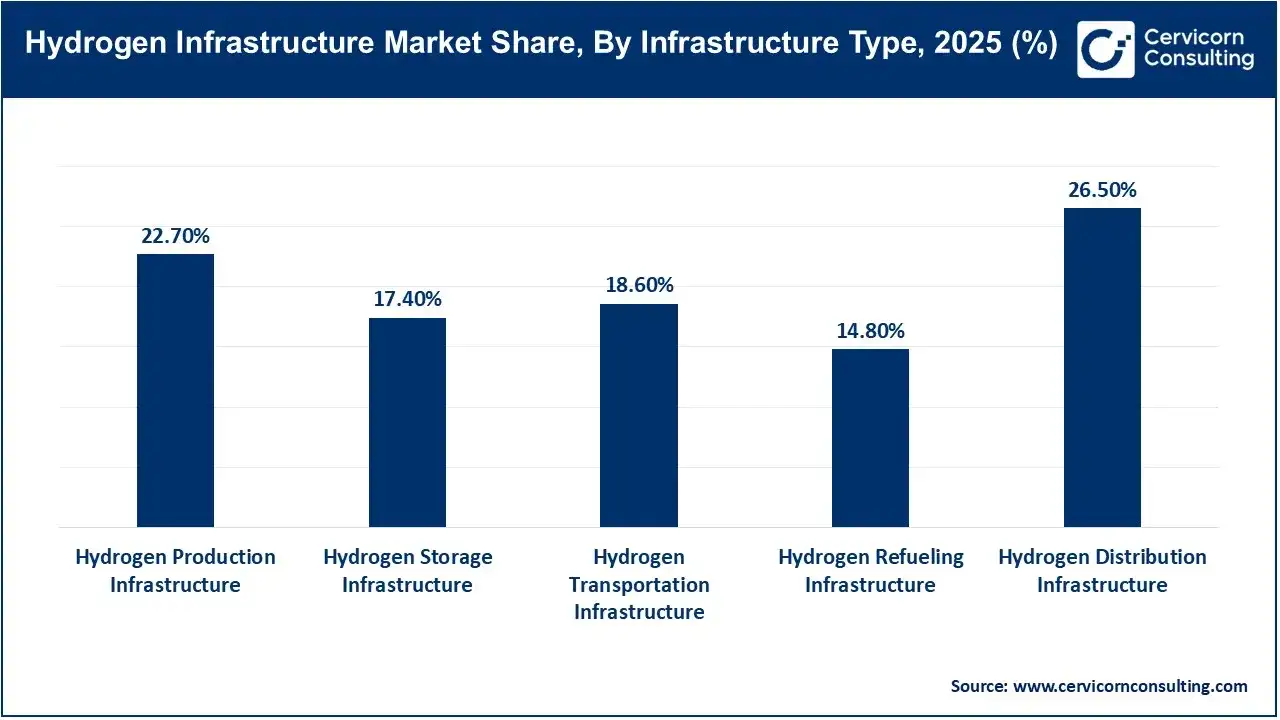
Hydrogen Storage Infrastructure is growing rapidly as developers need to balance intermittent renewable production with fluctuating industrial and transportation demand. Storage is becoming increasingly important for hydrogen hubs, refueling stations, power systems, and export facilities. The IEA estimates that announced underground hydrogen-storage projects could provide 11 TWh of capacity by 2035, with large-scale salt-cavern projects already under construction in the United States, Germany, and China.
Component Analysis
Pipelines dominate the component landscape because they provide efficient continuous transportation between large-scale hydrogen production facilities, storage locations, industrial users, and distribution hubs. Existing hydrogen pipelines primarily serve refineries and chemical facilities, while future networks are increasingly being designed as larger transmission systems. The IEA estimates that approximately 5,000 km of hydrogen pipelines were already operational worldwide, primarily connecting established industrial hydrogen users.
Hydrogen Infrastructure Market, By Component, 2025 (%)
| Component |
Revenue Share, 2025 (%) |
| Electrolyzers |
20.8% |
| Compressors |
16.3% |
| Storage Tanks & Cylinders |
13.7% |
| Pipelines |
21.9% |
| Dispensers & Refueling Equipment |
10.6% |
| Valves, Pumps & Flow Meters |
7.2% |
| Monitoring & Control Systems |
5.8% |
| Others |
3.7% |
Storage Tanks & Cylinders are expanding rapidly because hydrogen infrastructure requires localized storage for production buffering, transportation, refueling stations, and industrial applications. Compressed-gas storage is particularly relevant for mobility and distributed applications, while larger storage systems support industrial hubs and renewable hydrogen projects. Growing deployment of hydrogen refueling networks and transportation systems is increasing demand for high-pressure storage vessels, while underground storage development is further strengthening the broader requirement for hydrogen storage capacity.
End Use Industry Analysis
Industrial Manufacturing dominates hydrogen infrastructure demand because hydrogen is already deeply established in industrial processes and is increasingly being considered for decarbonizing steel, metals, chemicals, and other energy-intensive manufacturing. Global hydrogen demand surpassed 100 million tonnes in 2025, with almost all consumption still concentrated in traditional industrial and refining applications. The IEA estimates that 2.5 million tonnes of low-emissions hydrogen from committed projects is expected to be consumed by refineries and industrial facilities by 2030.
Hydrogen Infrastructure Market, By End Use Industry, 2025 (%)
| End Use Industry |
Revenue Share, 2025 (%) |
| Transportation & Mobility |
17.8% |
| Power Generation & Energy Storage |
19.6% |
| Industrial Manufacturing |
21.7% |
| Oil & Gas |
14.9% |
| Chemicals & Petrochemicals |
18.3% |
| Residential & Commercial |
3.4% |
| Others |
4.3% |
Transportation & Mobility is expanding rapidly as hydrogen fuel-cell technology gains traction in heavy-duty applications where long operating ranges, high utilization, and rapid refueling are important. Global fuel-cell electric vehicle stock increased 20% during 2025 to almost 130,000 vehicles, with truck sales in China and vehicle growth in Korea supporting expansion. The IEA expects trucks and buses to become particularly important hydrogen mobility applications, increasing requirements for refueling stations, compression equipment, storage systems, and hydrogen distribution networks.
Hydrogen Infrastructure Market Top Companies
Hydrogen Production Infrastructure
- thyssenkrupp nucera
- Nel ASA
- Plug Power
- ITM Power
- Enapter
Hydrogen Storage Infrastructure
- Hexagon Purus
- Worthington Enterprises
- Luxfer Holdings
- CIMC Enric
- NPROXX
Hydrogen Transportation Infrastructure
- Chart Industries
- Nikola Corporation
- Hyundai Glovis
- Wabtec Corporation
- Hexagon Composites
Hydrogen Refueling Infrastructure
- FirstElement Fuel
- H2 Mobility Deutschland
- Iwatani Corporation
- Toyota Tsusho Corporation
- Haskel
Segments Covered
By Infrastructure Type
- Hydrogen Production Infrastructure
- Hydrogen Storage Infrastructure
- Hydrogen Transportation Infrastructure
- Hydrogen Refueling Infrastructure
- Hydrogen Distribution Infrastructure
By Component
- Electrolyzers
- Compressors
- Storage Tanks & Cylinders
- Pipelines
- Dispensers & Refueling Equipment
- Valves, Pumps & Flow Meters
- Monitoring & Control Systems
- Others
By End Use Industry
- Transportation & Mobility
- Power Generation & Energy Storage
- Industrial Manufacturing
- Oil & Gas
- Chemicals & Petrochemicals
- Residential & Commercial
- Others
By Geography
- North America
- Europe
- Asia-Pacific
- LAMEA