Hydrogen Blending Market Size, Growth, Forecast 2026 to 2035
The global hydrogen blending market size was valued at USD 1.17 billion in 2025 and is expected to hit around USD 5.49 billion by 2035, reflecting a compound annual growth rate (CAGR) of 16.8% over the forecast period from 2026 to 2035. The hydrogen blending market is being driven primarily by the global push to decarbonize existing natural gas infrastructure without requiring immediate replacement of pipeline networks. Utilities and governments view hydrogen blending as a practical transition pathway because hydrogen can be injected into existing gas systems at low-to-moderate concentrations with limited modifications. Several studies and pilot programs indicate that hydrogen blending levels between 5% and 20% by volume can be achieved without major infrastructure changes, significantly reducing carbon emissions from gas consumption. The UK government has already endorsed blending of up to 20% hydrogen by volume into gas distribution networks, while industry trials have demonstrated the technical feasibility of operating gas networks with much higher hydrogen concentrations.
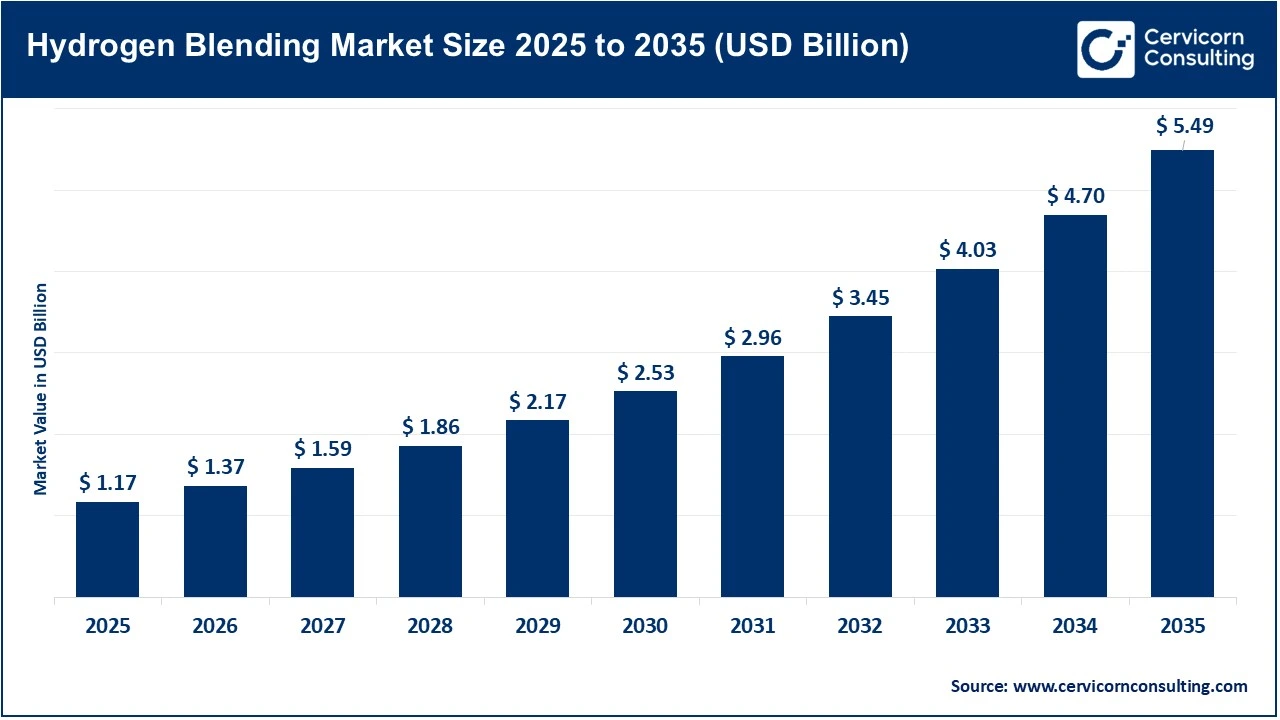
Another major growth factor is the rapid expansion of hydrogen production and dedicated hydrogen infrastructure worldwide. According to the International Energy Agency, global hydrogen demand reached nearly 100 million tonnes in 2024, reflecting growing interest in hydrogen across energy and industrial sectors. Simultaneously, Europe is accelerating investments in hydrogen transportation networks, with plans for a hydrogen backbone exceeding 58,000 km by 2040, approximately 60% of which is expected to be repurposed from existing natural gas pipelines. This ability to leverage existing infrastructure substantially lowers deployment costs and supports large-scale adoption of hydrogen blending as countries pursue net-zero targets, energy security, and renewable energy integration.
Report Highlights
- Europe led the global hydrogen blending market with 38.3% share, supported by strong hydrogen infrastructure investments and decarbonization policies.
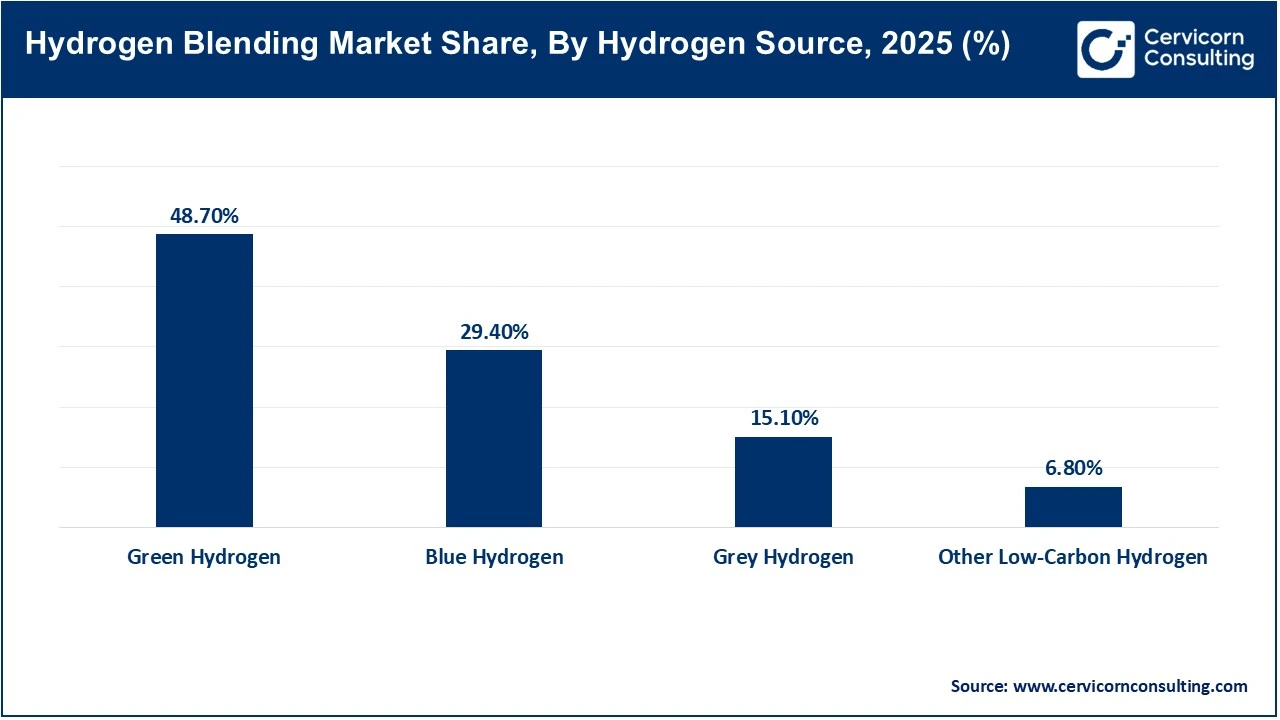
- Green hydrogen dominated the hydrogen source segment with 48.7% share, owing to increasing renewable energy integration and net-zero commitments.
- The Up to 5% blend ratio segment held 44.3% share, as it requires minimal modifications to existing gas infrastructure.
- Gas distribution networks led applications with 41.8% market share, reflecting widespread adoption across natural gas transmission and distribution systems.
- Power generation accounted for 23.7% share, supported by increasing utilization of hydrogen-blended fuels in gas-fired power plants.
- Gas utility companies dominated end users with 37.6% market share, driven by their role in pipeline operations and blending deployment.
What is Hydrogen Blending?
Hydrogen blending is the process of mixing hydrogen gas with natural gas and transporting the blended fuel through existing gas pipelines for use in residential, commercial, industrial, and power-generation applications. This approach enables energy providers to reduce greenhouse gas emissions from conventional natural gas systems while utilizing existing infrastructure, making it a cost-effective pathway toward decarbonization and the gradual transition to a hydrogen-based energy economy.
Uses of Hydrogen Blending:
- Residential heating and cooking applications
- Commercial building energy supply
- Industrial process heating and steam generation
- Power generation in gas turbines and combined-cycle plants
- Combined Heat and Power (CHP) systems
- Hydrogen-enriched compressed natural gas (HCNG) for transportation
- Integration of renewable energy through power-to-gas systems
- Reduction of carbon emissions from natural gas distribution networks
- Support for national clean energy and net-zero emission strategies
- Utilization of existing gas pipeline infrastructure for hydrogen deployment
Global Net-Zero Emission Targets and Decarbonization of Natural Gas Networks Driving Market Growth
The growing commitment of governments and industries to achieve net-zero emissions is a major catalyst for the hydrogen blending market, as blending hydrogen into existing natural gas networks offers a practical and cost-effective pathway to reduce carbon emissions without requiring complete infrastructure replacement. Hydrogen blending enables utilities to leverage existing pipeline assets while lowering the carbon intensity of gas supplied to residential, commercial, industrial, and power-generation users. As countries implement hydrogen roadmaps and decarbonization strategies, gas network operators are increasingly investing in hydrogen-ready infrastructure and pilot blending projects. The approach is particularly attractive because it supports renewable energy integration, enhances energy security, and accelerates progress toward climate goals while minimizing transition costs.
Key Statistics Related to This Driver:
- Hydrogen could help avoid approximately 7 gigatons of CO₂ emissions annually by 2050, equivalent to about 20% of projected global emissions on the current trajectory.
- Clean hydrogen has the potential to contribute about 11% of the cumulative emissions reductions required to limit global warming to 1.5–1.8°C by 2050.
- The planned European hydrogen backbone is expected to exceed 50,000 km of hydrogen pipelines by 2040, with roughly 60% repurposed from existing natural gas infrastructure.
- Canada's hydrogen strategy estimates hydrogen could contribute 21% of required GHG reductions by 2030 and nearly 30% by 2050.
- Global hydrogen demand reached nearly 100 million tonnes in 2024, reflecting growing adoption of hydrogen as a decarbonization solution.
- India's hydrogen blending initiatives are targeting blending levels of up to 20% hydrogen by volume in natural gas distribution networks to reduce emissions and support net-zero objectives.
Report Scope
| Area of Focus |
Details |
| Market Size in 2026 |
USD 1.37 Billion |
| Market Size in 2035 |
USD 5.49 Billion |
| CAGR 2026 to 2035 |
16.80% |
| Dominant Region |
Europe |
| Key Segments |
Hydrogen Source, Blend Ratio, Application, End User, Region |
| Key Companies |
Snam, National Gas, Enagás, Fluxys, Gasunie, SGN, Cadent Gas, SoCalGas, Engie, Mitsubishi Power, Siemens Energy, ATCO |
Recent Major Milestones
1. UK's First Live Hydrogen Blending Trial on the National Gas Grid (2025)
In 2025, Centrica and National Gas successfully completed the UK's first operational trial of injecting green hydrogen into the national gas transmission network and using the blended gas to generate electricity for the public grid. Unlike previous controlled demonstrations, this was a real-world deployment on an active gas network. The success of the project has strengthened confidence among utilities and regulators regarding the commercial viability of hydrogen blending, encouraging further investments in hydrogen-ready infrastructure and accelerating adoption across European gas networks.
2. Spain's Enagás Announces EUR 4+ Billion Hydrogen Infrastructure Investment (2025)
In 2025, Enagás unveiled plans to invest more than EUR 4 billion in hydrogen-related infrastructure by 2030, with over three-quarters of the funding dedicated specifically to hydrogen transport networks and associated assets. The initiative includes development of Spain's domestic hydrogen backbone and participation in the H2Med corridor connecting Iberia with wider Europe. This milestone is driving the hydrogen blending market by expanding the infrastructure needed to transport hydrogen at scale and creating future opportunities for blending hydrogen into existing natural gas systems.
3. Germany's Bad Lauchstädt Green Hydrogen Project Begins Test Operations (2025)
German gas company VNG announced the start of test operations for its 30 MW electrolyzer at the Bad Lauchstädt Energy Park in 2025. The facility is designed to produce approximately 2,700 tonnes of green hydrogen annually, supplying industrial customers through dedicated hydrogen infrastructure. This milestone supports market growth by increasing green hydrogen availability, which is essential for large-scale hydrogen blending programs. Greater hydrogen production capacity helps utilities secure reliable hydrogen supplies and reduces one of the key barriers to broader blending adoption.
4. India's National Green Hydrogen Mission Advances Hydrogen Blending Demonstrations (2025)
Under India's National Green Hydrogen Mission, researchers at Pandit Deendayal Energy University (PDEU) successfully demonstrated safe hydrogen blending levels of 18%–25% in simulated city gas distribution networks. The project validated pipeline compatibility, combustion performance, and operational safety while also supporting the development of a real-world hydrogen blending network with advanced monitoring systems. This milestone is helping drive the market by providing technical proof of feasibility for hydrogen blending in emerging economies and encouraging gas distribution companies to pursue commercial-scale deployment.
Hydrogen Blending Market Regional Analysis
The hydrogen blending market is segmented by region into North America, Europe, Asia-Pacific, Latin America, and LAMEA. Here is a brief overview of each region:
Why is the North America market witnessing significant growth in the hydrogen blending market?
The North America hydrogen blending market is expected to skyrocket from USD 1.17 billion in 2025 to over USD 5.49 billion by 2035. The North America market is witnessing significant growth due to increasing efforts to decarbonize natural gas networks, strengthen energy security, and accelerate the adoption of clean hydrogen technologies. Utilities across the United States and Canada are actively evaluating hydrogen blending as a practical pathway to reduce emissions while leveraging existing gas transmission and distribution infrastructure. Government-backed hydrogen strategies, growing investments in electrolyzer capacity, and the development of regional hydrogen hubs are creating favorable conditions for market expansion. Rising renewable energy deployment and supportive policies for low-carbon fuels are further encouraging utilities, industrial users, and power producers to adopt hydrogen blending solutions.
United States: Federal Hydrogen Hub Investments, Utility-Led Blending Projects, and Large-Scale Clean Hydrogen Development Continue Driving Market Expansion
- The U.S. Department of Energy has committed approximately USD 7 billion toward the development of regional clean hydrogen hubs, supporting hydrogen production, transportation, and end-use infrastructure.
- The United States operates more than 3 million kilometers of natural gas pipelines, creating substantial opportunities for hydrogen blending within existing gas networks.
- Several utilities, including SoCalGas, National Grid Renewables, and regional gas operators, are conducting hydrogen blending demonstrations to assess infrastructure compatibility and emissions reduction potential.
Canada: National Hydrogen Strategy, Strong Clean Energy Resources, and Utility Demonstration Projects Support Market Growth
- Canada's Hydrogen Strategy projects that hydrogen could contribute up to 30% of the country's end-use energy demand by 2050, supporting widespread deployment across multiple sectors.
- The country possesses more than 840,000 kilometers of natural gas distribution and transmission pipelines, providing a significant infrastructure base for hydrogen blending deployment.
- Canadian utilities such as ATCO and FortisBC have launched hydrogen blending pilot programs to evaluate operational performance, safety, and emissions reduction benefits.
Why is the Asia-Pacific experiencing robust growth in hydrogen blending market?
The Asia-Pacific hydrogen blending market is an estimated USD 1.17 billion in 2025, it is anticipated to cross USD 5.49 billion by 2035. The Asia-Pacific market is experiencing robust growth as governments seek to reduce dependence on fossil fuels, enhance energy security, and achieve long-term carbon neutrality goals. Countries across the region are investing heavily in hydrogen production, transportation, and utilization infrastructure while exploring hydrogen blending as a cost-effective method to decarbonize existing natural gas networks. Strong industrial demand, growing renewable energy capacity, and supportive policy frameworks are accelerating hydrogen adoption. Additionally, the region's large natural gas consumption base and expanding city gas distribution networks create significant opportunities for hydrogen blending deployment across residential, commercial, industrial, and power generation applications.
China: Massive Hydrogen Investments, Expanding Demonstration Projects, and Carbon Neutrality Goals Drive Market Leadership
- China aims to achieve carbon neutrality by 2060, driving substantial investments in hydrogen technologies and low-carbon energy infrastructure.
- The country produces more than 33 million tonnes of hydrogen annually, making it the world's largest hydrogen producer.
- China's national hydrogen development plan targets the production of 100,000–200,000 tonnes of renewable hydrogen annually during the initial phase of implementation.
India: National Green Hydrogen Mission and Expanding Gas Infrastructure Support Emerging Market Growth
- The National Green Hydrogen Mission aims to produce at least 5 million tonnes of green hydrogen annually by 2030.
- India's gas distribution sector is actively evaluating hydrogen blending levels of up to 20% by volume in selected city gas networks.
- Pilot projects conducted by research institutions and gas utilities have successfully demonstrated safe hydrogen blending in distribution systems.
Why does Europe represent the most advanced market for hydrogen blending?
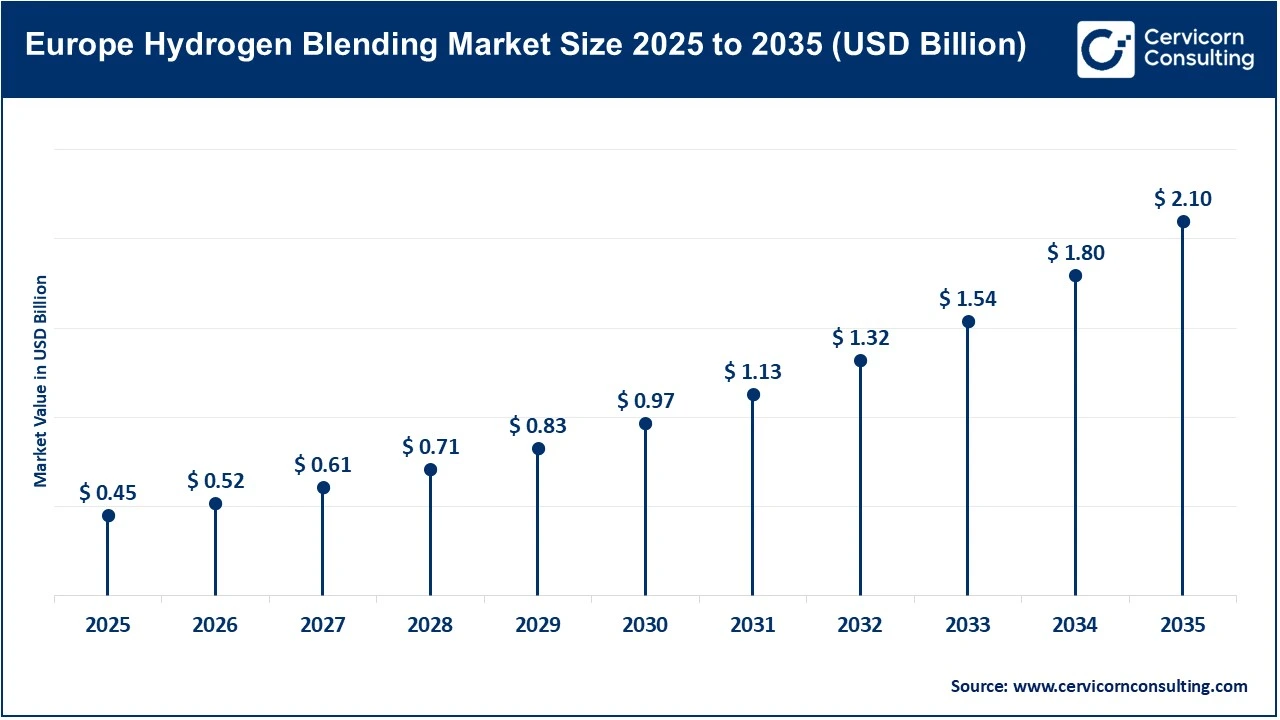
The European hydrogen blending market is projected to expand from USD 0.45 billion in 2025 to over USD 2.10 billion by 2035. Europe represents the most advanced hydrogen blending market globally, supported by ambitious climate targets, extensive hydrogen infrastructure investments, and proactive regulatory frameworks promoting low-carbon energy solutions. The region is accelerating the integration of hydrogen into existing natural gas networks as part of its broader strategy to achieve climate neutrality by 2050. Gas transmission operators, utilities, and governments are actively implementing hydrogen blending trials, pipeline repurposing projects, and large-scale hydrogen corridor initiatives. The expansion of renewable energy capacity, combined with growing investments in green hydrogen production and cross-border hydrogen transportation networks, continues to strengthen Europe’s leadership in the hydrogen blending market.
Germany: Hydrogen Backbone Expansion, Industrial Decarbonization Efforts, and Large-Scale Hydrogen Investments Drive Market Growth
- Germany's National Hydrogen Strategy targets the development of a large-scale hydrogen economy to support its 2045 climate neutrality goal.
- The country plans to establish a hydrogen core network exceeding 9,000 kilometers, largely through repurposing existing natural gas pipelines.
- Germany has committed billions of euros toward hydrogen production, transportation, and industrial decarbonization projects.
United Kingdom: Hydrogen Blending Demonstrations, Regulatory Support, and Gas Network Modernization Accelerate Adoption
- The UK government has evaluated hydrogen blending levels of up to 20% by volume within gas distribution networks as part of its decarbonization strategy.
- Utilities such as National Gas, Cadent, and SGN have conducted large-scale hydrogen blending and hydrogen transportation trials.
Hydrogen Blending Market Share, By Region, 2025 (%)
| Region |
Revenue Share, 2025 (%) |
| Europe |
38.3% |
| North America |
27.4% |
| Asia-Pacific |
24.6% |
| LAMEA |
9.7% |
What are the driving factors of LAMEA hydrogen blending market?
The LAMEA hydrogen blending market was valued at USD 0.11 billion in 2025 and is anticipated to reach at USD 0.53 billion by 2035. The LAMEA market is gaining momentum as countries leverage abundant renewable energy resources, pursue economic diversification, and implement decarbonization strategies. Governments and energy companies across the region are investing in green hydrogen production, hydrogen export infrastructure, and pilot blending projects to reduce emissions from existing natural gas networks. The availability of low-cost solar and wind resources, coupled with growing international demand for clean hydrogen, is encouraging the development of hydrogen ecosystems that support future blending applications in power generation, industrial operations, and gas distribution systems.
Saudi Arabia: Mega Green Hydrogen Projects, Energy Diversification Programs, and Net-Zero Commitments Drive Market Growth
- The NEOM Green Hydrogen Project is expected to produce approximately 600 tonnes of green hydrogen per day upon full operation, making it one of the world's largest hydrogen facilities.
- Saudi Arabia aims to achieve net-zero emissions by 2060, driving investments in clean hydrogen and low-carbon energy infrastructure.
- The country is leveraging its extensive energy infrastructure and industrial base to support hydrogen transportation and future blending opportunities.
Brazil: Abundant Renewable Resources, Green Hydrogen Investments, and Industrial Decarbonization Support Market Expansion
- More than 85% of Brazil's electricity generation comes from renewable sources, creating favorable conditions for low-cost green hydrogen production.
- Major ports including Pecém and Suape are attracting billions of dollars in proposed hydrogen production and export investments.
Hydrogen Blending Market Segmental Analysis
The hydrogen blending market is segmented into hydrogen source, blend ratio, application, end user, and geography.
Hydrogen Source Insights
Green hydrogen dominates the hydrogen blending market due to strong policy support, decarbonization mandates, and growing investments in renewable energy-powered electrolysis projects. Utilities and gas network operators increasingly prefer green hydrogen because it offers near-zero carbon emissions and aligns with national net-zero targets. Governments across Europe, Asia-Pacific, and North America are funding large-scale green hydrogen production facilities, making it the preferred source for blending applications. As hydrogen blending is primarily promoted as a clean-energy solution, green hydrogen remains the leading segment across most commercial and pilot projects.
Blue hydrogen is the fastest-growing segment because it provides a scalable and cost-effective pathway to expand hydrogen supply while green hydrogen production capacity continues to develop. Produced from natural gas with carbon capture and storage (CCS), blue hydrogen can leverage existing gas infrastructure and feedstock availability. Several countries are investing in large blue hydrogen hubs to accelerate decarbonization efforts and support hydrogen blending initiatives. Its relatively lower production cost and ability to deliver large volumes of hydrogen are driving rapid adoption, particularly in regions with established natural gas industries.
Blend Ratio Insights
The up to 5% blend ratio segment currently dominates the market because it can be implemented within existing natural gas networks with minimal infrastructure modifications and regulatory barriers. Most utilities begin hydrogen blending programs at lower concentrations to assess safety, pipeline compatibility, and end-user appliance performance. This approach reduces operational risks while allowing gas network operators to achieve incremental emissions reductions. As a result, the majority of active hydrogen blending projects worldwide continue to operate within this blend range, making it the largest segment by deployment volume.
Hydrogen Blending Market, By Blend Ratio, 2025 (%)
| Blend Ratio |
Revenue Share, 2025 (%) |
| Up to 5% |
44.3% |
| 5%–10% |
28.6% |
| 10%–20% |
20.4% |
| Above 20% |
6.7% |
The 10%–20% blend ratio segment is witnessing the fastest growth as governments and utilities seek greater carbon reduction benefits from existing gas infrastructure. Advances in pipeline integrity assessment, gas monitoring technologies, and hydrogen-compatible equipment are enabling higher blending percentages without major system upgrades. Several national hydrogen strategies are evaluating or targeting blending levels close to 20%, encouraging utilities to move beyond small-scale demonstrations. The ability to achieve substantially larger emissions reductions compared to low-level blends is expected to accelerate adoption of this segment over the coming years.
Application Insights
Gas distribution networks represent the dominant application segment because hydrogen blending is primarily designed to decarbonize existing natural gas delivery systems. Utility operators are increasingly injecting hydrogen into local and regional gas networks to reduce the carbon footprint of energy supplied to residential, commercial, and industrial consumers. The extensive global footprint of gas pipeline infrastructure provides a large addressable market for blending technologies. Since distribution networks serve millions of customers and require relatively limited modifications for low-to-medium hydrogen blends, they remain the largest application area.
Hydrogen Blending Market, By Application, 2025 (%)
| Application |
Revenue Share, 2025 (%) |
| Gas Distribution Networks |
41.8% |
| Power Generation |
23.7% |
| Industrial Process Heating |
18.9% |
| Transportation Fuel (HCNG) |
8.4% |
| Combined Heat and Power (CHP) |
7.2% |
Power generation is emerging as the fastest-growing application segment due to increasing demand for low-carbon electricity and grid flexibility. Utilities are testing hydrogen-blended fuel in gas turbines and combined-cycle power plants to reduce emissions while maintaining reliable power generation. Growing renewable energy deployment is also increasing interest in hydrogen as an energy storage and balancing solution. As turbine manufacturers continue developing hydrogen-compatible technologies and governments introduce stricter emissions targets for power producers, hydrogen blending in power generation is expected to expand rapidly.
End User Insights
Gas utility companies dominate the hydrogen blending market because they own and operate the infrastructure through which blended hydrogen is transported and delivered. These companies are leading pilot projects, infrastructure upgrades, and regulatory engagement efforts aimed at integrating hydrogen into existing gas systems. Their direct responsibility for pipeline operations, network safety, and energy distribution places them at the center of hydrogen blending deployment. Furthermore, utilities are under increasing pressure to reduce emissions while preserving the value of existing assets, reinforcing their leadership position in the market.
Hydrogen Blending Market, By End User, 2025 (%)
| End User |
Revenue Share, 2025 (%) |
| Gas Utility Companies |
37.6% |
| Industrial Manufacturers |
24.8% |
| Power Generation Companies |
16.9% |
| Oil & Gas Companies |
11.2% |
| Transportation and Mobility Operators |
5.4% |
| Commercial & Residential Consumers |
4.1% |
Industrial manufacturers are the fastest-growing end-user segment as industries seek practical solutions to decarbonize high-temperature heating processes and reduce dependence on conventional fossil fuels. Sectors such as chemicals, steel, cement, glass, and refining consume significant volumes of natural gas and are increasingly exploring hydrogen-blended fuel as a lower-carbon alternative. Corporate sustainability commitments, emissions regulations, and rising investor focus on environmental performance are accelerating adoption. Hydrogen blending allows industrial facilities to reduce emissions without immediately replacing existing combustion equipment, making it an attractive transitional solution.
Hydrogen Blending Market Top Companies
Recent Developments
- In May 2025, National Gas and Centrica completed the United Kingdom’s first live hydrogen blending trial on the national gas transmission network, successfully delivering hydrogen-blended gas to a power generation facility. The development demonstrated the operational feasibility of integrating hydrogen into existing gas infrastructure and supports broader commercialization of hydrogen blending across the UK energy sector.
- In February 2025, Enagás announced plans to invest more than EUR 4 billion in hydrogen infrastructure through 2030, including development of Spain’s hydrogen backbone network and participation in the H2Med corridor. The initiative strengthens Europe’s hydrogen transportation ecosystem and supports future large-scale hydrogen blending deployment across gas networks.
- In April 2025, Gasunie accelerated development of the Dutch national hydrogen network by advancing pipeline conversion projects and expanding hydrogen transport infrastructure across the Netherlands. The development enhances hydrogen availability and supports integration of hydrogen into existing gas distribution systems.
Market Segmentation
By Hydrogen Source
- Green Hydrogen
- Blue Hydrogen
- Grey Hydrogen
- Other Low-Carbon Hydrogen
By Blend Ratio
- Up to 5%
- 5%–10%
- 10%–20%
- Above 20%
By Application
- Gas Distribution Networks
- Power Generation
- Industrial Process Heating
- Transportation Fuel (HCNG)
- Combined Heat and Power (CHP)
By End User
- Gas Utility Companies
- Power Generation Companies
- Industrial Manufacturers
- Oil & Gas Companies
- Transportation and Mobility Operators
- Commercial & Residential Consumers
By Geography
- North America
- Europe
- Asia-Pacific
- LAMEA