Data Center Physical Infrastructure Market Size, Growth, Forecast 2026 to 2035
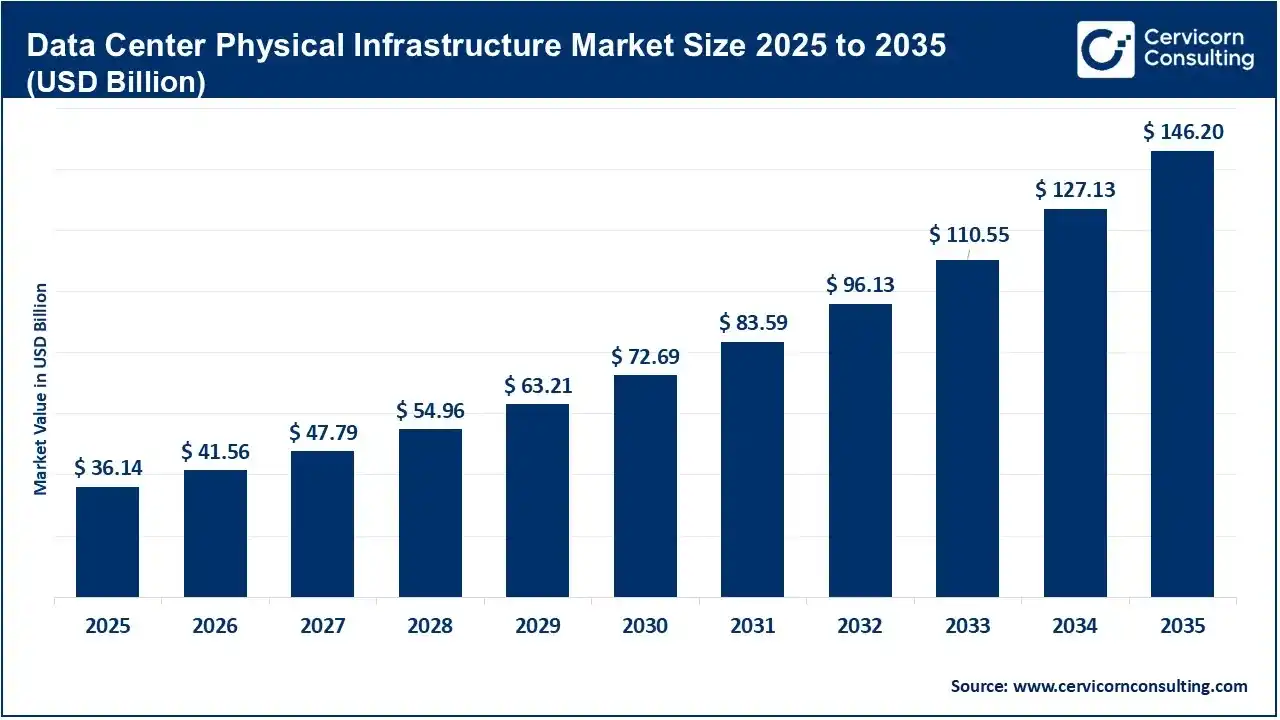
The global data center physical infrastructure market size was valued at USD 36.14 billion in 2025 and is expected to reach at USD 146.20 billion by 2035 with a promising expansion at CAGR of 15% during the forecast period from 2026 to 2035. Rapid adoption of artificial intelligence (AI) and high performance computing is the primary growth factor, as high-density GPU deployments require substantially greater power distribution capacity and advanced thermal management than conventional workloads.
Report Highlights
- By region, North America dominated, supported by its extensive installed data center base, concentration of hyperscalers and technology companies, and significant investment in AI-ready power and cooling infrastructure, while Asia-Pacific is expected to be the fastest-growing region due to expanding cloud adoption, AI investments, digitalization, and large-scale data center development across major regional markets.
- By component, the power infrastructure segment dominated, supported by the essential role of UPS systems, batteries, generators, switchgear, and power distribution equipment in ensuring reliable and uninterrupted data center operations, while thermal management infrastructure is expected to be the fastest-growing segment as AI and HPC workloads increase rack density and heat generation.
- By infrastructure technology, the UPS systems segment dominated, driven by the need for continuous, conditioned, and protected power for servers, networking equipment, storage systems, and AI accelerators, while direct liquid cooling is expected to be the fastest-growing technology as high-density computing creates greater thermal management requirements.
- By data center type, the hyperscale data centers segment dominated, owing to continued capacity expansion by major cloud and digital service providers and their large-scale investments in standardized, automated, and scalable infrastructure, while HPC and AI data centers are expected to be the fastest-growing segment due to their significantly higher power, cooling, and rack-density requirements.
- By end user, the cloud service providers segment dominated, driven by continuous investment in geographically distributed data center infrastructure to support expanding cloud workloads and maintain service availability, while hyperscalers are expected to be the fastest-growing segment due to rapid AI infrastructure expansion and the development of large-scale computing campuses.
What is Data Center Physical Infrastructure & How is the Market Growing?
Data center physical infrastructure carries components to support an organization and its IT operations while revolving around power supplies, servers, storage systems and cooling mechanisms. This system apparently holds a complex set of components made up of interconnected technologies. Every data center infrastructure relies on servers to process and manage data, network infrastructure to connect systems, physical security and structural systems. Improved uptime with proactive monitoring, faster issue resolution, simplified audits and optimized resource planning are few major benefits of data center physical infrastructure.
The market is evolving rapidly as AI, high-performance computing, cloud expansion, and hyperscale deployments push data centers toward significantly higher rack densities and greater power requirements. This is driving a transition from conventional air-cooled, lower-density architectures toward high-capacity power distribution, intelligent UPS and PDU systems, busways, direct-to-chip liquid cooling, immersion cooling, advanced heat exchangers, high-density racks, and integrated infrastructure-management technologies. Direct liquid cooling revenue more than doubled year over year in Q1 2025, while North America recorded particularly strong DCPI growth, illustrating how AI-driven infrastructure requirements are accelerating technology adoption.
Technology, Consumption & Adoption
- Global electricity consumption by data centers is expected to approach nearly 945 TWh by 2030, more than doubling from 2024 levels. The IEA estimates that data center electricity demand is projected to grow nearly 15% per year between 2024 and 2030, more than four-times the annual pace of electricity demand growth from other sources.
- AI-accelerated servers are expected to emerge as the largest sources of new electricity consumption. The IEA projects that electricity consumption for accelerated servers alone will grow by about 30% per year, in contrast to less than 9% growth per year for conventional servers.
- More than nearly half of the net increase in global data center electricity demand through 2030 will be driven by these accelerated servers.
- Data centers in the U.S. represented approximately 45% of global electricity consumption for data centers in 2024, followed by China at nearly 25%, then Europe at around 15%. The concentration explains why North America is the most mature market for physical infrastructure while China and other Asian markets offer the largest expansion opportunity.
- Investment in data centers has become incredibly power-intensive. From $253 billion in 2022, to more than $498 billion in 2024, there nearly has been a doubling of annual global data center investment.
- Densities in the 10 kW to 30 kW range are becoming mainstream. The average server rack power densities continue to increase in terms of adoption for racks from 10-30kW while extremely high-density server racks are still relatively rare among overall installations in the global market per the Uptime Institute report.
- The Uptime Institute estimates that current artificial intelligence hardware runs at densities in the 40-60 kW range with new systems anticipated to reach even higher levels through next year; and even some hardware released in 2025 is said to run at power densities beyond 100 kW per rack, leading to plans for some systems in the hundreds of kW range per rack.
Government Initiatives
| Country / Region |
Government Initiative |
Key Measure / Investment |
Impact on Data Center Physical Infrastructure Market |
| United States |
Federal AI Infrastructure & Data Center Development Initiatives |
2025 executive actions support AI data center development, including federal sites, energy generation, transmission infrastructure and financial support mechanisms such as loans, grants, tax incentives and offtake agreements. |
Creates demand for high-capacity power infrastructure, transmission equipment, UPS, switchgear, backup generation, energy storage and advanced cooling. |
| China |
Eastern Data, Western Computing (East-to-West Computing Project) |
China is relocating and expanding computing infrastructure toward western regions such as Inner Mongolia and Guizhou, where land, electricity and renewable-energy resources are more readily available. |
Supports large-scale construction of hyperscale and AI data centers, generating demand for electrical distribution, UPS, cooling, high-density racks, network infrastructure and energy-efficient facility systems. |
| European Union |
AI Gigafactories / EuroHPC Framework |
The EU is developing a framework for AI Gigafactories through the EuroHPC Joint Undertaking, with plans supporting up to five AI Gigafactories through public-private partnerships. |
Creates a new class of extremely high-density computing facilities requiring large-scale power infrastructure, liquid cooling, high-density rack systems, advanced thermal management and high-capacity electrical distribution. |
| India |
Digital India / GI Cloud (MeghRaj) |
India's GI Cloud provides scalable cloud infrastructure for government services. The Economic Survey 2025–26 reported approximately 1,280 MW of installed data center capacity as of June 2025, |
Government cloud expansion and digital public infrastructure create sustained requirements for data center capacity and facility management systems. |
Market Dynamics
What Drives the Growth of Data Center Physical Infrastructure Market?
Computing power growth and AI/cloud expansion are the two main forces driving physical data center infrastructure market growth by increasing the amount of power and thermal need per rack. AI needs have altered the fundamental design of a data center, as today's super-powerful graphics processors (GPUs) or AI accelerators are packing even more power into tiny enclosures that churn out far more heat.
The result is the need for higher-power UPSs, smart power distribution units (PDUs), busway, dense racks, liquid cooling systems, enhanced cooling systems, and data center infrastructure monitoring solutions. This is generating demand for not just new data centers, but also for upgrades to current facilities where operators want to increase power density without growing footprints.
What is the Biggest Challenge for the Data Center Physical Infrastructure Market?
The availability of reliable power is emerging as the biggest structural challenge, because data center construction can progress considerably faster than the electricity infrastructure required to energize new capacity. AI facilities create concentrated, 24/7 electricity loads that can place substantial stress on local grids, transmission networks, generation capacity, and interconnection queues.
The IEA estimates that data center electricity consumption will grow by around 15% annually between 2024 and 2030, while the U.S. is expected to see data centers account for nearly half of electricity-demand growth through 2030. This creates a fundamental mismatch between the speed of AI infrastructure deployment and the speed at which utilities can provide new generation and grid connections.
What Holds the Largest Opportunity in Data Center Physical Infrastructure Market?
AI-ready power and thermal infrastructure represents the biggest opportunity in technologies that can address the challenges posed by AI's need for dense racks while increasing energy efficiency, operational flexibility, and facility extensibility. The shift in compute from traditional IT to AI has created a significant technology gap between legacy data centers and the physical needs of next-generation accelerated compute.
For facilities that evolved to service traditional 10-20 kW rack density, it’s becoming increasingly difficult to accommodate AI clusters that demand more than 100 kW of power per rack, which will present opportunities to grow data center capacity with solutions such as direct-to-chip liquid cooling, cooling distribution units, high-capacity busways, intelligent rack PDUs, modular UPS systems, battery energy storage, advanced power distribution and high-density rack solutions. The opportunity is particularly compelling in the retrofit and brownfield markets as operators need to increase compute density without bringing in a new building.
Regional Analysis
What Made North America the Dominating Region in the Market?
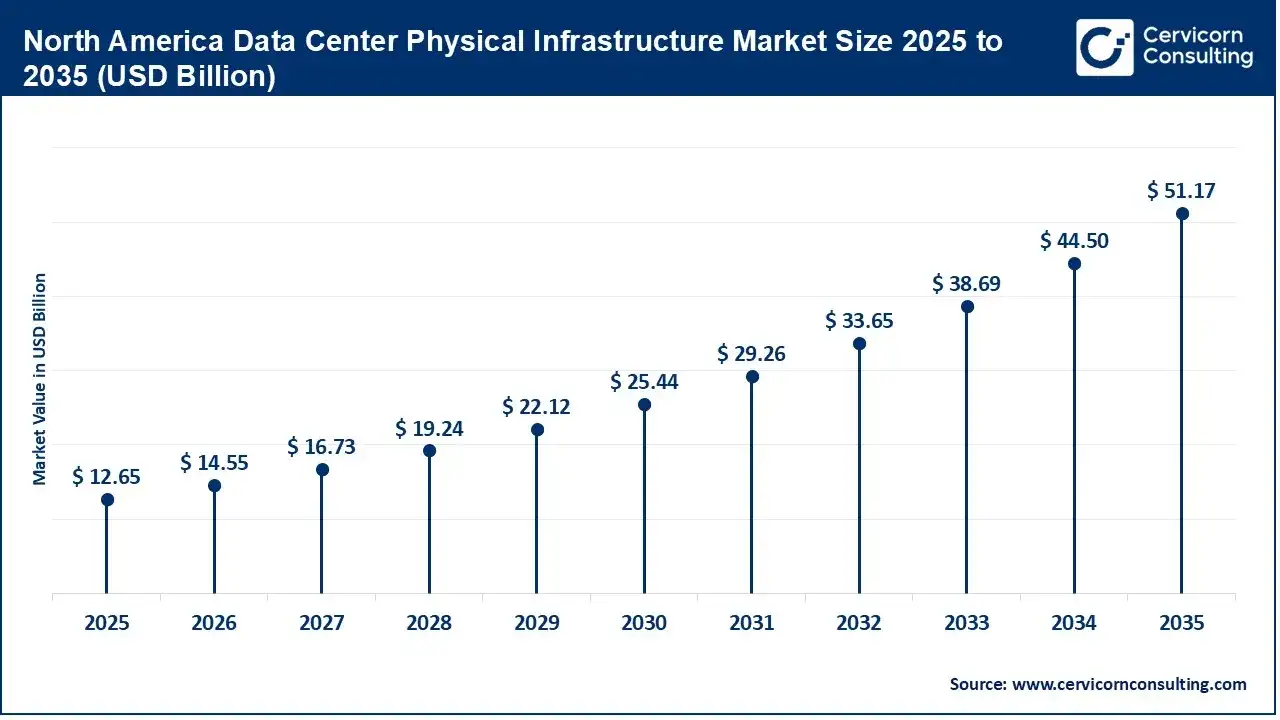
The North America data center physical infrastructure market size was estimated at USD 12.65 billion in 2025 and is projected to surpass USD 51.17 billion by 2035. North America, with one of the biggest installed data center inventory and concentration of hyperscalers, AI players and technology firms, is the leading regional market for data center physical infrastructure. The U.S. is responsible for a vast portion of overall demand, driven by extensive clusters of data centers throughout the country, including Northern Virginia, Dallas–Fort Worth, Silicon Valley, Phoenix, Chicago, Atlanta, and many newer markets.
The region is among the pioneers in AI infrastructure investments to power data center developments, leading to significant demand for high-density power distribution, modern UPS equipment, liquid cooling, higher-capacity racks, and intelligent infrastructure-management platforms.
Nonetheless, for the North American market, a tug-and-pull can be seen between burgeoning infrastructure demand and the limitations imposed by physical resources. Restrictions around utility power, lengthy processes of interconnection with local utilities, availability of land, waters and power transmission limitations force operators to rethink of alternative options to deploy data centers.
Data Center Physical Infrastructure Market Share, By Region, 2025 (%)
| Region |
Revenue Share, 2025 (%) |
| North America |
35% |
| Europe |
22% |
| Asia-Pacific |
32% |
| LAMEA |
11% |
Asia Pacific Data Center Physical Infrastructure Market Analysis
The Asia-Pacific data center physical infrastructure market size reached at USD 11.56 billion in 2025 and is expected to hit USD 46.78 billion by 2035. Asia-Pacific represents the fastest-growing regional opportunity because of the simultaneous expansion of cloud computing, digital services, AI adoption, data localization requirements, hyperscale investment, and enterprise digitization across major and emerging economies. China, Japan, India, Singapore, Australia, and South Korea are primary markets for data centers, though increasingly others throughout Southeast Asia, including Malaysia, Indonesia, the Philippines, and Vietnam, are attracting hyperscale providers for greater capacity and geographic diversification.
In mature markets including Singapore, Tokyo and pockets of South Korea, the data center ecosystem are highly mature but are encumbered by issues such as land, power and sustainability. Elsewhere such as India, Malaysia, and Indonesia, new capacity is going up at breakneck speed due to growing cloud consumption and digital usage. AI has also presented another wrinkle due to requirement to spec out a new facility with high-density rack requirements and advanced cooling systems from day zero.
Top 5 Countries Investing in Data Center Physical Infrastructure
| Country |
Key Investment Indicator |
Data Center / AI Infrastructure Position |
| United States |
5,427 data centers in 2025; approximately 36.0 GW of installed hyperscaler and colocation capacity in 2025 |
Global leader in hyperscale and AI data center deployment; hosts 15 of the world's 20 largest AI data centers |
| China |
Approximately 20.0 GW of installed hyperscaler and colocation capacity in 2025 |
One of the world's largest data center ecosystems, supported by cloud, AI, digital services and national computing infrastructure programs |
| India |
1.7 GW live IT capacity, with 1.3 GW under construction and 3.2 GW approved |
One of the fastest-expanding data center markets in APAC; major hyperscaler and domestic AI investment |
| United Kingdom |
523 data centers in 2025; approximately 2.2 GW of installed hyperscaler and colocation capacity in 2025 |
Europe's largest data center market by facility count; strong cloud, colocation and AI infrastructure demand |
| France |
322 data centers in 2025; major new AI infrastructure commitments |
Emerging European AI infrastructure hub benefiting from abundant nuclear power and major foreign investment |
Segmental Analysis
Component Analysis
The power infrastructure was the largest segment of the data center physical infrastructure market. This encompasses UPS systems, batteries, generators, switchgear and power distribution, monitoring and power protection systems which shield IT equipment from utility outages, fluctuations in voltage or harmonics.
Its prominence grows as datacenters move more and more towards high-performance computing and AI workloads which can sustain catastrophic computing and financial costs after a utility outage causing a GPU cluster to stop producing calculations, rack densities are prompting rethinking of older, low-voltage distribution architectures to favor higher capacity electrical systems, intelligent power distribution, modular UPS systems, Lithium-ion batteries, and distribution through busways.
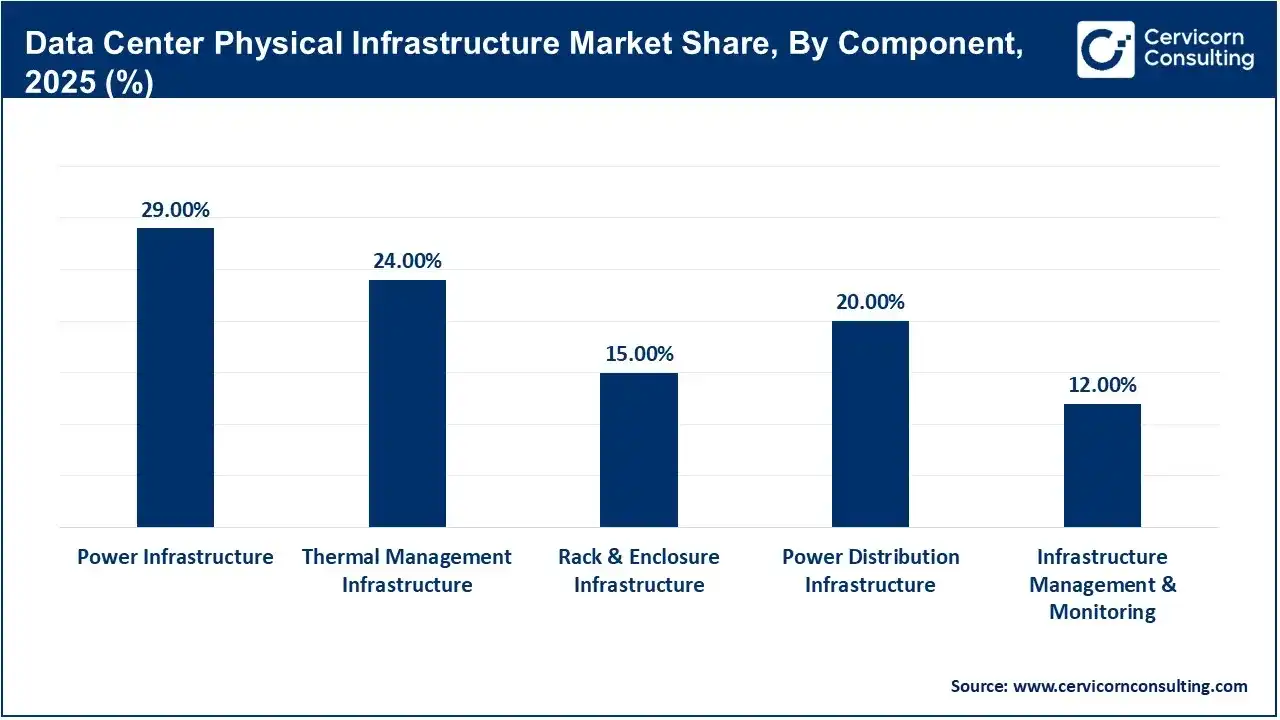
Thermal management infrastructure is emerging as the fastest-growing component category because the rapid deployment of GPUs, AI accelerators, and high-performance computing systems is fundamentally changing the heat profile of modern data centers. Conventional air cooling can efficiently manage traditional rack densities, but increasingly dense AI racks generate heat loads that place significant pressure on fans, chillers, computer room air handlers, and conventional cooling architectures. This is accelerating investment in direct-to-chip liquid cooling, rear-door heat exchangers, cooling distribution units, immersion cooling, advanced heat-rejection systems, and hybrid air-liquid architectures.
Infrastructure Technology Analysis
UPS systems, being the largest segment in 2025; will continue to be a core technology for the data center physical layer, due to the critical need to ensure uninterrupted IT availability and protect ever-more valuable computer equipment. UPS devices are applied in data centers to provide bridge power during utility failure between the interruption of the utility and the startup of backup generation resources, and are also used to condition the incoming utility power and provide power protection to sophisticated servers, storage, network and AI accelerator devices from voltage fluctuations.
Other UPS technologies include double conversion UPS, modular UPS, flywheel UPS, lithium-ion battery UPS and conventional valve-regulated lead-acid UPS, but technology is changing in the UPS segment as data center operators demand greater efficiency, smaller size, longer battery lifetime, enhanced management, and scalability.
Data Center Physical Infrastructure Market Share, By Infrastructure Technology, 2025 (%)
| Infrastructure Technology |
Revenue Share, 2025 (%) |
| UPS Systems |
17% |
| Power Distribution Units (PDUs) |
12% |
| Busway Systems |
5% |
| Air Cooling |
15% |
| Direct Liquid Cooling |
9% |
| Immersion Cooling |
4% |
| Rear-Door Heat Exchangers |
5% |
| Cooling Distribution Units (CDUs) |
6% |
| Data Center Racks & Cabinets |
10% |
| Containment Systems |
7% |
| Data Center Infrastructure Management (DCIM) |
7% |
Direct liquid cooling, a burgeoning segment for the upcoming years, is gaining traction rapidly as a solution to a primary physical infrastructure challenge introduced by AI computing-namely, removing immense quantities of heat from hyper-density computing devices within an already constrained physical space.
Direct liquid cooling is well-suited to server-grade GPUs in artificial intelligence systems, high-performance computing (HPC) and other accelerated computing applications where rack densities often exceed what either is economically or logistically feasible using conventional air cooling, but also to other forms of high-power density computing.
Data Center Type Analysis
The hyperscale data centers segment was the leading data center type-major cloud and digital service providers maintain massively distributed computer infrastructure that require ongoing expansion, feeding the need to consistently reinvest in the power, cooling, racks, electrical distribution, and facility infrastructure needed to support the growing demand for its services. These data centers feature very large IT capacity and infrastructure built on a basis of standardization, automation, and designs geared toward scalability. Hyperscale providers possess the financial strength, capacity and vision to take on leading-edge physical infrastructure innovation prior to those within other market segments.
Data Center Physical Infrastructure Market Share, By Data Center Type, 2025 (%)
| Data Center Type |
Revenue Share, 2025 (%) |
| Hyperscale Data Centers |
27% |
| Colocation Data Centers |
22% |
| Enterprise Data Centers |
14% |
| Cloud Data Centers |
19% |
| Edge Data Centers |
6% |
| High-Performance Computing (HPC) & AI Data Centers |
12% |
HPC and AI data centers are the fastest-growing data center category because accelerated computing has fundamentally different physical infrastructure requirements from conventional enterprise and cloud workloads. Training and inference of AI and machine learning consume tremendous power from dense clusters of GPUs and other accelerators on a level that no other type of application requires. This demands a cascade of new technologies, including higher densities that translate into increased rack level power, higher densities that generate tremendous power and consequently more heat.
End User Analysis
Cloud service providers represent the dominant end-user category because cloud computing has shifted data center infrastructure demand from individual organizations operating their own facilities toward large-scale providers serving thousands or millions of customers from centralized infrastructure. Cloud providers require extensive investments in UPS systems, power distribution, cooling, racks, containment, monitoring, and facility management to maintain service availability across geographically distributed data center portfolios. Their infrastructure requirements are also unusually scalable because capacity must be added continuously as customer workloads expand.
Data Center Physical Infrastructure Market Share, By End User, 2025 (%)
| End User |
Revenue Share, 2025 (%) |
| Cloud Service Providers |
28% |
| Hyperscalers |
22% |
| Colocation Providers |
19% |
| Enterprises |
14% |
| Telecom Operators |
10% |
| Government & Defense Organizations |
7% |
Hyperscalers are among the fastest-growing physical infrastructure users because they are aggressively expanding infrastructure specifically to support AI, cloud computing, search, social platforms, digital advertising, and other large-scale workloads. Their growth differs from conventional enterprise expansion because hyperscalers deploy infrastructure at campus scale, often requiring hundreds of megawatts of electrical capacity and highly standardized infrastructure architectures. The AI investment cycle is intensifying this requirement as hyperscalers build dedicated GPU clusters and AI-focused data center campuses with significantly greater power and cooling requirements than previous-generation facilities
Data Center Physical Infrastructure Market Competitive Landscape
- Schneider Electric: A leading end-to-end DCPI provider spanning UPS, power distribution, racks, cooling, DCIM and integrated data center infrastructure, with strong positioning in AI-ready electrical and thermal architectures.
- Vertiv: A major data center infrastructure specialist offering UPS, power distribution, thermal management, liquid cooling, racks and modular infrastructure, with particularly strong exposure to high-density AI deployments.
- Eaton: A major electrical infrastructure provider supplying UPS, switchgear, power distribution, rack power and increasingly liquid-cooling solutions for high-density data centers.
- Legrand: Provides data center power distribution, busways, rack infrastructure, PDUs, containment and connectivity solutions, benefiting from the industry's shift toward scalable overhead power architectures.
- ABB: Competes primarily across electrical distribution, UPS, switchgear, power management and automation, positioning its portfolio around resilient and energy-efficient data center power infrastructure.
- Siemens: Supplies electrical distribution, switchgear, power-management, automation and building-management technologies that support large-scale and increasingly intelligent data center facilities.
- Huawei Technologies: Offers integrated data center solutions spanning UPS, power distribution, cooling, racks and modular infrastructure, with significant emphasis on prefabricated and highly integrated data center architectures.
- Delta Electronics: Provides UPS, power electronics, thermal management, power supplies and data center infrastructure technologies, with particular relevance to energy-efficient high-density computing environments.
- nVent Electric: Provides electrical connection and protection, enclosures, power distribution and data center infrastructure solutions, and is strengthening its AI-data-center position through acquisitions.
- Johnson Controls: Competes primarily through cooling, HVAC, building management and intelligent infrastructure technologies, making thermal management and facility optimization its major data center opportunity.
Recent News, Launches & Business Insights
- In August 2026, nVent stated it had entered into a definitive agreement to purchase Maverick Power for $1.75 billion to enhance its data center power distribution offering as its high-powered electric systems are increasingly in demand with the rise of AI infrastructure. Based in San Marcos, California, Maverick is known for its data center power-distribution equipment and this purchase should put it squarely in position to take advantage of the growing high-density AI data center trend.
- In July 2026, Dell’Oro reported that the global data center physical infrastructure market expanded 28% year over year in Q1 2026. AI-driven power requirements were particularly influential, with busbars growing at a low-thirties percentage rate, UPS revenue increasing at a high-teens rate, and IT racks, containment and rack PDUs also recording high-teens growth.
Segments Covered
By Component
- Power Infrastructure
- Thermal Management Infrastructure
- Rack & Enclosure Infrastructure
- Power Distribution Infrastructure
- Infrastructure Management & Monitoring
By Infrastructure Technology
- UPS Systems
- Power Distribution Units (PDUs)
- Busway Systems
- Air Cooling
- Direct Liquid Cooling
- Immersion Cooling
- Rear-Door Heat Exchangers
- Cooling Distribution Units (CDUs)
- Data Center Racks & Cabinets
- Containment Systems
- Data Center Infrastructure Management (DCIM)
By Data Center Type
- Hyperscale Data Centers
- Colocation Data Centers
- Enterprise Data Centers
- Cloud Data Centers
- Edge Data Centers
- High-Performance Computing (HPC) & AI Data Centers
By End User
- Cloud Service Providers
- Hyperscalers
- Colocation Providers
- Enterprises
- Telecom Operators
- Government & Defense Organizations
By Region
- North America
- Europe
- Germany
- UK
- France
- Netherlands
- Spain
- Italy
- Rest of Europe
- Asia-Pacific
- China
- Japan
- India
- Singapore
- South Korea
- Rest of Asia-Pacific
- Latin America
- Brazil
- Mexico
- Rest of Latin America
- Middle East & Africa
- UAE
- Saudi Arabia
- South Africa
- Rest of Middle East & Africa